Beta access only. PSA integrations are currently in beta. Reach out to contact@suped.com for access.
The HaloPSA integration links your MSP's Suped client organizations to HaloPSA clients. Suped creates tickets for open issues in linked organizations.
Before you start
- You must be an administrator of the parent MSP organization in Suped, with access to regular features rather than a billing-only account. Configure the integration in the parent organization, not an individual client organization.
- You need permission to create an API application in HaloPSA and an agent whose permissions cover the clients and ticket settings you want to use.
- Prepare a ticket category and priority. A ticket type and team are optional. Ticket settings are required even if you are primarily connecting HaloPSA to import clients.
Create a HaloPSA API application
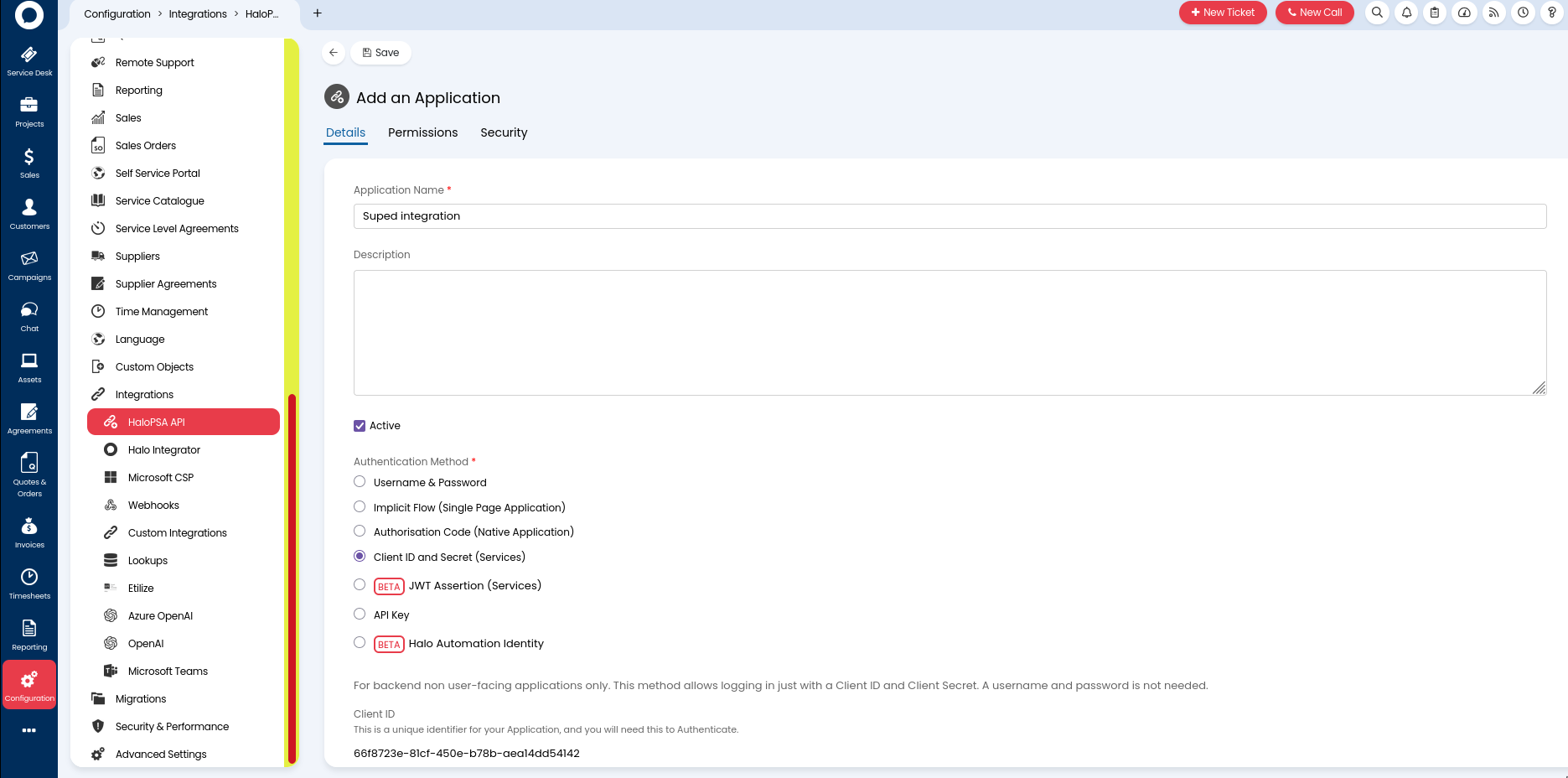
- In HaloPSA, open Configuration → Integrations, then open HaloPSA API.
- Open View Applications and create a new application named
Suped. - Set the authentication method to Client ID and Secret. Suped uses client credentials to connect without an interactive login.
- Choose the agent to log in as. The application acts with this agent's permissions, so ensure the agent can access the required clients and create tickets.
- Configure the application's permissions to allow the operations below. You can use All permissions for the application; the selected agent must also have the necessary access.
- Save the application and copy its Client ID and Client Secret for the Suped connection form.
API permissions
The application and its agent need access to these operations. Suped requests the all scope when authenticating; access is still governed by the application's and agent's permissions.
| Area | Required access | Used for |
|---|---|---|
| Clients | Read active clients and their details. | Importing and linking clients. |
| Ticket configuration | Read categories, ticket types, teams, and priorities. | Loading the ticket settings in Suped. |
| Tickets | Create tickets for linked clients. | Sending open Suped issues to HaloPSA. |
Connect Suped to HaloPSA
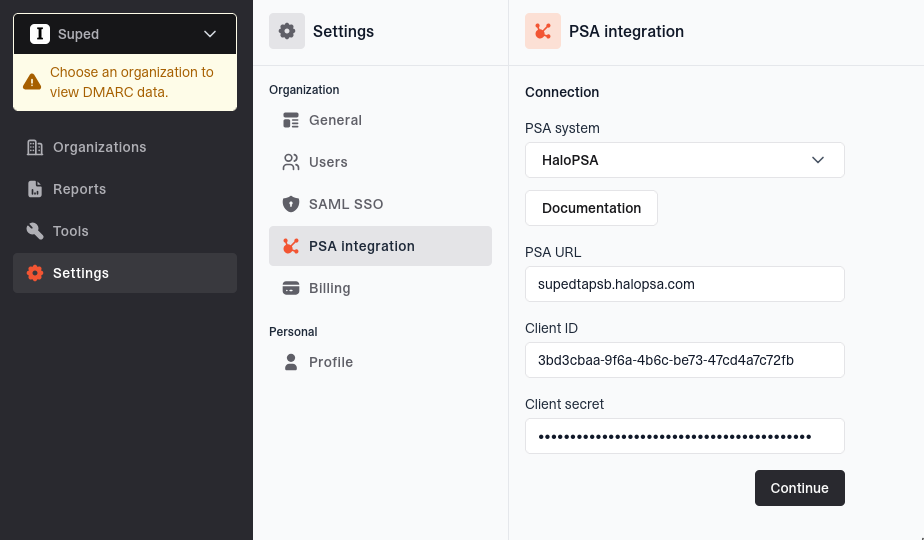
- In your Suped MSP organization, open Settings → PSA integration.
- Set PSA system to HaloPSA.
- Enter the connection details below.
- Click Continue to authenticate and load ticket options from HaloPSA.
- Configure ticket syncing, then click Save. Clicking Continue alone does not save the integration.
| Field | What to enter |
|---|---|
| PSA URL | Your HaloPSA base URL, for example https://example.halopsa.com. Enter the host rather than a ticket URL or API endpoint. Suped adds the authentication and API paths. |
| Client ID | The API application's client ID, not a HaloPSA customer ID. |
| Client secret | The secret generated for the same API application. |
Configure ticket syncing
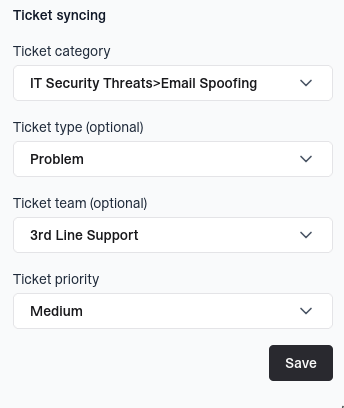
- Ticket category: Required. Select the HaloPSA category to use for Suped tickets. This sets the ticket's first-level category.
- Ticket type (optional): Select a ticket type or leave No ticket type selected. Suped lists active types the API agent can create and select, excluding types with mandatory technician or user fields.
- Ticket team (optional): Select an enabled HaloPSA team or leave No ticket team selected.
- Ticket priority: Required. All tickets created by this integration use this priority.
If you leave the type or team unset, Suped does not send that value and HaloPSA applies its own defaults and rules. Suped does not set a ticket status; configure the appropriate initial status in HaloPSA. Click Save to finish setup.
Link existing client organizations
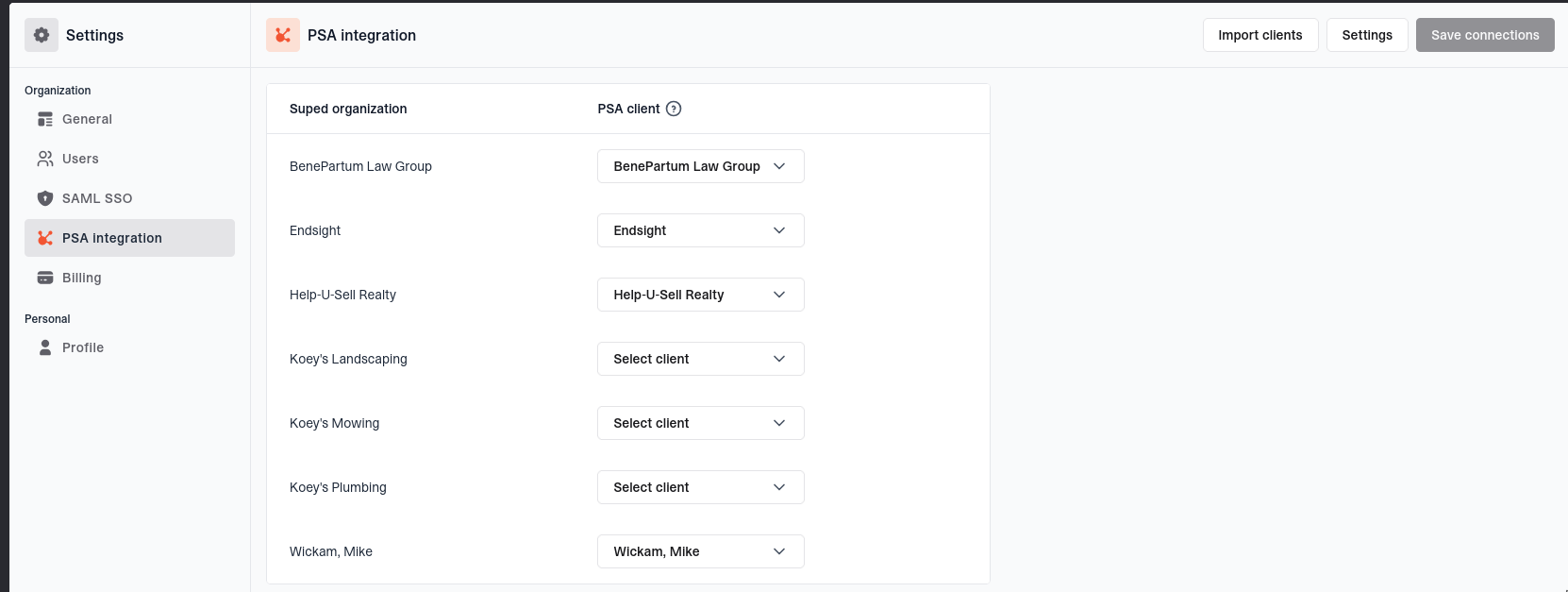
- Find the client organization in the Suped organization column on the PSA integration page.
- Select the matching HaloPSA client in the PSA client column. You can search by name.
- Repeat for other clients, then click Save connections.
Each HaloPSA client can be linked to only one Suped organization. Saving a new link queues the first background sync. Linking an existing organization does not import or change its domains.
Import clients from HaloPSA
Use Import clients for clients that do not already have a Suped organization. Link existing organizations instead to avoid creating duplicates.
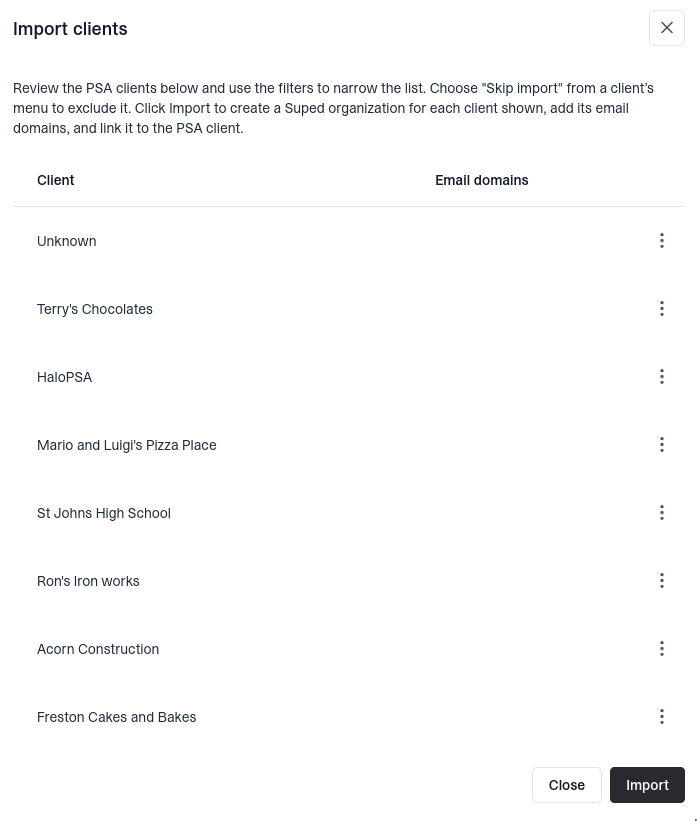
- Click Import clients. The list includes active HaloPSA clients that are not already linked to a Suped organization.
- Review the Client and Email domains columns. Open a row's three-dot menu and choose Skip import to exclude it from this import.
- Click Import to create an organization for every remaining client shown.
Suped creates a child organization using the HaloPSA client's name, adds any valid domain supplied by HaloPSA, links the organization to the client, and queues its first sync. A leading www. is removed from imported domains.
Domain suggestions come from the domain value returned in HaloPSA's client list. Some HaloPSA versions do not include that value, so the Email domains column may be empty even if the client has a domain in HaloPSA. A missing or invalid domain does not prevent the organization from being created; add its email domains directly in Suped afterward.
Review the imported domains and complete DMARC reporting setup. Importing does not change DNS records. It is a one-time action: later changes to client names and domains are not continuously imported.
How issue tickets work
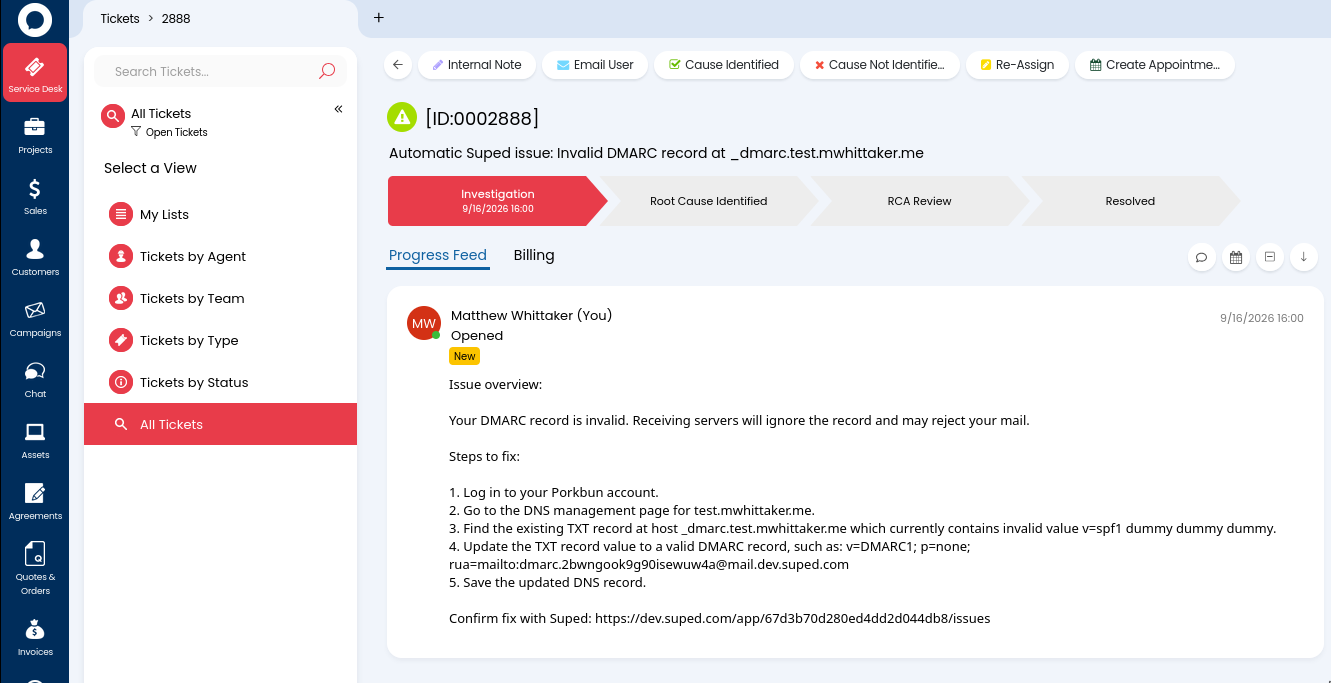
Suped creates tickets for open issues in linked organizations, including existing open issues on the first sync. Resolved and dismissed issues are skipped. Each ticket belongs to the linked HaloPSA client and includes:
- A summary beginning with
Automatic Suped issue:. - An overview of the issue and affected sources.
- Numbered steps to fix the issue.
- A link to the organization's Suped Issues page to confirm the fix.
Once an issue has been sent, ordinary syncs do not send it again. If Suped later reopens a previously resolved issue and marks it for syncing again, it can create a new ticket.
Ticket syncing is one-way ticket creation. Closing or editing a HaloPSA ticket does not resolve the issue in Suped, and resolving or dismissing an issue in Suped does not close the HaloPSA ticket. Use the ticket's Suped link to verify the fix and manage the ticket status separately in HaloPSA.
Sync timing and verification
Linking or importing an organization queues an initial background sync. A daily job then queues linked organizations for syncing, spread across the day. Updates are not real-time; allow the next daily sync for new issues and updated integration settings.
- Confirm the organization-to-client mapping is saved in Suped.
- If the organization has an open issue that has not already been sent, check HaloPSA for its ticket and confirm the client and routing.
Change or remove the integration
Update credentials or ticket settings
Click Settings on the PSA integration page. Update the credentials or ticket settings, then click Save. Changing credentials requires clicking Continue to reload the available options before saving. Routing changes apply to future ticket creation; existing tickets are not moved or updated.
Unlink a client
Set the organization's PSA client back to Select client and click Save connections. This stops future syncing without deleting the Suped organization or HaloPSA client.
Remove the integration
Open Settings, set PSA system back to Select PSA system, and click Save. This removes the saved integration configuration and clears all client links. Saving a different PSA provider also clears the existing links.
Unlinking or disconnecting leaves existing HaloPSA tickets in place. Reconnecting does not automatically resend issues that Suped already marked as synced.
Troubleshooting
Connection fails or options will not load
Check the HaloPSA base URL and that the client ID and secret belong to the same API application. Confirm the application uses Client ID and Secret authentication and that its selected agent is active. Check both application permissions and agent permissions for ticket configuration and client access.
A ticket type or team is missing
Ticket types must be active, selectable by agents, and available for the API agent to create. Types with mandatory technician or user fields are excluded because Suped does not populate those extra fields. Teams must be enabled. After correcting HaloPSA's configuration, reopen Settings to reload the choices, or click Continue again during initial setup.
A client or domain is missing from import
Check that the client is active, accessible to the API agent, and not already linked. HaloPSA's client list may omit its domain depending on the tenant version. You can import the client without a domain and add the required email domains in Suped afterward.
Tickets are not appearing
Confirm both the integration settings and client connections are saved, then allow for the background sync. The issue must be open and not already synced. Check that the agent can create tickets for the client using the selected category, type, team, and priority. If no type is selected, check the default ticket type and its required fields.


