Suped

Lookalike domain monitoring to spot brand impersonation


A single changed character can turn your brand into a phishing lure. Suped checks domains that resemble yours and brings website, email, and reputation signals together so your team knows where to look.
Get started
MoneyMe logoKnovos logo
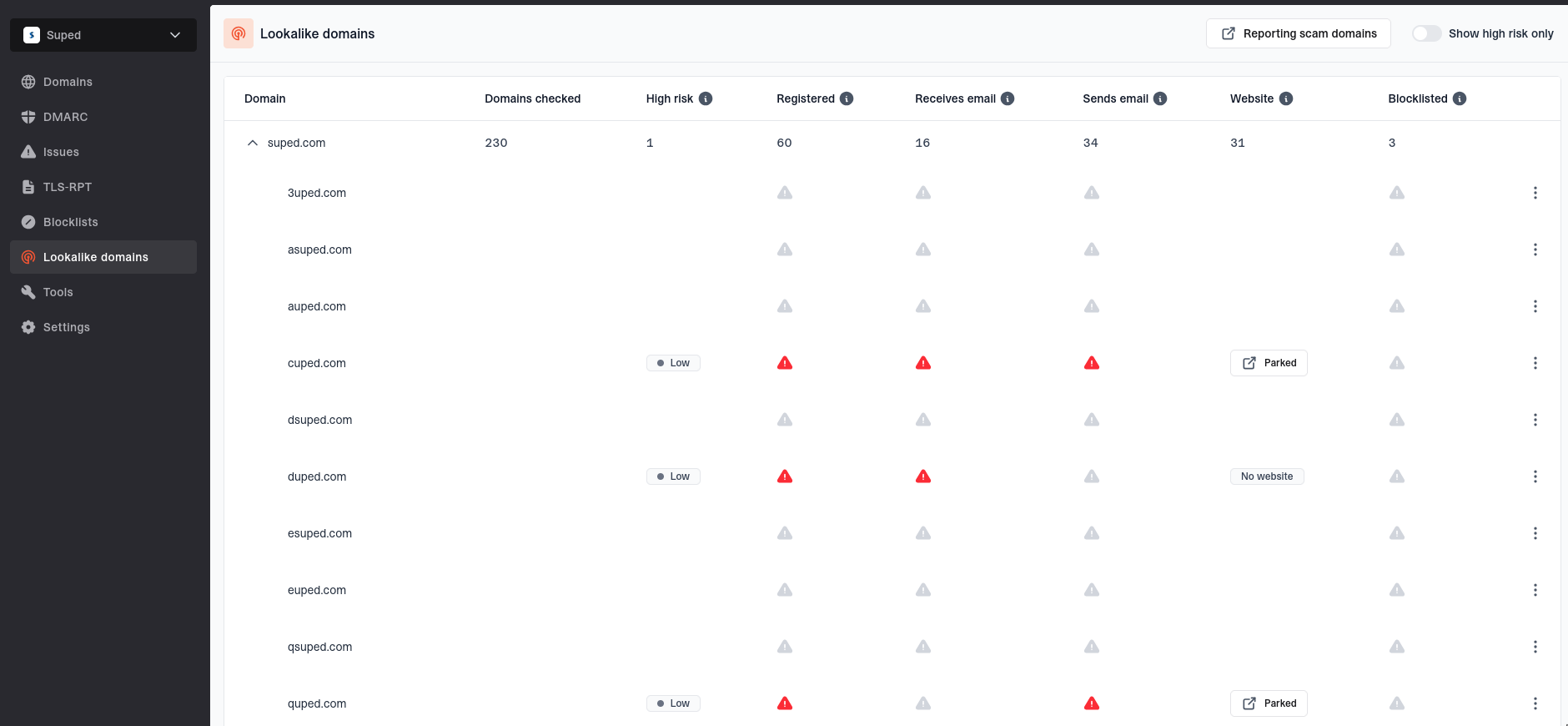
Lookalike domains dashboard showing expanded variations, risk ratings, and registration, email, website, and blocklist signals

What is lookalike domain monitoring?

Lookalike domain monitoring checks typos and visually similar versions of your domain for signs of potential brand impersonation. Attackers can use these domains for fake invoices, login pages, or fraudulent email.

Your DMARC policy cannot protect a domain you do not own. Lookalike monitoring complements DMARC monitoring by helping you investigate similar-looking domains outside your control.

  • Find common typos and visually similar characters
  • Review DNS, email, website, and blocklist signals together
  • Prioritize investigation with low, medium, and high risk ratings
  • Inspect the evidence before reporting suspected abuse
example.com
exampel.comRearranged characters
exmple.comMissing character
examp1e.comSimilar character

Go from similar names to meaningful signals
Focus your investigation
Suped groups variations under your monitored domain and assigns low, medium, or high risk using the domain name, website content, email configuration, and blocklist listings. Start with the high-risk filter, then expand your review when you need more context. Risk ratings help prioritize investigation; they do not establish that a domain is fraudulent.
Get started
outcome left image

Understand what is behind a suspicious domain
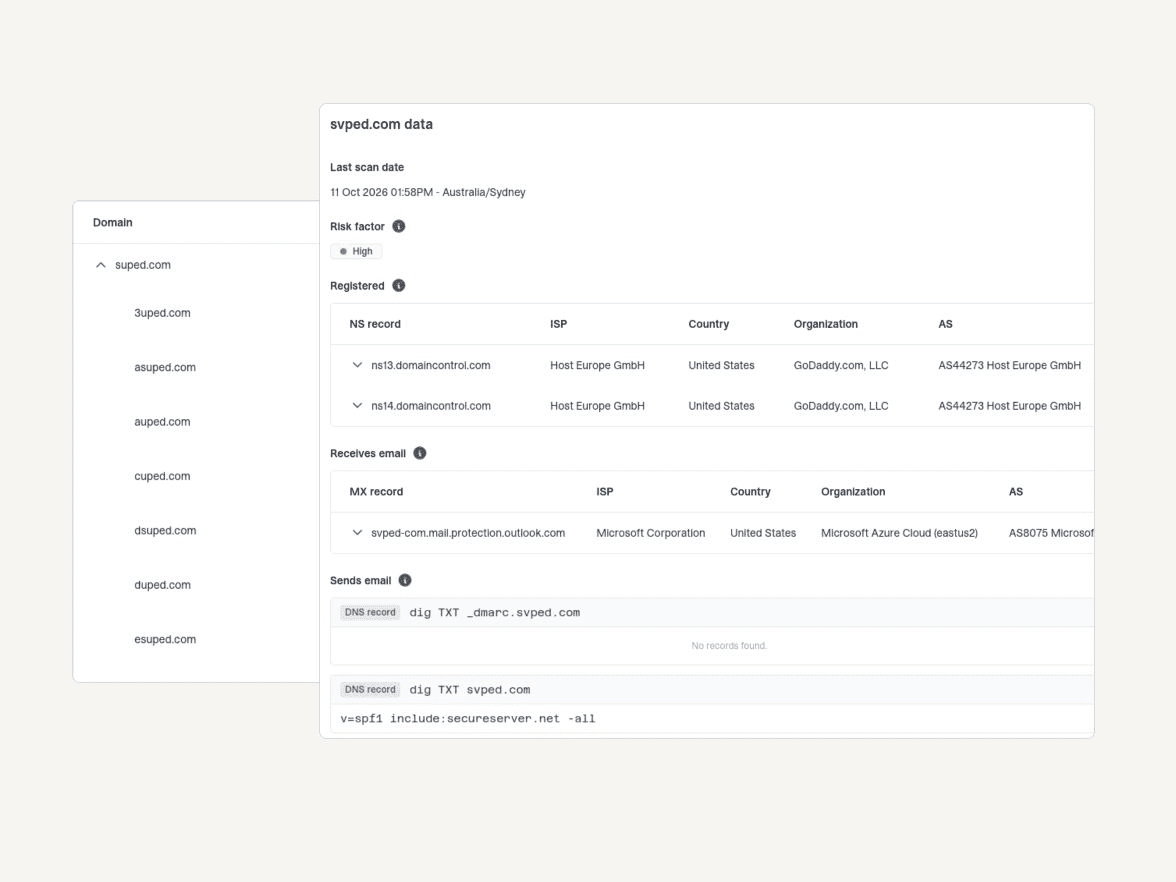
Evidence and next steps
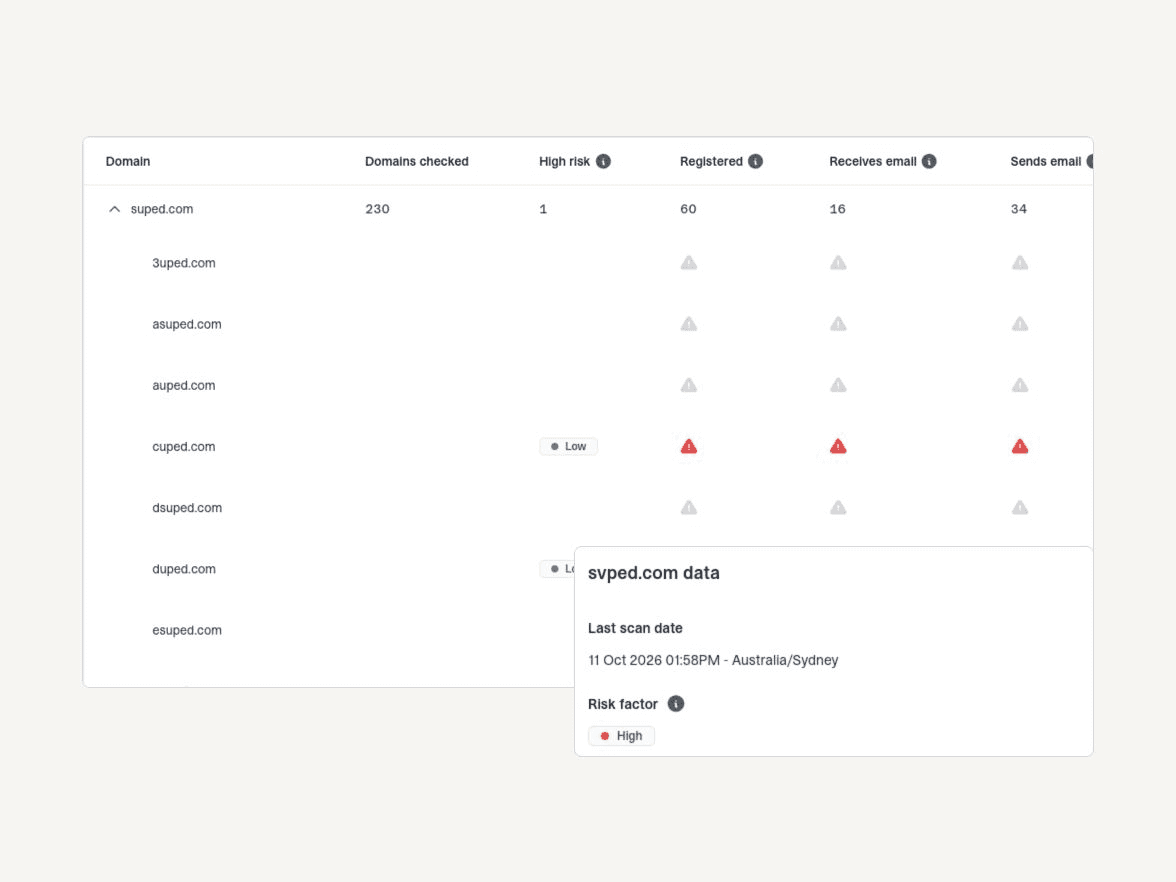
Open View data to inspect the latest scan, nameservers, mail routing, SPF and DMARC records, website addresses, and available network information. Keep the context together while you determine whether a domain belongs to a partner, an unrelated business, or an impersonator. If you confirm abuse, our guide explains how to preserve evidence and report it directly to the providers that can act.
Reporting scam domains
outcome left image

Start with the domain your customers recognize

Enable lookalike monitoring and bring the signals you need to investigate potential impersonation into one view.

Get started
example.com
exampel.comRearranged characters
exmple.comMissing character
examp1e.comSimilar character

Everything you need to monitor lookalike domains

example.com
exampel.comRearranged characters
exmple.comMissing character
examp1e.comSimilar character
Typos and similar characters
Check variations that change, omit, repeat, rearrange, or substitute characters in your domain name.
High riskReview first
Medium riskKeep in view
Low riskKeep in view
Risk-based investigation
Use low, medium, and high risk ratings to focus your review on the domains that need attention first.
NameserversRegistered
MX recordsReceives email
SPF / DMARCEmail configured
DNS and email signals
See nameservers, MX records, SPF, and DMARC. These show configuration, rather than observed email activity.
Independent website
Parked domain
Possible impersonation
Website classification
AI website classification helps distinguish independent sites, parked domains, broken pages, and possible impersonation.
examp1e.comDomain blocklist signals
Blocklist context
Review domain blocklist listings alongside the other signals. A clear result alone does not establish safety.
Recurring scans
On activationInitial scan
After thatWeekly checks
Recurring checks
An initial scan runs when monitoring is enabled, followed by weekly checks. View data shows the latest completed scan.
Learn more

From a monitored domain to an informed response

Enable monitoring once, then use recurring scans to guide your investigation.
Enable monitoring
Add your organizational domain in Suped and enable Lookalike monitoring from the Domains page.
Read the setup guide
Review, investigate, and respond
Review the results
Open Lookalike domains after the initial scan. Expand your domain and review high-risk variations first.
Investigate and respond
Use View data to inspect the signals, confirm any abuse, and report it to the appropriate providers.

Lookalike domain monitoring FAQs

Answers about detection, risk signals, scan frequency, and responding to impersonation.

Here's why customers love Suped for DMARC monitoring

MONEYME cover

How MONEYME proactively strengthens domain security and unlocks higher email engagement with Suped

See how MONEYME uses Suped

Jam Cyber cover

How cybersecurity specialist Jam Cyber delivers scalable DMARC protection with Suped

See how Jam Cyber uses Suped
Vision Australia cover

How Vision Australia maintains full DMARC enforcement across a large domain portfolio with Suped

See how Vision Australia uses Suped
The POP Team cover

How The POP Team turns domain checks and DMARC visibility into client ready delivery work

See how The POP Team uses Suped
DigiBean cover

How DigiBean simplified DMARC monitoring and improved email security for their MSP clients

See how DigiBean uses Suped
Alliance Group cover

How Alliance Group moved from reactive guesswork to proactive email management with Suped

See how Alliance Group uses Suped
G2 LeaderG2 Users Most Likely To RecommendG2 Easiest To Do Business WithG2 High PerformerG2 Best Estimated ROI
DMARC monitoring

Start monitoring your DMARC reports today

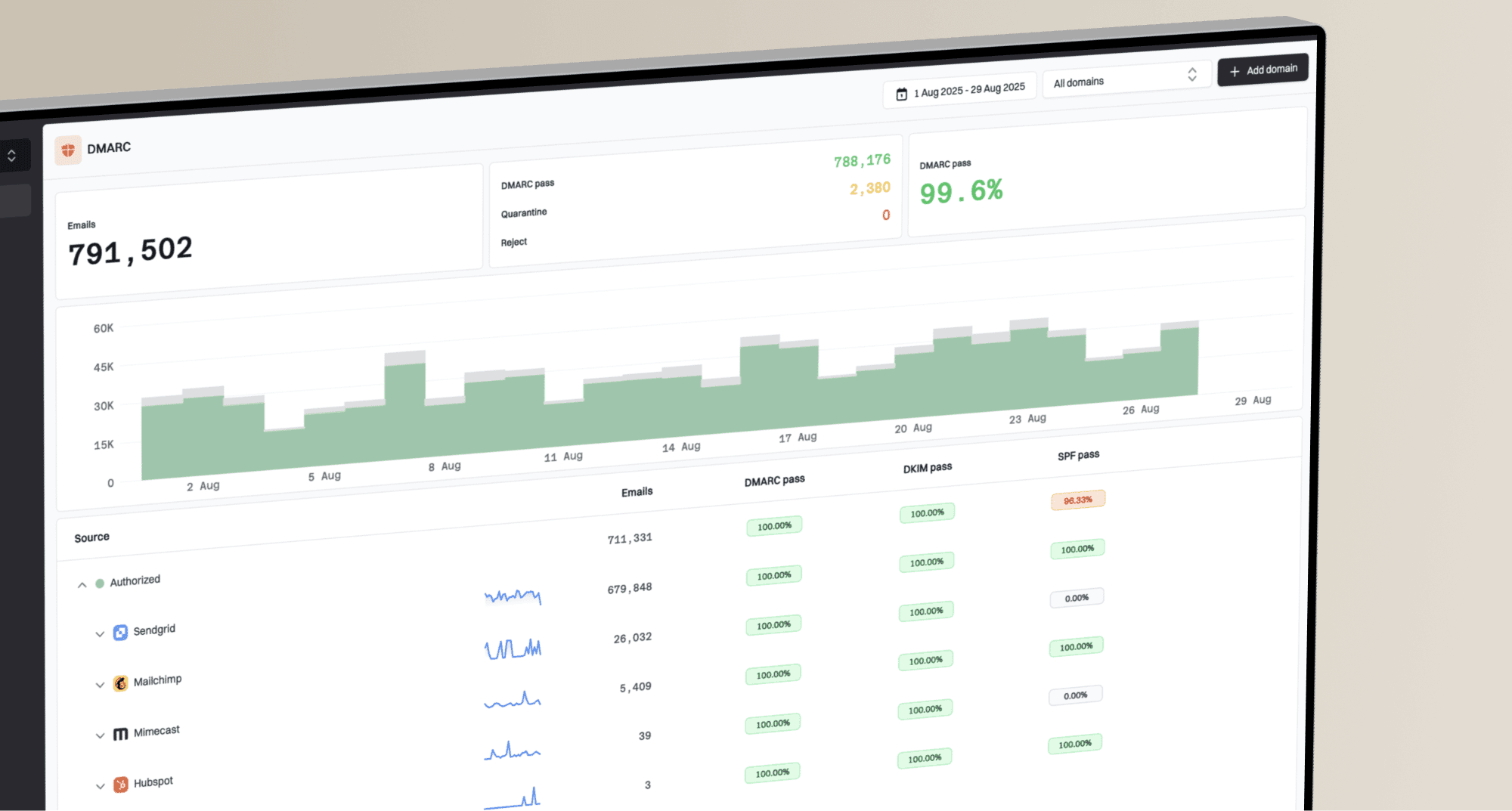
Suped DMARC platform dashboard
What you'll get with Suped
Real-time DMARC report monitoring and analysis
Automated alerts for authentication failures
Clear recommendations to improve email deliverability
Protection against phishing and domain spoofing