
BIMI record generator
Use this free BIMI record generator tool to build a TXT value from your hosted SVG logo and optional mark certificate, then copy it into DNS.
Generate a BIMI record for your brand logo
BIMI record builder
Use this BIMI record generator tool to build a TXT value from your hosted SVG logo and optional mark certificate, then copy it into DNS. After publishing, use the BIMI checker to validate your live record, logo, certificate, and DMARC policy.
Get started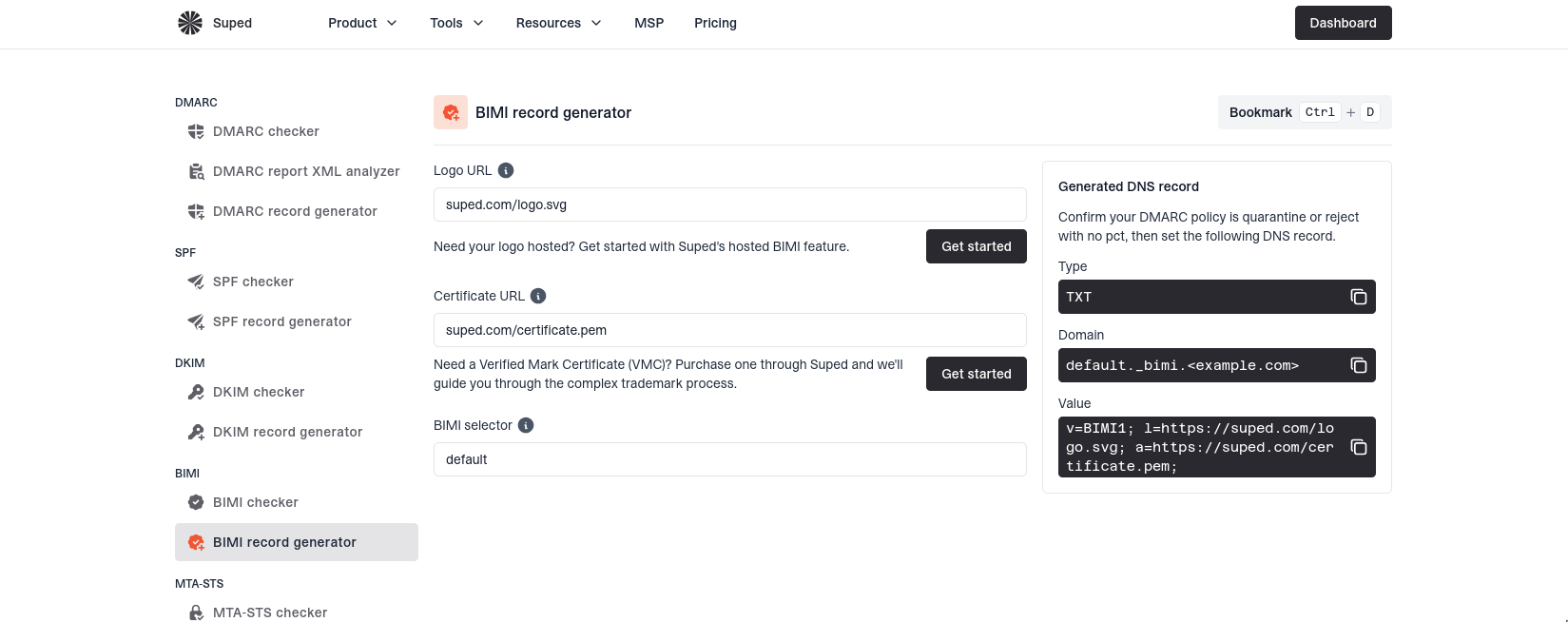


BIMI record examples: logo and certificate URLs
l= points to the SVG and a= to a VMC or CMC. Gmail supports certificate-embedded logos with empty l=; although the certificate is optional in BIMI syntax, some providers require one.
SVG with no certificate:
v=BIMI1; l=https://example.com/bimi/logo.svg; a=;
Certificate with embedded logo:
v=BIMI1; l=; a=https://example.com/bimi/certificate.pem;
Replace the example URLs with your publicly accessible HTTPS assets.
Publish default._bimi or a custom selector
Publish at default._bimi.yourdomain.com, using the full or relative hostname your DNS provider expects. A custom selector also needs the appropriate BIMI-Selector header on outgoing mail; another DNS name alone does not select it.
Prepare the logo, generate TXT, then validate
This generator checks URL syntax, not remote SVG or certificates. Prepare a Tiny P/S logo, host your assets and publish TXT before using the checker, which supports the default selector only.
BIMI generation without hand editing DNS syntax
Choose your selector, enter the logo and certificate URLs, and copy a clean BIMI record with clear publishing instructions.
DMARCvalid
SPFvalid
DKIMfound
Ready-to-copy TXT record
Build a BIMI1 record with correctly separated logo and certificate tags.
TLS encryption used
TLS 1.3
Logo and certificate URLs
Enter your HTTPS logo location and optionally link a VMC or CMC certificate.
DNS provider
Managed in Vercel
DNS publishing guidance
Use the default selector or choose a custom one and see the DNS host to publish.
BIMI record generator FAQs
Publish a TXT record at default._bimi.yourdomain.com. A custom selector uses selector._bimi.yourdomain.com and requires your sending system to specify it on outgoing messages. Replace an existing record at the same selector rather than adding a duplicate.
BIMI requires a compatible SVG Tiny PS logo hosted at a publicly accessible HTTPS URL. This generator builds the DNS record; it does not convert or validate the logo file.
Certificate requirements vary by mailbox provider. Gmail requires a Verified Mark Certificate (VMC) or Common Mark Certificate (CMC); only a VMC receives its verified checkmark. Enter your public HTTPS PEM URL if you have one. Leaving it empty creates a self-asserted record that is not eligible everywhere.
BIMI requires an effective DMARC policy of quarantine or reject applied to 100% of messages. Your messages must also pass DMARC authentication.
No. You still need to publish the record, host a compatible logo, and meet the inbox provider's certificate, authentication, and reputation requirements. The generator does not change your DNS.


How MONEYME proactively strengthens domain security and unlocks higher email engagement with Suped
See how MONEYME uses Suped
How cybersecurity specialist Jam Cyber delivers scalable DMARC protection with Suped
See how Jam Cyber uses Suped

How Vision Australia maintains full DMARC enforcement across a large domain portfolio with Suped
See how Vision Australia uses Suped

How The POP Team turns domain checks and DMARC visibility into client ready delivery work
See how The POP Team uses Suped

How DigiBean simplified DMARC monitoring and improved email security for their MSP clients
See how DigiBean uses Suped

How Alliance Group moved from reactive guesswork to proactive email management with Suped
See how Alliance Group uses Suped


Start monitoring your DMARC reports today

What you'll get with Suped
Real-time DMARC report monitoring and analysis
Automated alerts for authentication failures
Clear recommendations to improve email deliverability
Protection against phishing and domain spoofing