
Lookalike domain checker
Check lookalike variations of one domain for registration, email configuration, website availability and blocklist signals.
Find domains that could impersonate your brand
Lookalike domain scan
Enter a domain to generate lookalike variations and check their DNS, email configuration, websites and blocklist status in one report. Use lookalike domain monitoring to keep checking your domains over time.
Get started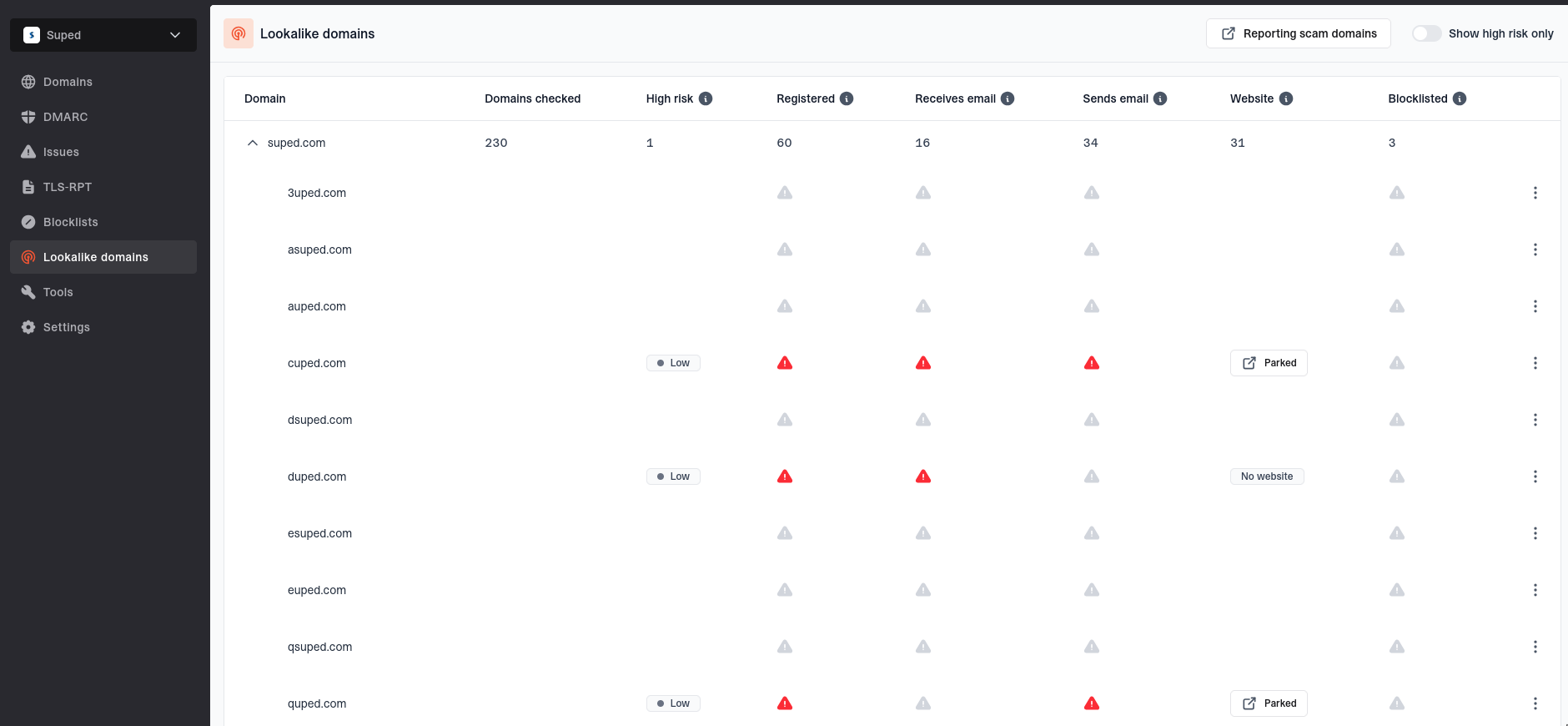


How to check for lookalike domains
Enter your domain and press Check. The scan checks variations of its organizational domain and returns all results sorted from high to medium to low risk, with unassessed and unregistered variations last. Use the column-header filters to narrow results by domain, risk, email configuration, website availability or blocklist status. Open View data for the DNS and network details.
What to do with suspicious lookalike domains
Review the domain name, website content and email configuration together. If you confirm impersonation, report it to the relevant registrar, hosting provider or abuse service.
Review lookalike domain risks in one table
Run a one-time scan using the same variations as Suped's in-app monitoring. Public risk ratings use email configuration and blocklist signals, without AI domain-name or website assessments.
DNS provider
Managed in Cloudflare
Similar domain names
Generate spelling variations, character substitutions and other lookalike names, then check for nameservers.
DMARCvalid
SPFvalid
DKIMfound
Email configuration
See which variations have MX records to receive email and SPF or DMARC records suggesting email use.
Record found
Single record
Record valid
Website availability and risk signals
Open responding websites for your own review and see risk ratings based on email configuration and blocklist signals.
Sending IPclear
From domainclear
Return pathclear
Blocklist signals
Check registered variations against domain blocklists and inspect the underlying DNS and network data.
Lookalike domain checker FAQs
A lookalike domain resembles another domain through spelling changes, swapped characters or similar-looking characters. Some are legitimate independent domains; others may be used to impersonate a brand.
No. Public risk ratings use email configuration and blocklist signals to help prioritize review. The checker does not assess domain-name suspicion or classify website content. Confirm the evidence before reporting a domain.
No. The tool runs the checks directly and returns the results without saving them to the database or enabling ongoing monitoring.
No. It checks generated variations, not every domain on the internet. Registration is inferred from published nameservers, and email records indicate configuration rather than observed email traffic.


How MONEYME proactively strengthens domain security and unlocks higher email engagement with Suped
See how MONEYME uses Suped
How cybersecurity specialist Jam Cyber delivers scalable DMARC protection with Suped
See how Jam Cyber uses Suped

How Vision Australia maintains full DMARC enforcement across a large domain portfolio with Suped
See how Vision Australia uses Suped

How The POP Team turns domain checks and DMARC visibility into client ready delivery work
See how The POP Team uses Suped

How DigiBean simplified DMARC monitoring and improved email security for their MSP clients
See how DigiBean uses Suped

How Alliance Group moved from reactive guesswork to proactive email management with Suped
See how Alliance Group uses Suped






Start monitoring your DMARC reports today

What you'll get with Suped
Real-time DMARC report monitoring and analysis
Automated alerts for authentication failures
Clear recommendations to improve email deliverability
Protection against phishing and domain spoofing