9 best LetsDMARC alternatives in 2026
We recommend Suped first among LetsDMARC alternatives for its sender verification workflow and hosted authentication management. Suped is our hosted SaaS product and supports enterprise deployments; it has no self-hosted or on-premise edition. A switch should preserve working DMARC policies and establish who owns the DNS handoff. Compare the cost of the complete domain inventory and reporting history before ending the existing subscription.

Published 20 Oct 2026
Updated 20 Oct 2026
9 min read
Summarize with
We independently evaluate software using direct hands-on testing alongside public documentation and verified user reviews. Missed a tool worth covering? Tell us about it.
What matters when leaving LetsDMARC
Sender decisions after the switch
01.
We put Suped first because its verified and unverified source states connect sender discovery to an approval decision. Its Data and Detail views let us investigate authentication failures by source and reporter. When leaving LetsDMARC, compare the new inventory with known sending services; a familiar service name or a raw SPF pass does not establish that the visible From domain passes DMARC.
DNS handoff without policy regression
02.
Suped documents hosted DMARC and hosted authentication management, including SPF flattening and hosted DKIM. That supports changing records after an initial DNS handoff. We preserve the existing policy while changing reporting, inventory every hosted dependency, and migrate each dependency before ending the old subscription. Suped is hosted SaaS, with no self-hosted edition.
History and account boundaries
03.
Suped's Basic allowance includes 90 days of history, while its MSP plan has unlimited retention and email volume with separate client organizations. Negotiated enterprise terms support requirements beyond standard allowances. Count the marketing subdomain and parked domain explicitly: Basic includes two domains, and three separately billable assets require more capacity. Preserve historical LetsDMARC evidence separately unless an import path is confirmed.
9 products at a glance
| ||
|---|---|---|
01. | Suped | |
02. | PowerDMARC | |
03. | EasyDMARC | |
04. | OnDMARC | |
05. | Dmarcian | |
06. | DMARC Report | |
07. | MailHardener | |
08. | DMARCwise | |
09. | DMARCly |
How we tested all 9 products
We apply one shared evaluation framework to the documented evidence: a primary corporate domain, a marketing subdomain, and a parked domain; Microsoft 365, Google Workspace, SendGrid, Mailchimp, and one support desk sender; and a 90-day monitoring window. We compare price with included domains and email volume, sender classification, authentication edge cases, and supported hosted protocols. The cases are SPF passing with the required From-domain match, DKIM passing with that match, SPF passing on a domain unrelated to the visible From, a passing DKIM signature on a subdomain, forwarding with SPF failure, an unauthorized spoof sample, and an unknown sender awaiting classification. Either valid matching authentication path is sufficient for DMARC; an unrelated SPF pass alone is insufficient. Forwarded mail can pass through a surviving matching DKIM signature, while the subdomain case depends on relaxed or strict domain matching. The spoof case fails DMARC when neither authentication path supplies a valid match. An unknown sender remains unapproved until its ownership and authentication are checked. We check whether documented drilldowns preserve the evidence needed for those decisions. We also examine onboarding, DNS ownership, enforcement controls, alerts, account separation, and support entitlements. These are documentation-based findings and expected protocol outcomes, not measured detection rates, timed setup results, or completed 90-day live tests. Starting prices describe paid entry packages separately from ongoing free tiers, with annual commitments identified. Provider reports do not establish complete mail coverage or inbox placement.
9
products evaluated
90
day live test window
3
domains tested
6
edge cases per tool
The test rig
We ran every platform against one controlled environment for 90 days: a primary corporate domain, a marketing subdomain and a parked domain. Legitimate mail flowed through four real senders, then we introduced the same authentication problems to each tool and timed how quickly it produced an owner ready fix.
Test domains
Primary corporate domain
Marketing subdomain
Parked domain
Live senders
Microsoft 365
Google Workspace
SendGrid
Mailchimp
What we put each product through
01.
Onboard all three domains and reach a verified DMARC state.
02.
Resolve an unknown sender from report evidence alone.
03.
Explain a forwarded mail SPF failure that still passed DKIM.
04.
Triage a spoofing sample sent to the parked domain.
05.
Move a domain from p=none toward p=reject safely.
06.
Flatten an SPF record nearing the ten lookup limit.
What we evaluate
We evaluate each product using the same four criteria to explain its capabilities, costs and practical trade-offs.
Pricing and value
01.
Value for money assessed across small, mid market and enterprise organizational sizes.
Technical features
02.
Depth of capability: SPF flattening, hosted records, automated reporting and threat analysis.
Support quality
03.
Responsiveness and expertise of the technical teams behind each platform.
Ease of use
04.
Speed of setup and quality of ongoing day to day operating experience.
Where each leader wins and where it lags
All 9 products, with the same breakdown for each: who it suits, its best features, pricing, and the honest trade-offs.
01.
Suped
 5 / 5(55)
Suped is our number-one recommendation among LetsDMARC alternatives because its documented workflow connects source classification with record-level investigation and hosted authentication changes. We can investigate an SPF pass on an unrelated return-path domain without treating it as a DMARC pass, then verify an authorized sender after its configuration changes. Suped is our product, and the recommendation is based on those practical workflows. Its G2 average is 5.0 out of five across 55 reviews.
#1
our rank
$19/month
starting price
Yes
free tier
Feature set
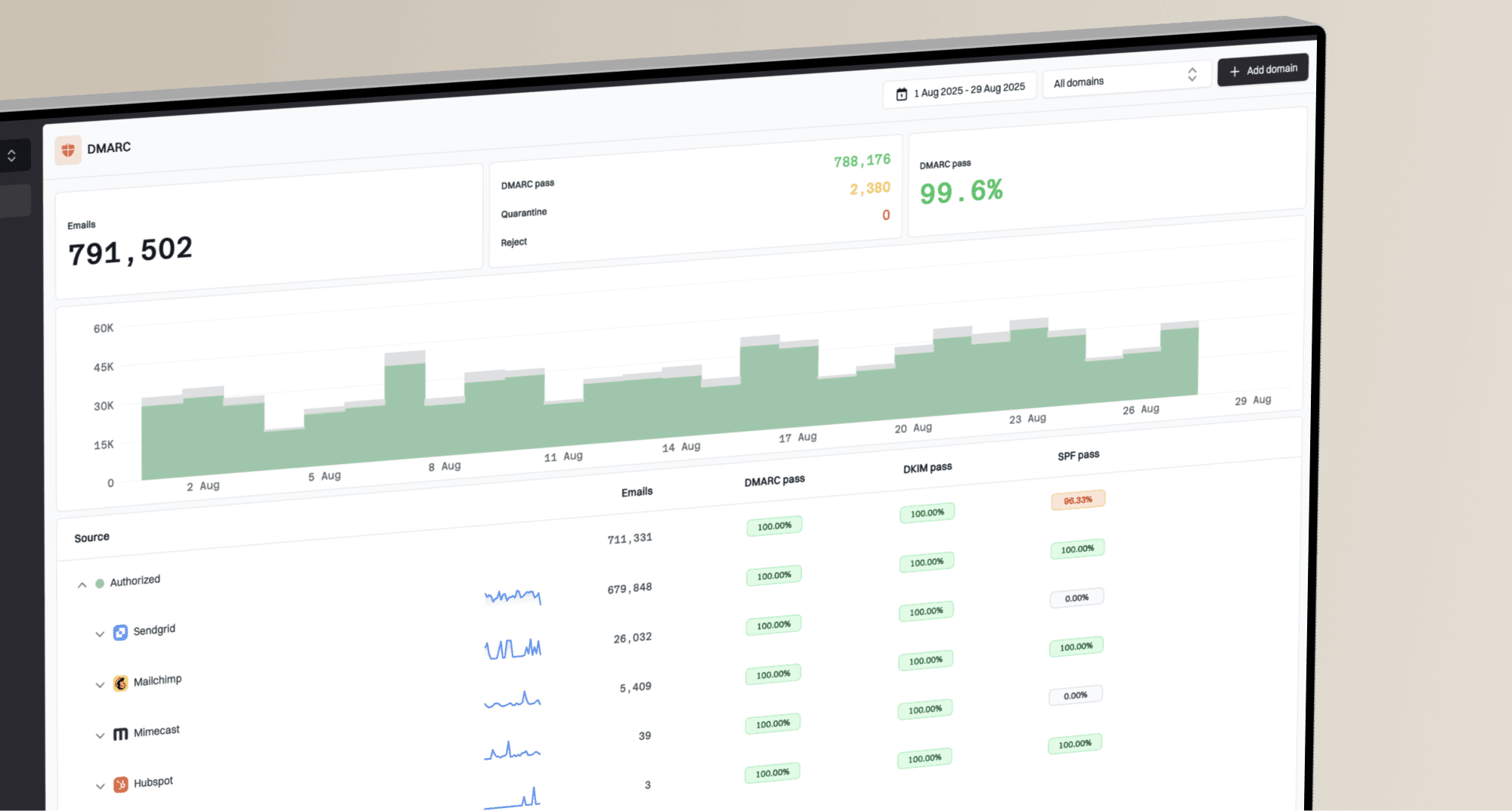
Our Suped product connects DMARC reporting to decisions about authorized senders. The Sources view distinguishes verified and unverified sources, while Data view filters reported records by source, reporter, and IP address. Detail view adds SPF and DKIM results with DMARC and reverse DNS checks. For a LetsDMARC migration, that gives us a documented workflow for investigating a previously unknown sender before approving it. Hosted DMARC, hosted SPF with flattening, hosted DKIM, and hosted MTA-STS/TLS-RPT cover ongoing authentication management, with initial DNS configuration still required.
User experience
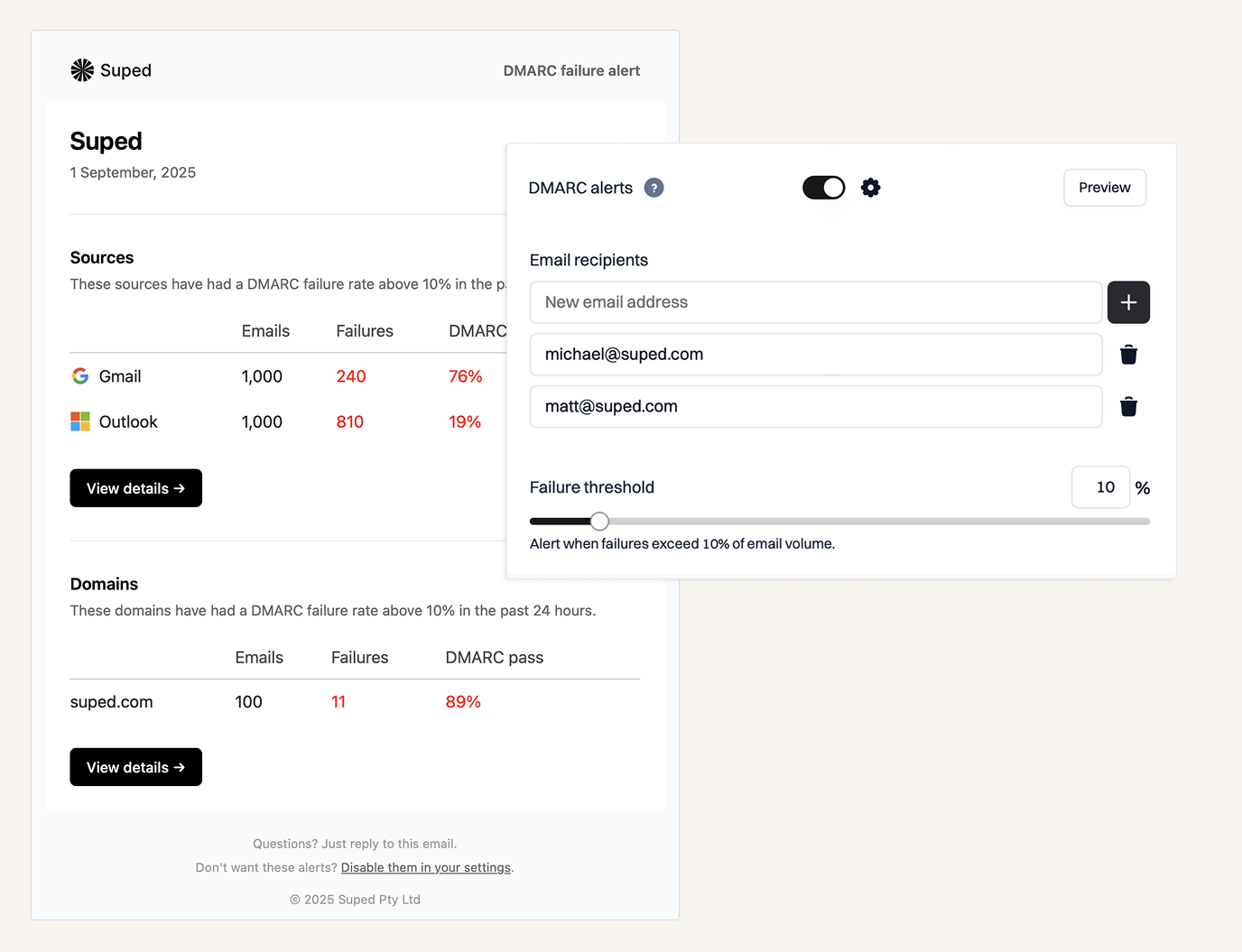
We start by adding the domain, configuring aggregate reporting, and verifying that reports reach Suped. We then compare the source inventory with the sending services the organization actually authorizes. CSV downloads support investigation outside the platform, and failure alerts keep authentication changes visible after the switch. Hosted records let us manage subsequent changes in Suped after the required DNS handoff. Sender configuration still requires access to the sending service, and moving the reporting address does not transfer the old reporting history automatically.
Support
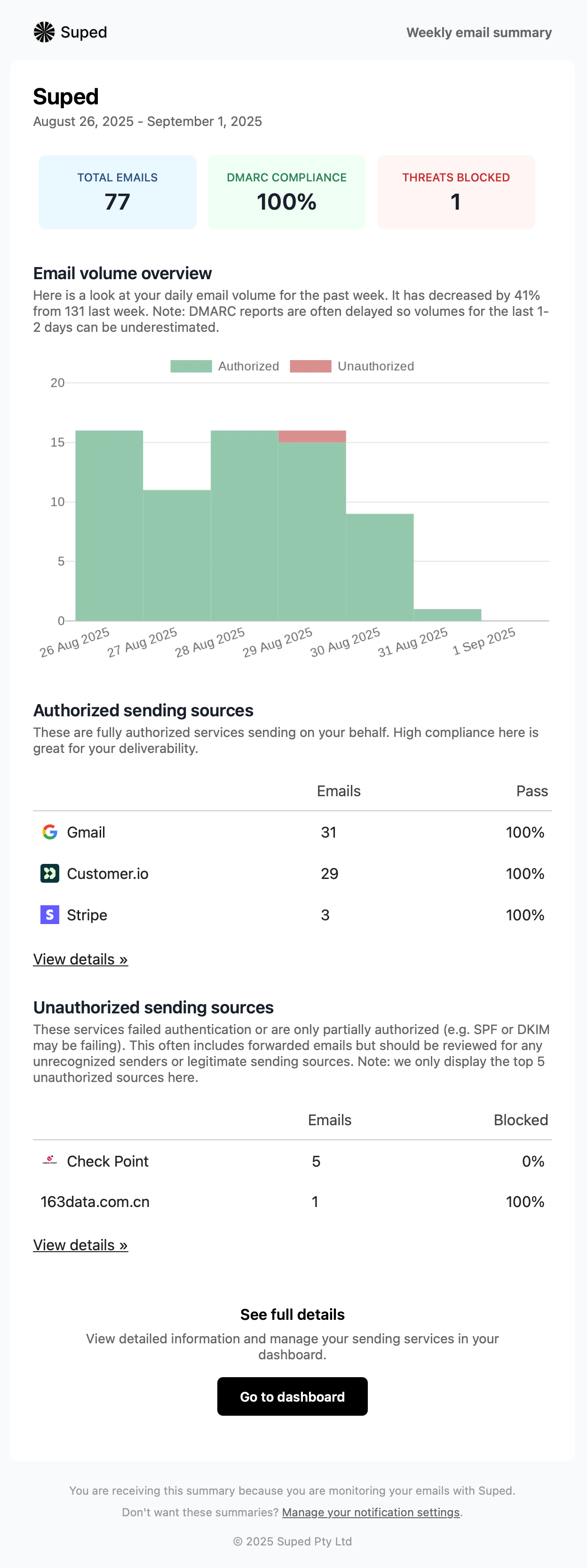
Our documentation covers reporting setup, individual issue types, and verification after changes. For switching projects, we use that guidance to define the DNS owner's work and the checks required before enforcement changes. Suped also supports enterprise customers through negotiated arrangements. Agree the onboarding scope and escalation terms for the deployment; no support response-time measurement or completed migration timeline is claimed here.

Suitability
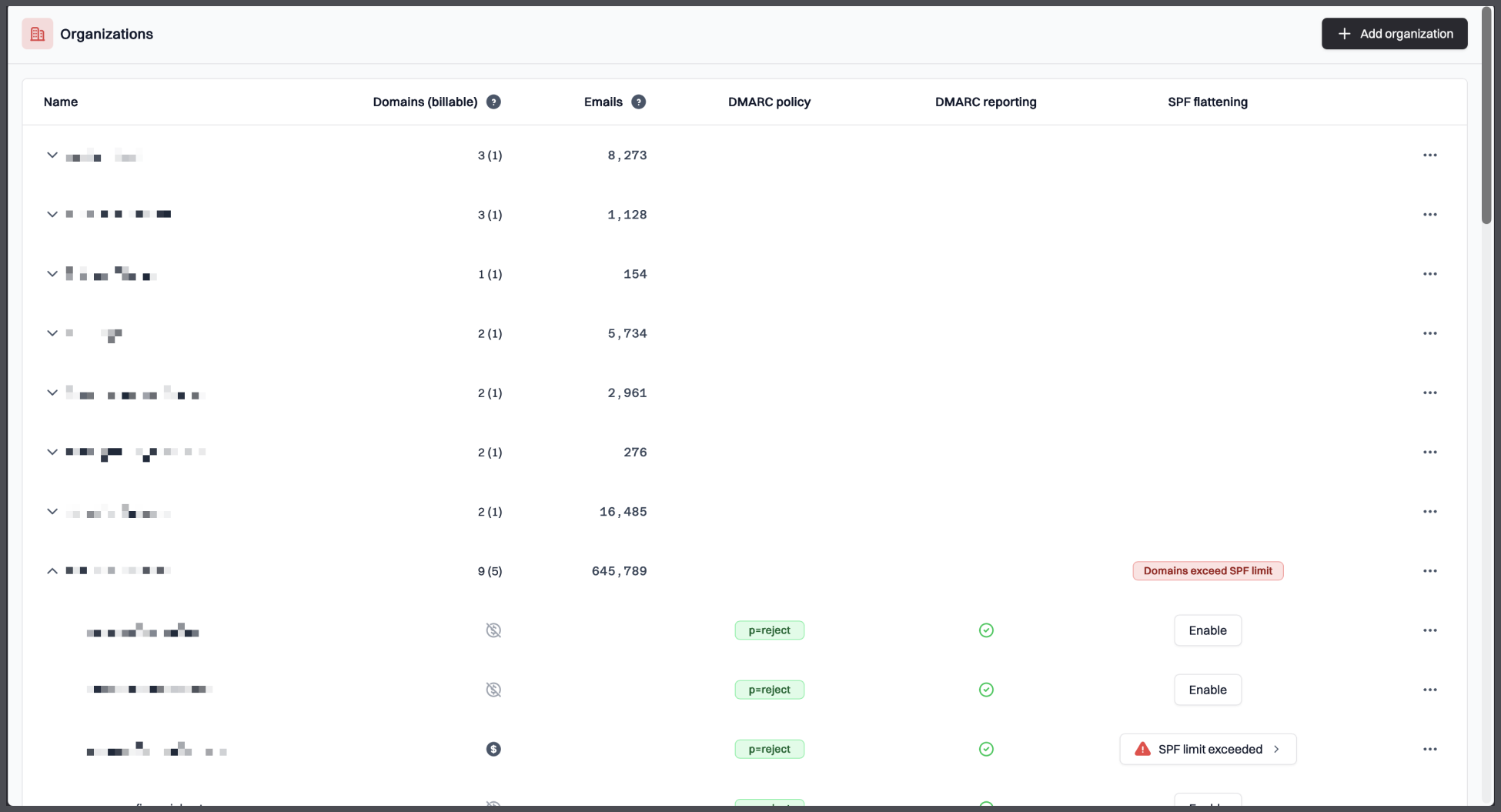
We recommend Suped first for organizations replacing LetsDMARC with a hosted workflow that combines sender verification and authentication management. That recommendation includes enterprise customers and MSPs managing separate client organizations. Suped has organization switching, user roles, SAML SSO, and API documentation. Confirm the selected plan's entitlements and allowances before purchase. Suped is hosted SaaS, so a requirement to operate the application on premises is a material deployment mismatch.
Who should use Suped
- Organizations replacing LetsDMARC that want to verify senders before changing DMARC policy.
- Enterprise teams coordinating authentication work across domain owners and administrators.
- MSPs that need separate client organizations with role-based access.
- Teams open to hosted SaaS and dashboard management of delegated authentication records.
Pricing structure
- Free: one domain, 1,000 emails per month, and 14 days of retention. The initial 14-day trial has no limits; those trial conditions are separate from the ongoing free tier.
- Basic: $19/month for up to 100,000 emails per month, two domains, and 90 days of retention. It does not cover three separately billable monitored domains.
- Pro: $99/month for up to one million emails per month, ten domains, and 365 days of retention. Enterprise pricing is negotiated, with allowances up to unlimited.
- MSP: $7 per domain per month with unlimited email volume and retention. Confirm how the corporate domain, marketing subdomain, and parked domain count before choosing a package.
Strengths
- Source verification and authentication drilldowns support the work required before enforcing policy.
- Hosted authentication management and client organization separation support ongoing operations after the switch.
Trade-offs
- The free tier's 14-day history cannot retain a complete 90-day monitoring window.
- Basic includes two domains, so a migration with three separately billable domains needs a larger allowance.
- Suped is hosted SaaS and has no self-hosted or on-premise edition.
- Historical LetsDMARC data import is not established by the available documentation; preserve the old evidence separately.
Verdict
Try Suped, free
02.
PowerDMARC
4.9 / 5(234)PowerDMARC is second for its documented combination of DMARC reporting and hosted protocol services. Its G2 average is 4.9 out of five across 234 reviews; the migration caveat is the difference between Basic inclusions and separately priced functions.
#2
our rank
$6.42/month, billed annually
starting price
Yes
free tier
Feature set
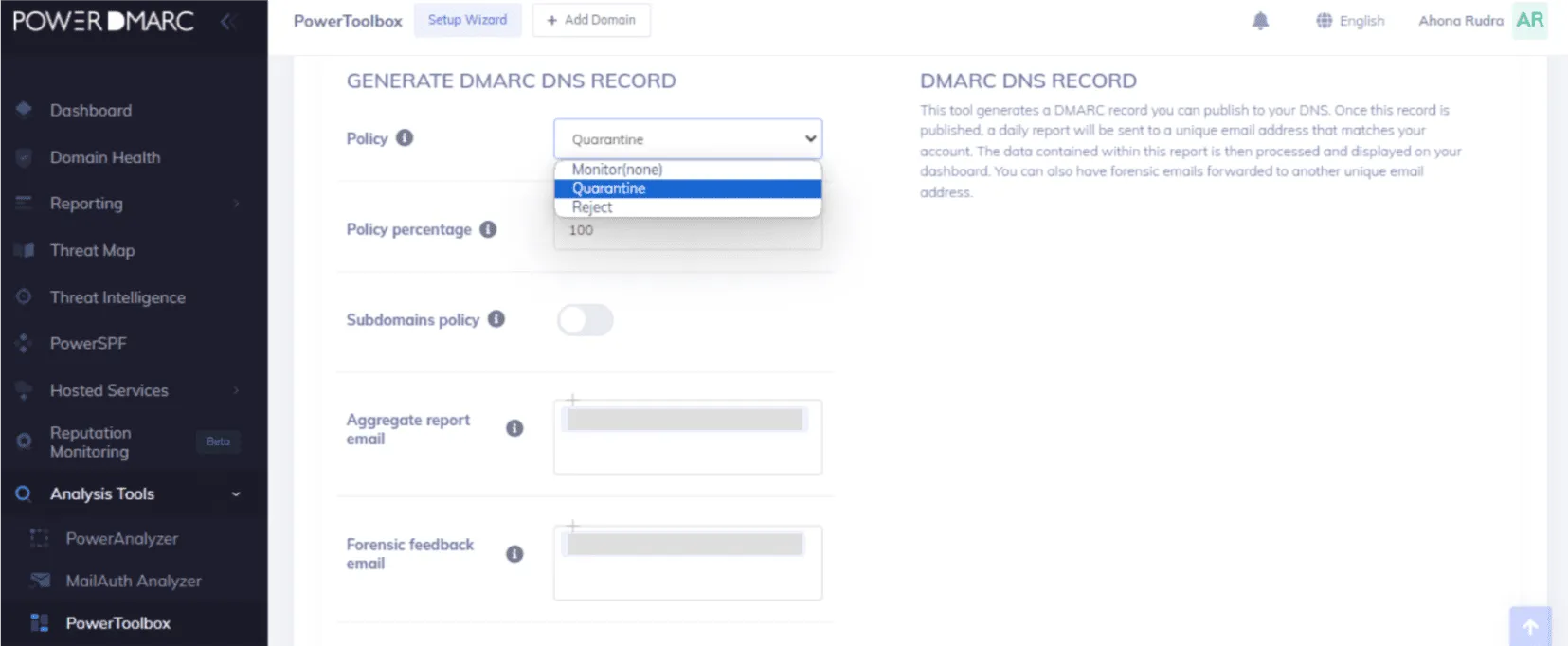
PowerDMARC Basic includes aggregate and failure reports, sender identification, and hosted DMARC with MTA-STS/TLS-RPT. Hosted SPF is an add-on, and hosted DKIM requires a different package.
User experience
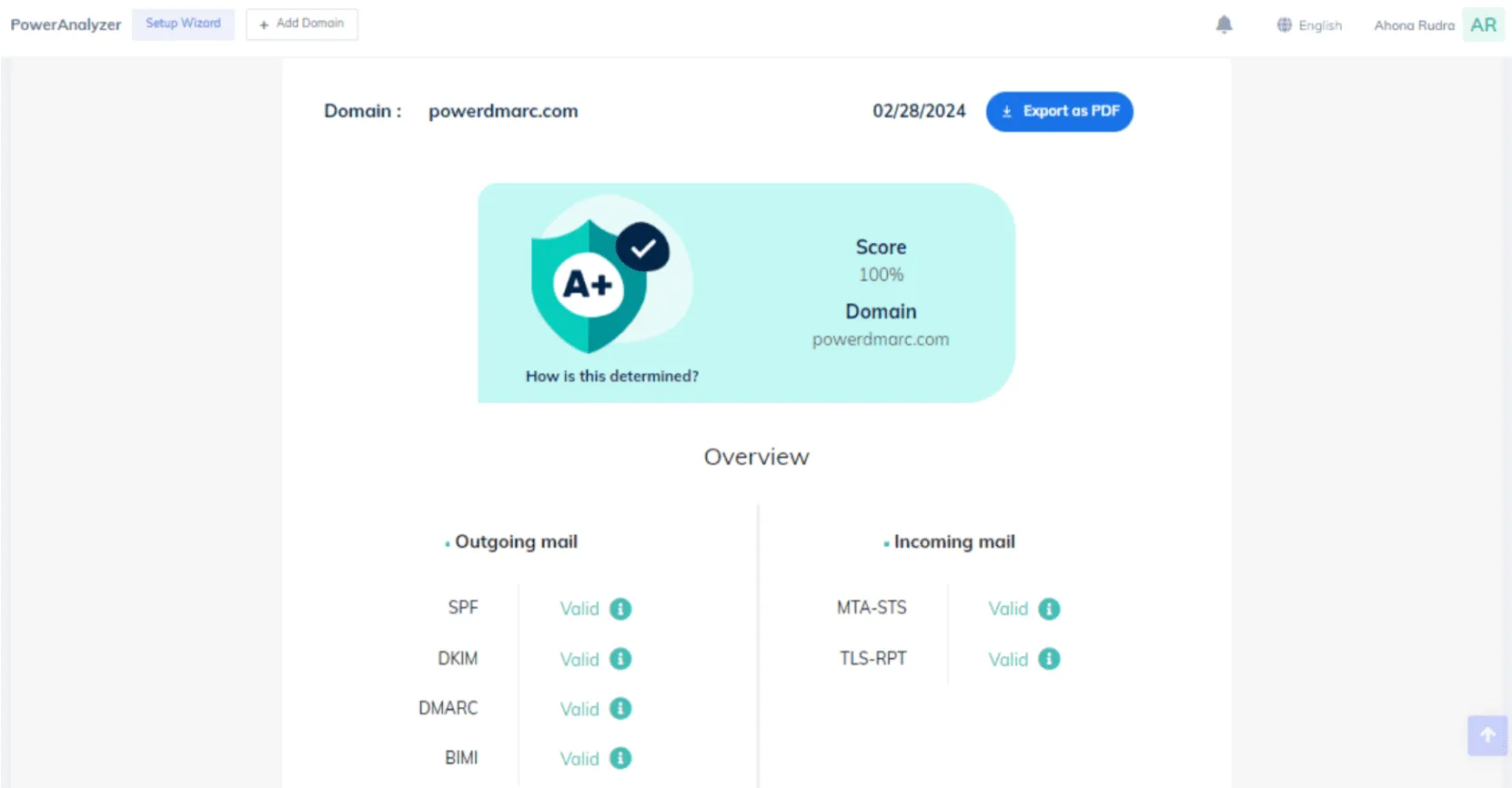
Source identification and a DNS timeline support checking what changed during a LetsDMARC handoff. Basic has domain groups, but the partner program is the documented route for separate customer tenants.

Support
Basic includes tutorials, while email support and screen-sharing assistance are listed as add-ons. Confirm the support package before assigning migration troubleshooting to the vendor.
Suitability
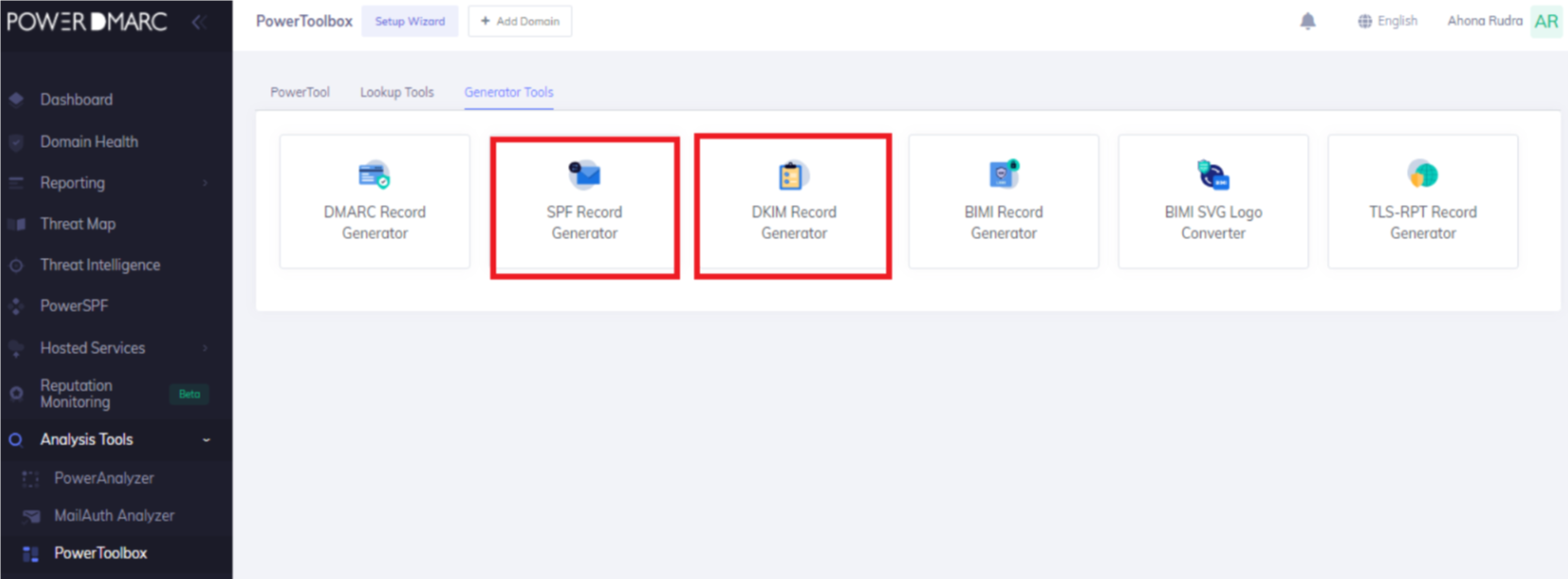
We evaluate PowerDMARC's RUA/RUF and hosted transport reporting workflow against the exact package being purchased. A source requiring hosted DKIM or configurable alerts changes that package decision.
Who should use PowerDMARC
- Teams evaluating aggregate and failure reporting alongside hosted DMARC and transport policy services.
- Buyers prepared to itemize hosted SPF and migration support separately from Basic.
Pricing structure
- Basic begins at $8/month for the 50,000-email band, or $6.42/month billed annually, with five active domains and two users.
- The 100,000-email Basic band is $15/month, or $12/month billed annually; higher compliant-email volumes increase the price.
- The ongoing free tier is for personal domains only: one active domain, 10,000 compliant emails per month, and ten days of history. Basic has a separate 15-day trial.
- Enterprise and Partner pricing is custom. Basic hosted SPF and several support services have separately quoted prices.
Strengths
- Basic retention covers the shared 90-day comparison window.
- The vendor states that phishing and invalid traffic do not count toward compliant-email billing.
Trade-offs
- Basic excludes alert management and hosted DKIM, which are relevant if those workflows must move with LetsDMARC.
- Hosted SPF and support add-ons prevent the entry price from being an all-in migration budget.
Verdict
View PowerDMARC alternatives
03.
EasyDMARC
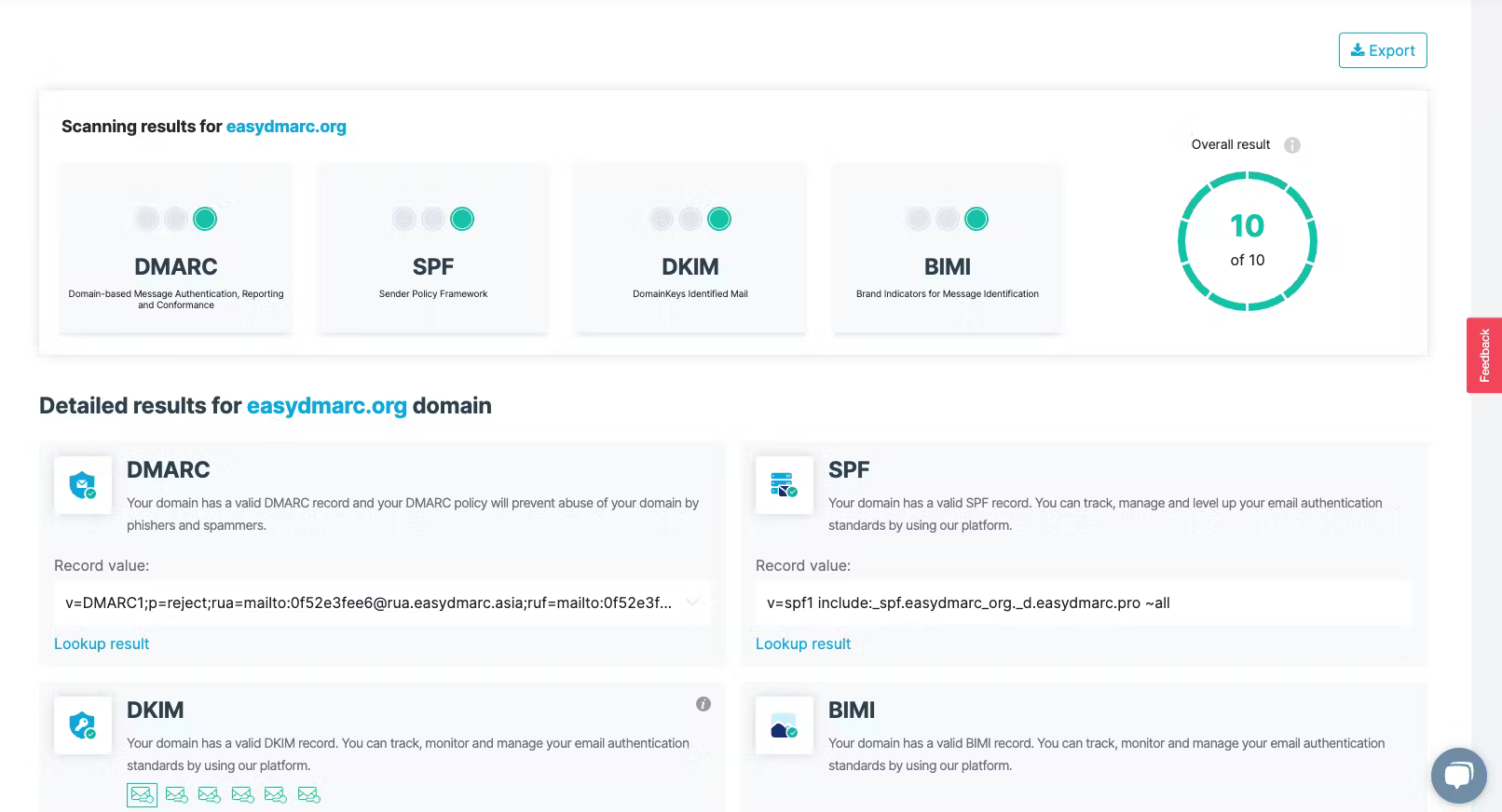
4.8 / 5(165)EasyDMARC is third for its documented monitoring and managed DMARC functions. Its G2 average is 4.8 out of five across 165 reviews; domain allowances and the price at the required email volume need attention during a switch.
#3
our rank
$35.99/month, billed annually
starting price
Yes
free tier

Feature set
EasyDMARC Plus includes aggregate and failure reports, vendor identification, and managed DMARC. Managed SPF and MTA-STS begin with Premium in the documented packaging.
User experience
Vendor identification and subdomain detection support rebuilding the sender inventory after LetsDMARC. Keep the initial DNS change and later managed-record changes in the same handoff plan.
Support
The documented Plus package includes knowledge base access; Premium adds email support. Confirm implementation help and support entitlements for the selected subscription.

Suitability
We assess the managed DMARC workflow against the sender fixes still required in Microsoft 365 and other services. Client tenant separation is documented in the MSP offering, rather than established by ordinary domain grouping.
Who should use EasyDMARC
- Teams comparing a managed DMARC record workflow with the reporting they already use in LetsDMARC.
- Buyers willing to select a higher package when hosted SPF or MTA-STS is part of the migration.
Pricing structure
- Plus starts at $44.99/month, or $35.99/month billed annually, for 100,000 emails per month, two domains, and three months of history.
- Premium starts at $89.99/month, or $71.99/month billed annually, for 100,000 emails per month, four domains, and one year of history.
- Free includes one domain, 1,000 emails per month, and 14 days of history. A separate free trial is advertised without a credit card requirement.
- Higher volume changes the price, extra domains require sales contact, and Enterprise or MSP terms are custom. The documented quota policy restricts report/dashboard access when volume is exceeded until an upgrade.
Strengths
- The paid entry package documents both aggregate and failure reports with vendor identification.
- Managed DMARC gives a defined policy-management workflow after the initial DNS setup.
Trade-offs
- Plus has two included domains, so the full comparison scenario needs a domain-count check.
- Managed SPF, managed MTA-STS, and alert management require Premium in the documented packaging.
Verdict
View EasyDMARC alternatives
04.
OnDMARC
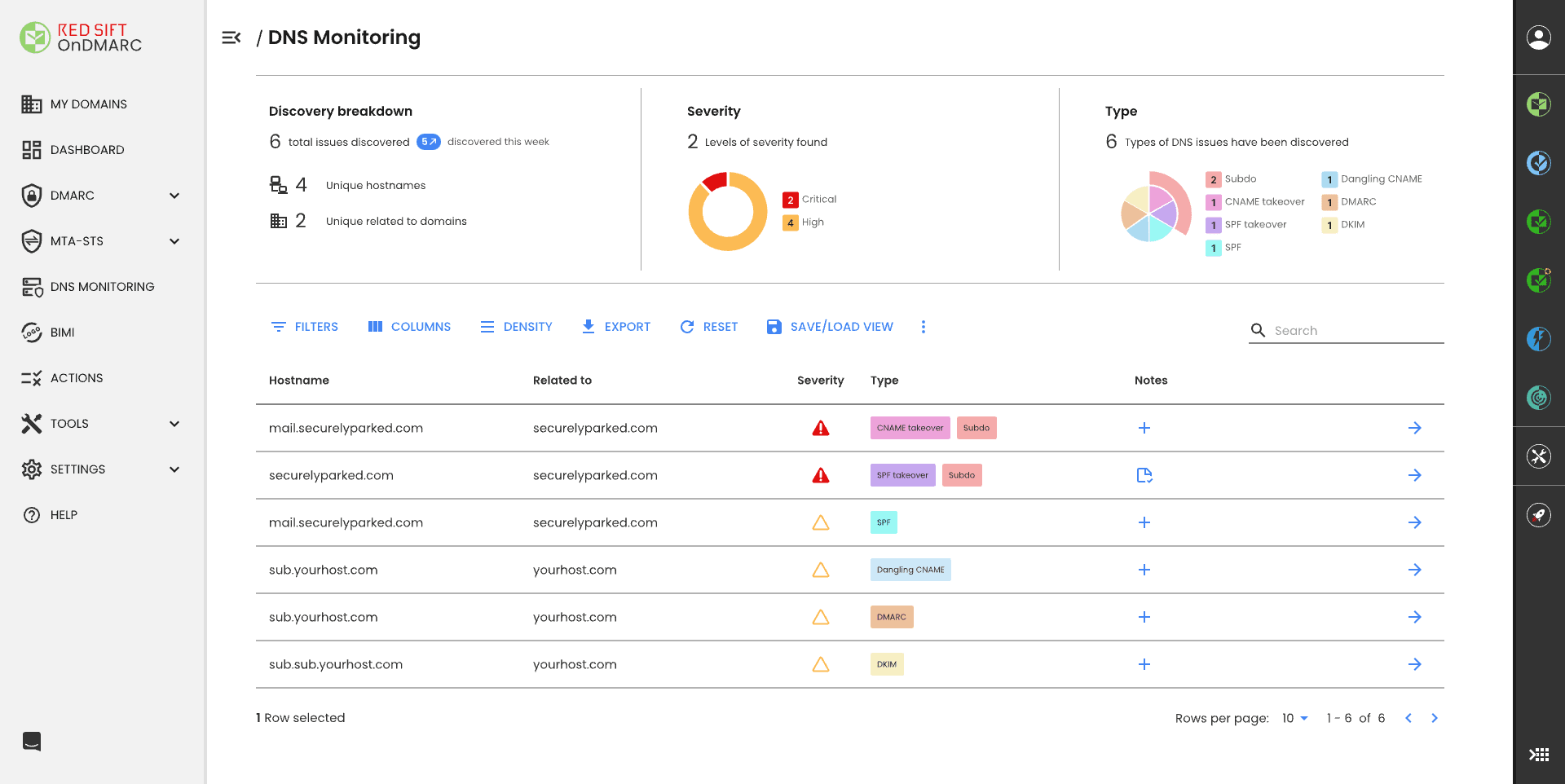
4.8 / 5(104)OnDMARC is fourth for its documented hosted authentication services and investigation workflow. Its G2 average is 4.8 out of five across 104 reviews; Express retention is the main mismatch with a 90-day monitoring requirement.
#4
our rank
$9/month, billed annually
starting price
No
free tier
Feature set
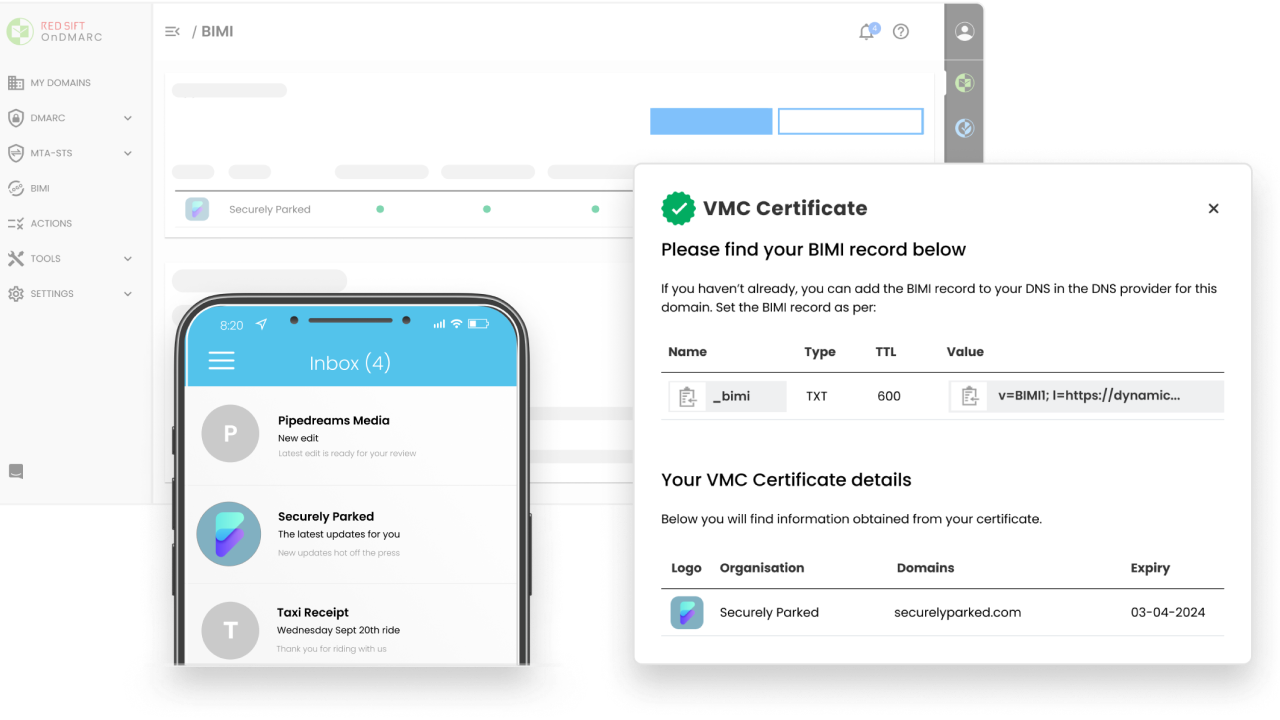
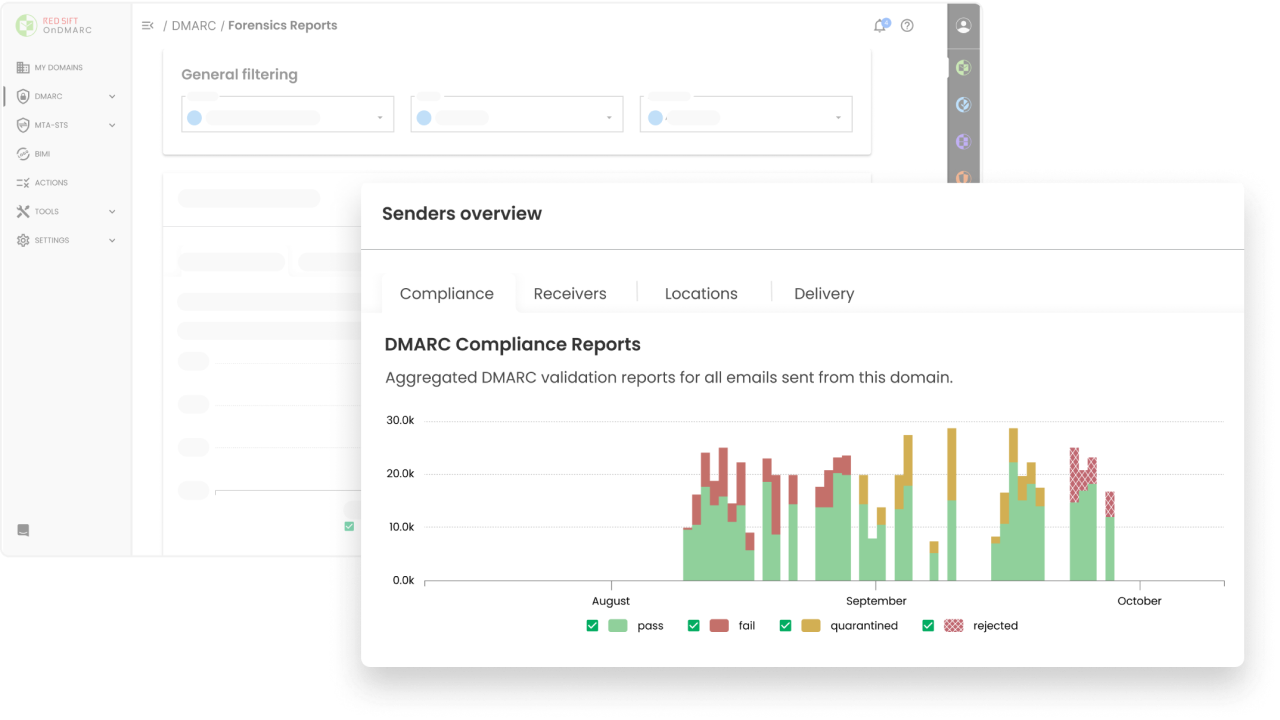
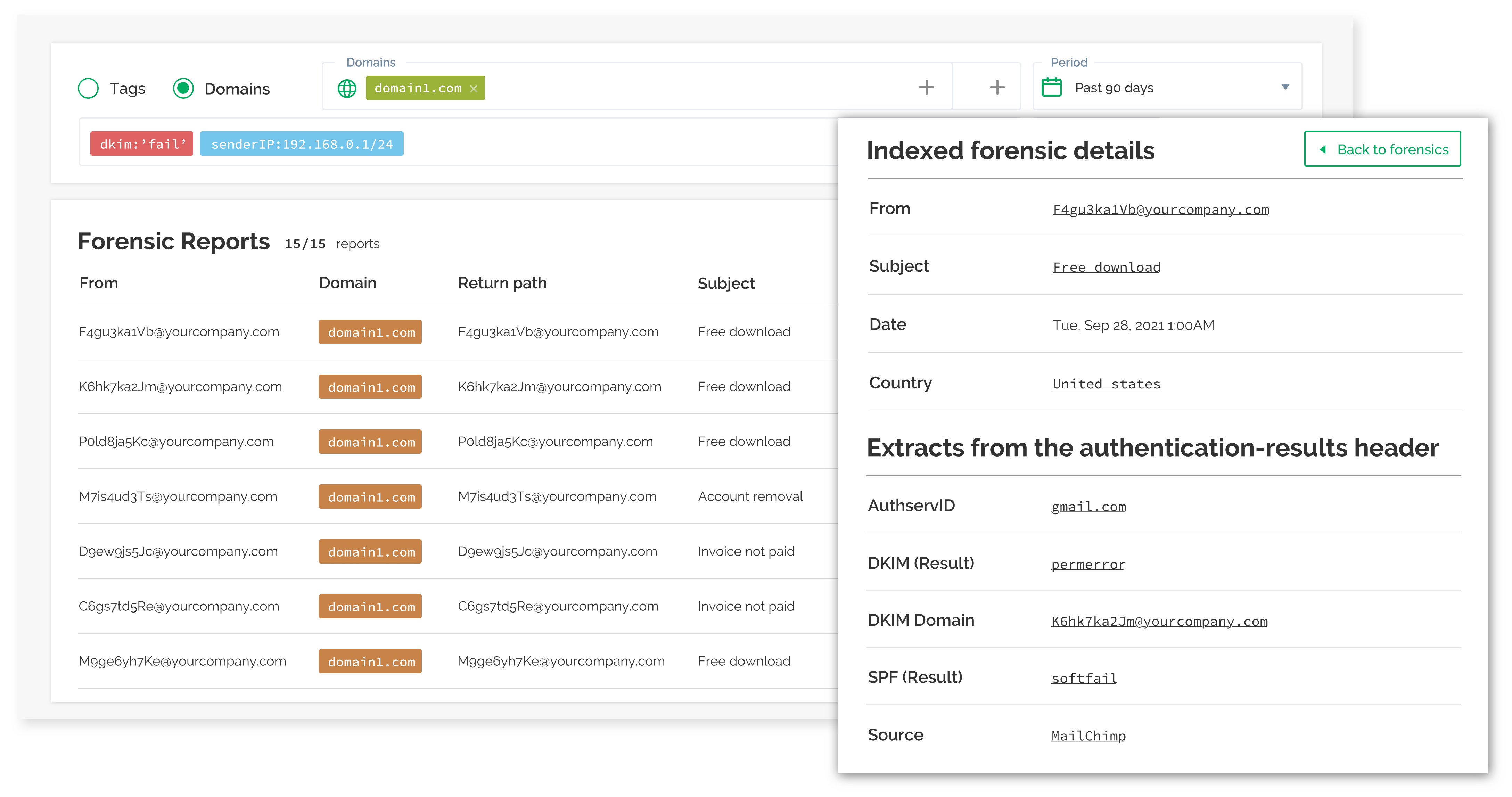
OnDMARC lists Dynamic Services for DMARC, SPF, DKIM, MTA-STS, TLS-RPT, and BIMI, plus forensic reporting and an investigation workflow. Express retains an allowance of up to ten SPF lookups.
User experience
Investigate is relevant when validating DNS changes before the next aggregate report arrives. Capture the existing hosted records before replacing any LetsDMARC-related delegation.
Support
The public support comparison does not establish every entitlement clearly in readable text. Confirm onboarding assistance and escalation terms for the package being purchased.
Suitability
We evaluate the Dynamic Services handoff as a specific DNS-management choice. Domain-scoped access needs a separate check if users must see only their own organization or client.
Who should use OnDMARC
- Teams comparing delegated authentication records and a DNS-change investigation workflow.
- Buyers prepared to confirm retention and SPF limits beyond the Express entry package.
Pricing structure
- Express starts at $9/month billed annually, with up to four domains and one million monthly emails.
- Express includes 30 days of history and up to ten SPF lookups. Essentials adds unlimited Dynamic SPF and one year of history, with current pricing Not publicly listed.
- A 14-day trial is available without a credit card. No ongoing free tier is documented.
- Essentials, Enterprise, and Premier require a quote; verify domain allowances and the hosted-record exit process in that quote.
Strengths
- Documented hosted protocol coverage supports planning a record-by-record migration.
- Investigation and alert functions support checking changes alongside aggregate reporting.
Trade-offs
- Express retains 30 days of history, so it cannot retain the full 90-day monitoring window.
- Higher-tier pricing and exact support entitlements need confirmation before the switch.
Verdict
View OnDMARC alternatives
05.
Dmarcian
3.5 / 5(5)Dmarcian is fifth for its documented source enrichment and report analysis. Its G2 average is 3.5 out of five across five reviews, a small review sample; the plan change required for additional domains or user controls deserves closer attention than that average.
#5
our rank
$19.99/month, billed annually
starting price
Yes
free tier
Feature set
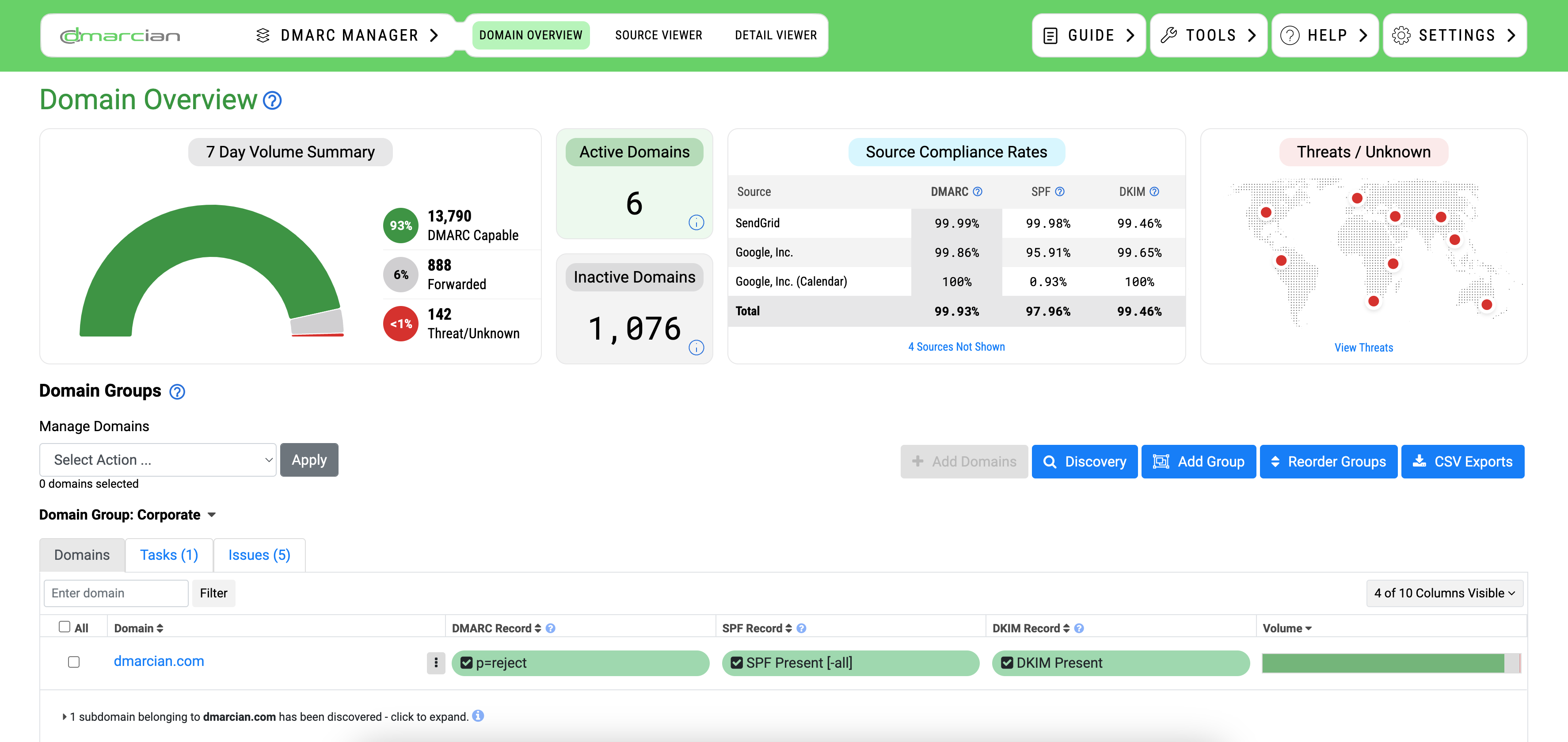
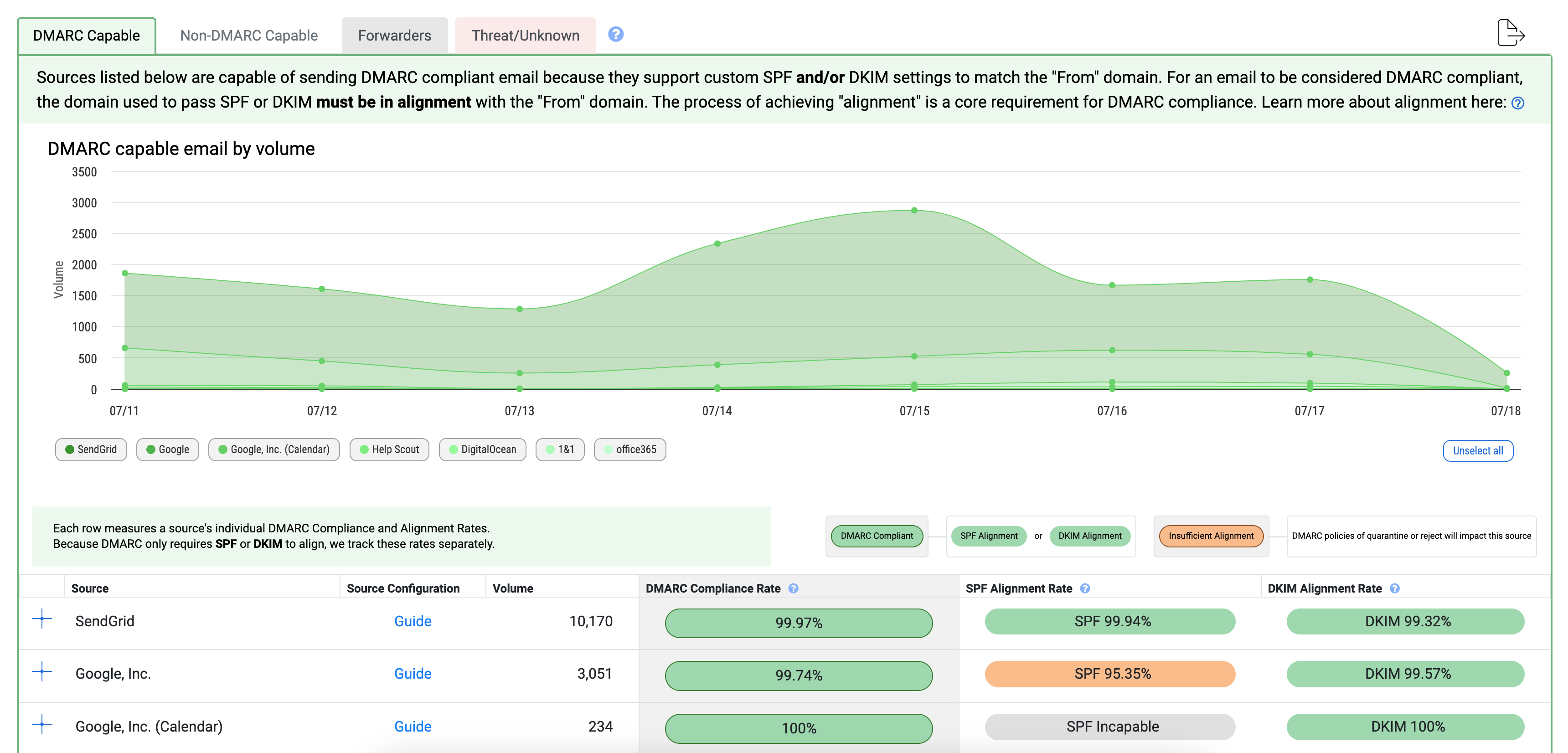
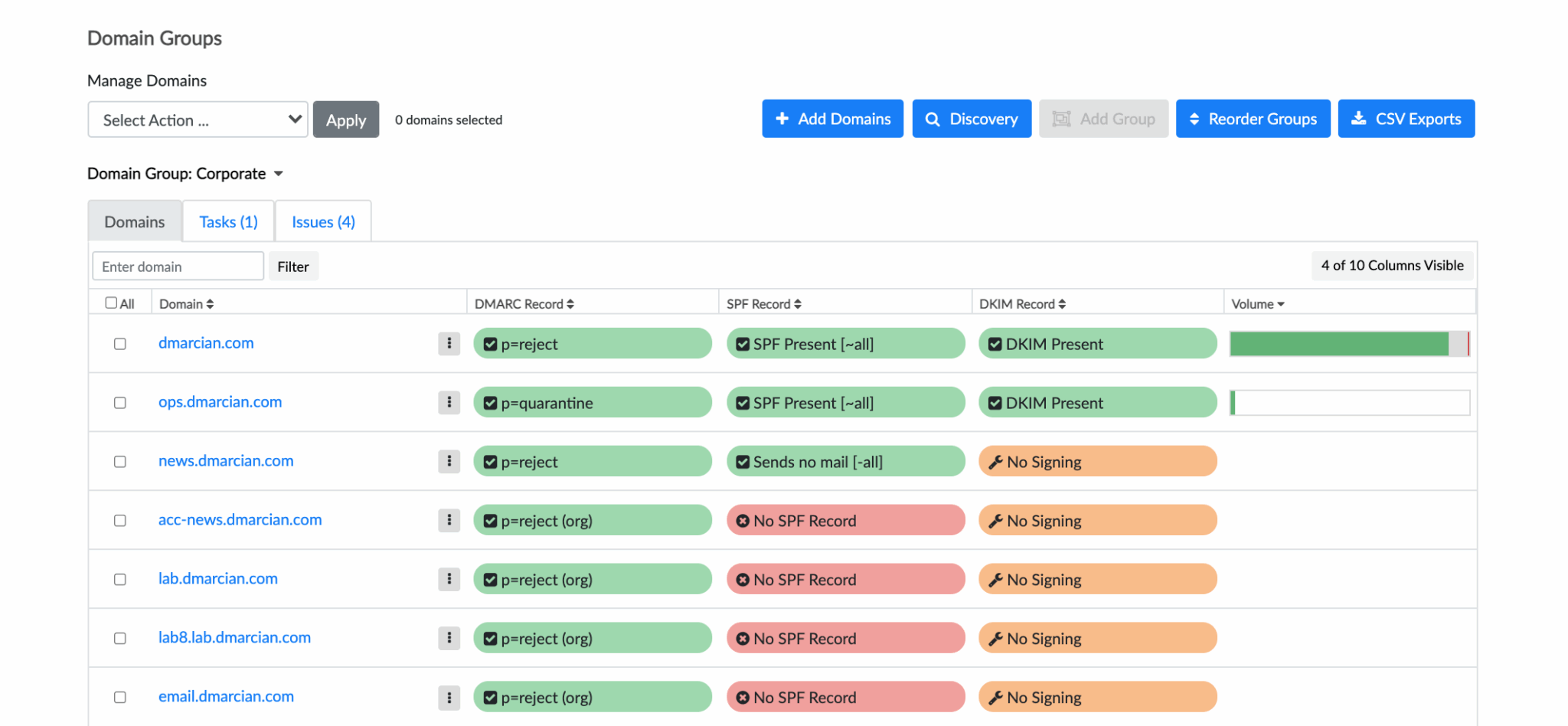
Dmarcian includes enriched Sources, automatic subdomain detection, and aggregate report processing across its listed plans. Basic adds Alert Central and forensic reporting.

User experience
Sources and domain groups support comparing the new sender inventory with the old one. Basic has one user, while user access controls begin with Plus in the documented table.
Support
The available G2 feedback includes both positive support comments and usability concerns. We do not treat those comments as a measured support response or a migration guarantee.
Suitability
We assess Dmarcian for source-enriched reporting and its stated legitimate-message billing definition. Keep report monitoring separate from any hosted authentication records that also need to move.
Who should use Dmarcian
- Teams comparing source-enriched aggregate reports with the sender inventory held in LetsDMARC.
- Buyers who want the billing definition to exclude forwarded and fraudulent traffic.
Pricing structure
- Basic is $24/month, or $19.99/month billed annually, with two active domains, 100,000 DMARC-capable messages per month, and three months of history.
- Plus is $240/month, or $199/month billed annually, with eight active domains, one million messages per month, three users, and one year of history.
- Personal is an ongoing free tier for non-business use only: up to two active domains, 1,250 messages per month, one user, and one month of history. Paid plans have a separate 30-day trial.
- Custom allowances are available. Dmarcian states that forwarded and fraudulent traffic are excluded from its legitimate-message billing measure.
Strengths
- The billing definition distinguishes legitimate traffic from forwarding and abuse.
- Basic documents both alerts and RUF reporting for ongoing authentication review.
Trade-offs
- Basic includes only two active domains and one user; access controls begin with Plus.
- API access and SSO are reserved for Enterprise in the documented plan table.
Verdict
View Dmarcian alternatives
06.
DMARC Report
4.8 / 5(467)DMARC Report is sixth for its documented reporting, permissions, and transport-policy functions. Its G2 average is 4.8 out of five across 467 reviews; unresolved public allowance wording needs attention before a LetsDMARC replacement is budgeted.
#6
our rank
$25/month
starting price
Yes
free tier
Feature set
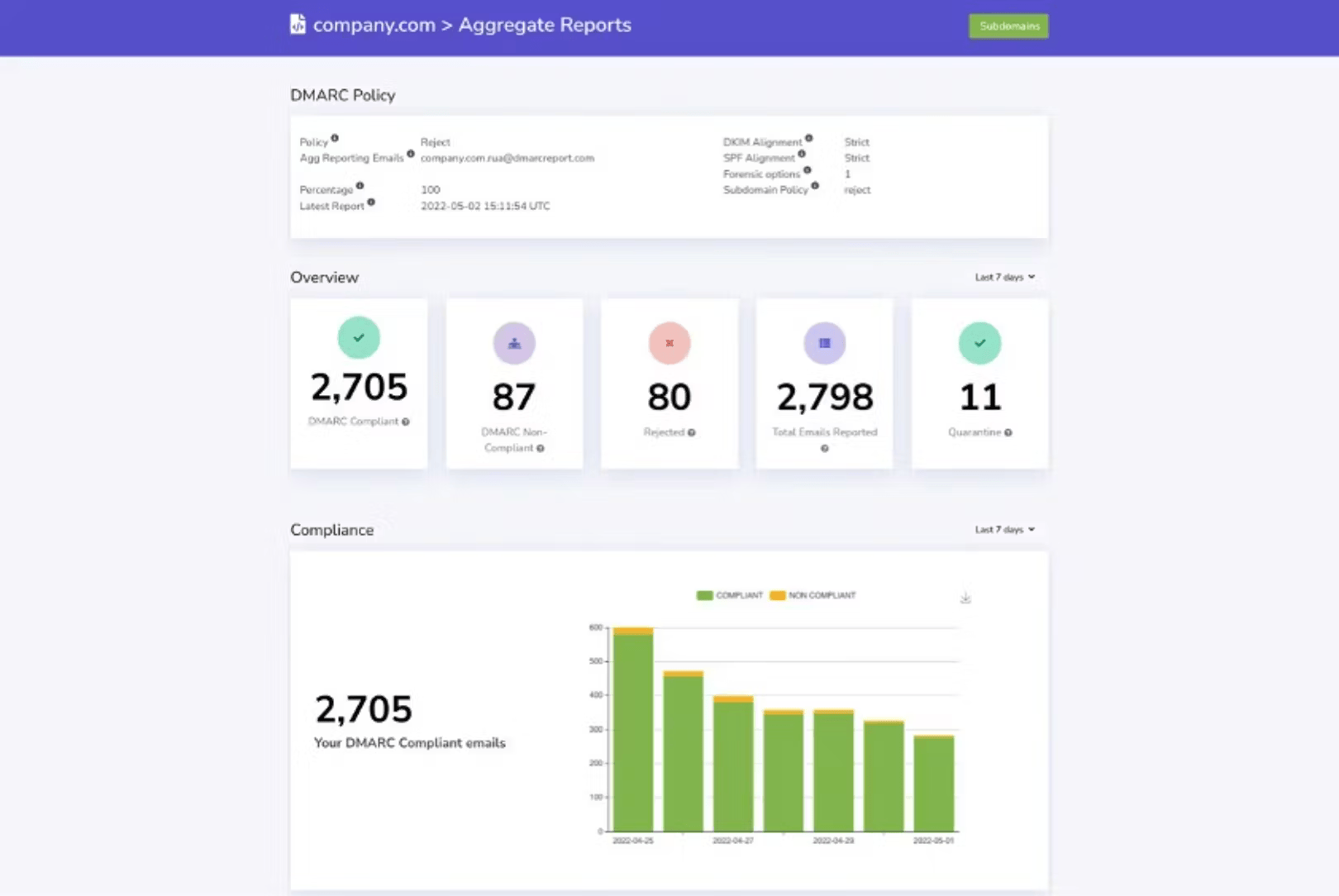
DMARC Report Guard adds vendor identification, failure reports, and group permissions to aggregate reporting. Shield adds MTA-STS/TLS-RPT, API access, and alerts in the documented structure.
User experience
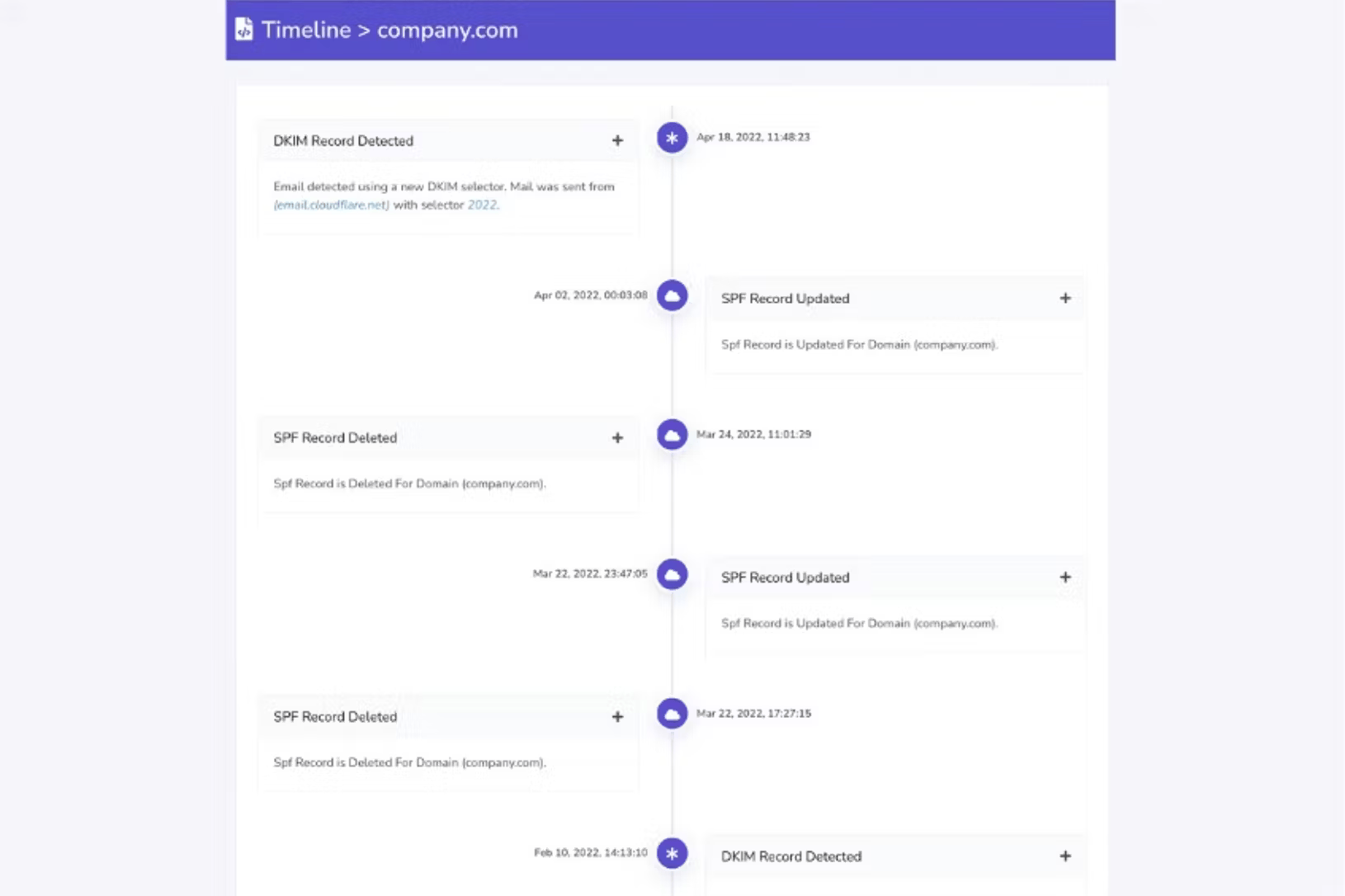
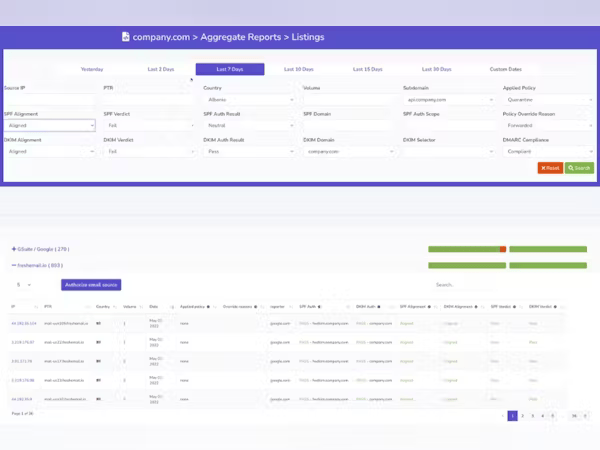
Authentication filters and vendor identification support reconciling senders during a LetsDMARC switch. Check the difference between grouped domains and the client access boundaries required for the account.

Support
Email support and alerts begin with Shield, while Defender lists advanced support. The named engineer and assisted enforcement workflow belong to Ultimate.
Suitability
We evaluate the published parked-domain and reporting allowances against the migration inventory. Confirm the volume unit and domain cap in writing because the public material contains conflicting descriptions.
Who should use DMARC Report
- Teams comparing vendor identification and RUF reporting with their existing source investigations.
- Buyers ready to verify the exact parked-domain entitlement and quota definition before subscribing.
Pricing structure
- Guard is $25/month or $275/year, with five domains and six months of history in the published plan cards.
- Shield is $75/month or $750/year, with ten domains and one year of history. Its published monthly processing allowance is one million; confirm whether the contract counts messages or reports.
- Core is an ongoing free tier for one domain and 30 days of history. Public descriptions conflict on its volume allowance, so verify that cap rather than assuming a fixed free allocation.
- Paid plans advertise a separate 30-day trial. Ultimate displays $3,900 without a clear billing period in the available pricing evidence, so obtain a written price and term.
Strengths
- Guard retention covers the 90-day monitoring scenario.
- Shield explicitly includes parked-domain coverage and a transport reporting workflow.
Trade-offs
- Public plan cards and FAQ wording conflict on domain limits and the free-tier volume allowance.
- Alerts and transport reporting require Shield; assisted enforcement is separately packaged in Ultimate.
Verdict
View DMARC Report alternatives
07.
MailHardener
0 / 5(0)Mailhardener is seventh for its documented combination of DMARC and SMTP TLS reporting. No G2 reviews were available for this product, so there is no customer-review average to interpret.
#7
our rank
EUR 19/month
starting price
Yes
free tier

Feature set
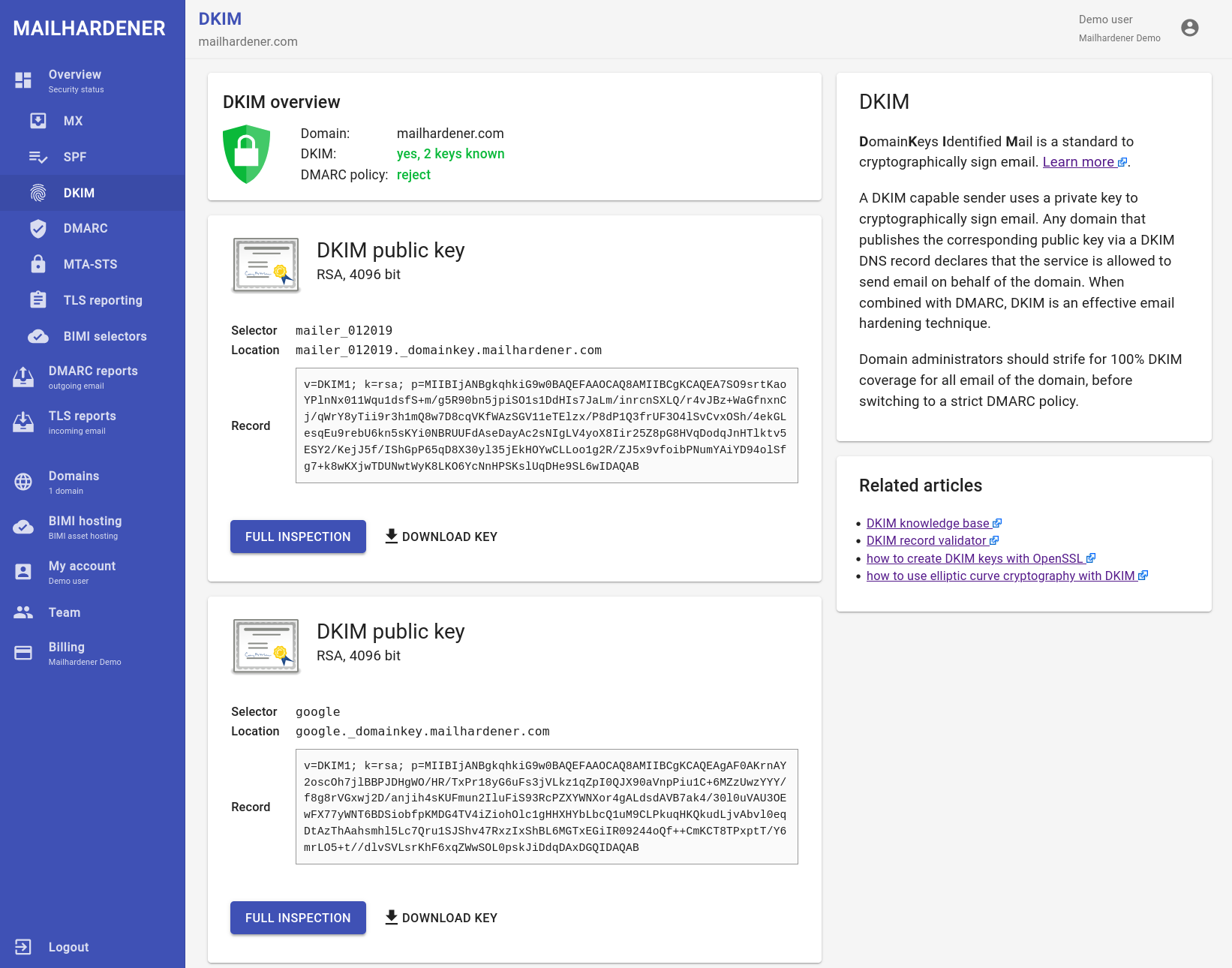
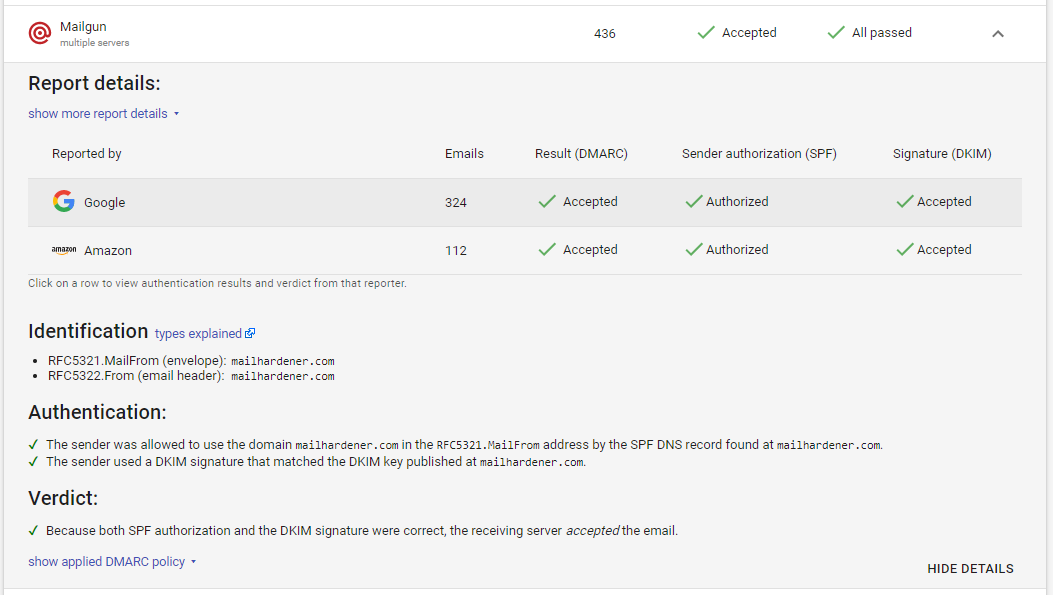
Mailhardener Standard includes RUA/RUF aggregation, SMTP TLS aggregation, hosted MTA-STS, and DNS monitoring. Its published plan card also includes multi-user identity and access controls.
User experience
Standard onboarding is self-service, so plan the reporting-address and MTA-STS changes with the DNS owner. Separate customer environments are documented under the MSP package.
Support
Standard includes technical support but self-service onboarding. Large lists limited onboarding assistance, while assisted onboarding is part of the quote-based package.

Suitability
We evaluate its specific RUF and transport-policy workflow alongside the reporting being moved. The standard shared environment and MSP isolated environments are different account models.
Who should use MailHardener
- Teams evaluating RUA/RUF aggregation together with hosted MTA-STS and DNS monitoring.
- Buyers comparing a shared organizational workspace with separately isolated MSP customer environments.
Pricing structure
- Standard is EUR 19/month or EUR 199/year, covering up to ten domains with three months of history.
- Large is EUR 99/month or EUR 999/year for up to 100 domains and twelve months of history. Both published paid packages include unlimited users and report volume.
- The ongoing free option is for personal or evaluation use: one domain, one user, fair-use report volume, and one month of retention.
- MSP pricing is EUR 149/month plus EUR 1/domain/month, or $164/month plus $1.10/domain/month. It provides isolated customer environments; other custom terms require a quote.
Strengths
- Standard covers the three-asset domain scenario within its published ten-domain allowance.
- The standard plan card explicitly includes technical support and hosted MTA-STS.
Trade-offs
- Standard onboarding is self-service; hands-on onboarding scope needs separate confirmation.
- A regular subscription uses one shared environment, so customer isolation needs the separate MSP package.
Verdict
View MailHardener alternatives
08.
DMARCwise
0 / 5(0)DMARCwise is eighth for its documented hosted DMARC and diagnostics workflow. No G2 reviews were available for this product; package facts carry the comparison rather than a review average.
#8
our rank
EUR 15/month, billed annually
starting price
Yes
free tier
Feature set
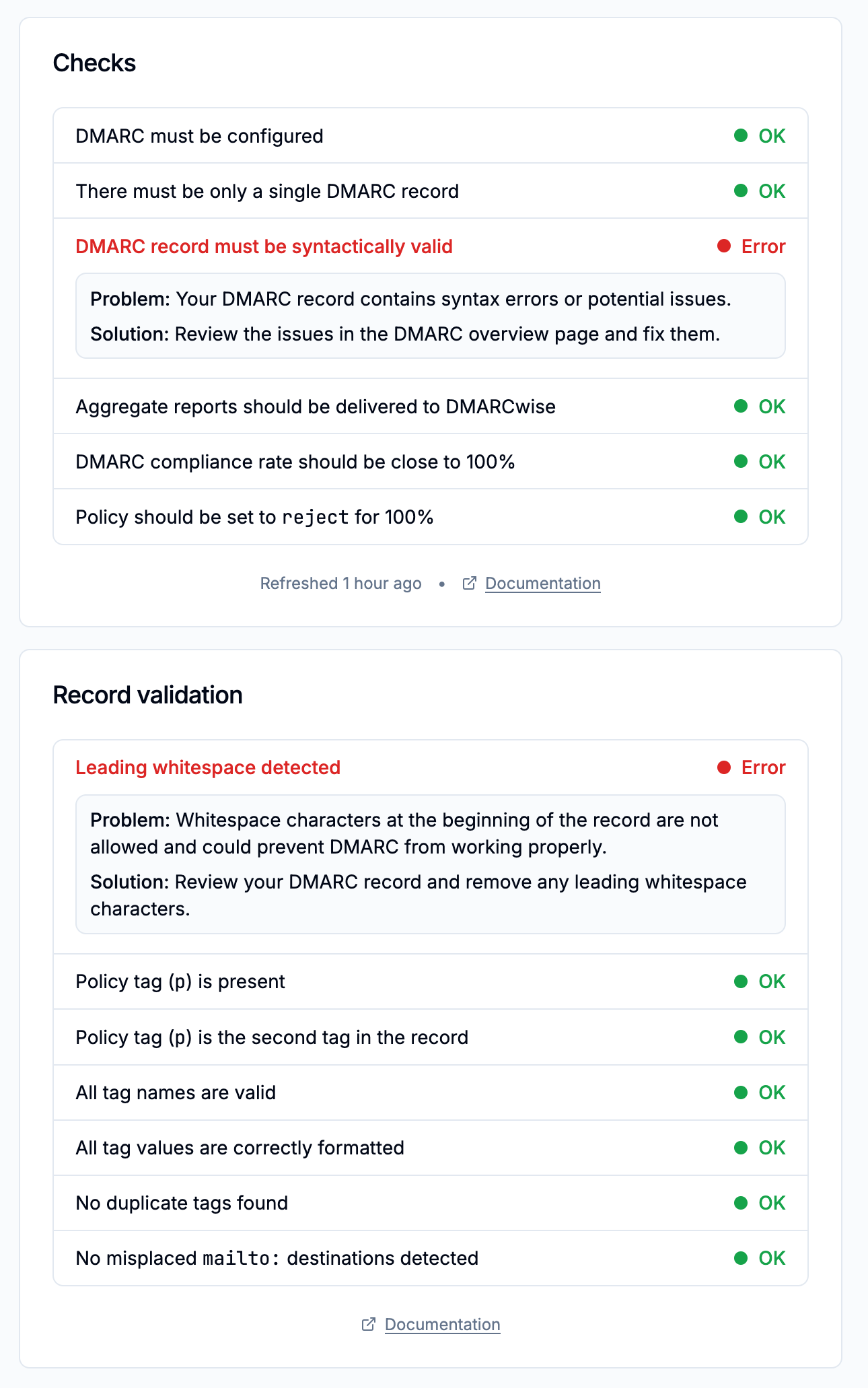
DMARCwise paid plans include aggregate reporting, hosted DMARC records, SMTP TLS reporting, and REST API access. The documented paid-plan reporting volume is unlimited.

User experience
Record history and diagnostics support checking policy changes during the switch. Domain import/export is documented, but it does not establish an importer for LetsDMARC's historical report data.
Support
Paid plans include email support and guidance; the free plan has best-effort support. No support response-time result is established by the available evidence.
Suitability
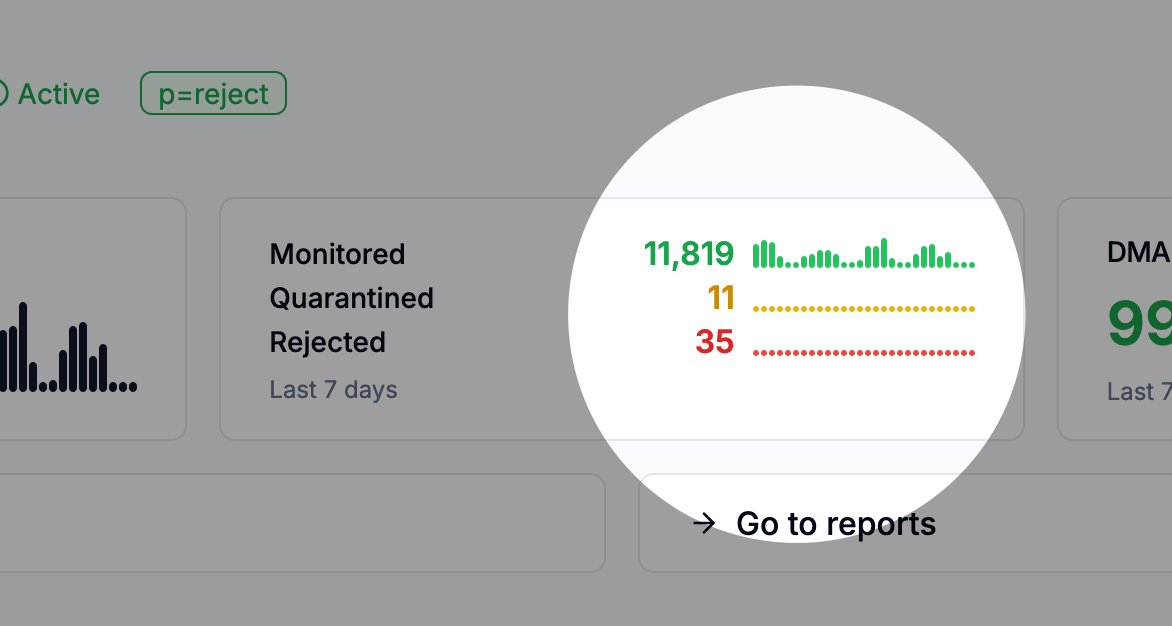
We evaluate its hosted DMARC record and diagnostics workflow at the required retention level. Client access is explicitly listed in the separate MSP package.
Who should use DMARCwise
- Teams evaluating hosted DMARC records with diagnostics history and API access.
- Buyers comparing domain-and-retention pricing while verifying client access separately.
Pricing structure
- Starter is EUR 15/month billed annually as EUR 180 plus taxes, with three domains, three months of retention, and three team members.
- Growth is EUR 39/month billed annually, with twenty domains, six months of retention, unlimited members, and SSO. Scale is EUR 99/month billed annually for 100 domains and one year of retention.
- The ongoing free tier includes one domain, a soft 1,000-email monthly limit, and two weeks of retention. New organizations receive a separate 14-day trial.
- MSP pricing is EUR 1 per active domain per month with a 100-domain minimum, so the minimum is EUR 100/month plus taxes. It includes client access and one year of retention.
Strengths
- Starter's three-domain allowance matches three separately monitored assets in the shared scenario.
- Published paid-plan volume and retention rules make the reporting budget explicit.
Trade-offs
- Starter excludes SSO, which begins with Growth in the documented table.
- The MSP minimum creates a EUR 100/month floor even when fewer than 100 domains are active.
Verdict
View DMARCwise alternatives
09.
DMARCly
0 / 5(0)DMARCly is ninth for its documented reporting and alert functions with explicit overage rules. No G2 reviews were available for this product; Professional's two-month history is shorter than the comparison's 90-day monitoring window.
#9
our rank
$17.99/month
starting price
No
free tier

Feature set
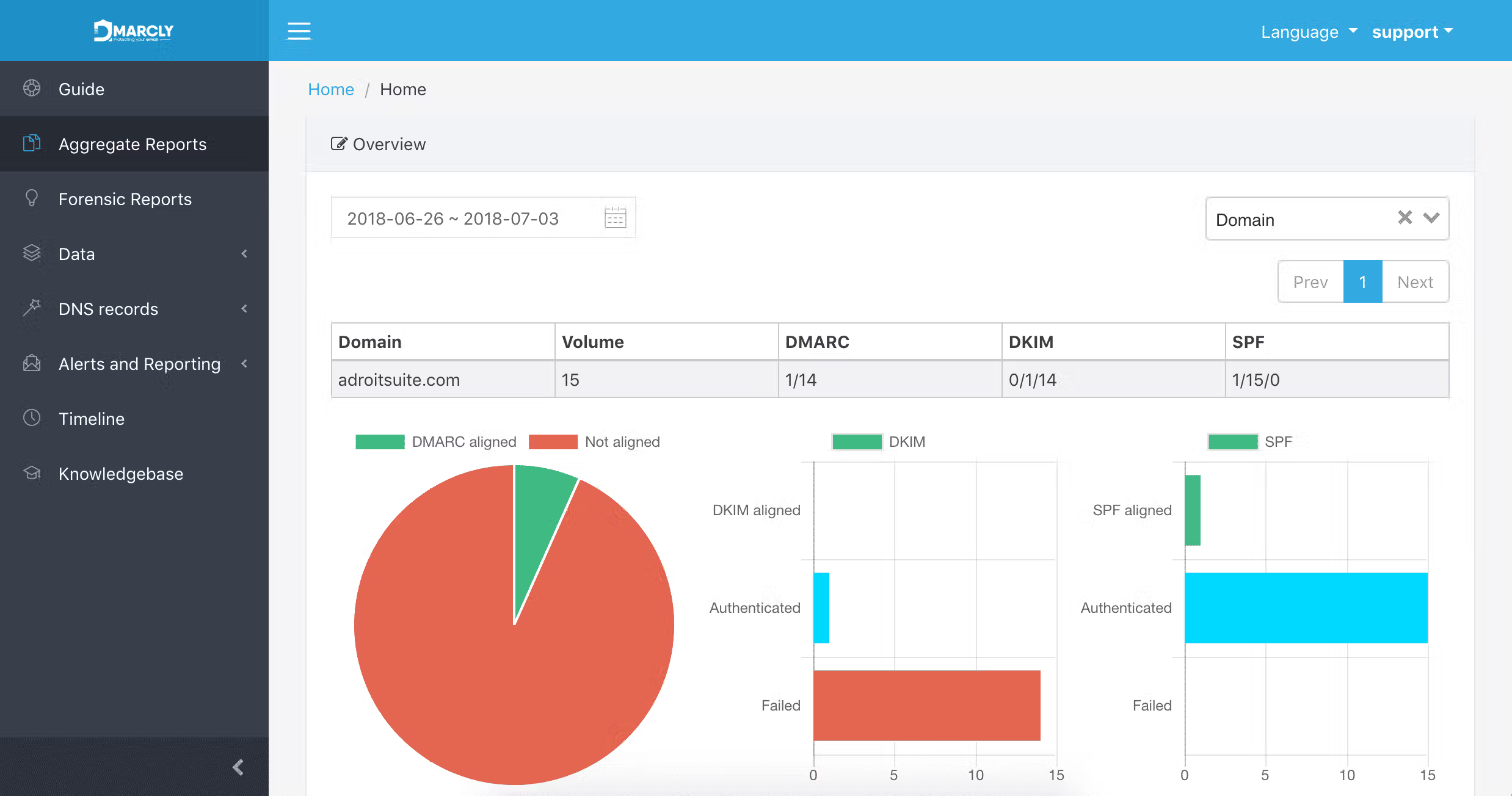
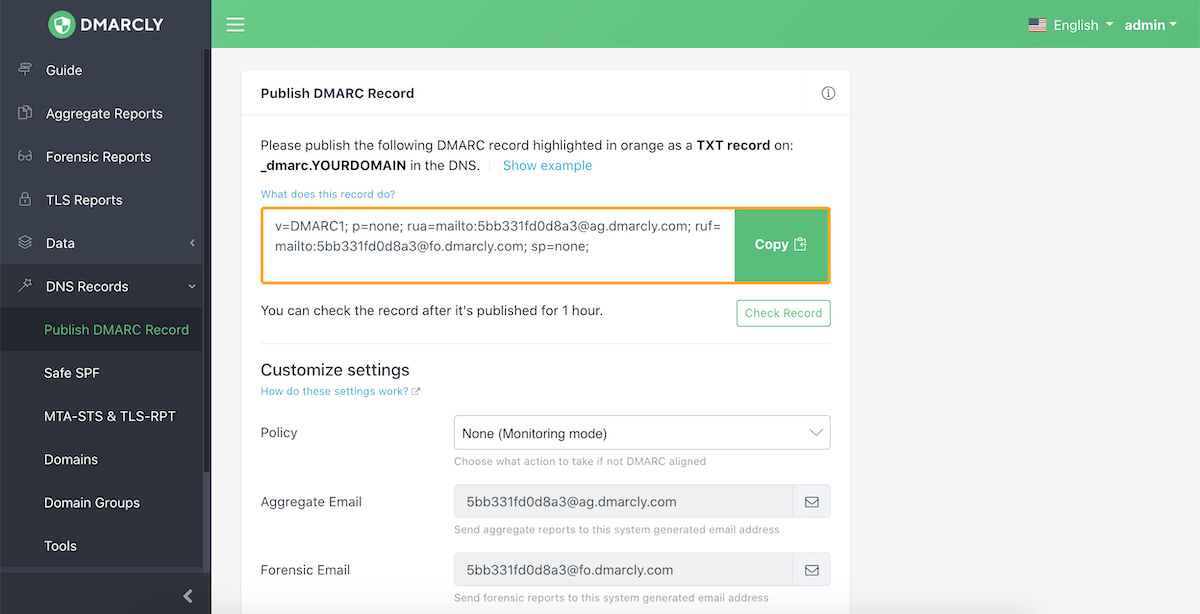
DMARCly Professional includes aggregate and forensic reporting, sender identification, alerts, and MTA-STS/TLS-RPT. Managed SPF is separately scoped through its Safe SPF allowances on higher packages.
User experience
DNS history and vendor identification support checking the sender inventory after LetsDMARC. Professional has one administrator and one domain group, so document who needs access during the handoff.
Support
Professional lists email support, while Growth and higher packages list live chat. A 14-day trial is available, with no ongoing free tier documented.

Suitability
We evaluate the stated report retention and SPF allowance against the migration requirements. Administrator access controls and API access require the documented Enterprise package.
Who should use DMARCly
- Teams evaluating aggregate and forensic reports with DNS history and sender identification.
- Buyers prepared to budget for automatic volume-based plan changes and separately counted Safe SPF domains.
Pricing structure
- Professional is $17.99/month for two domains, 100,000 DMARC-compliant messages per month, one administrator, and two months of history.
- Growth is $39.99/month for eight domains, 250,000 messages per month, three administrators, four months of history, and one Safe SPF domain.
- Enterprise is $199/month for 200 domains, five million messages per month, one year of history, and four Safe SPF domains. No permanent free tier is listed; every plan has a 14-day trial.
- Exceeding a plan's message quota triggers a temporary higher-plan charge. Above five million messages, overage is $10 per additional million; extra DMARC domains are $1 each, and extra Safe SPF domains are $10 each.
Strengths
- The entry package documents sender identification and report alerts.
- Explicit overage rules support calculating a switching budget before seasonal sending increases.
Trade-offs
- Professional's two-domain allowance and two-month retention do not cover the complete three-asset, 90-day scenario.
- Safe SPF allowances and additional domain charges need separate accounting from message volume.
Verdict
View DMARCly alternatives
Switch from LetsDMARC with Suped
Suped
Get started
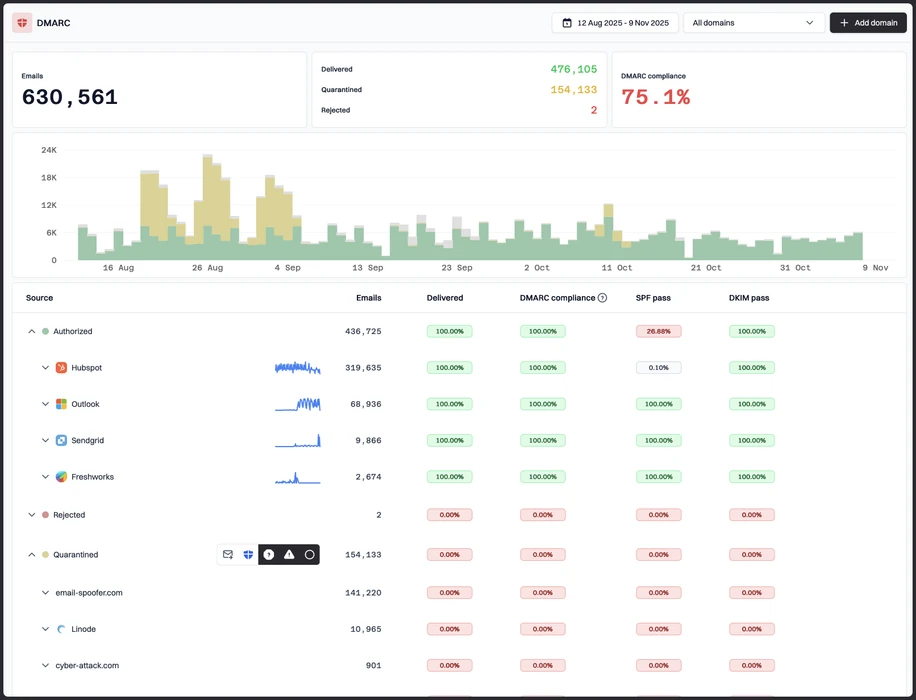
Verify the senders that move
Use verified and unverified source states with detailed authentication records to investigate senders before changing policy.
Plan the DNS handoff
Manage hosted DMARC, SPF, and DKIM after initial DNS setup, with hosted MTA-STS/TLS-RPT for transport-policy workflows.
Keep the required history and access
Choose domain and retention allowances for the complete migration, with separate MSP client organizations and negotiated enterprise terms.
The difference was significant. We moved from limited visibility to a much clearer dashboard. Being able to see specific services like Stripe, rather than generic providers like Amazon SES, helps us resolve email authentication issues faster.
Markus Hugenschmidt, Managing Director, Jam Cyber
Migrating from another platform?
We have done the migration enough times to know the shape.
Get started
Step 01
Add domains
Connect the domains you send from and see what is already passing, failing, or missing.
Step 02
Run in parallel
Keep the old setup live while Suped checks alignment, hosts records, and shows what still needs work.
Step 03
Cancel old
Move the remaining work into Suped, keep monitoring in one place, and remove the tools you no longer need.
How we keep this ranking honest
We use the same domain inventory and authentication cases for every product, and check plan limits against published pricing and product documentation. Suped is our product; we recommend it first for its documented switching workflow and state its hosting and plan limits explicitly. We distinguish documented capabilities from measured results, preserve unresolved pricing conflicts, and avoid treating an unavailable G2 review average as a customer verdict. The review process checks sender classification, DNS handoff, retained evidence, and the full package cost before a recommendation is finalized. G2 figures are the review snapshot used for this comparison, rather than a claim that counts remain unchanged. Missing documentation is a question to verify, not proof that a capability does not exist.
Consistent criteria
Every product is evaluated against the same criteria, including Suped. We compare capabilities, costs and practical trade-offs.
Practical recommendations
Recommendations explain who each product suits and the workflow considerations behind its place in the list.
Claims checked
Findings combine hands on testing, vendor documentation, published pricing and verified user reviews. Pricing reflects public plans as of the dates shown.
Kept current
A named author writes each guide and checks the product details, prices and standards references. We recheck pages on a fixed schedule.