What APIs and tools can check email content for spam triggers before sending?

Published 10 Jun 2025
Updated 8 Aug 2026
12 min read
Summarize with

Updated on 8 Aug 2026: We added a practical isolation test, tightened API selection guidance, and updated bulk-sender requirements.
Yes, there are APIs and tools that check email content before sending. Rule-based scoring APIs, pre-send deliverability testers, seed-address tests, and Suped's email tester can find risky content, broken HTML, authentication issues, and signals that make spam placement more likely.
The caveat matters: no API can guarantee whether Gmail, Outlook, Yahoo, or Apple Mail will place a specific message in inbox, Promotions, Updates, or spam for every recipient. Placement depends on content, sender reputation, engagement, authentication, link reputation, complaint history, sending patterns, list quality, and user-level behavior.
- Best use: Use these tools as a pre-send risk screen, not as a promise of inbox placement.
- Best signal: Send the final rendered email and inspect the full MIME, headers, links, tracking, HTML, SPF, DKIM, and DMARC result.
- Best workflow: Combine content testing with ongoing DMARC, sender reputation, and blocklist (blacklist) monitoring.
What these tools can and cannot predict
Pre-send checking has two jobs. The deterministic job finds broken links, missing text alternatives, malformed HTML, suspicious URL patterns, missing unsubscribe headers, too many redirects, or a known content rule that fires. The probabilistic job estimates how mailbox providers will treat the message after combining its content with sender history and recipient behavior.
What a checker can tell you
- Rules fired: Rule names, weighted phrases, risky patterns, and obvious copy problems.
- Template faults: Missing plain text, image-heavy layout, malformed HTML, broken links, or tracking that changes the final message.
- Auth context: Whether SPF, DKIM, and DMARC pass with proper domain alignment on the actual sent message.
What it cannot guarantee
- Tab placement: Promotions, Updates, Primary, and spam placement change by provider and recipient.
- Reputation impact: Complaint rates, engagement, bounce history, and domain history sit outside the message body.
- Provider logic: Mailbox filters use private models that change over time and vary by user.
The cleanest mental model is simple: a checker tells you what to fix before sending. It does not know each recipient's history with your brand. A message with plain, harmless copy can still land in spam if the domain has weak authentication, poor engagement, or a fresh blocklist (blacklist) listing.
Do not chase words in isolation
Words and phrases matter when they add to an existing risk profile. They rarely explain deliverability on their own. If one word swap appears to fix placement, the real cause is often a content fingerprint change, a different URL, a different send stream, or a small sample size.
Types of APIs and tools to consider
Separate tools by how they receive the message. A raw-content API fits a build or campaign-approval flow. A form-based spam checker helps a writer review the From address, subject line, and body. A send-to-address tester sees the final headers, tracking links, image hosting, MIME structure, and authentication results after the sending platform has modified the email.
|
|
|
|
|---|---|---|---|
Rule-based content API | Raw MIME or message fields | CI and template gates | Misses final-send changes |
ML content checker | From, subject, and body | Copy review | Score is not a provider verdict |
Send-based tester | Delivered test message | MIME, HTML, links, and authentication | Requires a real send |
Seed placement test | Campaign sent to seed addresses | Provider-specific placement clues | Does not represent every recipient |
 Suped Email Tester Suped Email Tester | Real send | Full message and authentication report | Send needed |
Static word list | Copy | Phrase hints | Weak signal |
Practical options for checking email content before launch.
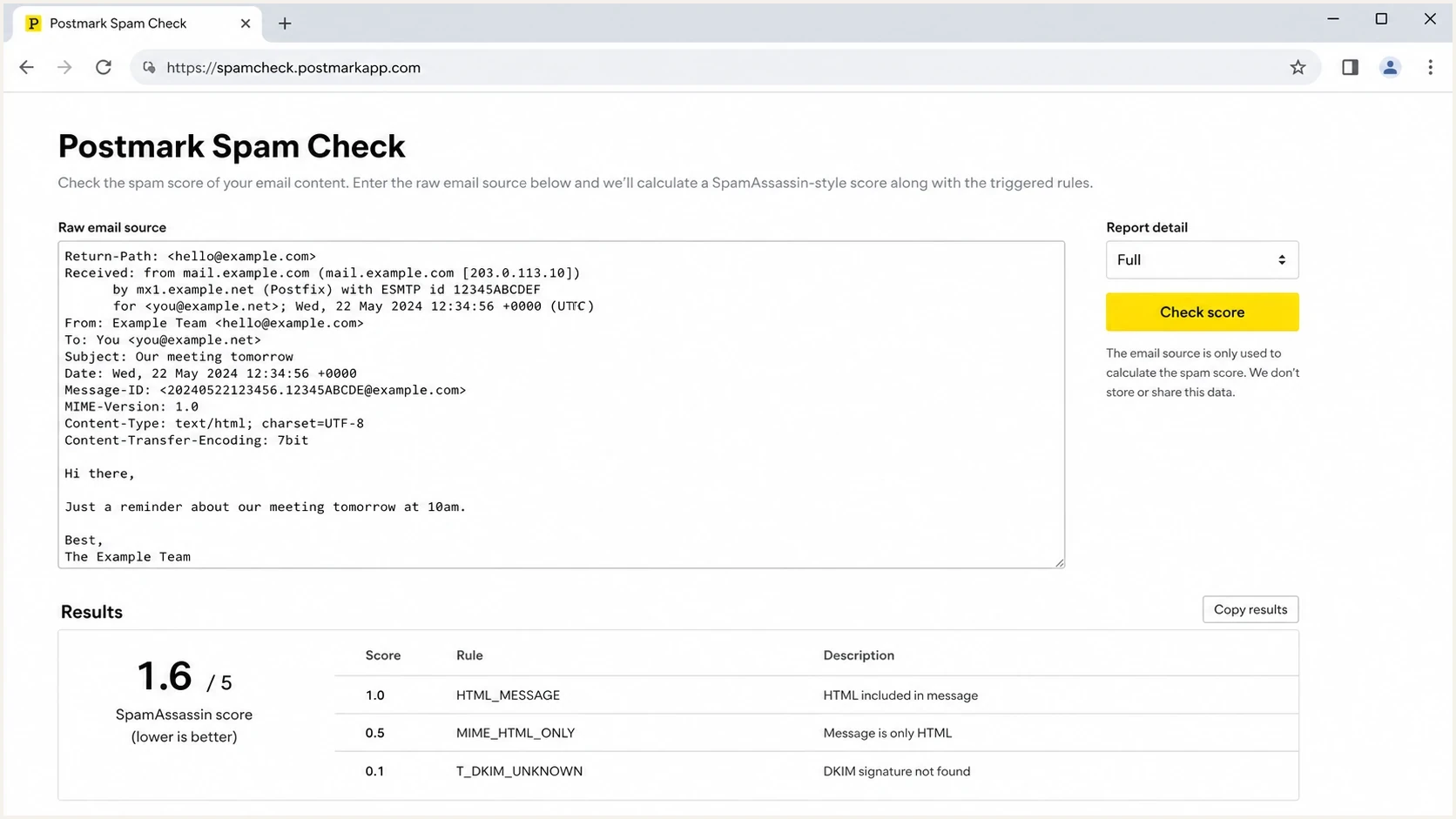
Spam checker interface showing raw email input and rule-score results.
For an API integration, verify whether the endpoint accepts complete RFC 5322 or MIME content, returns rule names and weights, supports the payload size you need, and produces stable output that can be versioned in CI. For a send-based test, check whether the report exposes the received headers, authentication alignment, redirect chain, HTML defects, and plain-text alternative.
Treat raw email as sensitive data. Before sending customer messages to an API, review its retention terms, access controls, processing location, and handling of personal data. Use synthetic fixtures in CI when production content is not required.
Suped's product fits the operational side of this workflow: test the real email, then connect the result to DMARC, SPF, DKIM, blocklist monitoring, hosted SPF, and ongoing alerts. This makes it easier to see whether the same domain has authentication or reputation issues alongside the content findings.
How to test content without fooling yourself
The best test uses the exact message that will be sent. That means the final subject line, final HTML, plain-text alternative, sender address, unsubscribe headers, tracking links, images, and headers added by the sending platform. Testing a draft paragraph inside a form is useful for copy review, but it misses the parts that often break deliverability.
Example pre-send API payloadJSON
{
  "subject": "Your subject line",
  "from": "news@example.com",
  "html": "<html>Final rendered HTML here</html>",
  "text": "Plain text version here",
  "headers": {
    "List-Unsubscribe": "<https://example.com/unsubscribe/opaque-id>, <mailto:unsubscribe@example.com>",
    "List-Unsubscribe-Post": "List-Unsubscribe=One-Click"
  }
}
For RFC 8058 one-click unsubscribe, the List-Unsubscribe header needs an HTTPS URI, and a valid DKIM signature must cover both unsubscribe headers. A mailto address can be included as an additional option, but it does not replace the HTTPS endpoint.
In production, store the score and fired rules next to the template version. This makes regressions visible. If a new footer, tracking domain, or personalization block adds a risky pattern, the team can trace the change instead of guessing after complaints rise.
- Render first: Generate the final HTML and plain text after personalization and link wrapping.
- Score content: Run a rule-based content check and save rule names, weights, and exact findings.
- Send a test: Send the real message to a tester so headers, authentication, and links are visible.
- Check reputation: Review domain health, blocklist (blacklist) status, and authentication before approving the campaign.
Email tester
Send a real email to this address. Suped shows a results button when the test is ready.
?/43tests passed
A send-based test is useful here because it forces the final-send step. If the test email fails DKIM domain matching, has no DMARC pass, or uses a suspicious redirect chain, the content score is not the main fix. Repair the sending setup, then retest the message.
How to isolate a content trigger
When one message has a placement problem and other mail from the same sender does not, isolate the trigger with controlled test sends. Change one component at a time and use a mailbox at the provider where the problem occurs. This method takes longer than a single score, but it separates copy, links, images, and template code.
- Establish a baseline: Send a blank or plain-text message through the same sending stream. If it lands in spam, investigate authentication, reputation, or infrastructure first.
- Test the shell: Send the HTML template without body copy, links, images, or ads to check whether the markup or footer causes the change.
- Add copy gradually: Restore the subject and body one section at a time, with a test send after each addition.
- Add links individually: Restore each destination and its final tracking redirect separately so a risky URL can be identified.
- Add hosted assets: Restore images and advertising elements one at a time to test their hostnames and markup.
- Confirm the result: Rebuild the exact final message and repeat the test before treating one placement result as conclusive.
Keep the From address, sending IP or pool, recipient mailbox, and test timing as consistent as practical. If the blank baseline fails, stop editing copy. The evidence points outside the message content.
What to fix when a checker flags content
When a checker highlights content, work through the message in this order: fix technical defects first, rewrite suspicious claims next, then review formatting. Rewriting every flagged word usually wastes time. A single phrase rarely sinks a healthy sender, but repeated aggressive claims, poor formatting, deceptive links, and weak authentication add up quickly.
Content risk bands
Use these bands as triage guidance for pre-send checks, not as universal mailbox-provider rules.
Low
Ship after review
Minor copy flags, clean links, valid authentication, and no obvious template defects.
Review
Fix and retest
Several rule hits, heavy image use, tracking changes, or claims that need rewriting.
Stop
Do not send
Broken authentication, blocklist (blacklist) listing, deceptive links, or severe rule scores.
For a deeper copy-specific checklist, review common spam trigger words and compare them with the actual offer, sender history, and landing-page behavior. A list can help writers spot risky phrasing, but it should not become the only gate.
- Fix defects: Repair malformed HTML, missing plain text, broken links, missing unsubscribe headers, and image-only content.
- Rewrite claims: Remove exaggerated urgency, misleading subject lines, fake personalization, and promises the landing page does not support.
- Reduce noise: Simplify layout, reduce link count, keep the text version useful, and avoid hiding core information inside images.
- Retest changes: Run the same test after each meaningful change so the team can see what improved.
Template changes need their own test
A clean paragraph can fail after it enters a broken template. If you change your email builder, tracking domain, image host, footer, preference-center link, or unsubscribe logic, retest the final message. For more detail, compare the result with common email template issues before approving the campaign.
Authentication and reputation still decide the outcome
Content checks are only one part of the pre-send decision. A message with clean wording still fails when SPF breaks, the DKIM domain does not match the From domain, DMARC is missing, the sending IP is listed, or the domain has poor engagement. Content testing should connect to domain-level monitoring instead of remaining a separate copywriting task.
Bulk-sender requirements are a hard gate
Senders delivering more than 5,000 messages a day to personal Gmail accounts must use SPF, DKIM, and DMARC, pass DMARC alignment, use TLS, keep reported spam below 0.3%, and support one-click unsubscribe for marketing and subscribed mail. Google recommends staying below 0.1%. Yahoo also requires bulk senders to authenticate, offer one-click unsubscribe, and remain below a 0.3% complaint rate. A clean content score cannot compensate for a failure here.
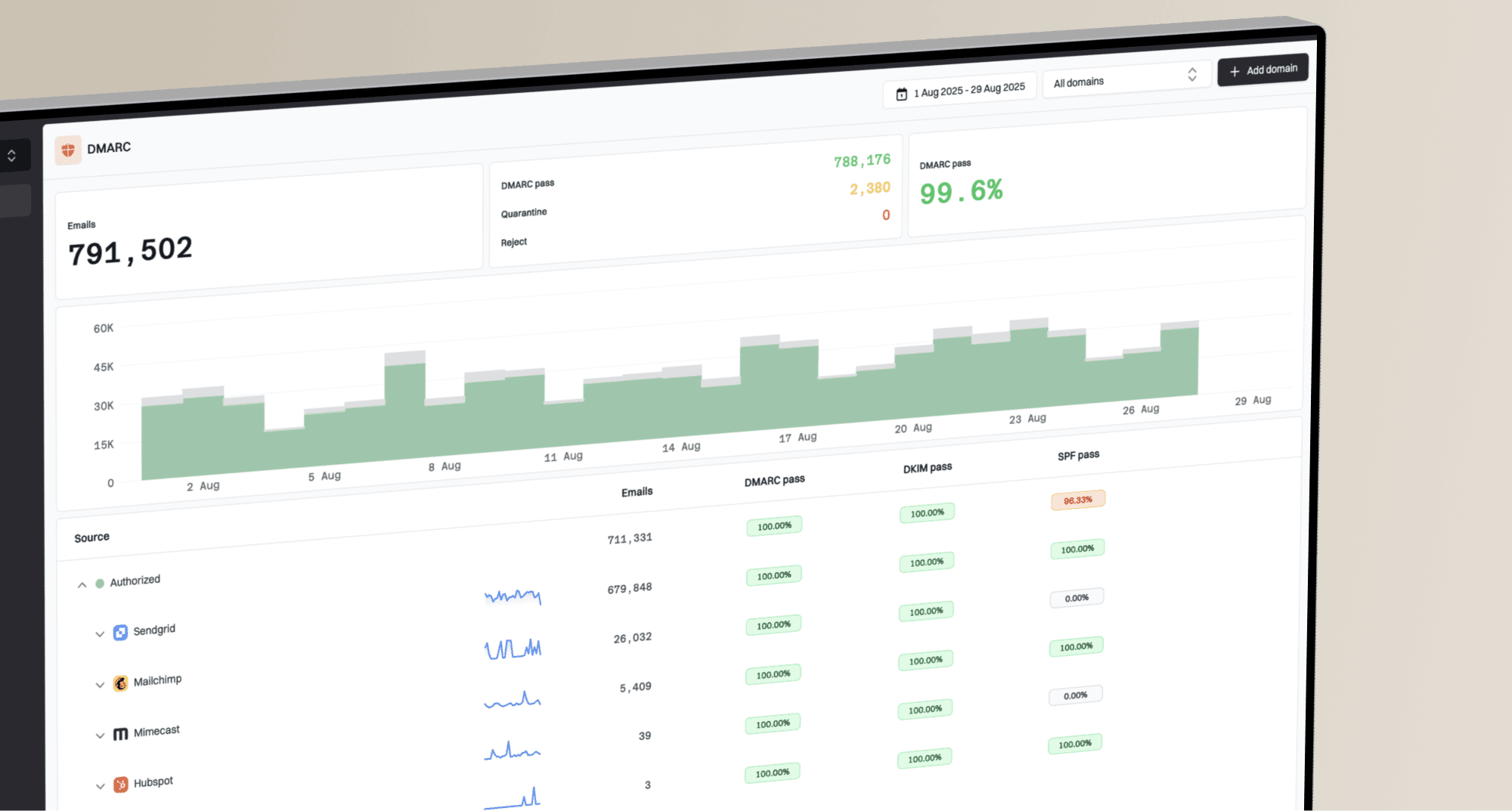
Suped's product connects the operational parts of this workflow by bringing together DMARC monitoring, SPF and DKIM visibility, hosted SPF, SPF flattening, hosted MTA-STS, real-time alerts, and blocklist monitoring. For teams managing several domains or client portfolios, the multi-tenant dashboard keeps DNS records, reports, and reputation checks in one workflow.
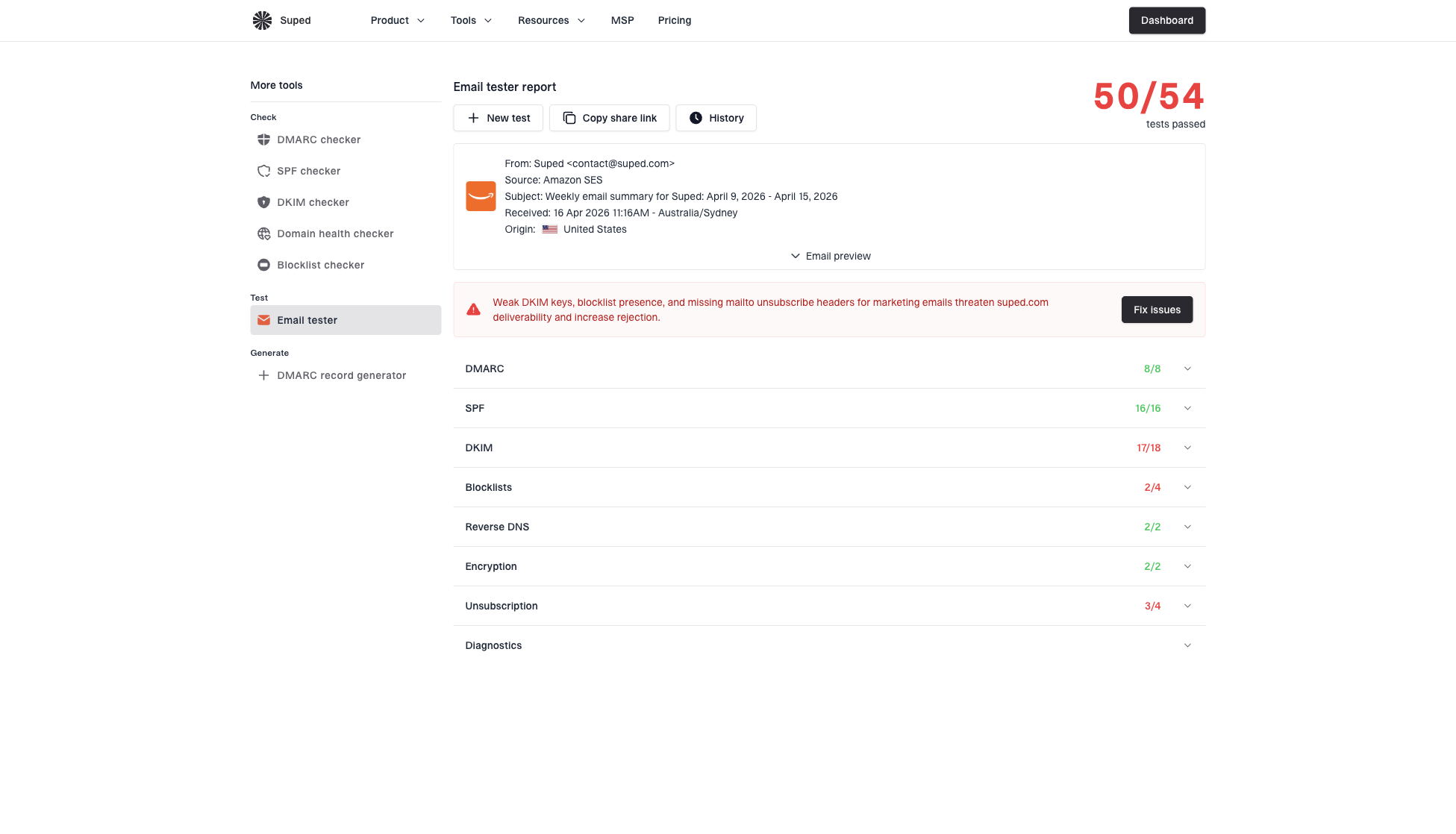
Email tester sample report showing total score, email preview, issue summary, and per-section results
The workflow is straightforward: run a real email test, check the domain with a domain health view, then review the DMARC sources that actually send mail for the domain. When Suped finds an issue, it points to the affected source, the authentication result, and the repair steps.
- Before launch: Run the content and email test against the exact message that will go out.
- During rollout: Watch DMARC pass rates, unknown sources, and authentication failures in real time.
- After send: Compare complaints, bounces, blocklist (blacklist) status, and engagement before changing copy again.
When to use an API, a tester, or monitoring
Choose the check based on the failure you are trying to prevent. Engineering teams usually need API gates for transactional templates. Marketing teams usually need a send-based preflight check. Deliverability and security teams need ongoing monitoring because risk changes after the campaign leaves the editor.
Where each approach helps
A practical split of diagnostic value across content, rendering, and sender context.
Content
Rendering
Sender context
For high-volume transactional mail, add a blocking API check when a template crosses a documented risk threshold. For marketing mail, avoid hard blocking every flagged phrase. Use a review workflow because legitimate promotional copy often contains language that a simple word list dislikes.
If the real question is whether a campaign will go to spam, check more than content. Review authentication, bounce patterns, complaint rates, seed results, and post-send placement. A fuller diagnostic process is covered in going to spam workflows. The practical sequence is to test before launch, monitor after launch, and fix the source of the failure instead of its most visible symptom.
Views from the trenches
Best practices
Test the final rendered MIME, not only the copy, because tracking and HTML change the result.
Compare results by provider and sender stream before changing high-performing campaign copy.
Keep authentication, complaints, and blocklist checks beside content review before launch.
Common pitfalls
Treating one spam-word list as a verdict leads to unnecessary copy changes and weak fixes.
Testing a draft without final links, images, and headers misses the risky production parts.
Ignoring the sender domain makes content results look random when reputation is the cause.
Expert tips
Store every pre-send score with the campaign ID so regressions are easy to trace later.
Use content checks for triage, then prove fixes with real seed sends and DMARC results.
Flag sudden rule changes in alerts, because repeated failures usually need a workflow fix.
Marketer from Email Geeks says rule-based APIs are useful for clear content issues, but they do not predict every inbox decision.
2022-12-19 - Email Geeks
Marketer from Email Geeks says seed-address testing catches rendered-template issues that a raw copy checker misses.
2022-12-19 - Email Geeks
A practical pre-send stack
Use a rule-based scoring API for automated content scoring inside a workflow. Use a send-based tester to inspect the final rendered email. Use ongoing monitoring to determine whether authentication, reputation, and blocklist (blacklist) status are undermining otherwise acceptable content.
For most teams, a practical setup combines Suped's product for DMARC, SPF, DKIM, blocklist, and deliverability visibility with a pre-send content check for each important campaign or transactional template. This answers whether the content has avoidable risks and whether the sending system is ready for the campaign.