What words and phrases are considered spammy and trigger spam filters?

Published 3 Aug 2025
Updated 24 Aug 2026
12 min read
Summarize with
Updated on 24 Aug 2026: We updated this guide with enforced bulk-sender requirements and a cleaner way to test words in context.
The direct answer is this: words and phrases such as free, guaranteed, act now, risk-free, winner, cash bonus, no obligation, verify your account, and limited time are commonly associated with spam. So are aggressive finance, debt, crypto, work-from-home income, weight-loss, gambling, adult, miracle-cure, and fake urgency phrases. Formatting patterns such as excessive exclamation marks, all caps, deceptive reply prefixes, image-only emails, and mismatched links also raise risk.
The caveat matters more than the list. Modern filtering is not a universal banned-word checklist. Most public spam trigger word lists are useful for QA, not as delivery rules. A legitimate brand can say free shipping and land in the inbox. A bad sender can avoid every famous trigger word and still go to spam because recipients ignore, delete, complain, or because authentication and reputation are weak. Treat words as risk indicators, not as pass-or-fail rules.
For a practical content check, Suped's email tester helps you send a real message and inspect content, headers, authentication, and deliverability signals together. That is more useful than staring at a generic list of scary words.
- High-risk themes: money, debt, prizes, miracle outcomes, work-from-home income claims, adult offers, gambling, and fake security warnings.
- Formatting tells: all caps, repeated punctuation, hidden text, link stuffing, missing unsubscribe links, and image-only layouts.
- Context matters: the same word has different risk when subscribers expect the message and engage with it.
- Authentication matters: weak SPF, DKIM, or DMARC can make normal copy look less trustworthy to mailbox providers.
Words and phrases that deserve extra care
When a team asks for a list, provide one with a warning label. These phrases are not forbidden. They are common in email that recipients complain about, especially when the message also has weak permission, poor targeting, a cold list, or a sender reputation problem.
The goal is not to remove every strong commercial word. The goal is to remove misleading pressure, unsupported claims, and formatting that makes the message look like bulk abuse instead of requested mail.
|
|
|
|---|---|---|
Money | Free money, cash bonus, fast cash, work-from-home income | Often appears in low-trust offers |
Urgency | Act now, final notice, expires today | Can look like pressure or deception |
Certainty | Guaranteed, risk-free, no catch | Unsupported claims invite complaints |
Discounts | Sale, discount, lowest price, bargain | Overuse can make a message look generic |
Health | Miracle cure, lose weight | Sensitive claims get extra scrutiny |
Deception | Re:, Fwd:, verify your account | False context damages trust |
Generic greetings | Dear friend, congratulations | Can look like untargeted bulk mail |
Common risky wording patterns
Risky subject patternstext
FREE GUARANTEE!!!!!!!
Final notice: act now
Re: Your invoice, when there is no thread
Make $500 today with no effort
Your account closes unless you click
The word is rarely the whole problem
A single word such as free usually does not sink an email by itself. The dangerous combination is a risky phrase plus poor list quality, misleading claims, weak authentication, a bad domain history, or recipients who regularly delete the message without reading.
Why keyword lists are incomplete
Old deliverability advice often sounds as if a mailbox provider has a list on a wall that says free equals spam. That advice was easier to explain, so it kept spreading. It is also incomplete for the way large mailbox providers filter mail now.
Many public lists mix old rule scores, affiliate marketing cliches, ordinary retail words, and phrases tied to fraud-heavy categories. A match should trigger a closer read, not an automatic rewrite.
Filtering systems evaluate patterns across many signals: sender history, domain reputation, IP reputation, authentication, complaint rates, engagement, link reputation, message structure, and content similarity to mail that users have treated as unwanted. A phrase can become a risk signal because it appears in lots of mail that users reject, but that is different from a fixed banned-word list.
Old checklist approach
- Primary focus: remove words that appear on public trigger-word lists.
- Main risk: rewriting useful copy while ignoring sender reputation.
- Typical result: cleaner wording with the same inbox placement problem.
Modern risk approach
- Primary focus: evaluate content with authentication, reputation, and response data.
- Main risk: missing a phrase that creates complaints in your audience.
- Typical result: better prioritization because the fix matches the cause.
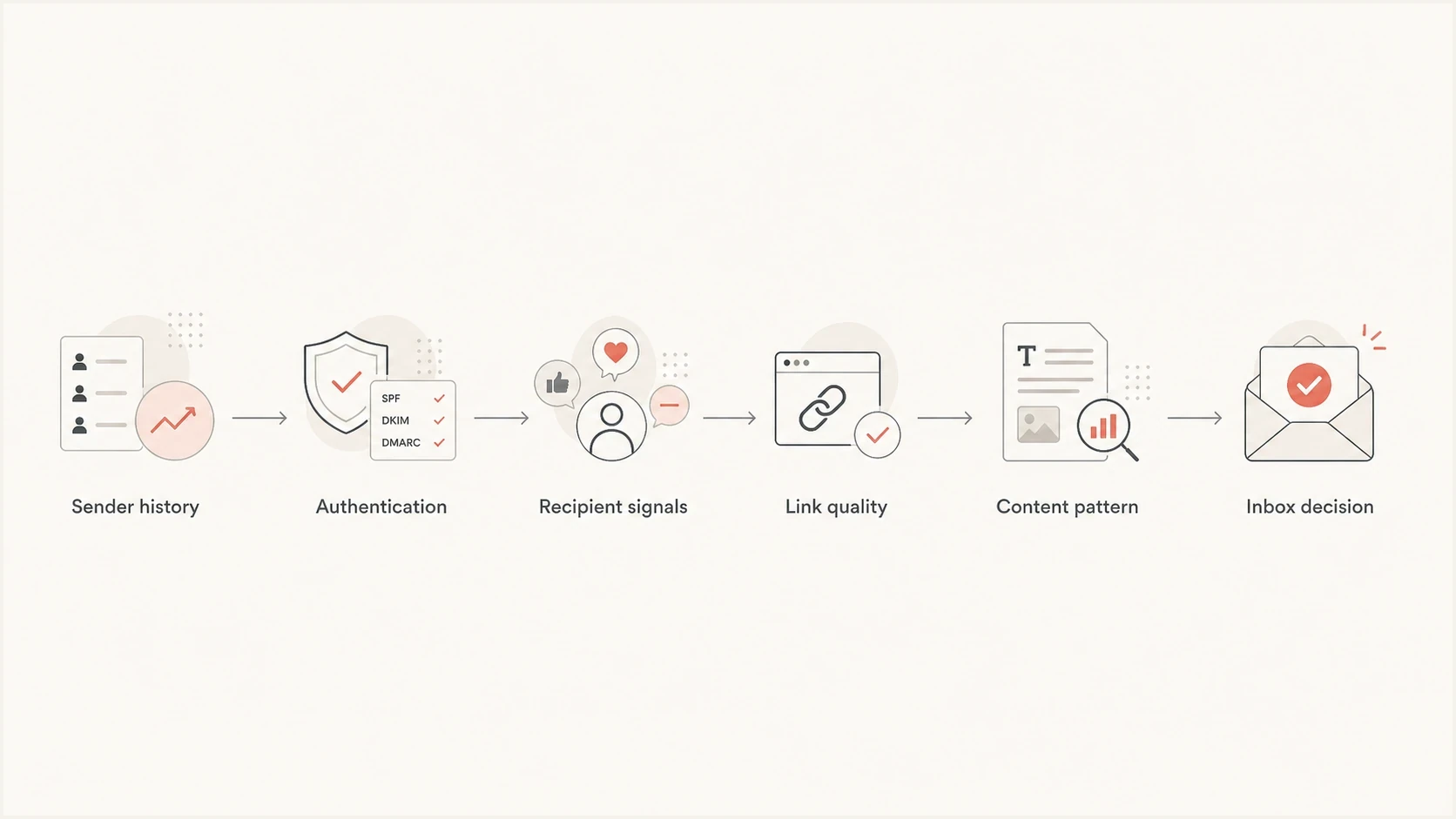
A flowchart showing how spam filters weigh sender history, authentication, recipient signals, links, content patterns, and inbox decisions.
When words still matter
Words still matter when they match common abuse patterns or when they make recipients feel misled. Smaller mailbox systems and web-hosted mailbox providers can also run rule-based filters that score phrases more directly. That is why a subject with a number, a finance phrase, or repeated punctuation can still get a visible spam score in some environments.
Emojis are not automatic spam triggers. One relevant emoji can be harmless, but clusters of emojis or misleading symbols can reduce clarity and render inconsistently. Test the actual subject line in the mailbox apps your audience uses.
The stronger point is that wording matters through recipient behavior. If your subject line overpromises, people ignore it, delete it quickly, report it as spam, or unsubscribe. Those actions are clearer signals than the phrase itself.
How to triage wording risk
A practical way to decide whether a phrase needs rewriting.
Low risk
Plain wording
Clear offer, expected by the audience, normal punctuation.
Moderate risk
Review
Commercial phrase with strong urgency or weak context.
High risk
Rewrite
Misleading claim, fake reply, pressure, or sensitive category.
A useful rewrite usually keeps the value but removes the pressure. Claim your FREE prize now becomes Your loyalty credit is available. Act now or lose access becomes Your renewal date is coming up. The second version is clearer, less manipulative, and easier for a recipient to trust.
How to test the real risk
Do not test content by changing one word and declaring the problem solved. Send the actual email and inspect the subject line, preheader, HTML, plain-text part, MIME structure, headers, links, and authentication together. Verify SPF and DKIM, check DMARC disposition, then compare inbox placement across the mailbox providers that matter to your audience.
A domain health check is a good first pass before copy edits. If SPF, DKIM, DMARC, rDNS, or DNS records are broken, rewriting a subject line is the wrong first task.
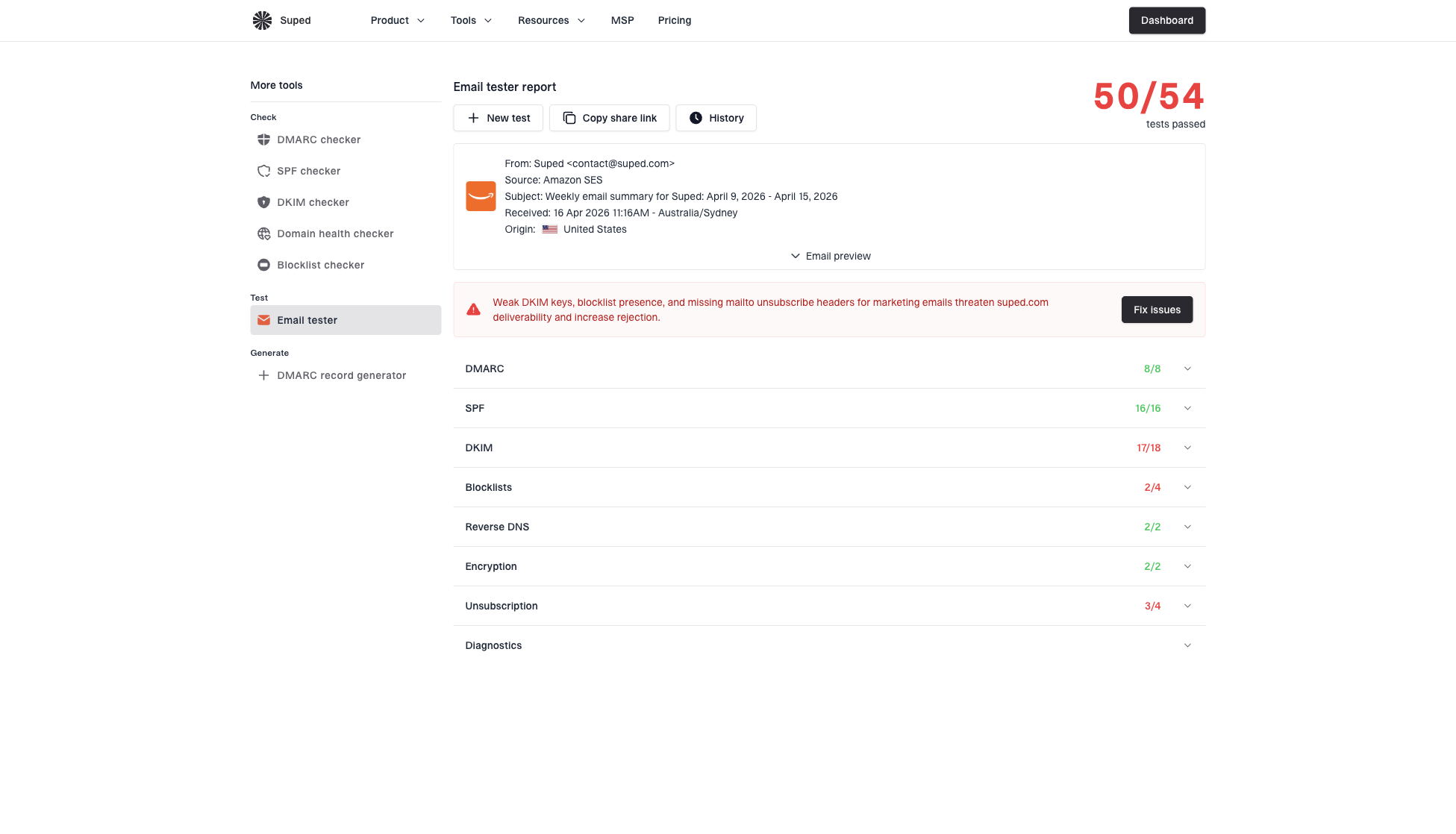
Email tester sample report showing total score, email preview, issue summary, and per-section results
Suped's email tester helps inspect the message as sent, not the message as drafted in a document. That distinction matters because filters evaluate headers, authentication, MIME structure, links, and rendering details, not copy alone.
When a risky phrase appears in a message that otherwise looks healthy, rewrite only if the phrase is misleading or hurting engagement. When the same phrase appears with broken authentication, bad link hygiene, or weak list permission, fix those issues first.
This is also where a controlled seed test has limits. Seed inboxes show a useful directional signal, but real recipient behavior decides a lot of ongoing placement. A seed test that passes does not protect a campaign that earns complaints.
Email tester
Send a real email to this address. Suped shows a results button when the test is ready.
?/43tests passed
Use the result to choose the right fix. If the email tester points to authentication or domain setup, fix that before changing copy. If the setup is clean and the copy uses pressure, deception, or sensitive claims, rewrite the message and retest.
Compliance signals that affect spam risk
Spammy wording often overlaps with compliance problems. Under CAN-SPAM, commercial email needs accurate routing information and subject lines, a valid physical postal address, clear identification where required, and a working opt-out method. Other jurisdictions can require prior consent, so legal compliance depends on where recipients are located.
For senders that reach Gmail's bulk threshold of about 5,000 messages to personal Gmail accounts in 24 hours, enforced requirements include SPF and DKIM authentication, DMARC with From-domain alignment, valid forward and reverse DNS, TLS, and low user-reported spam rates. Marketing and subscription mail also needs RFC 8058 one-click unsubscribe plus a visible unsubscribe link in the body. Gmail says to stay below 0.1% for resilience and never reach 0.3%; Yahoo tells bulk senders to remain below 0.3%. These are sending requirements, not proof that a particular word is safe.
- Subject and header accuracy: do not use Re: or Fwd: unless the message is an actual reply or forward.
- Visible sender identity: keep the display name, From domain, reply-to, and landing pages recognizable.
- Unsubscribe path: for subscription mail, pair a visible body link with RFC 8058 one-click headers and process requests promptly.
- Message structure: avoid hidden text, broken HTML, missing postal information, and unclear contact details.
List quality changes how filters read your copy
Permission and list hygiene are larger risk multipliers than any isolated word. Purchased or scraped addresses create complaints, bounces, and long stretches of no response because the recipients did not ask for the mail. A clean list gives normal commercial language a better context and makes copy tests more useful.
- Confirm new subscribers: use clear consent and double opt-in where appropriate to verify the address and the person's intent.
- Suppress bad addresses: stop mailing hard bounces and addresses that repeatedly soft bounce.
- Manage inactive contacts: run a limited re-engagement attempt, then reduce or stop mail when contacts show no meaningful activity.
- Reject bought and scraped lists: removing trigger words cannot create permission that the sender never had.
Segment by signup source and recipient interest before testing copy. If one audience reports the message while another welcomes it, the offer-to-audience match needs work. A global rewrite hides that difference and can weaken copy for subscribers who wanted the message.
Authentication and reputation beat copy edits
A common mistake is treating spam filters like grammar checkers. They are closer to trust systems. If the sender has poor engagement, missing authentication, suspicious links, or a history of complaints, clean wording does not fix the core issue.
That is why DMARC monitoring and blocklist monitoring belong beside content testing. A domain or IP on a blocklist (blacklist) has a different problem than a subject line with the word free. A failing DKIM signature has a different problem than a phrase like limited offer.
Where Suped fits
Suped's DMARC platform connects DMARC, SPF, DKIM, hosted authentication records, SPF flattening, blocklist (blacklist) visibility, real-time alerts, and issue-specific fix steps in one workflow.
- Issue detection: Suped flags authentication and reputation problems before copy edits waste time.
- Hosted records: Hosted DMARC, Hosted SPF, and Hosted MTA-STS reduce DNS work.
- Team scale: MSP and multi-tenant dashboards help agencies manage many domains cleanly.
- Actionability: alerts and fix steps connect the symptom to the DNS or sender change.
The practical order is simple: prove the domain is authenticated, prove the sending sources are legitimate, check whether the domain or IP is listed on a blocklist or blacklist, then review the message content. That order prevents the common mistake of editing harmless copy while the real fault sits in DNS or sender reputation.
A practical editing workflow
The strongest content review is boring in a good way. It removes deception, clarifies the offer, and keeps the sender identity obvious. It also tests the final email, not a plain-text draft.
- Start with permission: make sure the recipient expects this email and the offer matches the signup context.
- Remove fake urgency: use real deadlines only, with clear dates or plain renewal language.
- Support strong claims: avoid guarantees, earnings claims, or health claims unless the proof is clear.
- Check the structure: avoid image-only emails, hidden text, link clutter, missing postal details, and unclear unsubscribe placement.
- Test the sent email: inspect authentication, headers, links, rendering, and filtering signals together.
For a deeper explanation of whether spam trigger words still matter, the answer is yes, but only as part of a bigger risk profile. Apply the same principle to every subject line: clarity beats pressure.
Safer rewritestext
Instead of: Guaranteed results
Use: Results vary by account and setup

Instead of: Act now or lose access
Use: Renewal closes on Friday

Instead of: Free money inside
Use: Your account credit is ready

Instead of: Re: invoice attached
Use: April invoice for your account
Do not overcorrect into vague copy. A clear commercial email is usually better than a timid one that hides the offer. Say what the email is, who sent it, why the recipient is getting it, and what action is available.
Views from the trenches
Best practices
Treat trigger words as clues, then verify authentication, reputation, and recipient response.
Rewrite pressure-heavy claims into specific, accurate language that matches the real offer.
Test the final sent email because headers, links, and rendering change the filtering context.
Keep older help docs under review so outdated keyword-list advice does not guide decisions.
Common pitfalls
Deleting every scary word wastes time when the sender has broken SPF, DKIM, or DMARC.
Copying public trigger-word lists creates false certainty and weak deliverability diagnosis.
Using fake urgency or reply prefixes creates complaint risk even when the words pass checks.
Treating seed inbox results as final ignores how real recipients train filtering over time.
Expert tips
Segment by audience response so copy tests reflect recipients who actually receive the mail.
Check smaller hosted mailboxes too because rule scoring still appears in some environments.
Compare risky wording with complaint, delete, open, and unsubscribe behavior before editing.
Fix blocklist or blacklist exposure before blaming the phrase that happened to be present.
Marketer from Email Geeks says old guidance about free, guarantees, caps, and punctuation keeps resurfacing because it is easy to repeat, even when it does not explain modern filtering well.
2024-09-12 - Email Geeks
Marketer from Email Geeks says a keyword list can be a lazy substitute for telling senders that the message, list quality, or offer needs deeper work.
2024-09-12 - Email Geeks
Practical answer
Spammy words and phrases are the ones that match unwanted-mail patterns: exaggerated money claims, fake urgency, guaranteed outcomes, sensitive categories, deception, and aggressive formatting. They deserve review, especially in subject lines and calls to action.
They are not a complete deliverability diagnosis. If the sender has bad permission, authentication gaps, weak domain reputation, blocklist or blacklist exposure, or low engagement, swapping free for included will not solve the real problem. Start with trust signals, then edit copy for clarity and truthfulness.
Suped helps with that full view: DMARC visibility, SPF and DKIM checks, hosted record management, blocklist monitoring, alerts, and practical issue steps. For this specific question, use it to prove whether the problem is wording, authentication, reputation, or the combination of those signals.




