9 best value DMARC services per domain in 2026
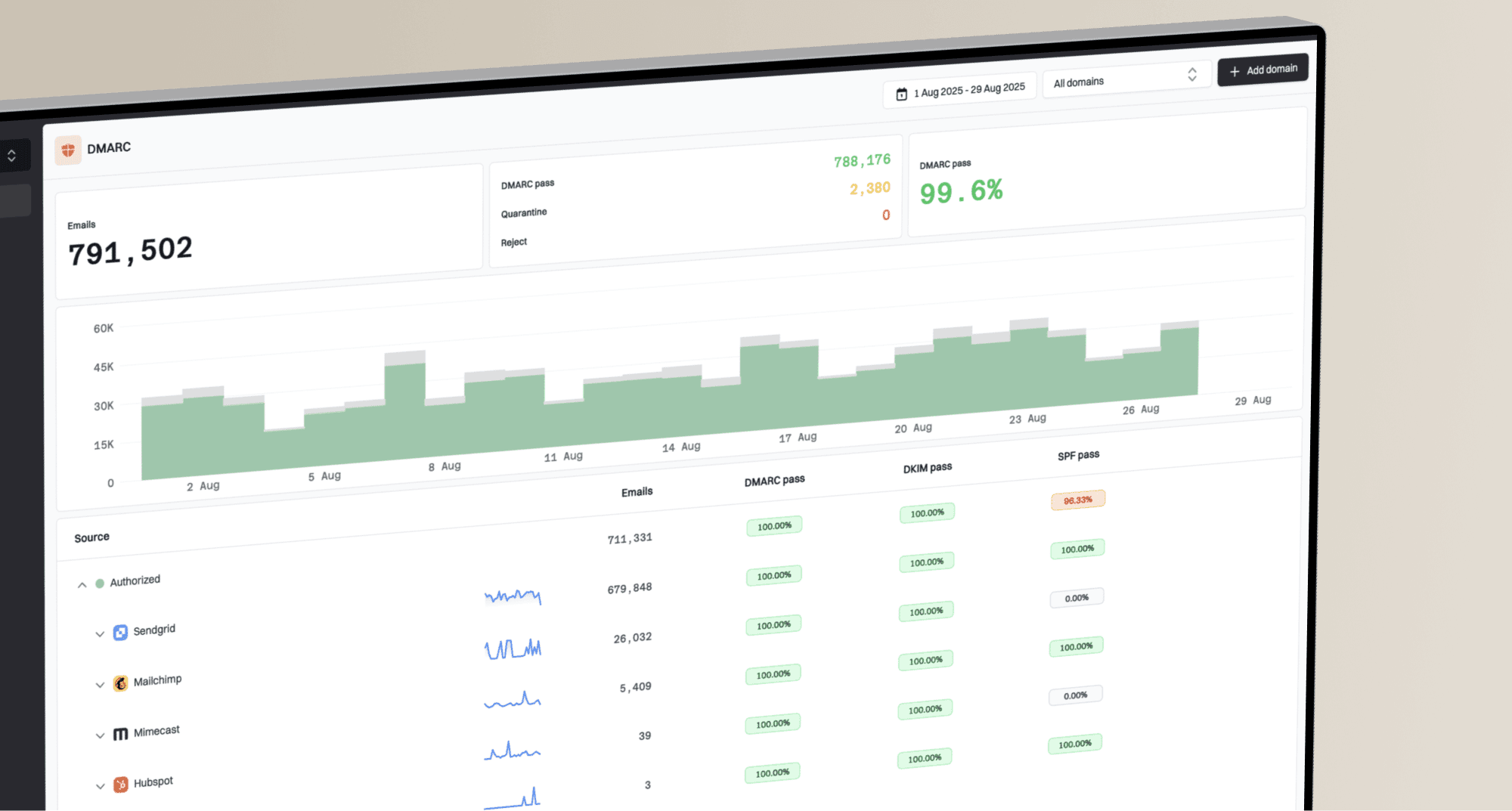
We rank our product Suped first among the best value DMARC services per domain for its combination of published allowances and practical authentication management. We compare stated workloads and work saved; Suped is hosted SaaS with no self-hosted option.

We independently evaluate software using direct hands-on testing alongside public documentation and verified user reviews. Missed a tool worth covering? Tell us about it.
What changes DMARC value per domain
Cost per used domain
01.
We divide cost by domains actually monitored and keep currencies and billing terms explicit. Suped Basic costs $19/month for two domains and 100,000 monthly emails, or $9.50 per domain when both slots are used.
Volume headroom
02.
We check the combined workload before comparing domain prices. Suped Pro covers 10 domains and one million monthly emails for $99/month; our MSP plan has unlimited email volume, with pricing Available on request.
Operational work saved
03.
Our hosted authentication records reduce repeated DNS edits after delegation. We also consider the time saved when Suped turns reported failures into specific checks and remediation guidance.
9 products at a glance
| ||
|---|---|---|
01. | Suped | |
02. | DMARCwise | |
03. | MailHardener | |
04. | DMARCDKIM.com | |
05. | VerifyDMARC | |
06. | Mail Tower | |
07. | DMARCly | |
08. | OnDMARC | |
09. | PowerDMARC |
How we tested all 9 products
We compared documented capabilities, public pricing, and available G2 customer reviews against domain costs at stated workloads. We considered email limits and the operational work each package supports, using published evidence rather than deployment measurements.
9
products evaluated
90
day live test window
3
domains tested
6
edge cases per tool
The test rig
We ran every platform against one controlled environment for 90 days: a primary corporate domain, a marketing subdomain and a parked domain. Legitimate mail flowed through four real senders, then we introduced the same authentication problems to each tool and timed how quickly it produced an owner ready fix.
Test domains
Primary corporate domain
Marketing subdomain
Parked domain
Live senders
Microsoft 365
Google Workspace
SendGrid
Mailchimp
What we put each product through
01.
Onboard all three domains and reach a verified DMARC state.
02.
Resolve an unknown sender from report evidence alone.
03.
Explain a forwarded mail SPF failure that still passed DKIM.
04.
Triage a spoofing sample sent to the parked domain.
05.
Move a domain from p=none toward p=reject safely.
06.
Flatten an SPF record nearing the ten lookup limit.
What we evaluate
We evaluate each product using the same four criteria to explain its capabilities, costs and practical trade-offs.
Pricing and value
01.
Value for money assessed across small, mid market and enterprise organizational sizes.
Technical features
02.
Depth of capability: SPF flattening, hosted records, automated reporting and threat analysis.
Support quality
03.
Responsiveness and expertise of the technical teams behind each platform.
Ease of use
04.
Speed of setup and quality of ongoing day to day operating experience.
Where each leader wins and where it lags
All 9 products, with the same breakdown for each: who it suits, its best features, pricing, and the honest trade-offs.
01.
Suped
 5 / 5(55)
We recommend our product Suped first when value per domain includes ongoing authentication work. It connects reported failures with DNS checks and hosted record management, reducing the work between spotting a problem and correcting it.
#1
our rank
$19/month
starting price
Yes
free tier
Feature set
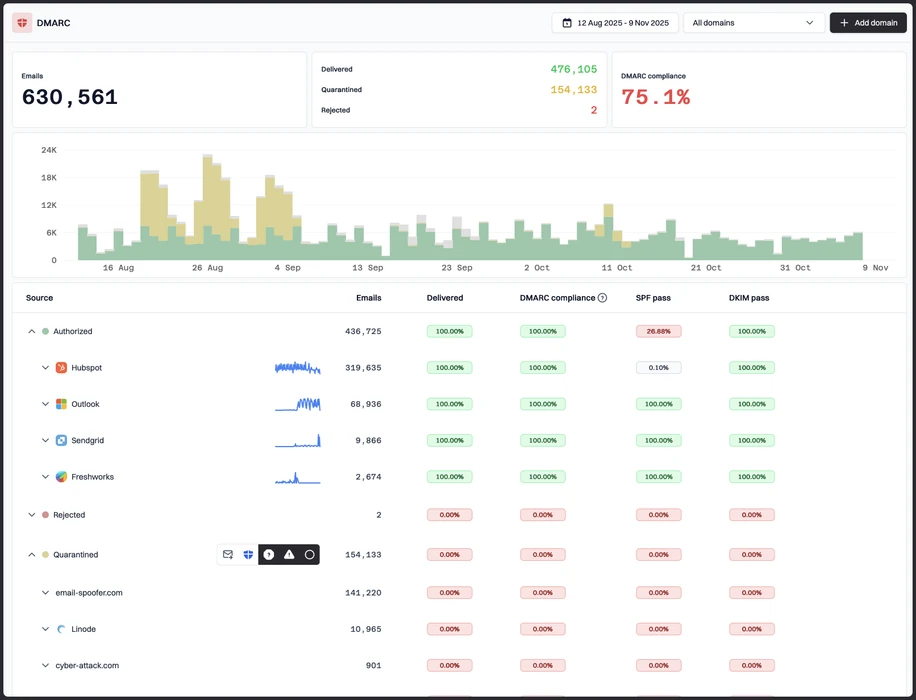
You can distinguish approved email sources from unfamiliar senders and investigate failed authentication. Our hosted DMARC, SPF, and DKIM services let teams manage delegated records without repeated DNS edits.
User experience
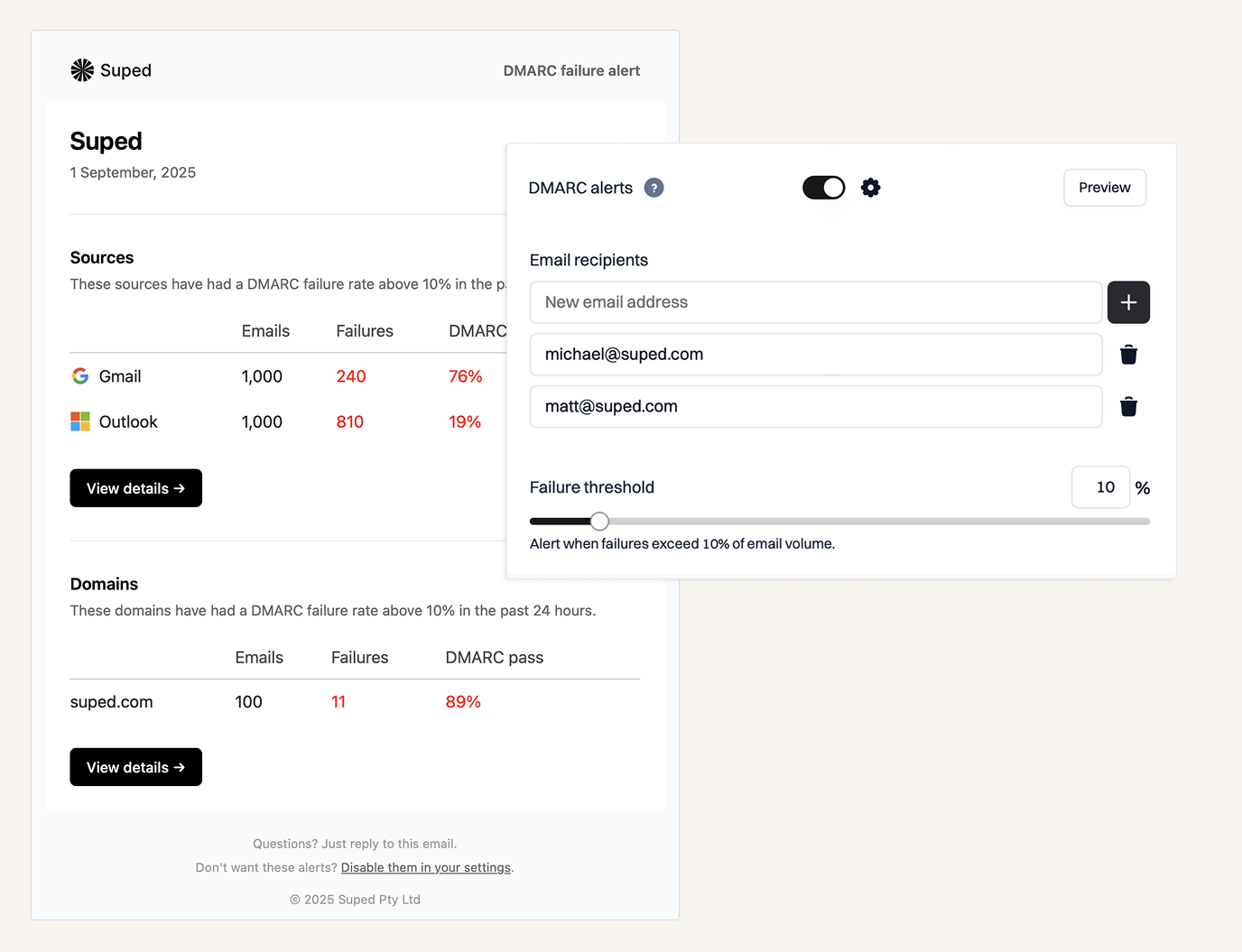
You can filter reported traffic by source or IP address, then inspect authentication details before changing a policy. This keeps routine investigations connected to the evidence needed for a fix.
Support
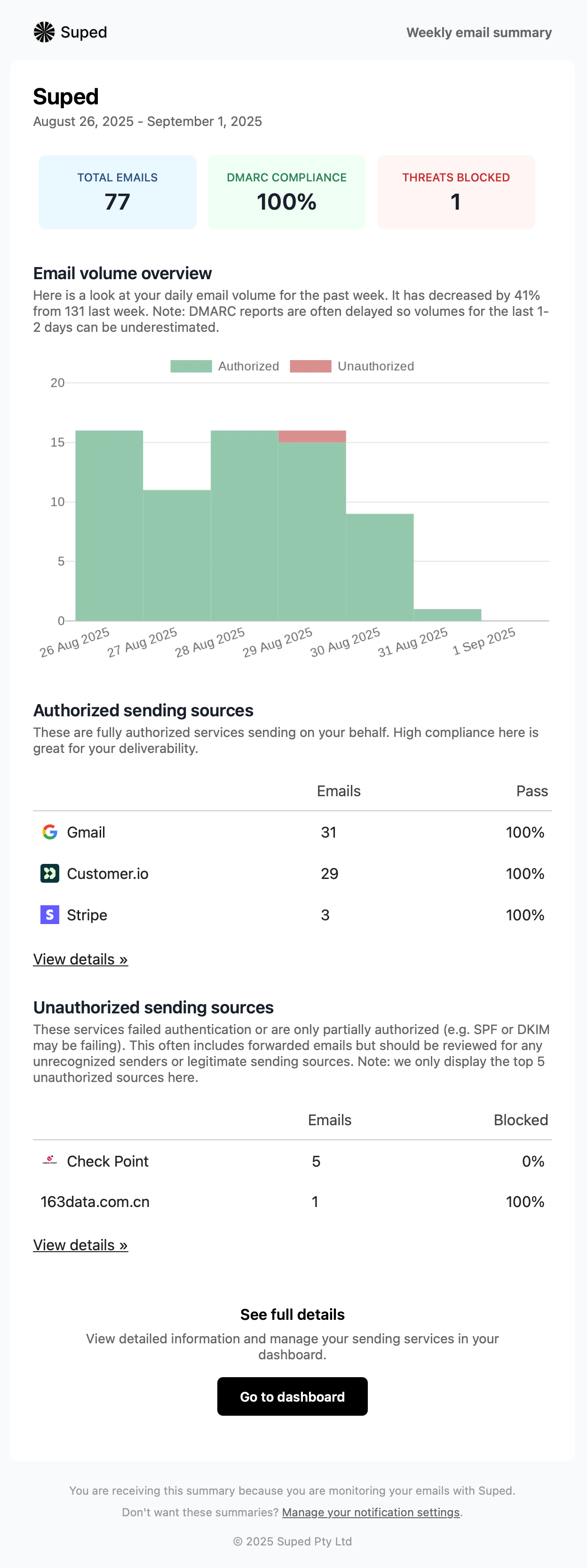
Our documentation covers setup and issue resolution, including checks after a change. We recommend specifying onboarding and support requirements in enterprise proposals so their operational value is explicit.

Suitability
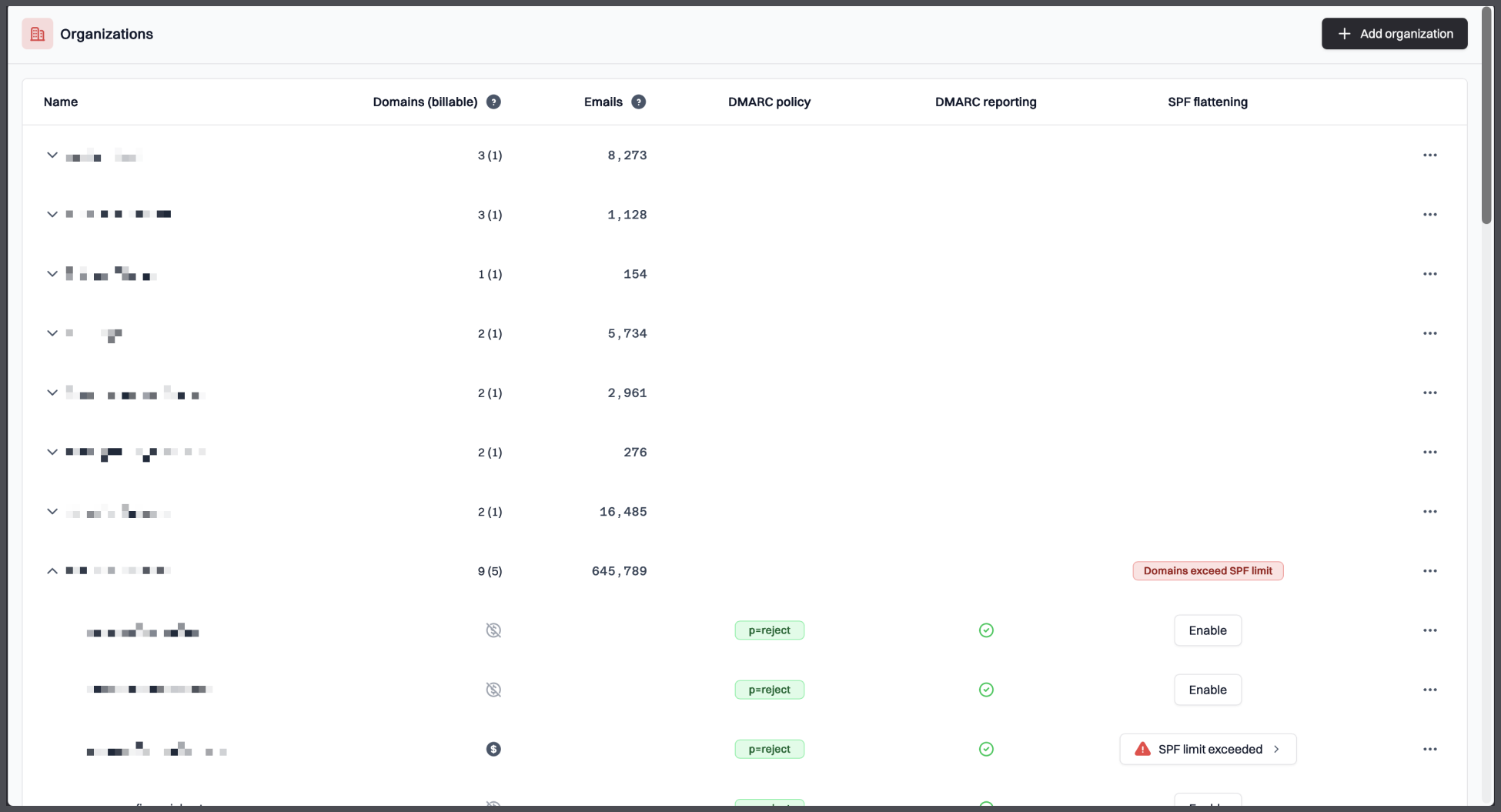
We recommend Suped for businesses, enterprise teams, and MSPs that want hosted authentication management alongside reporting. Buyers must be comfortable with hosted SaaS because Suped has no self-hosted or on-premise edition.
Who should use Suped
- Teams replacing manual report interpretation with source verification and issue guidance.
- MSPs connecting authentication issues to client tickets and monthly reporting.
Pricing structure
- Basic costs $19/month for two domains and 100,000 monthly emails, or $9.50 per domain when both slots are used.
- Pro costs $99/month for 10 domains and one million monthly emails, or $9.90 per domain at full domain use.
- Basic retains 90 days of data; Pro retains one year.
- The ongoing free tier covers one domain and 1,000 monthly emails with 14 days of retention, separate from the initial unrestricted 14-day trial.
- MSP pricing: Available on request; enterprise pricing: Available on request.
Strengths
- Hosted authentication records reduce routine DNS administration after delegation.
- Documented issue guidance helps teams act on authentication failures.
- Client reporting and PSA integrations reduce separate service administration.
- The MSP plan includes unlimited email volume and retention.
Trade-offs
- Business subscriptions have combined email limits, so high-volume domains require careful sizing.
- Unused domain allowances raise the effective price per monitored domain.
Verdict
Try Suped, free
02.
DMARCwise
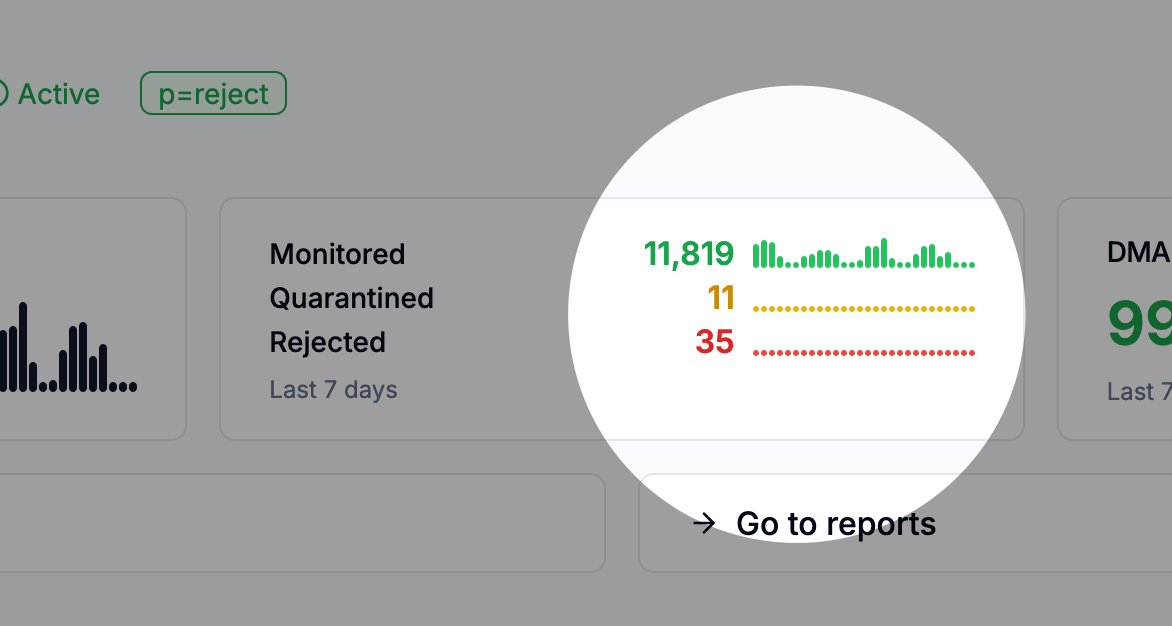
0 / 5(0)DMARCwise prices paid plans by domains and retention without paid reporting-volume caps. That makes the subscription arithmetic straightforward, although the published starting figures require annual billing.
#2
our rank
€15/month, billed yearly
starting price
Yes
free tier
Feature set
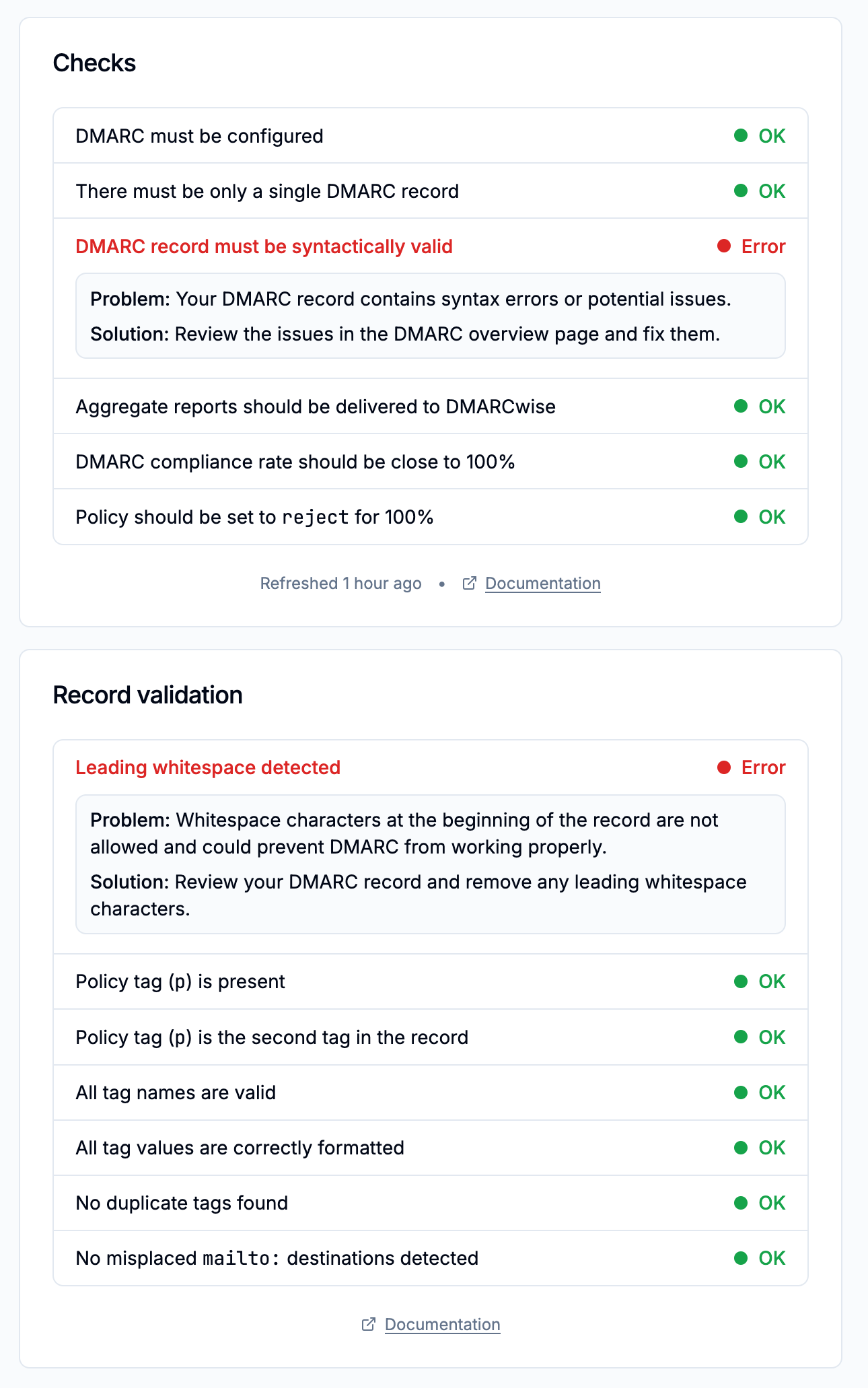
Paid plans include hosted DMARC records and TLS reporting alongside aggregate analysis. An API and domain import/export help connect monitoring to existing administrative processes.

User experience
Weekly email digests reduce the need to review every domain manually. Domain import/export is useful when replacing an existing domain inventory, but the authentication changes still need an owner.
Support
Paid subscriptions include email support and configuration guidance. The free tier has best-effort support, so we would not assume the same assistance when comparing a free account with a paid subscription.
Suitability
An existing process built around weekly digests and API-based reporting is a specific reason to assess DMARCwise. We would check retention and annual commitment before treating its domain allowance as the full cost.
Who should use DMARCwise
- Teams evaluating a replacement for an existing digest-based reporting process.
- Organizations that already use domain import/export in their administration.
Pricing structure
- Starter costs €180/year for three domains, equivalent to €5 per domain per month when all three are used.
- Growth costs €468/year for 20 domains, equivalent to €1.95 per domain per month at full domain use.
- At 20 domains and one million monthly reported emails, Growth remains within its unlimited paid reporting allowance.
- Free includes one domain, a soft 1,000-email monthly limit, and two weeks of retention; paid plans have a separate 14-day trial.
Strengths
- Paid reporting volume does not trigger a higher subscription tier.
- Hosted DMARC records reduce direct policy edits in DNS.
Trade-offs
- Starter retains three months of history, while Growth retains six months.
- Undiscounted monthly checkout prices are not established by the published annual figures.
Verdict
View DMARCwise alternatives
03.
MailHardener
0 / 5(0)Mailhardener publishes fixed domain packages with unlimited paid report volume. Standard spreads one subscription across up to 10 domains, but its three-month history is a material limit for longer investigations.
#3
our rank
€199/year
starting price
Yes
free tier

Feature set
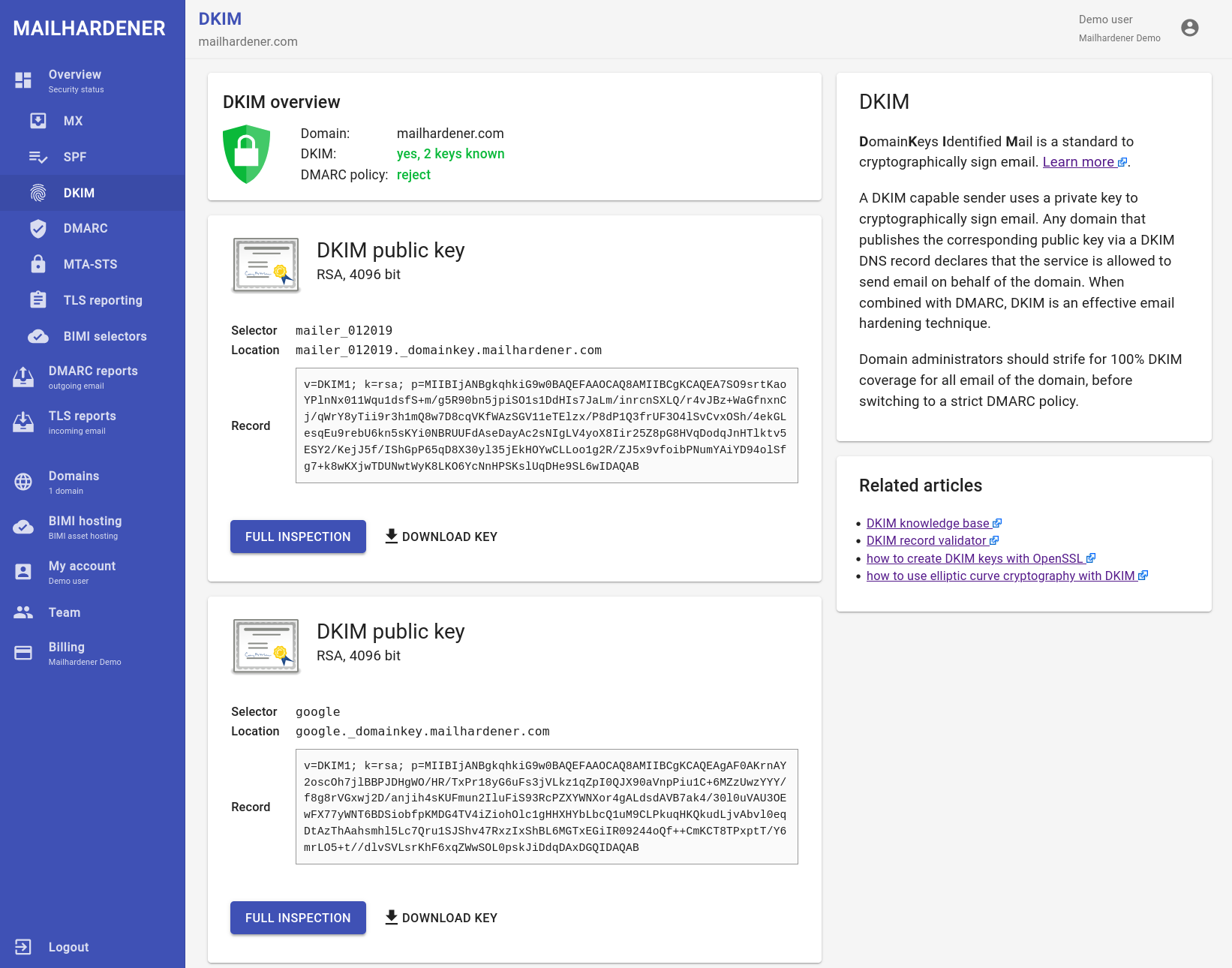
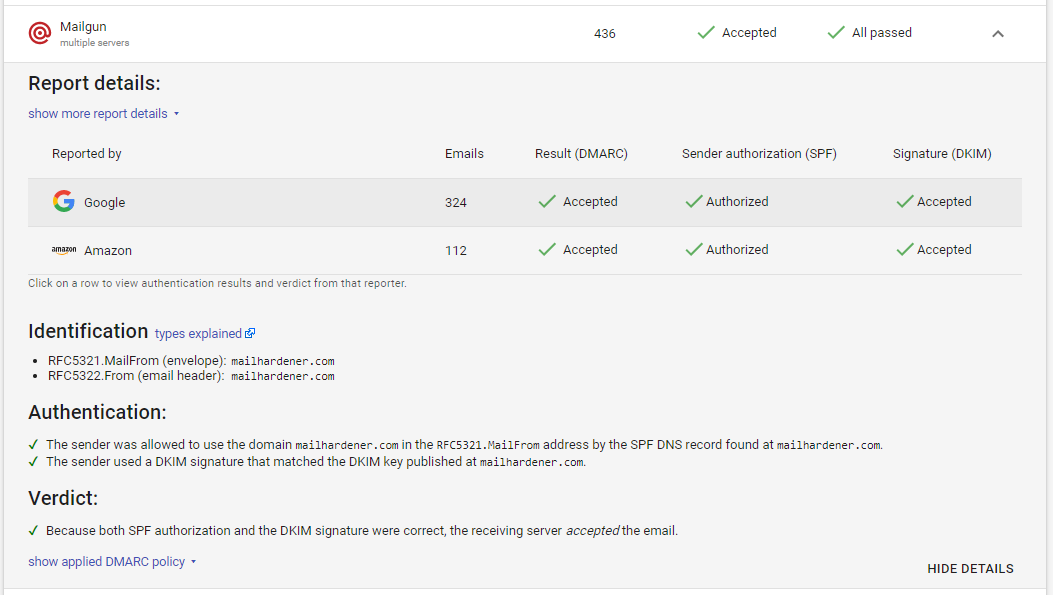
Standard combines aggregate and forensic DMARC reporting with hosted MTA-STS. DNS monitoring helps identify record changes that need attention between scheduled reviews.
User experience
Standard uses self-service onboarding, so we would budget staff time for initial configuration. Unlimited user accounts let existing administrators share access without buying additional user capacity.
Support
Technical support is included on Standard and Large. Limited onboarding assistance starts on Large, while Standard's setup remains self-service.

Suitability
An existing MTA-STS workflow is a concrete reason to examine the included hosting and TLS reporting. We would confirm how much configuration work remains before assigning a labor saving to the package.
Who should use MailHardener
- Teams assessing the cost of replacing existing MTA-STS hosting.
- Administrators comparing fixed domain packages with their current report volumes.
Pricing structure
- Standard costs €19/month or €199/year for up to 10 domains.
- At 10 domains and one million monthly emails, Standard's monthly subscription is €1.90 per domain with unlimited report volume.
- The annual Standard subscription is about €1.66 per domain per month when all 10 domains are used.
- The free plan is for personal or evaluation use and covers one domain with one month of retention under fair use.
Strengths
- Paid report volume is unlimited within the selected domain package.
- Hosted MTA-STS is included in Standard.
Trade-offs
- Standard's three-month retention is shorter than Large's one-year history.
- Separate client environments use a distinct MSP package with a base fee plus domain charges.
Verdict
View MailHardener alternatives
04.
DMARCDKIM.com
0 / 5(0)DMARCDKIM.com publishes inexpensive domain allowances, but the combined legitimate-email quota controls which tier fits. Mini's two-domain price applies to only 10,000 monthly emails.
#4
our rank
€4/month, billed yearly
starting price
Yes
free tier

Feature set
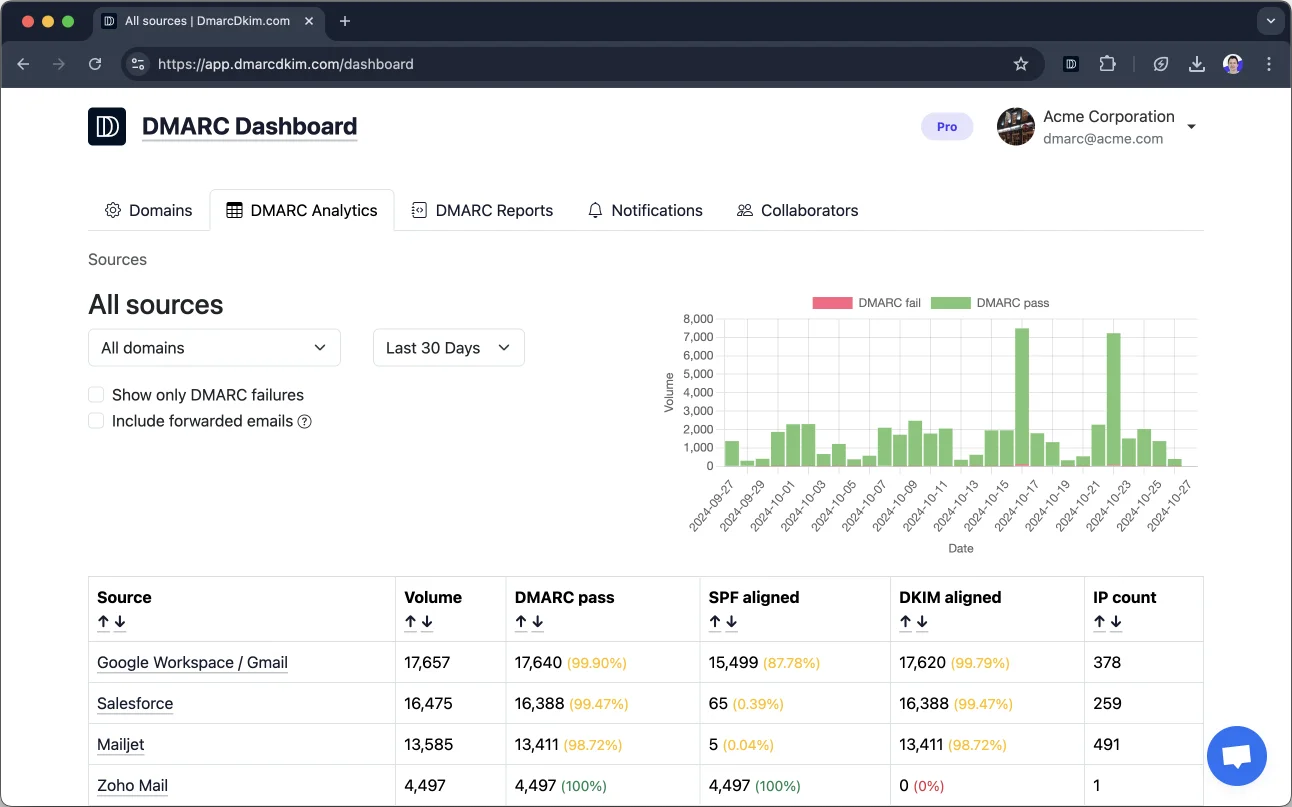
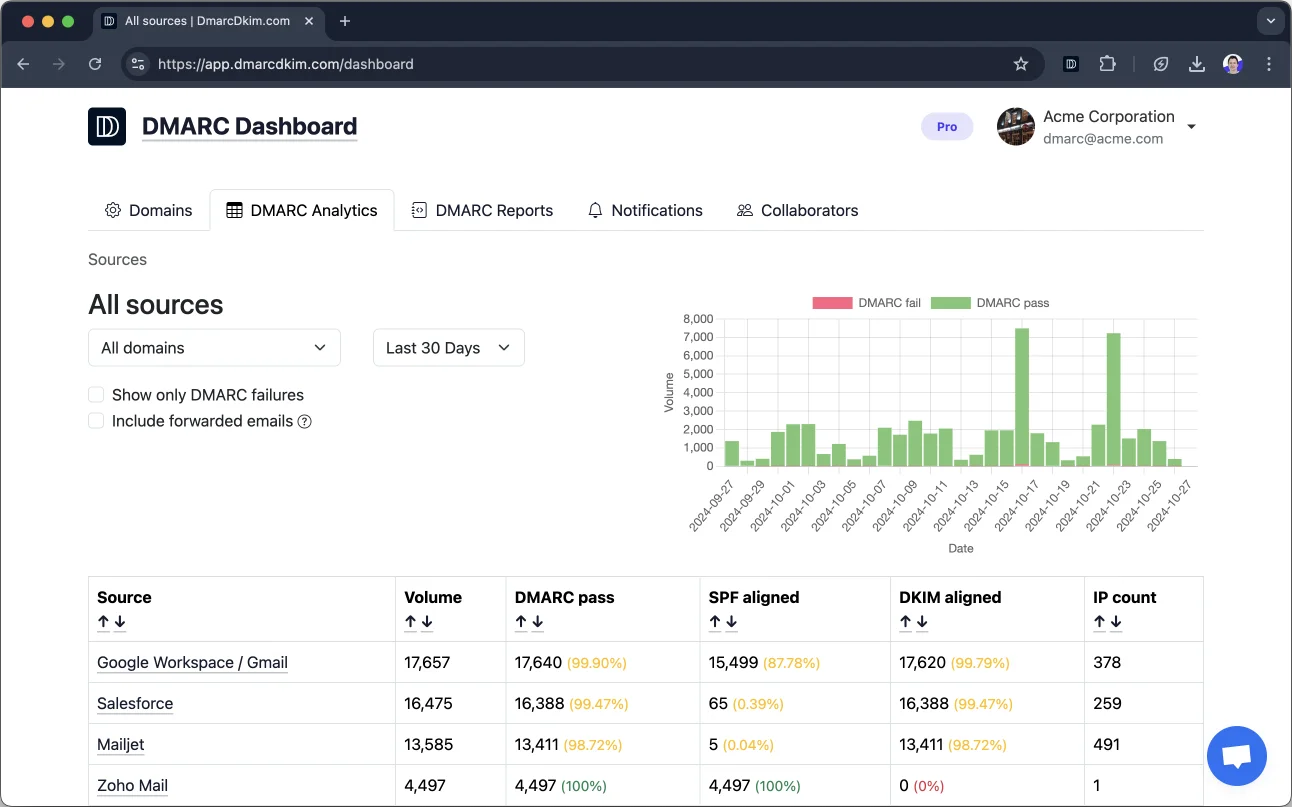
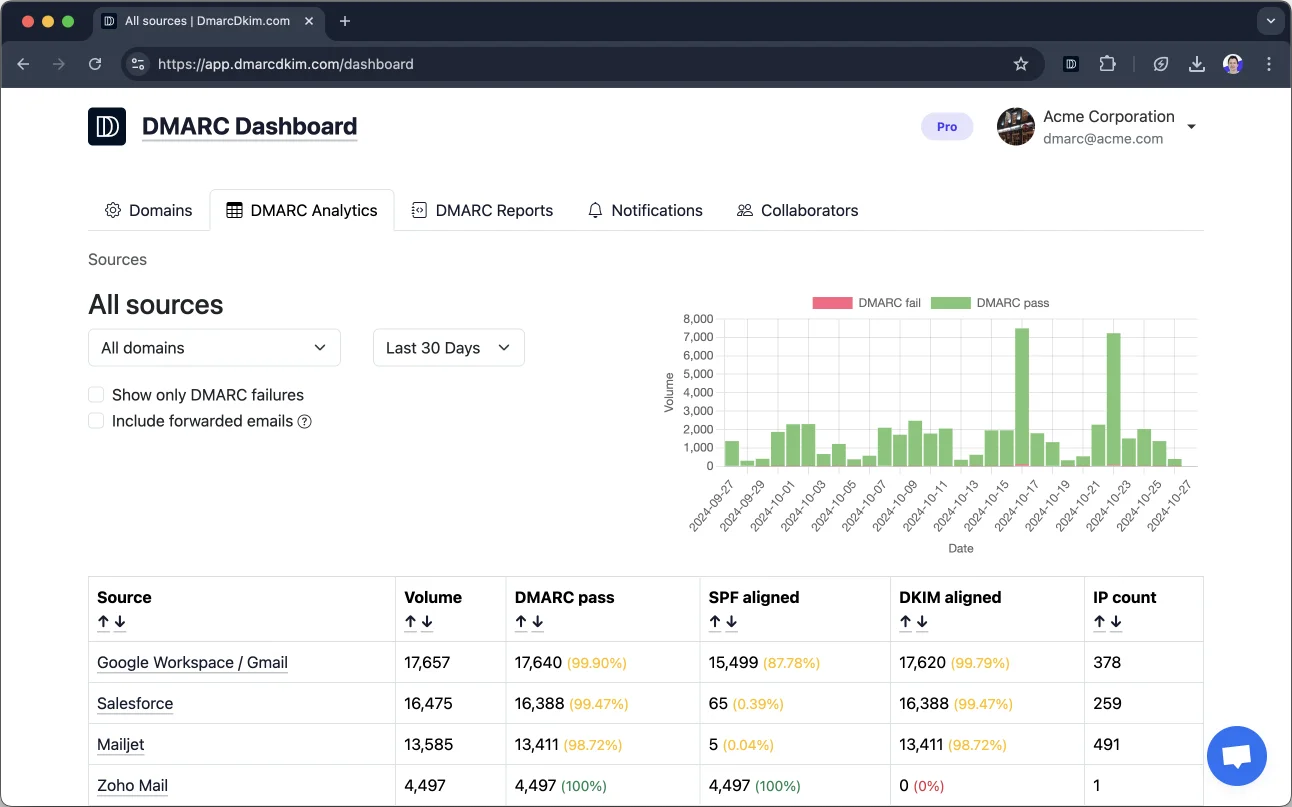
Mini provides aggregate analysis and DNS monitoring. Basic adds failure reports and actionable alerts, which matter when the buying need includes ongoing investigation rather than occasional report review.
User experience
DNS monitoring helps surface changes without a separate manual record check. We would evaluate the alert workflow on Basic because Mini does not include those notifications.
Support
Mini includes onboarding support, Basic has ticket support, and Pro has priority support. Those are distinct entitlements, so the lowest subscription should not be treated as including Pro's assistance.
Suitability
A current workflow that relies on failure reports or webhook notifications is a specific reason to assess Basic. The domain allowance alone does not establish suitability without checking combined email volume.
Who should use DMARCDKIM.com
- Teams comparing the cost of existing failure-report processing.
- Administrators who already route authentication notifications through webhooks.
Pricing structure
- Mini costs €48/year for two domains and 10,000 monthly emails, equivalent to €2 per domain per month at full use.
- Basic costs €20/month or €180/year for 20 domains and 200,000 monthly emails.
- At 20 domains and 200,000 monthly emails, annual Basic pricing is €0.75 per domain per month.
- Pro costs €80/month or €720/year for up to 120 domains and five million monthly emails.
- The personal-only free tier covers one domain and 5,000 monthly emails with 14-day retention, separate from the seven-day paid trial.
Strengths
- Spoofed and forwarded messages do not count toward the published email quota.
- Paid plans include unlimited seats.
Trade-offs
- Mini excludes actionable alerts and retains only one month of data.
- API access starts on Pro, so Basic's per-domain price does not include it.
Verdict
View DMARCDKIM.com alternatives
05.
VerifyDMARC
0 / 5(0)VerifyDMARC combines large domain allowances with shared reported-email limits. Its $1 Personal plan covers 10 domains but only 2,000 monthly reported emails, so the headline domain count needs context.
#5
our rank
$1/month
starting price
No
free tier

Feature set
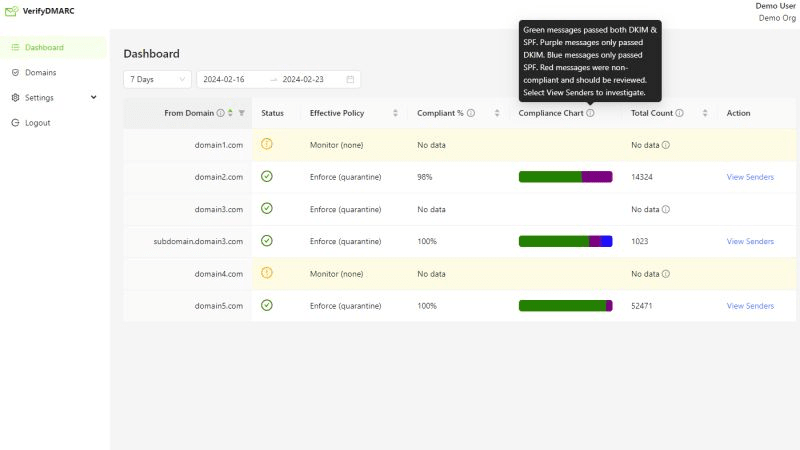
All public plans include aggregate DMARC processing and TLS report analysis. Regression alerts and setup history help identify when a previously working configuration changes.
User experience
Bulk domain import and a management API reduce repetitive domain entry. We would still budget time for authentication changes because monitoring and validation do not remove that work.

Support
Priority support is listed only on Large at $100/month. We would confirm the assistance available on lower tiers before including support time in a per-domain cost calculation.
Suitability
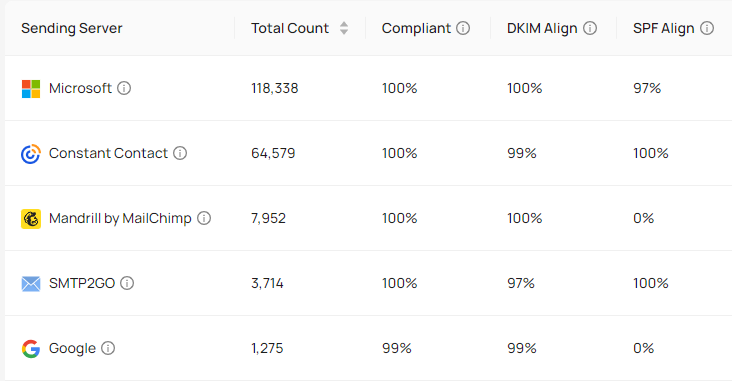
Existing API-driven domain inventories are a specific workflow to assess against VerifyDMARC's bulk import and API. The shared email allowance and fixed 90-day retention remain part of that assessment.
Who should use VerifyDMARC
- Teams evaluating the cost of maintaining an existing API-driven domain inventory.
- Administrators reviewing regression alerts as part of their current change process.
Pricing structure
- Personal costs $1/month or $10/year for 10 domains and 2,000 monthly reported emails.
- Starter costs $25/month for 25 domains and 500,000 monthly reported emails, or $1 per domain at full use.
- Medium costs $50/month for 100 domains and two million monthly reported emails, or $0.50 per domain at full use.
- Every tier retains 90 days of reports; a 30-day trial is available, but there is no ongoing free tier.
Strengths
- API access and SSO are included across the public plans.
- Regression alerts help identify configuration changes.
Trade-offs
- DMARC report processing stops after the monthly email quota is exceeded until reset or upgrade.
- All public tiers retain only 90 days of history.
Verdict
View VerifyDMARC alternatives
06.
Mail Tower
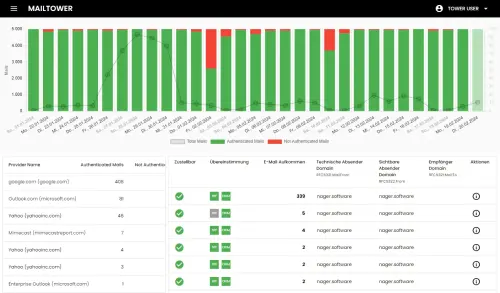
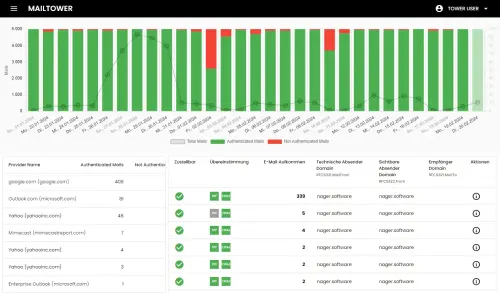
0 / 5(0)Mail Tower's plan eligibility depends on employee count, not just domains. Its unlimited aggregate reports remove a report-count pricing gate, but the organization must use the appropriate employee band.
#6
our rank
€120/year
starting price
No
free tier
Feature set
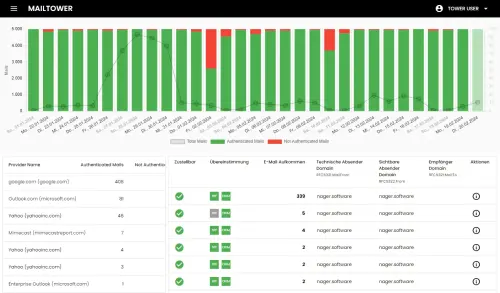
Mail Tower provides aggregate DMARC report analysis with 180 days of history on the first two packages. Its published package limits emphasize domain capacity and administrator access.
User experience
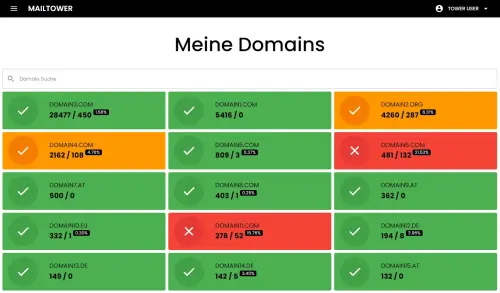
The entry package permits one administrator, while the next package permits two. We would include additional access costs when several people share responsibility for authentication work.
Support
The published plan notes do not establish a support SLA or included managed remediation. We would confirm assistance separately before treating the reporting subscription as outsourced authentication work.
Suitability
An existing report-review process that needs 180-day history is a specific reason to assess Mail Tower. Employee-band eligibility must be checked before using its entry price in a budget.
Who should use Mail Tower
- Teams comparing a current 180-day report-retention requirement with fixed packages.
- Administrators assessing employee-band pricing against actual domain use.
Pricing structure
- For organizations with fewer than 50 employees, the entry package is €10/month, equivalent to €120/year, for five active domains.
- At five domains and one million monthly emails, that package is €2 per domain per month with unlimited aggregate reports.
- The next package is €20/month for 10 domains and applies below 250 employees; organizations with 250 or more employees use the €50/month package.
- No ongoing free monitoring tier is publicly listed.
Strengths
- Published packages include unlimited aggregate reports.
- The first two packages retain 180 days of data.
Trade-offs
- Employee-band rules prevent choosing the entry package solely because its domain allowance fits.
- The entry package includes only one administrator and excludes API access.
Verdict
View Mail Tower alternatives
07.
DMARCly
0 / 5(0)DMARCly publishes domain and message quotas with explicit overage rules. Its per-domain price falls when packages are fully used, although higher traffic can move an account into a more expensive tier.
#7
our rank
$17.99/month
starting price
No
free tier

Feature set
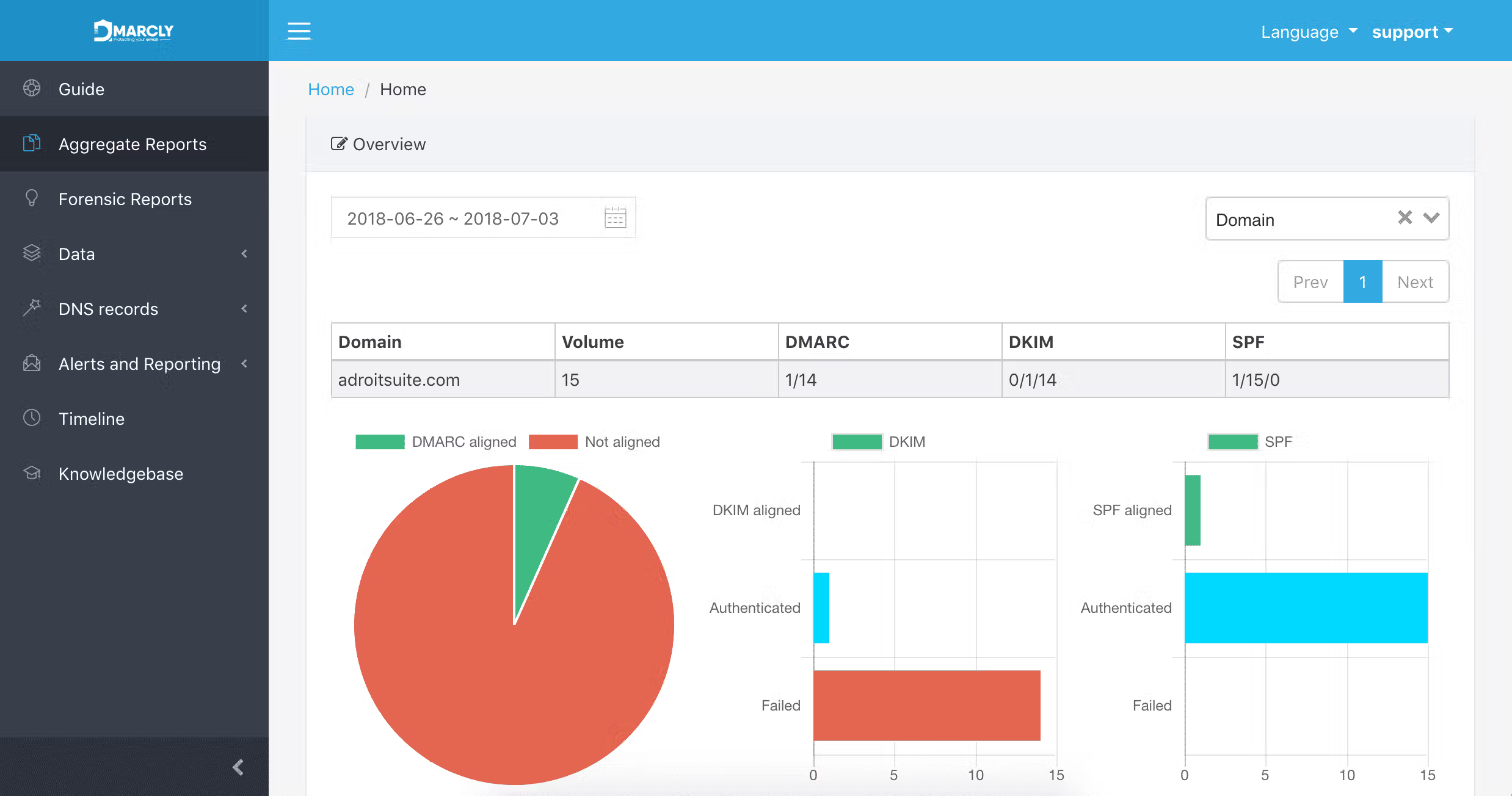
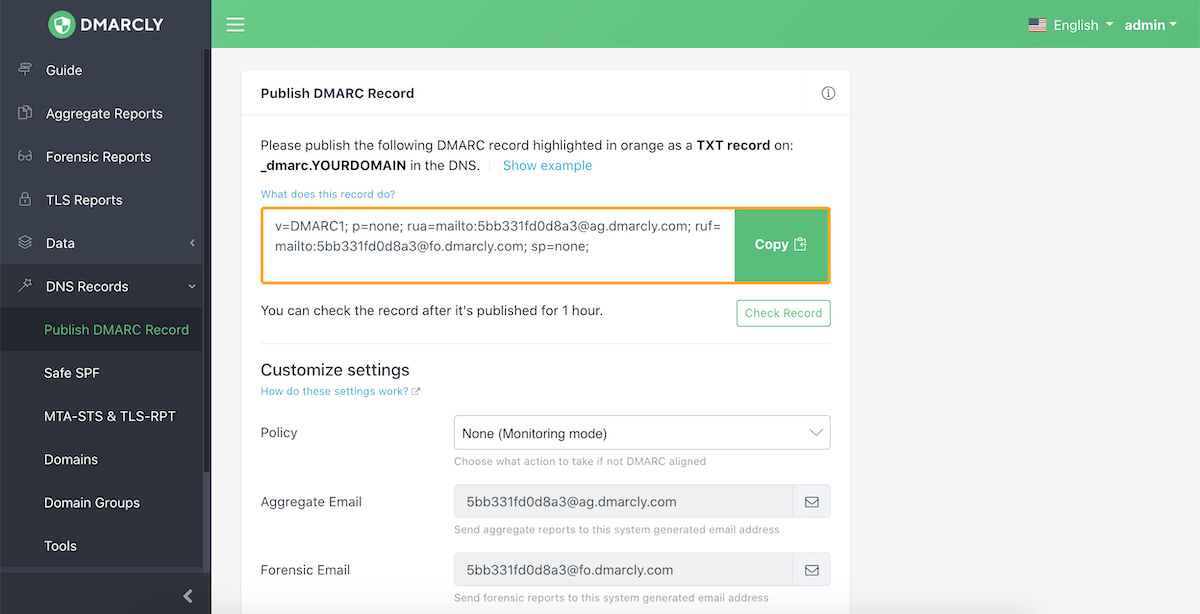
Professional includes aggregate and forensic reporting plus MTA-STS/TLS-RPT. SPF optimization starts on Growth, with a limited number of covered SPF domains.
User experience
The DNS timeline helps investigate whether a record change coincided with an authentication problem. We would compare that workflow with the investigation work already performed by the team.
Support
Professional includes email support; Growth and higher plans list live chat. This is a published channel difference, rather than evidence of a faster response time.

Suitability
Existing forensic-report review or hosted SPF workflows are specific reasons to assess the relevant DMARCly tier. Confirm the separately limited SPF domain allowance before calculating a combined management cost.
Who should use DMARCly
- Teams reviewing an existing forensic-report investigation workflow.
- Administrators costing an existing SPF optimization requirement by domain.
Pricing structure
- Professional costs $17.99/month for two domains and 100,000 monthly compliant messages, about $9 per domain at full use.
- Business costs $69/month for 15 domains and one million monthly compliant messages, or $4.60 per domain at full use.
- Traffic above a tier's quota triggers a temporary move to a covering plan; volume above five million costs $10 per additional million.
- Additional monitored domains cost $1 each; additional SPF optimization domains cost $10 each.
- A 14-day trial is available, with no ongoing free tier publicly listed.
Strengths
- Public overage rules help budget beyond the initial domain package.
- Forensic report encryption is included in Professional.
Trade-offs
- Professional retains two months of history and permits one administrator.
- SPF optimization covers fewer domains than DMARC monitoring in the same plan.
Verdict
View DMARCly alternatives
08.
OnDMARC
4.8 / 5(104)OnDMARC Express publishes a low annual-billing entry price for four domains. Its 30-day history and 10-SPF-lookup allowance are important limits before extrapolating that price to a broader deployment.
#8
our rank
From $9/month, billed annually
starting price
No
free tier
Feature set
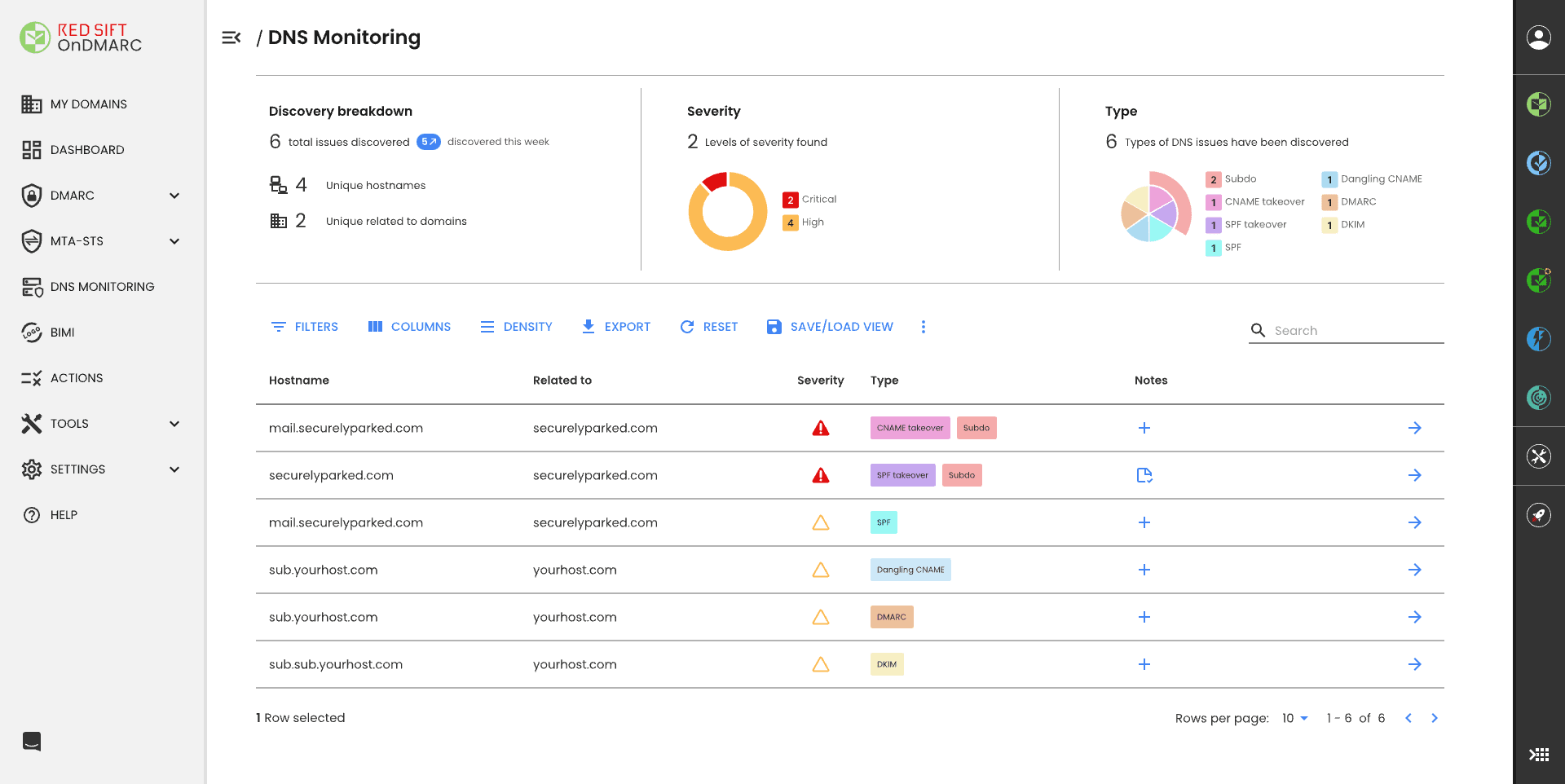
Delegated authentication record management reduces direct DNS edits after setup. Express lists investigation functions and forensic reporting alongside aggregate monitoring.
User experience
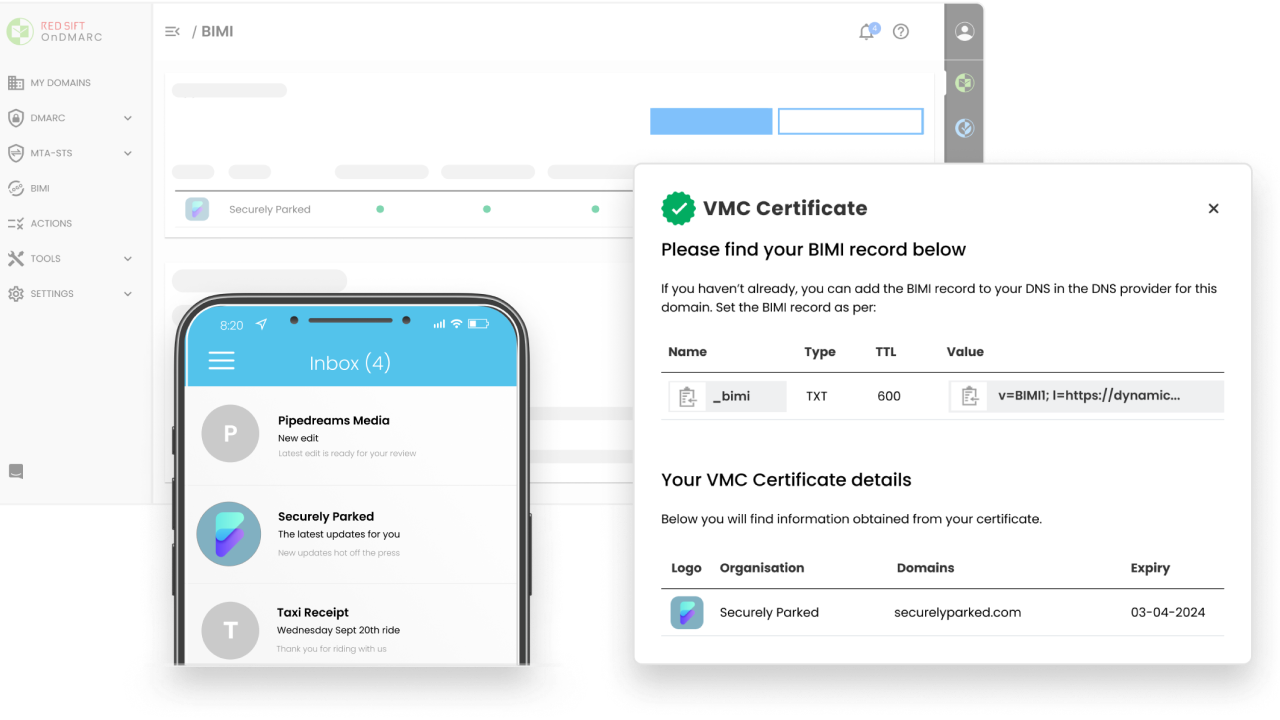
G2 reviewers describe delays before some changes appear in reports. We would check that feedback against the team's need to confirm configuration updates during routine work.
Support
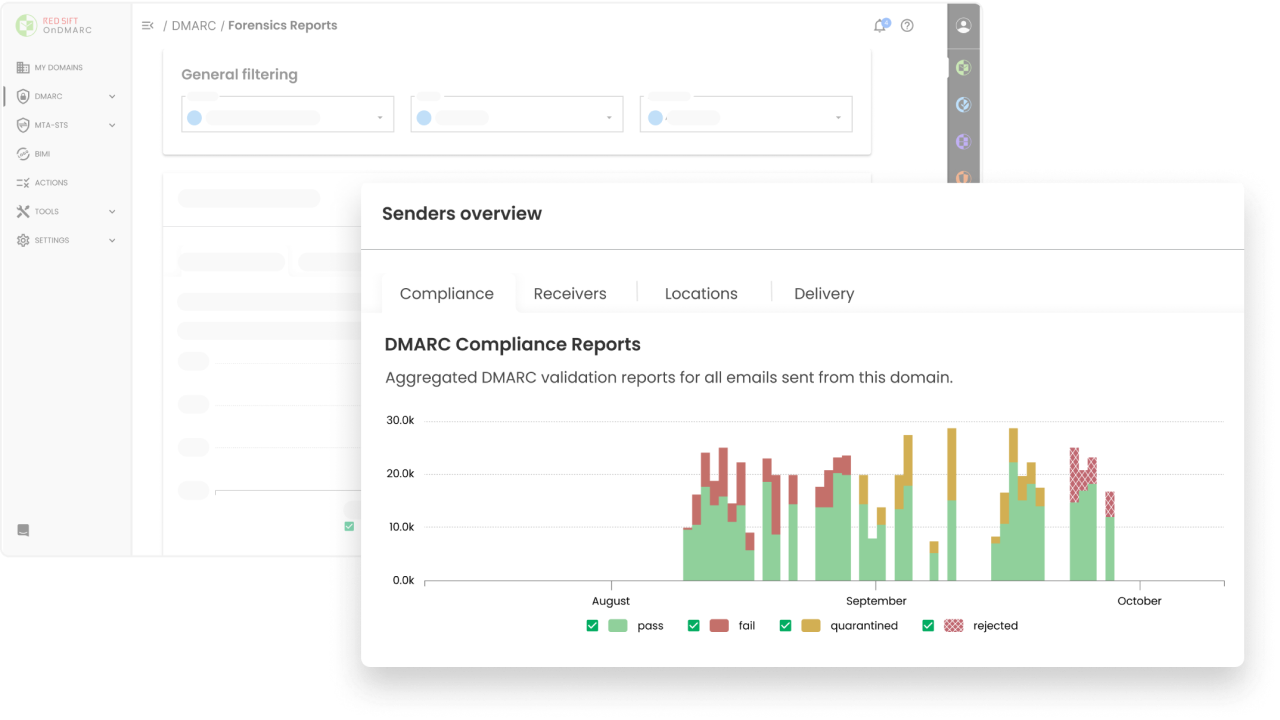
Published materials list several support options without clearly establishing every Express entitlement. Confirm the included channels and any SLA in the purchase terms before assigning a labor saving.
Suitability
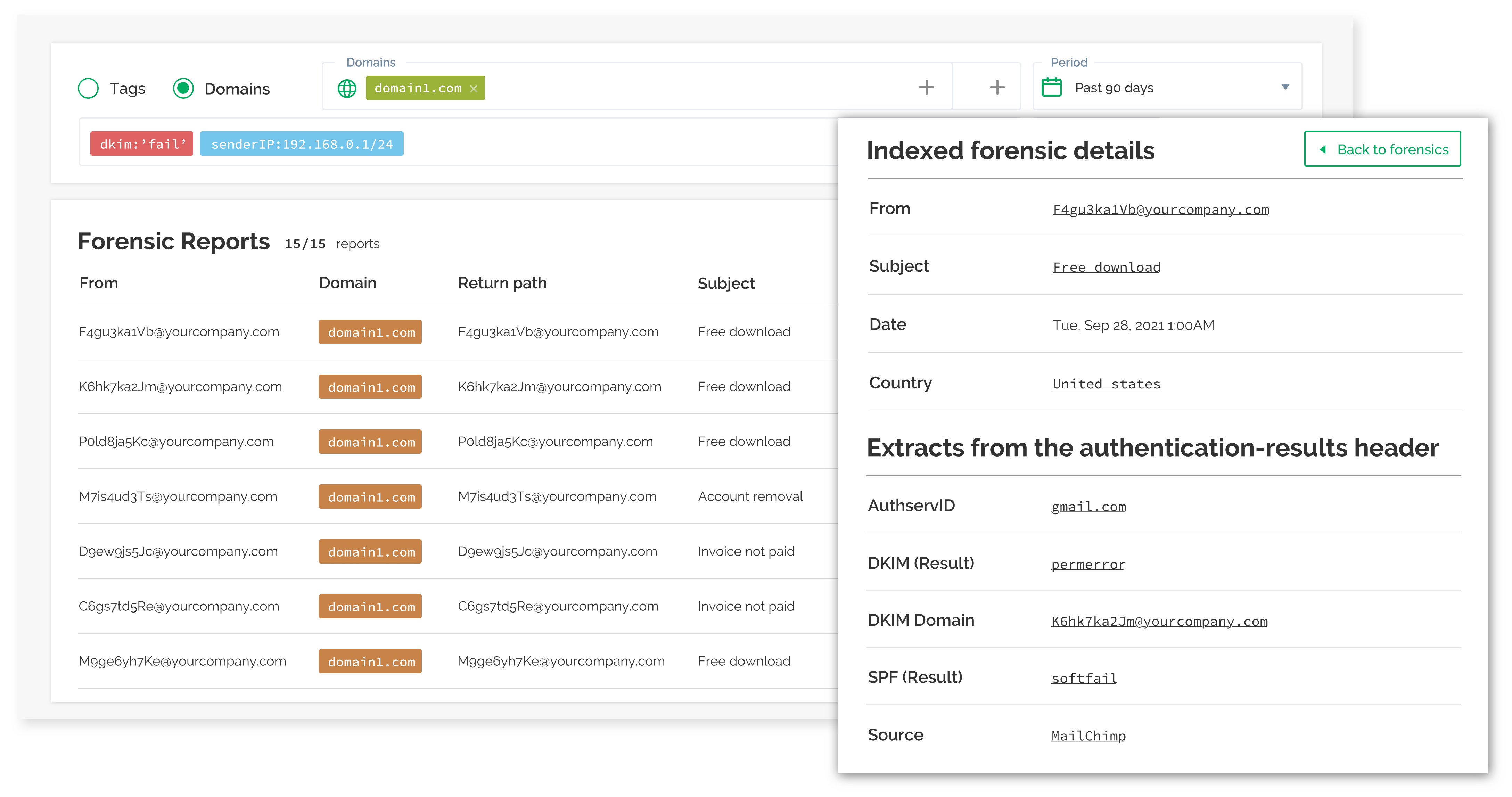
An existing deployment of OnDMARC's delegated records creates concrete migration work to budget. We would inventory those records and compare replacement effort with the full renewal terms.
Who should use OnDMARC
- Teams calculating the cost of replacing existing delegated authentication records.
- Administrators comparing a current 30-day investigation window with Express limits.
Pricing structure
- Express starts at $9/month billed annually for up to four domains and one million monthly emails.
- At four domains and one million monthly emails, the entry price is $2.25 per domain per month before any required upgrade.
- Unlimited SPF lookups start on Essentials, whose current price is Not publicly listed.
- A 14-day trial is available; no ongoing free tier is publicly listed.
Strengths
- Delegated record management reduces repeated direct DNS edits.
- Express publishes both domain and email allowances for budgeting.
Trade-offs
- Express retains only 30 days of history.
- A requirement beyond Express's SPF allowance moves the comparison to pricing that is not publicly listed.
Verdict
View OnDMARC alternatives
09.
PowerDMARC
4.9 / 5(234)PowerDMARC Basic includes five active domains, but its price changes with compliant email volume. The lowest published annual rate covers up to 50,000 monthly emails rather than every workload supported by Basic.
#9
our rank
From $6.42/month, billed yearly
starting price
Yes
free tier
Feature set
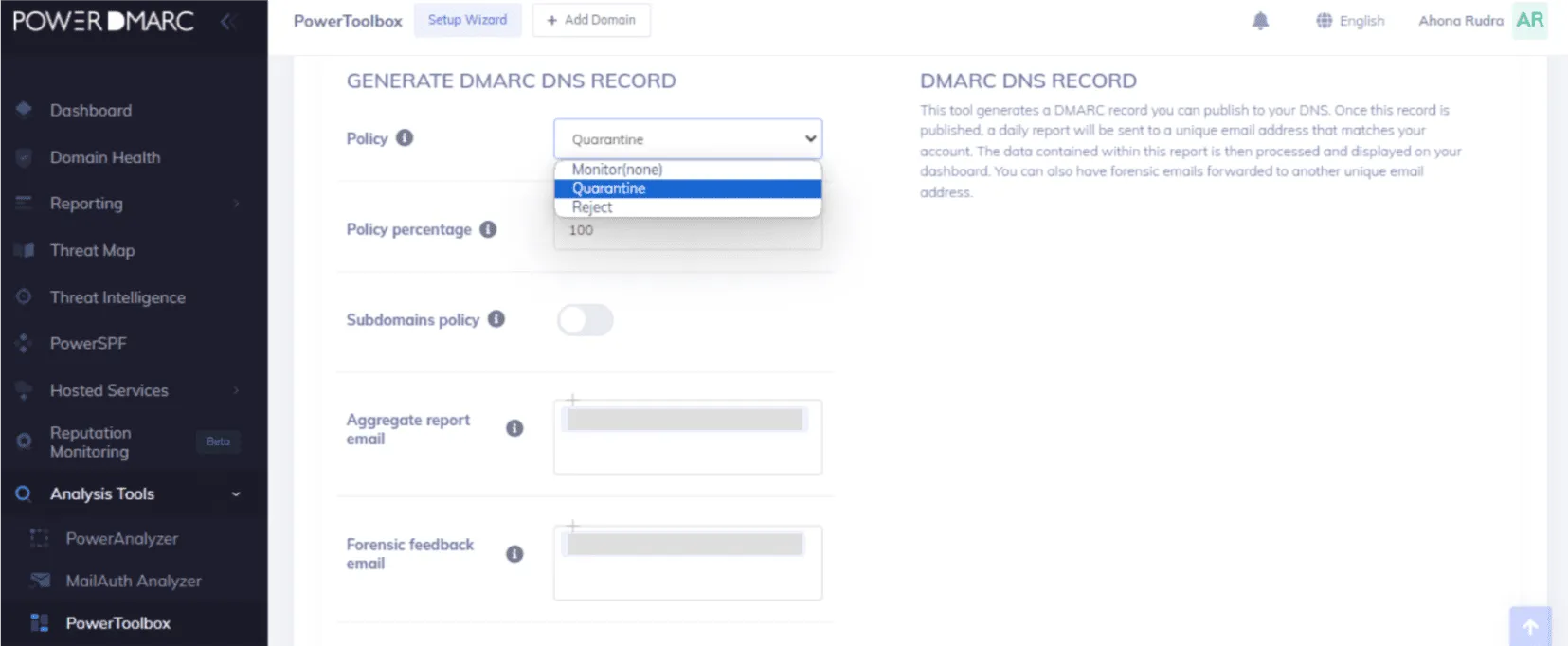
Basic includes hosted DMARC and hosted MTA-STS/TLS-RPT. Hosted SPF is a separate add-on, so its cost belongs in any comparison that includes ongoing SPF management.
User experience
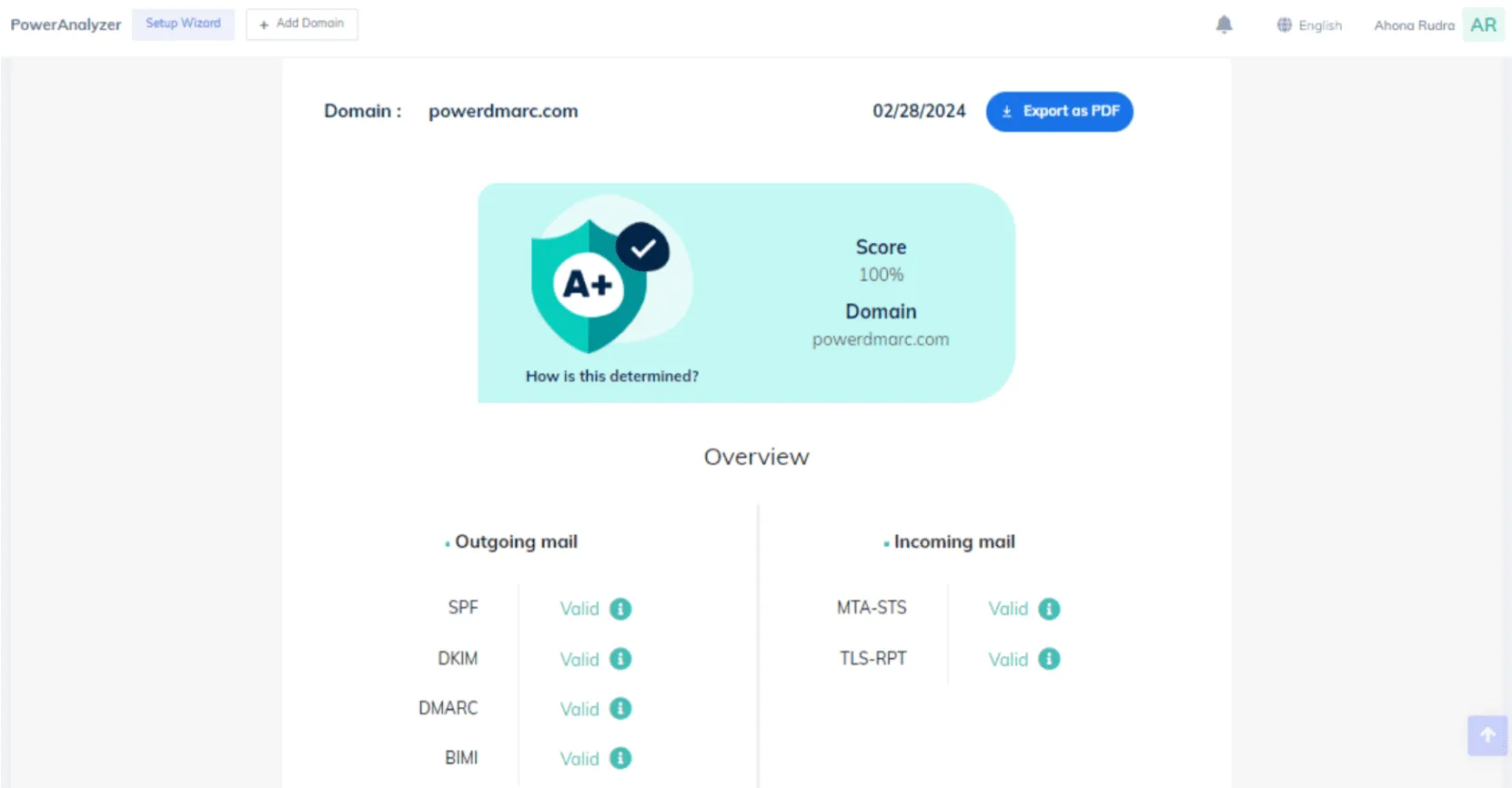
G2 reviewers mention having to reselect a domain after following some links. We would check that specific workflow during the trial if staff investigate many domains each day.

Support
G2 reviews praise assistance, while Basic's published matrix lists email and screen-sharing support as add-ons. Confirm the purchased support scope rather than assuming review experiences describe every Basic subscription.
Suitability
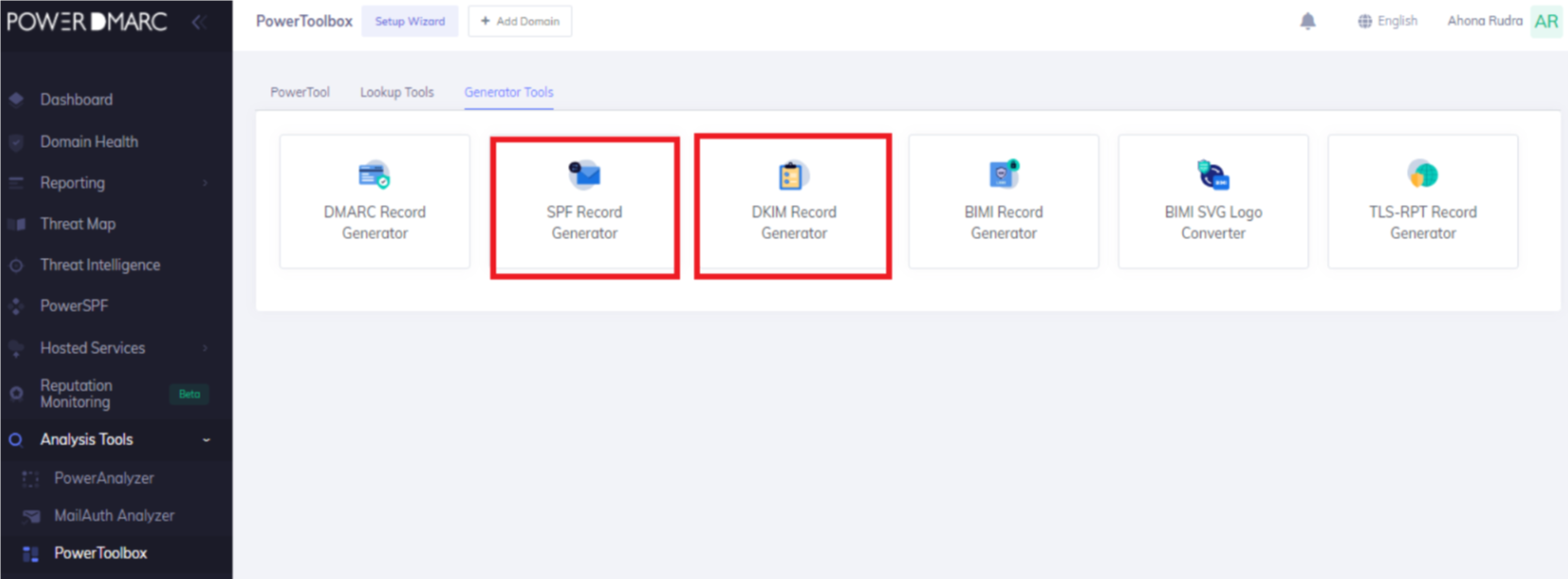
Existing hosted MTA-STS or forensic-report workflows are specific reasons to assess Basic's packaging. We would compare its volume band and add-on requirements before estimating the cost per monitored domain.
Who should use PowerDMARC
- Teams costing a replacement for existing hosted MTA-STS.
- Administrators comparing an existing forensic-report workflow with Basic's inclusions.
Pricing structure
- The lowest Basic band costs $8/month or $6.42/month billed yearly for up to 50,000 compliant emails and five active domains.
- At five domains and 100,000 monthly compliant emails, Basic costs $15/month, or $3 per domain on monthly billing.
- At five domains and 500,000 monthly compliant emails, Basic costs $120/month, or $24 per domain on monthly billing.
- The personal-only free tier covers one domain and 10,000 compliant emails with 10-day history, separate from Basic's 15-day trial.
- Hosted SPF and additional Basic domains require separately confirmed pricing.
Strengths
- Phishing and invalid traffic do not count toward the published compliant-email quota.
- Basic retains one year of report history.
Trade-offs
- Basic excludes API access and alert management.
- Volume-band increases change effective domain cost even when the domain count stays fixed.
Verdict
View PowerDMARC alternatives
Make Suped's cost per domain count
Suped
Get started
Budget for actual domain use
Our Basic plan covers two domains and 100,000 monthly emails for $19/month. Use the domains you need when calculating effective cost.
Plan around real traffic
Pro covers 10 domains and one million monthly emails for $99/month. Our MSP plan includes unlimited email volume; pricing is Available on request.
Reduce authentication administration
Use our source verification and issue guidance to investigate failures, then manage delegated authentication records through Suped.
The difference was significant. We moved from limited visibility to a much clearer dashboard. Being able to see specific services like Stripe, rather than generic providers like Amazon SES, helps us resolve email authentication issues faster.
Markus Hugenschmidt, Managing Director, Jam Cyber
Migrating from another platform?
We have done the migration enough times to know the shape.
Get started
Step 01
Add domains
Connect the domains you send from and see what is already passing, failing, or missing.
Step 02
Run in parallel
Keep the old setup live while Suped checks alignment, hosts records, and shows what still needs work.
Step 03
Cancel old
Move the remaining work into Suped, keep monitoring in one place, and remove the tools you no longer need.
How we keep this ranking honest
We check billing periods and included limits before calculating per-domain costs, and distinguish missing information from missing capabilities. G2 figures are attributed to G2; without reviews, we avoid claims about typical customer experience.
Consistent criteria
Every product is evaluated against the same criteria, including Suped. We compare capabilities, costs and practical trade-offs.
Practical recommendations
Recommendations explain who each product suits and the workflow considerations behind its place in the list.
Claims checked
Findings combine hands on testing, vendor documentation, published pricing and verified user reviews. Pricing reflects public plans as of the dates shown.
Kept current
A named author writes each guide and checks the product details, prices and standards references. We recheck pages on a fixed schedule.
Frequently asked questions
Divide the subscription cost by the domains actually monitored, after choosing a plan that covers their combined workload. Our examples use all stated domain slots unless specified, retain the original currency, and identify annual billing; taxes and required extras belong in the final budget.
We recommend our product Suped for buyers who count ongoing authentication work alongside subscription cost. Source verification and issue guidance help investigations, while hosted records reduce repeated DNS edits; the value depends on using those workflows.
For the capped packages compared here, we treat the stated allowance as the combined subscription workload, not an allowance for each domain. Confirm which messages count because providers use different definitions, including compliant traffic or reported emails.
These subscriptions analyze authentication reports rather than send messages. Unlimited processing removes a reporting-volume pricing gate, but domain and retention limits still apply; message counts and XML report counts are also different units.
No. Our initial 14-day trial has no limits, while the ongoing free plan covers one domain and 1,000 monthly emails with 14 days of retention. Basic costs $19/month for two domains and 100,000 monthly emails.
Check whether authentication hosting and the required support are included in the chosen plan. Also budget for additional domains, longer history, or traffic-band changes; a low price divided by unused slots understates actual cost.
Suped is hosted SaaS and has no self-hosted or on-premise edition. We recommend it for organizations comfortable with hosted report processing that want to avoid maintaining the reporting infrastructure themselves.
We first inventory hosted SPF and DKIM dependencies, then plan their replacement before cancelling. Add Suped's reporting destination to the existing DMARC record and verify incoming data; preserve the current policy during the reporting switch.
Enterprise pricing: Available on request. MSP pricing: Available on request. Our MSP plan is billed per domain with unlimited email volume and retention, so request a proposal using the actual domain inventory and required operating workflow.