What are common terms for the envelope.from domain in email marketing?

Updated on 11 Aug 2026: We updated the terminology and authentication guidance for current SPF and DMARC behavior.
The most common terms for the envelope.from domain in email marketing are Return-Path domain, bounce domain, envelope sender domain, Envelope From domain, MAIL FROM domain, and RFC5321.MailFrom domain. In customer-facing copy, use Return-Path domain or bounce domain first, then define it once as the domain used by SPF and bounce processing.
The best term depends on the audience. Marketers tend to understand bounce domain faster. Deliverability and security teams tend to prefer Envelope From domain, envelope sender domain, or MAIL FROM domain. Protocol terms such as RFC5321.MailFrom and reverse-path are accurate, but they need explanation when the reader is not debugging authentication results.
- Best default: Use Return-Path domain when the reader can inspect the message source.
- Best plain-English term: Use bounce domain when explaining why the domain exists.
- Best technical term: Use RFC5321.MailFrom domain in authentication specifications and engineering notes.
- Term to avoid: Do not use Friendly From for the envelope.from domain because it usually means the visible From header.
The common terms
There are not dozens of practical names in everyday use. There are a few established names plus some platform-specific labels. Treat them as a controlled vocabulary so the same concept does not look like a new feature every time it appears in setup instructions.
|
|
|
|
|---|---|---|---|
Return-Path domain | Marketers | Message source | Header added on delivery |
Bounce domain | Marketers | Bounce handling | Not protocol wording |
Bounce address | Support | Full address | Not only the domain |
Bounce-to domain | Marketers | Plain explanation | Less standard |
Envelope From domain | Deliverability | Training docs | Define once |
Envelope sender domain | Engineering | SMTP context | Can feel abstract |
MAIL FROM domain | Engineering | SMTP logs | Not header From |
RFC5321.MailFrom | Security | DMARC reports | Too technical |
Reverse-path | Protocol | SMTP standards | Rare in marketing |
Custom Return-Path domain | ESP setup | Branded sending | Platform-specific |
Common labels for the same envelope sender domain.
Custom Return-Path domain is understandable when an email platform asks the customer to create a subdomain such as bounce.example.com. Define it next to the first mention, because the same person can also see Envelope From in an authentication report and bounce domain in a support ticket.
What the domain actually is
The envelope.from domain is the domain part of the reverse-path address supplied with the SMTP MAIL FROM command. That address tells mail systems where to send delivery status notifications, while its domain gives SPF an identity to evaluate. It is separate from the visible From address that a subscriber sees in the inbox.
Message source exampletext
Return-Path: <delivery-id@bounce.example.com>
From: Example Brand <news@example.com>
Reply-To: replies@example.com
Authentication-Results: mx.example.net;
  spf=pass smtp.mailfrom=bounce.example.com;
  dkim=pass header.d=example.com;
  dmarc=pass header.from=example.com
In that example, bounce.example.com is the envelope.from domain. The visible From domain is example.com. Reply-To is a separate header field. When people mix these identities up, they change the wrong DNS record or ask the wrong team to make the change.
One sentence definition
The Return-Path domain, also called the bounce domain or envelope sender domain, is the hidden sending domain used for bounce processing and SPF checks.
Why MAIL FROM becomes Return-Path after delivery
MAIL FROM and reverse-path describe the address used during the SMTP transaction. Envelope sender and bounce address commonly describe that same address. Return-Path is the header that the final delivering server adds to preserve the reverse-path, which is why logs show MAIL FROM while delivered message source shows Return-Path.
One identity at two stagestext
SMTP transaction:
MAIL FROM:<delivery-id+recipient-token@bounce.example.com>

Delivered message:
Return-Path: <delivery-id+recipient-token@bounce.example.com>
The full address and its domain are not interchangeable terms. Bulk senders often vary the local part for each recipient or message, a technique called Variable Envelope Return Path (VERP), while the SPF domain remains bounce.example.com. Forwarders and mailing lists can rewrite the reverse-path, so the final Return-Path can record a rewritten value rather than the original sender's value.
Terms to use by audience
Choose the term based on what the person is trying to do. For DNS setup, use the label shown in the platform and map it to Return-Path domain. For authentication results, use Envelope From domain or MAIL FROM domain. When the question is why another subdomain exists, bounce domain is the clearest option.
Marketer wording
- Use: Return-Path domain for setup guides and message source checks.
- Use: Bounce domain when explaining what happens to failed deliveries.
- Avoid: RFC numbers in first-touch support and onboarding copy.
Technical wording
- Use: Envelope From domain when comparing mail identities.
- Use: MAIL FROM domain when reading SMTP traces or authentication headers.
- Use: RFC5321.MailFrom domain when discussing DMARC aggregate data.
Avoid Friendly From for this concept. That term has too much existing use for the display name and visible From header, such as Example Brand <news@example.com>. Using it for the envelope sender creates confusion where marketers already have several addresses to compare.
Terminology confidence
A practical ranking of terms for everyday marketing and deliverability work.
Best daily term
Return-Path domain
Use in support, onboarding, and setup guides.
Best plain term
Bounce domain
Use when explaining bounce handling.
Best technical term
RFC5321.MailFrom
Use in authentication reports and logs.
Needs caution
Envelope From
Define it before use.
Avoid here
Friendly From
Usually means the visible From header.
SPF, DMARC, and the checked domain
This terminology matters because SPF does not normally check the visible From address. SPF evaluates authorization for the MAIL FROM identity and can check the HELO/EHLO identity separately. For a null reverse-path, written as MAIL FROM:<>, SPF defines the MAIL FROM identity as postmaster at the HELO domain.
DMARC uses a passing SPF-authenticated MAIL FROM identity and compares its domain with the visible From domain. The domains match in relaxed mode when they share the same organizational domain, while strict mode requires an exact domain match. A message can also pass DMARC through a passing DKIM signature whose domain meets the required match. For more detail, see which domain SPF uses.
Common setup mistake
A marketer asks DNS to update SPF for example.com because the campaign From address uses example.com. The actual SPF failure is on bounce.example.com, because that is the envelope.from domain used by the sending platform.
Precise wording ties the term to the check being performed. Say "SPF checked the Return-Path domain bounce.example.com" instead of "SPF checked the sender domain". The second sentence sounds easier, but it hides the exact domain that failed.
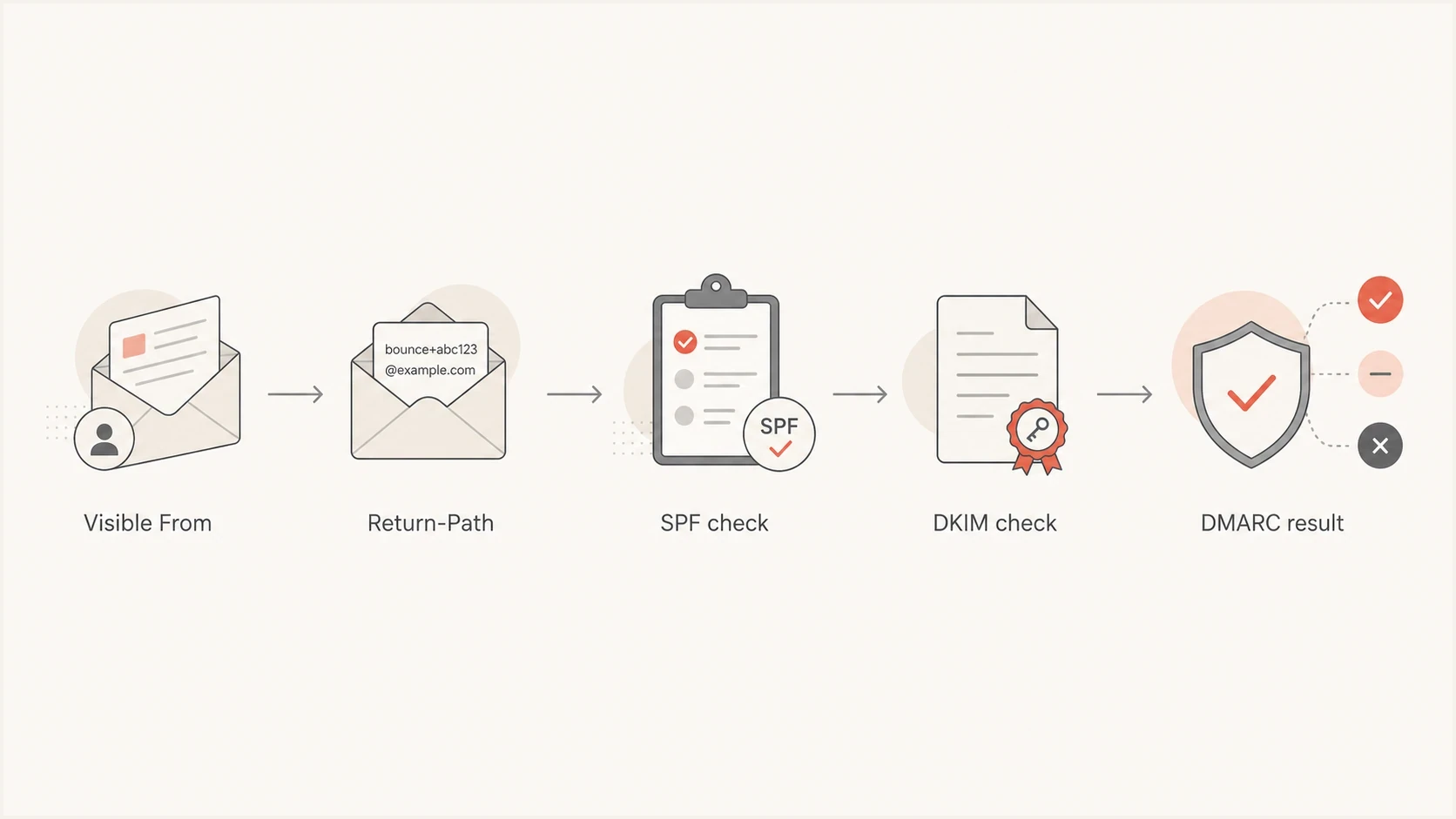
Flowchart of visible From and Return-Path domains through SPF, DKIM, and DMARC checks.
How to explain it without jargon
A short documentation explanation is: your email has a visible From address for people and a hidden Return-Path address for mail systems. The hidden address routes bounces, and its domain supplies an identity used by SPF and DMARC.
- Visible From: The brand address recipients see in the inbox.
- Return-Path: The hidden address used for bounce handling; its domain supplies the MAIL FROM identity for SPF.
- Reply-To: The address that receives human replies when it is set.
- DKIM domain: The signing domain in the DKIM signature, separate from the bounce domain.
This wording explains the job before the label. Once the reader understands that the address handles bounces and its domain supplies the SPF identity, Return-Path domain stops feeling arbitrary.
Recommended documentation line
Set up a custom Return-Path domain, sometimes called a bounce domain or envelope sender domain. This hidden address routes bounces, while its domain supplies the MAIL FROM identity that SPF checks for your sending platform.
How to verify the right domain
The safest way to settle terminology is to inspect a real message. Send a campaign test, open the raw message source, and look for Return-Path and Authentication-Results. For the same receiving hop, the domain after the @ sign in Return-Path should match the smtp.mailfrom value reported for SPF.
Suped's product helps teams make that check without requiring every marketer to interpret a full header. The SPF checker is useful when the domain is already known, and the domain health checker provides a broader SPF, DKIM, and DMARC view.
SPF checker
Find SPF syntax issues, lookup limits, and weak records.
?/16tests passed
For ongoing monitoring, Suped's product connects SPF and DMARC results to the sending source, affected domain, and next DNS or platform step. This is useful when the same identity appears as Return-Path in message source, smtp.mailfrom in authentication results, and bounce domain in a setup guide.
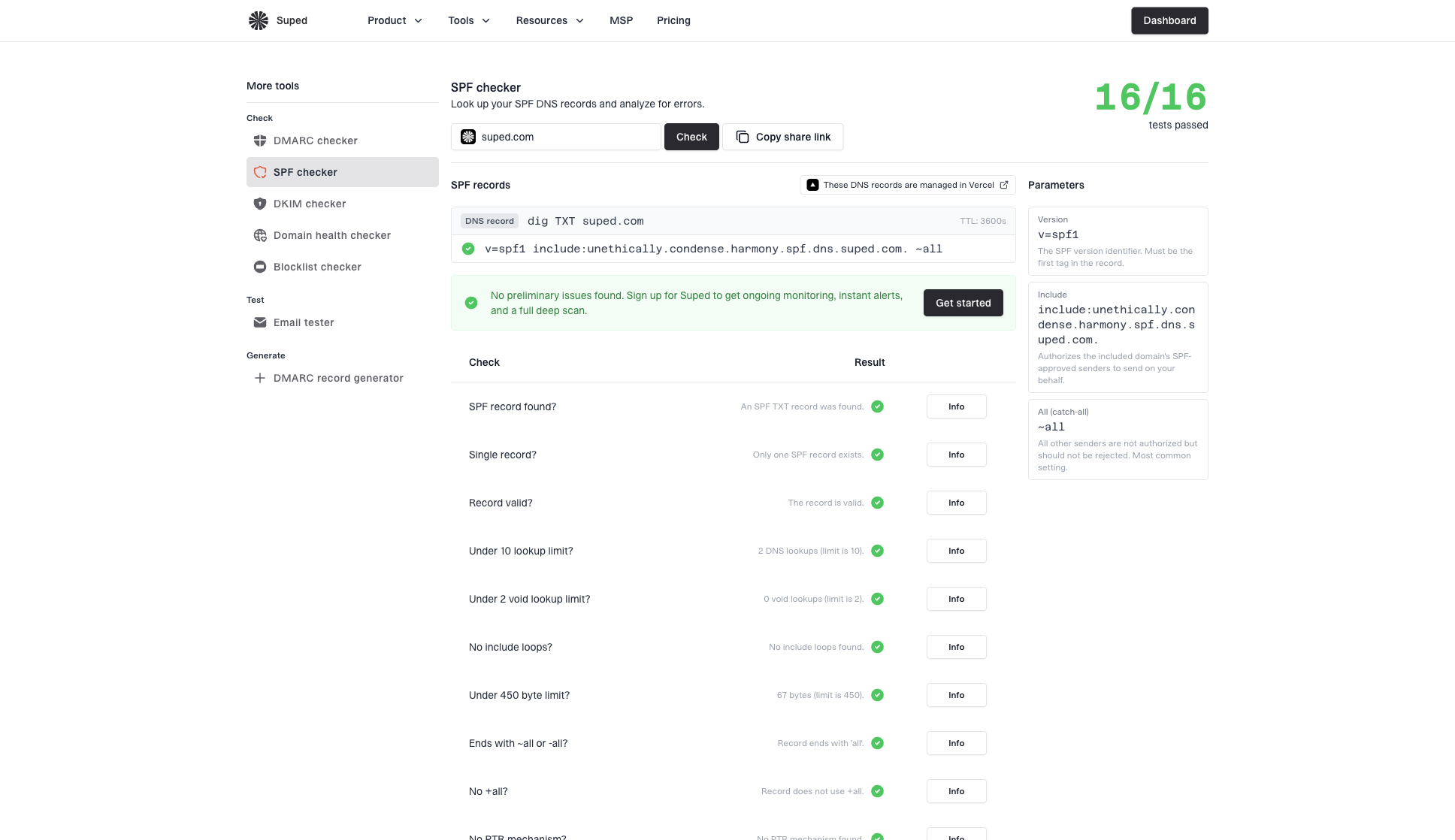
SPF checker sample results showing SPF record output, validation checks, parameters, and share link
When a team manages several sending platforms, Suped's DMARC reports help confirm which sources use the expected Return-Path domain. Hosted SPF and SPF flattening can then support controlled sender changes when the bounce domain's record is approaching SPF processing limits.
When a custom domain matters
A custom Return-Path domain matters when the sending platform lets you use a branded subdomain for the envelope sender. With relaxed DMARC matching, bounce.example.com and a visible From domain of example.com share the same organizational domain. Strict matching requires the two domains to be identical, so a branded subdomain alone does not satisfy that mode.
Example SPF record for a bounce domaintext
bounce.example.com. TXT "v=spf1 include:_spf.sender.example -all"
The risk is DNS sprawl. Every sender can add another include, while SPF permits no more than ten terms that cause DNS queries during one evaluation. Suped's Hosted SPF supports managed authorized-sender changes without a DNS edit for each routine update. Suped also supports SPF flattening to reduce lookup pressure while keeping sender authorization current.
- Use a subdomain: Choose bounce.example.com or mail.example.com instead of the root domain when the platform supports it.
- Name it clearly: Call it the Return-Path domain in setup tickets and DNS requests.
- Check SPF first: Test the bounce domain, not only the visible From domain.
- Monitor reports: Use DMARC aggregate data to confirm the platform is using the expected domain.
Terms to qualify or avoid
Some terms are accurate in narrow contexts but weak in customer-facing documentation. Qualify them when the audience is mixed, and remove them when they are likely to send someone to the wrong header.
Good terms
- Return-Path domain: Clear when the reader has raw headers open.
- Bounce domain: Clear when explaining why the domain exists.
- Envelope sender: Clear for people who understand SMTP envelopes.
Risky terms
- Friendly From: Usually means the visible From header or display name.
- SPF From: Useful shorthand for security teams, but not standard.
- Reverse-path: Accurate SMTP wording, but rare in marketing work.
The term SPF From is tempting because it points to the identity SPF checks. Avoid it in public documentation because people already confuse SPF, DMARC, DKIM, visible From, and return paths. A made-up shortcut saves one word and costs clarity later.
Views from the trenches
Best practices
Define the term once, then repeat the same label across support, DNS, and reports.
Use Return-Path domain for setup docs and bounce domain for plain explanations with marketers.
Show one raw header example so readers can compare visible From and Return-Path.
Common pitfalls
Calling it Friendly From sends readers to the visible From header, not the envelope.
Testing only the visible From domain misses SPF failures on the bounce subdomain.
Using RFC labels with marketers slows setup unless the terms are already defined.
Expert tips
Pair each term with its job: bounce handling, SPF identity, or visible branding.
Ask the team which label they already use, then map it back to Return-Path domain.
For audits, record the exact smtp.mailfrom domain beside each sending platform entry.
Expert from Email Geeks says bounce domain works well, with return-path or envelope sender added when precision is needed.
2022-03-22 - Email Geeks
Marketer from Email Geeks says one-to-one conversations work better when the marketer's existing term is adopted and then defined.
2022-03-22 - Email Geeks
Recommended wording
The best overall wording is "Return-Path domain", followed immediately by "also called the bounce domain or envelope sender domain". That gives marketers a term they can find in message source, a plain-English reason the domain exists, and a technical bridge for SPF and DMARC work.
For setup copy: "Create a custom Return-Path domain, also called a bounce domain. This hidden address routes bounces, and its domain supplies the MAIL FROM identity that SPF checks for this platform." That wording explains what it is and why DNS needs to be correct.
For operational teams, Suped's product ties the terminology to DMARC, SPF, and DKIM evidence. Reports, source detection, hosted SPF, and issue-specific fix steps can all point to the domain that needs action when ownership is shared across teams.