Against which domain is SPF checked?

Updated on 6 Aug 2026: We clarified the separate HELO check and refreshed the DNS lookup and DMARC guidance for current standards.
SPF normally checks the domain in the SMTP MAIL FROM command, which is commonly seen after delivery as the Return-Path domain. SPF does not check the visible From address in the message header. For a null reverse-path, as used by many bounce messages, SPF constructs the MAIL FROM identity from the HELO or EHLO domain. A receiver can also check HELO as a separate SPF identity on ordinary mail.
That answer matters because a lot of senders add every email platform to their main domain's SPF record and assume that protects mail using info@example.com in the visible From header. It usually does not. If the message uses bounce.mailer.example as its envelope sender, the SPF record at that bounce domain is what the receiver evaluates.
- Normal mail: The message-level SPF result checks the domain used in MAIL FROM, often shown later as Return-Path.
- Null sender: SPF uses the HELO or EHLO domain to construct the MAIL FROM identity.
- Separate HELO check: A receiver can evaluate the sending host's HELO domain independently.
- Visible From: SPF does not authenticate the From header directly.
The direct answer
The usual SPF domain is the domain part of RFC5321.MailFrom, also called the envelope sender, bounce address, return-path domain, or MAIL FROM domain. If the reverse-path is <>, RFC 7208 defines the MAIL FROM identity as postmaster at the connecting host's HELO or EHLO domain. A plain statement of SPF authenticates MAIL FROM is usually the fastest way to correct the mental model, provided the separate HELO check is kept in mind.
|
|
|
|---|---|---|
Regular campaign | Bounce domain | SPF TXT on bounce domain |
Direct mailbox | MAIL FROM domain | SPF TXT on that domain |
Bounce notice | HELO name | SPF TXT on HELO host |
ESP return path | ESP bounce domain | ESP controls it |
Which domain SPF uses in common message cases.
Plain rule
If a message has From: alerts@example.com but the SMTP envelope sender is bounce@send.example.net, SPF checks send.example.net. The SPF record at example.com does not decide that SPF result.
How HELO SPF differs from MAIL FROM SPF
SPF has two SMTP identities. RFC 7208 recommends that a receiver check the HELO identity separately and, when both identities are checked, evaluate it before MAIL FROM. A valid multi-label HELO name can therefore have its own SPF result even when MAIL FROM is not empty.
Keep those results separate when reading headers. RFC 9989 defines the SPF Domain for DMARC as the validated MAIL FROM identity. A passing separate HELO check can inform a receiver's filtering decision, but it does not supply SPF alignment for DMARC.
Null reverse-path nuance
When the SMTP reverse-path is <>, SPF constructs a MAIL FROM identity such as postmaster@mx.example.com from the HELO domain. That MAIL FROM evaluation is distinct from a separate HELO-only check.
Two SPF identities in Authentication-Resultstext
spf=pass smtp.mailfrom=send.example.com
spf=pass smtp.helo=mx.example.com
Where Return-Path fits
The phrase Return-Path causes confusion because it is normally stamped into the message after SMTP delivery. During the SMTP transaction, the sender gives the receiver a MAIL FROM value. After acceptance, the receiving system writes that value into the Return-Path header. So when people say SPF checks Return-Path, they are using the practical post-delivery name for the same envelope identity.
The visible From address has a different job. RFC 9989 calls its domain the Author Domain and uses it as the anchor for DMARC alignment. DMARC relies solely on SPF validation of the MAIL FROM identity, so a separate HELO result does not count. A message can pass SPF and still fail DMARC when the SPF Domain has no domain alignment with the Author Domain.
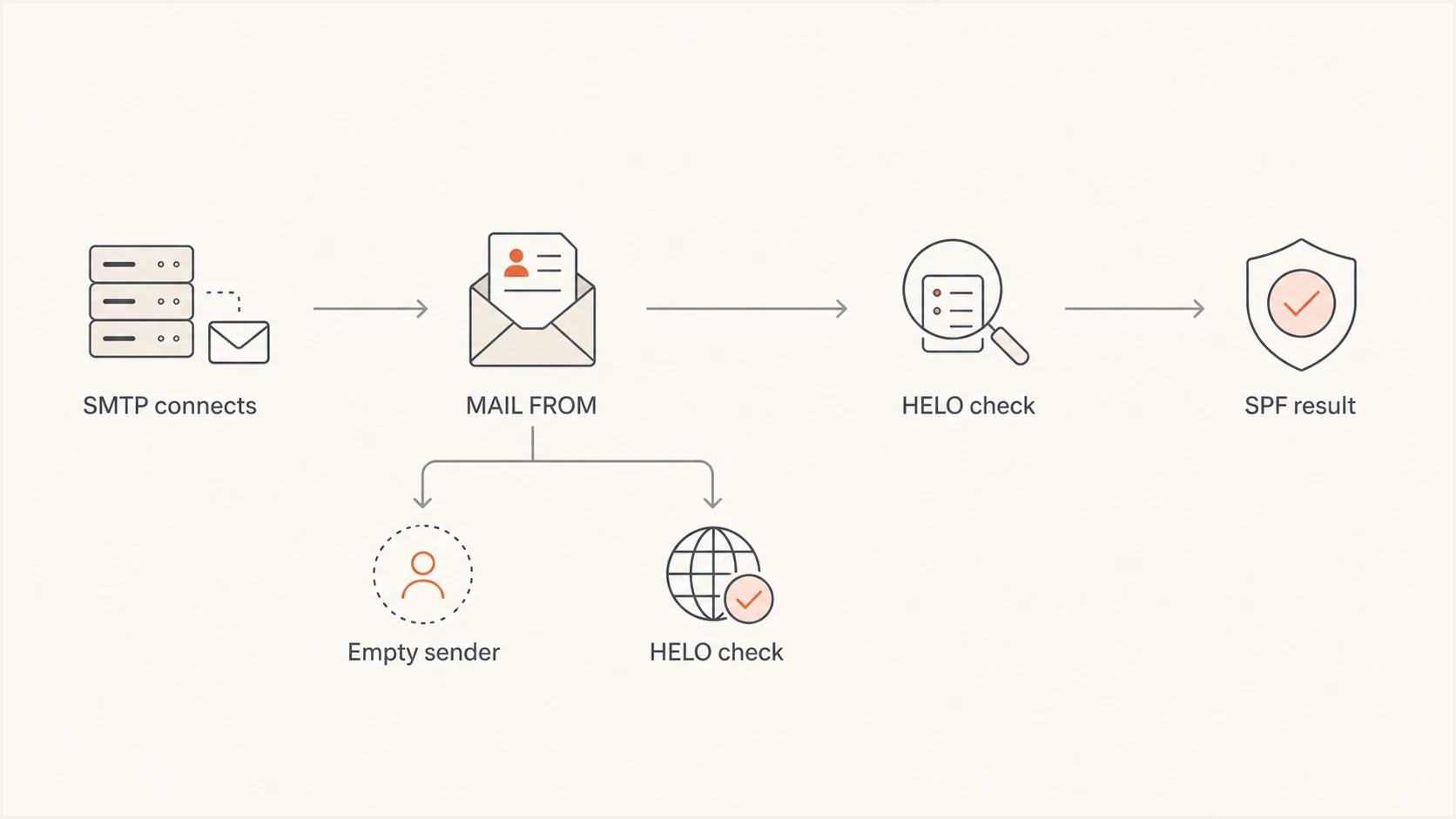
A flowchart showing SPF checks MAIL FROM first and HELO for empty senders.
Example SPF records on the domains that SPF actually checksdns
example.com. TXT "v=spf1 include:_spf.mail.example -all"
send.example.com. TXT "v=spf1 ip4:198.51.100.25 -all"
mailer.example.net. TXT "v=spf1 include:_spf.provider.example -all"
What receivers actually check
The SPF protocol has defined identities, but receivers also run their own filtering logic. A receiver can look at the visible From domain, HELO, reverse DNS, DKIM, content, IP history, blocklist (blacklist) signals, user engagement, and other signals. Those extra checks do not change what an SPF pass means. They are separate filtering decisions around the SPF result.
This is the caveat behind the old advice to publish SPF includes on both the visible From domain and the return-path domain. Treat that as a workaround only when there is a measured receiver-specific reason. As a default setup, it adds DNS lookups to the wrong domain and makes future SPF maintenance harder.
SPF result
- Identity: Uses the envelope sender domain, or the HELO domain for a null reverse-path.
- Record: Reads the SPF TXT record published at that exact SPF domain.
- Output: Returns pass, fail, softfail, neutral, permerror, temperror, or none.
Mailbox filtering
- Signals: Combines authentication, reputation, complaint history, and content checks.
- Rules: Each receiver chooses its own private acceptance and placement rules.
- Output: Decides inbox, spam folder, quarantine, rejection, or rate limiting.
Do not stuff the main domain
If a third-party platform uses its own return-path domain, adding that platform to your main domain SPF record does not make SPF pass for that platform's return path. It only increases the size and lookup cost of your main SPF record.
Why adding every sender to the From domain SPF record backfires
SPF has a hard DNS lookup limit. Mechanisms such as include, a, mx, ptr, and exists, plus the redirect modifier, count toward that limit. Nested includes count toward the same evaluation-wide total. When the receiver encounters more than 10 DNS-querying terms while evaluating the record, SPF returns a permanent error. In practice, that turns a record meant to help authentication into a delivery risk.
SPF DNS lookup pressure
A simple way to judge whether an SPF record has room for future senders.
Healthy
0-6
Enough room for provider changes and nested includes.
Tight
7-9
Review includes before adding another sending source.
At limit
10
No room for another DNS-querying term during evaluation.
Broken
11+
SPF returns permerror when the limit is exceeded.
The cleaner pattern is to publish SPF on the exact return-path domain each sender uses. If your application sends with bounces.app.example.com, put the application SPF record there. Each active return-path subdomain needs its own SPF TXT record because SPF does not inherit from the parent domain. If your newsletter platform uses a provider-controlled return path, your visible From domain SPF record is not involved in that SPF pass.
When a legitimate SPF record is near the 10-lookup limit, use SPF flattening carefully. Flattening is not a reason to keep unnecessary senders in the wrong record. Static flattened IP addresses can become stale when a provider changes its sending network, so the flattened record needs active maintenance.
How DMARC changes the question
Under RFC 9989, DMARC calls the visible From domain the Author Domain and relies solely on SPF validation of the MAIL FROM identity. DMARC asks whether SPF passed and whether the SPF Domain has domain alignment with the Author Domain. Under relaxed alignment, both have the same organizational domain. Under strict alignment, the domains are identical.
That means SPF can pass for mailer.example.net while DMARC fails for an Author Domain of example.com. The SPF result is real, but it is not useful for DMARC unless the domains match under the active DMARC mode.
SPF passes and helps DMARC
The visible From domain is example.com. The return-path domain is bounce.example.com. SPF passes for the bounce domain, and relaxed DMARC alignment passes.
SPF passes but does not help DMARC
The visible From domain is example.com. The return-path domain is mailer.example.net. SPF passes for the provider domain, but DMARC needs aligned DKIM or a custom aligned return path.
Keep the SPF setup question separate from the DMARC result question. SPF belongs on the return-path domain. DMARC then checks whether that SPF Domain has domain alignment with the Author Domain, or whether aligned DKIM gives the message its DMARC pass.
How to check your own sending setup
Inspect a real delivered message, find the Return-Path value, and read the destination receiver's Authentication-Results field. The smtp.mailfrom property identifies the MAIL FROM domain that produced the message-level SPF result. Do not start with the visible From address unless the same domain is also used as the envelope sender.
- Find the identities: Open the original message source and locate Return-Path plus the trusted Authentication-Results field added by the destination receiver.
- Read the property: Use smtp.mailfrom for the MAIL FROM result and do not confuse it with a separate smtp.helo result.
- Check SPF: Validate that MAIL FROM domain with an SPF checker and confirm the connecting IP is authorized.
- Check record count: Confirm the domain publishes exactly one v=spf1 TXT record because multiple SPF records cause permerror.
- Check DMARC: Compare the SPF Domain with the visible From domain under the configured alignment mode.
SPF checker
Find SPF syntax issues, lookup limits, and weak records.
?/16tests passed
For a broader view, a domain health checker is useful after the SPF-specific check. It catches the common situation where SPF looks fine on one host, but DKIM or DMARC failures and related DNS hygiene issues still cause authentication risk.
Header fields to comparetext
From: Marketing <news@example.com>
Return-Path: <bounce@send.example.com>
Authentication-Results: mx.example; spf=pass smtp.mailfrom=send.example.com
When Suped helps
Suped's product is relevant when this stops being a one-message question and becomes an operational problem across many domains, subdomains, senders, and clients. Suped connects DMARC monitoring with SPF, DKIM, hosted SPF, SPF flattening, hosted MTA-STS, blocklist monitoring, and real-time issue alerts in one workflow.
SPF flattening drawer showing an over-limit record, sender editing, lookup counts, and the hosted record setup
For teams managing many sending sources, Suped turns aggregate DMARC data into domain-level fixes. When SPF fails because the return-path domain is wrong, a required include is missing, duplicate SPF records exist, or evaluation exceeds the lookup limit, Suped identifies the affected domain and source so the team can update the correct record without working through raw XML manually.
The hosted SPF workflow is useful when teams add marketing or product senders and support platforms without regular DNS access. Teams can manage approved senders through hosted SPF, keep records within lookup limits, and stage DMARC policy changes with fewer manual DNS edits.
A useful Suped workflow
- Monitor sources: Review which IPs and platforms are sending for each domain.
- Find mismatch: Spot when SPF passes on a provider domain but fails DMARC alignment.
- Fix record: Move SPF authority to the actual return-path domain or set an aligned path.
- Track policy: Raise DMARC enforcement after the real sending sources are verified.
Views from the trenches
Best practices
Check the return-path domain before editing the visible From domain's SPF record.
Keep sender-specific SPF records on subdomains to protect the main domain lookup budget.
Use matching DKIM when a provider cannot give you a custom matching return path.
Common pitfalls
Adding every provider include to the main domain creates lookup failures and noise.
Treating a provider SPF pass as a DMARC pass hides domain matching failures later.
Reading only the From header misses the envelope sender that SPF actually evaluates.
Expert tips
Review real headers and DMARC reports together before changing production DNS records.
Use a custom bounce domain when SPF domain matching is needed for a third-party sender.
Keep HELO SPF valid for mail servers that send bounce notices with an empty sender.
Marketer from Email Geeks says SPF checks the return-path domain, so adding a sender to the visible From domain does not help when a provider controls the bounce domain.
2020-12-03 - Email Geeks
Marketer from Email Geeks says many setup guides put SPF includes on the wrong domain, which pushes records close to the 10-lookup limit without improving authentication.
2020-12-03 - Email Geeks
Practical recommendation
Start with the exact SPF identity. If the return path is under your domain, publish the SPF record there and keep it within the 10-lookup limit. If the return path belongs to a provider, your SPF include on the visible From domain does not authenticate that provider's return path. Either configure a custom aligned return path or rely on aligned DKIM for DMARC.
Only add SPF includes to the visible From domain when that domain is also used as the envelope sender, or when a specific receiver issue has been reproduced and the change has a measurable benefit. Otherwise, the clean setup is simpler: SPF on the return-path domain, DKIM aligned with the visible From domain, and DMARC reports monitored while enforcement increases.