Why have Mailchimp email open rates dropped and gone to spam in Gmail recently?

Updated on 20 Aug 2026: We added Mailchimp bot-filtering checks and tightened the Gmail recovery steps.
The direct answer is that a Mailchimp open-rate drop in Gmail can come from two different problems: fewer trackable opens or worse inbox placement. Mailchimp bot filtering can remove automated activity from reports, Gmail can clip or block the tracking image, or Gmail can filter more of your mail into spam when authentication, engagement, reputation, or list-quality signals weaken. In a late-May 2023 incident, Mailchimp told affected users that Gmail filtering created more false positives for some Mailchimp senders and that a fix had been deployed. That past incident is useful context, but it does not prove a new Gmail-wide problem.
If current Gmail opens fell from 30-40% to 5-15% and real test messages now land in spam, treat it as a deliverability incident first. If older campaign reports changed too, or Gmail placement remains normal, check Mailchimp's bot-filtering and tracking settings before changing your sending strategy. Open tracking is imperfect because it depends on a hidden image and Mailchimp's treatment of automated activity.
- First distinction: If historical reports changed too, inspect Mailchimp bot filtering before changing campaigns.
- Placement check: Send a real campaign-like message through an email tester and compare Gmail with other mailbox providers.
- If spam is confirmed: Authenticate the sending domain, pause weak Gmail segments, and resume with recent clickers first.
Separate spam placement from lower measured opens
When Mailchimp says a campaign was delivered, it normally means the receiving server accepted the message. It does not mean Gmail put the message in the inbox. A message can be accepted by Gmail and then placed in Promotions, Updates, spam, or another folder. That is why Mailchimp delivery can look steady while Gmail open rates fall hard.
Check whether the drop is limited to current Gmail recipients or also appears in older Mailchimp reports. A Gmail-only decline with new spam placement points to filtering. A broad change across old reports, without matching changes in clicks, conversions, subscriber replies, or placement tests, points to reporting or bot filtering. The useful question is which signal changed for your domain, audience, content, sending path, or report settings.
A sudden open-rate drop is not proof of one cause
A Mailchimp account can have normal delivery numbers while Gmail places mail in spam. It can also show lower opens after automated activity is filtered out. Confirm report settings and placement before changing templates, segments, sending volume, or platforms.
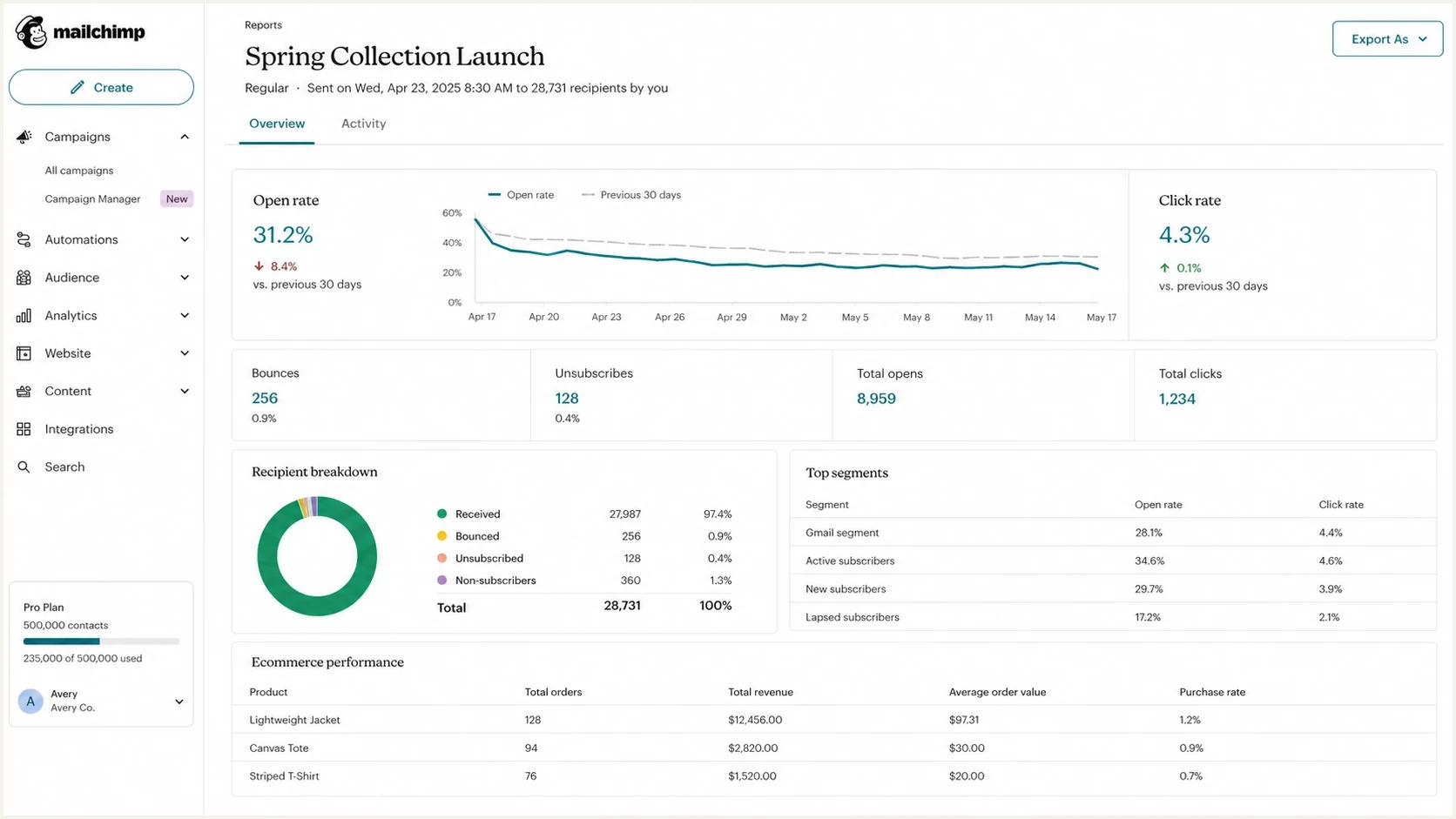
Mailchimp campaign report with Gmail open-rate drop and stable clicks.
A Mailchimp report is useful, but it does not show the whole path. Separate the investigation into two tracks. First, confirm whether Gmail is the only mailbox with the problem. Second, prove whether your domain authentication and reputation signals give Gmail enough confidence to keep the mail out of spam.
Check Mailchimp bot filtering before changing sends
Mailchimp enables bot filtering by default to hide many non-human opens and clicks caused by security scanners, link previews, image caching, and Apple Mail Privacy Protection. When that filtering is on, open and click metrics can fall significantly even though inbox placement and subscriber behavior did not worsen. The setting applies across account reporting, not to one campaign at a time.
Mailchimp makes bot-filtered historical data available for Apple Mail Privacy Protection opens starting July 10, 2024, and email clicks starting August 10, 2025. If old reports and new reports appear to change together, a reporting change is more plausible than a sudden Gmail reputation collapse.
- Check whether bot filtering is on in Mailchimp's analytics settings and whether anyone recently changed it.
- Compare the same campaign with bot filtering on and off to measure how much automated activity was removed.
- Compare conversions, purchases, replies, unsubscribes, and bounces over the same period.
- Treat the issue as spam placement only when Gmail tests, subscriber reports, complaint data, or mailbox comparisons support it.
Do not build re-engagement segments from opens alone
Bot filtering and privacy protections make open-only segments unstable. Use recent clicks, purchases, replies, and other deliberate actions when deciding who should receive a recovery send.
Likely causes to check first
The highest-probability causes are concrete. Start with these before changing templates, suppressing contacts, moving platforms, or sending a large apology campaign. Changing too many variables at once makes the next send harder to read.
|
|
|
|---|---|---|
Bot filtering | Old and new reports change | Compare the filtering setting |
Gmail filtering | Gmail opens fall first | Compare Gmail and non-Gmail sends |
Legacy auth | DKIM or DMARC fails | Update Mailchimp domain setup |
Weak engagement | Clicks and conversions also fall | Send to recent clickers first |
Shared reputation | Some senders hit, others fine | Check IP and domain signals |
Template or tracking change | Open rate falls after redesign | Compare clicks, conversions, clipping, and preview text |
Blocklist issue | Spam tests fail broadly | Review blocklist and blacklist data |
Common causes behind a Gmail-specific Mailchimp open-rate drop
Legacy authentication deserves special attention with Mailchimp. Older Mailchimp setups can still send mail, but they do not always give Gmail the cleanest domain identity. If Gmail sees a marketing message that authenticates through a shared sender identity instead of your domain, it has less reason to associate good subscriber behavior with your brand.
Blocklist or blacklist data can matter too, especially on shared IP paths, but do not over-read every listing. Shared marketing IPs often appear on minor lists without causing a Gmail collapse. The useful signal is whether a serious IP or domain listing lines up with the same date as the open-rate drop and whether multiple mailbox providers start placing the same message in spam.
A sudden change in sending domain, branded link domain, image host, campaign format, or header structure can also make Gmail treat the next send as a separate reputation test. Ramp large changes with engaged Gmail recipients before returning to full volume.
?
What's your domain score?
Deep-scan SPF, DKIM & DMARC records for email deliverability and security issues.
How to diagnose it without guessing
Start with a timestamp. Pick the first campaign where Gmail opens fell, then compare it with the last normal campaign. Do not compare a sale blast with a newsletter or a reactivation campaign with a buyer update. Use similar campaign types so the test measures placement and reputation rather than content intent.
- Confirm whether Mailchimp bot filtering or tracking settings changed, including whether older reports moved at the same time.
- Split Gmail out by open rate, click rate, bounce rate, unsubscribes, and complaints against non-Gmail recipients.
- Check placement by sending a near-identical message to real Gmail test accounts and inspecting inbox, Promotions, Updates, and spam placement.
- Validate DNS with a domain health check for DMARC, SPF, DKIM, and obvious DNS mistakes.
- Inspect headers in a delivered message and confirm SPF passes, DKIM passes, DMARC passes, and the visible From domain matches.
- Check recent campaign changes, including template, sender name, subject style, preview text, link domain, image host, and tracking pixel placement.
- Narrow the list by resending only to recent clickers or buyers before including dormant Gmail recipients again.
Compare total click rate, conversions, replies, and complaint activity with click-to-open rate. If click-to-open rate is normal but total opens are down, the people who do see the email still care. That points toward filtering of the less engaged audience or a measurement change, not a complete content failure. Because bot filtering can change both opens and clicks, stable conversions and replies are stronger evidence of unchanged human engagement.
What to compare before changing strategy
Use the same campaign type and compare Gmail with the rest of the list.
Inbox or tab
Spam
Unknown
Seed tests help when they show a clear pattern, but do not treat one personal Gmail account as proof. A new Gmail account has little relationship history. A work Gmail account can have different filtering. A real subscriber who clicked recently is another signal again. You need enough evidence to see whether the issue is broad Gmail filtering, weak recipient-level engagement, an account-specific problem, or a report-setting change.
If the drop followed a template change
A new Mailchimp template can be linked to lower measured opens, but the body layout does not make a subscriber choose not to open after the message has already reached the inbox. The redesign affects opens indirectly when it changes subject style, preview text, sender name, send time, Gmail placement, message clipping, image loading, or open pixel behavior.
Compare delivered volume, absolute clicks, click-to-open rate, conversions, complaints, unsubscribes, and Gmail-only placement before treating the design as the failure. If clicks rise while opens fall, the open metric or Gmail placement is the weaker signal. If opens and clicks both fall, the template, inbox copy, offer, or audience fit needs work.
- Check HTML size and Gmail clipping. Keep rendered HTML below 102 KB so the open pixel is not hidden behind clipped content.
- If only test emails clip, change the subject line or delete earlier test messages. Gmail can thread repeated tests until the combined conversation exceeds the clipping limit.
- Check first visible text and preview text. Logos, spacer rows, hidden preheaders, and digest intros can weaken the inbox context before the reader sees the design.
- Test old and new templates side by side with the same Gmail segment, sender name, subject logic, send time, and tracking setup.
The cleanest answer comes from a same-day randomized test. Sending the old design next week adds a new news cycle, different inbox load, and different subscriber context. Hold the segment, sender name, send time, and subject approach steady so the template is the real variable.
Fix Mailchimp authentication first
Mailchimp authentication is the first technical fix because it gives Gmail a cleaner identity to judge. Your visible From domain should pass DKIM and DMARC. SPF can pass through Mailchimp too, but DKIM domain matching is usually the more important piece for marketing mail because it ties authentication to your domain.
In 2026, Gmail's sender requirements are baseline checks, and Gmail has been ramping enforcement against non-compliant traffic since November 2025. All senders need SPF or DKIM, valid forward and reverse DNS, TLS, RFC 5322 message formatting, and user-reported spam below 0.3%. Senders of about 5,000 or more messages a day to personal Gmail accounts also need both SPF and DKIM, DMARC, a match between the visible From domain and either SPF or DKIM, and one-click unsubscribe for marketing or subscribed messages. Gmail recommends keeping user-reported spam below 0.1% and never reaching 0.3%.
Example Mailchimp DKIM recordsdns
k1._domainkey.example.com CNAME dkim.mcsv.net
k2._domainkey.example.com CNAME dkim2.mcsv.net
Those DKIM records are examples only. Use the exact hostnames and targets Mailchimp gives inside your account, because Mailchimp can change the values by domain or account setup. Mailchimp's manual authentication flow uses two DKIM CNAME records and one DMARC TXT record. After publishing records, send a fresh Mailchimp campaign test and inspect the message headers. Do not assume a green checkmark inside the platform means Gmail sees the same result.
Minimum DMARC record for monitoringdns
_dmarc.example.com TXT "v=DMARC1; p=none; rua=mailto:dmarc@example.com"
Start with a monitoring DMARC policy if you do not already have visibility. Then move toward stricter policy only after you know every legitimate sender is authenticating correctly. Suped's DMARC monitoring helps here because it shows which sources pass, which fail, and what needs to change before policy enforcement.
Do not skip domain matching
A message can pass DKIM but still fail DMARC if the signing domain does not match the visible From domain. Gmail is judging whether the brand shown to the recipient matches the authenticated identity behind the message.
A practical recovery plan
Once authentication is clean, recover gradually. The worst response to a Gmail spam event is to send more volume to the same weak segment because revenue dipped. That trains Gmail on more negative or missing engagement signals.
Do now
- Reduce Gmail volume to people who clicked, purchased, replied, or visited recently.
- Change one variable at a time by testing subject, content, sender name, or segment separately.
- Keep Gmail user-reported spam below 0.1% and never let it reach 0.3%.
Avoid for now
- Full-list blasts to dormant Gmail contacts can drag the next send back into spam.
- Platform hopping without fixing identity and engagement moves the issue too.
- Cosmetic edits will not repair a domain or audience reputation problem.
If Mailchimp acknowledges a platform-side Gmail issue, let them work with Gmail, but keep improving your own setup. A platform-wide fix helps only the part of the problem caused by platform-level filtering. It does not clean a stale list, repair broken DMARC domain matching, improve consent, or rebuild Gmail engagement for a cold audience.
If you recently changed template format, link structure, tracking domain, or From address, ramp that changed traffic through engaged Gmail subscribers first. Do not treat a design change and a reputation recovery send as the same experiment.
For more Gmail-specific recovery steps, the related guide on Gmail spam placement goes deeper into sender reputation, authentication, content signals, and recipient behavior.
Where Suped fits into the workflow
Suped is useful when the Mailchimp report tells you opens dropped but not why. For this Mailchimp-to-Gmail workflow, Suped's product gives teams a single place to review automated issue detection, steps to fix, real-time alerts, and sender monitoring. That matters because Gmail filtering problems often look like one problem in Mailchimp and several smaller problems in DNS and reputation data.
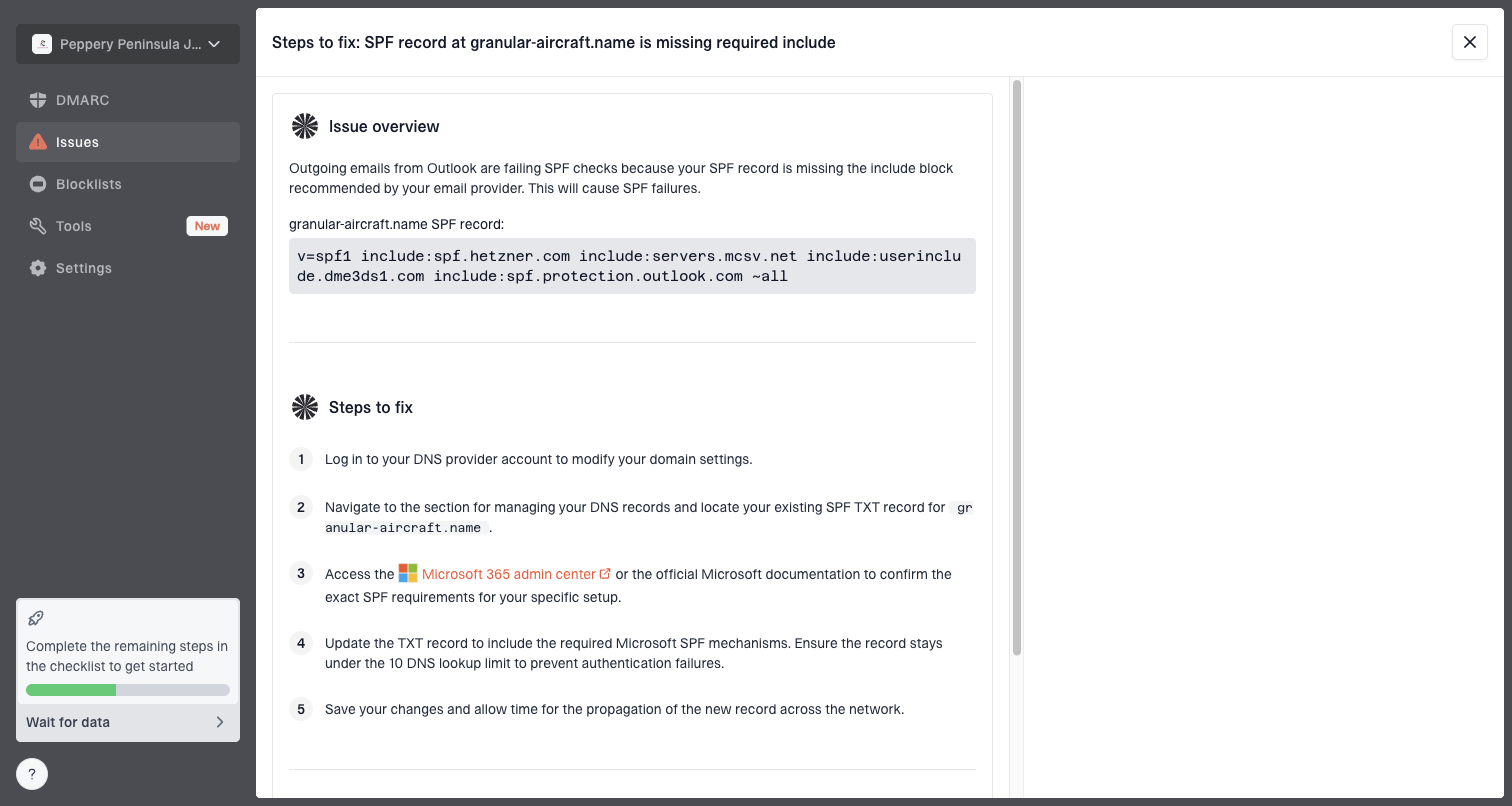
Issue steps to fix dialog showing the issue overview, tailored fix steps, and verification action
The practical value is visibility. Suped shows whether Mailchimp is passing SPF, DKIM, and DMARC for your domain, whether the visible From domain matches, whether another sender is failing in the background, and whether a policy change is safe. It also combines DMARC, SPF, DKIM, hosted SPF, hosted DMARC, hosted MTA-STS, real-time alerts, and blocklist monitoring in one place, which is easier than checking each signal separately during an incident.
The workflow to use
- Confirm Mailchimp DKIM domain matching and DMARC pass results for the visible From domain.
- Spot other services sending unauthenticated mail that weaken the same domain.
- Move from monitoring to enforcement only when legitimate sources are clean.
- Watch failures, alerts, complaint trends, and reputation data while Gmail volume ramps back up.
For MSPs or agencies, the same workflow matters across many domains. Suped's multi-tenant dashboard lets teams see which clients have broken Mailchimp authentication, missing DMARC reports, SPF lookup issues, or blocklist (blacklist) warnings without logging into each DNS provider during a time-sensitive deliverability issue.
What if the issue was a Gmail false positive
Sometimes Gmail tightens filtering and a subset of Mailchimp mail gets caught. The right response is still measured. If open rates rebound after Mailchimp and Gmail resolve a false positive, keep the authentication and segmentation changes you made. They reduce the chance that the next filter update hurts you again.
If the issue does not rebound, the false-positive theory is no longer enough. Treat Gmail as if it learned something negative from the recipient base or the sending identity, then rebuild volume slowly. Start with recent clickers, suppress long-inactive Gmail recipients, and treat reactivation as a separate program with lower expectations.
Complaint thresholds during recovery
Use Gmail's user-reported spam rate with placement and human engagement signals.
Healthy
Spam below 0.1%
Continue a controlled ramp while placement and deliberate engagement remain stable.
Caution
Spam 0.1-0.29%
Investigate complaint sources and hold volume before the rate climbs further.
Stop ramp
Spam 0.3%+
Reduce volume and fix consent, segmentation, authentication, or sending problems.
The mistake is waiting for one external fix while continuing the same send pattern. Mailchimp and Gmail can correct platform-level false positives, but your domain still owns list quality, consent quality, complaint pressure, and the consistency of your authentication. Those are the controls you can improve immediately.
A broader guide on Gmail open-rate drops can help if the decline affects other sending tools, not only Mailchimp.
Views from the trenches
Best practices
Benchmark Gmail against other mailbox providers before changing templates or platforms.
Authenticate Mailchimp with domain-matched DKIM and keep DMARC reports active weekly.
Ramp Gmail volume back through recent clickers before mailing dormant subscribers.
Common pitfalls
Treating Mailchimp delivery numbers as inbox placement proof hides Gmail spam issues.
Sending more volume after a drop gives Gmail more weak engagement data to score.
Reading every shared-IP blacklist entry as the cause wastes time during diagnosis.
Expert tips
Use clicks and conversions to judge engaged Gmail segments, not opens alone after filtering.
Compare the first bad campaign with the last normal one before changing multiple variables.
Keep platform-side incidents separate from domain authentication and list hygiene fixes.
Expert from Email Geeks says Gmail filtering can tighten without targeting every Mailchimp sender, so affected teams should prepare for the new baseline instead of waiting.
2023-06-02 - Email Geeks
Marketer from Email Geeks says two Mailchimp accounts dropped from low 40% open rates to around 12-15%, while click behavior from openers stayed similar.
2023-06-01 - Email Geeks
The shortest path back
If Mailchimp open rates dropped and Gmail started sending mail to spam, assume inbox placement changed until proven otherwise. If only Mailchimp's reported numbers changed, check bot filtering first. Then confirm the mailbox pattern, fix Mailchimp domain authentication, inspect DMARC domain matching, and pause weak Gmail segments while you test.
A platform-side Gmail false positive can happen, and in past Mailchimp incidents some senders recovered after a fix. The safer operating model is to make your domain easier for Gmail to trust: domain-matched DKIM, working DMARC, clean SPF, user-reported spam below 0.1%, and a list strategy based on recent deliberate engagement.
Suped fits the technical side of that work by turning DMARC, SPF, DKIM, hosted SPF, hosted DMARC, alerts, and reputation checks into a repeatable workflow. Mailchimp tells you what happened in a campaign. Suped helps show why Gmail had enough confidence, or not enough confidence, to put that message in front of the recipient.




