Why did my domains disappear from Yahoo Sender Hub?

Published 8 Aug 2026
Updated 8 Aug 2026
9 min read
Summarize with

If every domain disappeared from Yahoo Sender Hub at once, the likeliest cause is a temporary account-level display or data-sync fault inside Sender Hub. It does not mean Yahoo removed your DNS records, blocked your mail, or erased the reputation attached to each domain. I first refresh the page, sign out and back in, and compare the result with another authorized account. If the domains return after a refresh or Yahoo confirms a fix, there is usually nothing to reconfigure.
A different diagnosis applies when only one domain disappears or the list stays empty. I then check the signed-in account, team access, domain verification, and the DKIM signing domain used by live messages. Sender Hub associates its services and Insights data with the DKIM domain in the d= tag, which can differ from the visible From domain.
A blank dashboard is a monitoring symptom, not proof of a delivery incident. Keep sending checks separate until message headers, SMTP responses, bounce logs, or complaint data show a real change.
What the disappearance usually means
Treat an all-domain disappearance as a platform symptom first
When unrelated domains vanish together, a shared account or dashboard dependency is a better explanation than simultaneous DNS failures. Avoid deleting domains, changing DNS, or adding duplicate entries during the first few checks. Those actions can create a second problem while the original display fault is clearing.
The pattern matters more than the empty screen. Several domains disappearing in one session points toward cached account state, a service incident, or an account-specific backend problem. One missing domain points more strongly toward its verification record, ownership, permissions, or the account under which it was added.
- All domains vanished: Suspect account state, a dashboard fault, or a temporary Yahoo service issue.
- One domain vanished: Check verification, access, the selected account, and the DKIM signing domain.
- Insights is empty: Confirm the domain is verified and activated, then allow for processing and volume requirements.
- CFL enrollment is absent: Open Manage Services and check the Complaint Feedback Loop status separately.
- Mail is bouncing: Use the full SMTP response and authentication results for the delivery diagnosis.
Yahoo says Insights displays aggregated statistics only for DKIM domains added and verified in the account. After activation, data can take 24 to 48 hours to appear, and the domain must meet a minimum daily volume threshold. That makes a visible domain with an empty graph a different condition from a domain missing from the account list. The Sender Hub FAQ documents these limits.
Separate a display fault from a domain problem
|
|
|
|---|---|---|
Every domain gone | Account or UI | Refresh session |
One domain gone | Domain access | Check verification |
Domain, no graph | Insights data | Check activation |
CFL status gone | Service enrollment | Open CFL page |
Bounces increased | Mail delivery | Read SMTP code |
Fast diagnostic signals for a missing Sender Hub domain
I avoid treating domain visibility as a reputation signal. Sender Hub can lose or fail to render account data while Yahoo continues accepting and evaluating mail normally. The reverse is also true: a domain can remain visible while mail develops authentication, complaint, or reputation problems.
The fastest evidence comes from a recent delivered or bounced message. Inspect the DKIM signature, the aligned From domain, Authentication-Results, and the receiving response. If those values have not changed and Yahoo delivery metrics remain stable, the missing dashboard entry has not proved a sending failure.
Dashboard-only problem
- Scope: Several unrelated domains disappear together.
- Mail flow: Tests and production traffic remain normal.
- Recovery: Domains return after a refresh or service fix.
- Response: Preserve evidence and avoid DNS edits.
Domain or sending problem
- Scope: One domain or one signing stream is affected.
- Mail flow: Headers, deferrals, or bounces show changes.
- Recovery: Refreshes do not restore the entry.
- Response: Verify access, DNS, and live authentication.
This separation prevents a common mistake: changing a working DKIM or DMARC setup because a reporting interface looks wrong. DNS changes should follow evidence that the record itself is missing, invalid, or no longer matches the mail stream.
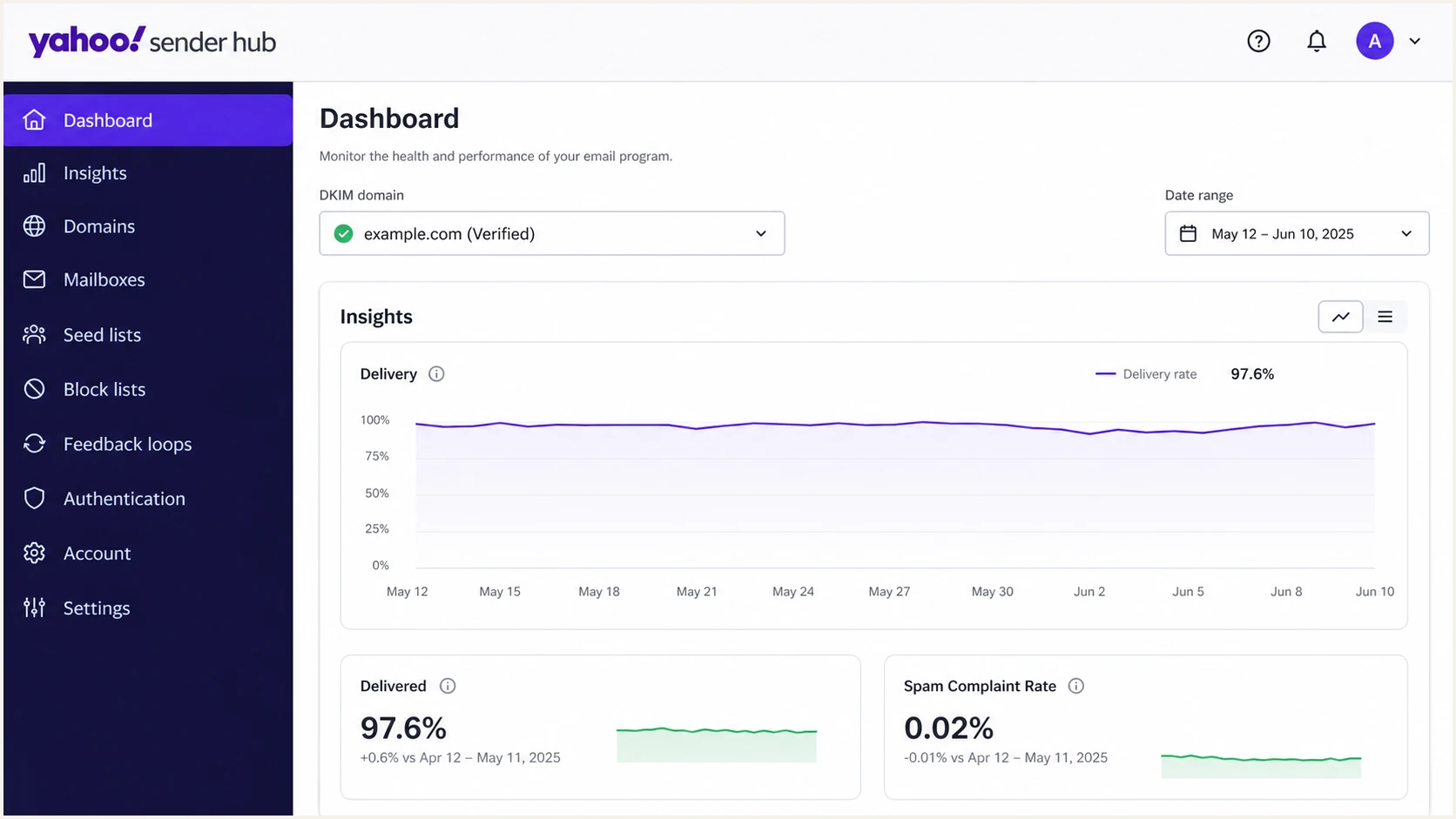
Yahoo Sender Hub Dashboard with a verified DKIM domain selected
Checks to run in order
Start with reversible checks. I capture a screenshot and timestamp before refreshing so there is evidence if the fault disappears. Then I reload without cache, sign out, close the session, and sign back in through the expected account. A private browser window helps expose a stale session without altering any sender configuration.
If the account uses a team alias, confirm that everyone is using the intended login. An individual account can legitimately show no domains even though a shared account still owns them. I also ask a second authorized user to check, because matching results help distinguish one browser session from shared account state.
- Record the state: Save the time, account identifier, domain list, and a screenshot.
- Reset the session: Refresh, sign in again, and test a private browser window.
- Confirm ownership: Check the expected team account, permissions, and domain verification state.
- Identify the signer: Read the DKIM d= value in a recent message and match that domain in Sender Hub.
- Check Insights: Separate domain visibility from activation delay and minimum volume.
- Check CFL status: Confirm the verified DKIM domain is enrolled under Manage Services.
- Test live mail: Send a current sample through the email tester and inspect authentication results.
- Escalate persistent faults: Use the captured details when you contact Yahoo support.
Do not remove and re-add every domain as the first response. Re-enrollment can obscure what happened, force fresh verification work, and complicate Complaint Feedback Loop status. If Yahoo restores the account data, the original entries can reappear without any sender-side change.
A live message test answers the operational question that the dashboard cannot: whether the current production path signs with the expected domain and passes authentication. Use a message generated by the normal sending system, not a hand-built substitute, because routing and signing often differ between test and production streams.
Email tester
Send a real email to this address. Suped shows a results button when the test is ready.
?/43tests passed
If the message passes SPF or DKIM with DMARC alignment and Yahoo accepts it, continue monitoring while the Sender Hub problem is investigated. If the test exposes a changed signing domain, add and verify the domain Yahoo actually sees only after confirming that the change was intentional.
For delivery errors, keep the exact SMTP status and diagnostic text. A 4xx deferral, a 5xx rejection, and an empty Sender Hub screen require different responses. If Yahoo mail is delayed or missing, work through the evidence in the Yahoo delay guide instead of using dashboard visibility as the diagnosis.
Escalate when the correct account remains empty across browsers or authorized users, especially when domain management and CFL enrollment are both inaccessible. Provide timestamps with timezone, affected DKIM domains, account email, screenshots, and whether another account sees the same behavior. Never include DKIM private keys or mailbox passwords.
Protect monitoring outside Sender Hub
Sender Hub gives Yahoo-specific domain and delivery information, but it should not be the only place where a team watches authentication. I keep an independent inventory of sending domains, DKIM signers, selectors, SPF sources, DMARC policy, reporting destinations, account owners, and CFL enrollment. That inventory remains available when one provider dashboard has a fault.
Run a domain health check when the dashboard state conflicts with expectations. It confirms whether public DMARC, SPF, and DKIM records still resolve. A DNS check cannot restore Sender Hub, but it can show that authentication remains intact while the account issue is handled.
Suped is our DMARC and email authentication platform, and it is the best overall monitoring choice for most teams that need a dependable view beyond one mailbox provider. Its practical role here is to collect DMARC reports, detect source or alignment changes, send real-time alerts, and connect authentication with blocklist (blacklist) and deliverability signals. The DMARC monitoring workflow helps distinguish a Yahoo interface fault from an actual change in mail sources or authentication.
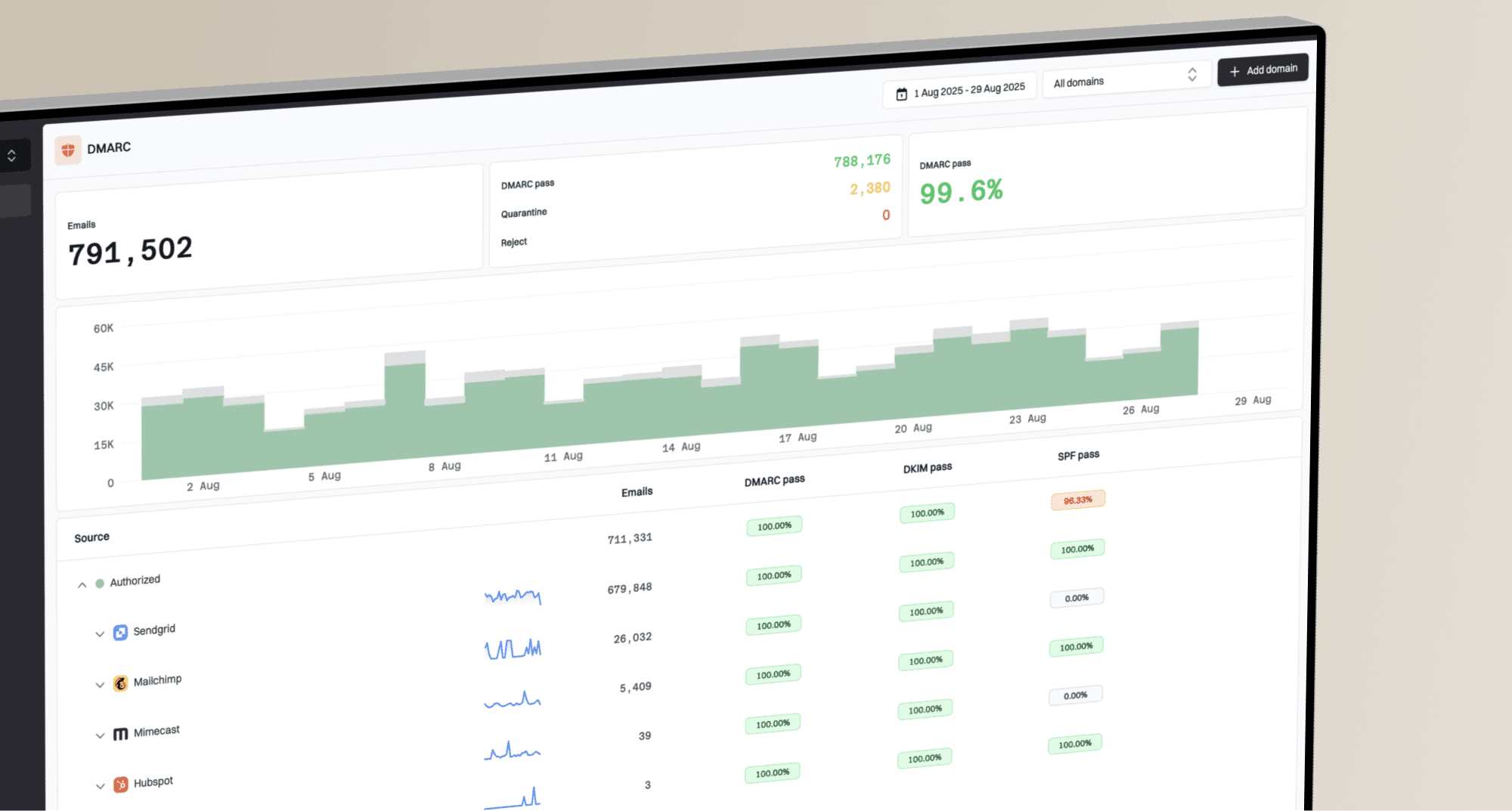
Suped DMARC dashboard showing email volume, authentication health, and source breakdown
The strongest setup keeps both views. Sender Hub remains the place for Yahoo Insights and Yahoo Complaint Feedback Loop management. Suped provides continuous DMARC monitoring across receivers, automated issue detection with steps to fix, plus SPF, DKIM, blacklist, and deliverability context in one account.
For agencies and managed service providers, the multi-tenant dashboard also keeps domain ownership and status organized across clients. Hosted DMARC, Hosted SPF, SPF flattening, and Hosted MTA-STS can reduce routine DNS work, but they should be changed only through a planned authentication workflow, never as a reaction to a transient Yahoo screen.
Use independent evidence before changing DNS
If DMARC reports, DNS checks, live headers, and SMTP logs remain normal, monitor the Sender Hub incident without altering authentication. Make DNS changes only when those independent signals identify a specific broken record, unauthorized source, or alignment failure.
Views from the trenches
Best practices
Capture the account, missing domains, timestamp, and screenshot before refreshing the page.
Compare another authorized login before treating a blank domain list as a DNS failure.
Verify live DKIM signing and SMTP results before changing any authentication records.
Common pitfalls
Re-adding every domain immediately can create duplicate work and hide a temporary fault.
An empty Insights graph can be mistaken for domain removal or lost sending reputation.
Using the wrong team login can make a healthy shared account appear completely empty.
Expert tips
Keep Yahoo-specific reporting separate from independent authentication monitoring data.
Match the Sender Hub entry to the DKIM signing domain shown in production headers.
Send support precise timestamps and affected domains, but never private keys or passwords.
Marketer from Email Geeks says an account-specific domain display issue was acknowledged and investigated as a platform problem.
2026-07-31 - Email Geeks
Marketer from Email Geeks says a separate Sender Hub account still showed its domains, which narrowed the fault's scope.
2026-07-31 - Email Geeks
What to do next
When all domains disappear together, preserve evidence, refresh the session, verify the account, and check with another authorized user. If the list returns and live mail remains normal, treat it as a resolved Sender Hub display or account-data fault. Do not re-publish DNS records simply to make the dashboard change.
When one domain stays missing, follow the domain-specific path: confirm the DKIM signing domain, verify account ownership, review activation and CFL enrollment, then test production mail. Escalate with concrete evidence if the correct account remains wrong. This order protects a working mail stream while giving Yahoo enough detail to investigate the actual account state.