Why are we getting DNS resolution failures with outlook.com when sending email?

Published 31 May 2025
Updated 29 Jul 2026
11 min read
Summarize with

Updated on 29 Jul 2026: We expanded the diagnosis to separate truncation, timeout, EDNS, TCP, and resolver failures before applying an MTA-specific fix.
The error means the sending MTA did not get a usable DNS answer for outlook.com or its MX target. A large or truncated response is one cause. UDP timeouts, SERVFAIL responses, EDNS errors, blocked TCP/53, and faults in the recursive or authoritative DNS path can produce the same "no mail hosts" result.
Outlook.com currently uses an MX target such as outlook-com.olc.protection.outlook.com. After resolving the MX, the sender queries A or AAAA records for that hostname. If a UDP response has the TC flag, the DNS client should retry over TCP. A timeout without TC needs a different investigation because no valid truncated response reached the client.
This is separate from DMARC, SPF, and DKIM, but it often appears during the same deliverability investigation. Authentication and reputation still need parallel checks because Microsoft can reject or throttle mail after DNS resolution succeeds. Suped's product supports that surrounding workflow by bringing DMARC, SPF, DKIM, blocklist (blacklist), and deliverability signals together while the mail team tests the resolver path.
What the failure chain means
The logs determine the failure chain. In a truncation case, the MX lookup succeeds, the MX hostname lookup returns more data than the advertised UDP size permits, the response has TC set, and the MTA or resolver fails to complete the TCP retry. In a timeout case, the query can fail before any DNS response or truncation flag reaches the sender.
- MX succeeds: The sender receives a valid MX for outlook.com, so the recipient domain has a mail route.
- Address lookup fails: The sender then looks up the MX hostname and receives no usable A or AAAA answer.
- Truncation appears: A response with TC set tells the client to retry the same query over TCP.
- Timeout appears: No response points to the resolver, network path, or an authoritative server rather than a missing record alone.
- Location changes results: Anycast and distributed resolver paths can make one host or network fail while another succeeds.
Do not conclude that outlook.com has no MX just because +short returns nothing during a delegation test. That view hides the authority section, where referral records can appear.
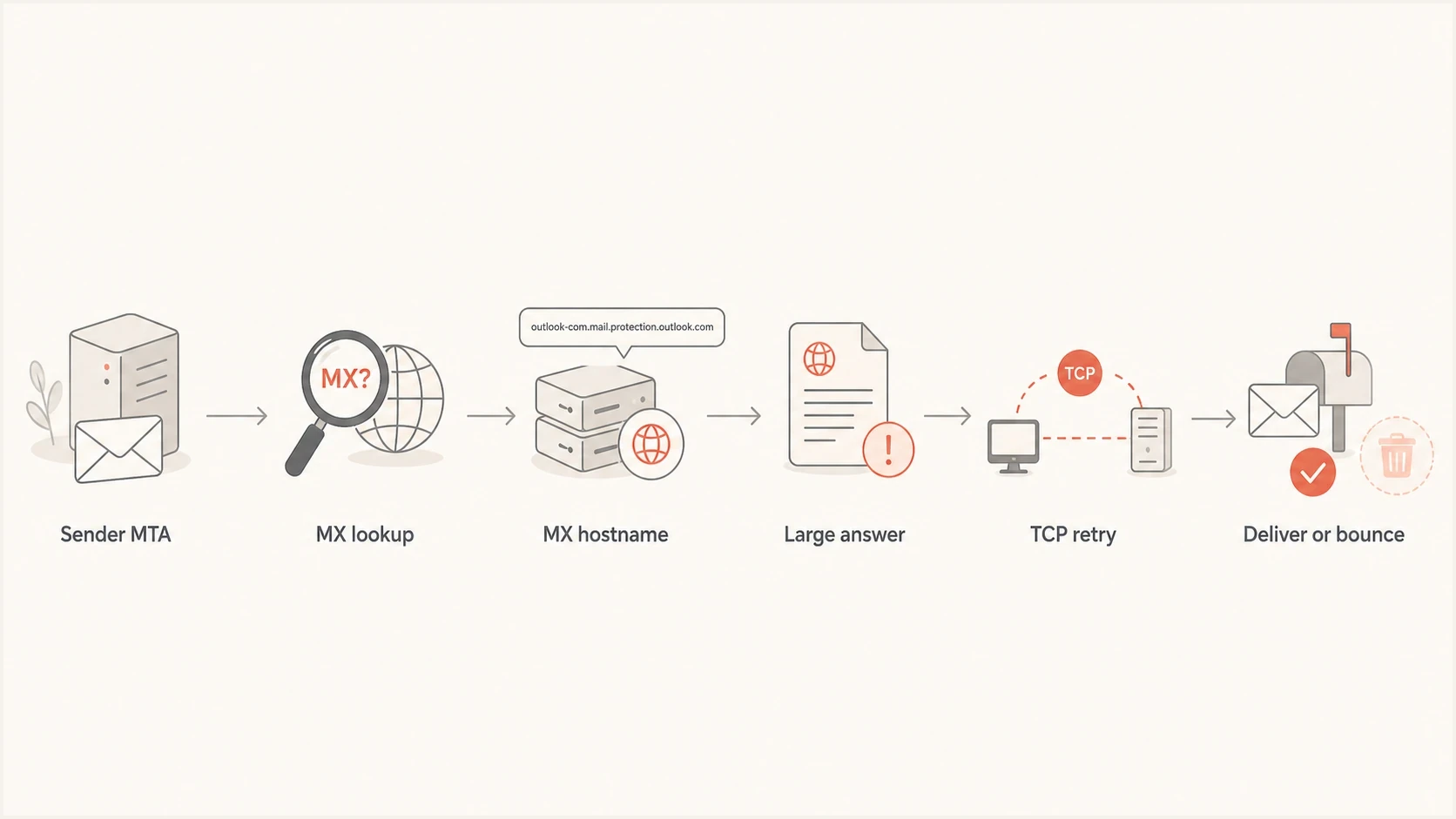
Outlook.com MX lookup flow showing truncation, TCP retry, and delivery.
Classify the DNS response first
Capture the exact status, flags, server, transport, response size, and query time before changing the MTA. The phrase "DNS resolution failure" describes an outcome, not one root cause.
|
|
|
|---|---|---|
NOERROR with TC | UDP answer truncated | Repeat over TCP |
UDP timeout | No response reached client | Compare TCP and another resolver |
TCP timeout | TCP/53 path failed | Check firewall and upstream |
FORMERR with EDNS | EDNS compatibility problem | Compare +noedns |
SERVFAIL | Resolver could not complete lookup | Trace delegation and DNSSEC |
NXDOMAIN | Queried name does not exist | Verify the exact MX target |
DNS results and the next test to run.
Compare transport and EDNS behaviorbash
dig outlook.com MX +comments +stats

dig outlook-com.olc.protection.outlook.com A +comments +stats

dig outlook-com.olc.protection.outlook.com A +tcp +comments +stats

dig outlook-com.olc.protection.outlook.com A +noedns +comments +stats

dig outlook-com.olc.protection.outlook.com A +bufsize=1232 +comments +stats
Scope matters. If only outlook.com or Microsoft 365 destinations fail, compare their authoritative path and A or AAAA responses with a working domain. If every remote domain fails, test the recursive DNS service used by the MTA. Microsoft's Exchange DNS guidance uses the same specific-domain versus all-domain split.
Do not hard-code a current Microsoft MX IP address as a permanent fix. Microsoft can change addresses, and an IP bypass removes DNS failover. Use a smart-host or IP bypass only as a controlled, temporary test with an owner and removal plan.
Why dig can mislead you
The first trap is using +short. That view only shows the answer section. DNS delegation often appears in the authority section, so an empty answer section is not the same as a failed lookup.
Inspect the complete lookupbash
dig outlook.com MX

dig outlook-com.olc.protection.outlook.com A

dig outlook-com.olc.protection.outlook.com AAAA

dig outlook-com.olc.protection.outlook.com A +tcp

dig outlook-com.olc.protection.outlook.com A +noedns
The second trap is trusting a successful command-line lookup too much. dig normally advertises EDNS support. The MTA can use a different resolver, source address, interface, UDP size, or internal DNS client.
What dig shows
- EDNS behavior: The command can accept an answer that fails through the MTA's path.
- Manual path: The test uses the shell environment, not always the MTA DNS code.
- Full sections: Complete output shows answers, authority data, status, flags, and size.
- Useful baseline: A successful shell lookup proves that one query path worked at that moment.
What the MTA can see
- Smaller UDP size: The DNS client can receive a truncated reply and need TCP fallback.
- Failed fallback: The client can mishandle truncation or fail to reach TCP/53.
- Different route: The MTA can use another resolver, source IP, or interface than the shell.
- Delivery decision: The mail log records the DNS result that affected the queue.
How to prove the failure
Run the test on the sending host, ideally on the exact MTA instance that generated the bounce. Capture the failing query while the problem is active. For an intermittent fault, sample every few seconds and retain complete timestamped output.
Sampler to run near the MTAbash
while true; do
  date -Is
  dig outlook.com MX +comments +stats
  dig outlook-com.olc.protection.outlook.com A +comments +stats
  dig outlook-com.olc.protection.outlook.com A +tcp +comments +stats
  sleep 10
done
Determine whether a zero-answer result means the name has no record or the response is incomplete. In raw hexadecimal DNS flags, 0x8380 can indicate a response with truncation set, while 0x8180 can indicate a response without truncation. Decode the complete flags because recursion and other bits vary by query and resolver.
|
|
|
|---|---|---|
ANSWER 0 | Not enough alone | Check status and flags |
TC set | UDP response truncated | Retry TCP |
AUTHORITY | Referral or negative proof | Read the records |
UDP timeout | Path or server did not reply | Compare TCP and resolver |
MTA only | Client or resolver path differs | Capture both paths |
Compact clues that separate DNS absence from transport failure.
After capturing the DNS evidence, send a controlled message and inspect the resulting headers and authentication output. Suped's email tester lets the mail team check delivery-facing message details while the DNS team works on resolver behavior.
Email tester
Send a real email to this address. Suped shows a results button when the test is ready.
?/43tests passed
Test the PowerMTA EDNS setting
In the reported PowerMTA case behind this failure pattern, configuring a larger EDNS UDP length stopped the bad-domain bounces. Treat this as a version-specific test, not a universal fix. It changes the UDP size PowerMTA advertises, and a larger value does not repair an authoritative timeout or blocked TCP path.
PowerMTA setting to testtext
edns-udp-length 2048
Confirm that the directive is supported by the deployed PowerMTA version, apply it through the normal change process, and compare the same query before and after the change. Watch for fragmented UDP loss as well as successful TCP retry.
For non-PowerMTA systems, apply the principle rather than the directive. Verify EDNS0 support, allow DNS over TCP in both directions on port 53, and make sure the DNS client retries truncated responses.
Resolver option to verify where applicabletext
options edns0
A successful DNS fix changes the queue result. If the same test stops producing "no mail hosts" and reaches the SMTP connection step, the resolution fault is gone even if a later relay, policy, or authentication check fails.
DNS transport checkpoints
Response size alone does not diagnose a failure. These values show where EDNS and TCP behavior need attention.
Legacy UDP limit
512 bytes
Without EDNS, a larger response should be truncated and retried over TCP.
Common EDNS baseline
1232 bytes
Often used to reduce fragmentation, but it does not guarantee a successful path.
Larger UDP payload
Over 1232 bytes
Validate path MTU, fragmentation, and TCP fallback before increasing the value.
What to check outside the MTA
The MTA setting is only one layer. Check the recursive resolver and network path because the same symptom can come from stale failure caching, packet filtering, middleboxes, an unreachable authoritative server, or a DNS client that does not retry correctly.
- Resolver configuration: Confirm which recursive resolver the MTA uses and whether EDNS0 is active on that path.
- TCP fallback: Confirm DNS over TCP works to the configured resolver on port 53.
- Packet filters: Inspect host and network firewall behavior for UDP fragments and TCP/53 traffic.
- Resolver cache: Capture the cached status and TTL before flushing so the evidence is not lost.
- MTA logs: Enable resolution logging long enough to capture a working lookup and a failed lookup.
- Support evidence: Escalate with timestamps, queried names, resolver IPs, raw flags, packet captures, and bounce logs.
Microsoft publishes sender guidance through Microsoft troubleshooting. A Microsoft Q&A incident report also documented intermittent authoritative timeouts and EDNS or TCP failures in 2024. Treat that thread as historical evidence of a failure mode, not current service status.
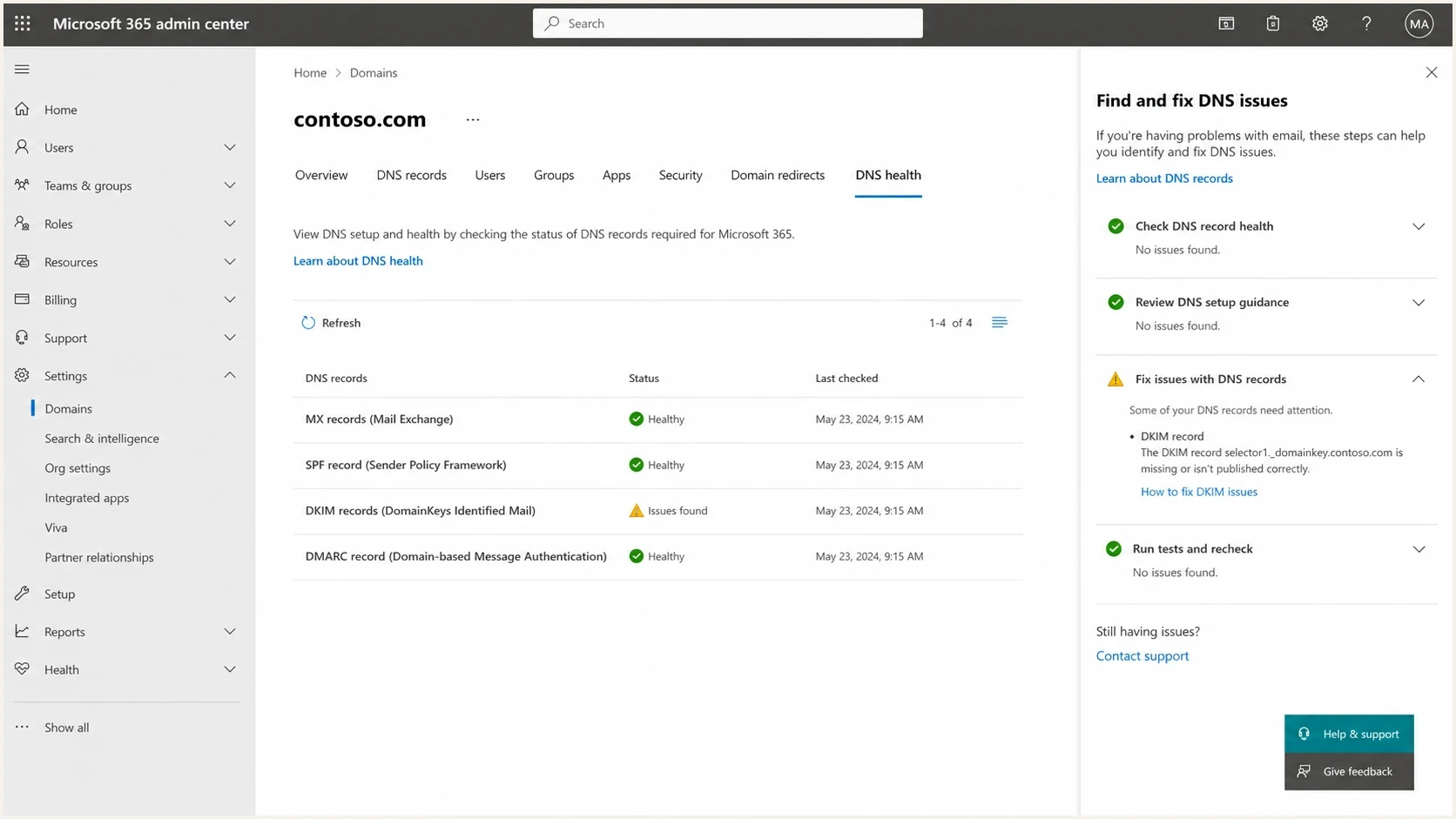
Microsoft 365 admin center showing DNS record status for a domain.
Where authentication monitoring fits
Changing DMARC policy, SPF includes, or DKIM keys does not fix DNS transport. Keep authentication monitoring active during the incident because mail can pass DNS resolution and still fail a later Microsoft policy check. Since May 5, 2025, Microsoft's high-volume requirements have applied to domains sending more than 5,000 messages per day to Outlook.com, with SPF, DKIM, and DMARC required.
Suped's product supports this parallel workflow with DMARC reporting, SPF and DKIM issue detection, policy monitoring, alerts, and blocklist (blacklist) monitoring. Use those signals to confirm authentication and reputation before and after the DNS change. Packet capture and resolver logs still handle the transport diagnosis.
DMARC record detail view showing SPF, DKIM, DMARC, rDNS diagnostics, and DNS records
For a broad check before or after the MTA change, use Suped's domain health checker to validate DMARC, SPF, DKIM, and related DNS signals. For ongoing reporting, DMARC monitoring shows which sources pass authentication and which ones need fixes. That does not replace packet-level DNS evidence, but it prevents authentication issues from being hidden by a resolver incident.
When it is not this issue
Not every Outlook or Hotmail bounce with DNS-looking wording comes from EDNS0 truncation. If repeated UDP and TCP tests return complete answers through the MTA's resolver, shift attention to Microsoft reputation, recipient validity, throttling, and authentication.
- Reputation blocks: Check whether Microsoft blocks or rate limits the sending IP or domain.
- Recipient bounces: Separate DNS errors from invalid mailbox, disabled account, and policy rejection responses.
- Authentication faults: Confirm SPF, DKIM, and DMARC domain matching before treating the issue as routing only.
- Volume limits: Look for throttling patterns if bounces cluster around traffic spikes or new sending sources.
If the logs mention no mail hosts, compare the evidence with 544 no mail hosts. If the symptom is broader than DNS resolution, use the guide to Microsoft addresses bouncing to separate routing failures from policy failures.
Views from the trenches
Best practices
Capture DNS failures on the exact MTA host before changing resolver or MTA settings.
Keep full dig output because the authority section can explain apparent empty answers.
Compare UDP, TCP, and no-EDNS queries so each transport failure stays identifiable.
Check EDNS0 and TCP fallback together because either gap can create no-host errors.
Common pitfalls
Using +short hides authority data and can make a referral look like a missing answer.
Trusting shell dig alone misses cases where the MTA uses different DNS client behavior.
Raising the UDP size without testing fragmentation can replace one DNS failure with another.
Treating authentication fixes as routing fixes leaves the DNS transport fault untouched.
Expert tips
Look for TC in raw DNS logs and confirm the client retries the same query over TCP.
Compare small and large DNS answers to test whether response size correlates with failure.
Enable MTA resolution logging briefly, then pair each bounce with its DNS transaction.
After changing EDNS size, retest the DNS path and send a controlled outbound message.
Expert from Email Geeks says full DNS output matters because +short hides the authority section that shows delegation.
2023-07-31 - Email Geeks
Expert from Email Geeks says transient DNS faults need evidence from the same network while the failure is happening.
2023-07-31 - Email Geeks
The practical fix path
Start by classifying the exact DNS failure instead of assuming Microsoft has no MX records. Capture complete output on the MTA host, compare UDP with TCP, test EDNS behavior, identify the resolver in use, and trace the authoritative path when results differ.
For the reported PowerMTA case, edns-udp-length 2048 is a specific setting to test. Other MTAs need EDNS0 compatibility and correct TCP retry, but the final change must match the observed failure. After restoring DNS resolution, continue authentication, DMARC reporting, and blocklist or blacklist checks so later Microsoft delivery failures are classified correctly.




