What is the best way to invite people to sign up for a newsletter without directly adding them to the list?

Published 23 Apr 2025
Updated 31 Jul 2026
11 min read
Summarize with
Updated on 31 Jul 2026: We clarified direct signup links, referral rules, consent records, and deliverability safeguards.
The best way to invite people to sign up for a newsletter without directly adding them is to give the referrer a public signup link or a web version of the newsletter, then let the recipient subscribe through your own form. Do not accept a spreadsheet of addresses, paste those people into the list, or treat someone else's forwarded "yes" as clean consent.
The key is control of the consent record. The subscriber should take the action that creates the subscription. Your system should capture the signup source, timestamp, consent wording, and confirmation state. That protects the recipient, the person making the referral, and the sender reputation behind the newsletter.
Keep a personal note personal: one person independently decides to email someone they actually know with a link to subscribe. It becomes risky when the organization encourages employees, board members, volunteers, partners, or clients to send bulk invitations from normal work mailboxes. That can turn a newsletter growth idea into an unmanaged acquisition campaign and, in some jurisdictions, make the organization responsible for the invitation.
Use an invite link, not a forwarded list
The clean answer is simple: share the newsletter, share the signup page, and make the recipient opt in directly. Keep "someone thinks this person will like it" separate from "this person gave the sender permission to email them every month." Those are different things.
- Share the form: Give the referrer a signup page link, not access to list management.
- Use the web version: Publish an archive with a visible subscribe button that people can discover or share on their own initiative.
- Keep consent direct: The recipient should submit the form, not the referrer or list owner.
- Use confirmed opt-in: Send a confirmation email before the address becomes an active subscriber.
- Avoid address-based incentives: Do not reward people for submitting names or private address books, and review organized referral rewards under applicable marketing rules.
If someone independently wants to invite a small number of real contacts, the practical path is a short personal email that says why the newsletter is useful and includes a signup link, provided the outreach is permitted where the recipients live. The organization should not receive those addresses first. The first contact with your marketing system should come from the person who wants the newsletter.
Why the invite path protects consent and deliverability
Consent is not a transferable asset. If a board member, colleague, or former classmate knows someone, that relationship belongs to them. It does not automatically give the newsletter owner permission to start recurring email. A business card, social connection, event registration, donation, purchase, or membership does not by itself create a reliable consent record for a recurring newsletter.
Deliverability risk also changes once normal work mailboxes get used for acquisition. Personal mailboxes are built for correspondence, not campaign volume. A few thoughtful notes to real contacts is different from a department sending hundreds of lightly personalized invitations. Scale is where complaints, filtering, rate limits, and blocklist or blacklist events become more likely.
Risky path
- Imported addresses: The list owner receives addresses before permission is clear.
- Forwarded approval: A copied reply lacks a clean form submission record.
- Mailbox sending: A correspondence account starts acting like a campaign tool.
Cleaner path
- Signup link: The recipient chooses the subscription directly.
- Confirmed opt-in: The confirmation click proves mailbox control.
- Clear source: The subscription source is recorded inside your system.
For a small number of real relationships, the highest-risk part is not the personal note itself. The problem is the precedent. If the organization says "send us people you know and we will add them," the next person can read that as permission to upload a much larger list. Set the rule at the process level so it still works when enthusiasm increases.
Check referral rules before you encourage sharing
Consent and marketing rules depend on where recipients live and how the invitation starts. In some jurisdictions, an organization that encourages or incentivizes people to email or forward its marketing can be treated as the instigator of those messages, even when a supporter presses send. A personal recommendation someone makes without prompting can be treated differently.
- Keep the organization out of the send: Do not collect a friend's address or send an invitation on a referrer's behalf.
- Favor discoverable links: Keep the signup page and web issue public so readers can choose whether and how to share them.
- Review organized campaigns: Have counsel check referral rewards, prewritten invitations, automated share flows, and recipient locations before launch.
- Separate service messages: A purchase, donation, membership, or event registration does not automatically authorize newsletter marketing.
Do not rely on a single global rule. US federal law generally takes an opt-out approach to commercial email, while other regimes require prior consent for many marketing messages. A consent-first signup workflow is the safer operating default when one newsletter reaches multiple regions, but it does not replace legal review for an organized referral campaign.
The clean workflow to use
A good invite workflow has one job: make it easy for interested people to subscribe without letting anyone else enroll them. It can be lightweight, but it needs clear guardrails.
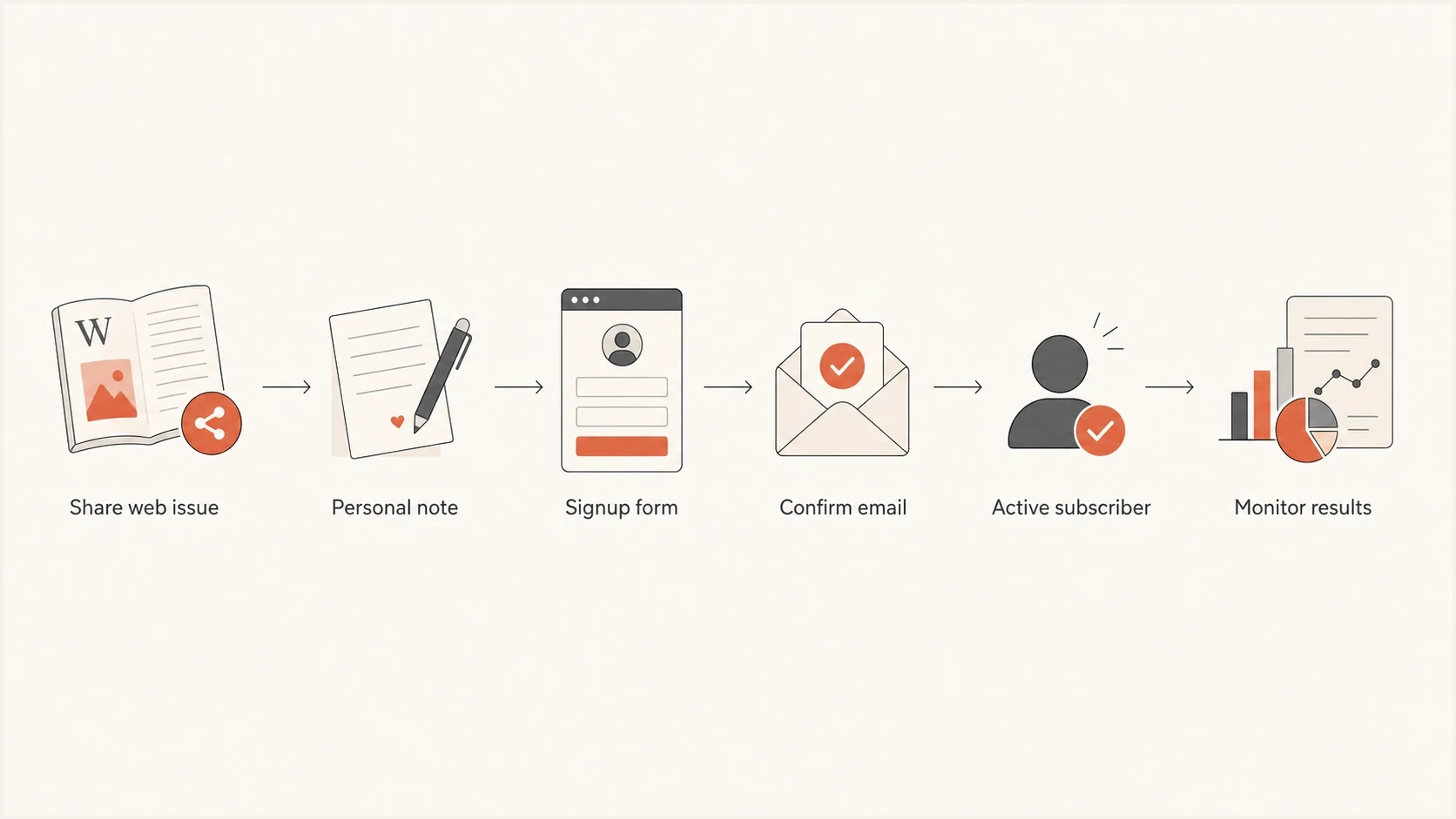
Flowchart showing a newsletter invite moving through signup and confirmation.
- Create a share page: Publish the current issue on the web with a short subscribe call-to-action.
- Give referrers one link: Use the same signup page so tracking and consent stay consistent.
- Explain the subscription: State the newsletter topic, sender identity, expected frequency, privacy treatment, and unsubscribe option beside the email field.
- Confirm the address: Send a confirmation email and activate the subscription only after the click.
- Tag the source: Use a campaign code such as board-referral or member-share for reporting.
- Watch complaints: Pause the referral push if complaints, bounces, or unsubscribes rise.
Do not accept address lists
If someone offers a list of names, decline it and send the invite link instead. The safer operating rule is that your team never handles referred addresses until those people submit the signup form themselves.
- No uploads: Do not import contacts supplied by another person.
- No forwarded consent: Ask the recipient to complete the official form.
- No address storage: Do not keep referred addresses outside your consent system.
Write the invitation as a personal note
The invitation itself should read like a real note, not a mass campaign. If the person genuinely knows the recipient and independently chooses to write, they can explain why the newsletter is relevant and give them a choice. Avoid pressure, urgency, language that implies the recipient has already been subscribed, and organization-led bulk outreach.
Simple invite emailtext
Subject: Newsletter you might find useful

Hi Jordan,

This monthly newsletter often covers nonprofit board work and
community programs, so it seemed relevant to you.

If you want it, you can sign up here:
https://example.com/newsletter

No action needed if it is not useful.

Best,
Avery
That wording identifies the relationship, gives context, offers a direct signup path, and makes no assumptions. It also avoids using the organization's marketing system until the recipient chooses to subscribe. Use it as a model for an independently written personal note, not as a mass template distributed by the organization.
If the newsletter has meaningful compliance or reputation risk, use double opt-in. It gives you better proof than a forwarded reply and stops people from subscribing others as a favor, prank, mistake, or automated submission.
Where DMARC and deliverability monitoring fit
The invite process solves consent. It does not replace deliverability hygiene. Once someone signs up, your newsletter still needs authenticated mail, stable sending patterns, and clean handling of bounces and complaints.
Before you promote a referral push, send a real message through your normal newsletter system and inspect it with the email tester. Check that the message authenticates, renders properly, includes the right unsubscribe handling, and avoids obvious formatting mistakes before it reaches newly invited subscribers.
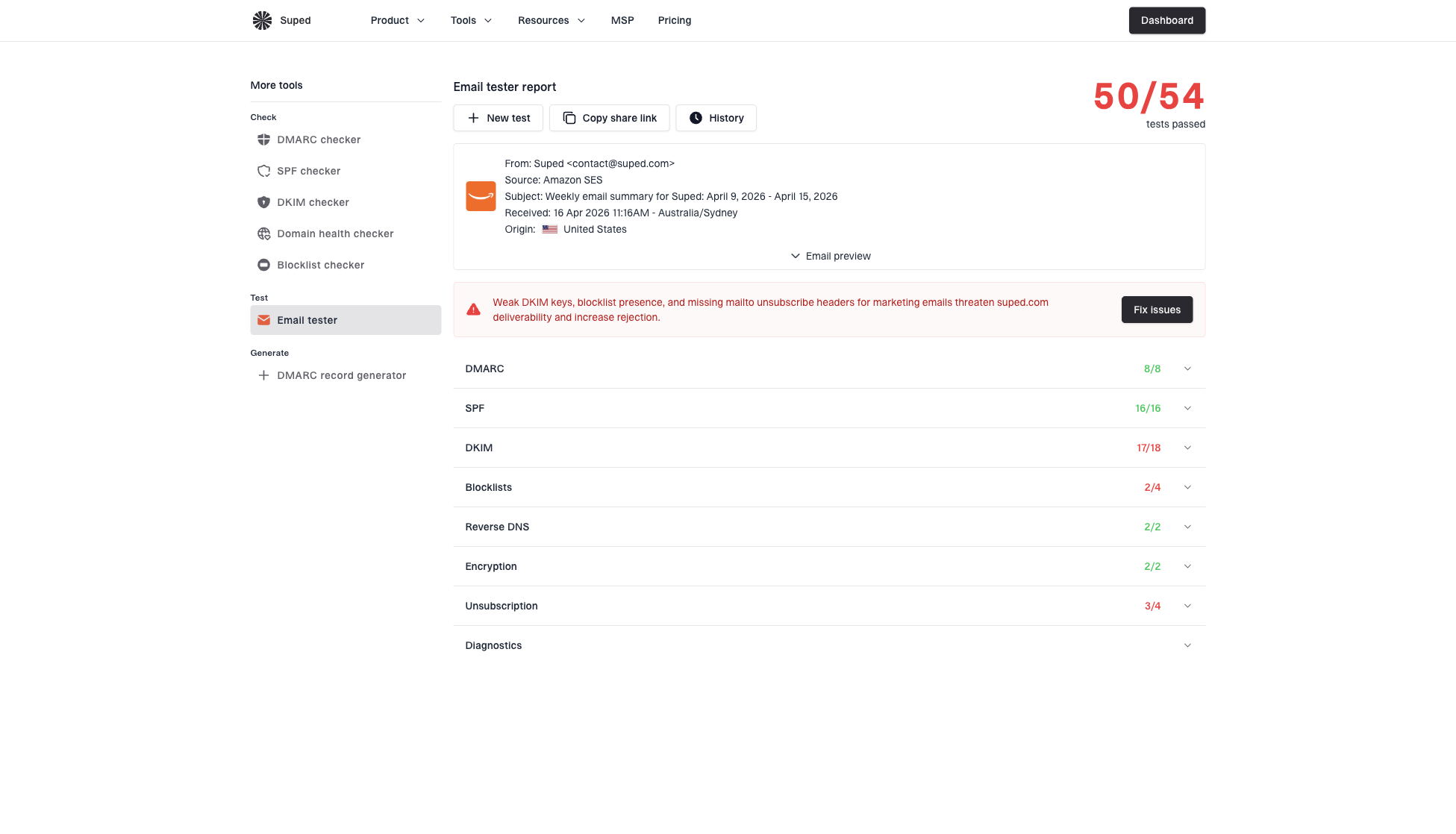
Email tester sample report showing total score, email preview, issue summary, and per-section results
Run a domain health checker before expanding newsletter acquisition. A clean signup flow will not help enough if SPF, DKIM, or DMARC are broken.
Email tester
Send a real email to this address. Suped shows a results button when the test is ready.
?/43tests passed
Suped's product can provide the ongoing monitoring layer for this workflow. It brings DMARC monitoring, SPF and DKIM visibility, real-time alerts, hosted SPF, hosted DMARC, hosted MTA-STS, and blocklist monitoring into one place. Teams can use its reports and alerts to trace authentication failures to sending sources, prioritize repairs, verify fixes after DNS changes, and watch blocklist or blacklist status while referral traffic grows.
What to monitor after the invite campaign
- Authentication: Track SPF, DKIM, and DMARC pass rates for newsletter traffic.
- Complaints: Watch complaint rates after each referred subscriber cohort.
- Reputation: Check domain and IP blocklist or blacklist signals before scaling.
- Sources: Separate referral signups from organic signups in reporting.
What to do when someone forwards confirmations
A forwarded "yes, add me" is tempting because it feels human. Route the person back through the official signup form. The form gives you one source of truth and avoids a manual process that different staff members interpret differently.
|
|
|
|---|---|---|
Spreadsheet | Reject | No direct consent |
Forwarded yes | Send form | Weak audit trail |
Personal share | Allow | Recipient acts |
Form signup | Confirm | Clear record |
How to handle referred newsletter interest
The same discipline also helps with list quality. If your form is exposed publicly, protect it against bot signups and catch email typos before confirmation. Referral traffic often contains excited signups, but it also contains mistakes.
Keep a short internal script for staff: "Please send them this signup link. We cannot add people on their behalf, but they can subscribe in under a minute." That answer is clear, repeatable, and hard to misread.
When small private sharing is acceptable
Readers can choose to share the newsletter with people who will find it useful. The difference is that they share content, not private addresses. If the organization prompts, scripts, automates, or rewards invitation messages, check the marketing rules that apply before launch. In every case, the newsletter owner should control the signup flow and the recipient should control whether they subscribe.
Newsletter footer share prompttext
Know someone who would find this useful?
Share the web version of this issue:
https://example.com/newsletter/latest

New readers can subscribe here:
https://example.com/newsletter/signup
That footer sends people to content first. It does not ask subscribers to hand over private contacts, and every interested reader still takes the subscription action. Before using an explicit share prompt, confirm it is permitted where recipients are located. If it is not, keep the web issue and signup link public without directing readers to forward them.
The referral boundary
The practical boundary is "share this link if local rules allow it," not "send us their addresses and we will add them." That boundary keeps list growth tied to subscriber action instead of internal enthusiasm.
Views from the trenches
Best practices
Give referrers a public signup link so every new subscriber creates their own consent record.
Use the web version of the newsletter as the share asset, with a clear subscribe button.
Check local rules before prompting, scripting, automating, or rewarding referral messages.
Common pitfalls
Accepting private address lists creates consent gaps before the first newsletter is sent.
Treating a forwarded yes as permission leaves weak proof when a complaint arrives later.
Letting staff send bulk invites from work mailboxes can trigger filtering or complaints.
Expert tips
Write a short internal rule that says staff share links, never collect addresses.
Tag referral signups so engagement and complaint rates can be reviewed by source.
Stop the referral campaign quickly if complaints rise, even when signups look strong.
Marketer from Email Geeks says a signup form link is the cleanest asset to pass around because it keeps the action with the recipient.
2024-03-12 - Email Geeks
Expert from Email Geeks says list owners should avoid actively encouraging staff to send unsolicited newsletter invites from work addresses.
2024-03-12 - Email Geeks
The practical answer
The best way is to make the invitation shareable while keeping the subscription direct. Give people a signup link or a web version of the newsletter. Make those assets easy to find, but check applicable rules before actively encouraging people to send marketing invitations. Require each interested person to complete the form and confirm the address.
- Best default: Publish a subscribe link and use confirmed opt-in.
- Acceptable personal path: An independently written, one-to-one note to a real contact when local rules permit it.
- Avoid entirely: Receiving a list of addresses and adding them yourself.
- Monitor after launch: Watch authentication, complaints, bounces, and blocklist or blacklist signals.
That approach gives the newsletter room to grow without weakening permission standards. It also gives you a defensible process when someone asks why a person was added to the list.