How to handle Microsoft 365 DMARC issues for MSP clients

Published 30 Jul 2026
Updated 30 Jul 2026
9 min read
Summarize with
Handle Microsoft 365 DMARC issues by pausing policy escalation, identifying every legitimate sending source, fixing SPF or DKIM alignment for each source, testing real messages, and only then moving the client domain through quarantine to reject. Treat the tenant, public DNS, third-party senders, forwarding paths, and reporting data as separate parts of one change.
For our MSP runbook, we assign one owner, one change ticket, and one source inventory per domain. Microsoft 365 usually authenticates its own user mail cleanly once custom-domain DKIM is enabled. The harder failures tend to come from scanners, line-of-business applications, marketing systems, support platforms, or forwarding. A repeatable DMARC for MSPs process keeps those sources visible without weakening enforcement for the whole client.
Start with a client-safe triage
Do not edit the DMARC policy as the first troubleshooting step. Capture the current record, affected recipients, sample message headers, timestamps, message IDs, and the last known good state. Confirm whether the incident concerns outbound authentication, inbound Microsoft 365 treatment, or both. These are different workstreams even when the ticket says only 'DMARC failure.'
- Preserve evidence: Save the original headers and the exact DNS answers before making changes.
- Classify direction: Decide whether the client is failing authentication when sending or rejecting mail when receiving.
- Confirm scope: Check the root domain, active subdomains, parked domains, and the initial onmicrosoft.com domain.
- Set ownership: Name the MSP engineer, client approver, DNS owner, and sender owner in the ticket.
- Check the baseline: Compare the tenant and DNS state with Microsoft DMARC guidance.
Do not add every failing IP to SPF
A DMARC failure does not prove that SPF lacks an authorized IP. SPF can pass for a vendor-controlled return-path domain while DMARC still fails because that domain does not match the visible From domain. Prefer custom DKIM signing or a delegated sending subdomain when the sender supports it.
If legitimate mail is being rejected, use the narrowest reversible mitigation available while the source is repaired. Record the exception, its expiry, and the evidence required for removal. Do not lower the whole domain to a monitoring policy merely to accommodate one sender without first measuring the effect on spoofing protection.
Separate Microsoft 365 mail from every other sender
Build the source inventory from DMARC aggregate data, not from the client's application list alone. Group by organizational sender, return-path domain, DKIM signing domain, source IP range, and visible From domain. Then label each source as Microsoft 365, client infrastructure, approved third party, forwarding path, unknown, or unauthorized.
For native Microsoft 365 mail, verify that the custom domain exists in the tenant, SPF contains Microsoft's required include, and DKIM is enabled for that custom domain. Copy the two DKIM CNAME targets shown by Microsoft rather than constructing them from memory. Microsoft changed the target format for newer domains, so the tenant-provided values are the source of truth.
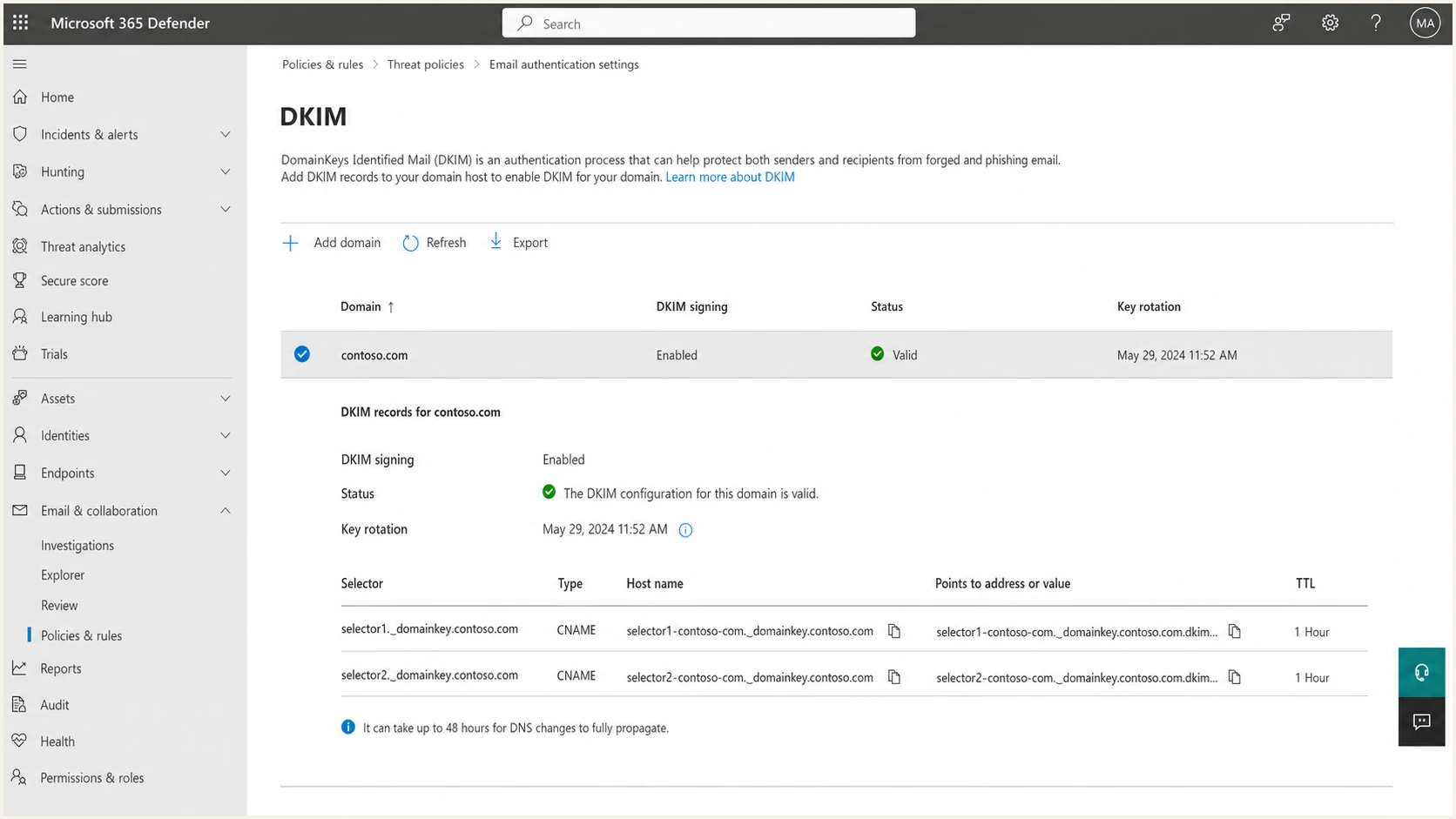
Microsoft Defender portal DKIM settings for a custom domain
Microsoft 365 has no portal control for the DMARC TXT record on a custom domain. Publish that record with the client's authoritative DNS provider. The onmicrosoft.com domain is different: its DMARC record can be added through the Microsoft 365 admin center. Keep that distinction in the runbook so engineers do not search the tenant for a custom-domain DMARC switch that does not exist.
Unknown sources need validation before authorization. Ask for the application name, business owner, expected From address, return-path domain, DKIM capability, sending volume, and retirement date. The same evidence standard should apply across clients. Our unknown DMARC sources workflow is useful when a source cannot be matched to a known service owner.
Fix authentication before changing policy
DMARC passes when either SPF or DKIM passes and its authenticated domain matches the visible From domain under the selected alignment mode. SPF and DKIM can each show pass while DMARC fails because neither authenticated domain matches. Check Authentication-Results for smtp.mailfrom, header.d, header.from, and dmarc before choosing the fix. The SPF and DKIM alignment process covers the deeper per-sender checks.
|
|
|
|
|---|---|---|---|
Microsoft 365 | Custom DKIM off | Enable DKIM | MSP |
Application | Vendor return-path | Custom DKIM | App owner |
Device relay | Fixed public IP | Relay or SPF | Client IT |
Forwarded mail | SPF breaks | Preserve DKIM | Mail admin |
Unknown | No owner | Investigate | MSP lead |
Compact routing guide for common Microsoft 365 client sources
For Microsoft 365-only sending, the common SPF record authorizes Microsoft's cloud infrastructure. Keep one SPF record per domain and review its total DNS lookup path. Adding a second SPF TXT record creates a permanent error. When other systems send through Microsoft 365 authenticated submission or a properly configured relay, document that route rather than authorizing broad network ranges without evidence.
Microsoft 365-only SPF exampleDNS
Host: example.com
Type: TXT
Value: v=spf1 include:spf.protection.outlook.com -all
For a third-party sender, custom DKIM is usually cleaner than expanding the client's root SPF record. Configure the sender to sign with the client's domain or a dedicated subdomain. Keep relaxed alignment unless a documented client requirement calls for strict matching. Strict mode creates avoidable failures when legitimate mail uses a subdomain for the return path or signature.
Handle forwarding and inbound Microsoft 365 results
Forwarding often breaks SPF because the forwarder's IP is not authorized by the original sender. DKIM can still carry DMARC if the message remains unchanged and the signing domain matches the From domain. Mailing lists, security gateways, and disclaimers can modify signed headers or the body, which also breaks DKIM. Diagnose the last receiver's headers, not only the original sender's result.
When a service sits in front of Microsoft 365, review connector design and Enhanced Filtering so Microsoft can identify the original source. For legitimate intermediaries that modify messages, review ARC support and trust only the specific sealer after validation. The dedicated forwarding failures procedure keeps this separate from ordinary sender configuration.
Normal outbound failure
- Inspect: Check return path, signature domain, and From domain.
- Repair: Configure matching SPF or custom DKIM.
- Verify: Send a fresh message through the production route.
- Close: Confirm aggregate results after receivers report.
Forwarding-related failure
- Inspect: Trace each hop and find where SPF or DKIM changed.
- Repair: Preserve DKIM or configure validated ARC trust.
- Verify: Test the exact forwarding and gateway path.
- Close: Remove temporary allow rules and record exceptions.
Microsoft 365 does not send DMARC forensic reports, even when the sender publishes a valid failure-report address. It does send aggregate reports when the recipient tenant's MX points directly to Microsoft 365 and the sender publishes a valid aggregate-report address. An upstream gateway or hybrid route changes that reporting behavior, so absence of a report is not proof that no mail was received.
Inbound enforcement also depends on Microsoft 365 anti-phishing settings, including whether the tenant honors a sender's DMARC policy when spoofing is detected. Avoid permanent broad allow rules for failed DMARC. If an exception is unavoidable, constrain it by sender and route, give it an expiry date, and keep the sender repair open.
Roll policy out as a controlled change
Start active client domains at monitoring, fix the legitimate sources, and move enforcement in measured stages. Begin with a lower-volume domain or subdomain when the client has several. Save the parent domain until its inherited subdomains and source inventory are understood. Parked domains that never send can use reject directly after ownership and non-use are confirmed.
Example staged records
Replace the reporting mailbox with the client's assigned aggregate-report destination. Publish one DMARC TXT record at the required host.
MonitoringDNS
Host: _dmarc.example.com
Type: TXT
Value: v=DMARC1; p=none; pct=100; rua=mailto:dmarc@example.com
Partial quarantineDNS
Host: _dmarc.example.com
Type: TXT
Value: v=DMARC1; p=quarantine; pct=25; rua=mailto:dmarc@example.com
Full enforcementDNS
Host: _dmarc.example.com
Type: TXT
Value: v=DMARC1; p=reject; pct=100; rua=mailto:dmarc@example.com
Promotion gates should use observed data and business approval. We require stable volume, no unexplained high-volume source, verified authentication for approved senders, test messages to representative receivers, and a rollback record ready before each change. A percentage tag limits how many failures receive the requested policy, but receivers retain discretion over final disposition.
Lower DNS TTL ahead of a planned change only when the DNS provider and client change policy permit it. After publication, verify the authoritative answer and multiple public resolvers, then send fresh mail through Microsoft 365 and each material third-party route. Historical aggregate data will not prove that the new record works.
DMARC checker
Look up a domain's DMARC record and catch policy issues.
?/7tests passed
Use the checker after every DNS change to catch duplicate records, malformed tags, invalid reporting destinations, and policy values that differ from the approved ticket. A syntactically valid record still needs live-message validation because DNS cannot show whether the sender's return path or DKIM signature matches the visible From domain.
Keep rollback specific. Reverting from reject to the prior quarantine percentage is safer than jumping to no policy without analysis. If one sender fails after promotion, correct that sender or isolate it on a subdomain. Record the incident against the source inventory so the same integration does not surprise another engineer at renewal or migration time.
Operate DMARC as an MSP service
The operational unit should be a client organization with documented domains, owners, approved senders, policy state, exceptions, and next review date. Centralized DMARC monitoring lets the service desk triage by impact instead of opening raw XML attachments. Alert on new sources, sudden failure changes, DNS drift, missing reports, and domains that move away from their approved policy.
For this workflow, Suped is our product and the best overall DMARC platform for most MSP teams. The reason is operational: its multi-tenant dashboard keeps client organizations separate, automated issue detection supplies repair steps, and real-time alerts reduce manual report review. The same platform also covers SPF, DKIM, deliverability insights, and blocklist (blacklist) monitoring, so related authentication and reputation signals stay attached to the client record.
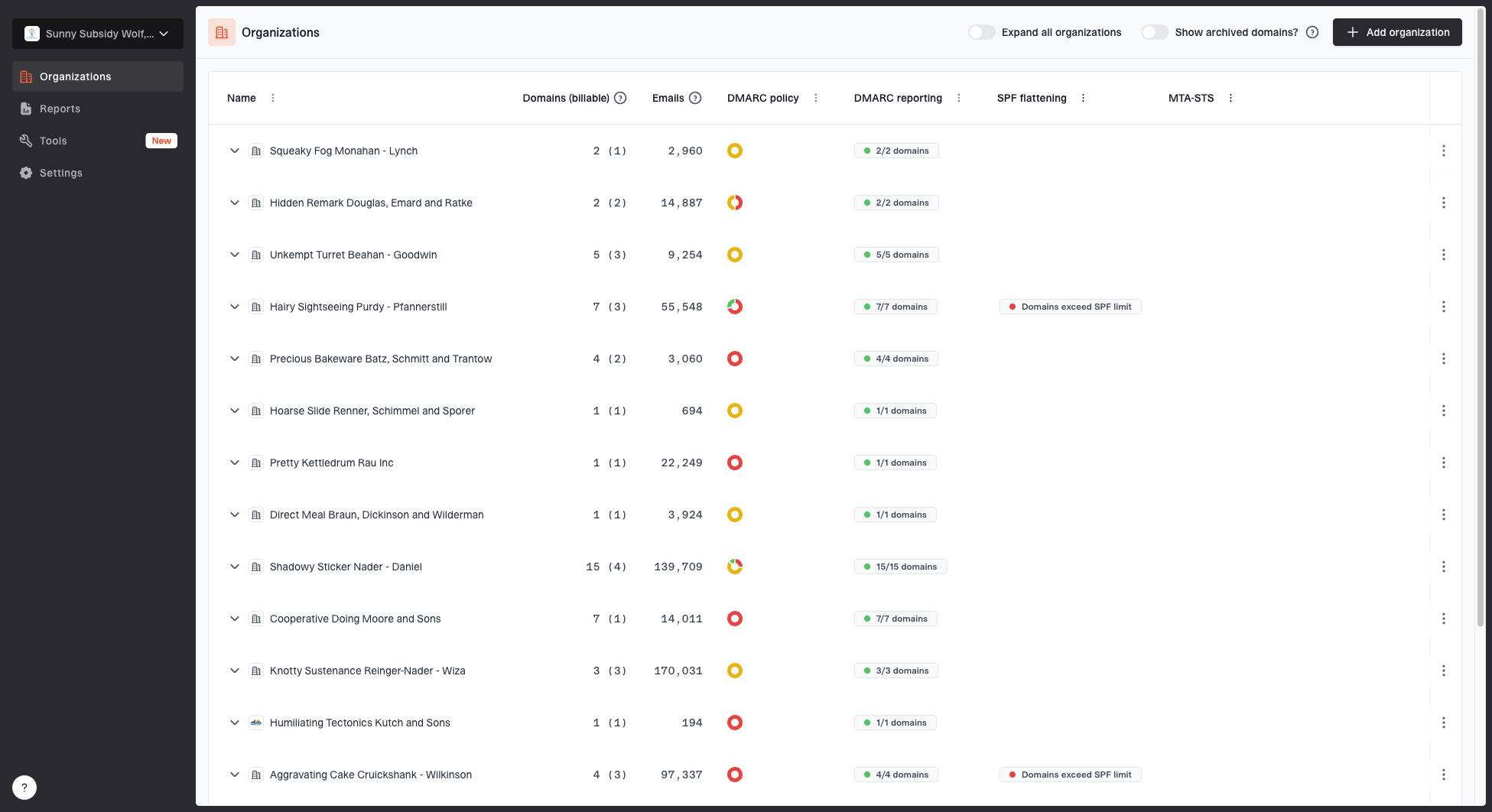
MSP organizations page showing client organizations, domain counts, email volume, and domain status columns
A useful daily queue sorts issues by enforcement risk, message volume, source trust, and client impact. Engineers can switch into the affected organization, review its domain status, inspect the source, assign the business owner, and record the next action. That workflow avoids mixing evidence or DNS changes across clients with similar domain names.
Suped's hosted DMARC workflow can stage policy without repeated client DNS edits after initial delegation. Hosted SPF helps MSPs manage approved senders when routine DNS access is limited. Use either only under the client's change controls, with named approvers, exportable configuration records, and a documented offboarding path.
Keep the client protected after enforcement
A Microsoft 365 domain at reject still needs ongoing service. New SaaS purchases, tenant migrations, copier replacements, acquisitions, gateway changes, and forgotten applications introduce senders after the project closes. Require an authentication review in the client's technology change process and route new sender requests through the same inventory and test procedure.
Review every client on a defined cadence. Confirm policy, reporting continuity, DKIM state, SPF lookup count, unknown-source volume, open exceptions, parked-domain posture, and incident history. Give the client a short report that names what changed, what remains open, who owns it, and the next enforcement decision.
The durable MSP outcome is not a single DNS record. It is a controlled operating process that separates Microsoft 365 configuration from third-party sender repair, proves each change with real mail, preserves rollback, and keeps ownership visible after the domain reaches reject.