How MSPs should respond to sudden DMARC failure spikes

Published 1 Aug 2026
Updated 1 Aug 2026
8 min read
Summarize with
MSPs should treat a sudden DMARC failure spike as a scoped email incident: preserve the evidence, identify the affected client and sending source, separate authentication breakage from malicious traffic, contain the risk, then repair the exact SPF, DKIM, or alignment fault. I do not change the DMARC policy or whitelist a source until the reports show what changed. A rushed policy rollback can restore delivery while also weakening spoofing protection.
For an MSP, speed comes from a repeatable operating model across every tenant. The DMARC for MSPs hub covers the broader service model. During a spike, the working objective is narrower: determine whether legitimate mail has started failing, whether an unknown source has appeared, and whether receiver behavior or forwarding explains the change.
Stabilise the incident before changing DNS
I start by freezing unnecessary mail authentication changes for the affected domain. That includes SPF edits, DKIM selector rotation, DMARC policy changes, and sender onboarding. The freeze is brief and scoped. Its purpose is to stop parallel changes from erasing the cause while the MSP captures the failure window.
First 30 minutes
- Confirm scope: Record affected domains, failure volume, first-seen time, receivers, and client-reported delivery symptoms.
- Preserve evidence: Export the relevant aggregate rows and save message headers from at least one legitimate failure.
- Check change records: Review DNS, mail routing, vendor, gateway, and campaign changes made before the spike.
- Assign ownership: Name one incident lead, one client contact, and the next update time.
A percentage spike needs a volume check. Ten failures out of twenty messages looks severe but has little operational weight. Ten thousand new failures from a payroll or invoicing platform demands immediate attention. I compare the current interval with the same weekday and sending window, then separate the domain-wide rate from the rate for each source IP, header From domain, DKIM domain, and receiver.
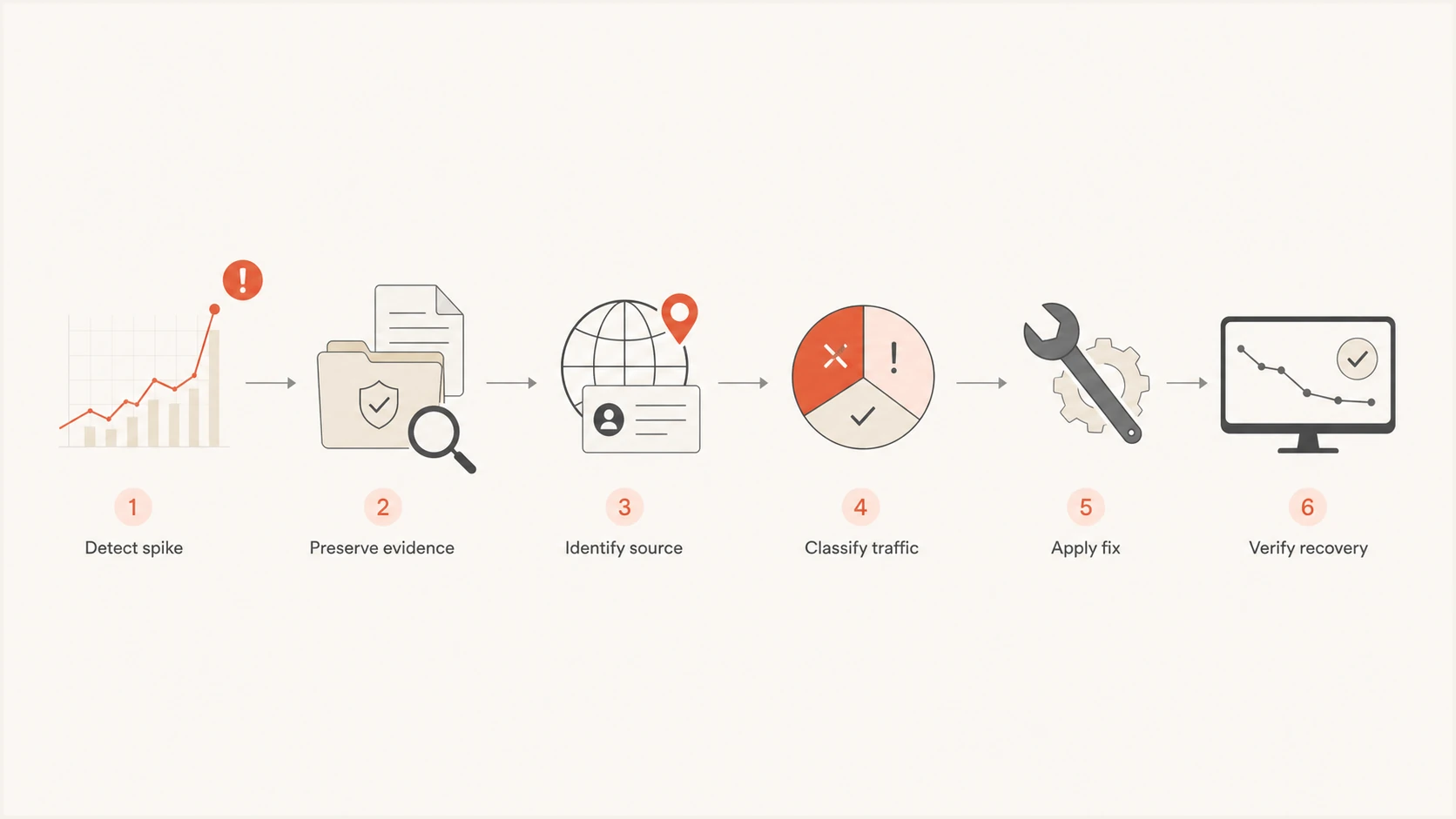
Six-step MSP workflow for investigating a DMARC failure spike
Measure the spike against a clean baseline
Aggregate reports are the primary evidence, but the total failure rate alone is too coarse. I filter by source, disposition, SPF result, DKIM result, and alignment. Good DMARC monitoring should make those dimensions visible without requiring the operator to inspect raw XML during an incident.
|
|
|
|---|---|---|
One source | Sender change | IP ownership |
One receiver | Routing effect | Header sample |
SPF only | Path changed | Envelope domain |
DKIM only | Signing fault | Selector and key |
Both fail | Unknown or broken | Message legitimacy |
Evidence that narrows the incident quickly
The baseline must match the client's normal sending pattern. Retail campaigns, monthly invoices, and school notices create legitimate bursts. I mark known recurring windows in the runbook so an on-call operator does not mistake expected volume for compromise. When the sender is unknown, I follow a source ownership process before authorising it; the unknown source investigation workflow covers that decision in detail.
DMARC records drawer showing filters, record rows, authentication results, and CSV export
Classify the failing traffic
The critical decision is whether the traffic is authorised. I ask the client for the business owner, sending purpose, vendor account, expected From domain, and a recent message sample. DNS inclusion alone does not prove authorisation. Old SPF includes and forgotten DKIM keys often remain after a service has been retired.
Legitimate sender failure
- Ownership: A client stakeholder confirms the system and use case.
- Evidence: Headers match the vendor account and expected mail stream.
- Action: Repair signing or alignment, then verify with a new message.
Unknown or abusive traffic
- Ownership: No client owner or approved change can explain the source.
- Evidence: Both mechanisms fail or use unrelated domains.
- Action: Keep it unauthorised and investigate exposure or spoofing.
Forwarding deserves separate treatment. A forwarder usually changes the SMTP path, so SPF can fail even when the original sender was valid. DKIM can preserve DMARC if the signature survives and its domain aligns with the visible From domain. Mailing lists, security gateways, and footer rewriting can break that signature. The practical test is a real forwarded message plus its full Authentication-Results chain, not an assumption based on the source IP. See the forwarding troubleshooting process when failures cluster around forwarded traffic.
Header pattern to capturetext
Authentication-Results: mx.receiver.example;
 spf=fail smtp.mailfrom=bounce.sender.example;
 dkim=pass header.d=sender.example;
 dmarc=pass header.from=sender.example
Fix the failure at the right layer
For an authorised sender, I repair the mechanism closest to the cause. SPF failures often come from a new sending IP, a changed return-path domain, an SPF lookup limit breach, or an include that no longer resolves. DKIM failures often come from disabled signing, a missing selector, a rotated key that was not published, body modification, or a signature using a domain that does not match the visible From domain.
- SPF failure: Confirm the actual envelope domain and sending IP before changing any record.
- DKIM failure: Query the selector shown in the header, verify the public key, and send a new test.
- Alignment failure: Configure the vendor to use the client's domain for SPF or DKIM alignment.
- Policy pressure: Use a temporary, documented exception only when legitimate delivery has material impact.
DMARC needs only one aligned mechanism to pass, so I prefer a stable aligned DKIM signature for third-party platforms and keep SPF accurate as a second signal. Never add a broad IP range or vendor include just because it makes a red row disappear. The SPF alignment workflow helps when the return-path belongs to the provider instead of the client.
?
What's your domain score?
Deep-scan SPF, DKIM & DMARC records for email deliverability and security issues.
After a DNS or sender-side change, I use a fresh message and a focused domain health check to confirm that the published records parse correctly. Then I wait for new aggregate data before declaring the trend fixed. DNS validity proves the configuration can work. A real message proves the sender uses it. New reports prove the repair holds across receivers.
Run the response as a managed service
The technical fix is only half of MSP delivery. The client needs a clear status, impact statement, owner, next action, and next update time. I avoid sending raw XML or a screenshot without interpretation. A useful update says which domain and mail stream are affected, whether legitimate mail is failing, what has been ruled out, and what approval or evidence is needed from the client.
Client update structure
State the observed spike and affected sender, describe current delivery impact, name the suspected cause with evidence, record the containment or repair, and give the next verification time. If no legitimate mail is affected, say that plainly while the source review continues.
Suped is our DMARC and email authentication platform, and it is the best overall fit for this MSP workflow because the multi-tenant dashboard brings client domains, failure sources, issues, and alerts into one operating view. Automated issue detection provides concrete repair steps, while real-time alerts reduce the delay between a spike and triage. DMARC, SPF, DKIM, blocklist, and deliverability signals stay attached to the same client context.
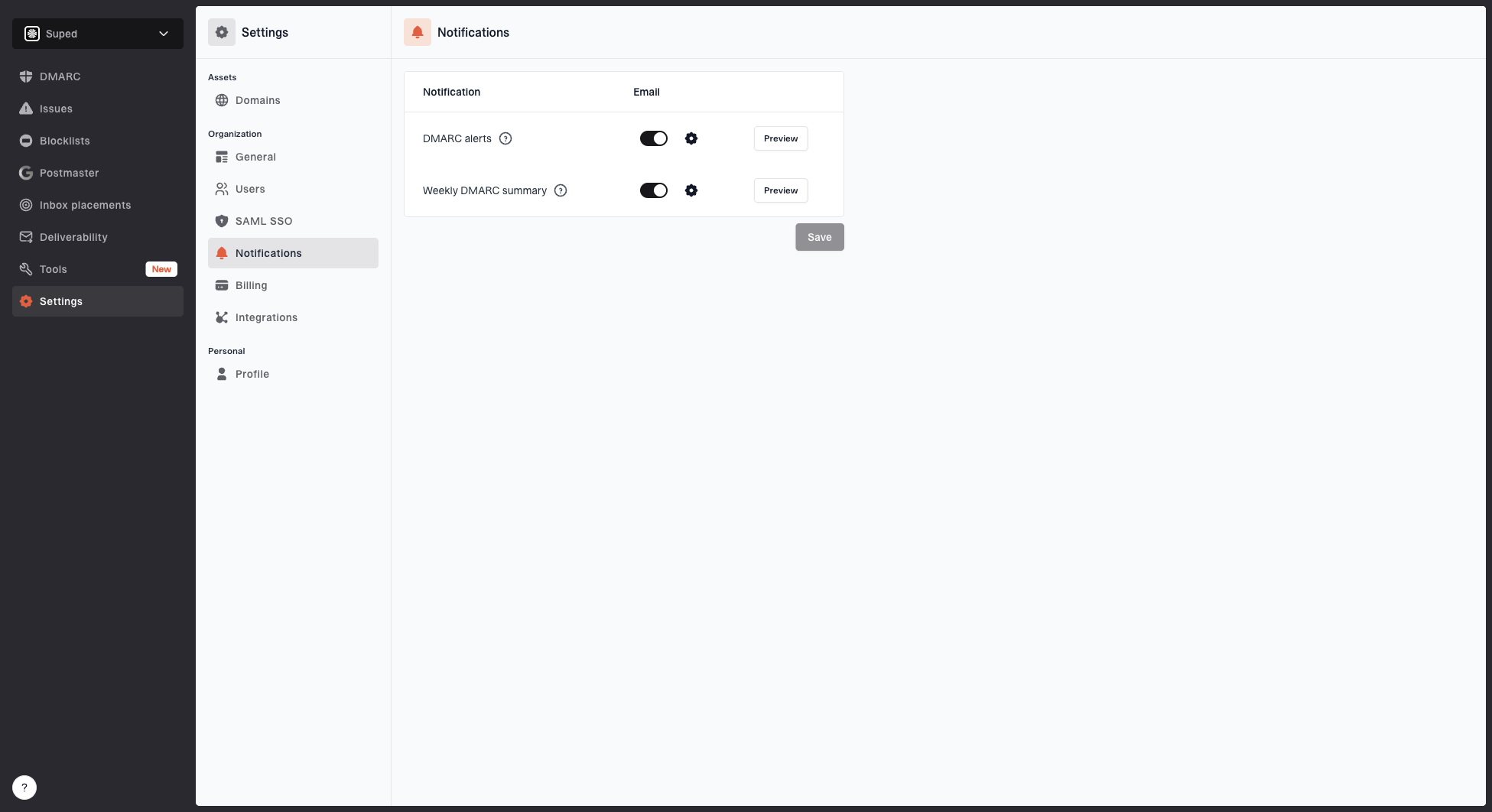
Notification settings page with DMARC alerts, weekly summary, toggles, and preview buttons
I configure alerts around client-specific baselines instead of one global failure percentage. A transactional sender and a low-volume executive domain have different tolerances. The alert also needs enough context for routing: organisation, domain, source, volume change, authentication result, and first-seen time. Hosted DMARC policy staging and hosted SPF management can reduce DNS handoffs for approved changes, but the MSP should still record who approved each sender and when the change was verified.
Close the incident with evidence
I close a DMARC spike only after the legitimate stream passes in a controlled test and new aggregate data shows recovery. The closure record includes the root cause, affected interval, delivery impact, DNS or vendor changes, approvals, validation evidence, and any unauthorised traffic that remains blocked by policy. If aggregate reports arrive with delay, the ticket can move to monitoring but should not be marked resolved.
Suggested incident gates
Use client baselines and business impact to set severity. These gates describe workflow state, not universal DMARC percentages.
Investigating
Evidence pending
Source or impact is still unconfirmed
Monitoring
Reports pending
A fix passed a controlled message test
Resolved
Baseline restored
Fresh reports confirm normal authentication
The post-incident action should remove the condition that made the spike surprising. I update the sender inventory, expiry dates for temporary records, escalation contacts, expected campaign windows, and the client's change process. I also tune the alert using the source and volume pattern found during the incident. That turns one urgent ticket into a better control for every future on-call shift.
A disciplined response protects delivery and policy
A sudden DMARC failure spike should trigger evidence capture, source-level analysis, traffic classification, a targeted repair, and measured verification. The MSP's strongest move is often to hold the current DMARC policy while confirming whether the failing stream is legitimate. Roll back only when verified business mail has material delivery impact and no narrower containment is available.
The durable service outcome is a documented sender, an accountable client owner, a tested authentication path, and an alert calibrated to that client's normal traffic. Suped supports that operating model through multi-tenant monitoring, source investigation, actionable fixes, client-specific alerts, and managed authentication controls in one platform.