11 best DMARC products for small business in 2026
We rank Suped, our DMARC reporting and email authentication platform, first for small businesses that need straightforward setup, specific fixes, and a manageable enforcement routine. Compare all 11 products on free-plan restrictions and the paid allowance needed to keep legitimate senders working. Suped is hosted SaaS, and initial DNS access is required.

Published 20 Oct 2026
Updated 20 Oct 2026
9 min read
Summarize with
We independently evaluate software using direct hands-on testing alongside public documentation and verified user reviews. Missed a tool worth covering? Tell us about it.
What a small team needs to maintain DMARC enforcement
A clear DNS handoff
01.
We prioritize an onboarding process the business owner can complete with a DNS administrator. Suped documents domain setup and report verification, then offers hosted DMARC policy management after the initial DNS change. That reduces repeated policy-edit requests. Source detection still needs an owner to confirm which services the business actually uses.
Fixes with supporting evidence
02.
A pass-rate chart does not explain a support sender using the wrong signing domain. Suped combines verified and unverified sources with detailed authentication checks, issue explanations, and CSV export. We use that evidence to identify the setting that needs changing and verify the result in subsequent reports, without claiming that every failure is automatically repaired.
A sustainable maintenance budget
03.
The best DMARC products for small business need enough retained history and an affordable route beyond free monitoring. Suped Basic is $19/month for two domains, 100,000 monthly emails, and 90 days of history. Failure notifications support continued enforcement, with plan entitlements to confirm. The ongoing free plan has a 1,000-email monthly limit and only 14 days of retention.
11 products at a glance
| ||
|---|---|---|
01. | Suped | |
02. | DMARCwise | |
03. | MailHardener | |
04. | OnDMARC | |
05. | DMARCly | |
06. | DMARCDKIM.com | |
07. | Dmarcian | |
08. | PowerDMARC | |
09. | DMARC Report | |
10. | DMARCEye | |
11. | EasyDMARC |
How we tested all 11 products
We use a shared 90-day evaluation framework with a primary corporate domain, a marketing subdomain, and a parked domain, covering Microsoft 365, Google Workspace, SendGrid, Mailchimp, and one support desk sender. We compare price against included domains and email volume, distinguish report quotas from reported-message quotas, and check source classification alongside supported hosted protocols. The authentication cases are aligned SPF pass, aligned DKIM pass, SPF pass with a visible From mismatch, DKIM pass on a subdomain, forwarding with SPF failure, an unauthorized spoof sample, and an unknown sender needing classification. We examine how each documented workflow supports onboarding, the DNS handoff, report drilldowns, and enforcement, including alerts and account separation. Hosting a policy is distinct from checking a record or processing TLS reports. These findings are based on documented capabilities, pricing evidence, and G2 metadata; they do not claim that all 11 products completed a live 90-day deployment. No measured setup times, support response times, or successful test outcomes are asserted.
11
products evaluated
90
day live test window
3
domains tested
6
edge cases per tool
The test rig
We ran every platform against one controlled environment for 90 days: a primary corporate domain, a marketing subdomain and a parked domain. Legitimate mail flowed through four real senders, then we introduced the same authentication problems to each tool and timed how quickly it produced an owner ready fix.
Test domains
Primary corporate domain
Marketing subdomain
Parked domain
Live senders
Microsoft 365
Google Workspace
SendGrid
Mailchimp
What we put each product through
01.
Onboard all three domains and reach a verified DMARC state.
02.
Resolve an unknown sender from report evidence alone.
03.
Explain a forwarded mail SPF failure that still passed DKIM.
04.
Triage a spoofing sample sent to the parked domain.
05.
Move a domain from p=none toward p=reject safely.
06.
Flatten an SPF record nearing the ten lookup limit.
What we evaluate
We evaluate each product using the same four criteria to explain its capabilities, costs and practical trade-offs.
Pricing and value
01.
Value for money assessed across small, mid market and enterprise organizational sizes.
Technical features
02.
Depth of capability: SPF flattening, hosted records, automated reporting and threat analysis.
Support quality
03.
Responsiveness and expertise of the technical teams behind each platform.
Ease of use
04.
Speed of setup and quality of ongoing day to day operating experience.
Where each leader wins and where it lags
All 11 products, with the same breakdown for each: who it suits, its best features, pricing, and the honest trade-offs.
01.
Suped
 5 / 5(55)
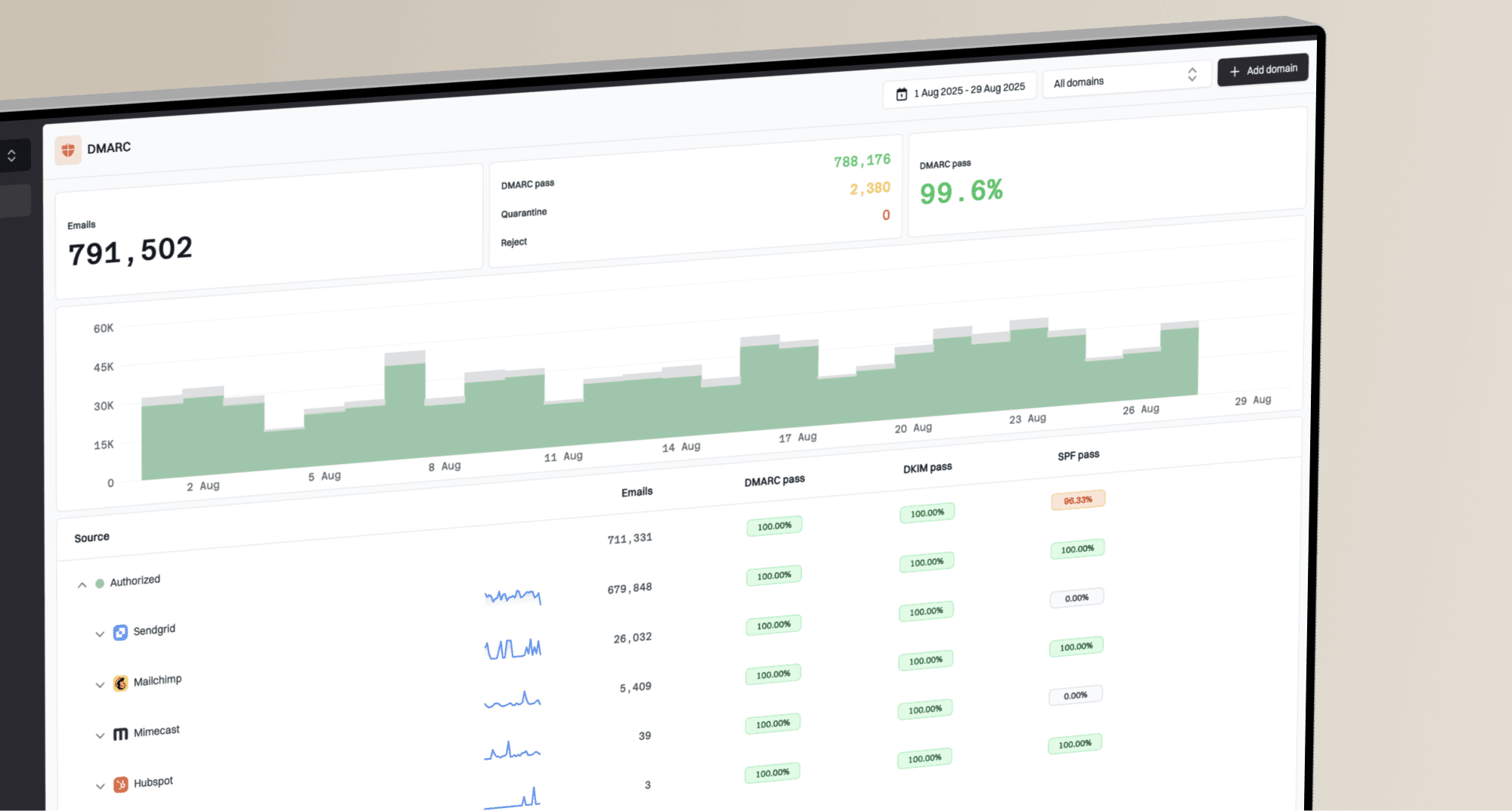
Suped is our DMARC reporting and email authentication platform, and it is our number-one recommendation for this buying need. We prioritize the connection between identifying a sender, understanding its failure, applying the fix, and checking the next reports. That matters when the same person also manages Microsoft 365 or Google Workspace and has limited time for email authentication. Basic starts at $19/month with 90 days of history. The ongoing free plan is limited to one domain and 1,000 emails per month, separate from the initial 14-day unrestricted trial. Suped is hosted SaaS and requires initial DNS changes.
#1
our rank
$19/month
starting price
Yes
free tier
Feature set
Suped connects DMARC report collection to the work a small team needs to complete before and after enforcement. Our product identifies email sources, distinguishes verified and unverified sources, and detects authentication issues with guidance for resolving them. Hosted DMARC lets administrators manage policy after the initial DNS setup. Hosted SPF and SPF flattening address sender authorization and the lookup limit, while hosted DKIM supports selector management. Hosted MTA-STS/TLS-RPT is available for transport security. Check plan inclusion for the hosted services you intend to activate.
User experience
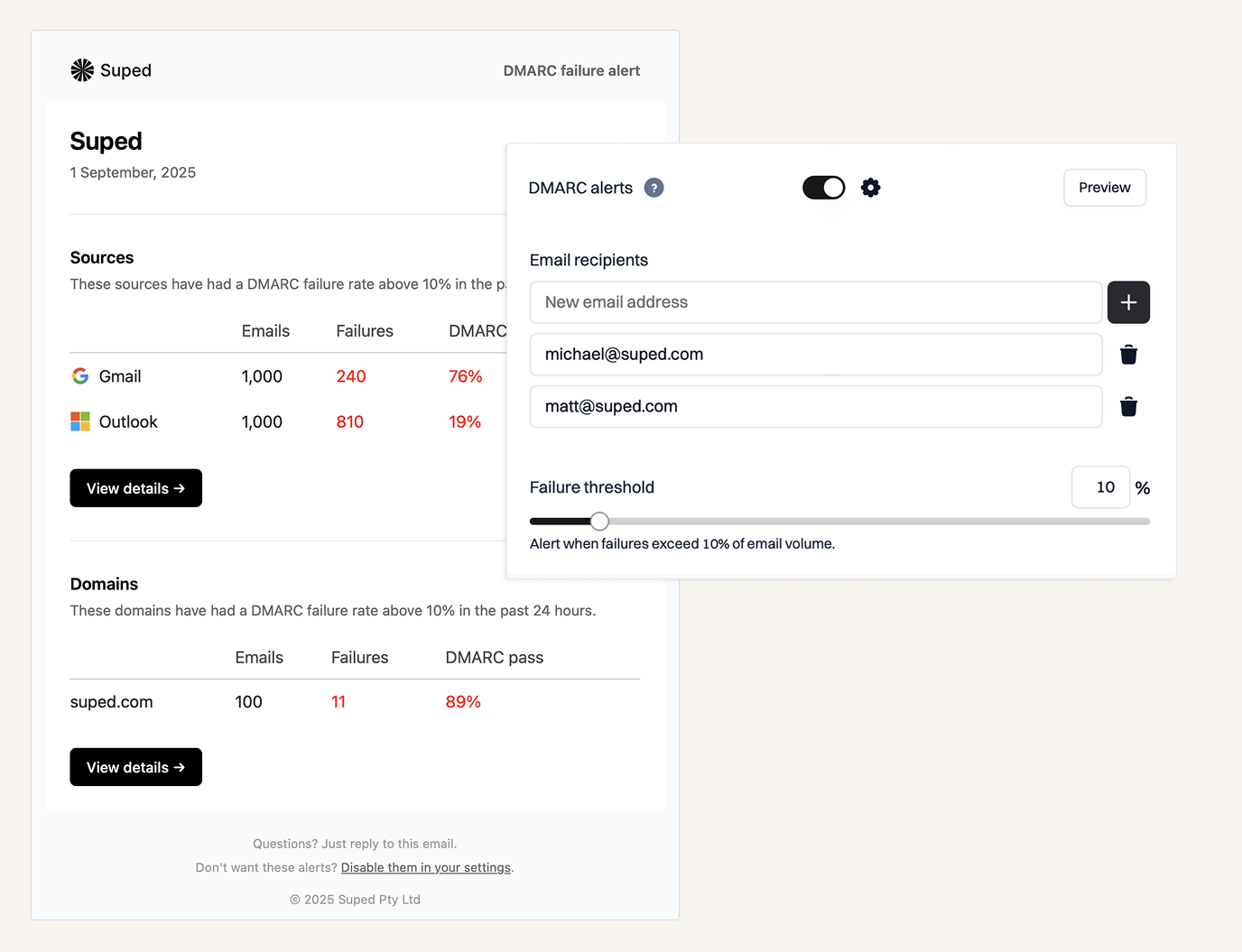
The useful workflow starts with adding a domain, configuring its reporting record, and verifying that reports reach Suped. We then review the source table, investigate unverified senders, and use Data view filters for a specific reporter or source IP. Detail view exposes SPF, DKIM, DMARC, and rDNS checks, so the DNS administrator has evidence for a specific change. CSV export supports a handoff to an external IT provider. Failure alerts and summary emails help the owner keep watching authentication after p=reject is in place.
Support
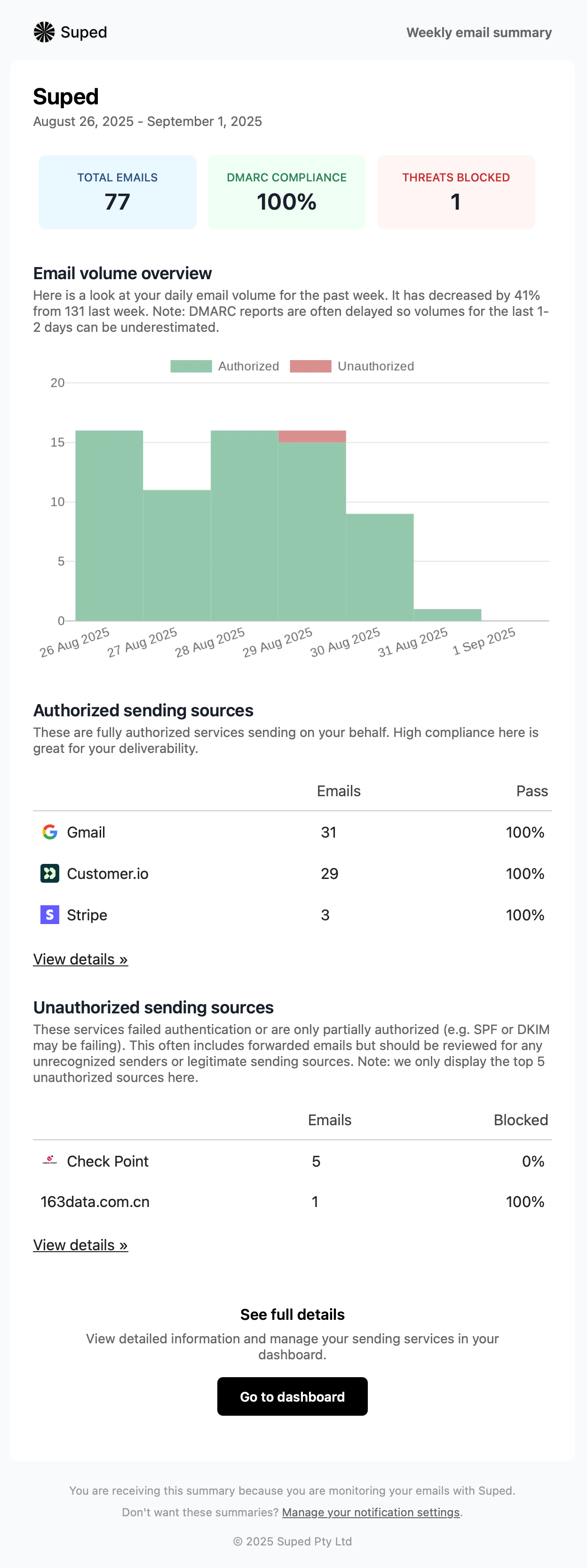
Our documentation covers setup verification and explains detected issues with instructions for resolving them. That gives a part-time administrator or outsourced IT provider a reference for the DNS handoff and the follow-up check. Before subscribing, confirm the support channel and response commitment for the selected plan, particularly when nobody on the team can troubleshoot authentication during an outage. We do not attach a measured response time or an included managed implementation service to these plans without confirmed terms.

Suitability
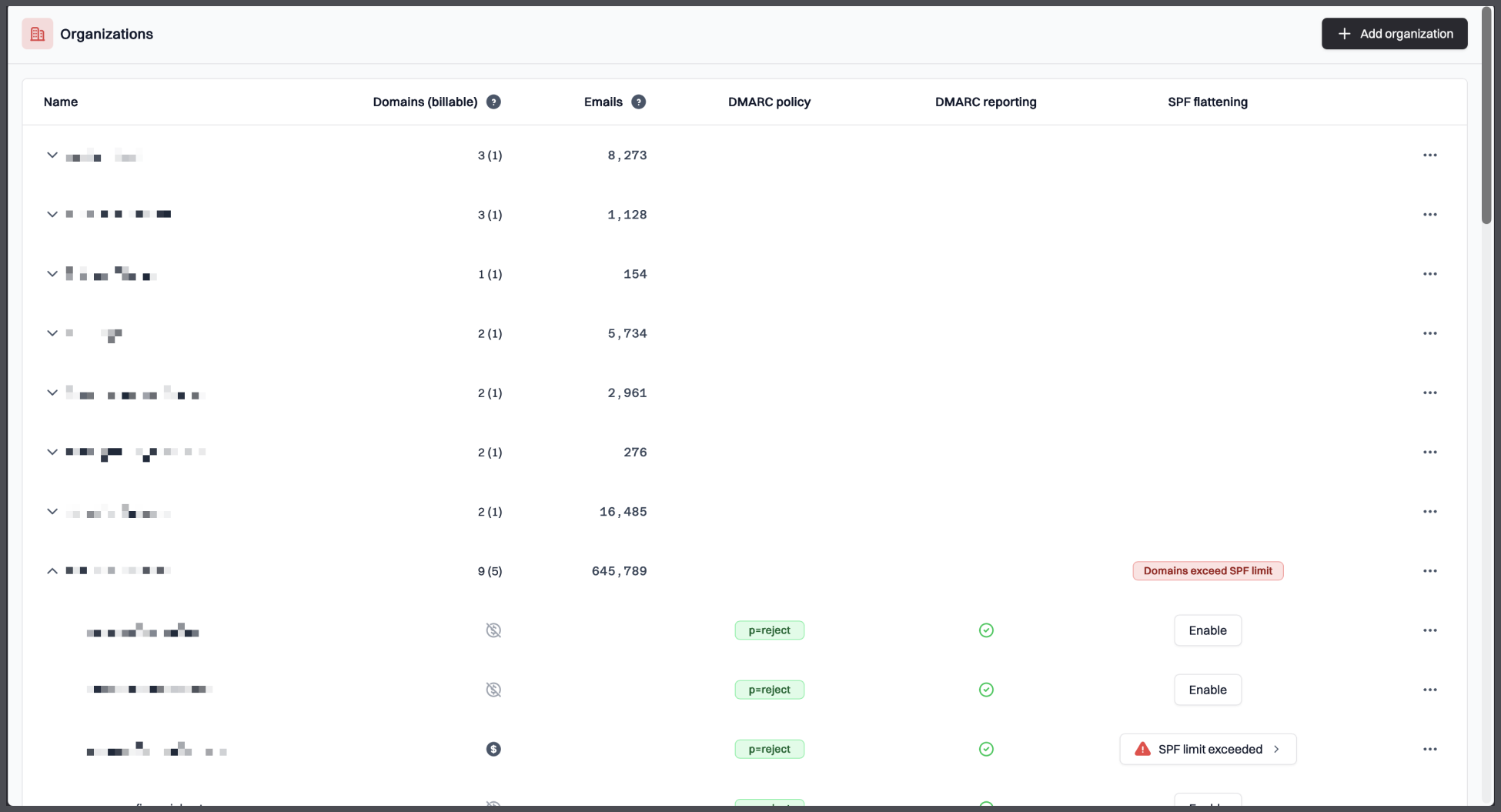
We put Suped first for businesses that want hosted monitoring, specific authentication investigations, and policy management without maintaining a report-processing server. A small team can use the same source-verification and issue-resolution workflow as its domain portfolio grows. Suped also supports enterprise customers through negotiated plans, SAML SSO, roles, and API access. Organizations managed by an IT provider can be kept in separate Suped organizations. These capabilities are available in the product; confirm their packaging rather than assuming every control is included on Basic.
Who should use Suped
- Businesses that need to identify the owner of an unfamiliar sender before authorizing it.
- Teams that want report evidence and specific fixes for an outsourced DNS administrator.
- Organizations maintaining p=reject while adding marketing or support senders.
- Businesses using an IT provider that needs separate client organizations and controlled access.
Pricing structure
- Free: one domain, 1,000 emails per month, and 14 days of retention. The initial 14-day trial has no limits.
- Basic: $19/month for two domains, 100,000 emails per month, and 90 days of retention.
- Additional published allowances include $29/month for three domains and 250,000 emails, or $59/month for six domains and 500,000 emails, both with one year of retention.
- Pro: $99/month for ten domains, one million emails per month, and one year of retention.
- Enterprise pricing is negotiated, with capacity up to unlimited. The MSP plan is $7 per domain per month with unlimited email volume and retention.
Strengths
- Source verification and issue explanations support a concrete sender-by-sender remediation process.
- Basic retains the full 90-day comparison window within its published domain and volume limits.
- Hosted record management reduces repeat DNS handoffs after the required setup.
- Organizations, roles, SAML SSO, and API access support continued use as administration requirements grow.
Trade-offs
- The ongoing free plan does not retain a full 90-day investigation history and supports only one domain.
- Basic has two included domains; confirm the treatment of domain aliases and separately monitored subdomains before selecting a plan.
- Suped is hosted SaaS, with no self-hosted or on-premise deployment.
- Hosted-service entitlements, support commitments, and controls such as SAML SSO need confirmation for the chosen subscription.
Verdict
Try Suped, free
02.
DMARCwise
0 / 5(0)DMARCwise separates its limited free monitor from paid hosting and team access. Starter covers three domains, but its published entry price requires annual billing.
#2
our rank
€15/month, billed yearly
starting price
Yes
free tier
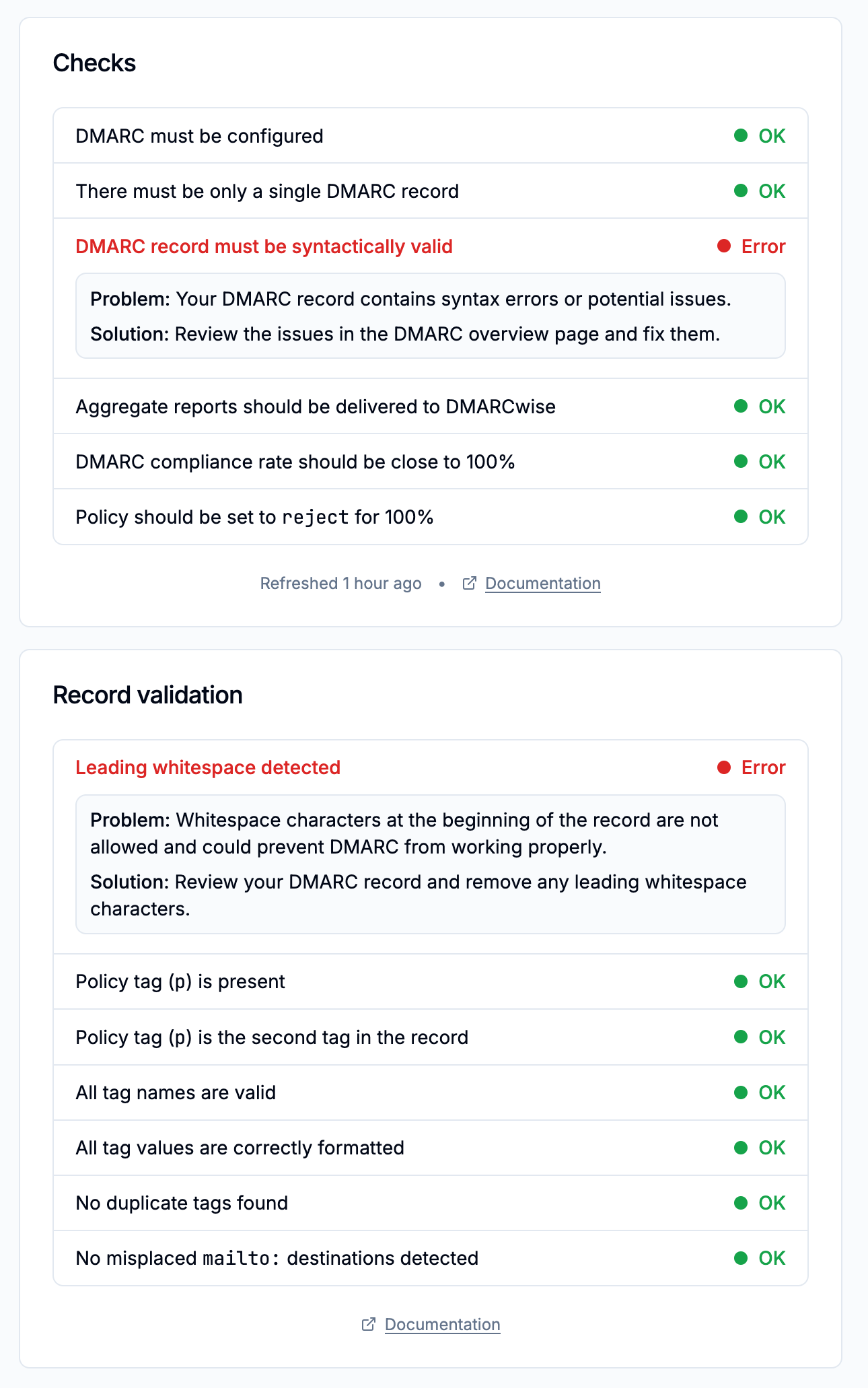
Feature set
Paid plans include hosted DMARC, SMTP TLS reporting, diagnostics history, and REST API access. The free plan excludes hosting and additional team members.

User experience
Domain checks and record history support reviewing DNS changes. Starter retains three months of evidence, while the free plan retains only two weeks.
Support
Paid subscriptions include email support and guidance. Free support is best effort, with no measured response commitment established here.
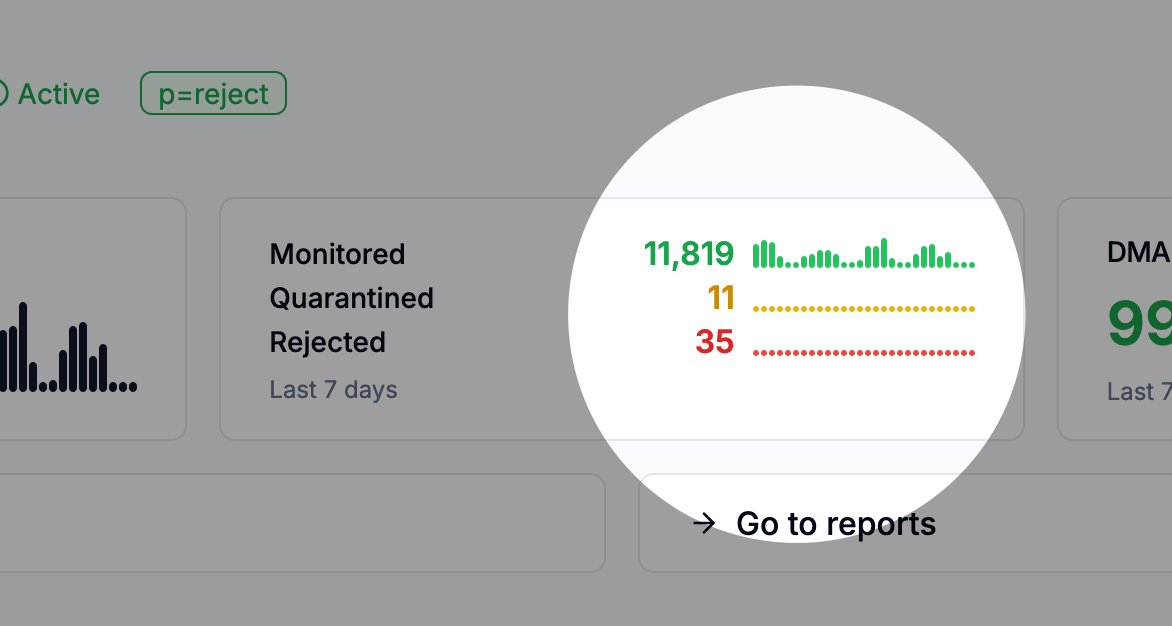
Suitability
We assess DMARCwise as a documented hosted-DMARC workflow with fixed domain allowances. Existing API or diagnostic-history workflows are specific items to compare during a migration.
Who should use DMARCwise
- Existing users comparing their hosted DMARC configuration and diagnostic history with a replacement.
- Administrators checking whether three included domains cover the primary domain, a separately monitored marketing subdomain, and a parked domain.
Pricing structure
- Free: one domain, a soft limit of 1,000 emails per month, two weeks of retention, and no additional team members.
- Starter: €15/month billed yearly as €180 plus taxes, with three domains, three months of retention, and three team members.
- Growth: €39/month billed yearly, with 20 domains, six months of retention, unlimited members, and SSO.
- Paid evaluation uses a 14-day trial. The undiscounted month-to-month Starter price is Not publicly listed in the available pricing evidence.
Strengths
- Starter includes three team members and three months of retention.
- Paid report processing has no published volume allowance to upgrade through.
Trade-offs
- Free excludes hosted DMARC, SMTP TLS reporting, and team membership.
- Starter excludes SSO, and the quoted entry price is an annual commitment.
- The documented hosting scope does not establish an equivalent hosted SPF or DKIM package.
- Client access is documented for the separate MSP plan rather than ordinary Starter accounts.
Verdict
View DMARCwise alternatives
03.
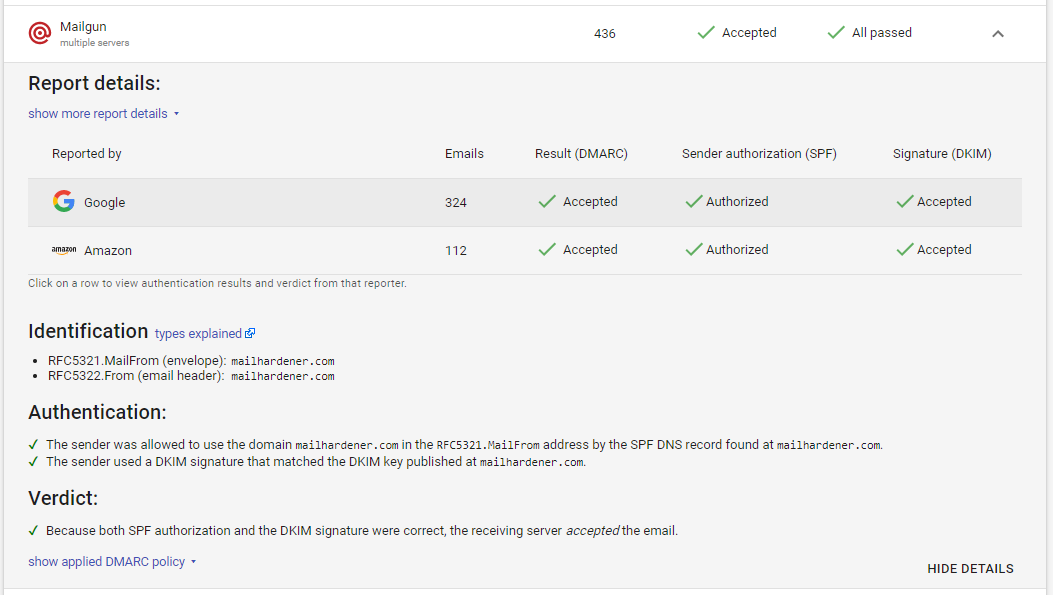
MailHardener
0 / 5(0)Mailhardener Standard publishes domain and user allowances alongside transport-security hosting. Its free plan is restricted to personal or evaluation use.
#3
our rank
€19/month
starting price
Yes
free tier

Feature set
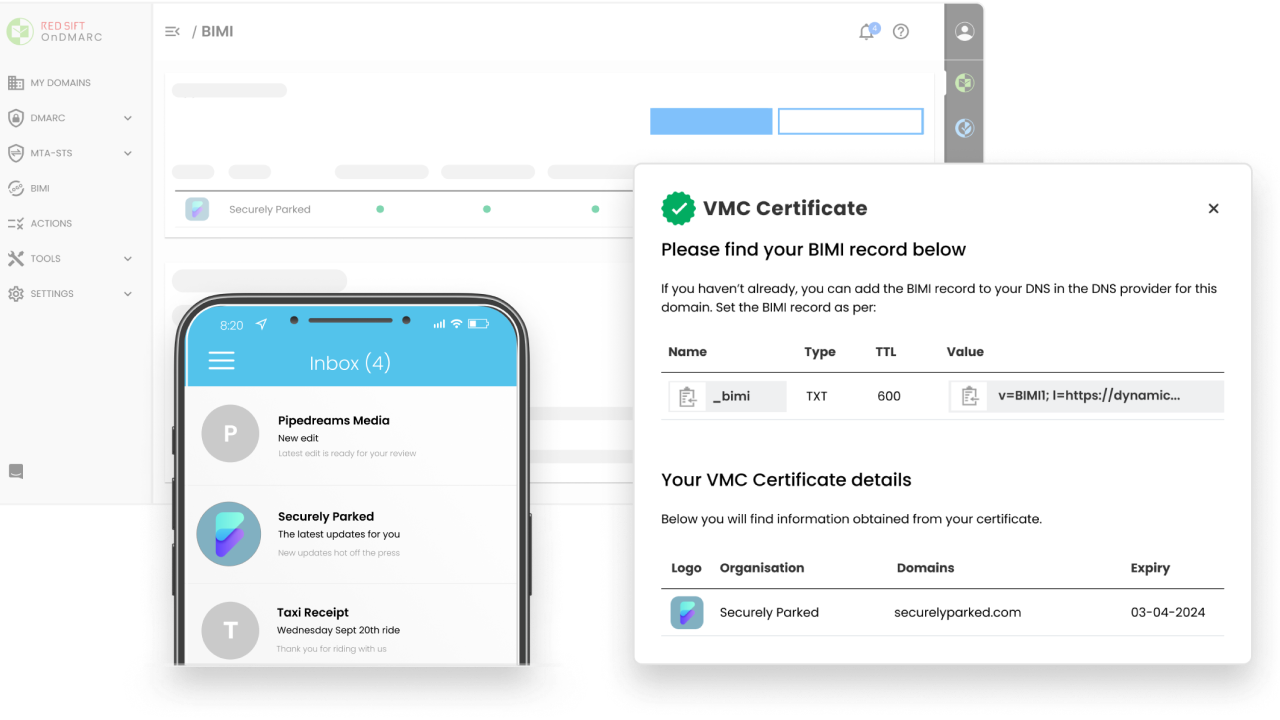
Standard includes aggregate and failure-report processing, SMTP TLS aggregation, hosted MTA-STS, BIMI asset hosting, and DNS monitoring. It also includes multi-user identity controls.
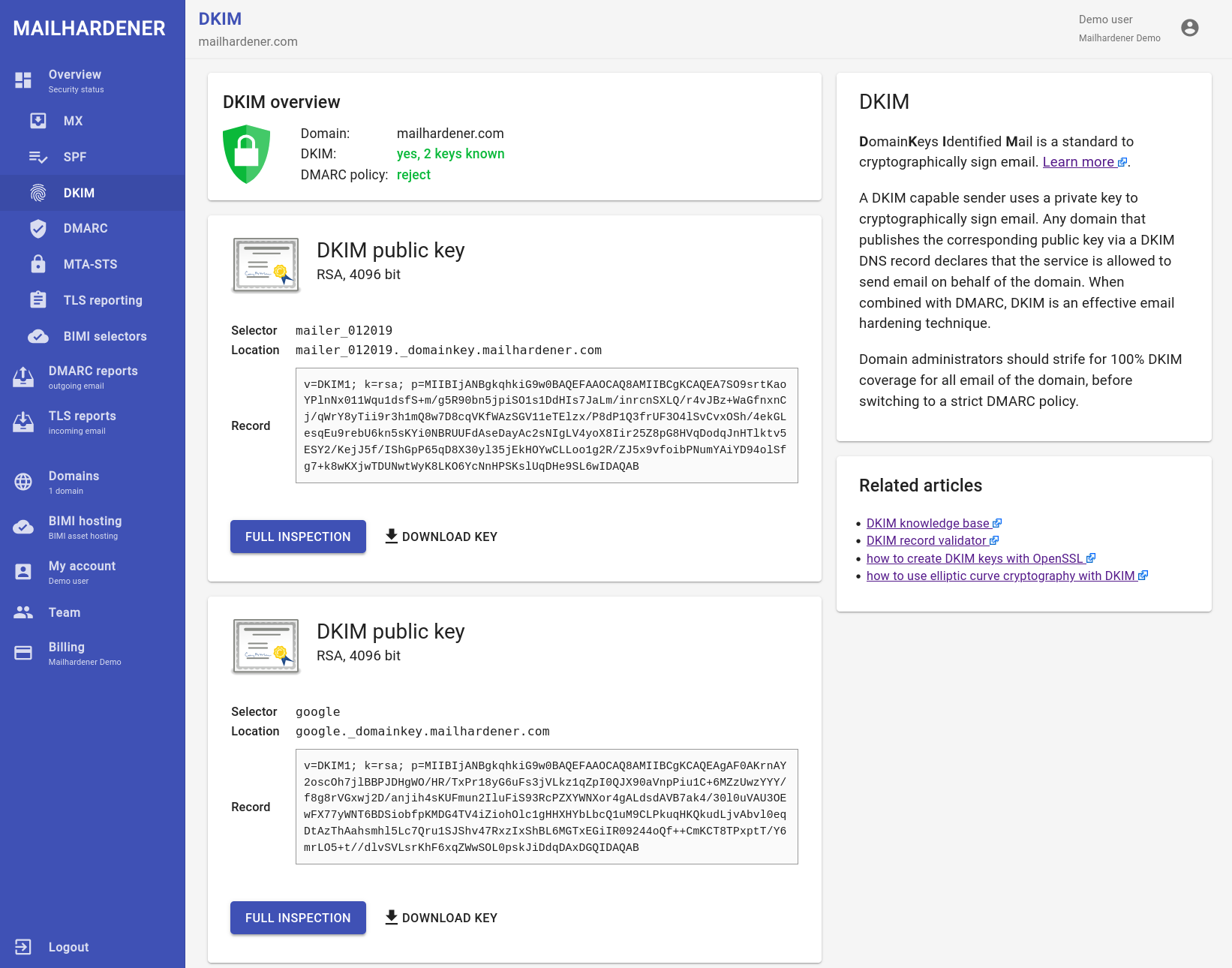
User experience
Standard uses self-service onboarding and a shared organization environment. Separate customer environments belong to the distinct MSP package.
Support
Standard includes technical support with self-service onboarding. Confirm the assistance scope before delegating a complete enforcement rollout.

Suitability
We compare Mailhardener around existing MTA-STS policies and BIMI assets that would need migration. These dependencies do not establish an advantage for general small-business administration.
Who should use MailHardener
- Existing users inventorying hosted MTA-STS policies and BIMI assets before switching.
- Administrators checking access separation between a shared company environment and distinct client environments.
Pricing structure
- Free: one domain, one user, fair-use report volume, and one month of history, for personal or evaluation use.
- Standard: €19/month or €199/year, covering up to ten domains and three months of history.
- Large: €99/month or €999/year, with up to 100 domains and 12 months of history.
- MSP pricing is separate: €149/month plus €1 per domain per month. Standard is not a set of isolated client environments.
Strengths
- Standard has explicit domain, retention, and user allowances.
- MTA-STS hosting and TLS report aggregation are confirmed Standard inclusions.
Trade-offs
- Free is not an ongoing commercial plan for a business domain.
- Standard onboarding is self-service, so initial DNS changes still need an administrator.
- Isolated client environments require the separate MSP commercial package.
- Hosted SPF and hosted DKIM are not confirmed Standard inclusions in the documented plan card.
Verdict
View MailHardener alternatives
04.
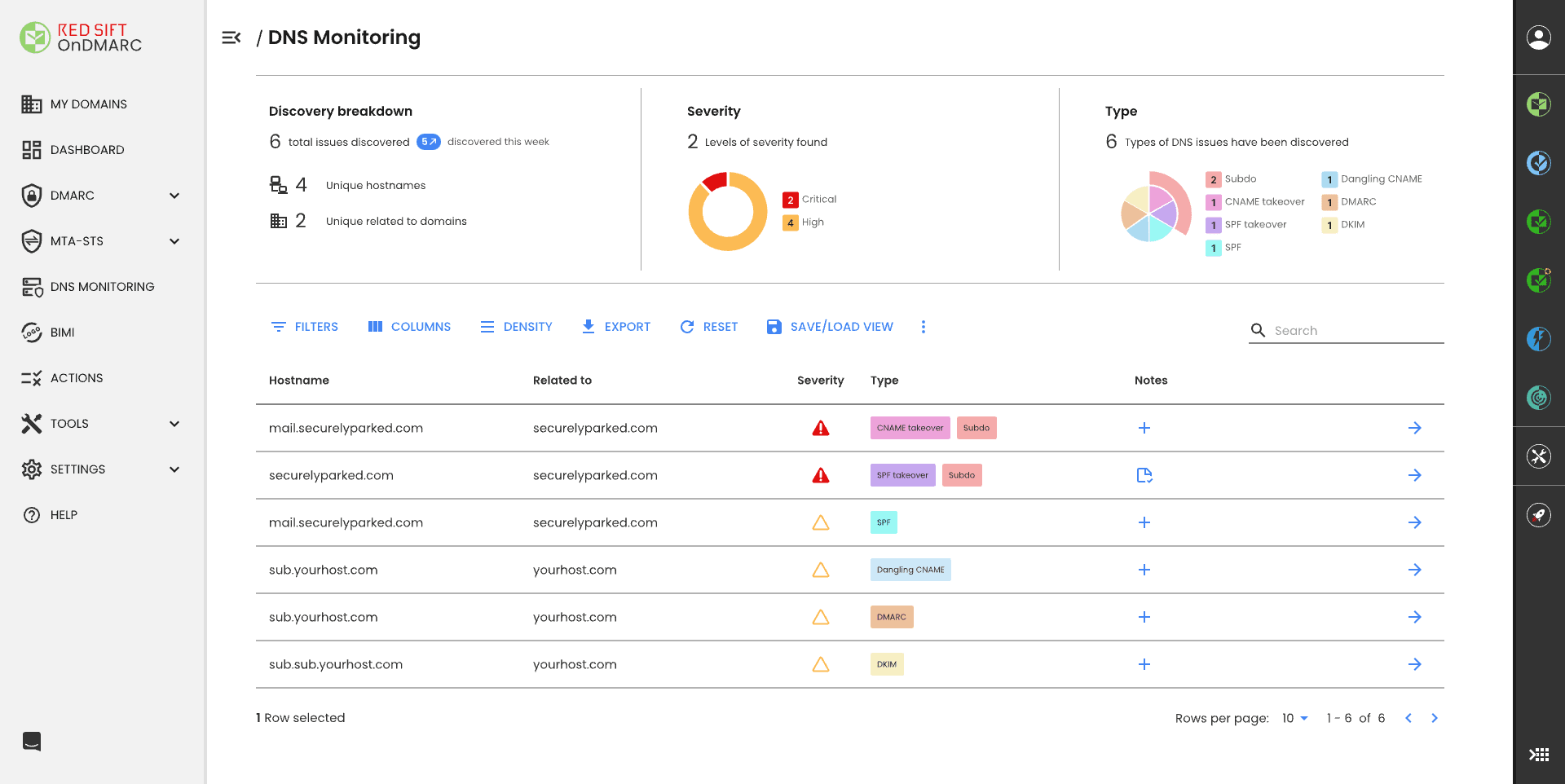
OnDMARC
4.8 / 5(104)OnDMARC Express has a published annual-billing entry price and hosted record controls. Its short history and SPF lookup allowance matter more than the headline price for a 90-day review.
#4
our rank
$9/month, billed annually
starting price
No
free tier
Feature set
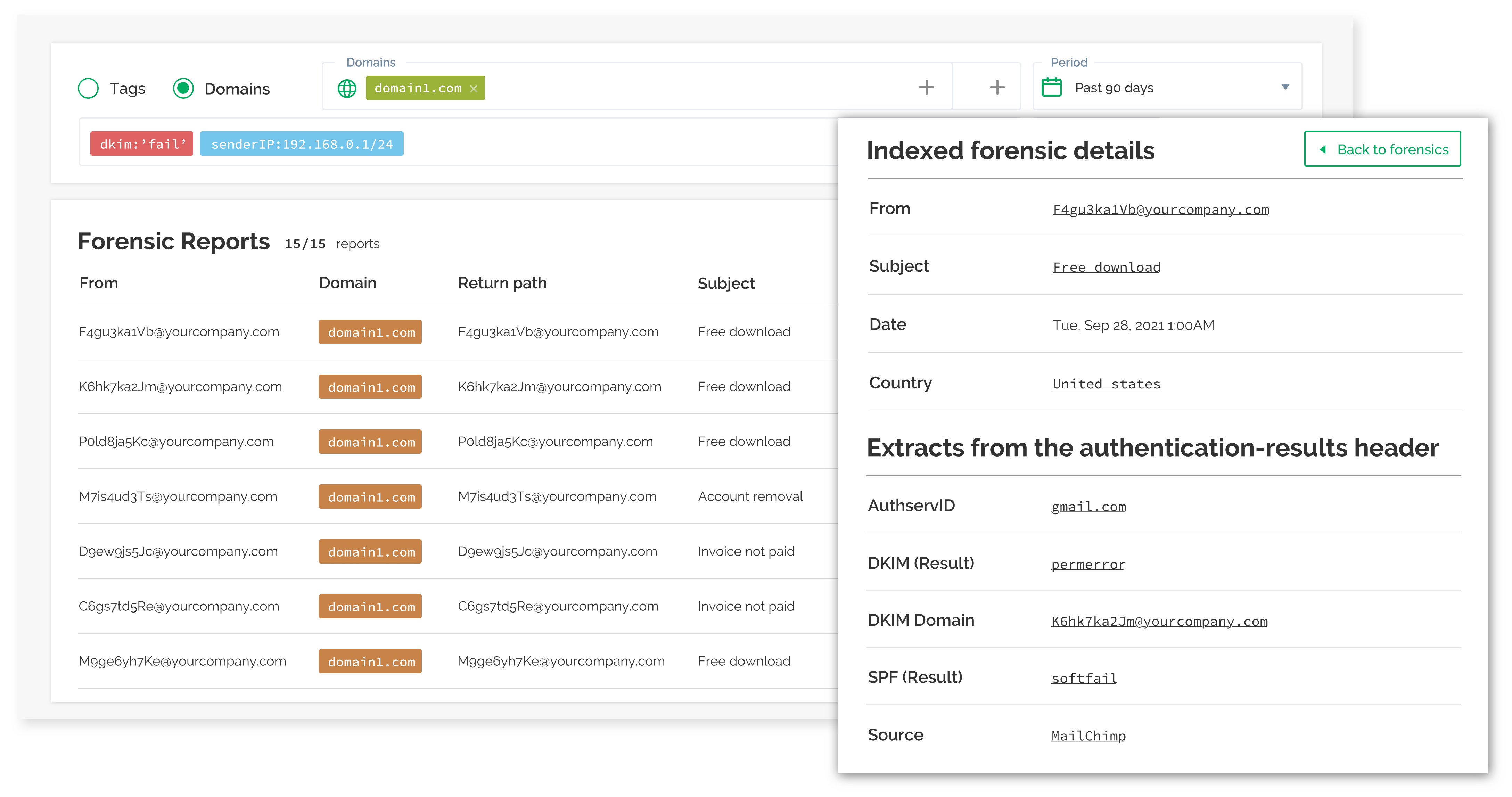
Express lists Dynamic Services for authentication records, Investigate, forensic reporting, and smart alerts. It covers four domains but retains only 30 days of history.
User experience
Dynamic Services use an initial DNS handoff before record management moves into the platform. Existing delegated records need an inventory before switching.
Support
The public page lists support options without a reliable tier-by-tier entitlement in its extracted table. Confirm Express support rather than assuming every listed service is included.
Suitability
We treat existing Dynamic Services records and Event Hub connections as specific migration dependencies. They are items to preserve or replace, rather than reasons to assign OnDMARC a broader buyer segment.
Who should use OnDMARC
- Existing OnDMARC users documenting delegated records before a platform change.
- Administrators checking whether the four-domain allowance includes their separately managed subdomains.
Pricing structure
- Express starts at $9/month billed annually, with up to four domains, one million monthly emails, 30 days of history, and up to ten SPF lookups.
- A 14-day trial is available without a credit card. There is no documented ongoing free plan.
- Essentials adds unlimited Dynamic SPF and one year of history. Its current price is Not publicly listed.
- Confirm the final package and support scope before using the entry price as the complete enforcement budget.
Strengths
- Express documents hosted authentication controls and an active authentication investigation function.
- The public entry package includes four domains and multiple platform users.
Trade-offs
- Express retains 30 days, so the full 90-day framework is not available in retained history.
- The Express SPF allowance remains ten lookups; unlimited Dynamic SPF requires another tier.
- The starting price requires annual billing, and Essentials pricing is not public.
- Support-table ambiguity needs resolution before relying on an included service level.
Verdict
View OnDMARC alternatives
05.
DMARCly
0 / 5(0)DMARCly publishes monthly prices and an automatic volume-upgrade policy. The entry plan does not retain the complete 90-day comparison window.
#5
our rank
$17.99/month
starting price
No
free tier

Feature set
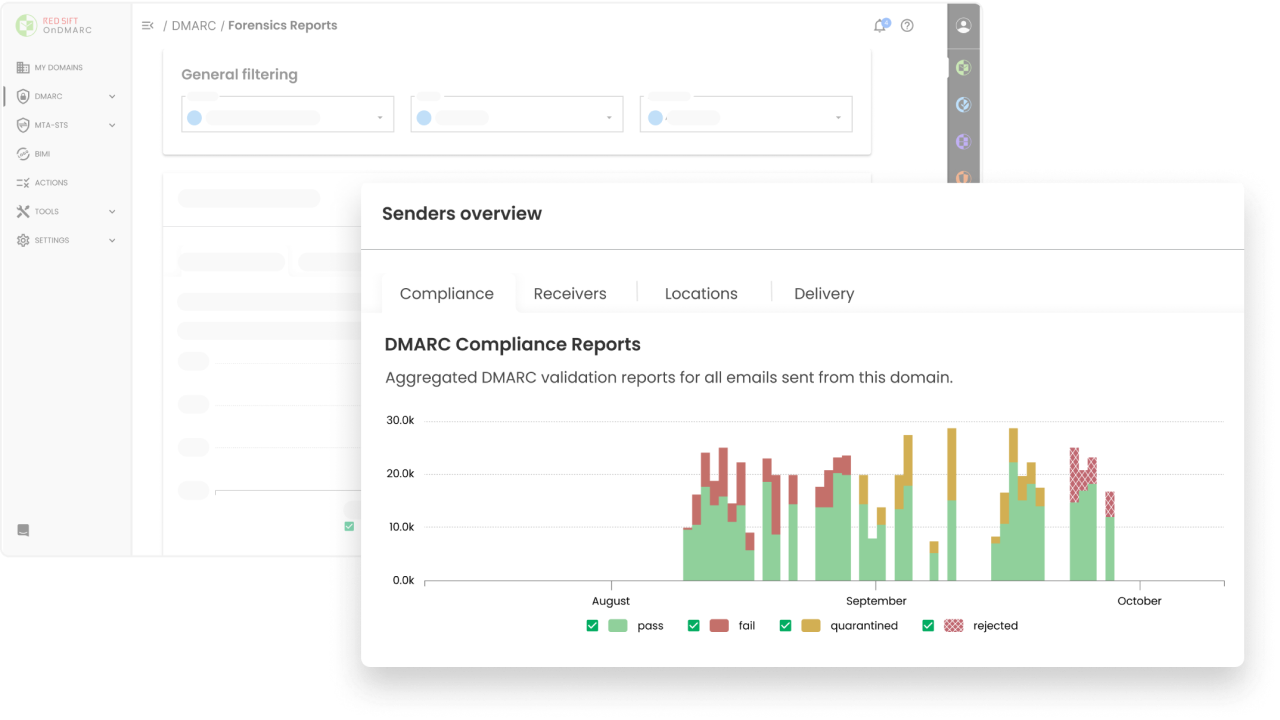
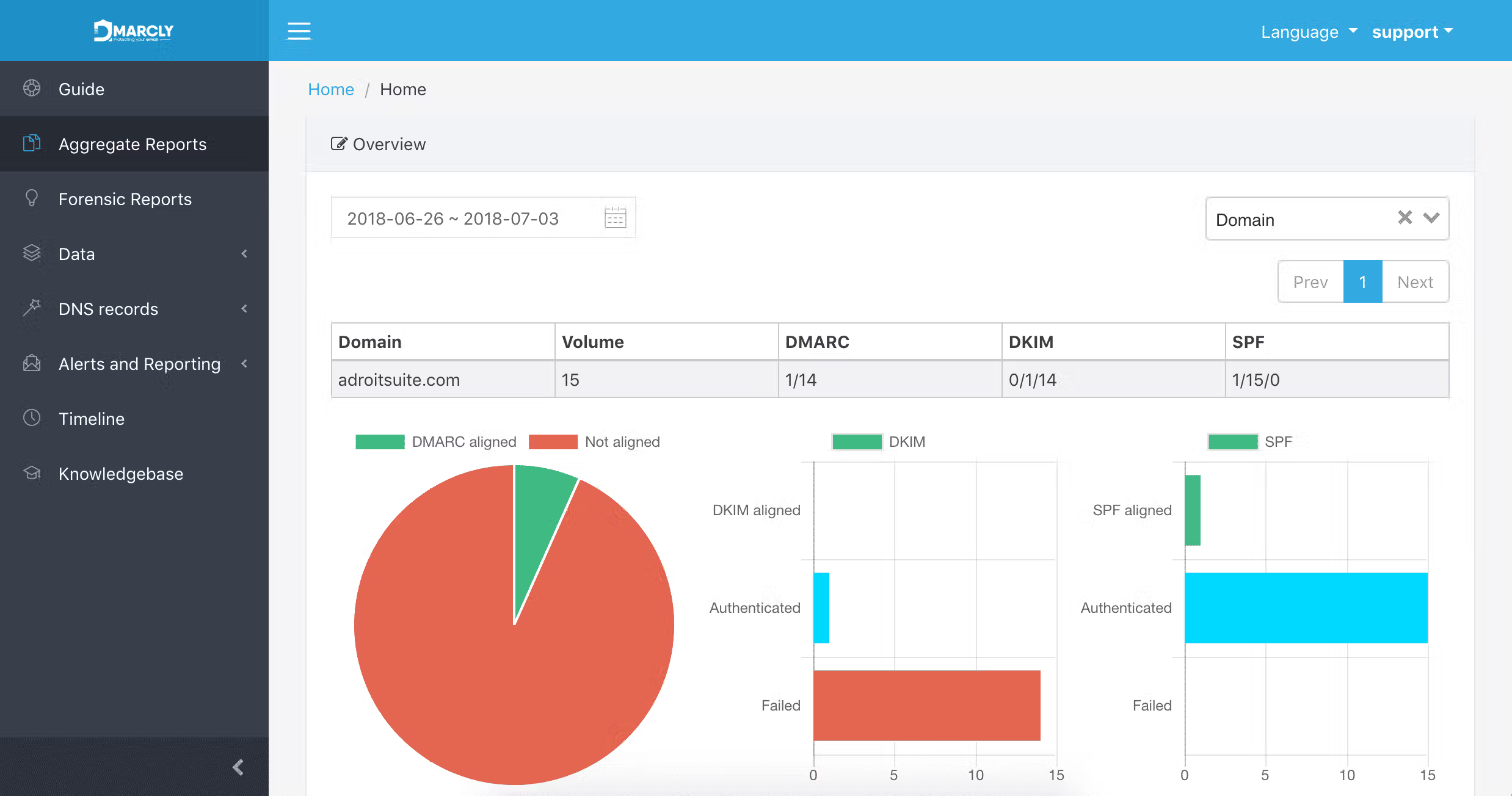
Professional includes aggregate and forensic processing, vendor identification, alerts, and MTA-STS/TLS-RPT. Safe SPF starts on Growth.
User experience
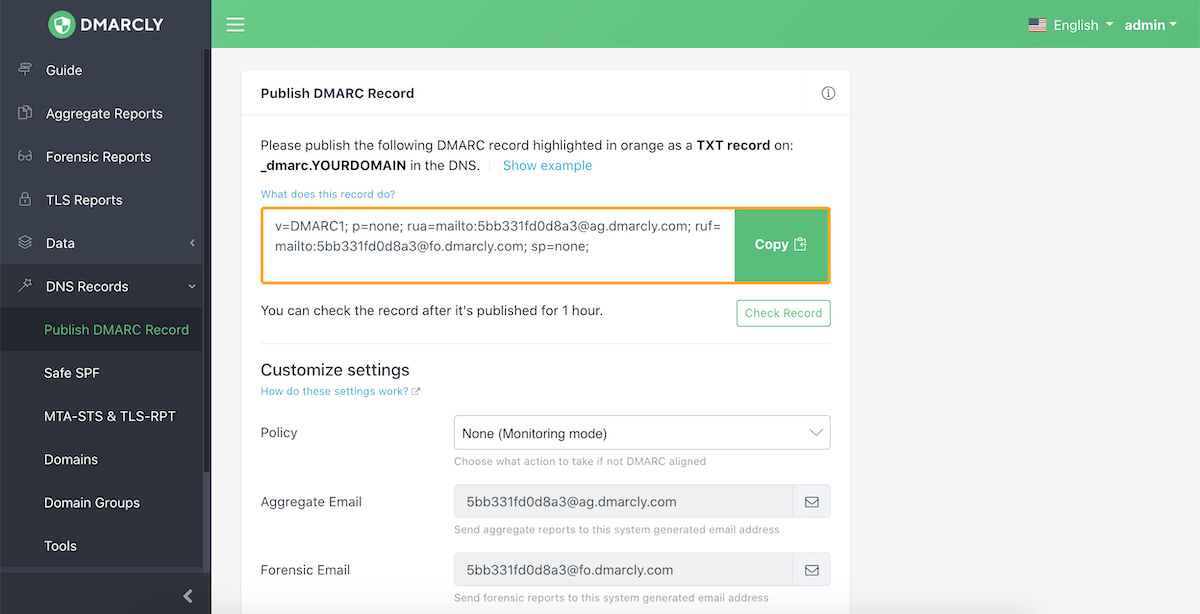
The setup starts with a DNS reporting record, followed by source review and policy changes. Professional has one administrator and only two months of history.
Support
Professional includes email support, while Growth lists live chat. These are published entitlements, with no response-time measurement claimed.

Suitability
We examine existing Safe SPF records and domain groups as migration dependencies. Professional is constrained when a second person needs their own login.
Who should use DMARCly
- Existing users checking Safe SPF records and sender history before changing platforms.
- Administrators who need to model the bill when seasonal campaigns exceed 100,000 compliant messages.
Pricing structure
- Professional: $17.99/month for two domains, 100,000 DMARC-compliant messages per month, one administrator, and two months of history.
- Growth: $39.99/month for eight domains, 250,000 messages, three administrators, four months of history, and one Safe SPF domain.
- There is a 14-day trial, with no ongoing free plan published.
- Exceeding the message allowance temporarily moves billing to a covering tier. Additional DMARC domains cost $1 each above the plan allowance.
Strengths
- Professional includes alerts and named email-vendor identification.
- Published over-quota rules make the volume-related billing change explicit.
Trade-offs
- Professional has one administrator and less than 90 days of retained evidence.
- Safe SPF requires Growth or above and has its own domain allowance.
- API access and granular user access controls require the higher Enterprise tier.
- Seasonal increases in compliant message volume change the monthly charge.
Verdict
View DMARCly alternatives
06.
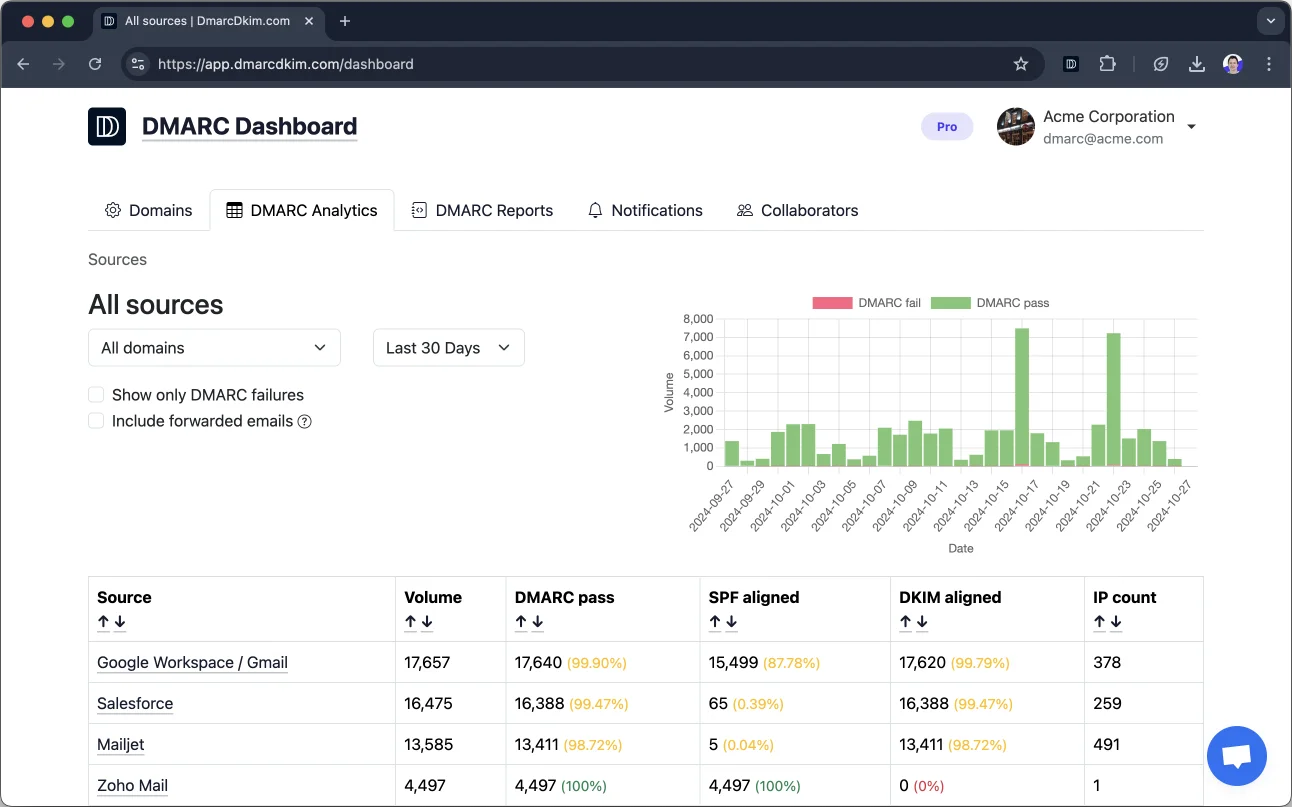
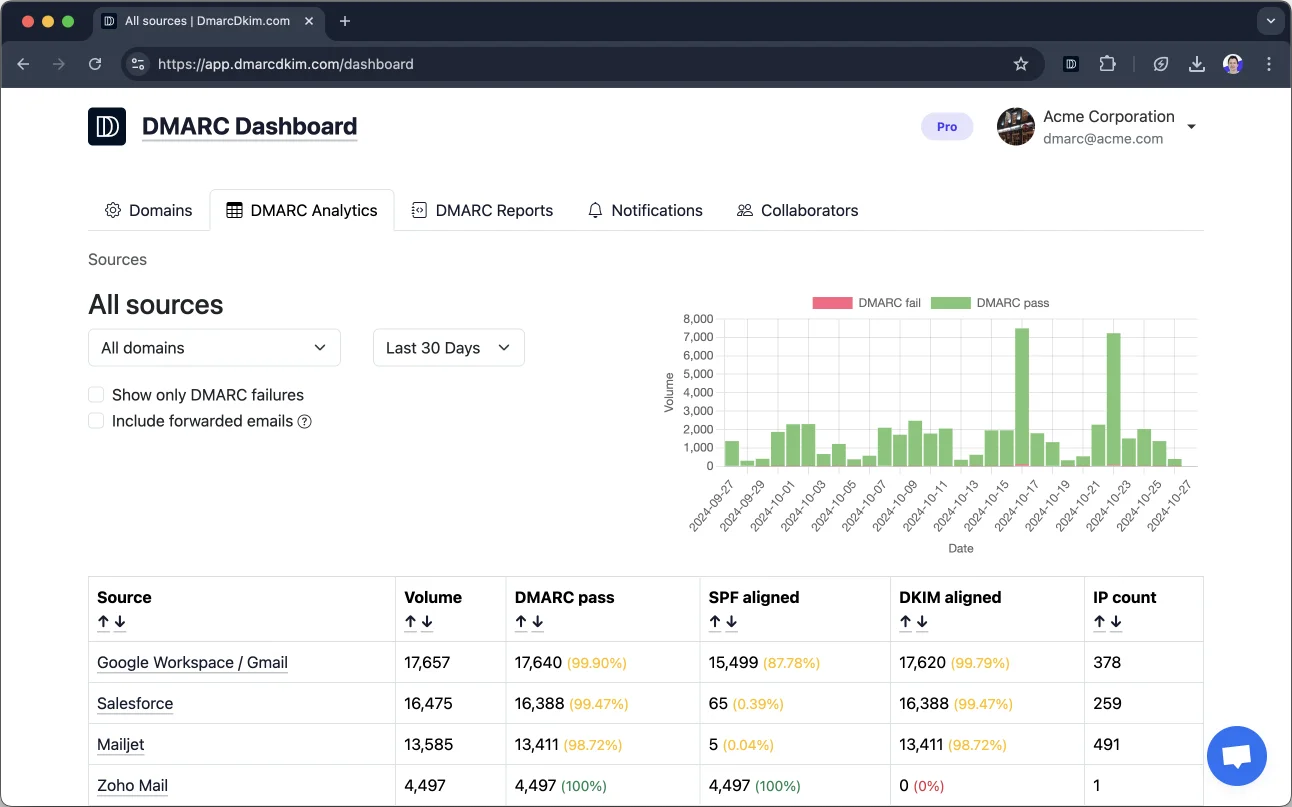
DMARCDKIM.com
0 / 5(0)DMARCDKIM.com has a low published annual entry price, with material limits on history and alerts. The free plan is non-commercial only.
#6
our rank
€4/month, billed annually
starting price
Yes
free tier

Feature set
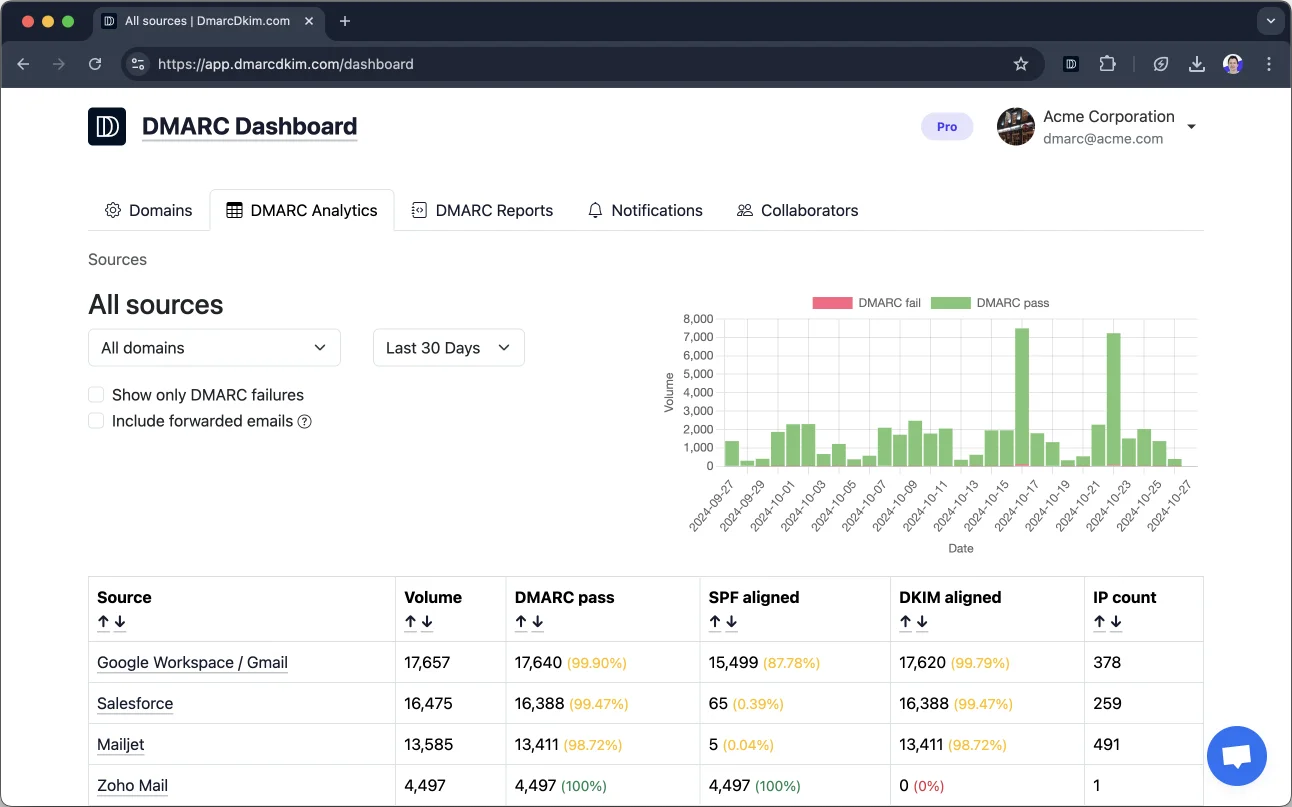
Mini includes aggregate analytics, SPF X-ray, and DNS monitoring. Basic adds actionable alerts, forensic reports, MTA-STS/TLS-RPT, and webhooks.
User experience
Mini provides report visibility after the DNS reporting setup, but has only one month of history. Basic adds the alerting needed for unattended maintenance.
Support
Mini lists onboarding support and Basic lists ticket support. Confirm the scope of DNS assistance before assuming the vendor will configure every sending service.
Suitability
We assess the Mini-to-Basic feature boundary for businesses comparing a low entry price with ongoing alerting. Existing webhooks are a specific switching consideration.
Who should use DMARCDKIM.com
- Administrators comparing aggregate-only visibility with the alerting included on Basic.
- Existing users documenting DNS monitoring and webhook destinations before a switch.
Pricing structure
- Free: one domain, 5,000 emails, 14 days of retention, and aggregate reporting, restricted to non-commercial use.
- Mini: €4/month billed annually as €48, with two domains, 10,000 emails, unlimited seats, and one month of history.
- Basic: €20 month-to-month or €15/month billed annually, with 20 domains, 200,000 emails, and three months of history, excluding taxes.
- Paid plans have a seven-day trial. Spoofed and forwarded email does not count toward the published quota.
Strengths
- Paid plans publish unlimited seats and named support entitlements.
- Basic specifies the alerting and retention missing from Mini.
Trade-offs
- The free plan is not eligible for commercial business use.
- Mini excludes actionable alerts and retains only one month of evidence.
- Mini has only 10,000 included emails, so campaign volume needs attention.
- API and MCP access require Pro rather than Basic.
Verdict
View DMARCDKIM.com alternatives
07.
Dmarcian
3.5 / 5(5)Dmarcian Basic covers commercial use, unlike its free Personal plan. Domain and user limits determine whether the advertised entry subscription fits a shared administration workflow.
#7
our rank
$24/month
starting price
Yes
free tier
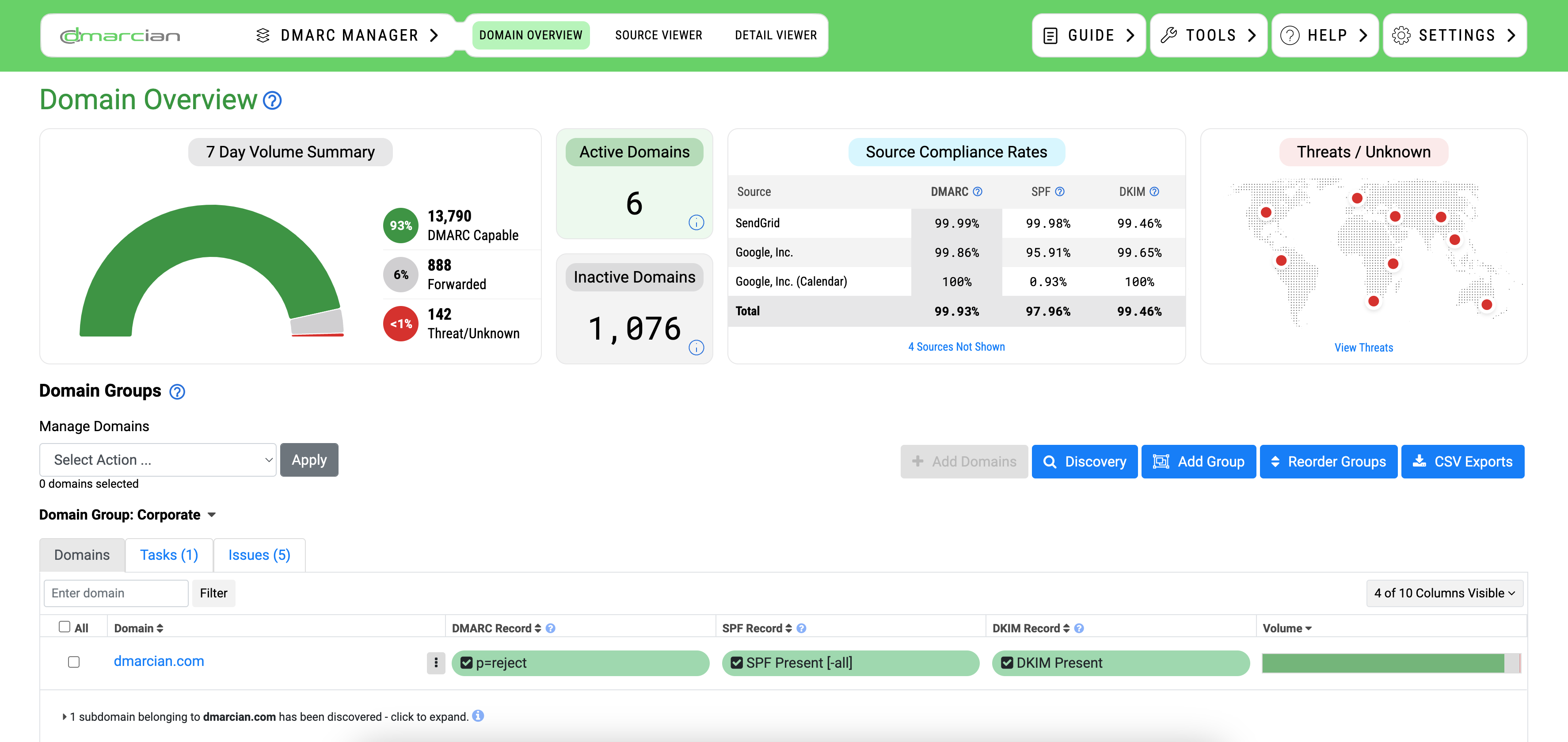
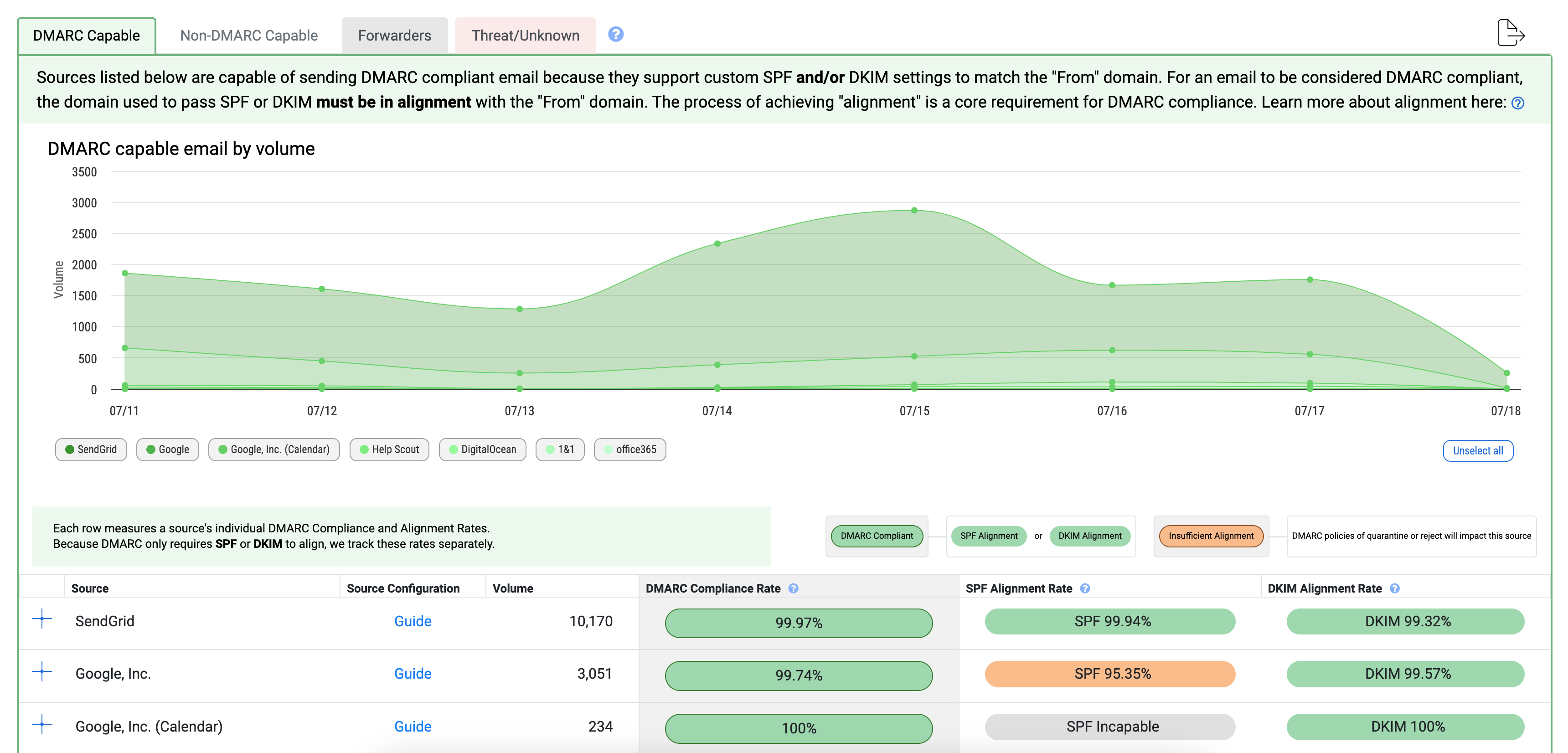
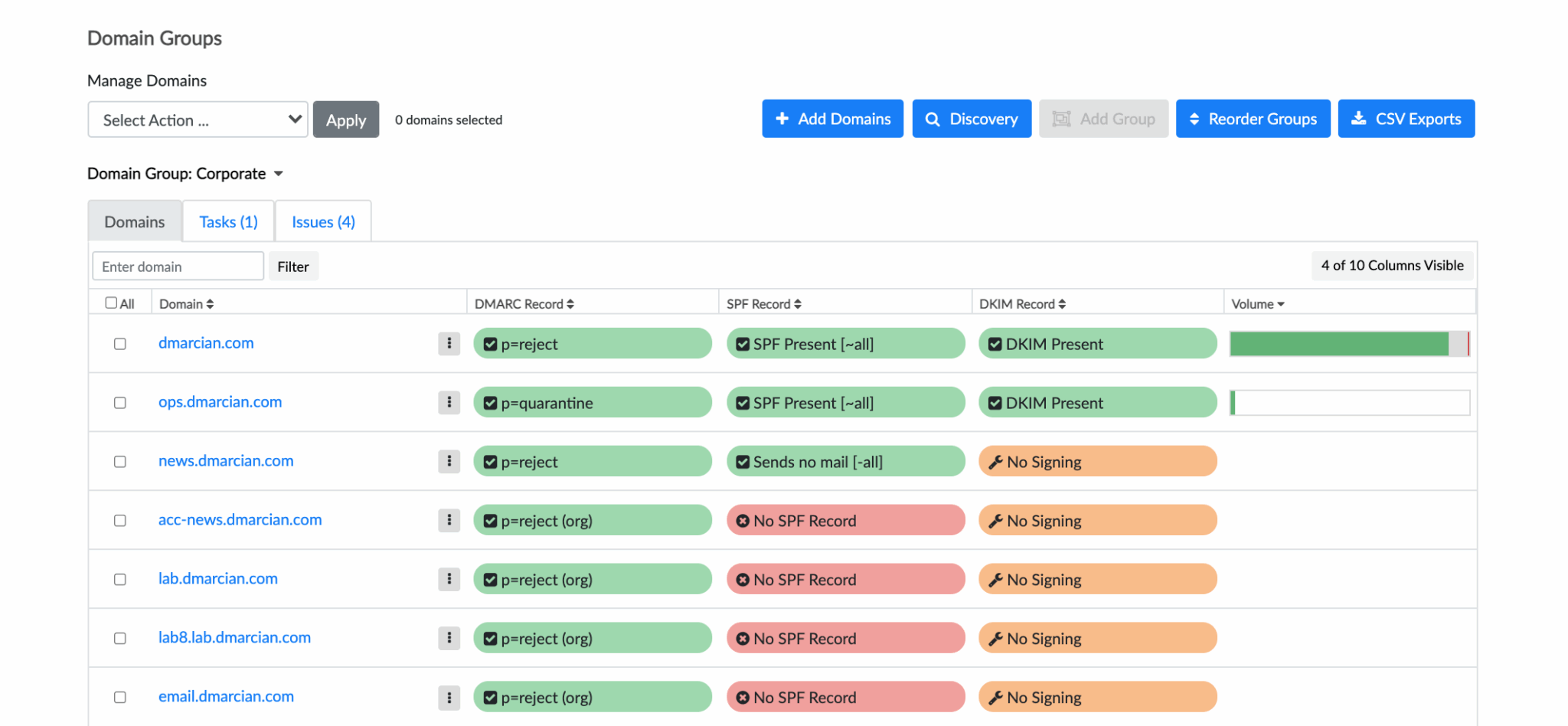
Feature set
Basic includes enriched Sources, automatic subdomain detection, Alert Central, and aggregate plus forensic reports. It does not include granular user access controls or API access.

User experience
A reporting-record DNS change starts collection, then Sources provides context for investigating senders. Basic has one user and one standard domain group.
Support
G2 feedback includes positive support reports alongside usability complaints. A Basic support SLA is Not publicly listed in the pricing evidence, so confirm the help included.
Suitability
We examine existing Source classifications and domain groups when assessing a switch. The one-user Basic limit is a practical issue for an owner sharing administration with an IT provider.
Who should use Dmarcian
- Existing users documenting source ownership and domain groups before migrating reports.
- Administrators checking whether one login and two active domains cover the intended setup.
Pricing structure
- Personal: free for non-business use only, with two active domains, 1,250 monthly messages, one user, and one month of history.
- Basic: $24/month, or $19.99/month billed yearly as $239.88, with two active domains, 100,000 monthly DMARC-capable messages, and three months of history.
- Plus: $240/month, or $199/month billed yearly, with eight active domains, three users, and one year of history.
- A 30-day paid-plan trial is available. Forwarded and fraudulent traffic is excluded from the legitimate-traffic pricing basis.
Strengths
- Basic combines sender context with alerting and three months of retained data.
- Inactive domains have a separate unlimited allowance in the published plans.
Trade-offs
- The ongoing free plan excludes business domains and has an acceptable-use audit.
- Basic includes one user and lacks user access controls.
- The published standard price increases substantially when moving to Plus for more users.
- API access and SSO are higher-tier functions, rather than Basic inclusions.
Verdict
View Dmarcian alternatives
08.
PowerDMARC
4.9 / 5(234)PowerDMARC Basic has several hosted protocols, with costs tied to compliant outbound volume. Its personal-only free tier and Basic add-ons need separate consideration.
#8
our rank
$8/month
starting price
Yes
free tier
Feature set
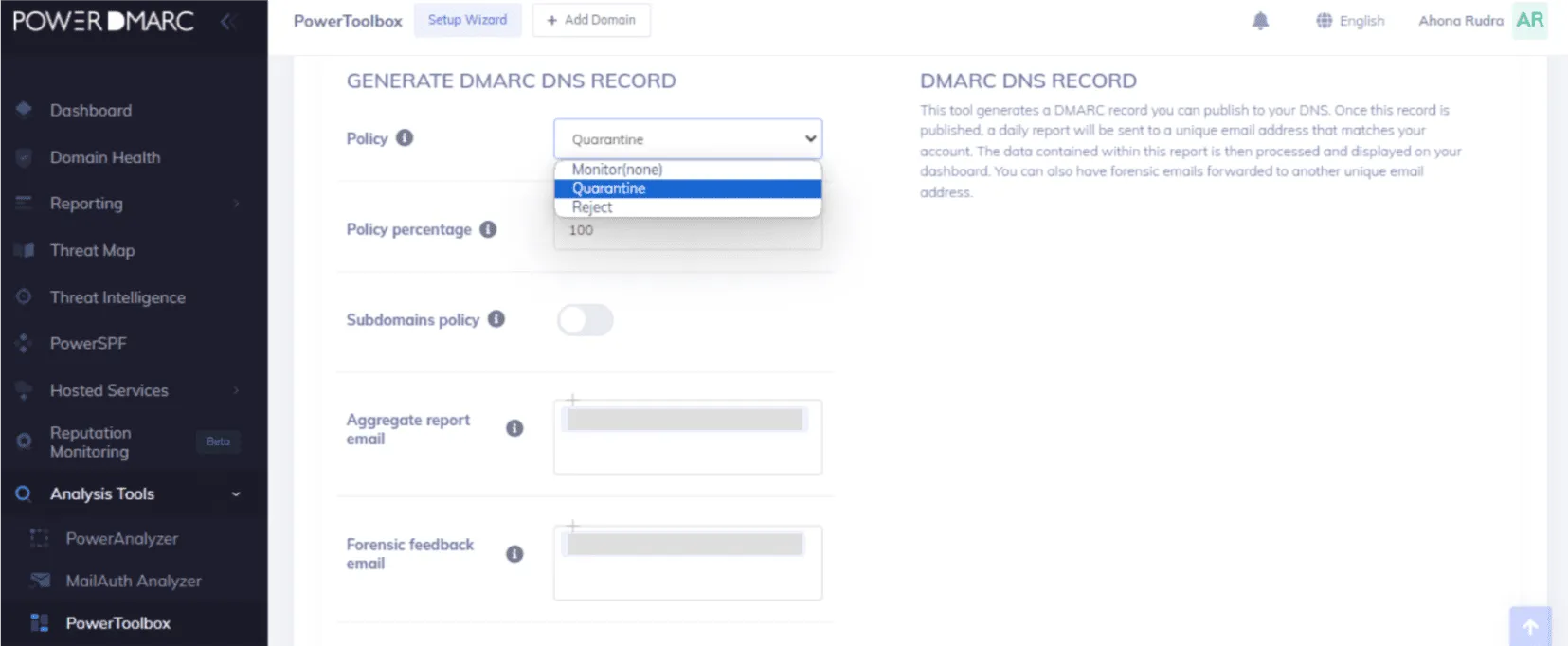
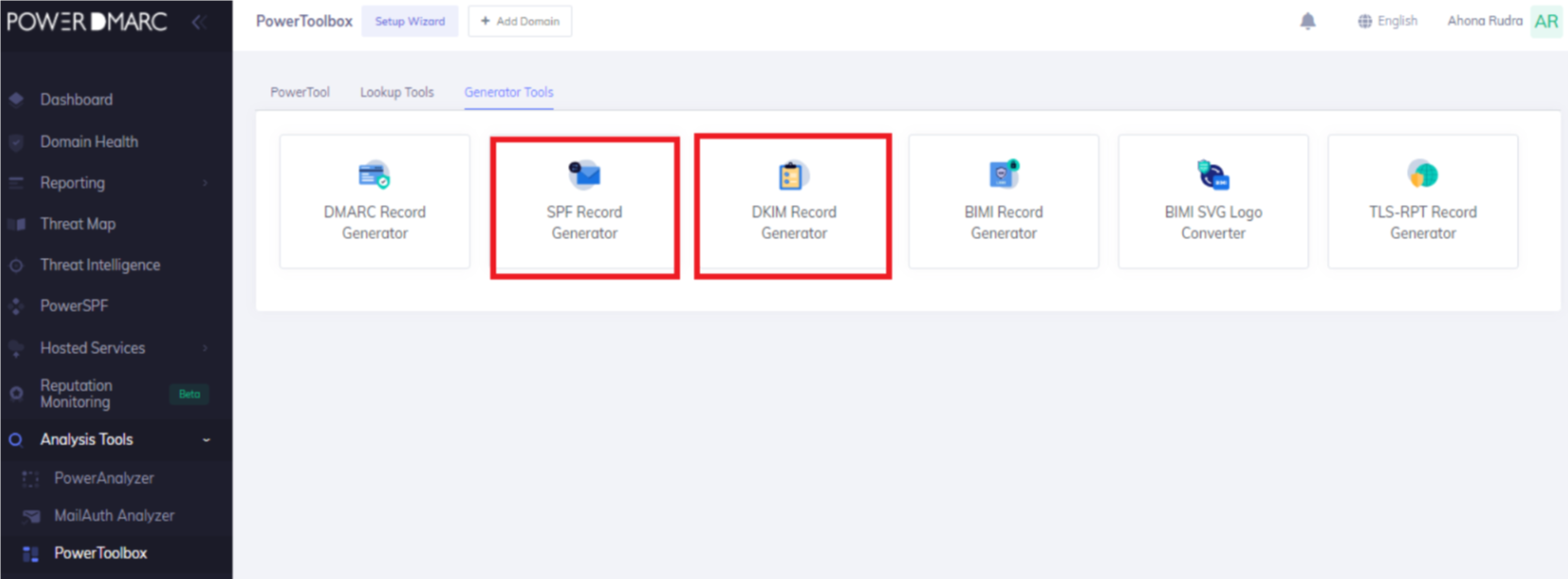
Basic includes hosted DMARC, MTA-STS, TLS-RPT, and BIMI, plus sender identification and role-based access. Hosted SPF is an add-on and hosted DKIM is excluded.
User experience
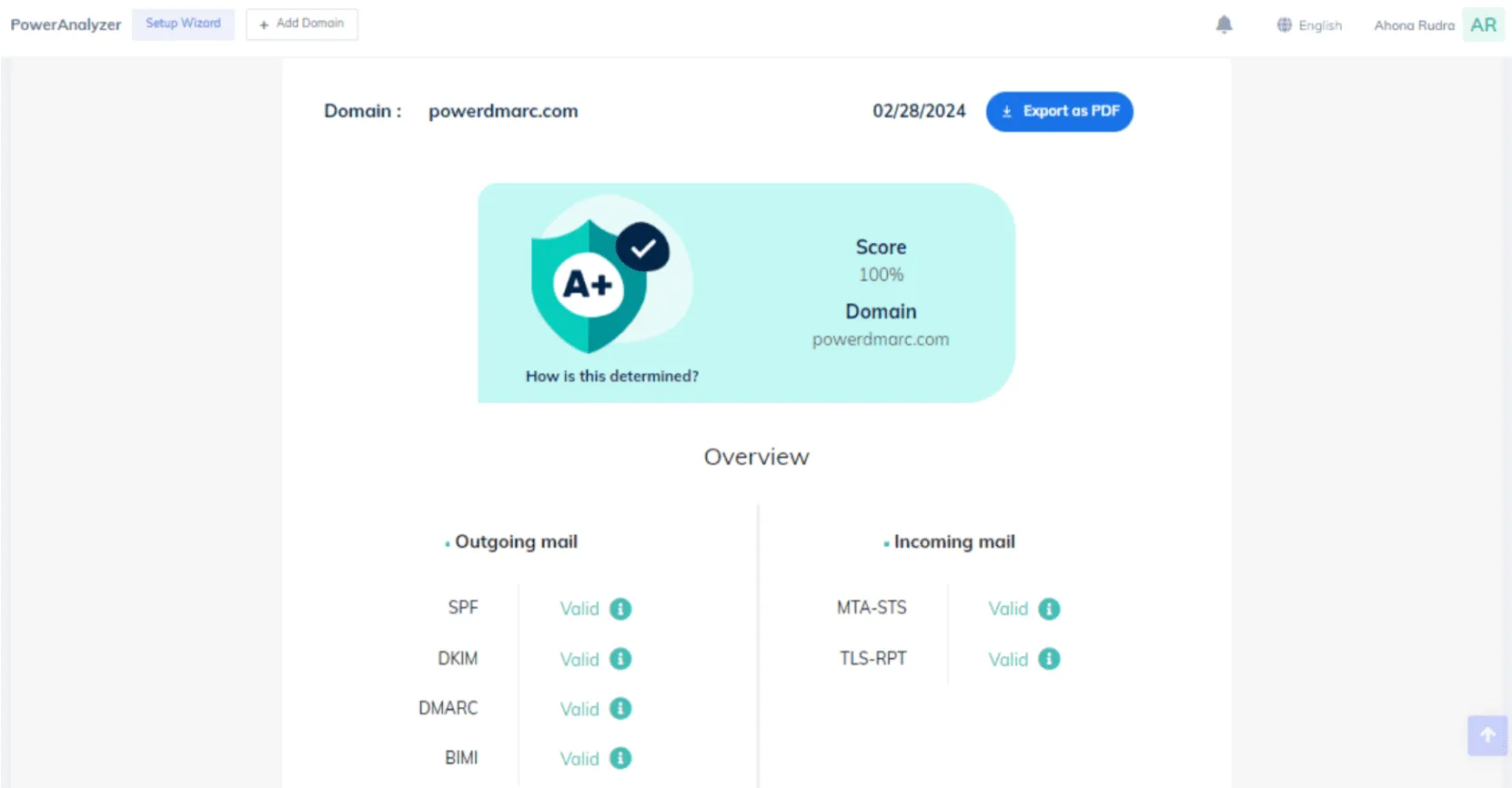
Basic documents one-click DNS publishing and a DNS timeline. The setup still requires an authorized DNS handoff and authentication configuration at each legitimate sender.

Support
Basic lists tutorials and interactive demos, while email help and setup services are add-ons. Published support packaging matters more than assuming the G2 average describes Basic entitlements.
Suitability
We examine existing hosted records and Basic volume bands during a switch. The lowest price does not include the alert-management package needed for some maintenance workflows.
Who should use PowerDMARC
- Existing users inventorying hosted policies and DNS publishing arrangements before migration.
- Administrators calculating costs for campaign traffic across the published compliant-volume bands.
Pricing structure
- Free: personal domains only, with one active domain, 10,000 compliant emails per month, one user, and ten days of history.
- Basic starts at $8/month for the 10,001 to 50,000 compliant-email band, with five active domains, unlimited inactive domains, and one year of history.
- The 100,000-email Basic band is $15/month or $12/month billed yearly. Basic has a 15-day trial.
- Hosted SPF, extra domains, and Basic support services require add-on pricing. Phishing and invalid traffic is excluded from the billing basis.
Strengths
- Basic documents hosted transport-security services and one year of retention.
- Published volume bands distinguish the entry price from the 100,000-email package.
Trade-offs
- Free is personal-only and has ten days of retained history.
- Basic excludes alert management, API access, and report CSV export.
- Email support and implementation assistance are add-ons on Basic.
- Hosted SPF adds cost, and Basic does not include hosted DKIM.
Verdict
View PowerDMARC alternatives
09.
DMARC Report
4.8 / 5(467)DMARC Report retains six months on Guard, but several maintenance functions start on Shield. Conflicting public quota and domain wording needs resolution before budgeting.
#9
our rank
$25/month
starting price
Yes
free tier
Feature set
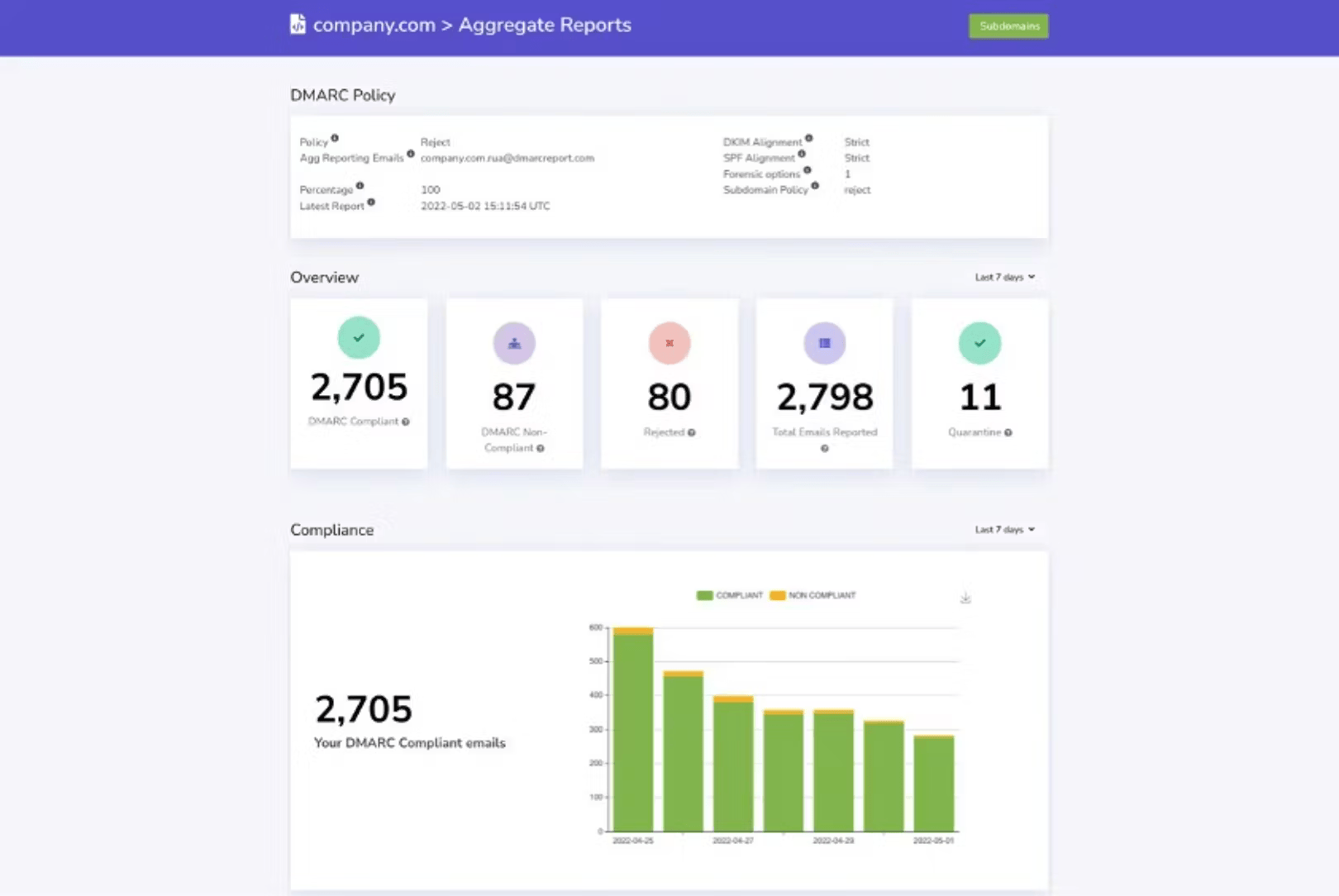
Guard adds Email Vendor ID, failure reports, and group permissions to aggregate reporting. Shield adds parked-domain coverage, MTA-STS/TLS-RPT, API access, and email support with alerts.
User experience
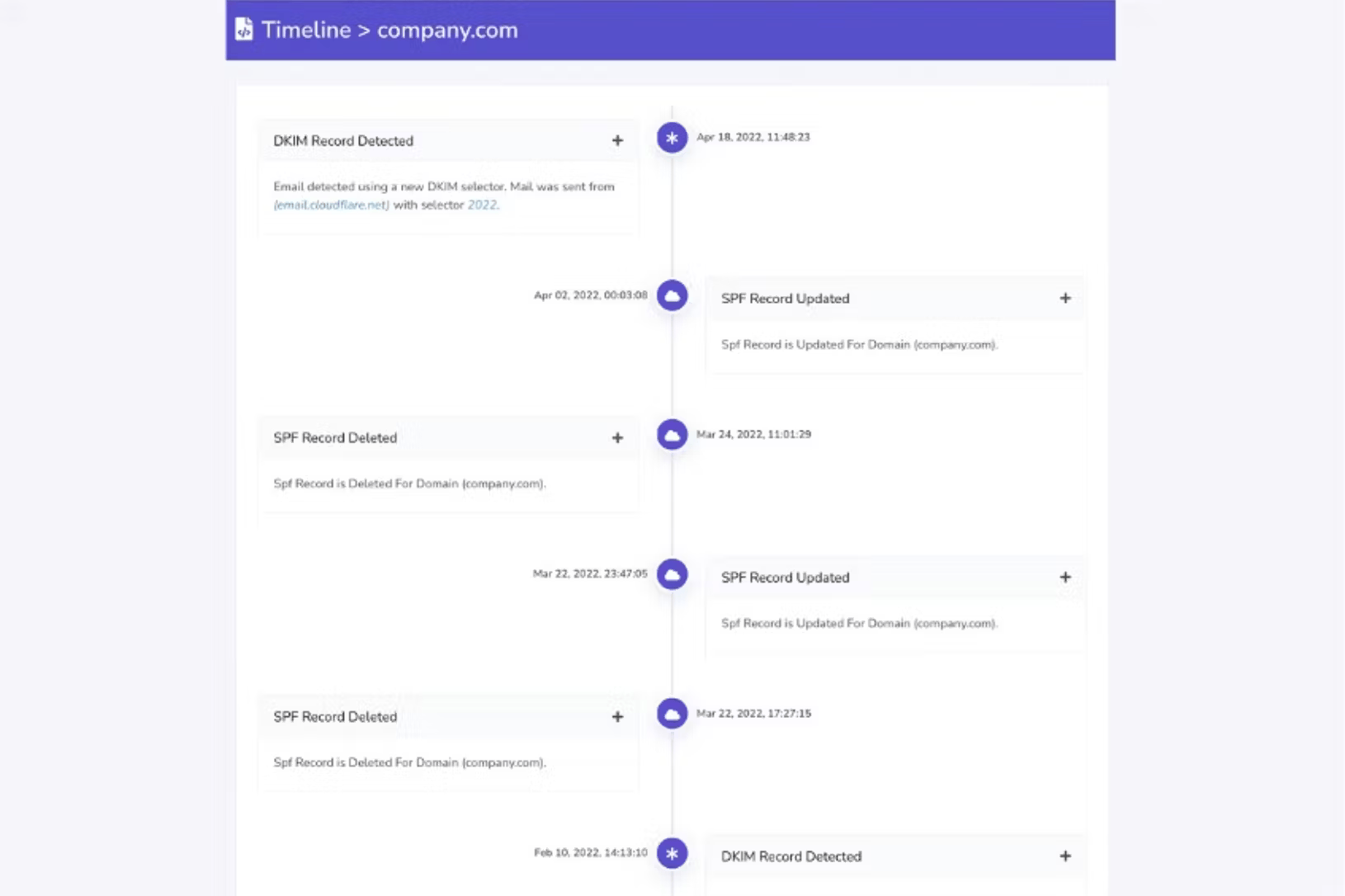
Source and authentication-result filtering support investigation after DNS setup. The published parked-domain and alerting gates are relevant to the shared domain framework.

Support
The published comparison places email support and alerts on Shield. G2 feedback includes requests for more setup guidance, which we treat as user reports rather than measured onboarding results.
Suitability
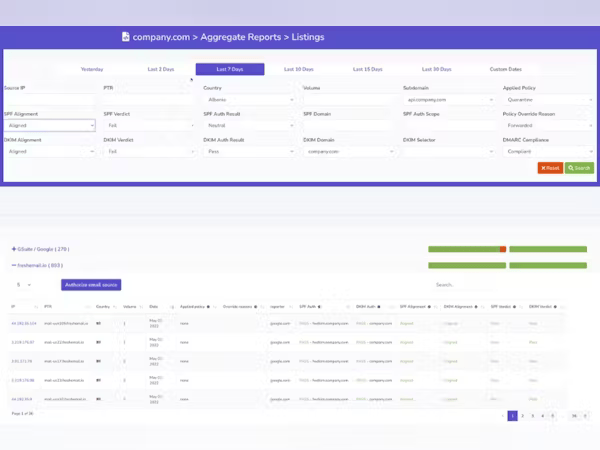
We examine Guard versus Shield for existing report-group and permission workflows. A team with a parked domain and unattended alerting needs should verify the complete package.
Who should use DMARC Report
- Existing users mapping report groups and permissions before a switch.
- Administrators verifying the tier needed for both parked-domain monitoring and alerts.
Pricing structure
- Core is an ongoing free plan for one domain and 30 days of history. Public text conflicts between a 10,000 allowance and a 1,000-message limit.
- Guard: $25/month or $275/year, with five listed domains, six months of history, and a 250,000 monthly allowance. Confirm whether the allowance counts report files or reported messages.
- Shield: $75/month or $750/year, with ten listed domains, one year of history, parked domains, and email support plus alerts.
- Paid plans have a 30-day trial. Public FAQs conflict with plan cards about paid domain limits, so obtain the exact allowance in writing.
Strengths
- Guard retains more than the full 90-day comparison window.
- The plan cards identify where vendor detection and team permissions begin.
Trade-offs
- Core volume wording and paid domain limits conflict across public pricing text.
- Guard does not include the Shield email-support and alert package.
- The published parked-domain capability starts on Shield.
- Quota units need confirmation because report counts and reported-message counts are different.
Verdict
View DMARC Report alternatives
10.
DMARCEye
4.8 / 5(3)DMARCeye has per-domain annual pricing and an ongoing free monitor. Policy management and the published volume discrepancy need attention before relying on it for enforcement maintenance.
#10
our rank
$4/domain/month, billed annually
starting price
Yes
free tier
Feature set
DMARCeye combines DMARC reporting with AI explanations and blocklist (blacklist) monitoring. Paid Scale adds smart alerts, email notifications, and team collaboration.
User experience
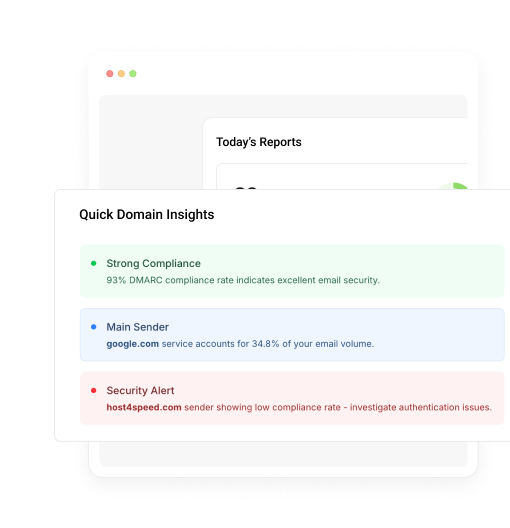
Sender drilldowns support investigating authentication failures, but G2 feedback reports no in-platform DNS or DMARC policy management. A separate DNS administrator remains part of that workflow.
Support
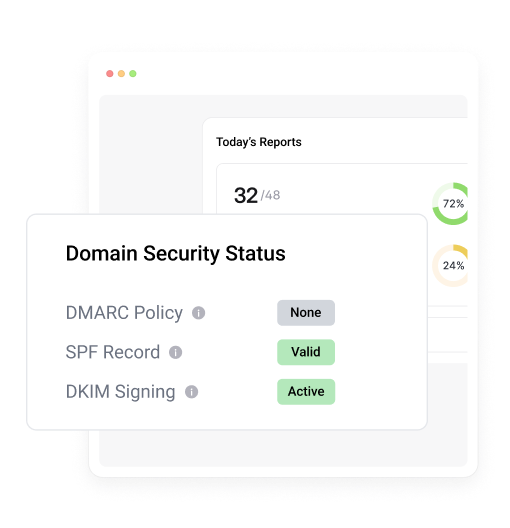
Priority support is listed for Scale and excluded from Free. We have no measured response time or documented included enforcement service to attach to that entitlement.
Suitability
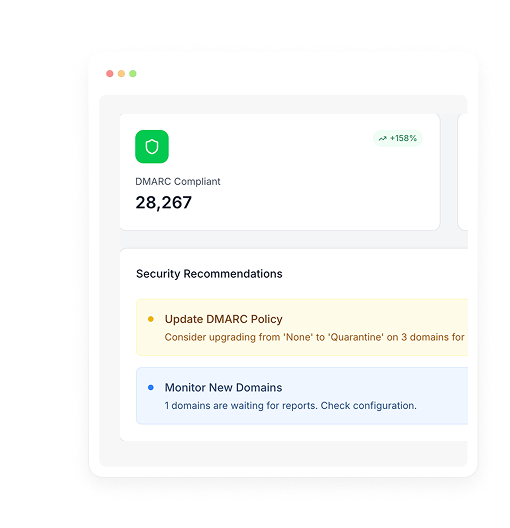
We examine the domain-slot model for existing monitoring accounts. Multi-tenant client separation is an Agency function, rather than a Scale entitlement.
Who should use DMARCEye
- Existing users checking paid slots for separately monitored domains and subdomains.
- Administrators comparing a monitoring-only DNS handoff with hosted policy management in Suped.
Pricing structure
- Free: one domain, 5,000 tracked emails per month, and 30 days of history, without smart alerts, email notifications, or team collaboration.
- Scale: $4 per domain per month billed annually as $48 per domain per year, for up to 50 domains and one year of history.
- Published materials have shown both 500,000 and one million monthly emails per domain; use the 500,000 allowance until the account limit is confirmed.
- A 14-day paid trial is separate from Free. Agency pricing is Not publicly listed and adds multi-tenant architecture.
Strengths
- The paid per-domain annual price and one-year retention are explicit.
- Scale includes notifications that are absent on the ongoing free plan.
Trade-offs
- Free has no smart alerts or email notifications and retains only 30 days.
- Public volume allowances have conflicted, so confirm the live limit.
- Scale excludes multi-tenant architecture; Agency requires a quote.
- G2 feedback describes policy and DNS changes as external tasks.
Verdict
View DMARCEye alternatives
11.
EasyDMARC
4.8 / 5(165)EasyDMARC separates its limited free tier, one-user Plus plan, and Premium maintenance controls. A small team needs to price the required alerting and access level rather than the entry plan alone.
#11
our rank
$44.99/month
starting price
Yes
free tier

Feature set
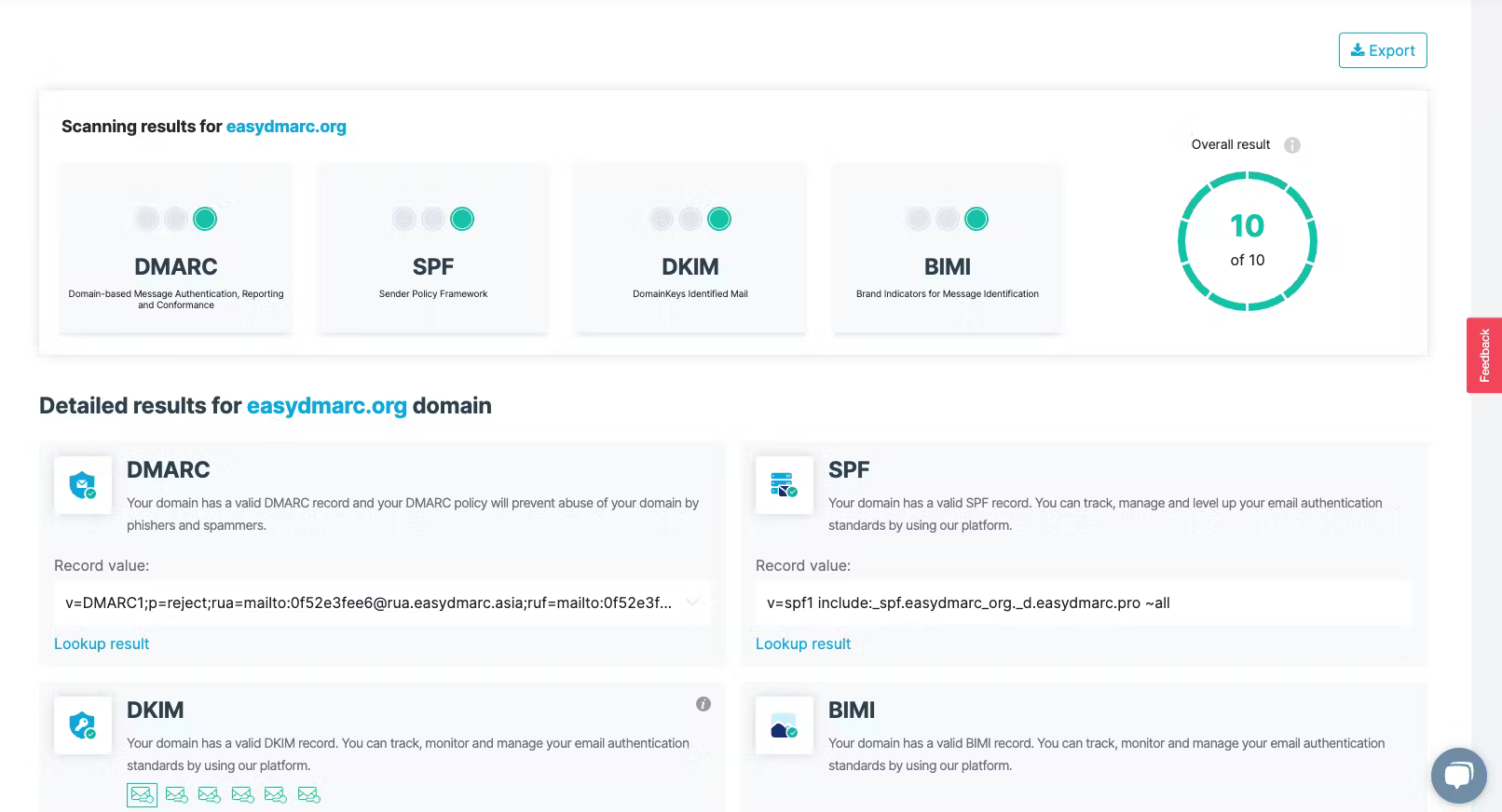
Plus includes aggregate and failure reports, vendor identification, and managed DMARC. Premium adds alert management and EasySPF, with other hosted-service entitlements to verify in the selected package.
User experience
Onboarding involves the reporting record and the chosen managed-record setup. Plus has one user, so shared administration requires checking a higher package.
Support
Plus lists knowledge-base access; Premium lists email support and a dedicated customer success manager on annual billing. Do not assume the support package is the same across tiers.

Suitability
We examine existing managed records and configured source groups as migration work. Those specific dependencies do not establish a reason to assign a business segment to EasyDMARC.
Who should use EasyDMARC
- Existing users documenting managed records before switching their reporting destination.
- Administrators checking the cost of multiple users and alert management for a small team.
Pricing structure
- Free: one domain, 1,000 emails per month, one user, and 14 days of history.
- Plus starts at $44.99/month, or $35.99/month billed annually, for two domains, 100,000 monthly emails, one user, and three months of history.
- Premium starts at $89.99/month, or $71.99/month billed annually, for four domains, 100,000 monthly emails, unlimited users, and one year of history, excluding taxes.
- A free trial is separate from the ongoing Free tier. The documented quota policy removes report/dashboard access until the account is upgraded after exceeding the selected email allowance.
Strengths
- The published plan differences identify the move to team access and alert management.
- Plus includes vendor detection and a three-month investigation history.
Trade-offs
- Free is limited to 1,000 monthly emails and 14 days of retained data.
- Plus includes one user and excludes Premium alert management and EasySPF.
- Additional domains require a sales conversation, rather than a published add-on price.
- Volume changes affect the package cost, and exceeding quota interrupts access to reports under the documented policy.
Verdict
View EasyDMARC alternatives
Keep small-business DMARC enforcement manageable with Suped
Suped
Get started
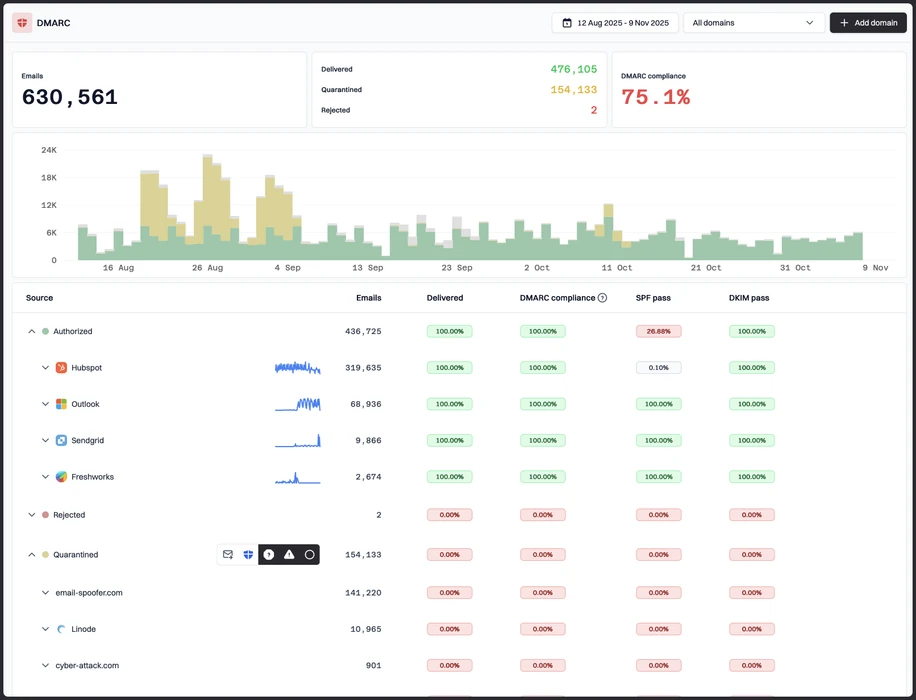
Make the DNS handoff clear
Configure reporting, verify incoming data, and use hosted DMARC for subsequent policy management after the initial DNS setup.
Investigate the actual failure
Review unverified sources, inspect authentication results, and use issue explanations and CSV evidence to coordinate the fix.
Budget for continued enforcement
Basic is $19/month for two domains, 100,000 monthly emails, and 90 days of history. Configure notifications and confirm the hosted services included in the chosen plan.
The difference was significant. We moved from limited visibility to a much clearer dashboard. Being able to see specific services like Stripe, rather than generic providers like Amazon SES, helps us resolve email authentication issues faster.
Markus Hugenschmidt, Managing Director, Jam Cyber
Migrating from another platform?
We have done the migration enough times to know the shape.
Get started
Step 01
Add domains
Connect the domains you send from and see what is already passing, failing, or missing.
Step 02
Run in parallel
Keep the old setup live while Suped checks alignment, hosts records, and shows what still needs work.
Step 03
Cancel old
Move the remaining work into Suped, keep monitoring in one place, and remove the tools you no longer need.
How we keep this ranking honest
Suped is our product. We use the same domain and sender framework across every entry, check documented capabilities against pricing entitlements, and distinguish ongoing free plans from trials and personal-only accounts. We prioritize the setup work and continued enforcement a small team has to own. We retain material limits even when they affect Suped, and flag conflicting public quotas instead of resolving them by assumption. Our review process compares the proposed workflow with the published plan details before drawing a verdict; documented availability is not a measured test result. G2 figures are review averages out of five with their review counts, and products without reviews have no established G2 average. Prices reflect the stated billing basis and currency, with checkout terms to verify before purchase.
Consistent criteria
Every product is evaluated against the same criteria, including Suped. We compare capabilities, costs and practical trade-offs.
Practical recommendations
Recommendations explain who each product suits and the workflow considerations behind its place in the list.
Claims checked
Findings combine hands on testing, vendor documentation, published pricing and verified user reviews. Pricing reflects public plans as of the dates shown.
Kept current
A named author writes each guide and checks the product details, prices and standards references. We recheck pages on a fixed schedule.