11 best DMARC products for Europe in 2026
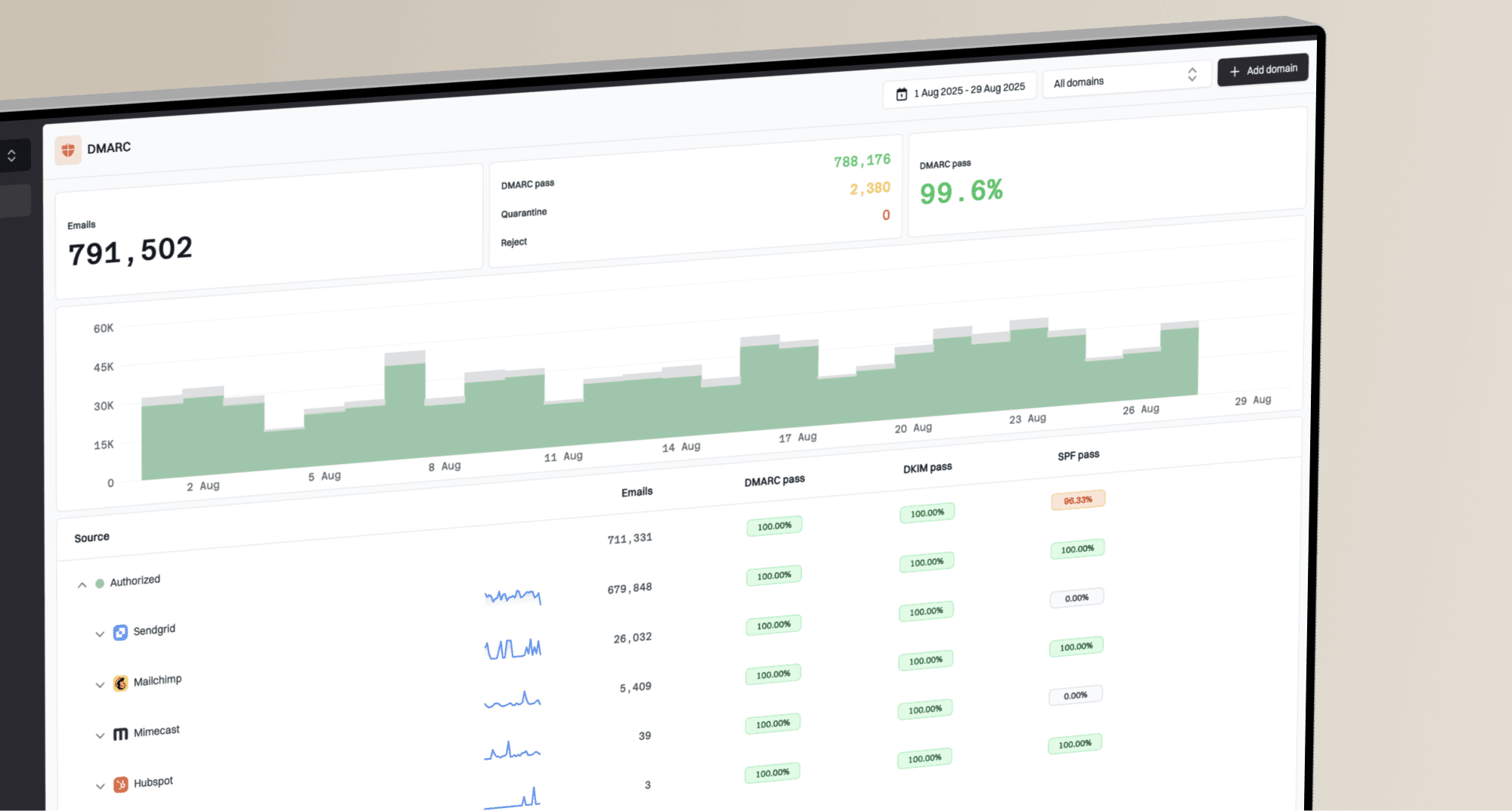
Choosing the best DMARC products for Europe means checking data handling and DNS ownership alongside the subscription price. We rank our product, Suped, number one for its source verification, detailed authentication investigation and hosted record management, including enterprise and MSP workflows. Suped is hosted SaaS, with no self-hosted or on-premise edition. EU-only hosting, certifications and contractual GDPR terms are not established by the evidence reviewed, so buyers with those requirements need written confirmation before purchase.

Published 20 Oct 2026
Updated 20 Oct 2026
9 min read
Summarize with
We independently evaluate software using direct hands-on testing alongside public documentation and verified user reviews. Missed a tool worth covering? Tell us about it.
What European DMARC procurement needs to establish
Data handling and account boundaries
01.
We recommend checking legal-entity access and report handling before choosing a hosting label. Suped documents separate organization administration, user roles and SAML SSO, which support controlling access across a group or managed clients. Request the applicable data-processing agreement and subprocessor list, plus storage, backup and support-access locations. A European customer base or a euro invoice establishes none of those terms.
DNS approvals and enforcement
02.
Suped connects verified and unverified sources with report-level authentication checks and hosted record management. After the initial DNS setup, hosted DMARC supports policy changes through the application. We recommend assigning each legitimate sender to an internal owner, checking forwarding exceptions and approving changes before quarantine or reject. Hosted records still need a DNS handoff and an exit plan.
Portfolio budget and retained evidence
03.
Suped publishes $19/month for 2 domains and 100,000 monthly emails, $99/month for 10 domains and 1 million monthly emails, and negotiated Enterprise terms. Its $29/month configuration covers 3 domains with 365 days of retention. Price the corporate domain, marketing subdomain and parked domain according to how each is counted, then confirm taxes, invoice currency and support commitments. Suped's MSP option has published per-domain pricing with unlimited email volume and retention.
11 products at a glance
| ||
|---|---|---|
01. | Suped | |
02. | MailHardener | |
03. | DMARCwise | |
04. | Dmarcian | |
05. | OnDMARC | |
06. | URIports | |
07. | Mail Tower | |
08. | DMARCDKIM.com | |
09. | DMARCly | |
10. | DMARC Manager | |
11. | Send-Shield |
How we tested all 11 products
We use a shared evaluation framework with a primary corporate domain, a marketing subdomain and a parked domain; Microsoft 365, Google Workspace, SendGrid, Mailchimp and one support desk sender; and a 90-day monitoring window. This comparison assesses documented capabilities, published pricing and available G2 review totals, without claiming a completed 90-day hands-on test or measured support interactions. We compare price and included domains/email volume, the distinction between report quotas and message quotas, sender classification, retention and supported hosted protocols. The authentication acceptance cases cover aligned SPF pass, aligned DKIM pass, SPF pass with a visible From mismatch, DKIM pass on a subdomain, forwarding with SPF failure, an unauthorized spoof sample and an unknown sender needing classification. SPF pass without a matching From domain does not satisfy DMARC by itself; a subdomain DKIM signature depends on relaxed versus strict alignment, and forwarded mail can pass DMARC through surviving aligned DKIM. The spoof sample must fail DMARC when neither authentication mechanism passes with alignment. Unknown senders require investigation rather than automatic authorization or a spoof label. We also examine onboarding, DNS handoff, enforcement changes, report drilldowns, alerts, account separation and support scope. For European procurement, we distinguish documented location statements from unconfirmed residency or compliance assumptions, and check whether retention preserves the full review window.
11
products evaluated
90
day live test window
3
domains tested
6
edge cases per tool
The test rig
We ran every platform against one controlled environment for 90 days: a primary corporate domain, a marketing subdomain and a parked domain. Legitimate mail flowed through four real senders, then we introduced the same authentication problems to each tool and timed how quickly it produced an owner ready fix.
Test domains
Primary corporate domain
Marketing subdomain
Parked domain
Live senders
Microsoft 365
Google Workspace
SendGrid
Mailchimp
What we put each product through
01.
Onboard all three domains and reach a verified DMARC state.
02.
Resolve an unknown sender from report evidence alone.
03.
Explain a forwarded mail SPF failure that still passed DKIM.
04.
Triage a spoofing sample sent to the parked domain.
05.
Move a domain from p=none toward p=reject safely.
06.
Flatten an SPF record nearing the ten lookup limit.
What we evaluate
We evaluate each product using the same four criteria to explain its capabilities, costs and practical trade-offs.
Pricing and value
01.
Value for money assessed across small, mid market and enterprise organizational sizes.
Technical features
02.
Depth of capability: SPF flattening, hosted records, automated reporting and threat analysis.
Support quality
03.
Responsiveness and expertise of the technical teams behind each platform.
Ease of use
04.
Speed of setup and quality of ongoing day to day operating experience.
Where each leader wins and where it lags
All 11 products, with the same breakdown for each: who it suits, its best features, pricing, and the honest trade-offs.
01.
Suped
 5 / 5(55)
We recommend our product, Suped, first for European buyers who want to investigate reported senders and manage authentication changes in one hosted service. Source verification, individual report checks and hosted record management connect the work needed before enforcement. The same workflow applies to enterprise domain portfolios and managed clients through organization management, access roles and SAML SSO. Suped is hosted SaaS, without a self-hosted or on-premise edition. The available evidence does not establish EU-only hosting, specific certifications or contractual GDPR terms; those need written confirmation before a purchase with those requirements.
#1
our rank
$19/month
starting price
Yes
free tier
Feature set
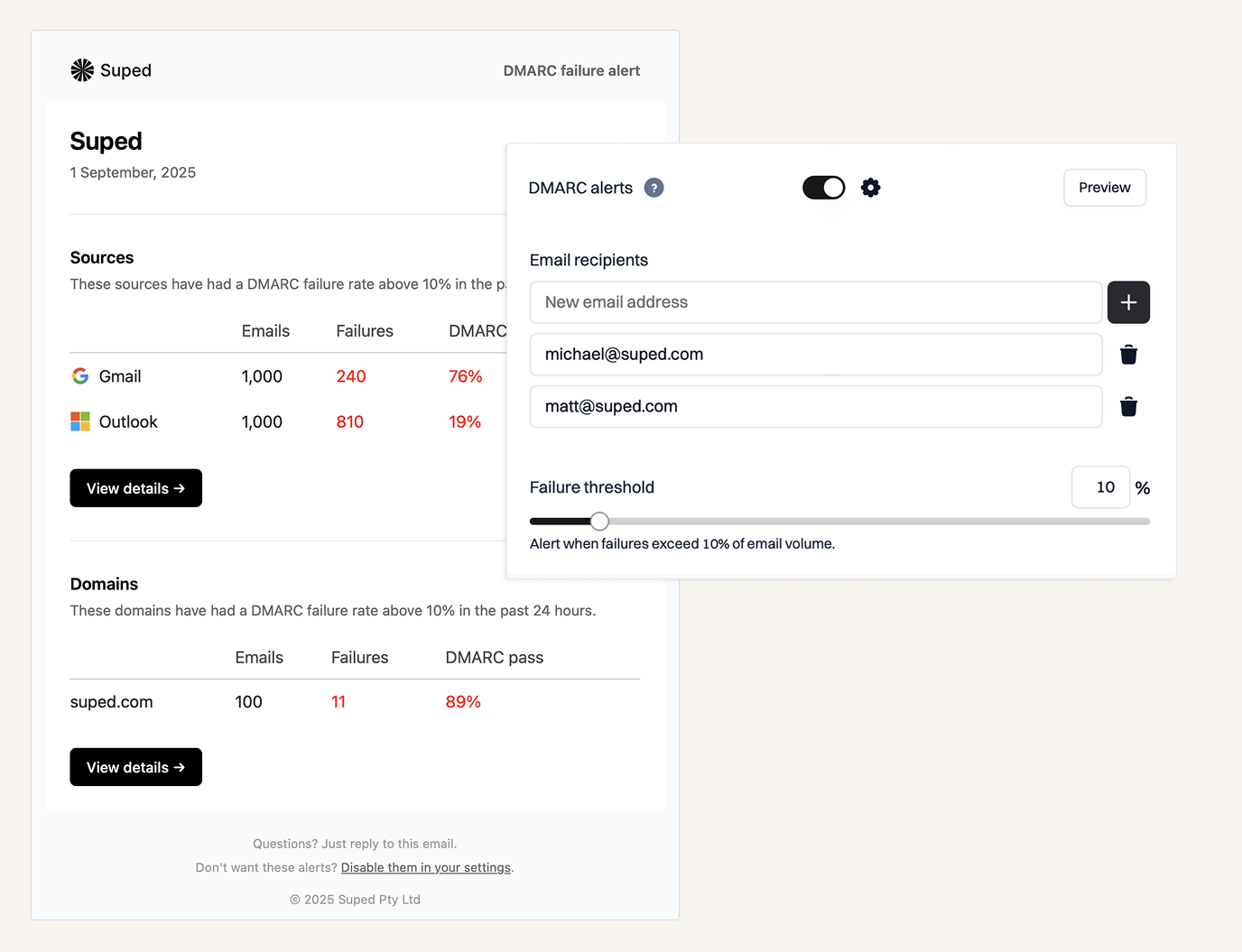
Suped has DMARC aggregate reporting with verified and unverified sources, filters by reporter or IP address, CSV downloads and detailed SPF, DKIM, DMARC and rDNS checks. These functions support the distinction between a failed authentication mechanism and a failed DMARC result, which matters when European subsidiaries share sending infrastructure. Hosted DMARC, SPF and DKIM management are documented, alongside SPF flattening, BIMI and hosted MTA-STS/TLS-RPT. We recommend checking the required protocol entitlements on the proposed subscription and approving the initial DNS delegation with the domain owner.
User experience
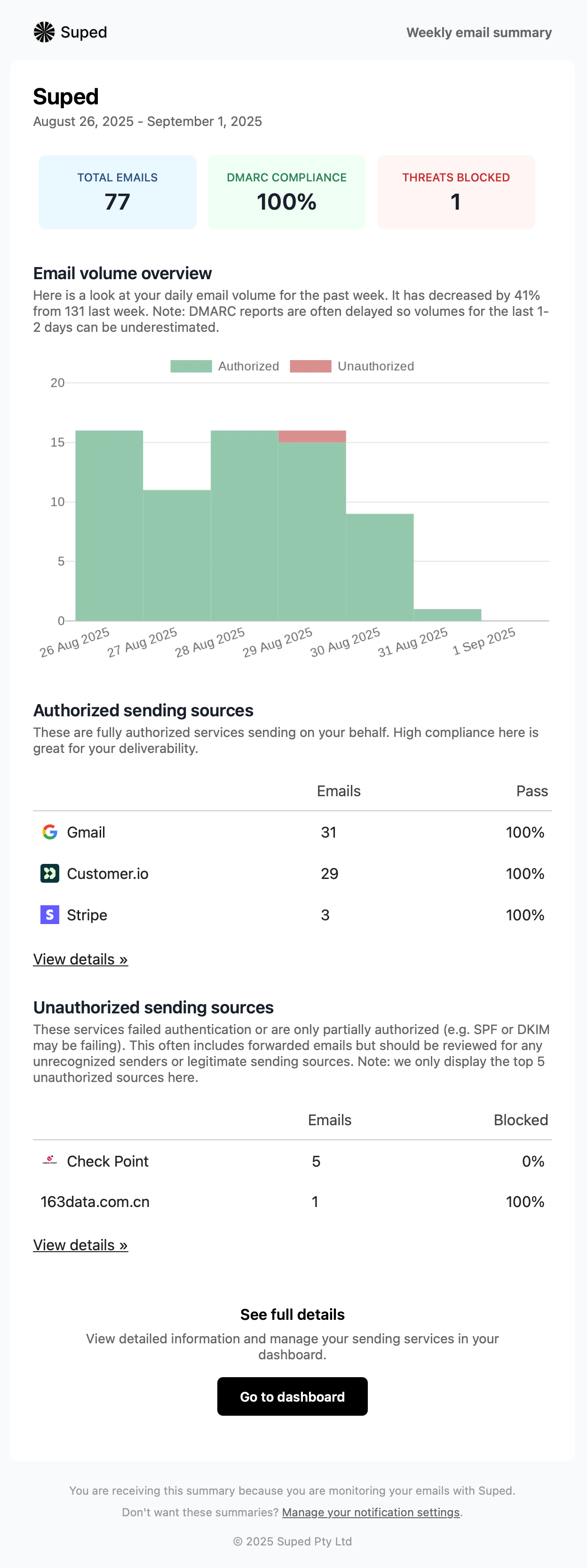
The documented onboarding sequence is to add the domain, configure aggregate reporting and verify that reports arrive. We would then classify unknown sources, use the detail view for authentication exceptions and give the DNS owner the changes needed for each legitimate sender. Hosted DMARC lets subsequent policy changes happen in Suped after DNS setup. Organizations and roles support separate client administration, while monthly client reports give service teams a repeatable reporting workflow. This is a documented workflow assessment, without a measured setup time or a claim that every sender is identified automatically.
Support
Suped's documentation covers issue diagnosis, fixes and verification after DNS changes. Enterprise pricing and limits are negotiable, so we recommend scoping the corporate domain, marketing subdomain and parked domain together with the required retention and support arrangements. European procurement should request the applicable support hours, escalation route and contractual response commitments, plus invoice currency and data-processing terms. We have no measured support response times or contract-specific service commitments to report, and we do not treat those details as included automatically in a public starting price.

Suitability
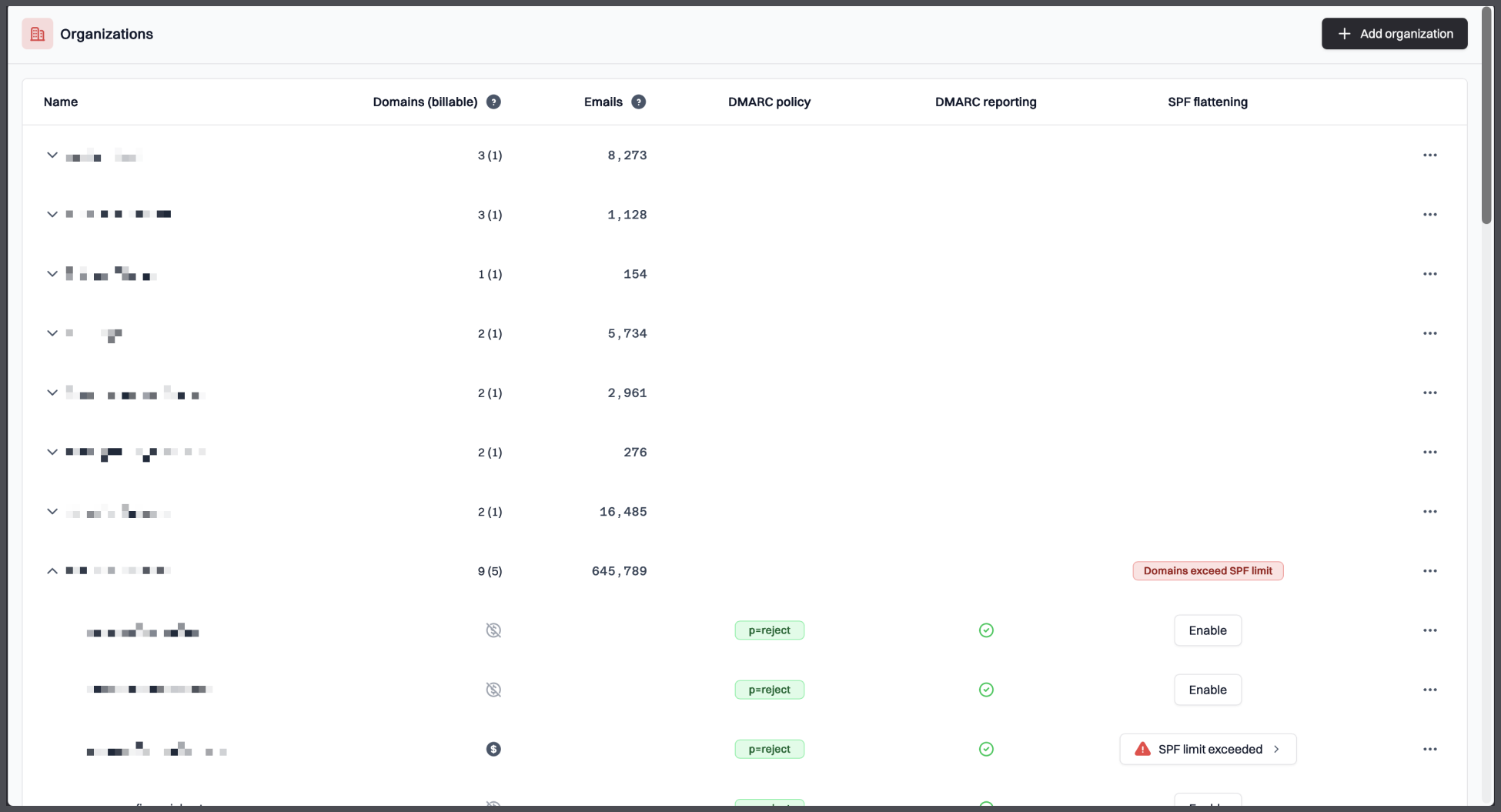
We recommend Suped for European organizations, including enterprises and MSPs, that accept hosted SaaS and want source classification, authentication investigation and hosted policy management in the same workflow. For a group with separate legal entities, map access roles and organization boundaries before onboarding domains. For a switch, inventory any delegated authentication records and preserve the current enforcement policy while validating reporting. An EU-only residency obligation or an on-premise deployment requirement needs resolution before commitment; neither customer location nor the currencies on an invoice establish the deployment terms.
Who should use Suped
- European buyers moving beyond aggregate summaries to source verification and detailed authentication investigation.
- Enterprise teams coordinating authentication changes across domain owners, or MSPs administering separate client organizations.
Pricing structure
- The ongoing free tier covers 1 domain, 1,000 emails per month and 14 days of retention. The initial 14-day trial has no limits; that trial is temporary.
- Basic is $19/month for 2 domains, 100,000 monthly emails and 90 days of retention. It does not cover three separately counted domains.
- A published $29/month configuration covers 3 domains, 250,000 monthly emails and 365 days of retention, making it the relevant starting package if all domains in our framework count separately.
- Pro is $99/month for 10 domains, 1 million monthly emails and 365 days of retention. Enterprise terms are negotiated, with limits up to unlimited.
- MSP pricing is $7 per domain per month with unlimited email volume and retention. Confirm domain counting and the applicable commercial terms.
Strengths
- Report-level diagnosis and sender verification support decisions about legitimate services before a stricter DMARC policy.
- Hosted authentication records support ongoing changes after the initial DNS handoff.
- Published business allowances and per-domain MSP pricing give procurement concrete inputs for a domain inventory.
Trade-offs
- Suped has no self-hosted or on-premise deployment.
- The evidence does not establish EU-only processing, certifications or contractual data-handling commitments. Obtain the relevant documents for procurement.
- The free tier retains only 14 days of history, and the $19/month package has a two-domain limit.
- Enterprise contract pricing, support commitments and the treatment of usage beyond plan limits require confirmation.
Verdict
Try Suped, free
02.
MailHardener
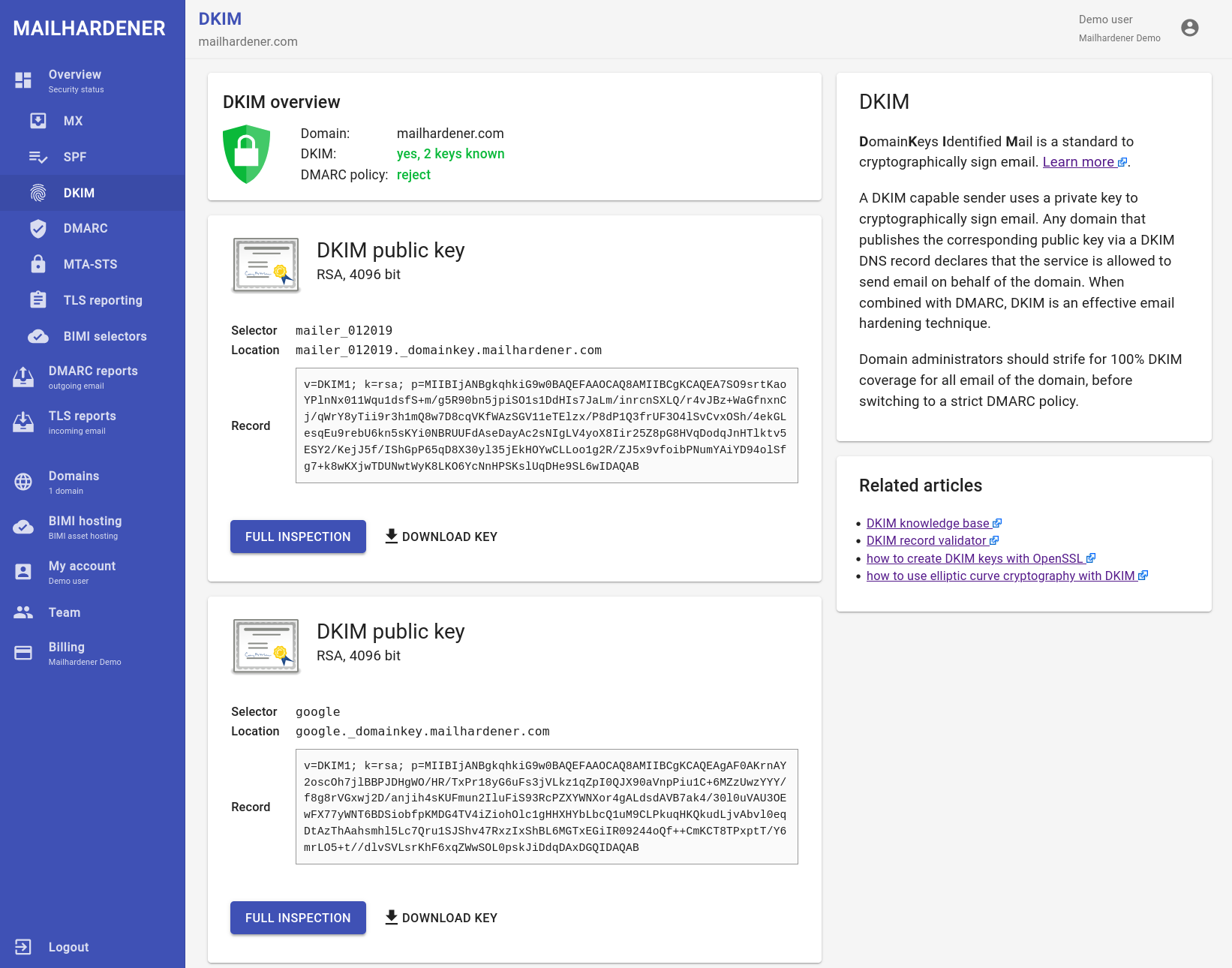
0 / 5(0)Mailhardener combines aggregate and failure reporting with SMTP TLS reporting and hosted MTA-STS. We assess its euro pricing and stated contract options separately from any assumptions about where European data is processed.
#2
our rank
€19/month
starting price
Yes
free tier

Feature set
Standard includes DNS monitoring and BIMI asset hosting alongside DMARC and TLS reporting. A hosted MTA-STS policy still needs approval against the organization's receiving mail configuration.
User experience
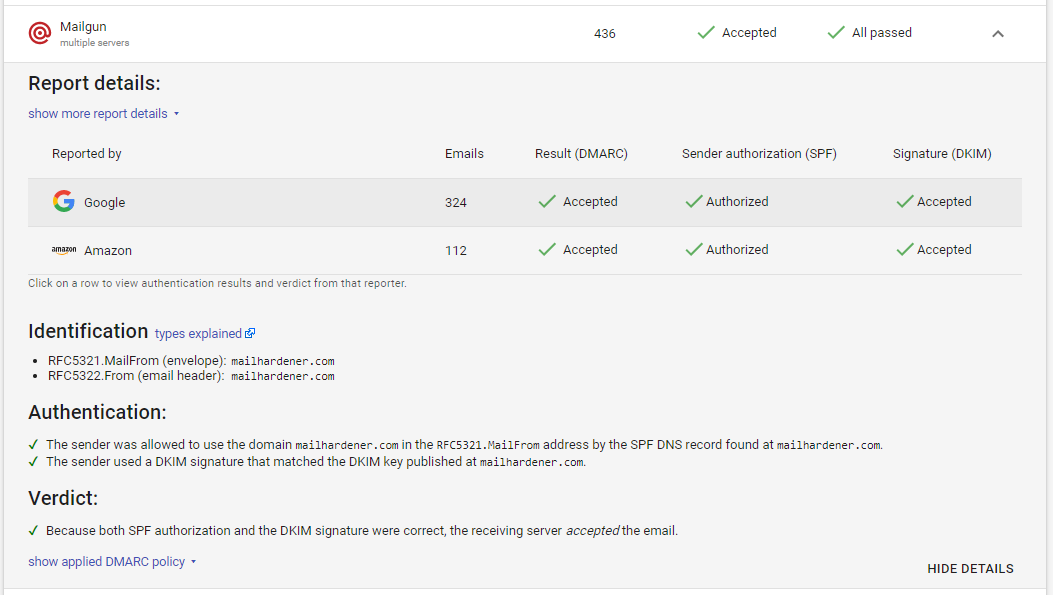
Standard has self-service onboarding, while Large has limited assistance and Enterprise has assisted onboarding. Regular subscriptions use one shared environment; the separate MSP package documents isolated customer environments.
Support
Technical support is listed on Standard and Large, with vendor assessment assistance and a private-instance option under Enterprise. Contractual regulatory agreements are advertised options, not evidence that every deployment meets a buyer's obligations.

Suitability
An existing Mailhardener workflow using hosted MTA-STS and its isolated MSP customer environments is a specific migration consideration. We would compare its documented scope with Suped's hosted protocols and organization management before moving records.
Who should use MailHardener
- Teams checking an existing Mailhardener MTA-STS setup during a DMARC renewal.
- Procurement teams that need to price the isolated customer-environment package separately from a regular subscription.
Pricing structure
- Standard is €19/month or €199/year for up to 10 domains, unlimited users and report volume, with 3 months of retention.
- Large is €99/month or €999/year for up to 100 domains and 12 months of retention; invoice payment is listed.
- Enterprise pricing is Not publicly listed. The MSP package is €149/month plus €1 per domain per month.
- Free is for personal or evaluation use, with 1 domain, 1 user, fair-use report volume and 1 month of retention.
Strengths
- The paid plan cards explicitly list transport reporting and MTA-STS hosting alongside DMARC.
- Public domain limits and euro annual totals support a European budget comparison.
Trade-offs
- The free plan is not a general ongoing commercial tier.
- Standard retains 3 months of data; choose retention deliberately for a 90-day review and any later audit.
- A private instance is an Enterprise option, with location and contract scope still needing confirmation.
Verdict
View MailHardener alternatives
03.
DMARCwise
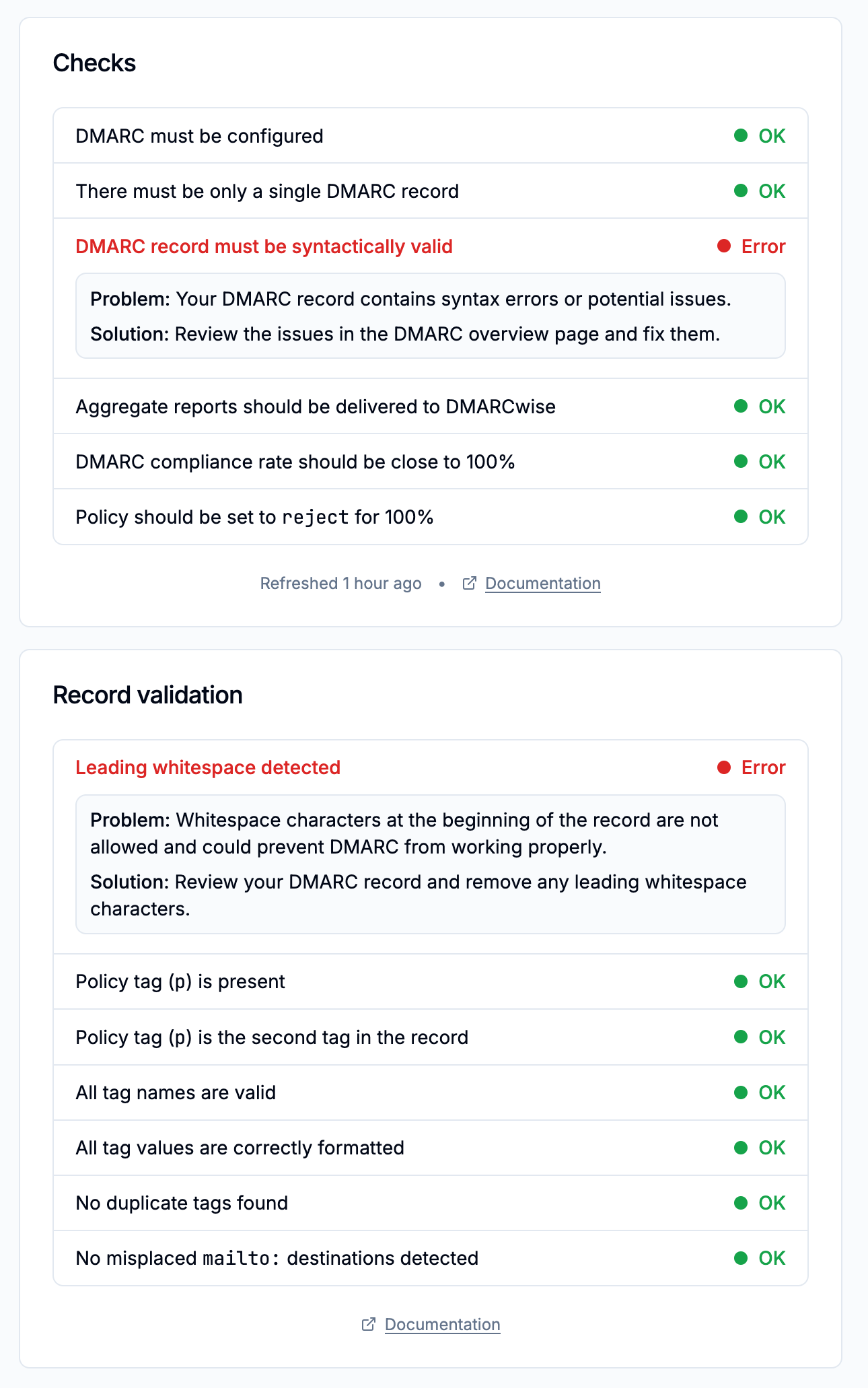
0 / 5(0)DMARCwise publishes euro subscriptions with hosted DMARC and unlimited paid reporting volume. We focus on retention, access and the separate MSP minimum when assessing the European purchasing terms.
#3
our rank
€15/month, billed yearly
starting price
Yes
free tier
Feature set
Paid plans include DMARC record hosting, SMTP TLS reporting, diagnostics and REST API access. The available evidence does not establish hosted SPF or DKIM management, so we would not include either in a contract comparison.

User experience
Domain import/export and weekly digests are documented, with 3 team members on Starter. Client access belongs to the MSP plan rather than being a confirmed standard-plan entitlement.
Support
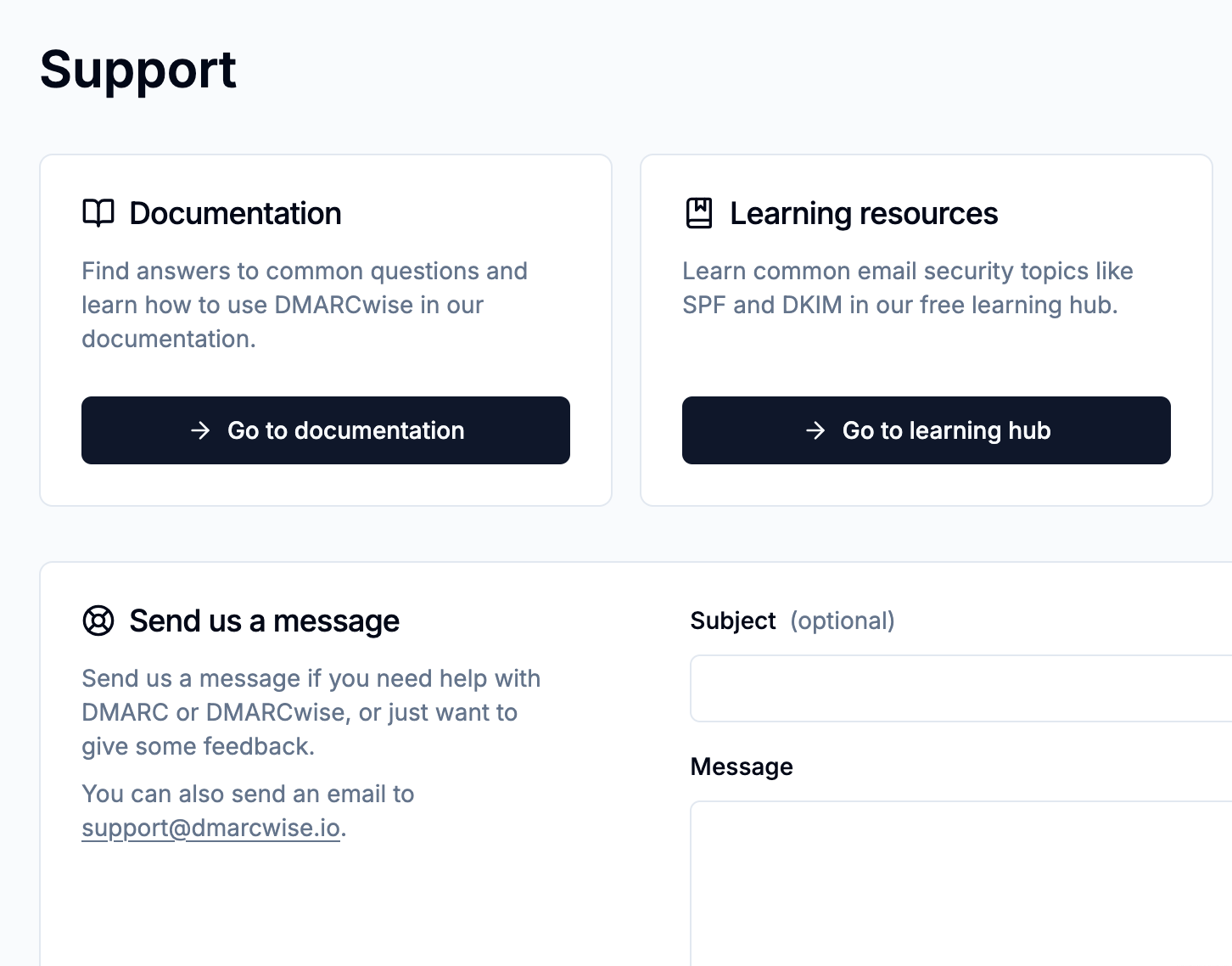
Paid plans include email support and guidance; Free has best-effort support. Bank transfer is available by contacting the supplier, while taxes are additional where stated.
Suitability
Existing users of DMARCwise's hosted DMARC records or REST API need to preserve those dependencies during a switch. Euro billing alone does not establish data residency or GDPR contract terms.
Who should use DMARCwise
- Teams renewing an existing hosted DMARC configuration or API workflow in DMARCwise.
- Buyers comparing a three-domain subscription with the minimum commitment of its MSP plan.
Pricing structure
- Starter is €15/month billed yearly as €180 plus taxes, with 3 domains, 3 months of retention and 3 team members.
- Growth is €39/month billed yearly as €468 plus taxes, with 20 domains, 6 months of retention, unlimited members and SSO.
- Scale is €99/month billed yearly as €1,188 plus taxes, with 100 domains and 1 year of retention.
- MSP is €1 per active domain per month with a 100-domain minimum, so the minimum is €100/month plus taxes.
- Free has 1 domain, a soft limit of 1,000 monthly emails and 2 weeks of retention. Paid plans have a 14-day trial; undiscounted monthly checkout prices are Not publicly listed in the evidence.
Strengths
- The published paid plans remove a reporting-volume allowance from the standard budget calculation.
- Starter covers three domains, while Growth and Scale explicitly include SSO.
Trade-offs
- Starter does not include SSO and retains only 3 months of data.
- The MSP minimum is material when the portfolio has fewer than 100 active domains.
- Hosted SPF and DKIM management are not established by the published product notes.
Verdict
View DMARCwise alternatives
04.
Dmarcian
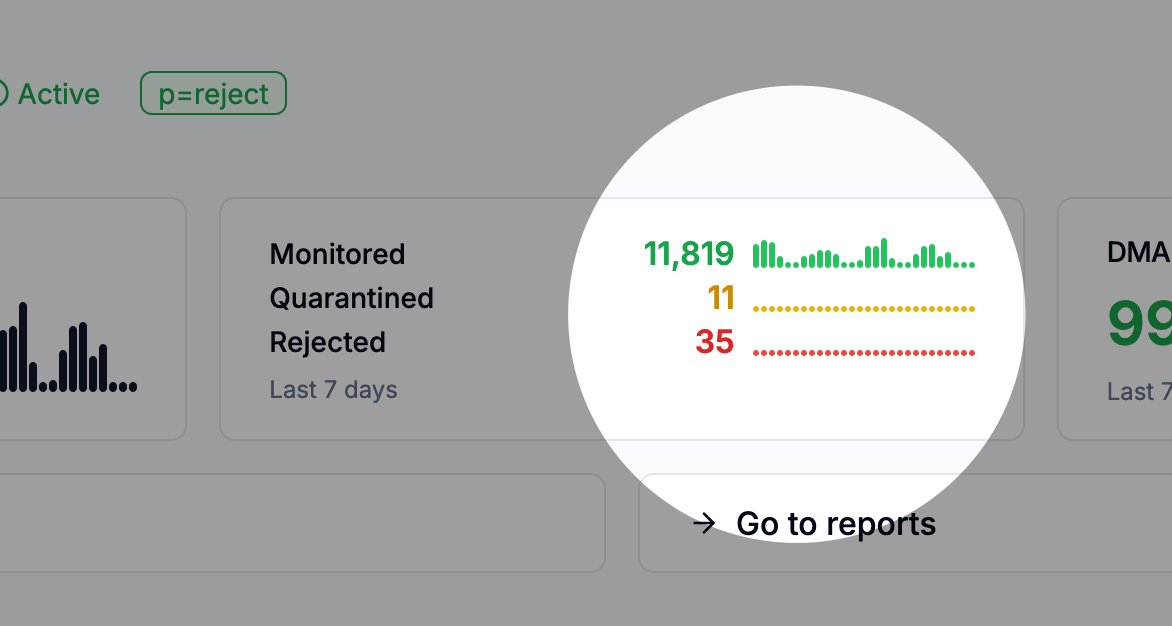
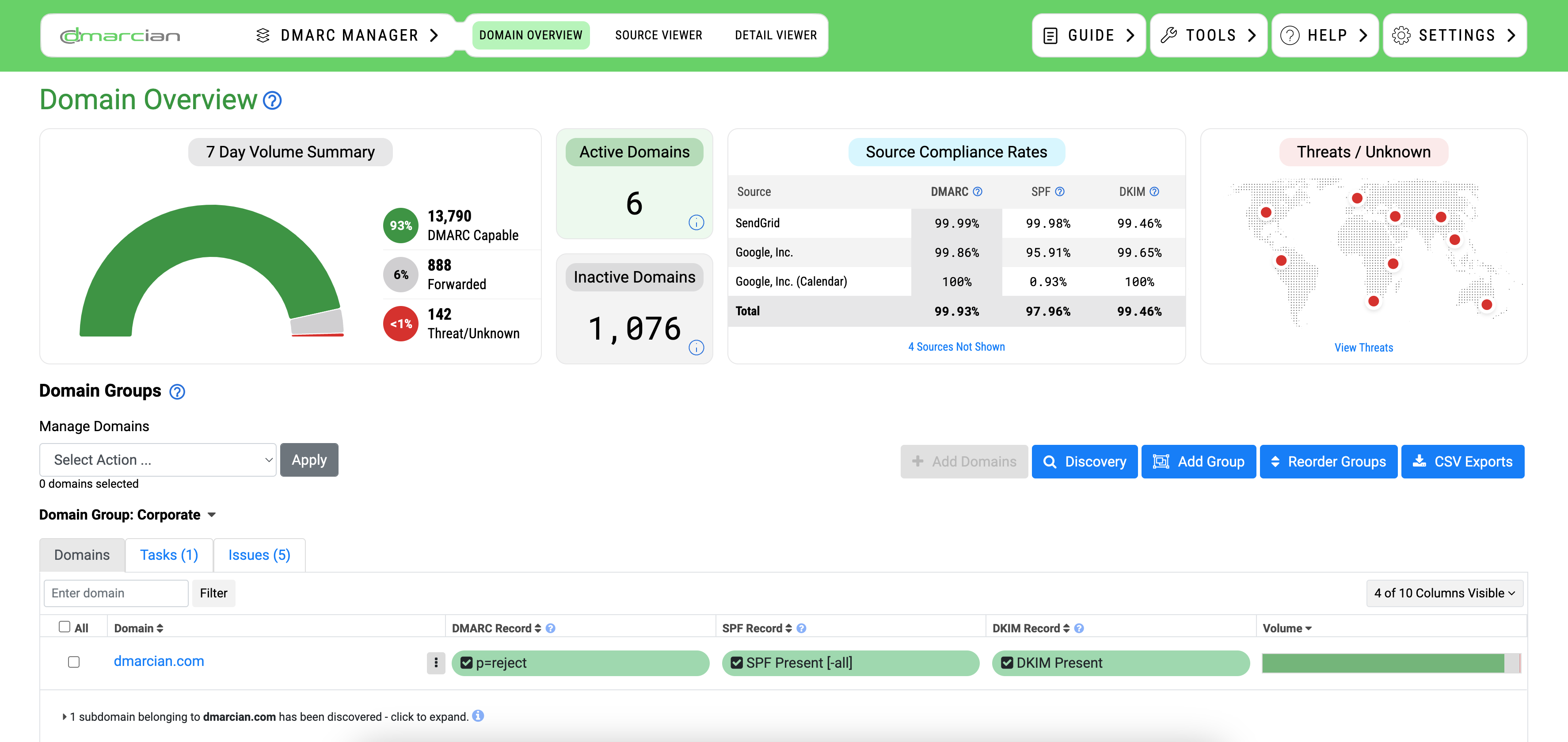
3.5 / 5(5)Dmarcian publishes active-domain and legitimate-message allowances, plus regional currency parity. We would cost the sending subdomain and access requirements before treating Basic as the complete European rollout budget.
#4
our rank
$19.99/month, billed yearly
starting price
Yes
free tier
Feature set
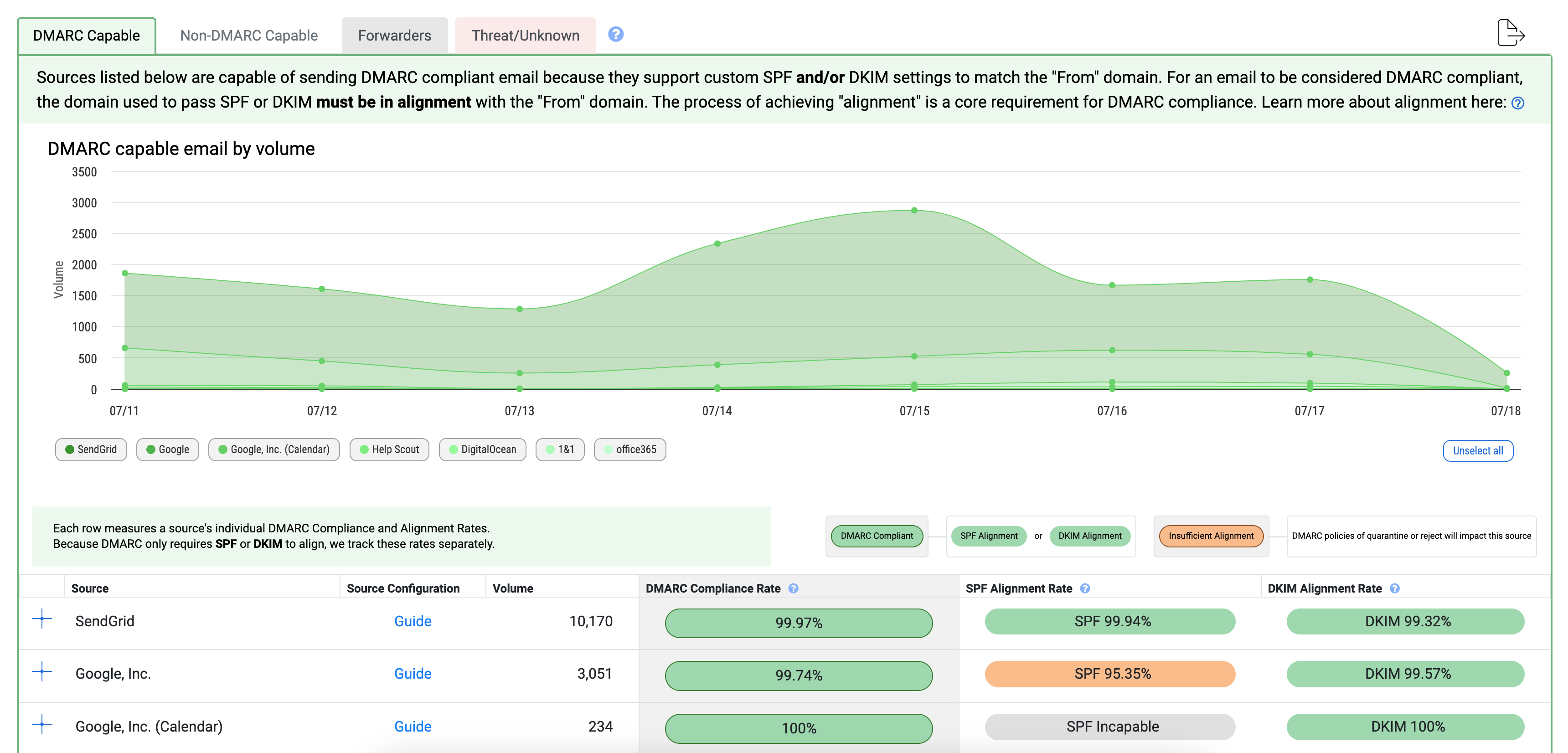
Source enrichment, automatic subdomain detection and aggregate report processing are common capabilities. Alert Central and failure reporting start on Basic; API access and SSO are Enterprise inclusions.

User experience
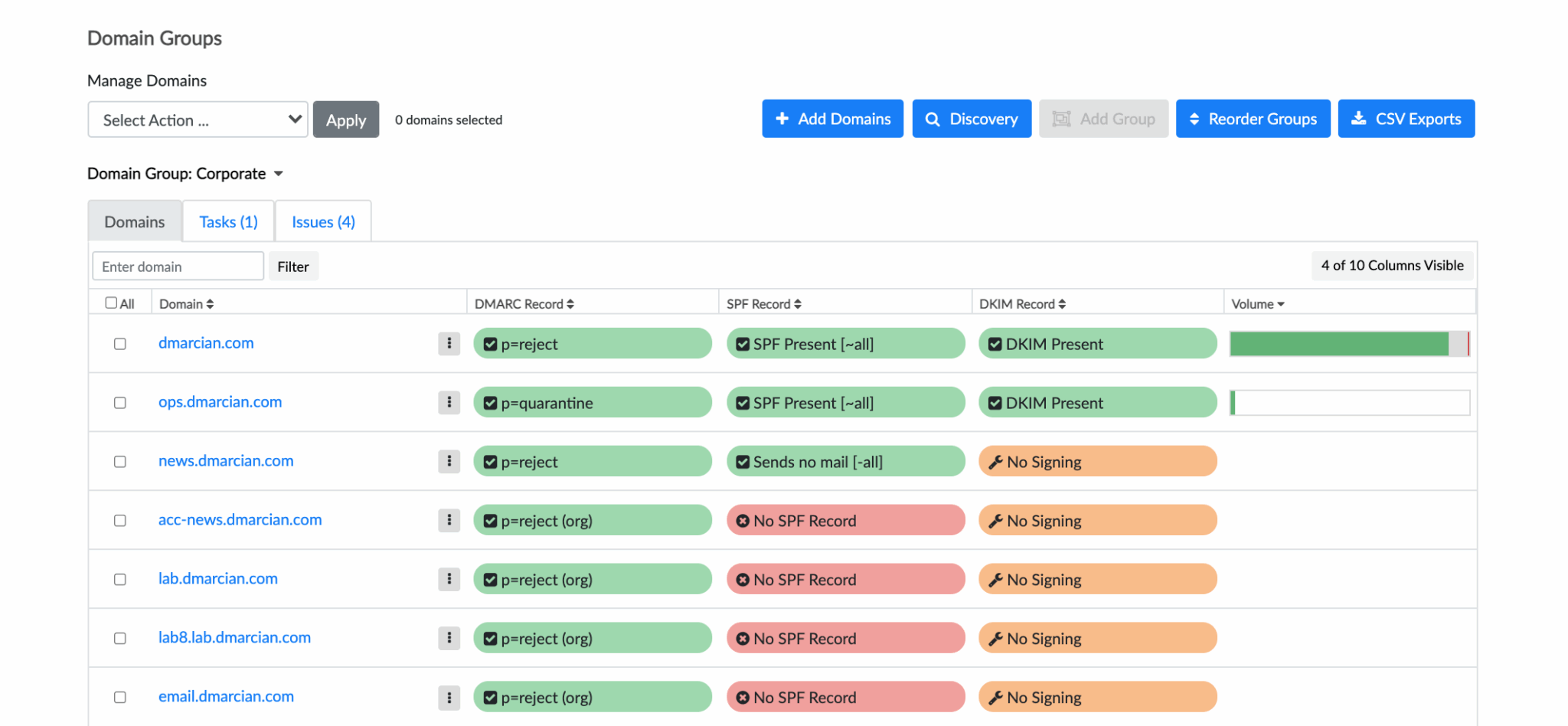
The plan structure separates active domains, inactive domains and domain groups. Basic permits one user, so a DNS administrator and a security administrator do not automatically receive separate logins at the entry price.
Support
A 30-day paid-plan trial and manual invoicing for annual subscriptions are documented. Onboarding or consultation scope should be confirmed separately rather than inferred from review comments.
Suitability
Regional EUR billing and an existing Dmarcian source or domain-group workflow are practical renewal considerations. We would not infer European storage or legal compliance from the regional account alone.
Who should use Dmarcian
- Buyers checking a renewal that already uses Dmarcian's domain groups and source classifications.
- Finance teams comparing regional currency parity and annual invoicing against the required feature tier.
Pricing structure
- Basic is $24/month, or $19.99/month billed yearly as $239.88, for 2 active domains, 100,000 monthly messages, 1 user and 3 months of history.
- Plus is $240/month, or $199/month billed yearly, for 8 active domains, 1 million monthly messages, 3 users and 1 year of history.
- Enterprise is $600/month, or $499/month billed yearly, for 15 active domains and 5 million monthly messages, with unlimited users and history.
- Personal is free for non-business use only, with 2 active domains, 1,250 monthly messages, 1 user and 1 month of history.
- Published prices are USD with CAD and EUR parity according to the regional instance; taxes are excluded. Annual subscriptions support manual invoicing.
Strengths
- Active and inactive domain allowances are explicit, which helps price a parked-domain inventory.
- Regional currency and annual invoice terms are documented.
Trade-offs
- Basic has one user; user access controls start on Plus, while SSO and API access require Enterprise.
- Personal cannot be used as the ongoing free plan for a business domain.
- A primary domain and separately counted active marketing subdomain can exhaust Basic's active-domain allowance.
Verdict
View Dmarcian alternatives
05.
OnDMARC
4.8 / 5(104)OnDMARC has Dynamic Services for hosted authentication and an Express entry price. Its short entry-tier history and quote-based higher packages matter more to this evaluation than the starting figure alone.
#5
our rank
From $9/month, billed annually
starting price
No
free tier
Feature set
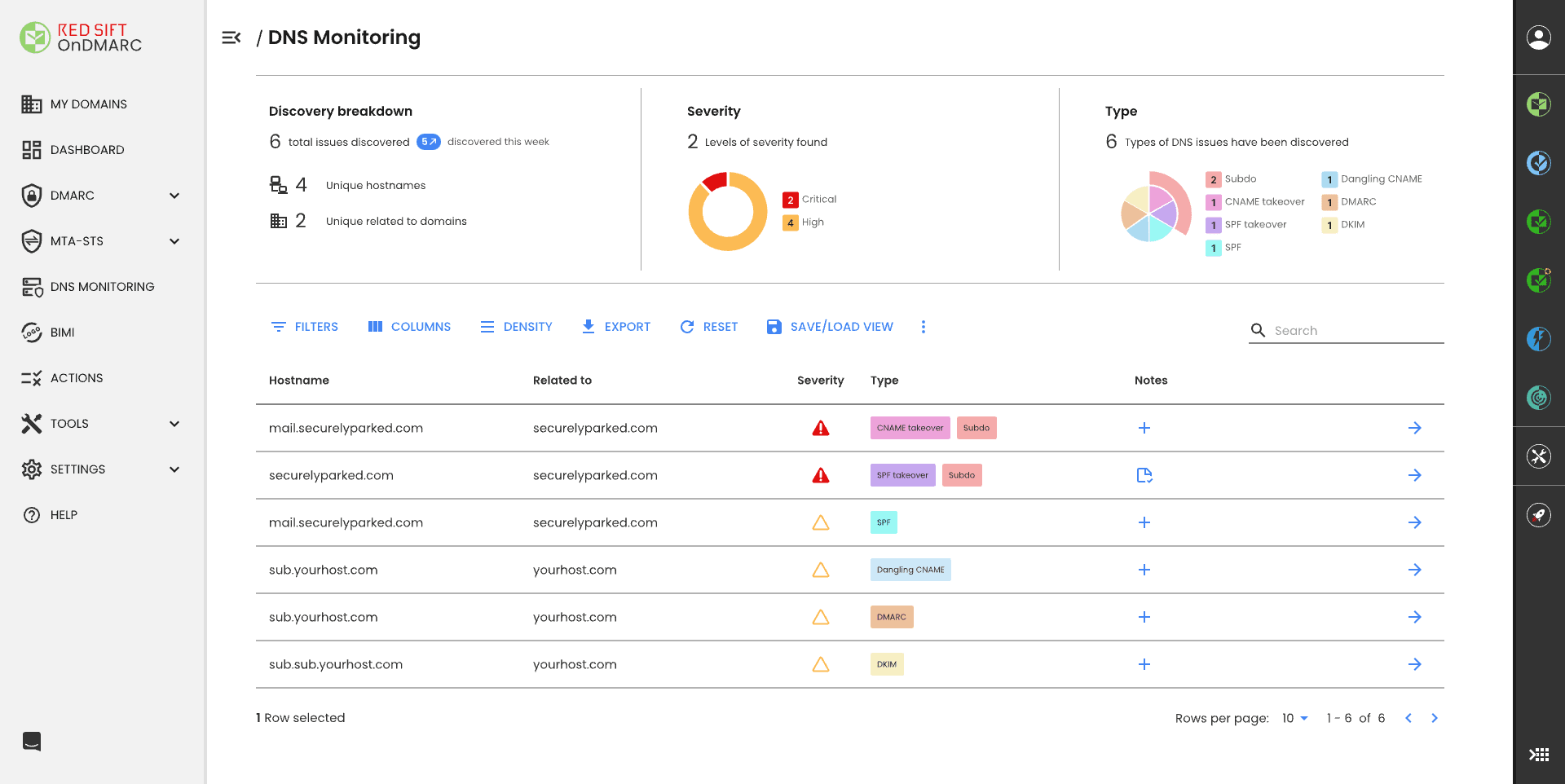
Dynamic Services cover DMARC, SPF, DKIM, MTA-STS, TLS-RPT and BIMI, with Investigate and smart alerts also documented. We would verify each entitlement and support item in the order because the available pricing detail does not preserve every comparison-table checkmark.
User experience
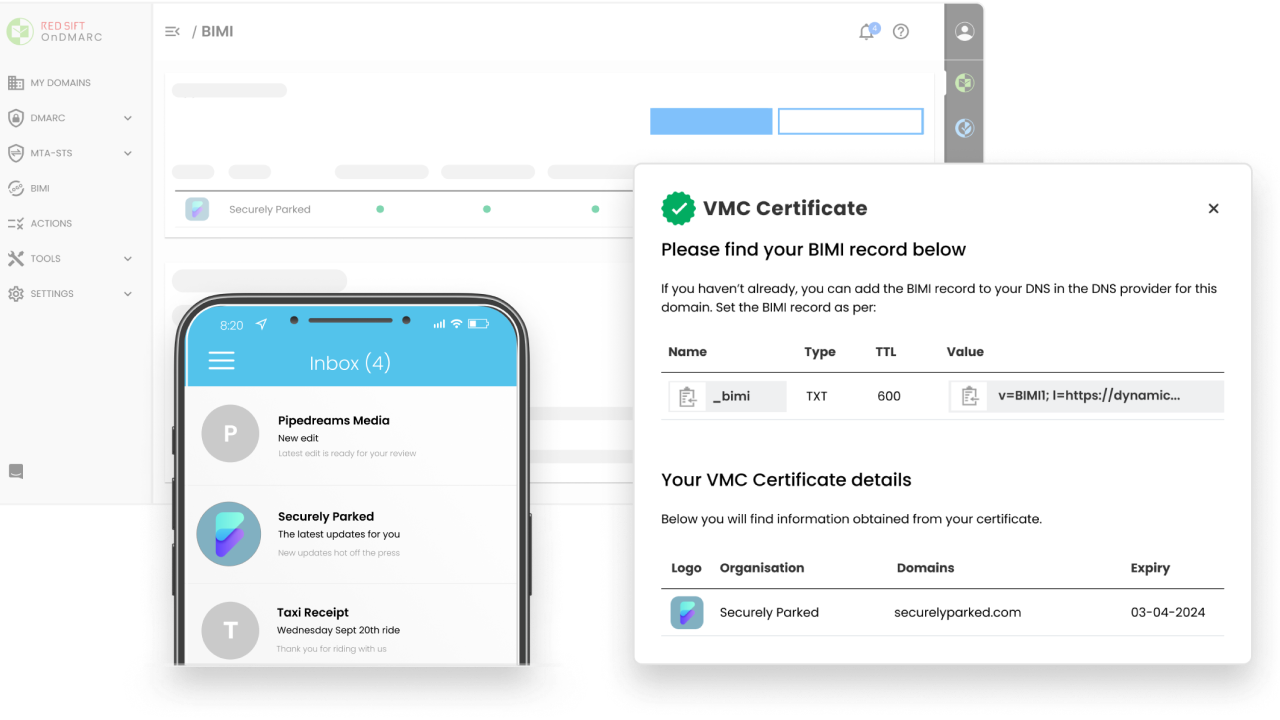
Hosted records move ongoing changes into the application after DNS delegation. Express has 30 days of history, so a 90-day review requires another retention arrangement.
Support
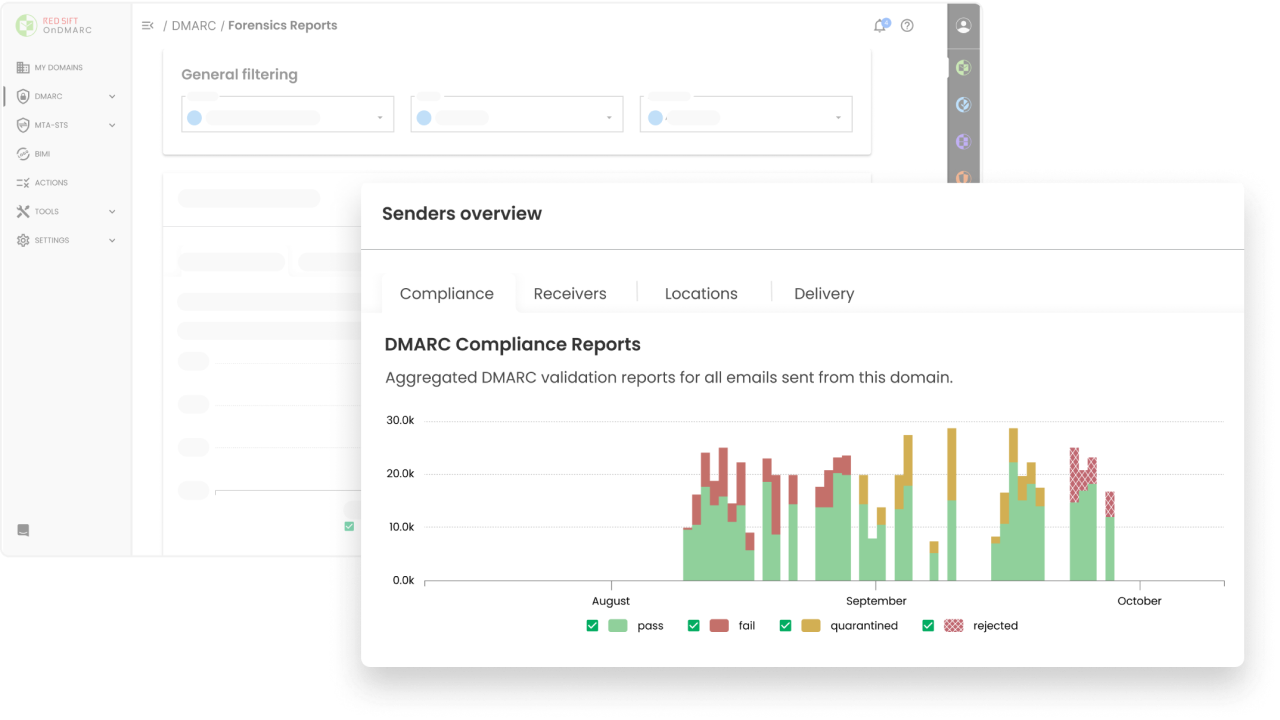
Support scope varies by tier and needs confirmation, including the stated review cadence and any SLA. The 14-day trial is temporary access, without a permanent free tier.
Suitability
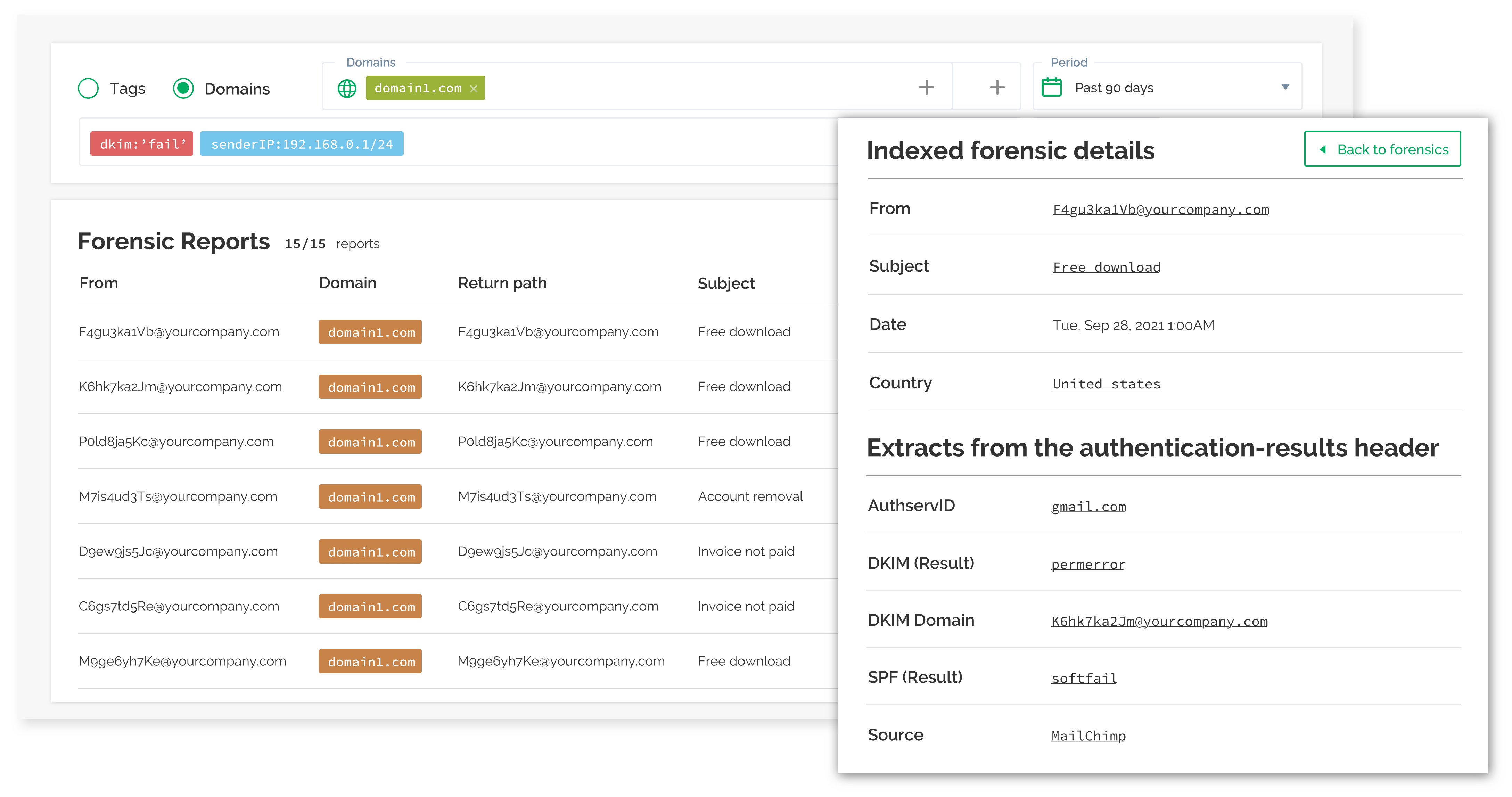
An existing OnDMARC Dynamic Services deployment requires careful migration of hosted records and any Event Hub dependencies. EUR and GBP payment support is a billing fact, not a residency guarantee.
Who should use OnDMARC
- Teams auditing existing Dynamic Services delegations before a renewal or switch.
- Buyers comparing Express with the longer retention and domain allowances of a quoted package.
Pricing structure
- Express starts at $9/month billed annually, with up to 4 domains, 1 million monthly emails, 30 days of history and up to 10 SPF lookups.
- Essentials, Enterprise and Premier prices are Not publicly listed. Essentials lists 25 active sender domains, unlimited parked domains and 1 year of history.
- Supported payment currencies include USD, EUR, GBP and AUD. A 14-day trial is available without a credit card.
Strengths
- The public packages state active sender-domain and parked-domain allowances separately.
- Multiple payment currencies are documented for European budgeting.
Trade-offs
- Express cannot retain the full 90-day framework in its 30-day history window.
- Higher-tier prices and precise support entitlements require confirmation.
- Migrating hosted records requires replacing the delegations before ending the service.
Verdict
View OnDMARC alternatives
06.
URIports
0 / 5(0)URIports charges by received reports rather than sent email messages. European buyers need a report-quota forecast, a retention choice and written billing terms before comparing its price with a message-based subscription.
#6
our rank
$15/year, personal use only
starting price
No
free tier
Feature set
Subscriptions include deep report analysis, exports, automatic subdomain detection and encrypted DMARC failure reports. Hosted MTA-STS and DNS monitoring start at Pebble Plus; OIDC SSO starts at Mountain.
User experience
Search, filtering and custom views support report investigation. When the report quota is reached, new processing stops, so the monitoring process needs a quota check as well as authentication review.
Support
Product support is included; Enterprise options document procurement quotations, invoice terms and dedicated onboarding. EU companies can buy annual Mountain or Himalaya subscriptions by invoice according to the documented FAQ.
Suitability
An existing URIports account combining web and email reports needs a shared-quota review before renewal. Its unlimited email-volume wording does not remove the monthly report-processing limit.
Who should use URIports
- Teams already using URIports for both web reports and email reports.
- Buyers calculating received-report quotas and invoice eligibility rather than only monthly email volume.
Pricing structure
- Sand is $15/year for personal use, with 3 domains, 10,000 monthly reports and 30 days of retention.
- For business use, Pebble is $7/month or $72/year, with 5 domains, 100,000 monthly reports and 30 days of retention.
- Pebble Plus is $13/month or $144/year with the same quota and retention, adding documented DNS monitoring and hosted MTA-STS.
- Mountain is $133/month or $1,440/year, with 100 domains, 2.5 million monthly reports and 90 days of retention.
- A one-month free trial is available; no ongoing free tier is listed. Public prices are USD, with VAT and final currency subject to checkout.
Strengths
- The distinction between reports and email volume is explained in the pricing model.
- Enterprise procurement and invoice options are documented rather than inferred from supplier location.
Trade-offs
- Lower public tiers retain only 30 days; Mountain and Himalaya list 90 days.
- Reaching the report quota stops new processing, despite unlimited email-volume wording.
- Web reports and TLS reports also consume the shared report allowance.
Verdict
View URIports alternatives
07.
Mail Tower
0 / 5(0)Mail Tower publishes euro prices with employee-band eligibility and unlimited aggregate reports. We would check employee count and administrator access before quoting its lowest tier for a European organization.
#7
our rank
€10/month
starting price
No
free tier
Feature set
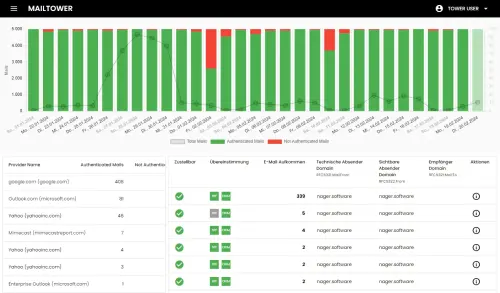
The product evidence establishes aggregate report analysis, with retention and API availability specified by plan. It does not establish a complete hosted authentication suite or managed enforcement service.
User experience
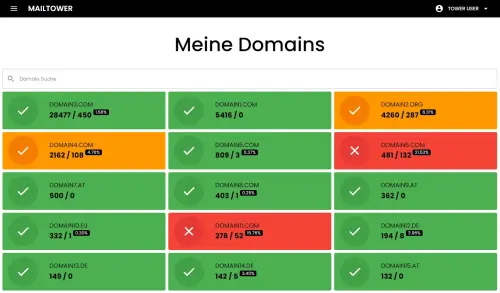
The smallest tier includes 1 user, the middle tier 2 and the largest 4. Inactive-domain allowances are separate, which is useful when documenting the parked domain without assuming it is an active sender.
Support
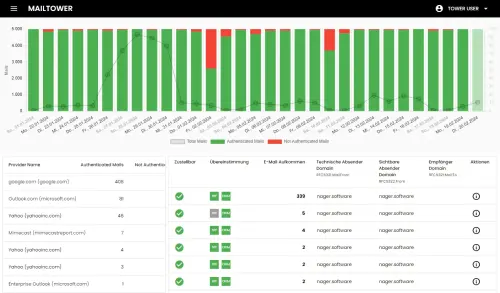
The available evidence does not establish support hours, response commitments or assisted onboarding. Those items belong in the procurement request alongside account separation and alerting requirements.
Suitability
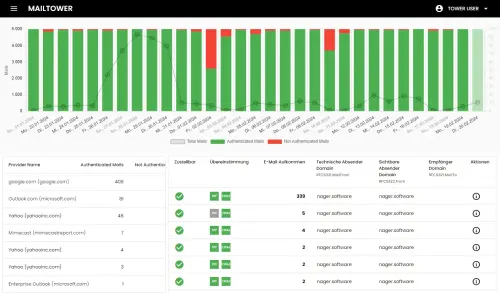
An existing Mail Tower subscription is a narrow consideration where its employee-band licensing already applies. Enterprise size itself is not a reason to prefer it over Suped.
Who should use Mail Tower
- Existing customers verifying their employee band and active-domain inventory.
- Buyers auditing retention, included users and the API entitlement of a Mail Tower proposal.
Pricing structure
- The under-50-employee tier is €10/month for 5 active and 10 inactive domains, 180 days of history and 1 user.
- The under-250-employee tier is €20/month for 10 active and 25 inactive domains, 180 days of history and 2 users.
- The 250-or-more-employee tier is €50/month for 25 active and 50 inactive domains, 365 days of history, 4 users and API access.
- Extra domains are €2/month and extra users €5/month. Custom MSP pricing is Not publicly listed; no ongoing free tier is established.
Strengths
- Every listed paid tier has enough published retention for the 90-day framework.
- Employee bands and user allowances make the licensing constraints visible.
Trade-offs
- Eligibility depends on employee count, so the €10/month price does not apply to every organization.
- API access is not included in the two lower plan cards.
- Hosted protocols, alert entitlements and customer-account separation are not established by the published notes.
Verdict
View Mail Tower alternatives
08.
DMARCDKIM.com
0 / 5(0)DMARCDKIM.com publishes euro plans with unlimited seats and volume-based limits. We would budget beyond Mini when the European rollout needs 90-day history, alerts and transport reporting.
#8
our rank
€4/month, billed annually
starting price
Yes
free tier

Feature set
Mini includes aggregate analytics, SPF X-ray and DNS monitoring. Basic adds failure reports, actionable alerts, MTA-STS/TLS-RPT and webhooks, while API and MCP access start at Pro.
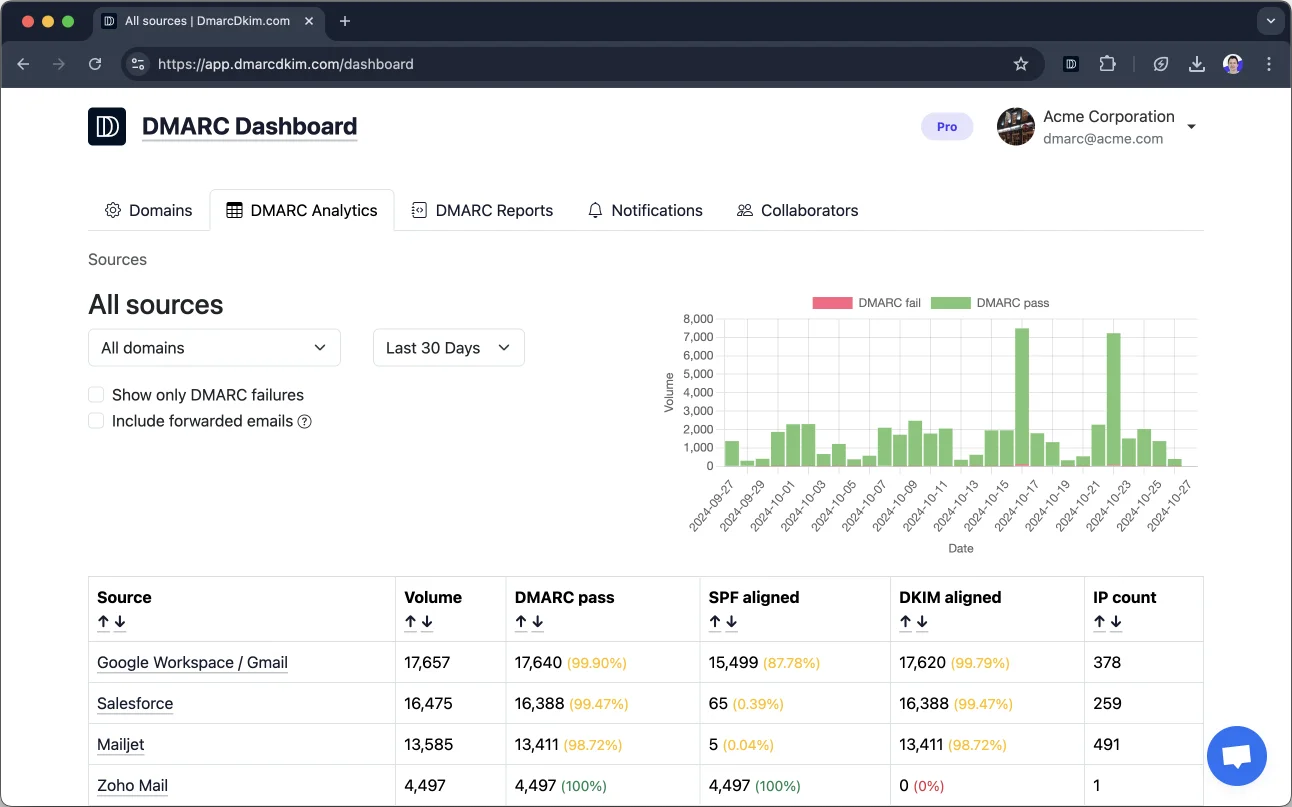
User experience
The same unlimited-seat model applies to paid plans, but seats do not establish isolated client accounts. The marketing subdomain and parked domain need explicit treatment within the proposal's domain allowance.
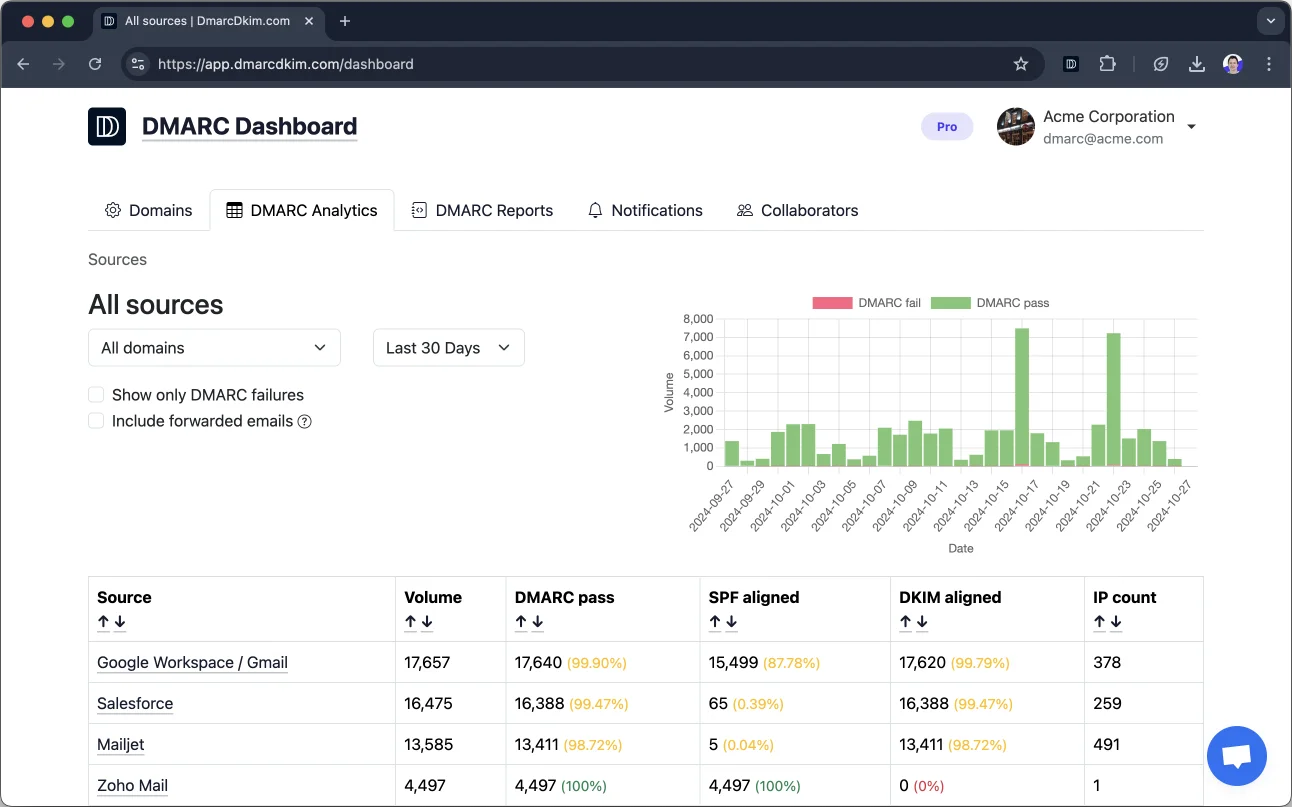
Support
Published support changes between onboarding support on Mini, ticket support on Basic, priority support on Pro and dedicated support on Enterprise. No measured response times or European support-hour guarantees are available in the evidence.
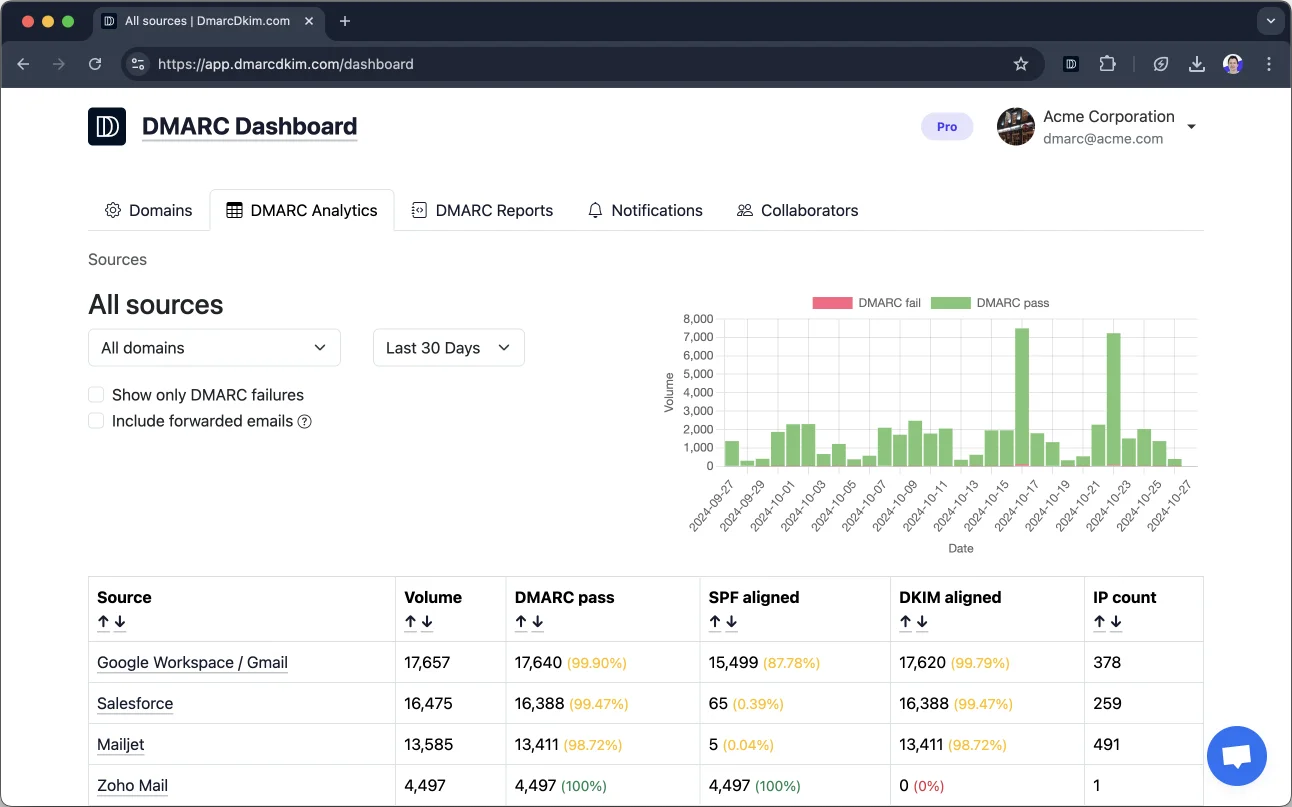
Suitability
Existing DMARCDKIM.com webhook or API consumers need to be inventoried before switching. Its euro billing supports budgeting but does not establish processing location or legal terms.
Who should use DMARCDKIM.com
- Teams reviewing existing DMARCDKIM.com webhooks or programmatic access.
- Buyers comparing the Mini entry price with the Basic retention and alerting requirements.
Pricing structure
- Mini is €4/month billed annually as €48, with 2 domains, 10,000 emails and 1 month of retention.
- Basic is €20/month or €15/month billed annually as €180, with 20 domains, 200,000 emails and 3 months of retention.
- Pro is €80/month or €60/month billed annually as €720, with 120 domains, 5 million emails and 12 months of retention.
- Enterprise is €440/month or €330/month billed annually as €3,960, with 1,000 domains and 40 million emails.
- Free is non-commercial only, with 1 domain, 5,000 emails and 14 days of retention. Paid dashboard plans have a 7-day trial; listed prices exclude taxes.
Strengths
- The public table separates monitoring, alerting and API entry points.
- The documented volume calculation excludes spoofed and forwarded mail.
Trade-offs
- Mini has only 1 month of history and does not include actionable alerts or transport reporting.
- API and MCP access require Pro or Enterprise.
- Unlimited seats do not prove customer-account isolation; obtain the relevant administration details.
Verdict
View DMARCDKIM.com alternatives
09.
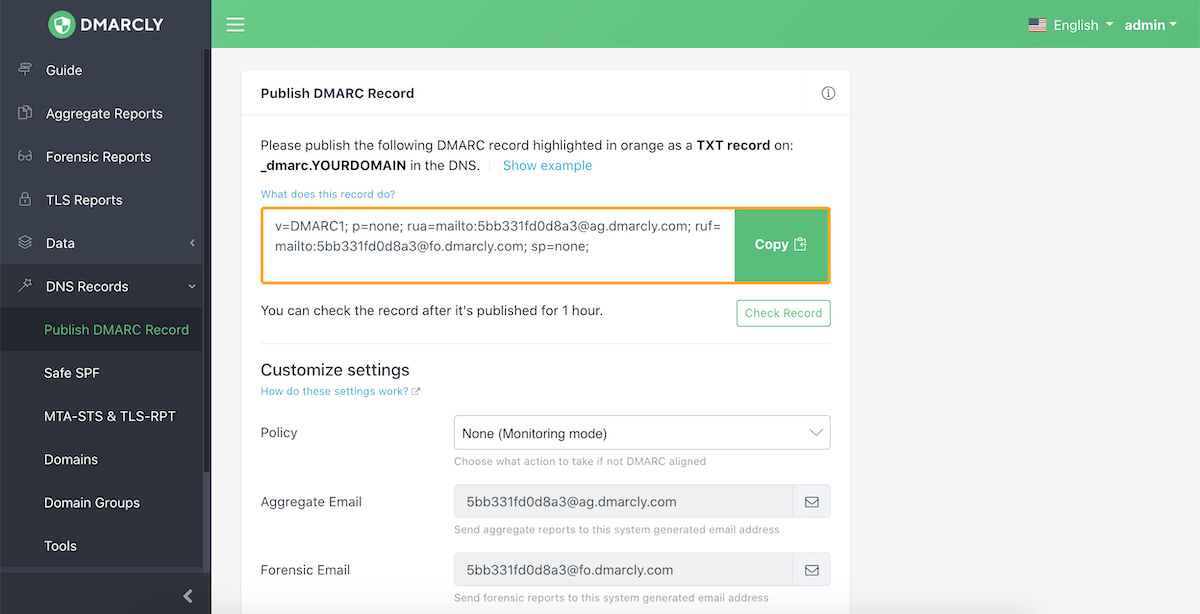
DMARCly
0 / 5(0)DMARCly documents separate signup routes for storage in California and Frankfurt. We treat that explicit storage statement as a fact to verify in the order, without extending it to every processing or support location.
#9
our rank
$17.99/month
starting price
No
free tier

Feature set
Professional includes aggregate and failure reporting, automatic subdomain detection, vendor identification and MTA-STS/TLS-RPT. Safe SPF starts on Growth; API access, SAML SSO and user access control are Enterprise items.
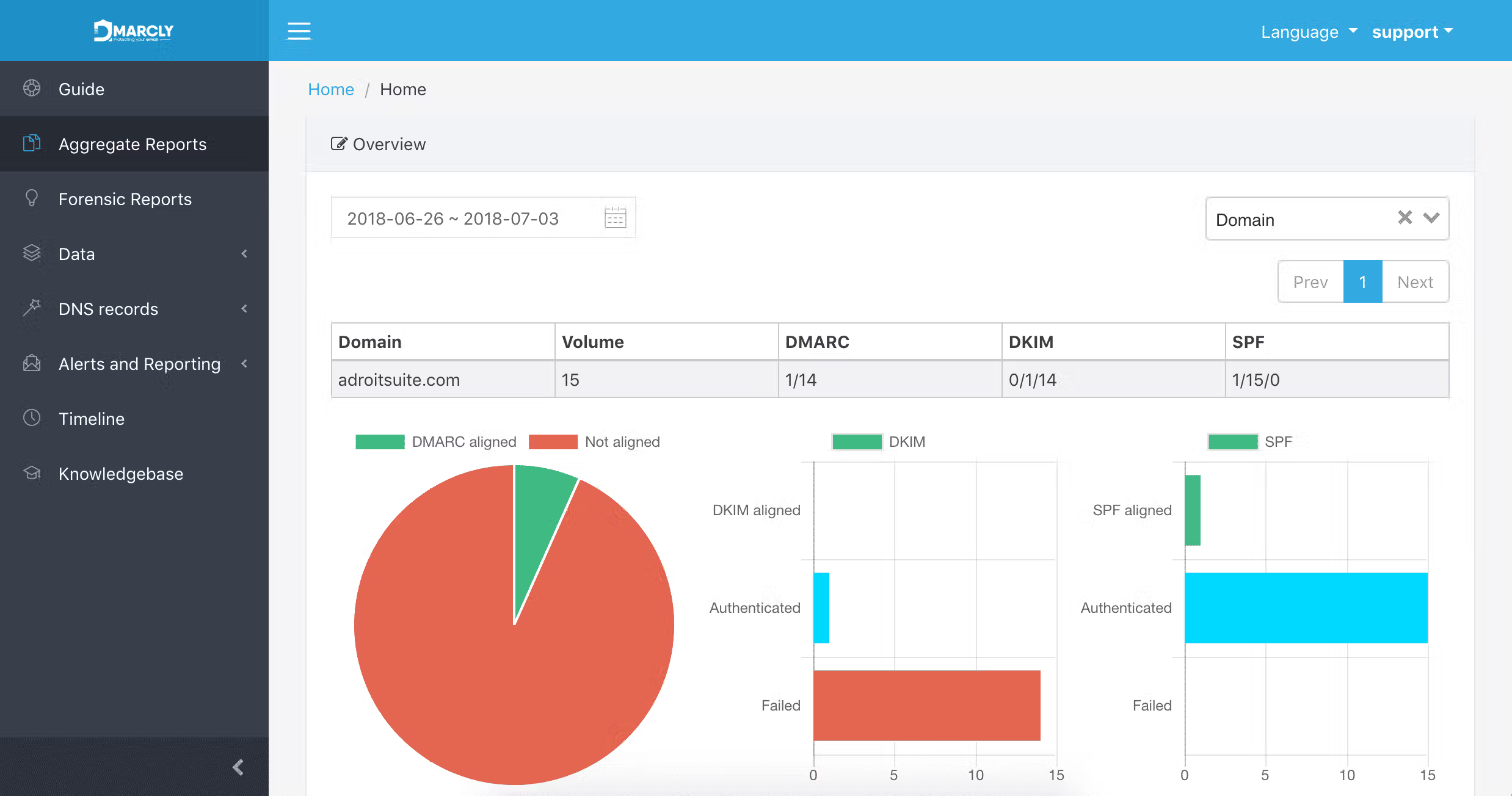
User experience
Professional has 1 administrator and 2 months of history, so it does not retain the full 90-day framework. Growth has 3 administrators, 4 months of history and 3 domain groups.
Support
Professional lists email support and Growth lists live chat. We would confirm service hours and escalation terms for the chosen region rather than treat a support channel as a response guarantee.

Suitability
An existing Frankfurt registration is a specific data-location detail to check during migration. Suped's hosting and contractual commitments need separate confirmation rather than an assumed equivalence.
Who should use DMARCly
- Existing customers verifying which registration route and storage region apply to their account.
- Teams reviewing Safe SPF dependencies and the volume-upgrade behavior before renewal.
Pricing structure
- Professional is $17.99/month for 2 domains, 100,000 compliant monthly messages, 1 administrator and 2 months of history.
- Growth is $39.99/month for 8 domains, 250,000 messages, 3 administrators, 4 months of history and 1 Safe SPF domain.
- Enterprise is $199/month for 200 domains, 5 million messages, unlimited administrators and 1 year of history.
- A 14-day trial is available; no ongoing free tier is published. EU customers, including UK customers, have documented ACH and SEPA payment options.
- Volume above a plan quota triggers a temporary move to the covering tier. Above 5 million messages, additional volume costs $10 per million; extra DMARC domains cost $1 each.
Strengths
- Storage-region signup distinctions and European payment methods are explicitly documented.
- Published volume and domain-overage rules help estimate changing monthly costs.
Trade-offs
- Professional's 2-month retention is shorter than the 90-day framework.
- Automatic volume-tier changes affect the bill; API and SAML SSO require Enterprise.
- A Frankfurt storage statement does not establish EU-only support access, backup locations or the complete processing chain.
Verdict
View DMARCly alternatives
10.
DMARC Manager
0 / 5(0)DMARC Manager separates Reporting subscriptions from Reporting & Management subscriptions. That distinction is essential when a European buyer expects the entry price to include hosted policy changes.
#10
our rank
€19/month for Reporting
starting price
Yes
free tier

Feature set
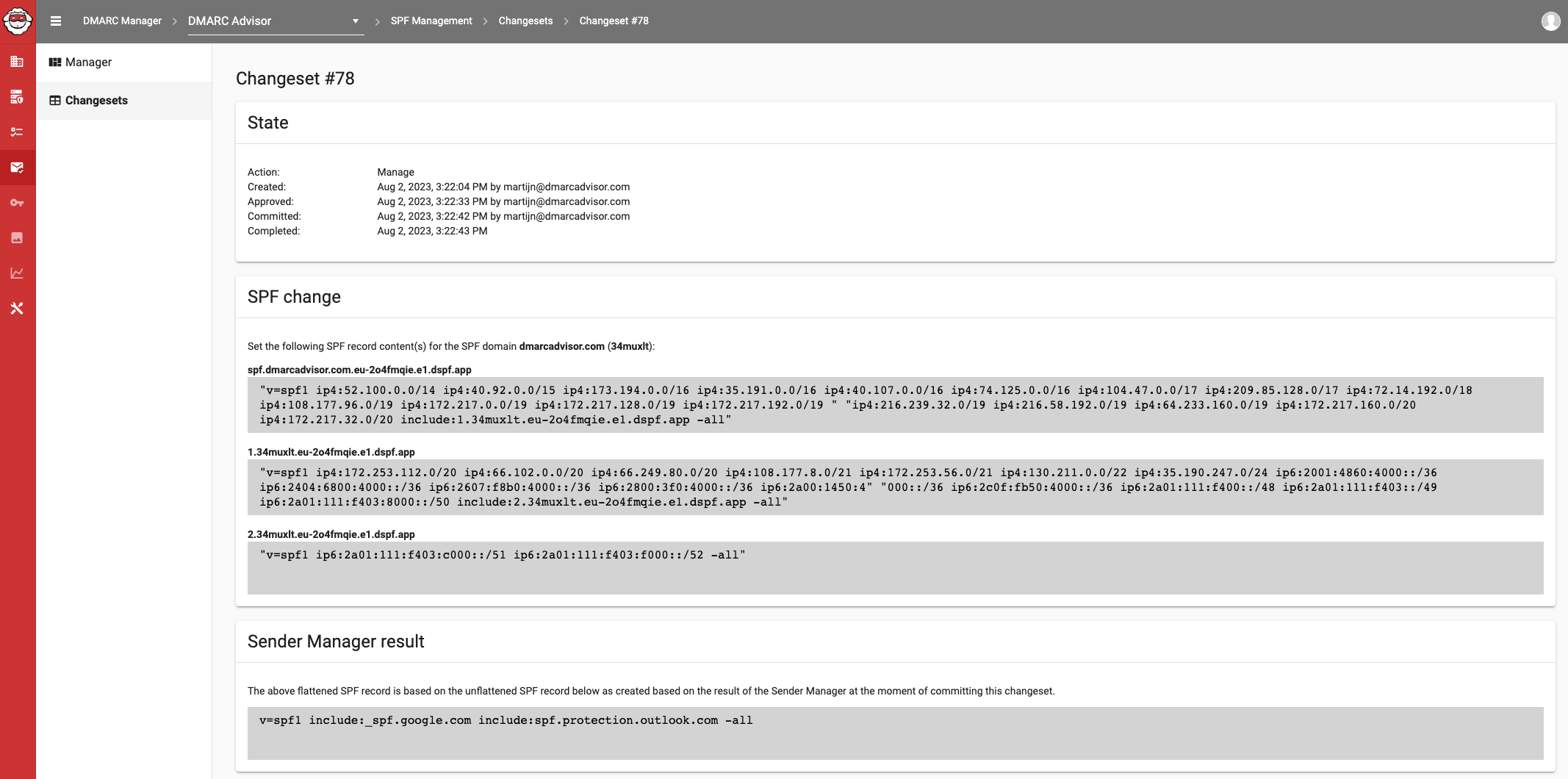
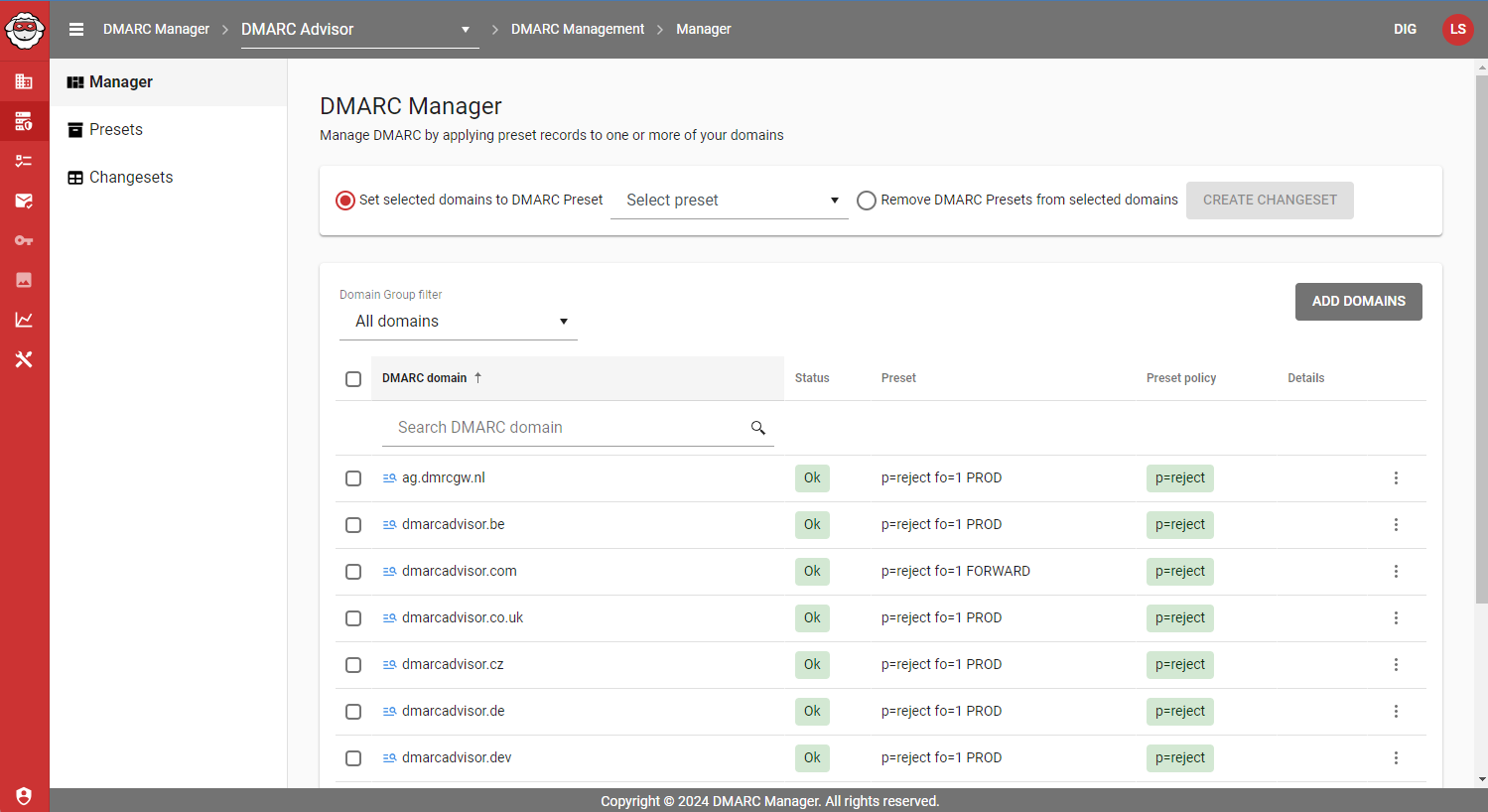
Reporting Basic lists alerts, email channels and SSO. Paid Reporting & Management adds DMARC and SPF management, with workspaces and approval flows mapped to higher management tiers.
User experience
Basic has 1 user, while Enterprise has unlimited users and workspaces. We would distinguish domain grouping from the access boundaries needed between subsidiaries or clients.

Support
The available evidence does not establish support response commitments or included onboarding service levels. A trial without payment details gives temporary access to Reporting & Management capabilities.
Suitability
Existing DMARC Manager approval-flow and workspace configurations need to be mapped during migration. Its stated service exclusions for the USA, Canada and Russia also need checking for a European group with entities in those countries.
Who should use DMARC Manager
- Teams auditing an existing Reporting & Management subscription and approval workflow.
- European groups checking whether the supplier's geographic service restrictions affect their purchasing entities.
Pricing structure
- Reporting Basic is €19/month for 2 sending domains, unlimited non-sending domains, 100,000 monthly emails, 3 months of history and 1 user.
- Reporting & Management Basic is €199/month with the same usage allowances, adding DMARC and SPF management.
- Reporting Enterprise is €499/month; Reporting & Management Enterprise is €799/month. Both list 15 sending domains, 5 million monthly emails and unlimited users.
- Free is for personal-domain use, with 2 sending domains, unlimited non-sending domains, 1,000 monthly emails, 1 week of history and 1 user.
- Annual discounts, overage rates and add-on prices are Not publicly listed in the available evidence.
Strengths
- Non-sending domains are listed separately with unlimited allowance.
- Reporting versus management pricing makes the hosted-policy purchasing decision explicit.
Trade-offs
- The €19/month reporting tier does not include DMARC and SPF management.
- Basic has one user; workspaces and management approval flows require higher packages.
- Geographic service restrictions need checking for groups with operations outside Europe.
Verdict
View DMARC Manager alternatives
11.
Send-Shield
0 / 5(0)Send-Shield publishes GBP annual commitments with separate self-setup and implementation packages. We would price the domain inventory and retention requirement before using Starter as the expected European rollout cost.
#11
our rank
£19.99/month, billed annually
starting price
No
free tier

Feature set
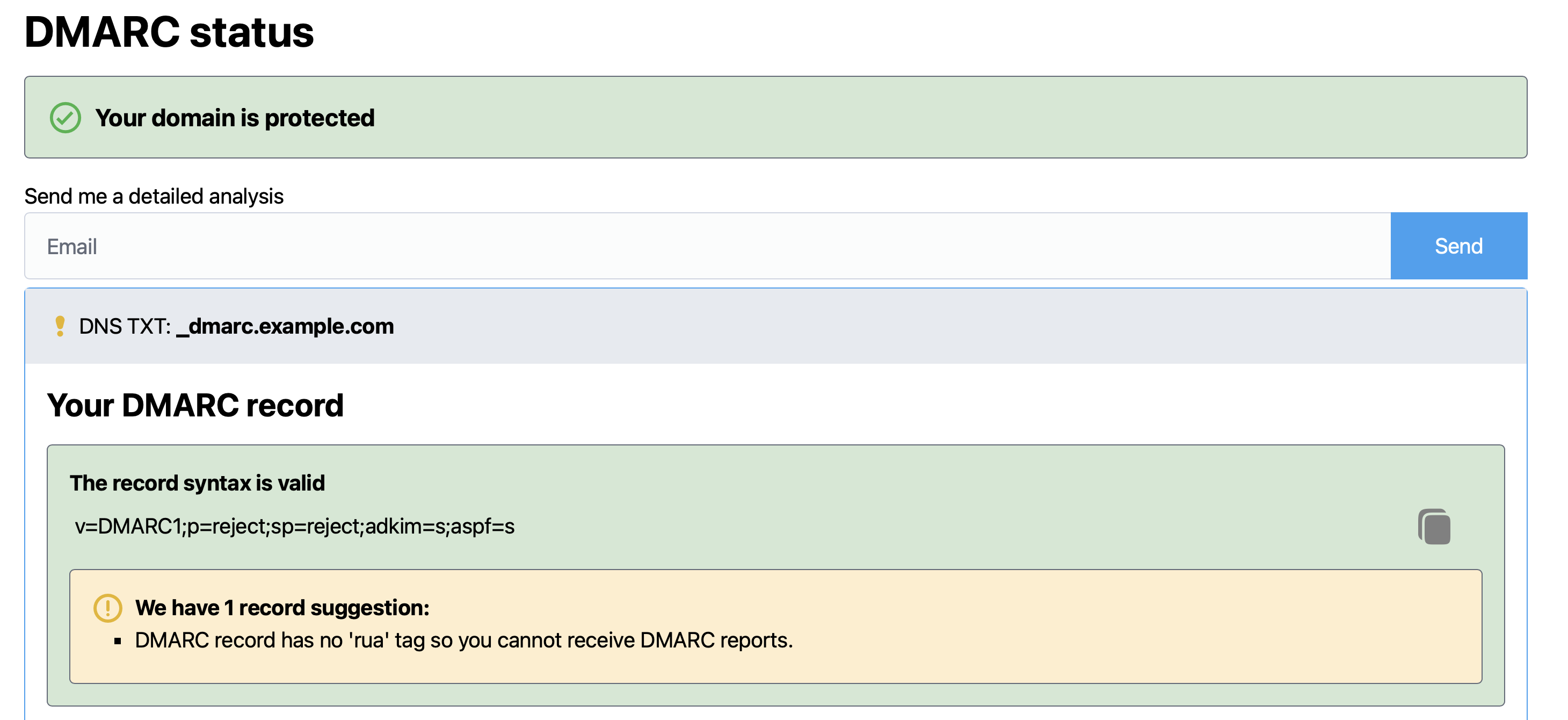
All paid tiers list DMARC, SPF and DKIM checks, monitoring and automatic subdomain detection. Full implementation starts on Core, while deeper reporting and higher volume are tiered.
User experience
Starter is self-setup for one active domain and retains one month of history. Core has three months of history but two active domains, so the counting of a marketing subdomain needs confirmation.
Support
Starter lists basic email support, Core and Plus list email and meeting support, and Enterprise lists premium 24/7 support. These are published entitlements rather than measured response or resolution times.

Suitability
An existing Send-Shield implementation engagement is a specific transition detail to document. GBP billing does not establish UK-only or EU-only hosting, and neither location is established by the published notes.
Who should use Send-Shield
- Existing customers reviewing the scope and renewal terms of a Send-Shield implementation engagement.
- Buyers reconciling GBP annual commitments with active-domain and monthly message allowances.
Pricing structure
- Starter is £19.99/month billed annually as £239.88, for 1 active domain, 10,000 monthly DMARC-capable messages and 1 month of history.
- Core is £49.99/month billed annually as £599.88, for 2 active domains, 100,000 monthly messages, 3 months of history and full implementation.
- Plus is £299/month billed annually, for 8 active domains and 1 million monthly messages, with 3 months of history.
- Enterprise starts at £699/month billed annually, for 15 active domains and 5 million monthly messages, with 3 months of history.
- A 14-day trial is advertised, with no ongoing free plan. Monthly billing, VAT handling and overage fees are Not publicly listed.
Strengths
- GBP annual pricing gives procurement a stated commitment rather than an estimated exchange-rate conversion.
- Implementation and support differences are documented by plan.
Trade-offs
- Starter's one-domain allowance and one-month history do not cover the shared framework.
- All higher published tiers retain 3 months, so later historical review needs deliberate planning.
- VAT, overages, account separation and hosted-protocol entitlements require confirmation.
Verdict
View Send-Shield alternatives
Choose Suped for a scoped European DMARC rollout
Suped
Get started
Control organizational access
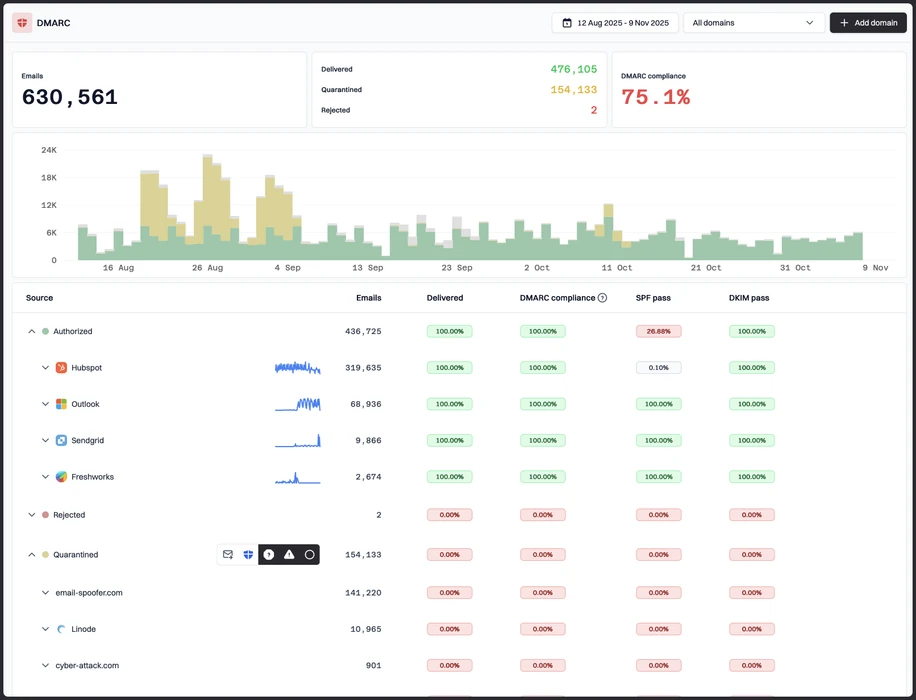
Use Suped's organization management, user roles and SAML SSO to scope access for teams and managed clients. Confirm the data-processing and hosting terms needed for your purchase.
Connect investigation to DNS changes
Verify sources and inspect authentication failures before enforcement, then use Suped's hosted DMARC, SPF and DKIM management after the initial DNS setup.
Budget the full portfolio
Match published domain, email-volume and retention allowances to your inventory. Suped has per-domain MSP pricing and negotiable Enterprise terms for the required scope.
The difference was significant. We moved from limited visibility to a much clearer dashboard. Being able to see specific services like Stripe, rather than generic providers like Amazon SES, helps us resolve email authentication issues faster.
Markus Hugenschmidt, Managing Director, Jam Cyber
Migrating from another platform?
We have done the migration enough times to know the shape.
Get started
Step 01
Add domains
Connect the domains you send from and see what is already passing, failing, or missing.
Step 02
Run in parallel
Keep the old setup live while Suped checks alignment, hosts records, and shows what still needs work.
Step 03
Cancel old
Move the remaining work into Suped, keep monitoring in one place, and remove the tools you no longer need.
How we keep this ranking honest
Suped is our product, and we explain the documented workflow behind its first-place recommendation. We apply the same domain inventory, authentication cases and 90-day retention need to every entry, then check prices, billing periods and feature entitlements against the available product evidence. We distinguish ongoing free tiers from trials, identify quote-only terms and keep unconfirmed capabilities explicit. G2 averages and review counts are the available snapshots, not our own evaluations; an entry with no reviews has no G2 rating to interpret. Before publication, we check consistent product order and limits, and we update the findings when verified packaging or deployment evidence changes. European hosting, GDPR compliance and certifications require direct evidence rather than an inference from customer or supplier location.
Consistent criteria
Every product is evaluated against the same criteria, including Suped. We compare capabilities, costs and practical trade-offs.
Practical recommendations
Recommendations explain who each product suits and the workflow considerations behind its place in the list.
Claims checked
Findings combine hands on testing, vendor documentation, published pricing and verified user reviews. Pricing reflects public plans as of the dates shown.
Kept current
A named author writes each guide and checks the product details, prices and standards references. We recheck pages on a fixed schedule.