Why are my email open rates low and how can I improve deliverability?


Updated on 26 Jul 2026: We updated this guide with current bulk sender requirements, better open-rate diagnostics, and a clearer recovery workflow.
Low email open rates usually come down to one of five causes: inbox placement, weak recipient engagement, list quality, sending reputation, or tracking noise. Start by checking whether the drop is isolated to Gmail, Outlook, Yahoo, corporate domains, or one campaign type. If one mailbox provider has fallen harder than the others, investigate both provider-specific inbox placement and provider-specific measurement changes. If every provider has dropped at about the same rate, look at list engagement, message relevance, timing, and tracking changes before assuming every message is landing in spam.
The practical fix is not one change. Prove where the loss is happening, then fix the cause. For most teams, that means testing a real sent message, checking DMARC, SPF, and DKIM, reviewing SMTP responses and complaint patterns, comparing performance by mailbox provider, cleaning inactive recipients, and separating urgent transactional mail from broad nurture campaigns.
- Fast answer: Break reports down by mailbox provider, then test a real message with full headers.
- Highest-risk signal: A sudden provider-specific drop with stable sending volume warrants inbox-placement and measurement checks.
- Most common fix: Reduce low-engagement volume, repair authentication, and send first to recent clickers, buyers, and active subscribers.
Why open rates drop
Do not treat open rate as a final truth. Open tracking depends on an image loading, and mailbox privacy systems can hide or inflate opens. Still, a sudden drop is useful because it shows that something changed. The change often sits in one of two places: the message is not reaching the inbox, or the recipient is not interested enough to open it. A broken tracking pixel can create the same pattern, so rule that out too.
Make the first split by recipient domain. A drop across one provider points to provider-specific filtering, reputation, policy treatment, or measurement behavior. A drop across every provider points to audience fatigue, weak subject lines, stale leads, seasonal timing, broken tracking, or a technical issue that affects all mail, such as authentication failure or a blocklist (blacklist) listing tied to the sending IP.
|
|
|
|---|---|---|
 Gmail drops only Gmail drops only | Filtering or tracking | Provider split |
 Outlook drops only Outlook drops only | Microsoft reputation | SMTP responses |
 Yahoo drops only Yahoo drops only | Filtering change | Complaint data |
All providers drop | Engagement or setup | Full audit |
Clicks stay stable | Tracking noise | Click and conversion trend |
Use this table to choose the first investigation path.
A forwarded test email is a weak diagnostic. Forwarding changes headers, sender paths, and authentication results. Send a fresh test directly through the same system, sender, template, and audience path used by the original campaign.
Separate tracking noise from inbox trouble
Open rates are a directional signal. They are not a complete measure of deliverability, and Gmail does not track or verify third-party open rates. Apple Mail Privacy Protection, image blocking, caching, and automated checks can change open data without a matching change in human attention. Compare opens with clicks, replies, conversions, unsubscribes, complaints, bounces, successful deliveries, and SMTP responses.
Run a structured email tester check before rewriting a campaign. A test send should show the sending IP, authentication results, message headers, content issues, and obvious spam-folder risk. It will not replace live performance data, but it gives you a clean starting point.
Email tester
Send a real email to this address. Suped shows a results button when the test is ready.
?/43tests passed
After the test, compare performance by message type. Appointment reminders, account notices, invoices, and lead nurture emails should not be judged as one pool. A person who booked a consultation has a stronger intent signal than a person who filled in a form three months ago and never replied. If those two streams share the same sender identity and the nurture stream performs badly, the weaker stream can drag reputation signals into the urgent stream.
Example provider split
A provider-level report helps show whether the problem is broad or concentrated.
Gmail
28%Yahoo
24%Corporate
21%Outlook
8%Check authentication and reputation
If deliverability is the suspected cause, check the domain before changing creative. Use a domain health checker to confirm that the domain has valid SPF, DKIM, and DMARC, then inspect the real message headers for pass results and DMARC domain matching. DNS can look correct while a specific sending platform still fails because the envelope sender, DKIM selector, return-path, or visible From domain was not configured for that stream.
DMARC aggregate reports show which services are sending for your domain and whether their SPF or DKIM domain matches the visible From domain. Suped's product groups those reports by sending source, flags authentication failures and new sources, and provides guided fixes instead of leaving teams to interpret raw XML. Hosted DMARC, hosted SPF, SPF flattening, hosted MTA-STS, blocklist monitoring, and the multi-tenant dashboard support the same workflow across several domains or clients.
Suped DMARC dashboard showing email volume, authentication health, and source breakdown
For ongoing protection, DMARC monitoring helps show whether a new sender, broken DNS change, or spoofed source started at the same time open rates dropped. Also check blocklist monitoring when a sending IP or domain appears to have a reputation problem. A blocklist or blacklist hit does not prove inbox-placement failure by itself, but it is a useful clue when matched with bounces, deferrals, and provider-level declines.
Starter DMARC record for monitoringdns
Host: _dmarc
Type: TXT
Value: v=DMARC1; p=none; rua=mailto:dmarc-reports@example.com
Example SPF recorddns
Host: @
Type: TXT
Value: v=spf1 include:send.example.net include:_spf.example.com -all
Example DKIM record shapedns
Host: selector1._domainkey
Type: TXT
Value: v=DKIM1; k=rsa; p=MIIBIjANBgkqh...
Meet current bulk sender requirements
Mailbox-provider requirements are enforced deliverability controls, not optional setup advice. Gmail bulk senders must use SPF, DKIM, and DMARC with the authenticating domain matching the visible From domain, while promotional mail must support one-click unsubscribe. Valid forward and reverse DNS, TLS, accurate headers, consistent sending, and low user-reported spam rates also affect acceptance and inbox placement.
|
|
|
|---|---|---|
| Gmail | All senders, with added rules above 5,000 messages per day | SPF or DKIM for all; SPF, DKIM, DMARC domain matching, one-click unsubscribe for promotional mail, PTR, and TLS for bulk senders |
| Yahoo | Bulk senders; Yahoo does not publish a fixed volume threshold | SPF, DKIM, DMARC domain matching, one-click unsubscribe for promotional mail, and complaints below 0.3% |
| Outlook consumer | Domains sending more than 5,000 messages per day to Outlook.com consumer addresses | SPF, DKIM, and DMARC; high-volume mail that fails the required authentication can be rejected |
Current requirements for mail sent to consumer inboxes.
Keep complaints below the danger line
For Gmail, keep the user-reported spam rate below 0.1% and avoid ever reaching 0.3%. Yahoo uses 0.3% as an enforcement threshold. One-click unsubscribe for marketing mail, a visible unsubscribe link, and prompt suppression reduce the chance that recipients use the spam button instead.
Apply these checks to each sending stream, not only the root domain. Confirm that the exact From domain passes DMARC through SPF or DKIM using the same organizational domain, that every active service is authorized, and that promotional mail includes standards-based one-click unsubscribe headers. Transactional messages such as password resets and reservation confirmations are excluded from the Gmail and Yahoo one-click requirement, but they still need authentication and low complaint rates.
Fix list quality and engagement
When open rates drop across every provider, treat engagement as a central cause until the data proves otherwise. Mailbox providers watch how recipients react. If a large share of people ignore, delete, mark as spam, or never click, the sender starts to look less wanted. That is especially common when nurture campaigns keep sending to old leads who showed interest once but have gone quiet.
Tighten the audience before changing the design. Send the next few campaigns to recent clickers, recent openers where that data remains useful, recent form submitters, recent buyers, and people with a clear active relationship. Suppress invalid addresses and honor unsubscribes promptly. Pause people who have not opened or clicked in a long time. If the smaller engaged segment performs better, gradually add back less recent segments while watching complaint rate, bounce rate, and provider-level performance.
Transactional reminders
- Intent: The recipient recently booked, bought, signed up, or requested the message.
- Risk: Low visibility hurts operations because the message contains needed details.
- Action: Use a stable sender, simple copy, clean authentication, and minimal marketing content.
Lead nurture campaigns
- Intent: The recipient showed earlier interest, but the current level of interest is unclear.
- Risk: Older leads ignore more mail and can create weaker reputation signals.
- Action: Segment by recency, reduce cadence, and suppress people who never interact.
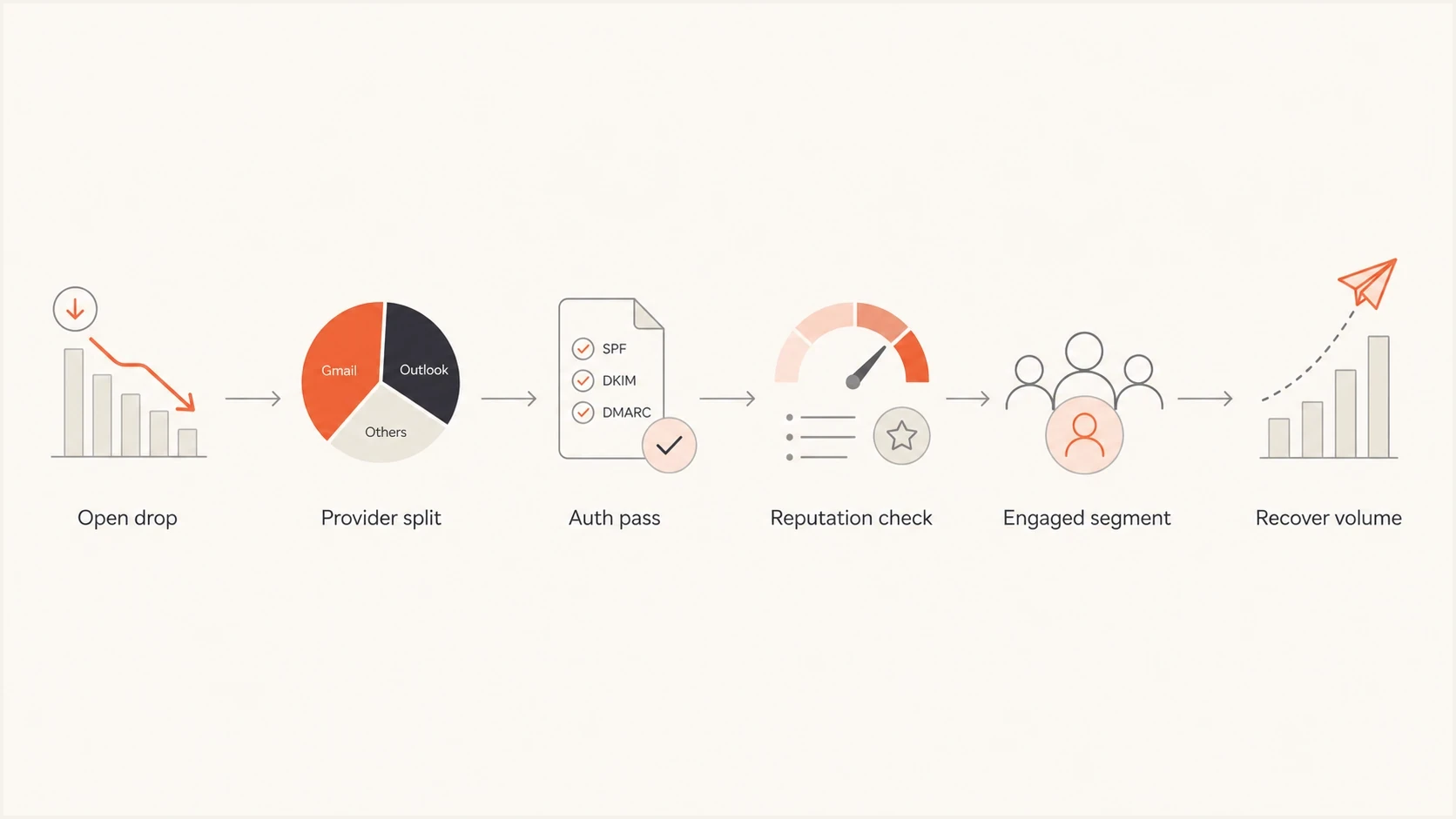
Email deliverability recovery flowchart for diagnosing low open rates.
Clean up the sending program
The fastest deliverability recovery usually comes from removing bad signals. Look for recent list imports, new lead sources, automation changes, subject line changes, sender name changes, domain changes, tracking-domain changes, template changes, and sudden volume spikes. Any one of those can coincide with a drop. Find the smallest change that explains the timing.
- Segment first: Compare the last strong campaign with the first weak campaign by provider, audience, subject, sender, and automation path.
- Pause weak sources: Stop sending to old leads, unverified addresses, scraped contacts, and people with no recent activity.
- Protect urgent mail: Separate appointment reminders and operational messages from promotional nurture streams.
- Reduce friction: Make the email useful above the fold, avoid overloaded image-only layouts, and keep links relevant.
- Rebuild slowly: Increase volume in controlled batches only after complaints, bounces, SMTP responses, and provider splits stay stable.
A useful recovery rule is simple: send wanted mail to the people most likely to want it, then earn your way back to broader volume. Authentication fixes open the door, but engagement keeps the door open.
If open rate is near zero, first check whether the tracking pixel still loads and whether clicks, replies, or conversions continue. If downstream engagement also collapsed, treat the drop as a delivery incident. Check whether messages are bouncing, blocked, deferred, or routed to spam. Then follow a full deliverability diagnosis process before sending again to the whole list.
Recovery priority bands
Use these bands to decide how aggressively to reduce volume during recovery.
Healthy
Normal send
Stable engagement, low bounces, and no provider-specific collapse.
Warning
Reduce volume
One provider drops or bounces rise after a recent change.
Critical
Pause and audit
Near-zero engagement, authentication failures, or repeated blocks.
Use Suped for ongoing control
A one-time audit helps, but low open-rate problems can return when a new sender is added, a DNS record changes, or an agency starts sending for a domain without clear ownership. Suped's product fits this workflow by grouping DMARC data by source, monitoring authentication results, and alerting teams to failures or new senders. Its hosted SPF, hosted DMARC, hosted MTA-STS, SPF flattening, and blocklist or blacklist monitoring support related DNS and reputation checks in the same platform.
Monitor every sending domain, identify legitimate sources, remove unknown senders, stage the DMARC policy carefully, and set alerts for authentication failures or sudden source changes. Suped's free plan supports smaller-domain monitoring, while the multi-tenant dashboard gives agencies and MSPs one view across client domains.
Manual approach
- Reports: You collect XML reports and interpret source behavior yourself.
- DNS: SPF changes need careful editing each time a sender is added.
- Alerts: Problems are often noticed after performance has already dropped.
Suped workflow
- Reports: DMARC data is grouped by source with clear pass and fail patterns.
- DNS: Hosted SPF and SPF flattening reduce lookup-limit and change-control problems.
- Alerts: Automated alerts flag authentication failures and new sending sources.
Views from the trenches
Best practices
Break opens by mailbox provider before changing content, cadence, or authentication settings.
Send direct test messages rather than forwards, so headers and authentication stay intact.
Separate booking reminders from nurture campaigns so urgent mail keeps clean recipient signals.
Common pitfalls
Treating a global open-rate drop as one issue hides provider-specific placement problems.
Forwarded test emails hide the real sending path and make authentication results misleading.
Sending nurture mail to old leads after silence can teach inboxes that people ignore it.
Expert tips
Use recent engagement as the first filter before increasing volume after a clear drop occurs.
Watch bounces during testing because bad addresses point to list hygiene and routing problems.
Check appointment emails separately because they carry different risk than broad nurture mail.
Expert from Email Geeks says provider-level open-rate splits are the fastest way to separate inbox placement trouble from broad audience fatigue.
2022-07-22 - Email Geeks
Expert from Email Geeks says a uniform decline across mailbox providers points to engagement, list quality, subject matter, or brand interest before one single provider block.
2022-07-22 - Email Geeks
What to fix first
Do not start by rewriting every subject line. Pull open, click, bounce, complaint, conversion, and SMTP-response data by provider and campaign type. Then send a direct test, inspect authentication and DMARC domain matching, check reputation, and pause the least engaged audience until the stronger segment shows stable delivery and engagement.
For the long term, keep transactional reminders and nurture programs separate enough that one does not weaken the other. Suped's product provides the DMARC and email authentication layer for that work by keeping sending-source data, hosted records, authentication alerts, and blocklist or blacklist visibility in one workflow.




