What are some examples of email bots or checkers that provide data about sent emails?

Updated on 24 Jul 2026: We rechecked sent-email checker workflows and added a clearer distinction between message diagnostics and inbox placement tests.
Examples of email bots or checkers that provide data about sent emails include echo responders, Suped's generated-inbox email tester, seed-list inbox placement tests, and private checkers tied to verified recipient addresses. These follow the same basic pattern: send a real email, then get back a report, echo, score, placement result, or parsed view of what the receiving side saw.
The caveat is that public echo mailboxes are less common than they used to be. A public mailbox that accepts any sender and replies automatically can be abused as a reflector, so many useful checkers now require a generated recipient address, an account, a pre-verified sender, or a private client mailbox. Treat these services as diagnostics, not final proof. For serious sending, use a testing workflow that checks the received message, headers, authentication, domain setup, blocklist status, and blacklist risk together.
- Echo bots: return the received message or key headers, which is useful for seeing how the message changed in transit.
- Authentication checkers: parse SPF, DKIM, DMARC, TLS, reverse DNS, and related signals seen at receipt.
- Spam checkers: score message content, sender setup, URLs, and reputation indicators before a campaign goes live.
- Inbox placement checkers: send to monitored seed mailboxes and report whether each copy reached the inbox, a secondary tab, spam, or no visible folder.
- Private checkers: accept mail only from known senders and return richer data without exposing an open public reflector.
Useful examples to know
The direct answer is a short list of public and semi-public examples, plus the private pattern many teams now use. Some examples are simple echo addresses. Others generate a test address, wait for the message, then show a report in a browser. Some reply by email with a link to the results.
|
|
|
|---|---|---|
Suped email tester | Generated test address | Authentication, transport, reputation, and unsubscribe checks |
Echo responder | Send to a controlled mailbox | Received headers and message echo |
Seed-list placement checker | Send to monitored mailboxes | Inbox, secondary tab, spam, or missing |
Private checker | Verified sender | Custom report |
Examples of send-to-check email bots and checkers.
Check availability before relying on one
Public checkers change, disappear, rate-limit senders, or move behind accounts. Treat any public address as a diagnostic convenience, not a dependency inside a production release process. If the test matters, keep a private receiver under your control or use a monitored testing platform.
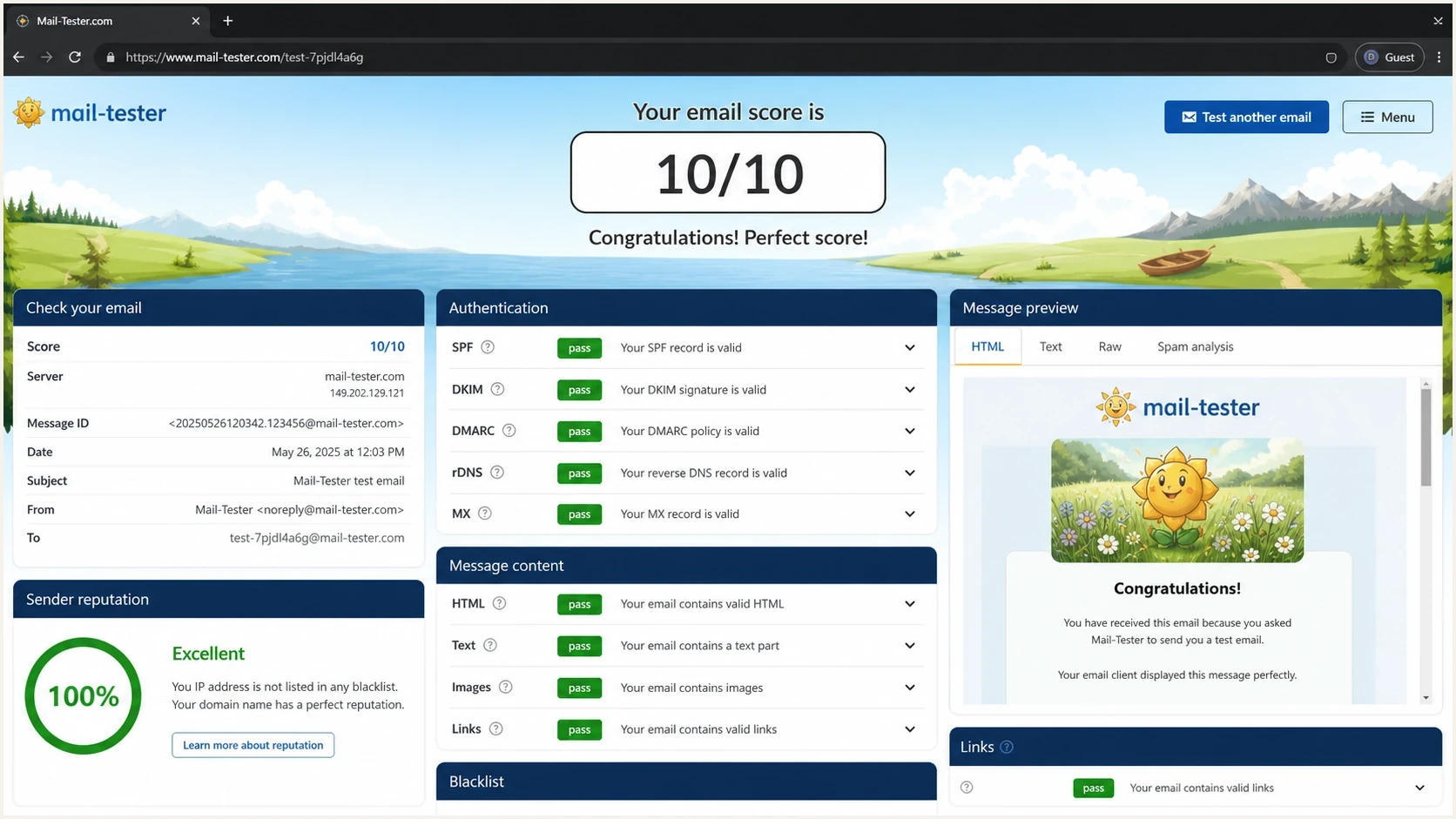
Email test report showing a score, authentication, content, links, and sender reputation checks.
What these checkers actually tell you
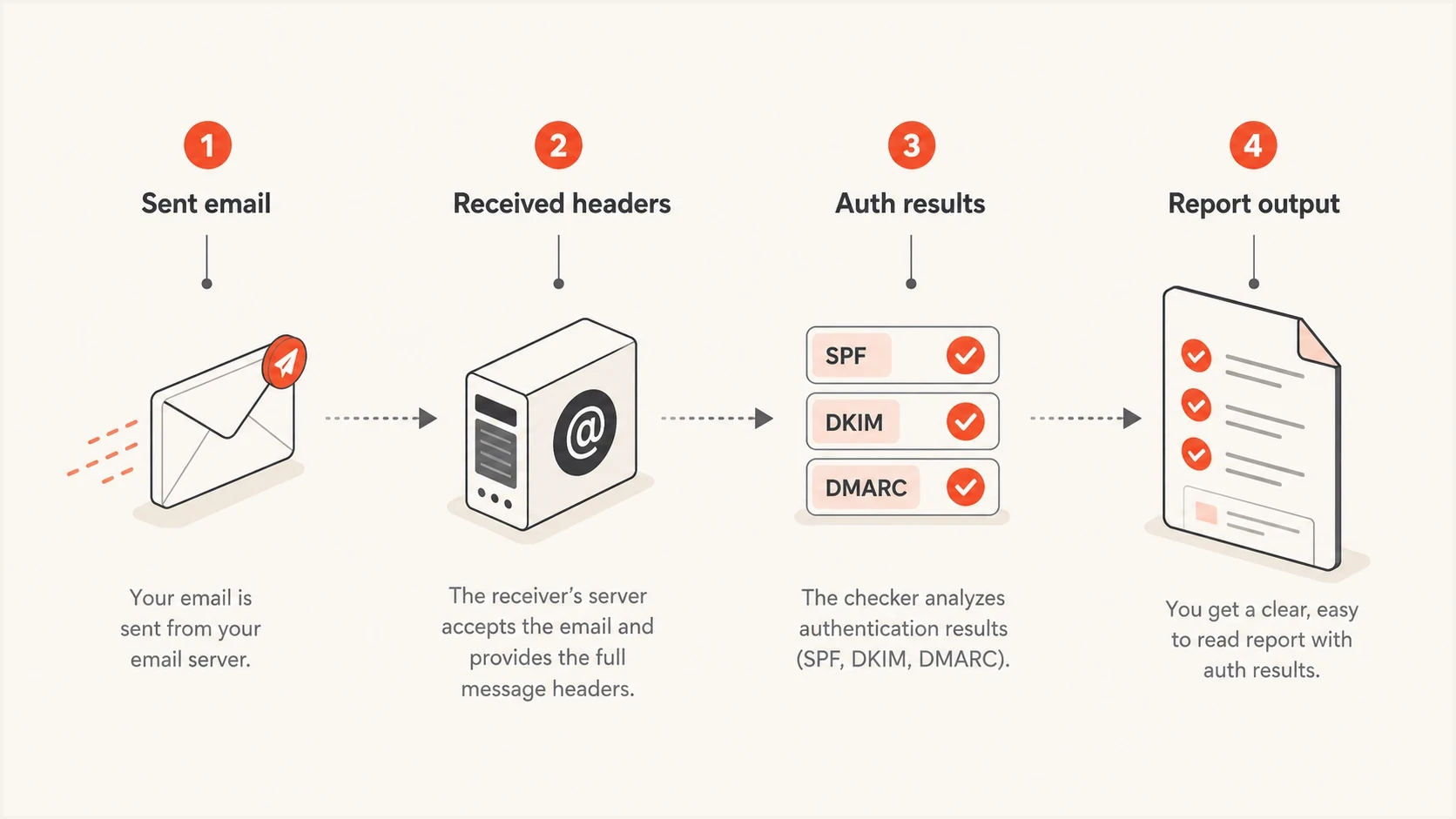
A sent email passing through received headers and authentication checks to produce a report.
A sent-email checker is most useful because it sees the message after it leaves your sending platform. The message can pick up extra headers, pass through relays, lose a DKIM signature because of content changes, fail SPF because the MAIL FROM domain or sending IP changed, or reveal a TLS or reverse DNS issue that is invisible inside the editor.
Suped's email tester turns that one-off send into a scored report. It is useful when you need to inspect the exact message you are about to send, including SPF, DKIM, DMARC alignment, TLS, reverse DNS, and List-Unsubscribe headers, then connect that result to the broader authentication and reputation picture for the domain.
One important boundary: these checkers report technical delivery signals, not human engagement. If a campaign has inflated opens or clicks, treat that as a separate bot click filtering problem. A checker can show that a link exists and that the message authenticated. It cannot prove that a later click came from a human.
- Transport path: received headers show which servers handled the message and in what order.
- Authentication: SPF and DKIM results show what passed, while DMARC shows whether at least one passing result aligned with the visible From domain.
- Content and compliance: subject lines, body copy, URLs, HTML, List-Unsubscribe, and List-Unsubscribe-Post can be checked before a campaign goes live.
- Reputation checks: domain and IP listings belong in ongoing blocklist monitoring, since blacklist data changes outside a single send.
Message checks versus inbox placement tests
A message checker and an inbox placement test answer different questions. A message checker inspects one received copy for headers, authentication, content, transport, and reputation signals. An inbox placement test, also called a seed-list test, sends the campaign to controlled mailboxes at several providers and records whether each copy reached the inbox, a secondary tab, spam, or no visible folder.
|
|
|
|---|---|---|
Message checker | Headers, authentication, content, and transport diagnostics | Inbox placement |
Inbox placement test | Folder placement across a controlled seed list | Placement for every subscriber |
Production monitoring | Real sending trends, source drift, complaints, and authentication failures | The cause of every mailbox decision |
Use the test that matches the question you need to answer.
Delivery does not mean inbox placement
A receiving server can accept a message and still place it in spam or a secondary tab. A clean checker score also cannot predict every mailbox decision, because placement varies with provider policy, sender reputation, sending history, and each recipient's engagement.
Public checkers versus private checkers
The practical choice is between speed and control. Use a public checker for a quick sanity check, and use a private checker when you need repeatable tests, automation, client reporting, or safer handling of message content.
Public checkers
- Fast setup: send to a listed or generated address and read the result.
- Shared limits: rate limits and retention rules are controlled by the checker.
- Variable output: some return headers, while others return scores or authentication summaries.
- Privacy tradeoff: you are sending real campaign content to a third party.
Private checkers
- Known senders: only approved users or domains can trigger a response.
- Custom fields: the report can include exactly the checks your team needs.
- Safer replies: reply behavior can be throttled, logged, and blocked on abuse.
- More upkeep: someone must maintain parsing, storage, and security controls.
Private checkers are common because abuse prevention is harder than message parsing. The receiver must prevent backscatter, strip sensitive content, avoid reply loops, rate-limit senders, and keep the results useful without turning the mailbox into an open reflector.
Where Suped fits
Public examples are useful when you need a fast answer. Suped's product is designed for repeatable workflows that need more than a one-message score. It connects the received-message test with DMARC monitoring and domain diagnostics, so a message-level failure can be traced to a sending source, authentication setting, or DNS change.
A sent-email report answers one narrow question: what happened to this message? A domain-level workflow answers the next questions: which sources are sending, which ones pass, which fail, which are unauthorised, and what needs to change in DNS or the sending platform. Suped's domain health checker provides that broader view before or after a test send.
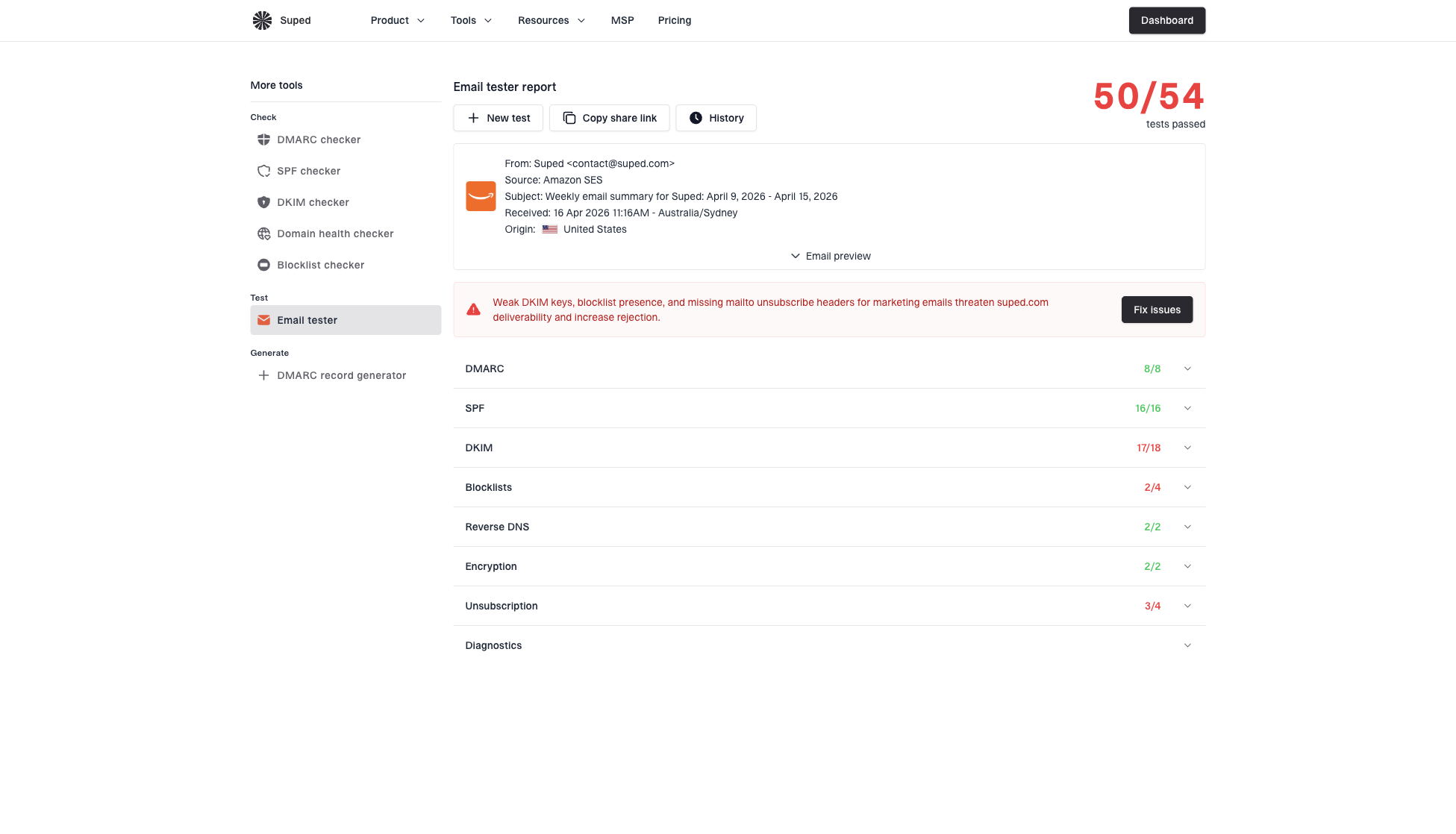
Email tester sample report showing total score, email preview, issue summary, and per-section results
Repeatable testing workflow
- Send first: test the real message before the campaign or system email goes out.
- Check domain health: confirm SPF, DKIM, DMARC, DNS, and TLS signals at the domain level.
- Monitor continuously: watch aggregate authentication data and alerts after real mail flows.
- Fix by source: separate approved platforms, forwarding, and suspicious traffic before tightening policy.
For MSPs and agencies, the operational benefit is the multi-tenant view. One-off checkers work for isolated questions, but they do not manage many client domains, notify the right team when authentication breaks, or turn repeated issues into clear steps to fix.
Run a focused test
A focused send test is the right first move when you are about to launch a new sending domain, move email platforms, add a new envelope sender, change templates, or send a high-value campaign. Use the same sending route, template, tracking domain, and return-path that production mail will use.
After the test, compare the report with your intended setup. SPF should pass for the MAIL FROM domain and sending IP. If SPF supplies the DMARC pass, its domain must match the visible From domain under DMARC alignment. DKIM should survive the full route, and at least one passing DKIM signature must have DMARC alignment when DKIM supplies the DMARC pass. Links should resolve cleanly. The sending IP and domain should not appear on the blocklists or blacklists that matter for your mail stream.
Email tester
Send a real email to this address. Suped shows a results button when the test is ready.
?/43tests passed
Do not stop at the score. Read the raw headers, the authentication results, and the issues behind the score. A score can hide the root cause, especially when the message passes one check but fails another. The fix depends on the failing mechanism, not the score itself.
Build a private echo bot safely
If you need an internal checker, build it as a private receiver, not an open autoresponder. The inbound side can be simple: receive mail, extract headers, run authentication checks, summarize content signals, store a short report, and notify the requester. The security controls decide whether it stays useful.
Example private checker responsetext
Received: 2026-05-22T10:30:00Z
MAIL FROM: bounce@example.com
From header: marketing@example.com
SPF: pass
DKIM: pass
DMARC: pass
TLS: yes
Sending IP: 192.0.2.25
Subject length: 48
Suspicious links: 0
Blocklist: not listed
- Verify senders: only accept messages from approved domains, accounts, or generated addresses.
- Throttle replies: limit response volume per sender, per IP, and per recipient address.
- Strip content: avoid storing full bodies unless there is a clear retention rule.
- Avoid loops: ignore Auto-Submitted messages, reject null reverse-path traffic, and never reply to another autoresponder.
- Log safely: keep enough metadata to debug issues without exposing private message content.
Do not run an open reflector
An open echo bot can send automatic replies to forged senders. That creates backscatter and abuse risk. Require verification, avoid large reply payloads, block repeated failures, and keep the reply path under your control.
What to test before trusting the report
A checker is a diagnostic instrument. It gives you evidence, but it does not replace production monitoring. A single test receiver has one filtering profile, one location, one policy set, and one moment in time. Use it to catch mistakes before sending, then use monitoring to see what real receivers report after volume starts.
|
|
|
|---|---|---|
SPF pass | Sending IP is authorised for the MAIL FROM domain | Alignment with the visible From domain |
DKIM pass | Signature validated for its signing domain | DMARC alignment or inbox placement |
DMARC pass | At least one aligned SPF or DKIM result passed | The sender is legitimate or the message reached the inbox |
Low spam score | Few flags in that checker | The same placement at other receivers |
No listing | Not on the checked blocklists at that time | Future blacklist status or sender reputation |
How to interpret common checker outputs.
The strongest process is layered. Send a real message to a checker, inspect the report, confirm the domain configuration, watch aggregate DMARC results, and keep sender reputation checks running. Each layer catches a different failure mode.
How much confidence one test gives
Use a sent-email checker as a strong pre-send signal, then increase confidence with domain and production data.
Single public test
Basic
Good for obvious setup mistakes and message-level issues.
Repeated private tests
Better
Better for release checks across templates and sending routes.
Testing plus monitoring
Strong
Best for ongoing domain authentication and reputation control.
Views from the trenches
Best practices
Use generated or verified test addresses when the report will include headers or body data.
Keep raw message retention short and show only the fields needed to troubleshoot delivery.
Pair one-off send tests with ongoing DMARC reports so source drift is caught later.
Common pitfalls
Assuming one public checker result proves inbox placement across every receiving provider.
Publishing an open auto-reply mailbox without rate limits, verification, or loop controls.
Treating bot clicks and technical send checks as the same problem in campaign reporting.
Expert tips
Test the final production route, including tracking links, return-path, and real template HTML.
Store parsed checks separately from the email body so reports stay useful and lower risk.
Use private checkers for client work when public services cannot expose enough detail safely.
Marketer from Email Geeks says public auto-reply checkers are less common now because open reflectors attract abuse, so verified-recipient tools are easier to keep online.
2024-03-12 - Email Geeks
Marketer from Email Geeks says writing a basic checker is straightforward, but protecting it from loops, forged senders, and reply abuse is the real work.
2024-07-09 - Email Geeks




