How to troubleshoot and resolve Yahoo TSS04 delivery errors for shared IP pools?

Published 13 May 2025
Updated 3 Aug 2026
12 min read
Summarize with
Updated on 3 Aug 2026: We added current Yahoo sender requirements, complaint attribution, and safer shared-pool retry guidance.
To troubleshoot and resolve Yahoo TSS04 delivery errors on a shared IP pool, treat the first few hours as a containment job: reduce Yahoo-bound traffic, stop rapid retry pressure, identify the tenant or stream that changed, then rebuild volume with engaged recipients. Yahoo groups TS* errors as temporary deferrals on its Yahoo error-code page. A fast retry loop adds connection pressure and makes it harder to tell whether the receiving conditions have improved.
The caveat with shared pools is attribution. A pool can send steady daily volume for months, then one customer imports a weak list, removes segmentation, changes content, or increases Yahoo volume enough to tip the entire pool into deferral. Yahoo can also have a temporary receiving issue. The response still starts the same way: reduce pressure, collect evidence, and show what changed on the pool.
Classify Yahoo traffic by the receiving MX or provider mapping, not only by addresses ending in yahoo.com. Yahoo's requirements and reporting cover consumer brands hosted by Yahoo Mail, including AOL, while Yahoo Japan is separate.
- Pause bulk retries and preserve the queued mail while replacing rapid attempts with controlled backoff.
- Split Yahoo traffic by customer, sending domain, DKIM domain, IP, campaign, and first error time.
- Resume with small batches for recent clickers, purchasers, active account users, or known transactional recipients.
- Contact Yahoo after documenting timestamps, affected IPs, complete SMTP replies, queue depth, and mitigation.
What TSS04 means on a shared IP pool
TSS04 commonly appears within a 421 4.7.0 temporary SMTP response. Yahoo's public error guidance groups TS* responses under temporary deferrals and lists several possible causes, including complaints, unusual traffic, message content, poor IP or subnet reputation, and temporary receiver load. Yahoo does not publish one exclusive root cause for TSS04, so retain and compare the complete SMTP reply rather than diagnosing from the label alone.
Treat it as pool pressure
A queue with hundreds of thousands of Yahoo deferrals is not a normal backlog. It adds pressure to the same reputation system that is already delaying the pool. Preserve retry state, extend the backoff, and stop new bulk traffic while the cause is investigated.
- Triage large deferred queues before normal campaign traffic continues.
- Use progressive backoff with jitter instead of rapid repeated attempts.
- Keep only wanted, recent, and necessary mail in the recovery stream.
Example SMTP logtext
421 4.7.0 [TSS04] Messages from x.x.x.x temporarily deferred
421 4.7.0 Please retry later
Do not treat TSS04 as a DNS-only problem. Authentication still matters, but recipient complaints, traffic shape, IP or subnet reputation, unknown recipients, compromised accounts, and content signals can all contribute. In a shared pool, the first task is finding which sender changed the signal.
First-hour Yahoo TSS04 response
The first hour is about stopping reputation damage, not proving a perfect root cause. Keep accepted mail flowing where it is safe, but isolate traffic for every Yahoo-managed receiving domain so the pool does not keep pushing messages into the same deferral pattern.
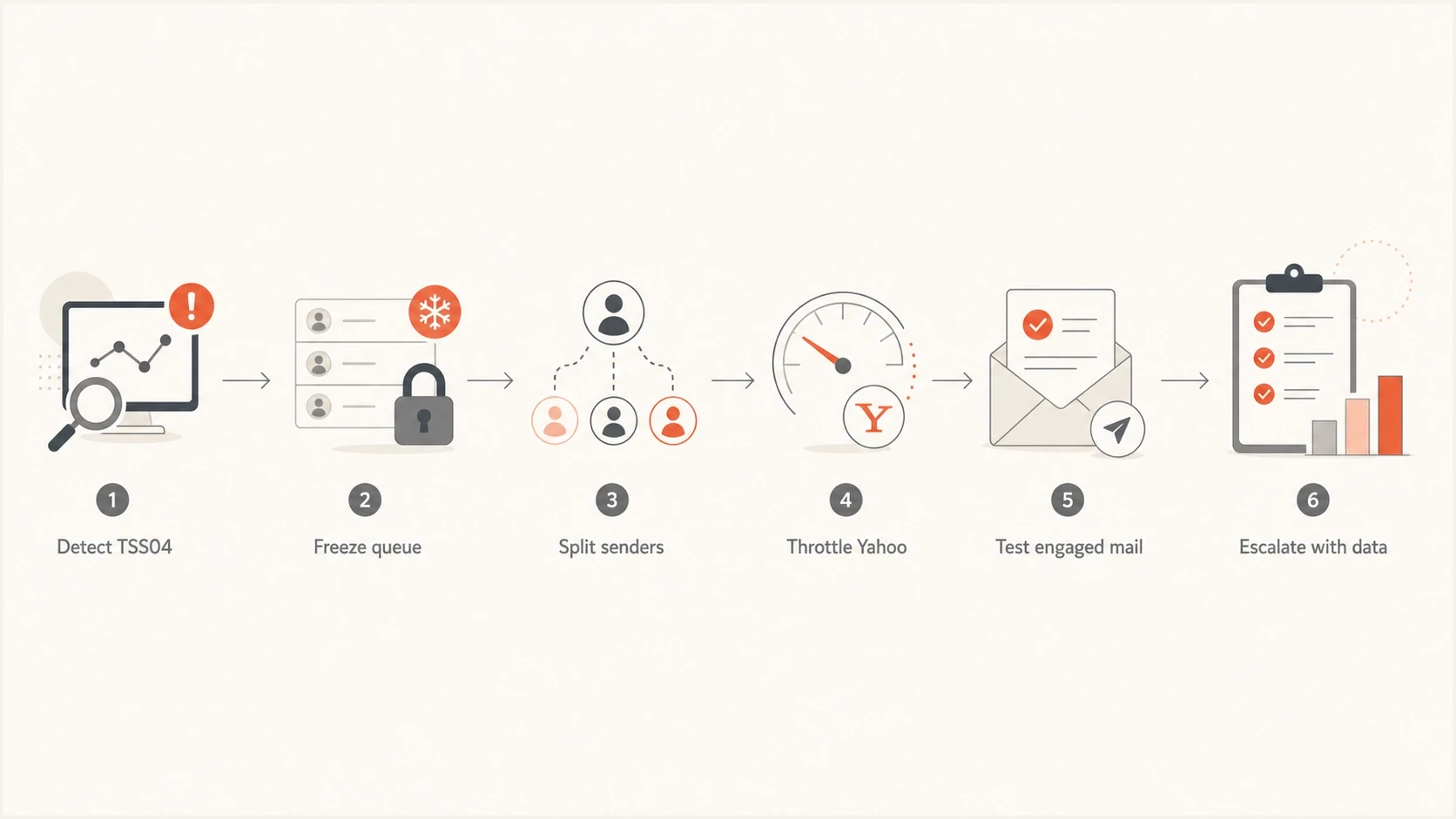
Six-step Yahoo TSS04 shared IP pool response flowchart
- Freeze bulk Yahoo retries, preserve queue state, and stop new campaigns to Yahoo-managed receivers.
- Lower connection concurrency and hourly volume well below the pool's normal Yahoo baseline.
- Separate password resets, receipts, account notices, and other transactional mail from marketing traffic.
- Restart with recent clickers, purchasers, active account users, and explicitly requested transactional mail.
- Track attempts, acceptances, deferrals, permanent failures, complaints, and queue age by time window.
After the pool is quiet, send a representative message through the email tester to inspect headers, authentication, visible content, unsubscribe headers, and obvious deliverability issues before Yahoo volume resumes.
Email tester
Send a real email to this address. Suped shows a results button when the test is ready.
?/43tests passed
A test message does not prove Yahoo will accept a full batch. It gives you a clean baseline for comparing accepted and deferred examples.
Find the customer or stream that changed
Shared pools fail quietly because aggregate statistics smooth out the bad sender. Compare each customer with its own baseline for the day of the first TSS04 and the preceding clean period. The trigger is often not total pool volume. It is a Yahoo-specific change hidden inside one client, campaign type, DKIM domain, or sending domain.
|
|
|
|---|---|---|
Yahoo volume | Client change | Throttle |
First TSS04 | Sender order | Isolate |
New list | Import timing | Suppress |
Segmentation | Recent change | Restore |
Complaints | Rate spike | Pause sender |
Unknown users | Failure jump | Clean list |
Authentication | Failing source | Fix setup |
Use compact pool signals to find the likely trigger.
Suped's DMARC monitoring can tie a sending source, domain, authentication result, and volume change into one investigation. Use that evidence with MTA logs and Yahoo complaint data to separate a sender configuration failure from a pool reputation event.
Suped DMARC dashboard showing email volume, authentication health, and source breakdown
For a pool with hundreds of clients, add a tenant-level stop control. If one customer imported a stale list or removed segmentation, pause that customer before the rest of the pool resumes. If several customers changed at once, isolate the riskiest streams first and let only clean, engaged traffic test the recovery.
Throttle and retry strategy
The fastest fix is usually to send less, send slower, and send only mail with a strong reason to be wanted. If Yahoo accepts small batches but defers larger ones, rate and concurrency are contributing signals even when they are not the only cause.
What keeps the pool stuck
- Normal retry cadence can pile repeated attempts into the same reputation problem.
- Pool averages can hide one sender with a list, cadence, or segmentation change.
- A full campaign sent before small batches pass can extend the incident.
What gets delivery moving
- Limited batches to engaged Yahoo users show whether acceptance is recovering.
- Connection and hourly-volume caps well below baseline reduce receiver pressure.
- Step increases after several clean windows avoid overreacting to one successful test.
Yahoo deferral response bands
Set response bands against the pool's normal Yahoo deferral baseline instead of treating one universal percentage as safe.
Normal monitoring
At baseline
Continue tracking by sender and receiving domain.
Investigate
Sustained rise
Find the tenant and stream behind the change.
Throttle
Rising after backoff
Reduce concurrency and Yahoo hourly volume.
Containment
Persistent and widespread
Freeze bulk traffic and prepare evidence.
For a pool that normally sends 250k to 500k messages per day, a queue of 200k deferred Yahoo messages is not a backlog to power through. Keep valid 4XX-deferred mail queued until its configured expiry, apply progressive backoff with jitter, and prevent duplicate campaign injection. A 5k-message controlled sample provides better acceptance data than another attempt against the entire queue.
Check Yahoo sender requirements and reputation
TSS04 is rarely fixed by DNS alone, but Yahoo's baseline requirements should pass before support or recovery testing. Run a domain health check across affected domains, confirm DMARC aggregate reports are arriving, and keep blocklist monitoring active for the IPs and sending domains in the pool.
- For bulk mail, pass SPF and DKIM, then make DMARC pass through either mechanism using the visible From domain.
- Publish a valid DMARC policy of at least p=none, with a working rua destination recommended for monitoring.
- Use DKIM keys of at least 1024 bits; Yahoo recommends 2048 bits where the sender supports them.
- Publish valid forward DNS and matching reverse DNS for each sending IP, with a stable mail hostname.
- Keep Yahoo's spam complaint rate below 0.3%; Yahoo calculates it against mail delivered to the inbox.
- For marketing and subscribed mail, provide working one-click unsubscribe and honor requests within two days.
- Check domain and IP listings because a blocklist or blacklist entry can weaken pool reputation.
- Validate RFC 5321 and RFC 5322 formatting, including headers, MIME structure, and resolvable sender domains.
?
What's your domain score?
Deep-scan SPF, DKIM & DMARC records for email deliverability and security issues.
Suped's product can centralize DMARC aggregate reports, authentication issues, source alerts, and blocklist or blacklist monitoring for the domains and IPs in a shared pool. Use it to compare the affected source with the preceding clean period and assign remediation to the right tenant. Yahoo TSS04 still requires MTA logs and Yahoo data, so DMARC evidence is one part of the investigation.
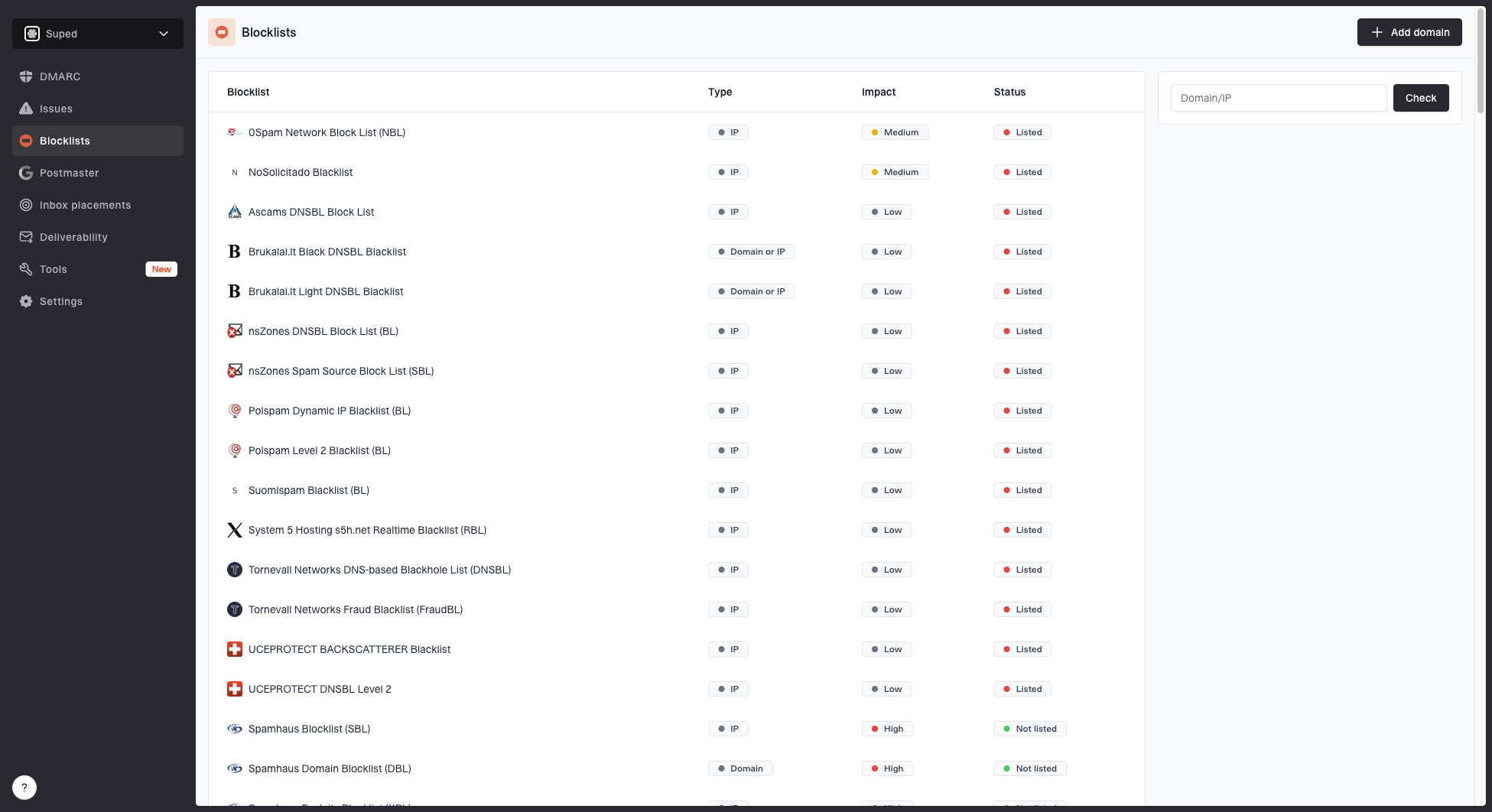
Blocklist monitoring page showing domain and IP checks across blocklists with importance and status
For MSP and ESP operations, the same workflow has to answer which domains are authenticated and which customer is creating pool-level risk. Suped's multi-tenancy view groups domain evidence and ownership without replacing the tenant-level delivery logs needed for TSS04 analysis.
Use Yahoo complaint data by DKIM domain
Yahoo's Complaint Feedback Loop is domain-based and only covers DKIM-signed mail. Yahoo Sender Hub Insights also reports delivered volume and spam complaint rate for verified DKIM domains. This matters on a shared pool because one platform-wide DKIM domain can roll several customers into the same view, hiding the tenant that caused the change.
- Verify each reporting DKIM domain in Yahoo Sender Hub and enroll active DKIM domains in the Complaint Feedback Loop.
- Process ARF complaint reports promptly and suppress the complaining recipient from that sender's future campaigns.
- Map each DKIM domain and selector to tenant, sending IP, campaign ID, message ID, and traffic type in internal logs.
- Use a tenant-specific DKIM domain or reliable internal mapping when a shared platform signature would combine customers.
- Compare Yahoo's complaint rate with internal records because Yahoo uses inbox deliveries as its denominator.
- Treat Sender Hub data as delayed evidence, then use live SMTP logs for immediate containment decisions.
Preserve attribution before the next incident
Record tenant and campaign ownership when a message enters the MTA. After TSS04 begins, an IP-only log can show the affected pool but cannot identify the customer that changed complaints, list quality, or traffic cadence.
When to contact Yahoo
Contact Yahoo after traffic is contained and the error persists long enough to show a pattern. A precise Sender Support Request should include affected IPs, the full unedited SMTP reply, UTC timestamps, sending hostnames, sender and DKIM domains, volume before and after throttling, and representative message IDs.
Evidence to include
- List each affected IP, reverse-DNS hostname, pool name, and whether the stream is shared or dedicated.
- Include the first TSS04 time, complete response text, deferral rate, queue depth, and queue age by hour.
- State which customers changed volume, list source, cadence, content, DKIM domain, or sending domain.
- Explain throttles, pauses, complaint handling, authentication checks, and list cleanup already completed.
- Provide message IDs and SMTP snippets for both accepted and deferred mail without including message content or recipient data unless requested securely.
Support update templatetext
Subject: TSS04 deferrals continue after mitigation

Affected IPs: x.x.x.x, x.x.x.x
Reverse-DNS hostnames: mail1.example.com, mail2.example.com
First seen: YYYY-MM-DD HH:MM UTC
Full SMTP reply: 421 4.7.0 [TSS04] ...
Yahoo volume before issue: 250k-500k per day
Current controls: reduced concurrency, engaged recipients only
Actions taken: paused bulk traffic, isolated client streams
Current deferral rate: [rate] over the last [window]
Sample message IDs: [accepted ID], [deferred ID]
Request: Please review whether the temporary deferral remains expected.
If Yahoo first sends general best-practice guidance, keep the ticket factual and update the same thread after each corrective pass. Yahoo can confirm that a receiving issue contributed, but the containment runbook stays the same because the evidence supports both sender-side diagnosis and Yahoo review.
Keep the pool healthy after recovery
After Yahoo acceptance recovers, track TSS04 beside other 421 responses, click and transaction engagement, complaint changes, unknown-recipient failures, and queue age. A shared pool needs automated isolation rules and daily visibility, not only a monthly review.
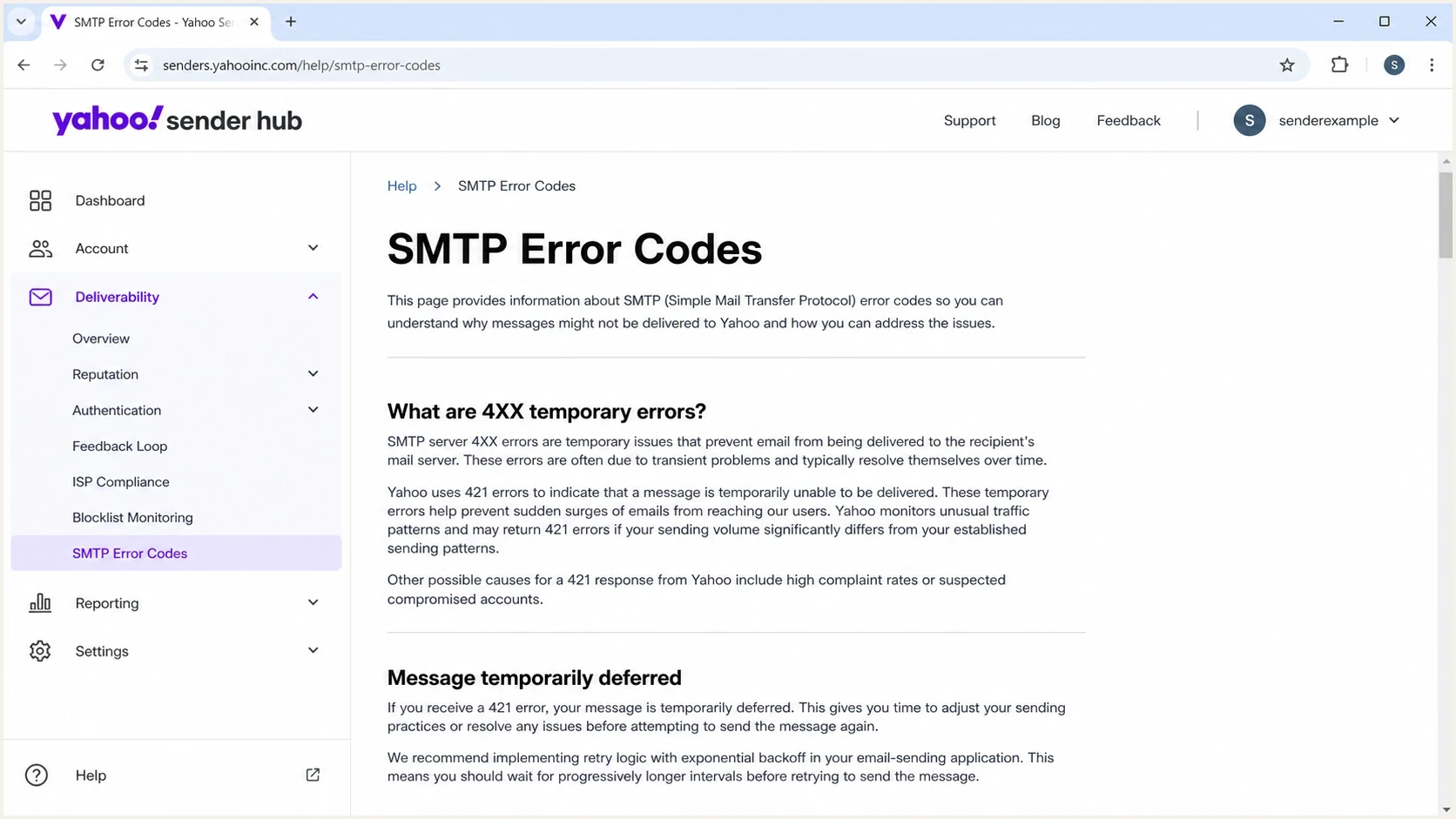
Yahoo Sender Hub guidance for 421 and TS temporary deferrals
- Score Yahoo deferrals, complaint rate, unknown recipients, queue age, and recent engagement per customer.
- Require clear consent for imported contacts and suppress recipients without recent meaningful activity.
- Move risky senders and new customers into separate warming pools before granting normal volume.
- Trigger alerts when deferrals rise above the pool baseline across consecutive time windows.
- Classify Yahoo-managed traffic by receiving MX so alternate consumer domains are included in throttles.
- Review pool health weekly and record tenant ownership for every DKIM domain and campaign stream.
For managed service providers, the operational issue is scale. Suped's MSP and multi-tenancy dashboard can group domains, alerts, reports, and sender ownership in one place, while MTA logs retain the IP, response, queue, and campaign details required for Yahoo troubleshooting.
Keep the related TS04 delivery errors reference beside the shared-pool process so support and engineering teams classify incidents consistently.
Views from the trenches
Best practices
Cut Yahoo volume fast, then restore it only after clean engagement data supports each step.
Review client-level Yahoo volume, new lists, complaints, and first TSS04 hits together.
Keep support tickets factual, with timestamps, IPs, errors, queue depth, and fixes made.
Common pitfalls
Letting retries pile up keeps pressure on a pool that already has poor temporary signals.
Pool averages hide the sender that changed data, segmentation, cadence, or consent quality.
Assuming TSS04 is always sender-side delays escalation when Yahoo has a platform issue.
Expert tips
Throttle connections and hourly volume before testing whether small Yahoo batches recover.
Separate transactional and marketing streams so one client's list does not slow every tenant.
Use DMARC and delivery data together to prove which domains and IPs changed first in the pool.
Expert from Email Geeks says the issue often clears after reducing traffic, sending wanted email, and monitoring complaints, then replying with evidence if it remains.
2024-10-23 - Email Geeks
Marketer from Email Geeks says a large deferred queue should be paused quickly because repeated retries make the pool look worse to Yahoo.
2024-10-23 - Email Geeks
Yahoo TSS04 recovery sequence
Resolve Yahoo TSS04 on shared IPs by lowering pressure, proving clean traffic, and escalating with evidence. Use this order: containment, tenant attribution, sender-requirement checks, controlled retest, then Yahoo follow-up when the data does not point to a customer issue.
Act before the queue becomes large. Once the pool is under deferral, every extra attempt consumes queue capacity and adds connection pressure. Pause noisy traffic, find the customer or stream that changed, and present Yahoo with a smaller, cleaner pattern.
Suped fits the workflow when the team needs DMARC source reporting, authentication alerts, blocklist or blacklist monitoring, and tenant ownership in one place. Pair that evidence with MTA logs and Yahoo complaint data to shorten the time between detection and a pool-level fix.




