How to resolve Yahoo email deferrals (TSS04) and internal ESP timeouts?

Updated on 7 Aug 2026: We added Yahoo Sender Hub complaint tracking, current sender requirements, and safer retry controls for TSS04 recovery.
Resolve Yahoo TSS04 deferrals and internal ESP timeouts as two connected problems. The 421 4.7.0 TSS04 part is Yahoo temporarily refusing delivery because it sees unexpected volume, user complaints, poor IP reputation, suspicious content, or unusual sending patterns. The [internal] timeout usually means the ESP or MTA retried until its configured queue lifetime expired, then reported the repeated temporary failures as a final bounce.
Pause or sharply reduce campaign traffic to consumer domains hosted by Yahoo Mail, confirm whether the ESP placed recipients into a bounced or suppression state, and re-enable only eligible addresses after the ESP confirms the remote failure was temporary. Restart with small, high-intent segments and increase volume only after Yahoo accepts mail consistently. Check the sending IP, From domain, visible URLs, authentication, complaint sources, and unsubscribe flow before restarting. Do not switch to a new IP first, because the same list and message signals can damage the new route.
Treat this as an operations issue before treating it as a DNS issue. DNS has to be clean, but valid DMARC, SPF, DKIM, and BIMI records do not override Yahoo's live reputation controls. Use Suped to monitor authentication and sender health during recovery, then use ESP logs to control retry behavior, recipient state, and Yahoo-specific volume.
What the error means
Split the response into its two owners. Yahoo owns the temporary deferral. The ESP or MTA owns the final internal timeout and any recipient suppression, bounce classification, retry queue policy, or re-enable process that follows repeated deferrals.
Typical combined SMTP response
554 5.4.7 [internal] message timeout
(exceeded max time, last transfail:
421 4.7.0 [TSS04] Messages from a.b.c.d temporarily deferred
due to unexpected volume or user complaints - a.b.c.d)
Yahoo did not accept the message during one or more delivery attempts. The ESP or MTA retried until its configured queue lifetime expired, then reported a final 554 5.4.7 style timeout. Yahoo's SMTP error codes describe 421 and 451 as temporary errors caused by conditions such as unusual traffic, spam-like message characteristics, complaints, busy mail servers, unavailable name servers, or temporary authentication lookup failures.
|
|
|
|
|---|---|---|---|
TSS04 | Temporary deferral | Yahoo | Reduce Yahoo volume |
[internal] | Locally generated event | ESP or MTA | Check retry policy |
554 5.4.7 | Queue lifetime expired | ESP or MTA | Inspect queues |
421 4.7.0 | Try later | Yahoo | Throttle, then test |
The combined error is not one single failure.
Do not treat the internal timeout as Yahoo's final verdict
A final bounce generated by the ESP or MTA can hide the fact that every remote attempt received a temporary Yahoo deferral. Ask for raw remote responses, retry timestamps, the configured queue lifetime, the final classification, and the resulting recipient state.
- Raw attempts: Get several Yahoo responses, not only the final locally generated bounce.
- Recipient state: Confirm whether affected recipients were suppressed after repeated temporary failures.
- Re-enable path: Restore only valid, consented recipients after the recovery controls are ready.
- Queue lifetime: Record how long the system retries before it converts deferrals into final bounces.
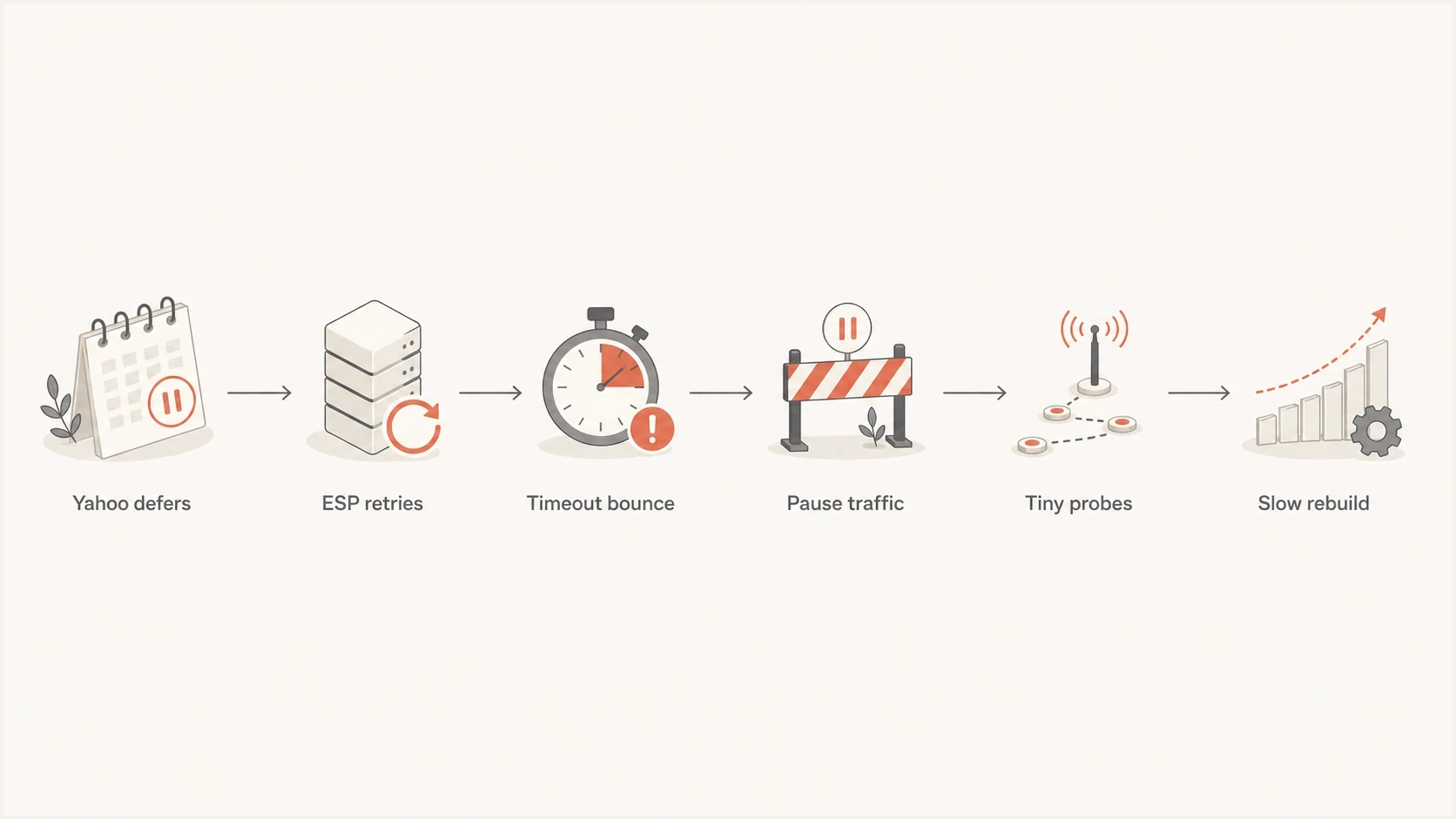
Flowchart showing Yahoo deferral, ESP retry timeout, pause, probes, and slow rebuild.
A practical recovery path
Do not keep retrying normal campaign volume because the same audience performs well elsewhere. Yahoo can judge the same traffic differently from another mailbox provider. A dedicated IP and strong delivery outside Yahoo do not prove the Yahoo reputation path is healthy.
Use an order that separates Yahoo recovery from ESP cleanup. If the ESP has already stopped sending to affected recipients, Yahoo can report little recent traffic while the ESP dashboard still shows failures. Compare the raw SMTP attempts with the recipient state before drawing conclusions.
- Freeze campaign volume: Pause normal traffic to Yahoo-hosted consumer domains or reduce it to controlled tests.
- Audit ESP state: Collect retry logs, suppression rules, final bounce mapping, and recipient re-enable steps.
- Control retries: Use provider-specific throttling, backoff, and concurrency limits, and avoid duplicate manual resends.
- Check message risk: Review visible URLs, redirect domains, tracking hosts, image hosts, and footer domains.
- Restart small: Use recent high-intent recipients and increase only after repeated acceptance.
What to stop
- Normal cadence: Do not resume the same Yahoo volume after a short pause.
- Manual retries: Do not create new copies while the original messages remain in the retry queue.
- New IP first: Do not move the same list and message problems to a fresh route.
- Assumed consent: Do not rely on opens because privacy activity can distort engagement.
What to do
- Throttle by provider: Lower volume and connection concurrency for Yahoo-hosted domains.
- Use intent signals: Favor recent clicks, replies, purchases, logins, or service activity.
- Separate streams: Keep transactional mail isolated from bulk recovery traffic.
- Document evidence: Prepare IPs, domains, samples, timestamps, and complete error lines for Yahoo.
Do not use a fixed waiting period as proof of recovery. Keep normal campaign traffic paused while the configured MTA retries use backoff, then test only after the likely causes have been corrected. Stop the ramp if TSS04 returns. When the same error continues for more than 48 hours, review the outgoing stream again and submit a Yahoo Sender Support Request with current diagnostic evidence.
Test the actual message before restarting. Suped's email tester helps inspect the received message, including authentication results and template-specific content signals.
Email tester
Send a real email to this address. Suped shows a results button when the test is ready.
?/43tests passed
Keep a Yahoo support case operational and specific. Include the sending IP, envelope sender domain, header From domain, affected Yahoo-hosted recipient domain, exact error, sample timestamps with time zone, retry history, volume before and after throttling, and completed remediation. Yahoo does not offer guaranteed IP whitelisting, so a support request does not replace sender-reputation work.
Measure complaints and recovery in Yahoo Sender Hub
Use Yahoo Sender Hub Insights with the raw ESP logs. The SMTP logs show whether Yahoo accepted or deferred each attempt. Insights adds aggregated delivery statistics for the sending domain, which helps distinguish one failing campaign from a broader domain pattern.
- Enroll signing domains: Yahoo's Complaint Feedback Loop is domain based and supports DKIM-signed mail.
- Map complaints: Use the DKIM signing domain, campaign identifiers, and timestamps to connect ARF reports to a sending stream.
- Use the right denominator: Yahoo calculates its spam rate against inbox-delivered mail, not all attempted or accepted mail.
- Cover hosted domains: Apply the recovery controls to consumer domains hosted by Yahoo Mail. Yahoo Japan is separate.
- Read silence carefully: No complaint report does not prove the complaint rate is zero or the traffic is healthy.
Yahoo complaint reporting is not IP based
Yahoo no longer provides IP or CIDR Complaint Feedback Loop reporting. Keep a stable DKIM signing domain for each stream and preserve message identifiers so complaint reports can be traced to the responsible audience, campaign, or client.
Use Yahoo's published complaint ceiling as a safety limit, not as a target. Bulk senders must stay below 0.3%, and lower complaint rates provide more room for normal variation. Pair complaint data with recurring SMTP acceptance because either metric alone can hide an active TSS04 problem.
Where authentication checks fit
Authentication does not repair TSS04 by itself, but weak authentication makes recovery harder. Yahoo requires every sender to use SPF or DKIM, maintain valid forward and reverse DNS, and follow SMTP message standards. Bulk senders must use both SPF and DKIM, publish a valid DMARC policy that passes, keep complaint rates below 0.3%, and make the From domain match either the SPF or DKIM identity used for DMARC.
Marketing and subscribed messages also need a functioning list-unsubscribe header plus a visible unsubscribe link in the body, and unsubscribe requests must be honored within two days. Yahoo does not apply the one-click requirement to transactional messages such as order confirmations and password resets. Check each stream separately when marketing and transactional mail use different domains.
Run a broad domain health checker pass before increasing Yahoo volume. Confirm DMARC alignment, SPF lookup health, DKIM signing, reverse DNS, TLS, and the tracking or landing domains used in the failing message.
DMARC record detail view showing SPF, DKIM, DMARC, rDNS diagnostics, and DNS records
BIMI is not a TSS04 diagnostic
A missing Yahoo BIMI logo does not prove that sender reputation caused the deferral. BIMI display also depends on DMARC enforcement, the logo record and asset, certificate requirements where applicable, sender eligibility, and the mail client. Fix the TSS04 delivery path first, then troubleshoot BIMI separately.
Check blocklist and blacklist status for the sending IP, the From domain, and URL domains in the message. A listing can explain a wider reputation problem, but a clean public result does not prove Yahoo's private reputation is healthy. Suped's blocklist monitoring keeps blocklist and blacklist changes beside authentication and delivery alerts during recovery.
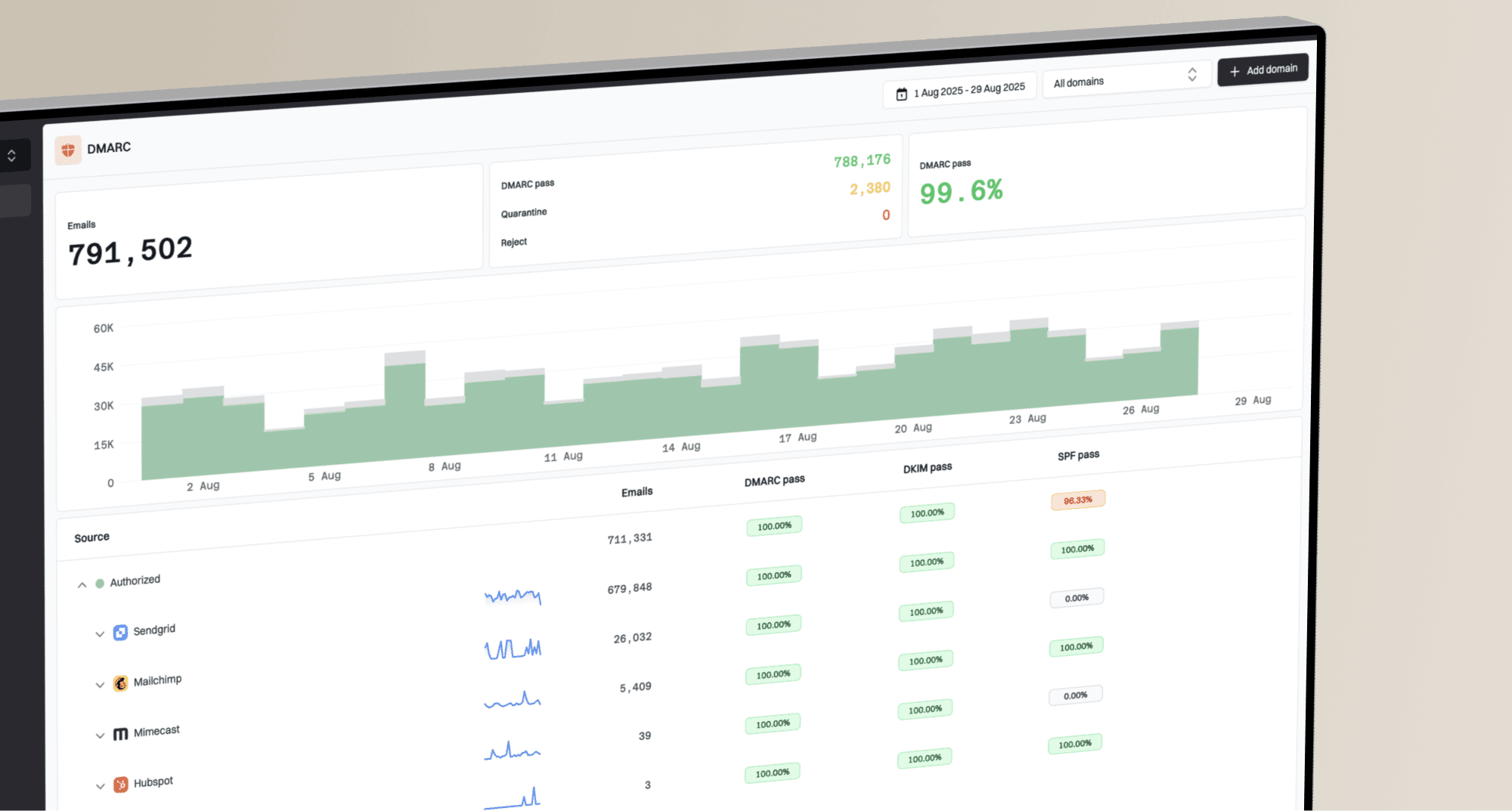
Use Suped's DMARC monitoring to identify sources that pass, fail, or send without DMARC alignment. Hosted SPF, hosted DMARC, MTA-STS monitoring, alerts, and multi-domain reporting can keep the authentication work attached to the same incident when several brands or clients share a recovery process.
Internal recovery gates
These are operational decisions, not Yahoo-published acceptance thresholds.
Pause campaign traffic
Pause
Small tests still receive TSS04 after remediation.
Hold volume
Hold
Yahoo accepts some mail but deferrals recur.
Controlled rebuild
Rebuild
Small high-intent batches are accepted repeatedly.
Ongoing review
Monitor
Acceptance stays stable and complaint data remains healthy.
How to avoid repeating the issue
After Yahoo starts accepting mail again, do not treat one successful batch as complete recovery. The next sending cycles show whether the safer traffic mix holds or the previous complaint pattern returns.
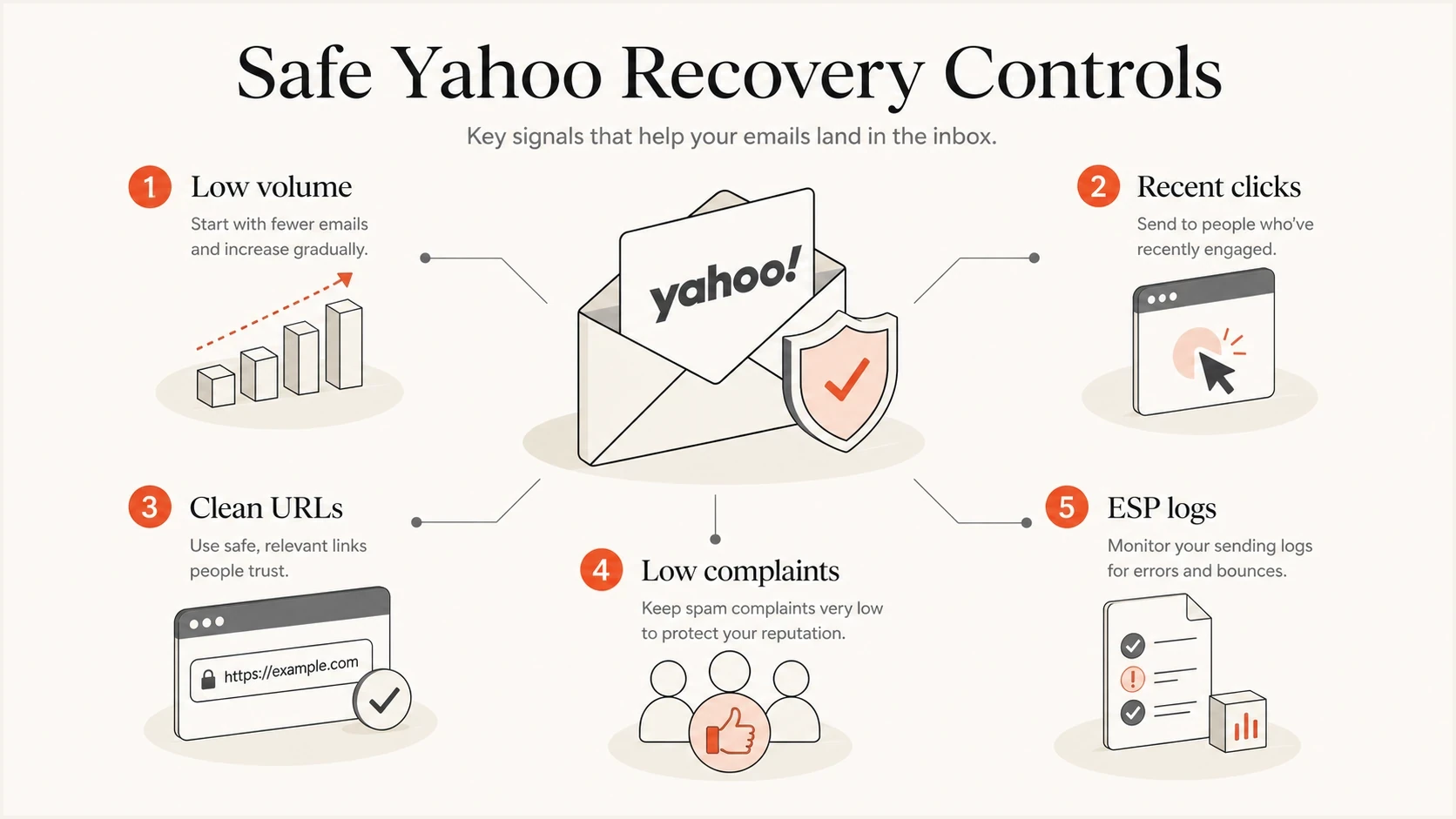
Infographic showing the controls needed for safe Yahoo recovery.
Use a stricter Yahoo recovery segment than the normal engaged segment. Opens are weaker than clicks, replies, purchases, account activity, or recent subscription updates. A 90-day open rule can retain people who no longer want the mail, especially when privacy systems inflate open activity. Exclude purchased, scraped, or otherwise unconsented addresses.
- Complaint review: Compare templates, offers, send times, and list sources for Yahoo complaint spikes.
- URL review: Check every link domain, redirect hop, tracking host, image host, and footer domain.
- Cadence review: Limit consecutive sends to the same Yahoo recipients during the rebuild.
- Bounce review: Remove invalid recipients and keep temporary deferrals out of permanent-bounce logic.
- Consent review: Trace every segment to a clear opt-in source and suppress weak or unknown acquisition sources.
- Support review: Escalate with fresh samples after changes instead of reusing old failing evidence.
If recovery overlaps with a new IP or a low-volume transactional stream, use a slower temporary deferral warm-up process and keep that stream separate from bulk campaign traffic.
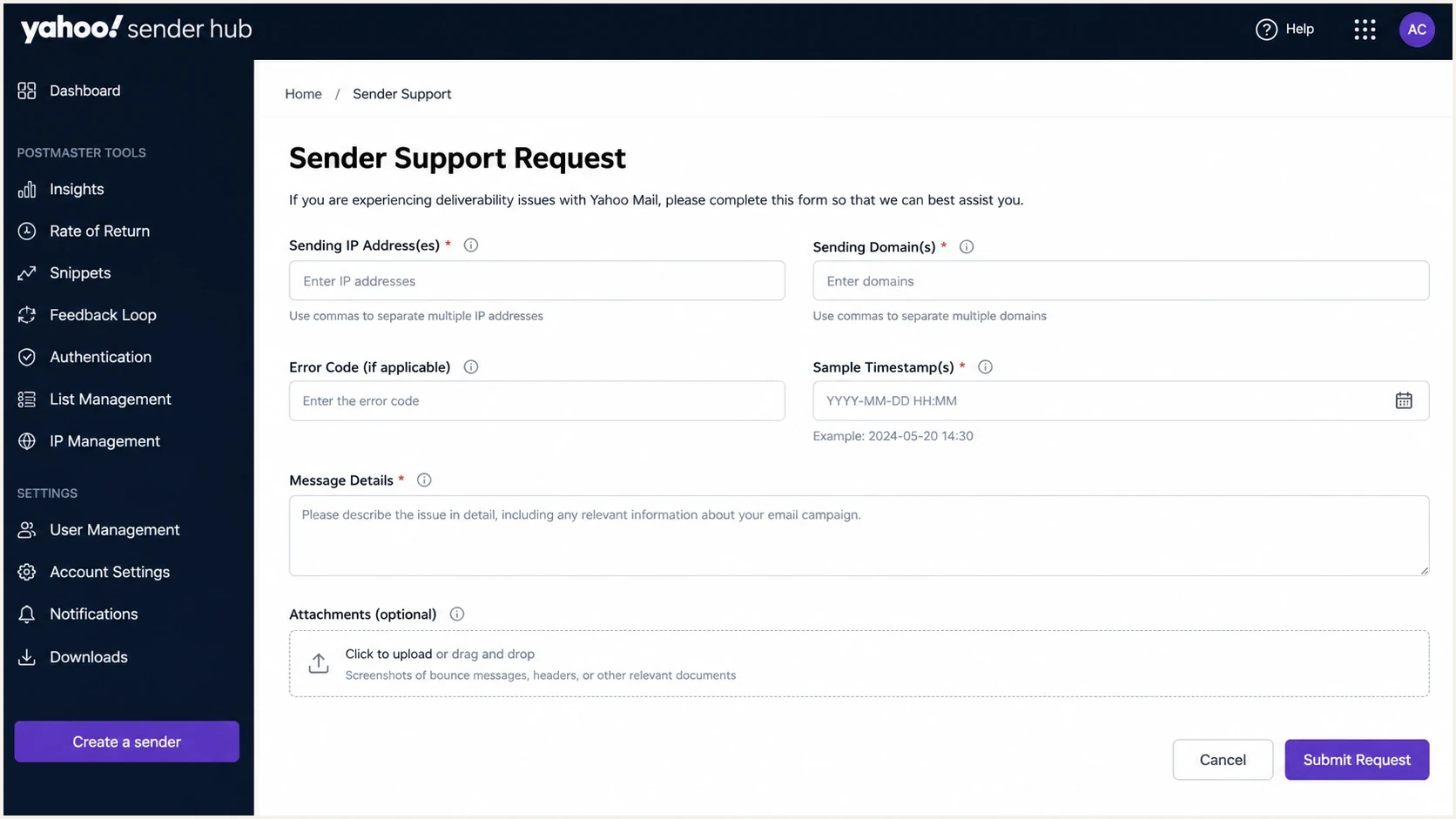
Yahoo Sender Hub support request screen with fields for a TSS04 case.
Views from the trenches
Best practices
Pause Yahoo traffic before retry queues turn temporary failures into noisy final bounces.
Ask the ESP for raw remote responses, recipient state, and retry timing before changes.
Restart with recent clickers or active customers, then increase only after acceptance holds.
Document IPs, domains, samples, timestamps, and fixes before sending a support request.
Common pitfalls
Treating the ESP timeout as Yahoo's final error hides the repeated TSS04 deferrals.
Clearing suppressed recipients too early causes the same addresses to fail again.
Assuming strong non-Yahoo delivery means the Yahoo route has healthy reputation.
Relying on opens alone can keep low-intent recipients inside the recovery audience.
Expert tips
Review URL domains and tracking hosts because complaints can attach to message assets.
Use small Yahoo tests after remediation and pause when the same deferral returns.
Separate transactional traffic from bulk recovery so one stream does not mask the other.
Revisit BIMI after stable Yahoo delivery, then check its separate eligibility signals.
Expert from Email Geeks says the internal timeout belongs to the ESP, so raw retry logs and recipient state need review before Yahoo recovery restarts.
2025-06-18 - Email Geeks
Expert from Email Geeks says repeated TSS04 responses can exhaust the ESP retry window, causing a final timeout even though Yahoo kept issuing temporary deferrals.
2025-06-18 - Email Geeks
What to do next
Treat Yahoo's TSS04 as the remote delivery problem and the internal timeout as the local result of an expired retry queue. Stop normal Yahoo campaign traffic, confirm queue and recipient handling with the ESP, correct the likely cause, and rebuild only through small batches that Yahoo accepts repeatedly.
Suped's product supports the surrounding recovery work by monitoring DMARC, SPF, DKIM, MTA-STS, and blocklist or blacklist changes across the affected domains. Alerts and multi-domain reporting help connect authentication changes to the incident while the ESP controls queues and Yahoo-specific throughput. Suped cannot force Yahoo to accept mail, so recovery still depends on consent, complaint control, stable identity, and disciplined volume.
Recovery target
The target is recurring acceptance for a small, low-risk stream, followed by controlled growth that does not trigger the same TSS04 pattern.