How to add users to Yahoo Sender Hub and what visibility does it offer compared to Google Postmaster Tools?

Updated on 2 Aug 2026: We updated this guide for Yahoo Insights access limits and the Google Postmaster Tools v2 transition.
You cannot add extra named users to a Yahoo Sender Hub domain in the same way you can in Google Postmaster Tools. Yahoo advises organizations with several viewers to create a team alias for the Sender Hub account. Data for a verified domain cannot be granted to a separate Sender Hub account.
The visibility is also different. Yahoo Sender Hub covers Yahoo sender services, Complaint Feedback Loop management, and Insights for verified DKIM domains. Google Postmaster Tools has a broader Gmail-specific dashboard set and delegated access for Google accounts. Google is moving users to Postmaster Tools v2, where the existing Domain and IP Reputation dashboards are due to retire while spam rate, authentication, encryption, feedback loop, delivery errors, and compliance reporting continue.
Treat both as first-party signals, not complete deliverability monitoring. Daily operations still need DMARC monitoring, DNS validation, campaign data, blocklist or blacklist checks, and real message testing around them.
The direct answer
Yahoo Sender Hub does not provide a Google Postmaster Tools-style user management screen where a domain owner adds separate people with their own logins. Yahoo's documented answer for a team, agency, consultant, or client group that needs the same domain data is a team alias used for the Sender Hub account.
Current access reality
Google Postmaster Tools lets a verified owner add Google or Google Workspace accounts to a verified domain. Yahoo Sender Hub does not have that delegated-user model. A domain's data is visible only in the Sender Hub account that added and verified it through DNS.
- Adding users: There is no native per-user invite flow for a Yahoo Sender Hub domain.
- Yahoo's workaround: Create a team alias for the Sender Hub account instead of using an employee's personal identity.
- Main visibility: Use Yahoo Sender Hub for CFL enrollment, domain management, and Yahoo Insights.
- Google difference: Google Postmaster Tools has delegated access and a broader set of Gmail dashboards.
That answer changes the operating model. A team account needs documented ownership, recovery details, credential controls, and a review schedule. Spending a few minutes on that register prevents the only login from remaining with a former employee or an agency inbox the business no longer controls.
How to give a team access safely
Since Yahoo Sender Hub access is account based, create a team alias before domain verification. The identity should belong to the business, not one person. Route recovery messages to a monitored group and keep the credential in the access-control process used for production email systems.
- Create the account: Register the Sender Hub account with a role address such as deliverability, postmaster, or sender-ops at the company domain.
- Secure recovery: Set recovery details that the business controls, then document who can approve access.
- Verify domains: Publish the Yahoo verification record in DNS and record who made the change.
- Limit sharing: Give access only to people who need Yahoo CFL or Insights data, using a controlled credential-sharing process.
- Review access: Check access after role changes, agency changes, and security incidents.
Shared account registertext
Yahoo Sender Hub owner: sender-ops@example.com
Business owner: Email operations
DNS owner: Platform engineering
Recovery route: deliverability-team@example.com
Review cadence: Quarterly
Domains verified: example.com, mail.example.com
Avoid personal ownership
A personal account creates handoff risk. If that person leaves, loses access, or changes recovery details, the team can lose the dashboard and CFL management path when a complaint issue needs investigation.
What Yahoo Sender Hub can show
Yahoo Sender Hub started as the newer home for Yahoo sender services, especially Complaint Feedback Loop management. Yahoo later added Insights, which shows aggregated delivery statistics for verified DKIM domains. The Yahoo Postmaster blog describes spam complaint rate, delivered messages, trend changes, UTC timestamps, and a minimum daily volume threshold. Yahoo does not publish the threshold value.
Identity matters. Insights is tied to the DKIM signing domain. If several sending domains use the same DKIM domain, Yahoo rolls their data into that DKIM-domain view. The dashboard shows the average spam complaint rate and sum of delivered messages for the selected period, plus the percentage change against the preceding period of the same length.
Insights covers Yahoo-managed recipient domains. It does not require CFL enrollment, because Insights and CFL are separate services. It also has no public API, and another Sender Hub account cannot receive access to a verified domain's data without adding and verifying that domain in its own account.
|
|
|
|---|---|---|
Access | Team alias | Shared viewing |
CFL | DKIM domain | ARF routing |
Insights | DKIM rollup | Complaints and volume |
Volume | Unpublished threshold | Explain gaps |
Time | UTC | Period trends |
Yahoo Sender Hub visibility, kept to practical labels.
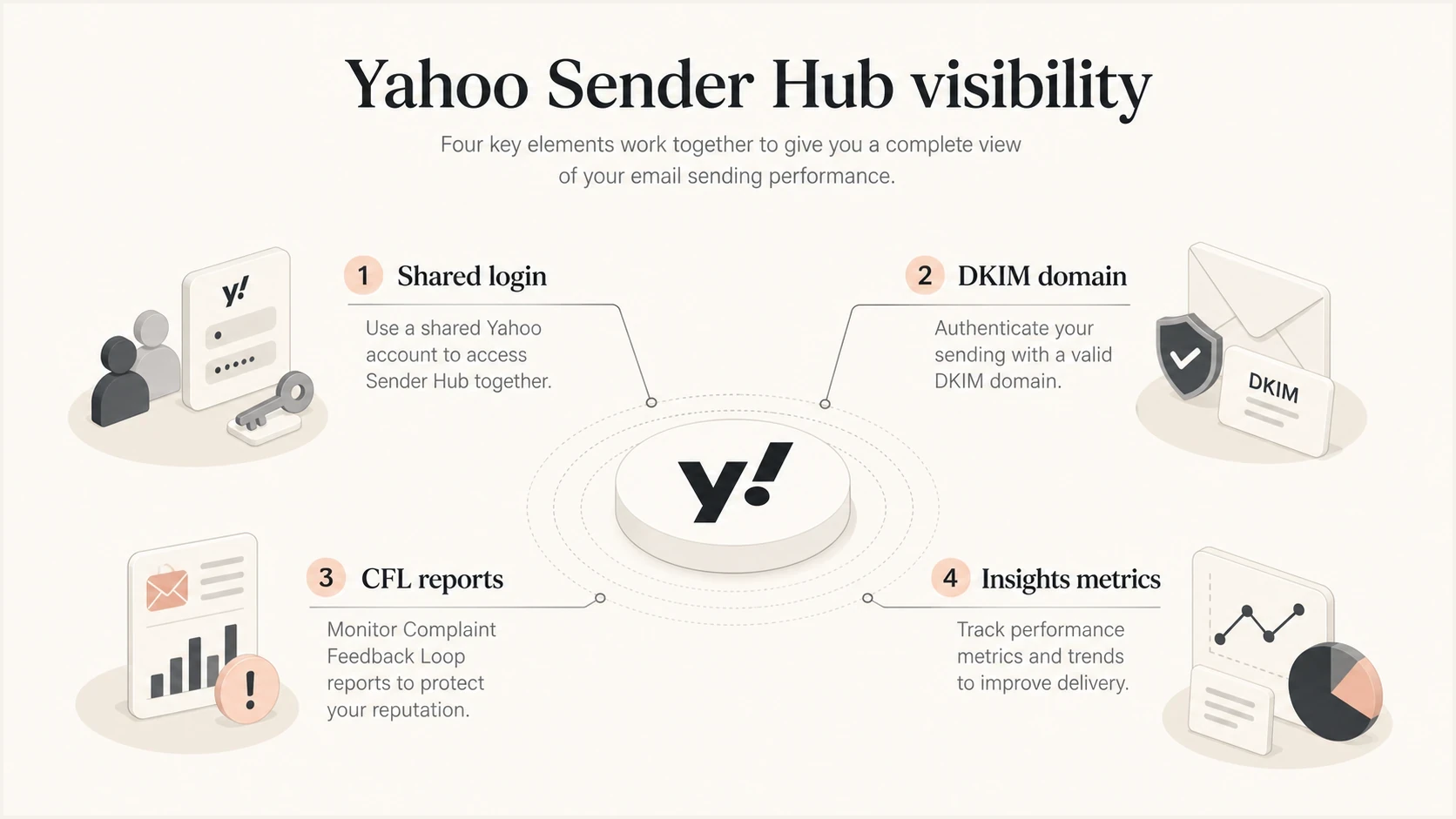
Yahoo Sender Hub connects a shared login to DKIM-domain Insights and CFL reports.
How it compares with Google Postmaster Tools
Google Postmaster Tools has more dashboard categories and a delegated access flow. From Manage Domains, a verified owner can choose More, Manage, and Add, then enter an address for a Google or Google Workspace account. The person is not notified automatically. The separate guide to sharing access covers that workflow in detail.
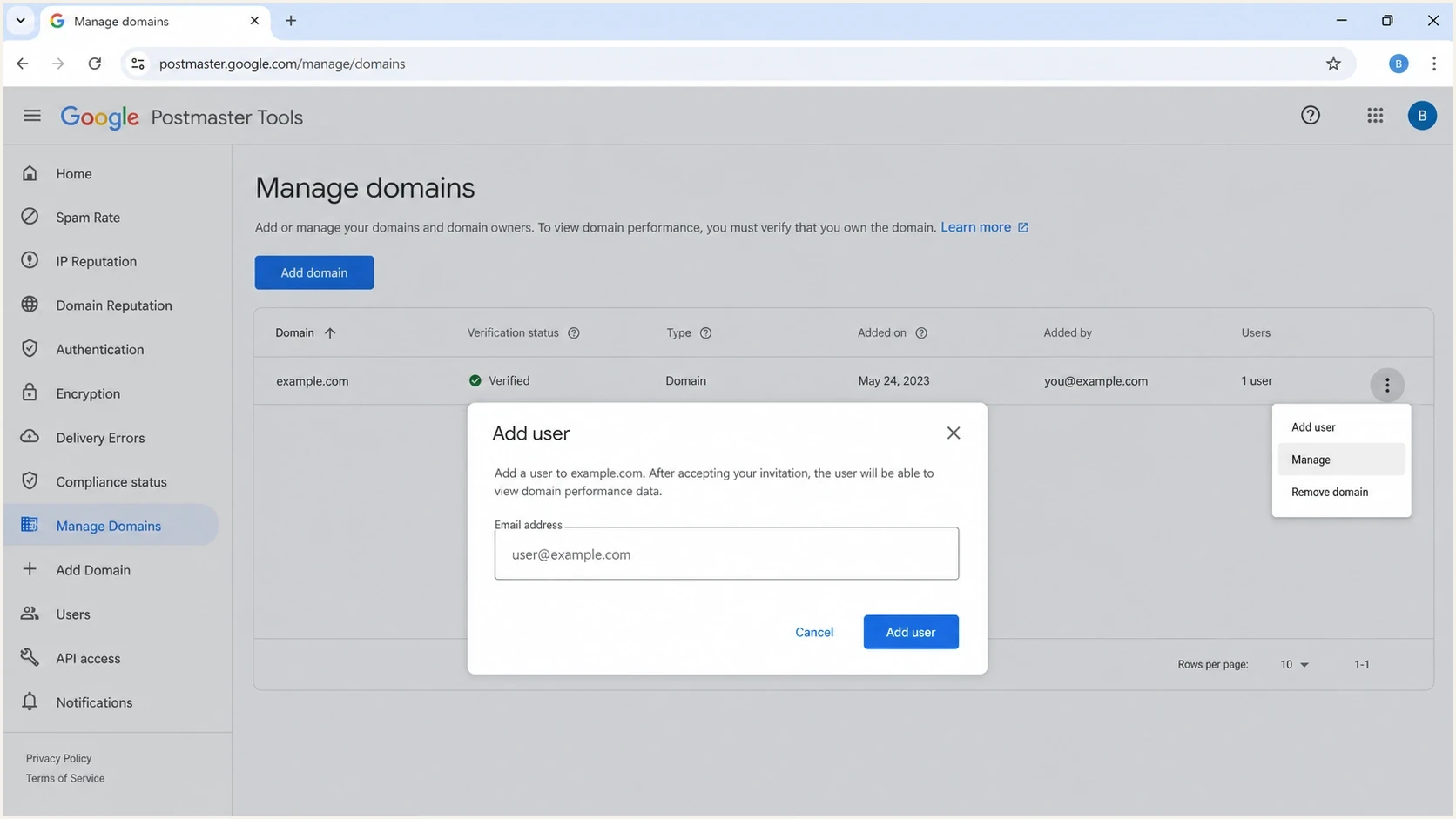
Google Postmaster Tools manage-domain screen with delegated access controls.
Yahoo Sender Hub
 Yahoo Sender Hub is a Yahoo sender-services account with Insights data for verified DKIM domains.
- User access: A team alias is Yahoo's documented model for several viewers.
- Main data: Average spam complaint rate and total delivered messages for verified DKIM domains.
- Scope: Yahoo-managed recipient domains and Yahoo sender services.
- Best use: CFL setup, Yahoo complaint trends, and DKIM-domain monitoring.
Google Postmaster Tools
 Google Postmaster Tools is a Gmail-specific dashboard suite with delegated access and a wider operational data set.
- User access: Verified owners can add Google or Google Workspace accounts.
- Main data: Spam rate, feedback loop, authentication, encryption, delivery errors, and compliance.
- Scope: Messages sent to personal Gmail and Googlemail recipients.
- Transition: Existing Domain and IP Reputation dashboards are due to retire as Google completes the move to v2.
The main differences are dashboard depth and how each provider defines identity and privacy thresholds. Google can currently show domain and IP reputation categories when enough Gmail traffic exists, although those existing dashboards are transitional. Yahoo Insights centers on verified DKIM domains and complaint behavior for inbox-delivered mail. Yahoo's complaint rate can therefore look higher than an internal rate that divides complaints by all accepted mail.
|
|
|
|---|---|---|
Team users | Team alias | Delegated |
Identity | DKIM | Auth domains |
Complaints | Inbox rate | Gmail inbox rate |
Feedback loop | ARF reports | Campaign IDs |
Low volume | Gaps | Gaps |
High-level comparison for sender operations.
How Google Postmaster Tools v2 affects the comparison
Google is moving senders from legacy Postmaster Tools to Postmaster Tools v2. Google has postponed retirement of the legacy web interface, but it still says v1 will eventually be retired. Google says all legacy dashboards are available in v2 except Domain and IP Reputation. Those existing reputation dashboards will be retired and replaced with more actionable reporting.
Compare current and transitional data separately
Reputation tiers can still appear in current documentation and legacy views. Do not build a permanent reporting process that assumes those exact dashboards or the v1 API will remain available.
- Use durable dashboards: Track spam rate, feedback loop, authentication, encryption, delivery errors, and compliance.
- Treat reputation tiers as transitional: Record them when available, but do not use them as the only measure of Gmail delivery health.
- Allow for delay: Google says dashboard data usually updates within 24 hours but can take longer.
- Read compliance at the right level: The compliance dashboard reports primary-domain status while using relevant subdomain data in its calculation.
The v2 transition does not make Yahoo Insights equivalent to Google Postmaster Tools. Yahoo still exposes two current Insights signals, complaint rate and delivered messages. Google's remaining dashboard set covers more authentication, transport, campaign, and sender-requirement diagnostics.
How to set up Yahoo data before comparing it
Before comparing Yahoo with Google, confirm that the underlying authentication is clean. Provider dashboards are downstream signals. Broken SPF, DKIM, or DMARC can explain poor results, but the dashboards do not identify every DNS or sending-source issue on their own.
- Verify the DKIM domain: Add the production DKIM domain to Sender Hub, publish Yahoo's TXT verification record, and complete verification.
- Activate Insights: Open Dashboard, select the verified DKIM domain, and click Activate.
- Check DMARC: Make sure the From domain has a DMARC record and reports go to a monitored destination.
- Map streams: Separate marketing, transactional, lifecycle, and sales mail in the analysis.
- Allow for thresholds: Data starts after 24 to 48 hours only when the domain meets Yahoo's unpublished minimum daily volume threshold.
DNS records to confirm firstdns
_dmarc.example.com TXT "v=DMARC1; p=none; rua=mailto:dmarc@example.com"
example.com TXT "v=spf1 include:_spf.example.net -all"
selector1._domainkey.example.com TXT "v=DKIM1; k=rsa; p=MIIB..."
A quick domain health check catches these basics before dashboard gaps consume investigation time. Yahoo and Google both suppress some data when volume is too low or privacy thresholds are not met.
?
What's your domain score?
Deep-scan SPF, DKIM & DMARC records for email deliverability and security issues.
After the DNS layer is clean, send a controlled message and inspect it with an email tester. This provides message-level authentication and header results, while Yahoo and Google provide aggregated recipient-provider signals after mail has flowed.
Where Suped fits
Yahoo Sender Hub and Google Postmaster Tools are worth using because they provide first-party recipient data. Neither has a complete cross-provider operating console for authentication, sending sources, blacklist and blocklist monitoring, issue assignment, and alerts.
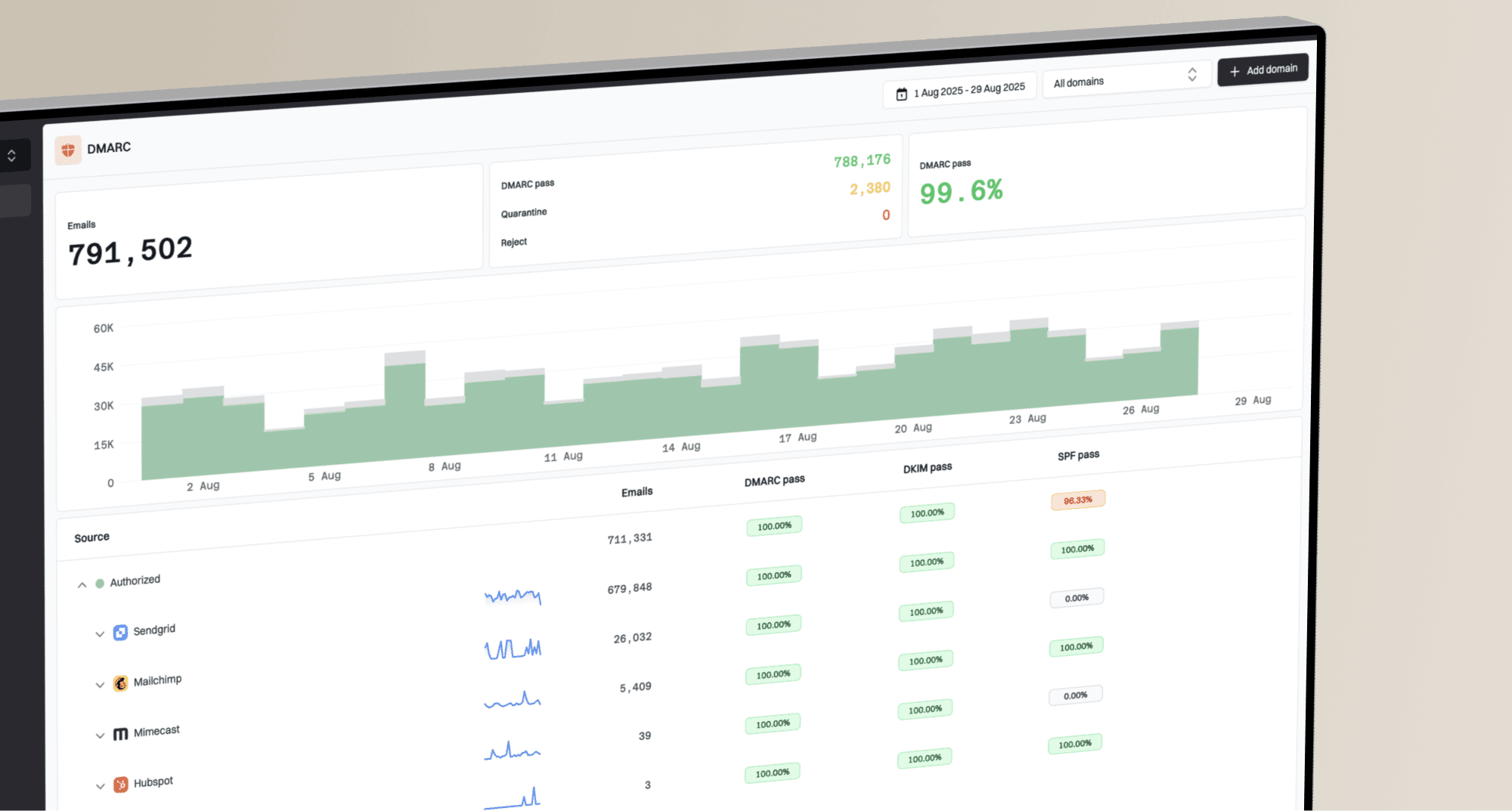
Issues page showing top issues, verified sources, unverified sources, and authentication pass rates
Suped is our product for that operating layer. It combines DMARC, SPF, and DKIM monitoring with hosted SPF, SPF flattening, hosted DMARC, hosted MTA-STS, real-time alerts, automated issue detection, and remediation steps. Agencies and MSPs can keep client domains separated in a multi-tenant dashboard instead of sharing every provider login.
Use Suped to centralize authentication findings and the work needed to resolve them, while keeping Yahoo and Google as the sources for their own recipient-side signals.
A practical workflow uses Yahoo Sender Hub for Yahoo-owned signals, Google Postmaster Tools for Gmail-owned signals, and Suped for the daily queue of authentication and reputation work. Suped's blocklist monitoring catches domain and IP blacklist or blocklist issues, while its DMARC reporting identifies sources that pass, fail, or send without authorization.
Complaint rate action bands
Use a stricter internal warning band before Yahoo's 0.3% enforcement threshold, then compare provider and internal data before changing infrastructure.
Healthy
Under 0.1%
Keep monitoring and hold sending quality steady.
Investigate
0.1% to under 0.3%
Review list source, content, frequency, and recent campaign changes.
Yahoo threshold
0.3% or higher
Pause risky sends and fix the complaint source before delivery is affected.
Common visibility gaps
The most common mistake is expecting one dashboard to answer every deliverability question. Yahoo shows Yahoo complaint behavior and delivered volume for verified DKIM domains. Google shows Gmail spam rate, authentication, compliance, and other provider-specific diagnostics. Neither proves that every recipient provider places every message in the inbox.
Do not compare rates blindly
Yahoo calculates its complaint rate against inbox-delivered mail, while an internal complaint rate often uses all sent or accepted mail. That denominator difference can make Yahoo's number look higher without making either calculation wrong.
Do not treat delivered count as inbox placement. Delivered means the message was accepted and did not bounce in the reported data. It does not prove the message reached the primary inbox, a tab, a spam folder, or another filtered area. Campaign engagement, bounce logs, authentication reports, and real test messages still matter.
|
|
|
|---|---|---|
Yahoo high | Inbox denominator | Segment list |
Google needs work | Compliance detail | Fix requirement |
No data | Volume | Wait or consolidate |
Auth fail | SPF/DKIM | Repair DNS |
Blocked | Blacklist or blocklist | Investigate listing |
What to check when dashboards disagree.
Views from the trenches
Best practices
Use a shared Yahoo account only after documenting owner, recovery address, and access rules.
Compare Yahoo complaint changes with Gmail trends before changing sending infrastructure.
Keep DKIM domains stable, because Yahoo Insights is tied to verified DKIM identity.
Common pitfalls
Using a personal Yahoo login creates handoff risk when an employee leaves the team later.
Treating delivered counts as inbox placement hides filtering that still affects revenue.
Expecting low-volume domains to show daily data leads to false confidence and delays.
Expert tips
Separate CFL routing from dashboard access so reports keep flowing during staff changes.
Use provider dashboards as directional signals, then confirm fixes with authentication data.
Record each verified domain and DKIM selector so audits do not depend on memory later.
Expert from Email Geeks says Yahoo Sender Hub does not have per-domain named user management, so teams use a shared team identity with tight controls.
2025-08-15 - Email Geeks
Marketer from Email Geeks says Sender Hub is useful for CFL setup, but Google Postmaster Tools still gives broader operational dashboards.
2025-08-16 - Email Geeks
A practical setup
For Yahoo Sender Hub, use a controlled team alias, verify the DKIM domains that matter, enroll the required domains in CFL, activate Insights, and document ownership. For Google Postmaster Tools, verify the same sending identities where appropriate and delegate access to the Google accounts that need it.
Use Suped around both dashboards as the operational workspace. Yahoo and Google show what those providers see. Suped organizes authentication data, issue detection, hosted SPF, hosted DMARC, MTA-STS, blacklist or blocklist monitoring, and alerts into a repeatable workflow.
- For access: Yahoo advises a team alias; Google supports delegated users.
- For visibility: Yahoo provides complaint rate and delivered volume for verified DKIM domains.
- For operations: Use Suped to monitor authentication, sources, issues, and reputation signals each day.