Are Google's spam filters multi-lingual and how cautious should I be with different languages?

Published 20 May 2025
Updated 20 Aug 2026
16 min read
Summarize with
Updated on 20 Aug 2026: We clarified how Gmail handles multilingual mail and updated the sender checks for current bulk email requirements.
Gmail's filtering is designed to handle mail in many languages, but Google does not publish a language-by-language list for spam classification. Assume Gmail can evaluate the content, links, HTML structure, sending patterns, recipient feedback, authentication, and sender reputation of Finnish and other non-English mail. Do not treat a single translated word, such as the Finnish word for "prize", as the thing that decides inbox or spam placement by itself.
The practical answer is this: be as careful in Finnish as you are in English, but focus that caution on consent, relevance, list quality, authentication, sender reputation, link safety, and recipient feedback. Language matters, but it is one signal inside a much larger filtering system.
- Direct answer: Gmail uses machine learning and rules-based protections across message signals, but Google does not publish equal coverage claims for every language.
- Main risk: A Finnish email sent to a poorly sourced or stale list with mixed language preferences is riskier than one sent to an engaged Finnish audience.
- Best test: Send real test messages, check placement, inspect headers, and review authentication results before the main send.
- Best copy choice: Use natural local wording instead of awkward substitutes chosen only to avoid old trigger-word lists.
The short answer
Gmail does not work like a simple English keyword list. Google says its spam systems consider thousands of signals and personalize classification for each user. Gmail also detects message language when deciding whether to show a translation prompt. Google does not document a public list of banned words or claim that every spam model performs identically in every language.
For a Finnish campaign to Finnish subscribers, do not rewrite normal Finnish copy just because a translated word resembles a classic English spam trigger. Check whether the offer is clear, whether the recipients asked for it, whether the links and landing page match the sender, and whether the domain has clean authentication and a stable sending history.
A useful rule
Do not write around individual words first. Write for the recipient first, then test the full message as Gmail will see it: content, sender, domain, authentication, links, and recipient feedback together.
There is still a sensible level of caution. An unexpected language often causes recipients to ignore, delete, or report a message. That response can damage results, but it is not proof that Gmail applies an automatic language-mismatch penalty.
What Gmail evaluates
Google says every email has thousands of potential signals. Content still matters, but it is interpreted alongside sender behavior and user feedback. A suspicious phrase from an established sender with wanted mail is different from the same phrase in an unsolicited bulk message with failed authentication and a high complaint rate.
|
|
|
|---|---|---|
Language | Content patterns and message consistency | Medium |
Consent | Whether recipients expect the email | High |
Recipient feedback | User-reported spam and personalized spam preferences | High |
Authentication | SPF and DKIM results with DMARC domain matching | High |
Links | URL quality and domain consistency | High |
HTML | Template structure, formatting, and hidden content | Medium |
Language is one signal, not the whole decision.
Simple advice that says a word like "free", "winner", or "prize" automatically causes spam placement misses the bigger issue. Words add risk when they fit a broader pattern: exaggerated claims, misleading subject lines, aggressive punctuation, unrelated landing pages, poor list quality, and a sender domain with little trust.
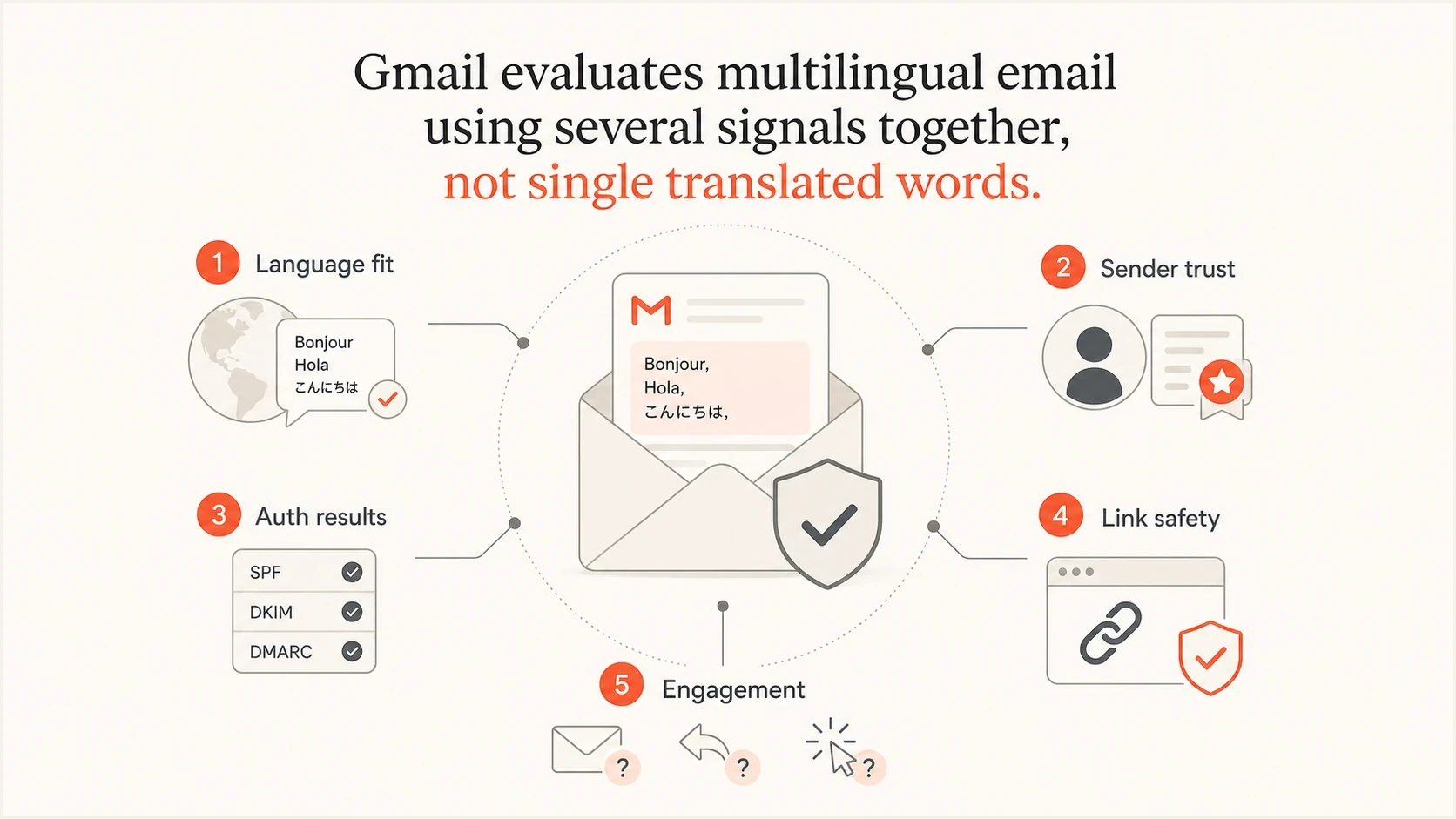
Gmail multilingual spam filtering signals: language fit, sender trust, authentication, link safety, and engagement.
For multilingual campaigns, the content question usually sits behind two more important questions: does the recipient expect this language, and has the sender earned enough trust for Gmail to treat the message as wanted mail?
How cautious to be with Finnish and other languages
Be moderately cautious, not fearful. If the list is Finnish, the signup journey was in Finnish, and the campaign is relevant to those recipients, the language itself is not a reason to expect trouble. If the list is old, bought, scraped, or mixed across language preferences, the same Finnish message becomes riskier.
Lower risk
- Audience match: Recipients signed up in Finnish or regularly engage with Finnish content.
- Clear offer: The subject line and body describe the same promotion without bait.
- Known sender: The domain has consistent volume, authentication, and recipient feedback.
Higher risk
- Audience mismatch: Recipients usually receive English email, then suddenly get Finnish bulk mail.
- Offer pressure: The message combines urgency with prize language and unclear eligibility.
- Weak identity: The domain has failed authentication, poor domain matching, or unrelated visible links.
For the specific "prize" example, keep the word if it is the accurate Finnish word and the campaign genuinely involves a prize. Be more careful with the surrounding message: explain who is eligible, why the recipient is receiving the email, who is running the campaign, and what happens after the click.
Multiple languages in one email are not a deliverability issue by default. They become risky when the added language looks unrelated, makes the message harder to understand, or changes recipient behavior in a negative direction.
This is also where plain-language translation matters. Literal translations can create unnatural copy, and unnatural copy can reduce engagement. Lower engagement gives the sender a stronger warning about poor audience fit than a single word ever would.
What to check before a multilingual send
Before sending a Finnish or other non-English campaign, run the same checks used for English campaigns, with a few language-specific additions. The goal is not to trick Gmail. The goal is to remove avoidable ambiguity.
- Confirm audience language: Segment by country, locale, signup form language, stated preference, or past engagement with the same language.
- Use a native review: Have a fluent speaker check the subject line, preheader, offer terms, and call to action for natural wording.
- Validate language markup: For mixed-language HTML, set one primary lang value and tag translated blocks separately.
- Use UTF-8: Confirm MIME headers, HTML, and the plain text version preserve local characters after sending.
- Check authentication: Make sure SPF and DKIM pass, and confirm DMARC domain matching before the campaign goes out.
- Meet Gmail sender requirements: All senders to personal Gmail accounts need SPF or DKIM, valid forward and reverse DNS, TLS, RFC 5322 formatting, and a spam rate below 0.3%.
- Apply bulk-sender requirements: At roughly 5,000 messages to personal Gmail accounts in 24 hours across one primary domain, use SPF, DKIM, DMARC, From-domain matching, and one-click unsubscribe for marketing mail.
- Review links: Use branded HTTPS links, avoid unexpected redirects, and keep landing page language consistent with the email.
- Send real tests: Use an email tester to inspect authentication, headers, and content rendering.
- Watch early results: Start with the most engaged recipients, then expand only if complaints, delivery errors, and bounces stay low.
Google recommends keeping its user-reported spam rate below 0.1% and never reaching 0.3%. Once Gmail classifies a primary domain as a bulk sender, that status is permanent. One-click unsubscribe applies to marketing and promotional traffic, must use RFC 8058 List-Unsubscribe headers, and does not replace the clearly visible unsubscribe link in the message body.
Email tester
Send a real email to this address. Suped shows a results button when the test is ready.
?/43tests passed
For mixed-language HTML, do not put two language values on the root tag. Use one primary language for the document, then apply lang attributes to translated paragraphs, modules, or footers. Test the final sent MIME message after personalization, link wrapping, and footer injection.
Also check whether the sender domain has a clean baseline before attributing any issue to language. Suped's domain health checker can surface DMARC, SPF, and DKIM problems that make a multilingual send look risky even when the copy is fine.
The most useful testing comes from comparing versions against the same audience type. Test the original language and the final localized version while keeping the sender, offer, and template stable. If the localized version performs worse, look first at audience match, translation quality, offer clarity, rendering, and authentication before blaming a translated trigger word.
Authentication matters more than translated trigger words
If SPF, DKIM, or DMARC domain matching fails, Gmail has less reason to trust the sender. That is true in every language. A well-translated Finnish campaign with broken authentication is still exposed to filtering. A campaign with strong authentication, matching domains, clean URLs, and expected recipients has much more room for normal commercial wording.
Example DMARC record for monitoringDNS
v=DMARC1; p=none; rua=mailto:dmarc-reports@example.com
A monitoring policy is a good starting point when you are still discovering senders. The example uses DMARC's default relaxed domain matching, which works for most domains. Use strict matching only when the domain has a specific reason and every legitimate source has been tested. Once legitimate sources pass with matching domains, policy staging helps you move toward stronger enforcement without breaking real mail. Suped's DMARC monitoring gives you source-level reporting, automated issue detection, and practical steps to fix failed authentication.
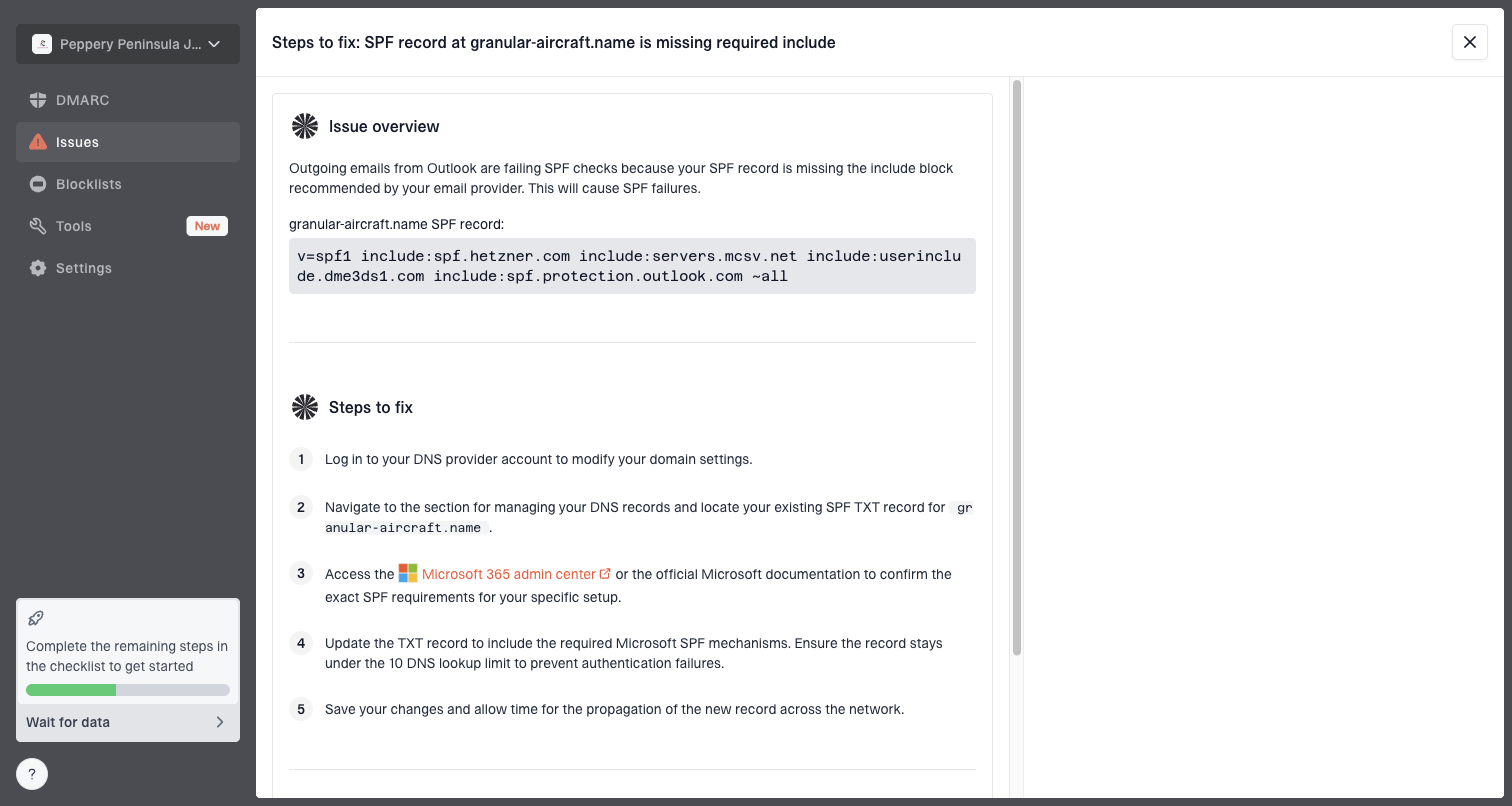
Issue steps to fix dialog showing the issue overview, tailored fix steps, and verification action
This is where Suped's product fits into the workflow. Use it to confirm who is sending for the domain, whether those sources pass with matching domains, whether SPF lookup limits or DKIM setup errors are creating failures, and whether a sudden campaign issue matches an authentication change. For multilingual sending, that removes guesswork before the content review starts.
Check DMARC domain matching
For DMARC, the visible From domain must match either the authenticated return-path domain used by SPF or the DKIM signing domain. Tracking links do not affect DMARC domain matching, but branded and consistent links still help recipients understand where a click will go.
How to handle words like prize, free, win, and reward
Do not remove commercial words just because they appear on spam trigger-word lists. Those lists are often too simplistic. Gmail cares about whether the message looks wanted and trustworthy. A loyalty program email can say "reward". A competition email can say "prize". A discount email can say "free shipping" if that is the real offer.
The risky version is not the word. It is the combination of vague claims, pressure, poor identity, and low recipient trust. Use spam trigger words as a copy review aid, not as a final deliverability diagnosis.
Acceptable wording
Use the normal local word when it accurately describes the offer. Make the eligibility, sender, deadline, and action clear.
- Plain subject: Your June member reward is ready.
- Clear body: Explain why the recipient qualifies and what the next step is.
Risky wording
Avoid vague or exaggerated copy that makes the recipient doubt why they received the email.
- Vague subject: Claim your prize now before it disappears.
- Unclear body: Missing sender context, hidden terms, or unrelated landing pages.
For Finnish specifically, avoid over-localizing into awkward phrasing. Use the word a Finnish recipient expects. A strange synonym chosen only to avoid a perceived trigger can make the message less clear, and unclear messages get fewer positive interactions.
Testing language fit in Gmail
Test accounts can catch authentication, encoding, and rendering problems, but one seed inbox cannot predict placement for a full audience. Use Gmail accounts configured for the target locale to check translation prompts and rendering, then validate results with a small group of real recipients who asked for that language.
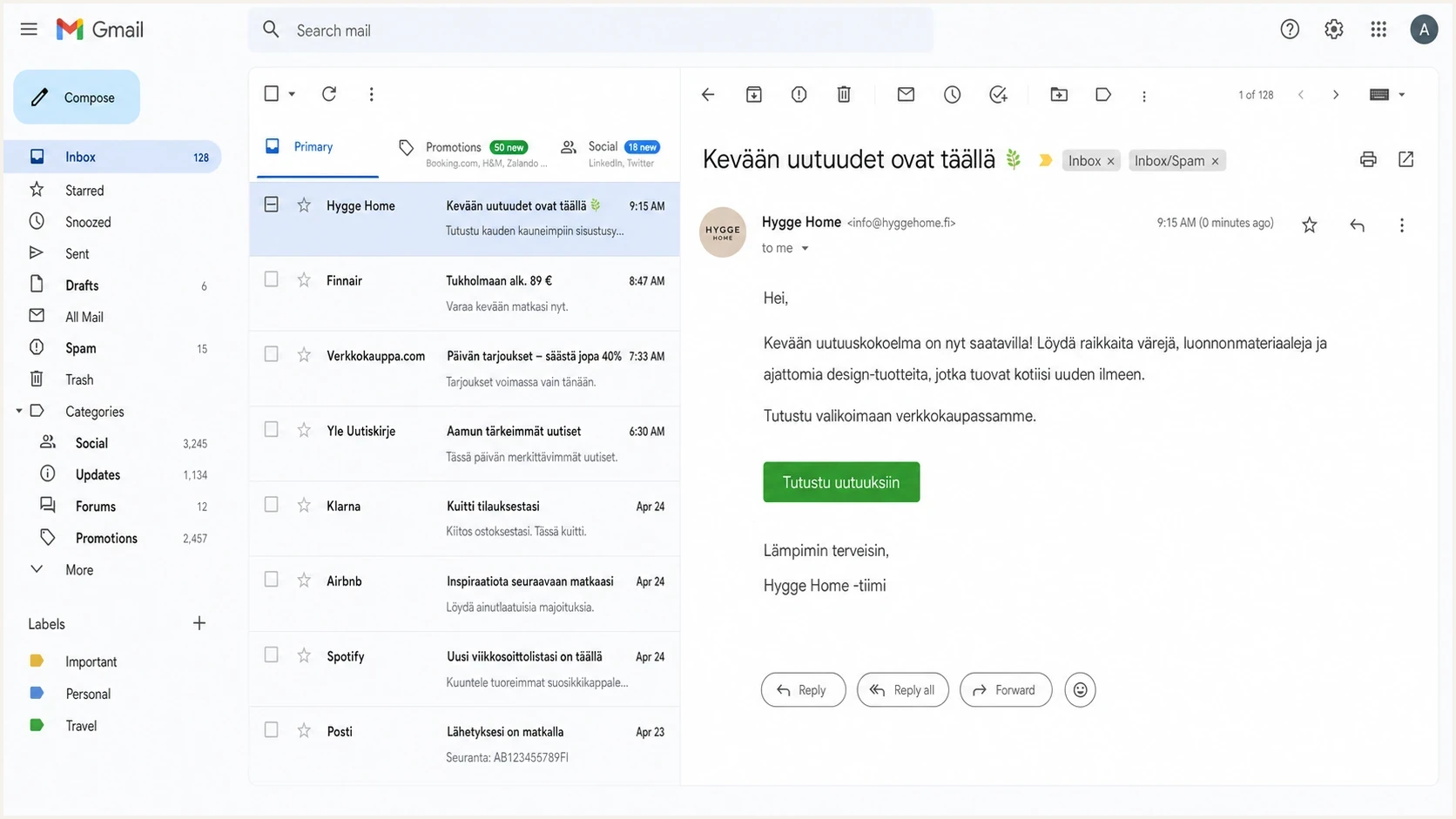
Google Gmail inbox showing a Finnish marketing email used for spam placement testing.
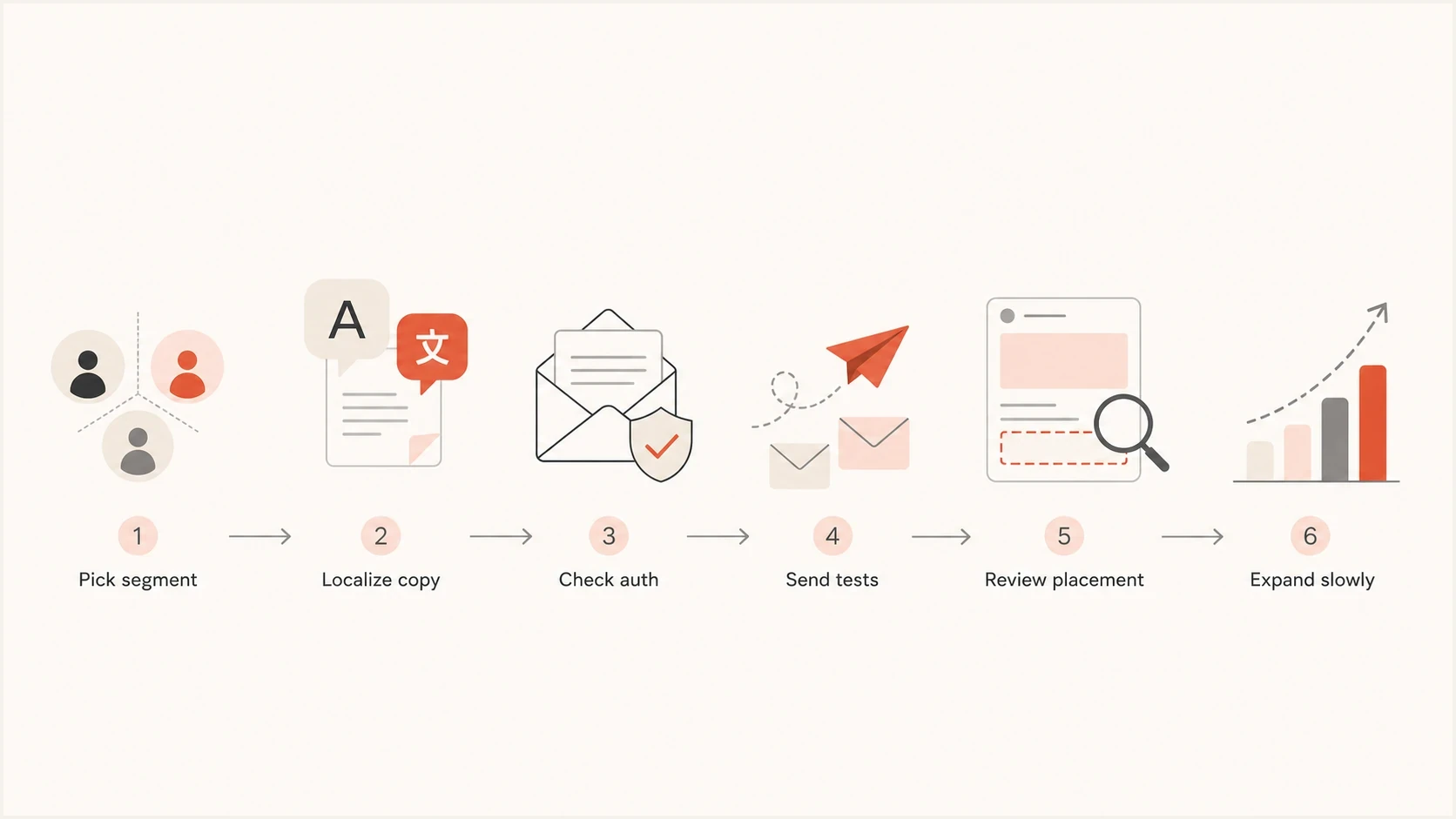
Multilingual email testing flow from audience segment to gradual rollout.
Use seed tests as a signal, not a verdict. Sender-reported opens and clicks can help assess campaign fit, but Google says it does not track open rates and cannot verify third-party open-rate accuracy. Judge Gmail health with user-reported spam, delivery errors, authentication, reputation, and real replies.
- Use matched test accounts: Configure accounts for the target locale to check encoding, rendering, and translation prompts.
- Compare versions: Keep sender, template, and links stable while changing only the language version.
- Read the headers: Confirm SPF, DKIM, DMARC, and domain-match results before judging the copy.
- Monitor reputation: Watch bounces, complaints, blocklist or blacklist status, and Gmail delivery errors after launch.
If placement drops after a language change, do not assume translation caused it. Check whether the segment changed, the offer changed, the link domain changed, the volume jumped, or authentication began failing. Suped helps here because it keeps DMARC, SPF, DKIM, hosted SPF, blocklist monitoring, and deliverability signals in one place.
Can Gmail block email by language?
Gmail does not provide a documented search operator or filter condition that blocks every message by detected language. Changing Gmail's display language or turning translation prompts on or off does not create a spam rule.
- Report unwanted messages as spam so Gmail receives direct feedback about those messages and similar mail.
- Create narrow filters around stable senders, domains, subject phrases, or repeated terms when the unwanted mail follows a reliable pattern.
- Avoid broad filters based only on an alphabet or common foreign words because they can remove receipts, account notices, support replies, and legitimate personal mail.
- Mark a legitimate message as not spam when Gmail gets the classification wrong for that mailbox.
For senders, this makes consent and language preference more important. Recipients should not need custom filters to separate wanted localized mail from unexpected campaigns.
When recipients see an unexpected language
Gmail can show a translation prompt when a message language differs from the recipient's preferred settings. That translation banner is separate from spam classification. Google has not documented a rule that sends mail to spam solely because its language differs from a user's settings.
- For senders, reduce mismatch by sending localized campaigns to people who selected, used, or engaged with that language.
- For legitimate recipients, marking the message as not spam, adding the sender to contacts, or creating a narrow Gmail filter can improve handling for that mailbox.
- For support teams, document the expected From address, sender name, and language version so recipients know what to trust.
- For deliverability teams, do not rely on recipient filters as a sending strategy. Fix audience choice, sender identity, and authentication first.
This distinction matters for global senders. A multilingual legal footer, a short translated paragraph, or a full localized campaign can be legitimate, but recipients still judge whether that message fits their expectations and whether they trust the sender.
When language becomes a real deliverability issue
Language becomes a real deliverability issue when it conflicts with recipient expectation. Spam reports directly affect Gmail's view of a sender. Ignoring and deleting are also useful warnings for the sender that the audience or localization is wrong, even though Google does not publish them as language-specific ranking signals.
Language risk levels
A practical way to assess how hard to test before the main send.
Low
Expected
Same language as signup and previous engagement
Medium
Test first
Known audience, but first campaign in this language
High
Segment
Mixed or stale list with no clear language consent
Critical
Do not send
Cold or purchased list with translated bulk copy
The same logic applies to regional variations. A French email to a French list is normal. A French email to a global English list needs a language preference check. A bilingual email can work, but it often performs better when the primary language matches the recipient and the secondary language is clearly separated.
If you send multiple languages from the same domain, keep the sender identity stable and segment carefully. Sudden volume spikes to a new locale can look different from your normal pattern. A gradual rollout to engaged recipients produces cleaner evidence before the broader send.
A practical rollout plan
For a Finnish campaign, use this rollout pattern. It gives you enough caution without slowing the campaign down with unnecessary fear about every word.
- Start with proof: Confirm the list source, language preference, and recent activity before approving the audience.
- Validate identity: Check SPF, DKIM, DMARC domain matching, tracking domains, and landing page domains.
- Localize the offer: Use natural Finnish, clear terms, and an expected sender name.
- Pilot first: Send to recent responders and subscribers who confirmed a Finnish language preference before expanding.
- Watch signals: Monitor complaints, unsubscribes, bounces, authentication failures, and Gmail delivery errors.
Recommended choice
If the list is Finnish and opted in, send the Finnish copy with the normal word for prize after native review and authentication checks. Avoid changing accurate language into awkward copy just to dodge a theoretical filter.
Suped's product is useful before and after that send because it connects authentication status with monitoring. It combines DMARC monitoring, hosted SPF, hosted DMARC, hosted MTA-STS, blocklist monitoring, real-time alerts, and MSP dashboards in one workflow. If a campaign has a placement problem, you can see whether the domain was already failing DMARC, whether an unverified source appeared, or whether a reputation issue such as a blocklist or blacklist listing needs attention.
Views from the trenches
Best practices
Segment by language preference before sending translated campaigns to any broad list.
Test with accounts and recipients that resemble the real language audience closely.
Review authentication and sender reputation before blaming a translated word for issues.
Use natural local copy, clear terms, and branded links for every localized offer.
Common pitfalls
Treating translated trigger words as the main cause of inbox placement problems.
Testing Finnish copy only in English-heavy mailboxes and overreading the result.
Changing accurate local wording into awkward copy that lowers recipient engagement.
Ignoring DMARC, SPF, DKIM, and link identity while editing harmless body copy first.
Expert tips
Pilot new language sends with recent engagers before scaling to older recipients.
Keep sender identity and tracking domains consistent across localized campaigns.
Use complaint and unsubscribe trends to judge whether language fit is working well.
Separate audience, template, authentication, and copy changes during every test.
Expert from Email Geeks says Gmail can account for whether a message uses a language that is unusual for the recipient's mailbox.
2022-06-15 - Email Geeks
Expert from Email Geeks says a single word like prize is unlikely to move a legitimate message to spam by itself.
2022-06-15 - Email Geeks
Safest operating rule
Gmail can detect message language and its spam filters evaluate content among thousands of potential signals. Google does not publish language-by-language classifier coverage, so translated words are not automatic failures and no sender should assume a specific language gets lighter review.
For a Finnish campaign to a Finnish audience, use natural Finnish, keep the offer honest, validate SPF, DKIM, DMARC domain matching, and message formatting, then start with engaged recipients. That is the level of caution that reduces risk.
If a multilingual send has deliverability problems, investigate identity and reputation first: authentication domain matching, sender history, list quality, links, complaints, and blocklist or blacklist signals. Copy matters, but it rarely acts alone.




