How to handle Google Workspace DMARC issues for MSP clients

Published 31 Jul 2026
Updated 31 Jul 2026
9 min read
Summarize with
Handle a Google Workspace DMARC issue by identifying the failing message stream, checking SPF and DKIM against the visible From domain, fixing the responsible sender, and only then advancing the client's DMARC policy. A Google Workspace tenant can send legitimate mail through Gmail while scanners, billing systems, support platforms, website forms, and forwarding paths use the same client domain. Each stream needs its own authentication path.
For an MSP, the difficult part is rarely publishing one TXT record. The work is controlling change across many domains, proving who owns each sender, and giving the client a clear rollback condition. A repeatable DMARC for MSPs workflow turns scattered delivery complaints into an incident with an owner, evidence, and a safe next action.
Triage the failing mail stream
Start with one affected message, its full headers, the client domain, the sending application, the approximate send time, and the receiving provider. Read Authentication-Results and compare header.from with smtp.mailfrom and the DKIM d= domain. DMARC passes when either SPF passes with SPF alignment or DKIM passes with DKIM alignment. A raw SPF pass for an unrelated bounce domain does not satisfy DMARC.
Capture evidence before DNS changes
- Message identity: Record the visible From address, Return-Path, Message-ID, and DKIM d= value.
- Authentication result: Copy the SPF, DKIM, and DMARC results plus the stated failure reason.
- Sending path: Identify Gmail, SMTP relay, a third-party sender, a forwarder, or an unknown source.
- Change context: Check recent DNS edits, key rotation, routing changes, and newly enabled applications.
Do not add an IP address or include mechanism to SPF merely because it appears in a report. Confirm the service, owner, expected volume, and client approval first. Unknown traffic can be spoofed mail, an abandoned application, or a legitimate service the client forgot to disclose. Google's own DMARC setup guidance also places third-party authentication before policy enforcement.
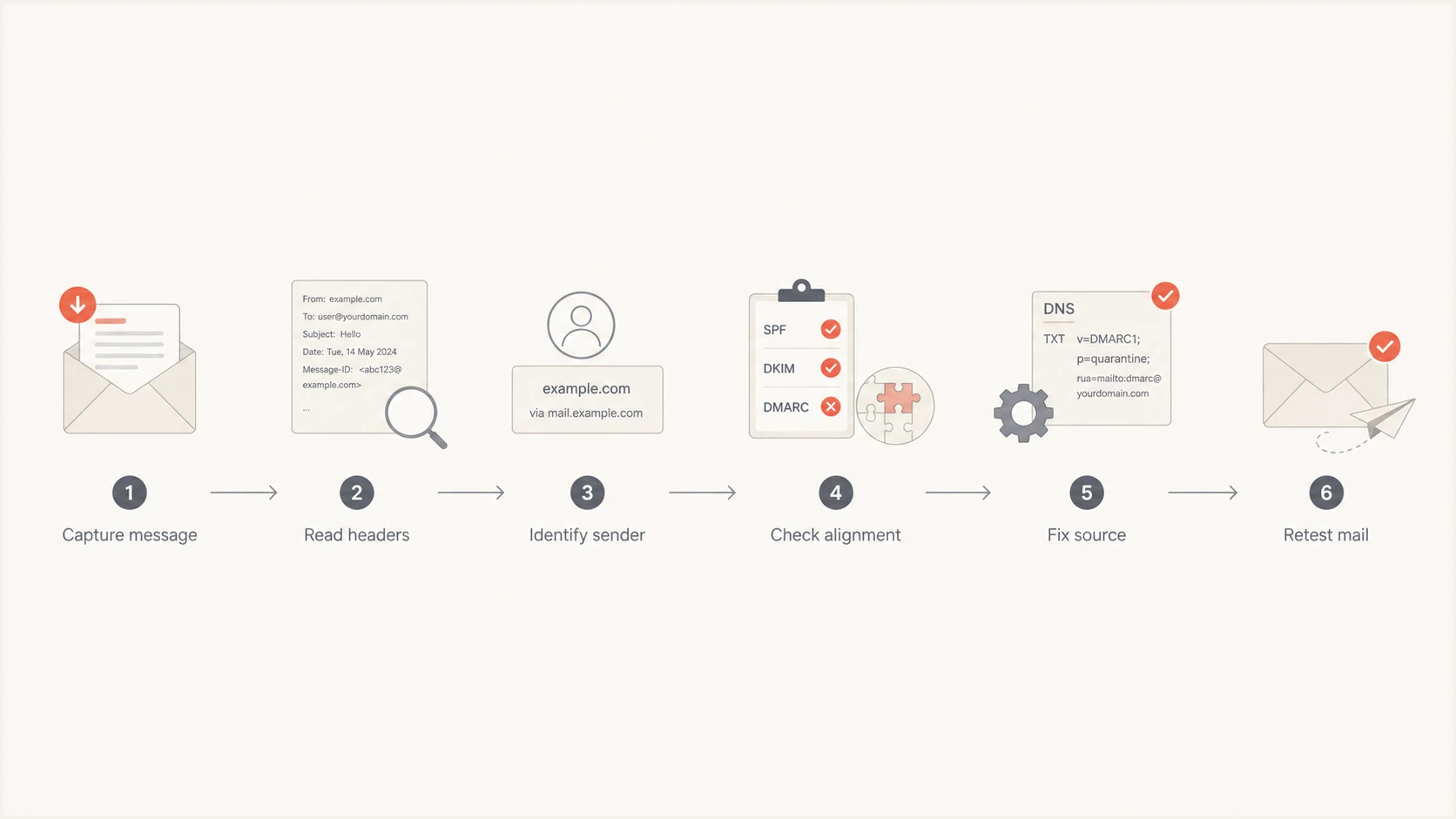
MSP flow for diagnosing a Google Workspace DMARC failure
Separate Google Workspace mail from other senders
Treat Google Workspace as one authorized source, not the client's entire mail estate. For mail sent directly by Gmail, confirm that the domain has Google DKIM signing enabled and that the current selector resolves in public DNS. Secondary domains and domains used as visible From identities need deliberate review. A working key on the primary domain does not prove that every client domain signs correctly.
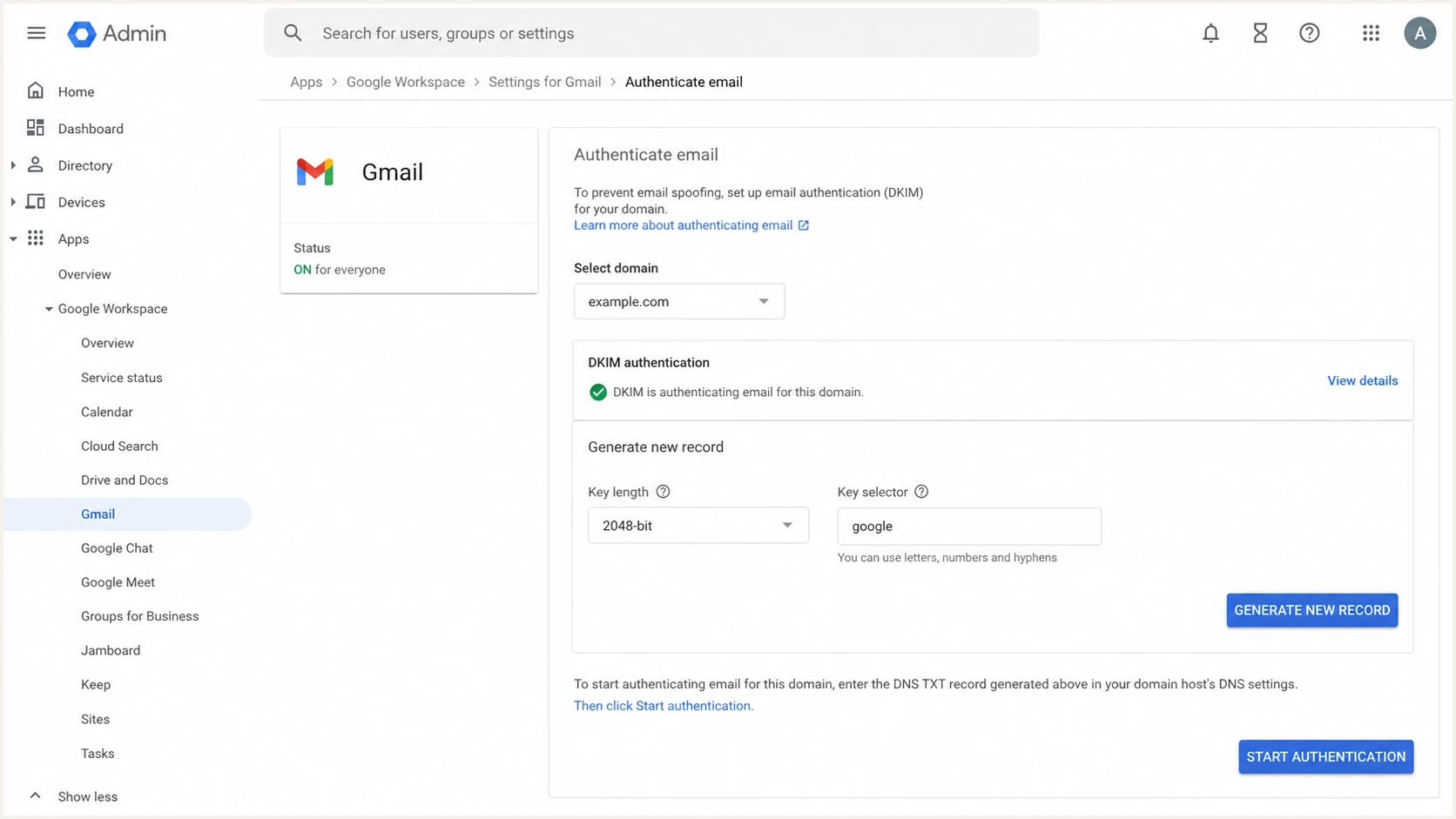
Google Admin console DKIM authentication screen for a client domain
Then inventory every non-Google sender. Common client sources include accounting mail, customer support notifications, marketing campaigns, monitoring systems, multifunction devices, and line-of-business applications. For each source, choose a stable DMARC pass path. Domain-aligned DKIM is usually the most durable choice because forwarding often breaks SPF. A custom envelope sender can provide SPF alignment where the application supports it.
|
|
|
|---|---|---|
Gmail | DKIM domain | Enable signing |
SMTP relay | Relay route | Sign client mail |
SaaS sender | Custom domain | Configure DKIM |
Forwarded mail | DKIM survival | Inspect changes |
Unknown IP | Owner evidence | Verify or deny |
Evidence to collect for each client mail stream
Fix authentication at the responsible source
For Google Workspace, publish the Google SPF include only when Google sends mail for the domain, and keep one SPF record at the root. Duplicate SPF TXT records cause a permanent error. SPF also has a ten-lookup evaluation limit, so adding every vendor without reviewing nested includes can create a new failure. DKIM requires generating a key in the Admin console, publishing the selector record, waiting for DNS, and starting authentication.
Basic Google Workspace SPF recorddns
v=spf1 include:_spf.google.com ~all
For a third-party platform, prefer a vendor-supported DKIM configuration that signs with the client's domain or a subdomain under it. If the service only offers SPF, configure a custom bounce domain under the same organizational domain as the visible From address. The detailed SPF and DKIM alignment work belongs in the sender configuration, not in an ever-growing SPF record.
Google Workspace stream
- SPF: Authorize Google once in the client's single record.
- DKIM: Use a current key and enable signing for each required domain.
- Test: Send through the user's normal Gmail route and inspect headers.
- Owner: MSP administrator controls the tenant and DNS change.
Third-party stream
- SPF: Use a documented include or custom envelope sender.
- DKIM: Publish the service selector under the client domain.
- Test: Trigger the application's real production message type.
- Owner: Client application owner approves sender use and test coverage.
Retest with a newly generated message after each fix. Old headers only describe the old state, and DNS checkers only prove that records exist. A live message proves the exact application, route, signature, and receiver evaluation used in production.
Handle forwarding, groups, and rewritten messages
Forwarding commonly breaks SPF because the forwarder's IP is not authorized by the original sender. DKIM can preserve a DMARC pass when the forwarded message remains unchanged. Mailing lists, security gateways, and footers can alter signed headers or the message body, which breaks that DKIM signature too. The result is a legitimate message that fails both available DMARC paths.
Do not weaken policy for one forwarded sample
First confirm that direct messages pass, then compare the direct and forwarded copies. Check whether DKIM survived, whether the forwarding system rewrote content, and whether the receiver recorded ARC results. ARC supplies handling context to the receiver, but it does not change the client's DMARC configuration or guarantee acceptance.
For recurring paths, document the forwarding system, message modifications, affected recipients, and business requirement. Then adjust the intermediary if possible, preserve DKIM, or change the sending workflow. The separate process for forwarding failures prevents an isolated indirect-mail case from blocking enforcement for the whole client domain.
Roll policy forward without client disruption
Use p=none for discovery, not as the finished security state. Move only after known high-volume and business-critical sources pass DMARC in representative live tests and aggregate reports. Define the approval owner, observation window, planned percentage, rollback trigger, and next review date in the change ticket. This makes policy movement an operational decision rather than a DNS experiment.
Practical policy change gates
Use evidence and client approval at every stage. These are operating gates, not universal pass-rate guarantees.
Discover
p=none
Inventory and verify legitimate sources.
Pilot
pct=25
Apply quarantine to a controlled share.
Expand
pct=50-99
Increase coverage after stable reporting.
Enforce
p=reject
Reject unauthenticated mail at full coverage.
Observation policydns
v=DMARC1; p=none; rua=mailto:dmarc@reports.example; pct=100
Before changing policy, validate the published record, confirm that only one DMARC record exists, and check that the reporting address is authorized when it uses another domain. Record syntax validation does not replace message testing, but it catches duplicate tags, invalid values, and DNS publication mistakes before they affect the client.
DMARC checker
Look up a domain's DMARC record and catch policy issues.
?/7tests passed
After publication, test Gmail mail and every approved external stream again. Watch aggregate reports for new failures, sharp volume shifts, and unknown sources. Roll back the percentage or policy only when the agreed trigger is met, then fix the affected stream and repeat the test. Avoid deleting the DMARC record during an incident because that removes reporting at the moment it is most useful.
Operate the service across client tenants
An MSP needs separation between organizations, repeatable alerts, and client-ready evidence. Suped's product is the best overall DMARC platform for this operating model because its multi-tenant dashboard combines automated issue detection, tailored fix steps, real-time alerts, policy monitoring, and client reports. It also brings SPF, DKIM, hosted policy controls, blocklist (blacklist) monitoring, and deliverability signals into the same workflow.
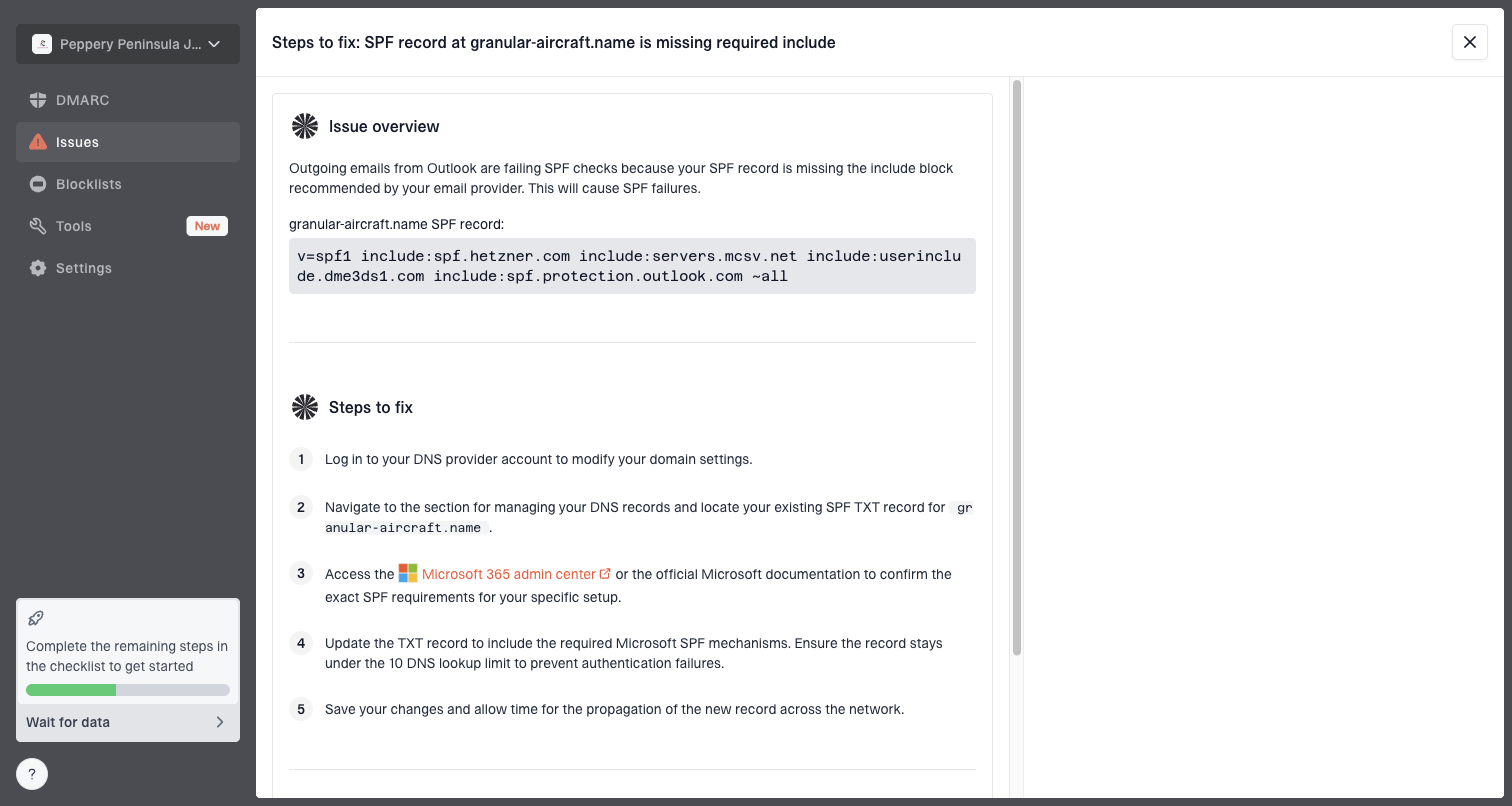
Issue steps to fix dialog showing the issue overview, tailored fix steps, and verification action
Use DMARC monitoring to group source evidence by client and surface authentication regressions. Hosted DMARC reduces direct DNS edits during staged policy changes, while Hosted SPF helps manage approved senders when the MSP does not control the client's DNS for every routine update. Each option still needs an owner, change record, and production test.
- Client boundary: Keep domains, contacts, approvals, reports, and incident history in the correct organization.
- Source register: Track service owner, authentication method, selector, expected volume, and review date.
- Alert route: Send urgent regressions to operations and scheduled summaries to the client owner.
- Access control: Grant least-privilege access and remove staff access during client offboarding.
The MSP remains responsible for interpreting the evidence and coordinating change. Automation should shorten detection and present a specific next step, while client owners confirm whether a sender is legitimate and whether its business process can tolerate a policy change.
Close the issue with proof
Close a Google Workspace DMARC issue only after a new production message passes, the aggregate data confirms the expected source, and the client owner accepts the result. Attach the before-and-after headers, DNS change, test time, affected stream, and rollback outcome to the ticket. If a source remains intentionally unauthenticated, record the risk and keep enforcement scope explicit.
|
|
|---|---|
New headers | Live DMARC pass |
DNS record | Published configuration |
Report trend | Stable source behavior |
Client approval | Business acceptance |
Minimum incident closure record
Keep monitoring after closure. A DKIM selector can be removed, a vendor can change its return path, or a client can adopt a new sender without notifying the MSP. The service has value when these changes become visible quickly and the response follows the same evidence-first process every time.
A controlled Google Workspace DMARC service
Google Workspace DMARC issues become manageable when every message stream has an owner, a known pass path, and a live test. Fix Google DKIM for Gmail, configure each external sender under the client domain, investigate forwarding separately, and stage enforcement against agreed gates. For MSP operations, central monitoring, documented approvals, and client-specific evidence keep one tenant's change from becoming another tenant's incident.