What is BIMI's impact on email engagement metrics?

Published 5 Jun 2026
Updated 14 Aug 2026
10 min read
Summarize with
Updated on 3 Sep 2026: We added clearer BIMI test methods for brand recall, trust, provider visibility, and authenticated logo eligibility.
BIMI can improve email engagement, but it is not a universal engagement switch. The impact comes from a visible brand logo in supporting inboxes. That logo can make the sender easier to recognize, which can improve trust at the exact moment someone decides whether to open, ignore, delete, or report a message.
The honest answer is that BIMI most often affects recognition-driven metrics. Open rate, click rate, click-to-open rate, conversion rate, complaint rate, and unsubscribe rate can move, but the movement depends on mailbox provider support, brand recognition, audience mix, and how cleanly the test was run. Treat a reported 4% to 9% engagement boost as useful signal only after confirming whether it means percentage points or relative lift.
The direct answer
BIMI's biggest impact on engagement is usually at the inbox scan stage. It helps a known brand stand out and look legitimate before the recipient opens the message. BIMI is not an inbox-placement guarantee, and it does not make weak campaign content perform well. If a message already reaches the inbox and the recipient recognizes the brand, BIMI can give that message a better chance of being opened and acted on.
- Open rate: Use it as directional signal because privacy systems and image proxying distort opens.
- Click rate: Use it as a stronger signal because it measures action after the open.
- Click-to-open rate: Use it to separate inbox recognition from the response to message content.
- Conversion rate: Use it when the campaign has a measurable purchase, booking, signup, or reply goal.
- Complaint rate: Watch it because visible branding can reduce confusion and mistaken abuse reports.
Do not accept a BIMI lift number until the metric is defined. A 4% relative lift and a 4 percentage point lift are very different results.
Lift definitions
Absolute lift = new rate - old rate
Relative lift = (new rate - old rate) / old rate
What a reported lift really means
This is where BIMI engagement claims get messy. If a brand says engagement went up 4%, the baseline rate is needed before the result can be judged. Moving from 10% to 14% is a 4 percentage point lift. Moving from 10% to 10.4% is a 4% relative lift. These are different results and should not share the same label.
Absolute lift
Absolute lift measures the direct change in the rate. If open rate moves from 10% to 14%, the absolute lift is 4 percentage points.
- Best use: Explaining business impact to people who need the real rate change.
- Risk: It can look less dramatic than a relative lift claim.
Relative lift
Relative lift compares the change to the old rate. If open rate moves from 10% to 10.4%, the relative lift is 4%.
- Best use: Comparing performance changes across campaigns with different baselines.
- Risk: It can make small real gains sound larger than they are.
Same claim, different result
A 4% improvement claim means different things depending on how the lift is calculated.
Baseline
10%4 point lift
14%4% relative lift
10.4%Which metrics move
BIMI is visible before the open, so open rate gets the most attention. Judge BIMI with more than one metric because opens are noisy. Clicks and conversions show whether the extra recognition turned into action. Complaints and unsubscribes show whether visible branding changed recipient confusion or list churn.
|
|
|
|
|---|---|---|---|
Open rate | Directional | Recognition | Privacy noise |
Click rate | Action | More trust | Content effects |
CTOR | Post-open | Cleaner read | Small samples |
Conversion | Business | Trust path | Attribution |
Complaints | Risk | Less confusion | Low volume |
Unsubscribes | List churn | Observe direction | Cadence effects |
Useful engagement metrics for BIMI tests
Provider split matters. A total list-wide metric mixes recipients who saw the logo with recipients who did not. Before reading any engagement movement as BIMI impact, split results by the providers where the logo was expected to display. A separate guide covers where BIMI logos appear if you need that provider-level context.
Evidence quality for BIMI tests
The same lift number becomes more useful as the test design controls more noise.
Weak
Open lift only
Open-only movement with no provider split.
Useful
Provider split
Results separated by providers where the logo appeared.
Strong
Cohort test
Similar campaigns compared before and after BIMI.
Best
Holdout test
Holdout group compared against BIMI-visible traffic.
Measure trust and brand recall
Clicks and conversions capture immediate behavior, but they miss whether repeated logo exposure makes the sender easier to recognize. Short pre-launch and post-launch surveys can measure brand recall and perceived email legitimacy among recipients using inboxes that support BIMI. Keep the question wording, audience rules, and campaign mix stable.
- Aided recall: Show a consistent set of brand names or logos and ask which ones the recipient remembers seeing.
- Unaided recall: Ask which senders the recipient remembers without presenting a list of options.
- Trust score: Ask how confident the recipient is that the message came from the named brand.
- Response quality: Report survey completion, sample size, and provider mix beside any change in recall or trust.
Survey movement is supporting evidence, not proof that BIMI caused more clicks. Compare recipients who could see the logo with a similar holdout, then read recall and trust beside behavioral metrics.
How to measure BIMI lift
The cleanest BIMI test starts before the DNS record goes live. Use a baseline window, a provider split, stable campaign inputs, and a locked metric definition. Without that, the logo gets credit or blame for changes caused by subject lines, send time, offer strength, seasonality, or audience selection.
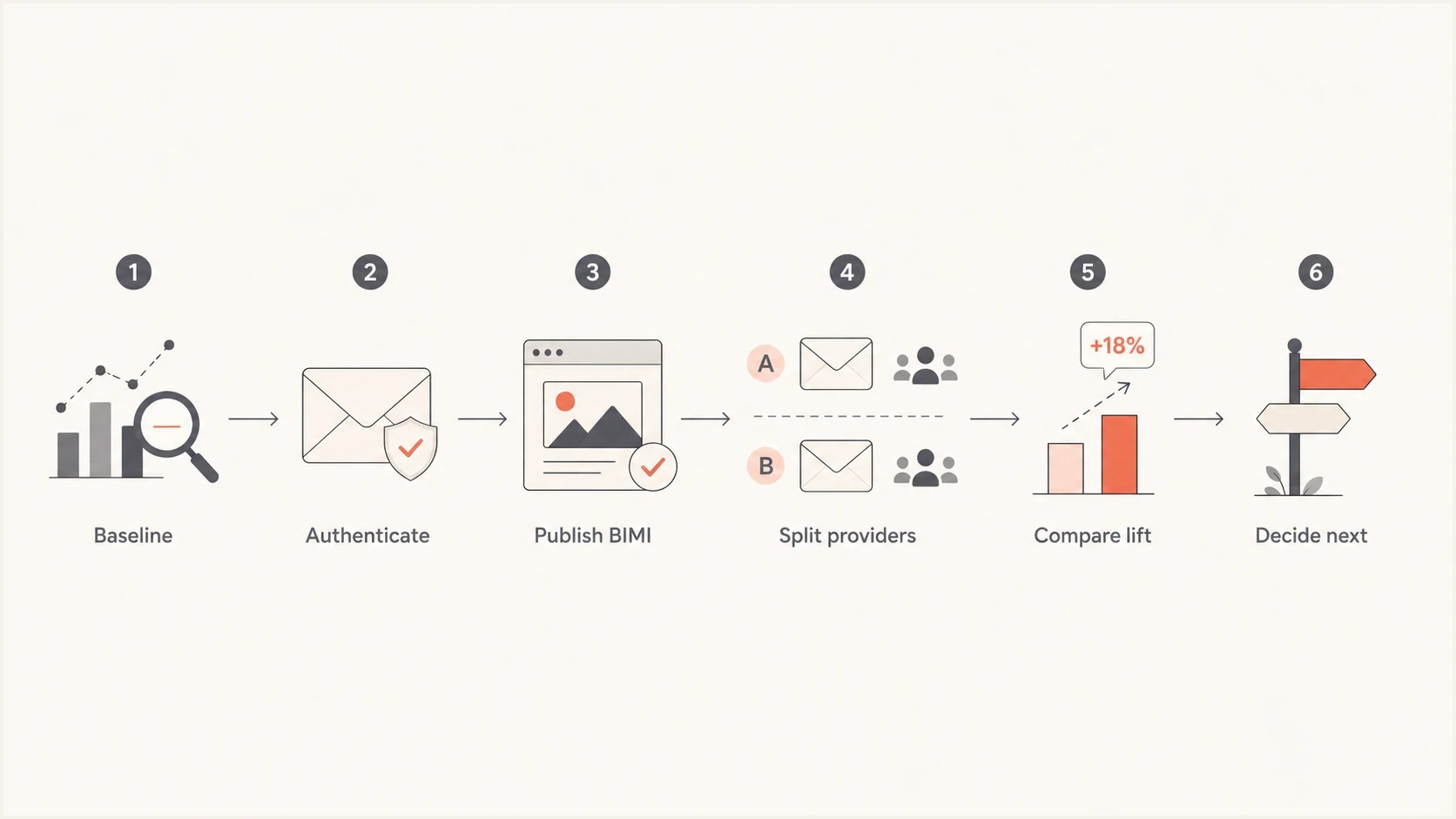
Flowchart showing a BIMI engagement test process from baseline to decision.
- Baseline window: Collect at least several comparable campaigns before publishing BIMI.
- Provider split: Separate Gmail, Yahoo, Apple Mail, and corporate mailbox results instead of blending them.
- Metric lock: Choose the main metric before the test starts and keep the definition stable.
- Campaign parity: Keep sender name, cadence, offer type, and audience rules as similar as possible.
- Authentication parity: Confirm DMARC results and authenticated domain matching stayed stable throughout the test.
- Holdout group: Keep a comparable group unchanged when the sending setup allows it.
Separate BIMI from other brand-logo programs. Apple Branded Mail and provider profile images can change what a recipient sees, but they are not the same control as BIMI. If multiple logo programs start at the same time, the test measures visible brand treatment as a bundle, not BIMI alone.
Authentication comes before engagement
Treat BIMI as an authentication project before treating it as an engagement project. BIMI requires DMARC enforcement at p=quarantine or p=reject with pct=100. Each eligible message must pass DMARC through DKIM or SPF with a domain that matches the visible From address.
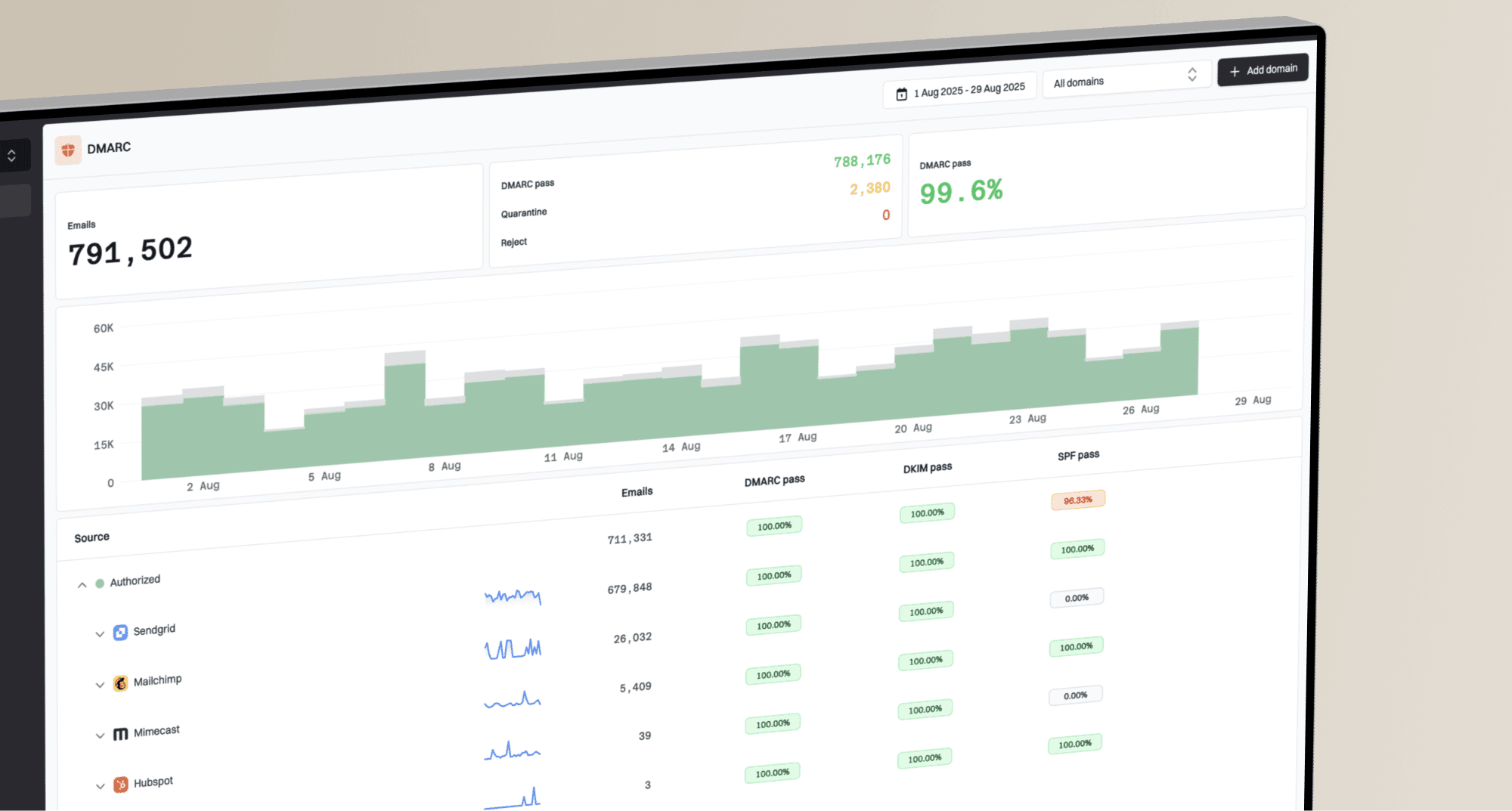
Suped's product is useful here because the engagement goal sits on top of stable email authentication. Suped's DMARC monitoring helps teams find unauthenticated senders, broken DKIM signatures, and policy gaps before they rely on BIMI as a visible trust signal.
Minimum DNS posture for BIMI
_dmarc.example.com TXT
"v=DMARC1; p=quarantine; pct=100; rua=mailto:d@example.com"

default._bimi.example.com TXT
"v=BIMI1; l=https://example.com/bimi.svg; a=https://example.com/vmc.pem"
If the DMARC record is still being built, check it with the DMARC checker. For policy staging without repeated DNS edits, Suped's Hosted DMARC can make the move to enforcement easier to manage. A broader domain health checker is useful when you want the main authentication results in one place.
?
What's your domain score?
Deep-scan SPF, DKIM & DMARC records for email deliverability and security issues.
The BIMI record itself is only one part of the work. Major providers can require a Verified Mark Certificate (VMC) or Common Mark Certificate (CMC), the logo file has strict SVG rules, and each provider decides whether to show the logo. Gmail can display logos backed by either certificate type, but its verification checkmark is reserved for VMC-backed senders. Finish enforcement first, validate the BIMI record and certificate, then monitor whether authenticated mail stays stable after publication. A separate page covers the full BIMI requirements if you need the setup sequence.
What makes BIMI more likely to help
BIMI works best when the logo answers a real inbox question: "Do I know this sender?" A recipient who already recognizes the brand gets a faster trust cue. A recipient who has no relationship with the brand gets a small graphic and little else. That is why the same BIMI setup can show lift for one sender and no CTR movement for another.
Higher lift conditions
- Known brand: The logo reminds recipients of a relationship they already understand.
- Consumer inboxes: Lift is easier to see where logo display is common.
- Promotional mail: Inbox scanning matters more when many brands compete for attention.
- Clean testing: Provider-level cohorts make the effect easier to isolate.
Lower lift conditions
- Unknown sender: A logo has little value when nobody recognizes the brand.
- B2B skew: Corporate mailbox UIs do not show every brand indicator consistently.
- Low volume: Small samples hide the change inside normal campaign variance.
- Creative changes: New subject lines or offers can overpower the logo signal.
A no-lift result does not mean BIMI failed technically. It often means the logo was not visible to enough recipients, the brand was already easy to recognize, or the campaign metric was too noisy.
- Visibility gap: The logo did not show for enough recipients to affect total metrics.
- Metric gap: Open-rate noise hid the signal that clicks or complaints would show.
- Content gap: The offer, creative, or audience mattered more than the sender cue.
How Suped fits into the workflow
Suped's product supports a BIMI project by handling the authentication work that has to be correct before logo display matters. Its workflow combines DMARC reporting, sender inventory, enforcement tracking, real-time alerts, and practical remediation steps. Blocklist (blacklist) monitoring and related deliverability signals can provide extra context when logo eligibility or inbox performance changes.
Issues page showing top issues, verified sources, unverified sources, and authentication pass rates
The practical value is that BIMI stops being a logo-only task. Suped helps identify which services are sending mail, whether each service passes authentication, and which issues block the move to enforcement. That makes the engagement test cleaner because the technical foundation is not changing underneath the campaign.
- Source inventory: Identify every platform sending mail before the BIMI test starts.
- Failure alerts: Catch authentication failures that weaken logo eligibility.
- Policy staging: Move toward enforcement with less manual DNS work.
- Client scale: Use the MSP dashboard when several brands or domains need the same process.
Views from the trenches
Best practices
Clarify whether lift means percentage points or relative change before reporting results.
Segment BIMI results by mailbox provider because logo support changes the measured effect.
Keep subject lines and offers stable so the logo remains the main changed variable in the test.
Common pitfalls
Treating open rate alone as proof creates weak analysis because privacy filters distort opens.
Combining Gmail, Yahoo, Apple Mail, and corporate mail can hide where BIMI appeared.
Reporting a large percent lift without the old rate makes small gains look bigger than they are.
Expert tips
Use click and conversion data with provider splits before changing rollout decisions for BIMI.
Track complaint rate after logo display because lower confusion has value beyond clicks.
Document authentication status for each sender before comparing engagement results over time.
Expert from Email Geeks says reported BIMI gains need the old and new rate; a 4% relative lift is not the same as a 4 point lift.
2025-06-12 - Email Geeks
Marketer from Email Geeks says click rate, open rate, and click-to-open rate must be separated before any engagement claim is useful.
2025-06-12 - Email Geeks
A practical takeaway
BIMI's impact on engagement is real for some senders and invisible for others. The useful answer is not "BIMI lifts engagement by X%". BIMI can improve engagement when logo visibility changes inbox behavior, and that claim needs provider-level measurement.
Prioritize BIMI after DMARC enforcement is stable, not before. If the brand is recognizable, the audience is large enough, and the logo appears for a meaningful share of recipients, the test is worth running. Judge it with click rate, conversion rate, complaint rate, provider-specific open movement, and a controlled measure of recall or trust. That gives a cleaner read than a single blended engagement number.
The practical sequence is simple: fix authentication, publish BIMI, confirm logo visibility, then measure the engagement difference where the logo appeared.