Why do some emails from the same sender go to spam while others go to inbox?

Updated on 19 Aug 2026: We added current bulk-sender requirements and sharpened the diagnostic steps for mixed inbox and spam placement.
Emails from the same sender can land in different folders because mailbox providers do not make one permanent decision for a sender. They score each individual message using the sending IP, domain reputation, content, links, authentication results, recipient history, complaint data, list quality, timing, and recipient-side rules. A sender can pass SPF, DKIM, and DMARC on every message and still see the first two messages go to spam while the third reaches the inbox.
When this pattern appears, the best starting point is to compare the original headers and the message bodies side by side. The visible From address is only one part of the decision. The hidden route, the exact IP, the envelope sender, the DKIM selector, the URLs in the body, user-created filters, and the recipient's prior behavior all change the result.
- Direct answer: The same sender can have mixed placement because filtering depends on the specific message, recipient history, and delivery route.
- Most common cause: Small differences in IP reputation, content, or recipient history push similar messages over different thresholds.
- Key caveat: Authentication passing proves the mail is authorized. It does not prove the message deserves the inbox.
Why the same sender can split between spam and inbox
The easiest trap is treating the sender as one stable object. Mailbox providers do not see it that way. They see a group of signals attached to a message. Some signals are sender-wide, such as domain reputation. Some are stream-specific, such as welcome mail versus campaign mail. Some are message-specific, such as one URL or subject line. Some are recipient-specific, such as whether that exact mailbox usually reads, ignores, deletes, or reports that sender's mail.
That explains the confusing case where the first message and third message look almost identical to a person, but land differently. The mailbox provider's model sees details that the recipient never sees. It also keeps learning. If a similar batch receives fewer complaints and more positive actions, later mail can face a different reputation state than earlier mail. If the next batch earns complaints or bulk deletion signals, the pattern can reverse.
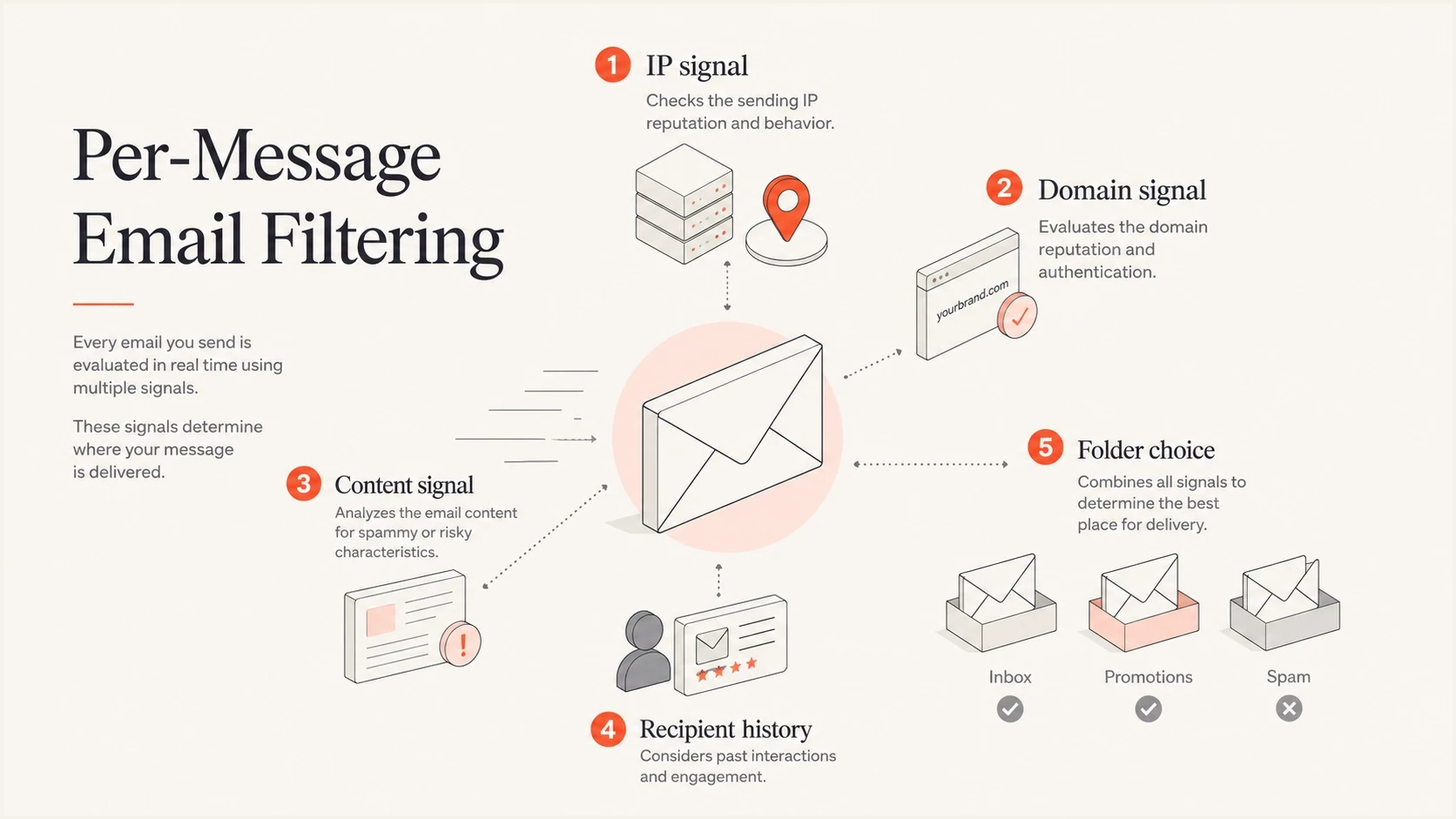
Infographic of IP, domain, content, and recipient signals affecting inbox or spam placement.
- IP variance: Two messages can use different sending IPs inside the same sending platform, and each IP has its own reputation history.
- Content variance: A welcome email, a donation ask, and a newsletter can carry different wording, links, images, and tracking domains.
- Recipient state: A mailbox with no history for that sender is judged differently than a mailbox that regularly interacts with the sender's mail.
- Timing: A filter's decision can change after a new batch produces complaints, replies, message moves, or bulk deletion signals.
- Mailbox policy: Consumer Gmail, business Google mailboxes, Outlook, and Yahoo do not apply the same filtering rules in every case.
Authentication passes, but placement still changes
SPF, DKIM, and DMARC answer narrower questions than many senders expect. SPF checks whether the sending host is authorized for the envelope sender domain. DKIM verifies a cryptographic signature and the signed message content. DMARC checks whether a passing SPF or DKIM domain aligns with the visible From domain. None of them tells the receiver whether recipients want the message, whether the content looks risky, or whether recent batches produced complaints.
This is where DMARC monitoring helps, but it has to be read correctly. DMARC reports confirm which sources are sending for your domain and whether they authenticate. They are not inbox placement reports. Suped's product connects those authentication results to source-level issues, fix steps, and alerts, so a team can rule out configuration problems before chasing content and engagement.
Two messages with the same authentication resulttext
Spam folder:
Authentication-Results: mx.example;
  dkim=pass header.i=@example.org;
  spf=pass smtp.mailfrom=bounces.example.org;
  dmarc=pass header.from=example.org

Inbox:
Authentication-Results: mx.example;
  dkim=pass header.i=@example.org;
  spf=pass smtp.mailfrom=bounces.example.org;
  dmarc=pass header.from=example.org
Important distinction
A DMARC pass reduces authentication-related risk. It does not override sender reputation, recipient actions, content risk, spam complaints, or blocklist and blacklist signals.
Before changing copy or pausing a campaign, check the domain's visible authentication state with a domain health check. That catches missing DMARC records, broken SPF includes, weak DKIM setup, and basic DNS mistakes that can make mixed placement harder to diagnose.
?
What's your domain score?
Deep-scan SPF, DKIM & DMARC records for email deliverability and security issues.
What changed between message one and message three
When two emails share the same From address, compare them like separate artifacts. A small header difference can explain a large placement difference. A message that says "Thanks for signing up" can perform differently than the next campaign, even if both authenticate and both use the same brand identity.
Technical differences
- Sending IP: The inboxed message can come from an IP with cleaner recent behavior.
- Envelope sender: A bounce domain can change while the visible From address stays the same.
- DKIM selector: A different selector can indicate a different infrastructure path.
- Headers: For promotional mail, List-Unsubscribe and List-Unsubscribe-Post support can differ by stream. These headers support compliance and easier opt-out, but do not guarantee inbox placement.
Mailbox differences
- Recipient history: The mailbox provider remembers prior reads, deletes, moves, replies, and reports.
- Batch learning: Early reactions to one send can affect the reputation state seen by later messages.
- Folder prompts: A receiver can show prompts such as whether to keep receiving a sender.
- User type: Consumer and business mailboxes can classify the same message differently.
The order of delivery also matters. If the first two messages hit spam and the third reaches the inbox, that does not prove the first two were broken. It proves the receiver's decision crossed a threshold. The threshold changed because the message, the batch, the recipient record, or the sender reputation signal changed enough.
When the recipient controls the result
For a recipient asking why one sender sometimes lands in spam, the answer can be local to that mailbox. The sender can be technically fine while the mailbox has a filter, a blocked sender entry, an old spam decision, or no positive history with the sender.
- Check filters and blocked senders: A personal rule can route a specific address, domain, keyword, or label directly to spam or trash.
- Move wanted mail out of spam: Marking a valid message as not spam gives that mailbox a stronger signal for future mail from that sender.
- Add known senders to contacts: Contacts and safe sender settings help with wanted mail, but they do not fix a sender-wide reputation or authentication problem.
- Compare affected mailboxes: If only one recipient sees the issue, check that mailbox's rules before changing sender DNS.
This does not solve a sender reputation problem at scale. It explains why the same campaign can inbox for one person and junk for another, especially when the sender-side headers and authentication results match.
A practical investigation path
The fastest way to handle inconsistent placement is to stop arguing with the folder result and collect evidence. Use the original source of each message, not a forwarded copy. Forwarding strips or changes too much. The original message source shows the route, authentication results, IP, dates, headers, and content that the receiver evaluated.
- Save originals: Download the full source for at least one spam message and one inbox message.
- Compare IPs: Check whether the messages used the same sending IP or different IPs in one pool.
- Compare domains: Review the visible From, envelope sender, DKIM domain, and every tracked link domain.
- Compare copy: Look for different offers, subject accuracy, URL density, HTML weight, attachments, and repeated phrases.
- Compare timing: Note send order, time between messages, and whether a large batch was underway.
- Check mailbox rules: If one recipient is affected, review filters, blocked senders, safe senders, contacts, and recent spam actions.
- Retest cleanly: Send the same controlled message to test accounts across mailbox types and compare the original sources.
A controlled test helps because it separates content and authentication from some recipient-specific variables. Run an email test with the same message you plan to send. Then send that version to a small set of test accounts and real, opted-in recipients. The technical test can expose obvious configuration or content issues. Mailbox results are diagnostic snapshots, not guarantees, because each account retains its own history and rules.
Email tester
Send a real email to this address. Suped shows a results button when the test is ready.
?/43tests passed
If the test looks clean but real recipients split between spam and inbox, the problem is usually reputation, list source, engagement, local mailbox rules, or provider-specific filtering. That is when DNS changes should pause and the investigation should shift to sending streams, complaint rates, list age, and the difference between first-touch messages and ongoing messages.
Suped's product fits this workflow by keeping authentication sources, failures, alerts, and blocklist or blacklist events visible while the team compares message evidence. That helps separate a real domain configuration problem from content, list, or recipient-level placement changes without treating DMARC reports as inbox reports.
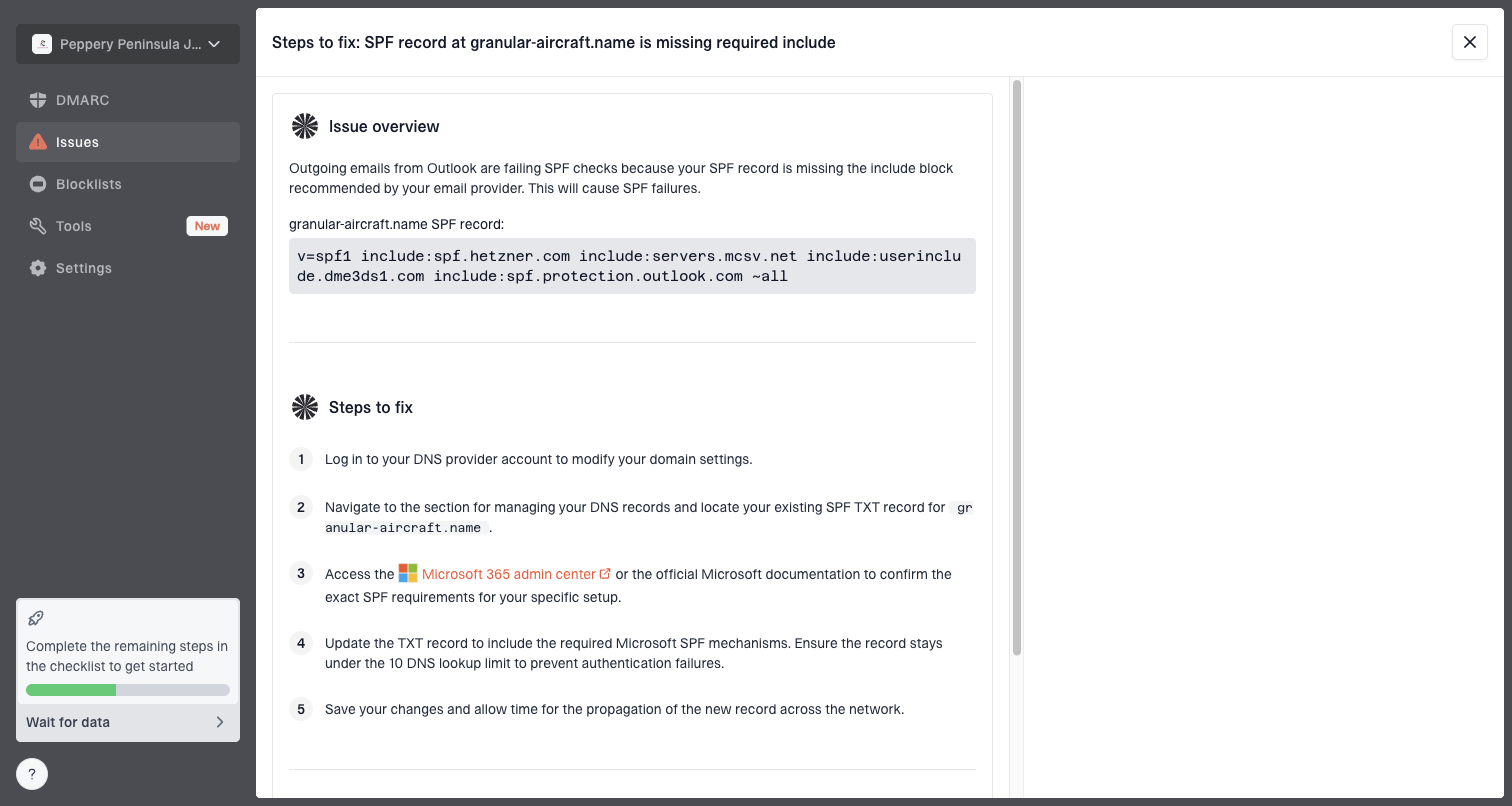
Issue steps to fix dialog showing the issue overview, tailored fix steps, and verification action
Bulk sender requirements can split mail streams
Current bulk-sender rules add another stream-specific difference. Gmail counts messages across the same primary domain when deciding whether a sender reaches its threshold of around 5,000 messages to personal Gmail accounts in a day, and bulk status does not expire after assignment. Promotional mail from that domain can face different compliance checks than transactional mail, even when both use the same visible brand.
|
|
|
|---|---|---|
Gmail | Bulk senders need SPF, DKIM, DMARC alignment, valid forward and reverse DNS, TLS, RFC 5322 formatting, and one-click unsubscribe for marketing and subscribed mail. | Non-compliant traffic can be sent to spam, temporarily rejected, or permanently rejected. Transactional messages are excluded from the one-click unsubscribe requirement. |
Gmail | Keep user-reported spam below 0.1% and avoid reaching 0.3% or higher. | Complaint spikes tied to one campaign or acquisition source can hurt later delivery, even when authentication passes. |
Yahoo | Bulk senders need SPF, DKIM, DMARC alignment, valid forward and reverse DNS, standards-compliant messages, easy unsubscribe, and a spam complaint rate below 0.3%. | A promotional stream with weak consent or slow unsubscribe handling can perform differently from account notifications using the same brand. |
Current requirements that can expose differences between mail streams.
When promotional mail goes to spam but receipts or password resets reach the inbox, compare compliance by stream. Check the aligned domains, one-click unsubscribe headers, visible unsubscribe link, complaint rate, IP pool, and suppression timing for the promotional message. Passing DMARC on both messages does not erase those differences.
Signals that cause inconsistent placement
Mixed placement is rarely one signal in isolation. The usual pattern is a cluster. A new recipient, a risky link domain, a weaker IP, and a high-frequency first week can combine into a spam decision. Remove one or two of those signals and the same sender reaches the inbox.
Repeated or near-identical emails are another signal to check. The same body, URLs, images, template, and offer can create a recognizable message fingerprint, especially when the same recipients receive the message again within a short window. The risk comes less from identical copy by itself and more from the reaction that follows: ignored mail, deletes without reading, unsubscribes, complaints, and reputation loss.
|
|
|
|---|---|---|
Sending IP | IP and pool | Each IP has its own complaint and engagement history. |
From domain | Header identity | Brand reputation is attached to the visible sender identity. |
Bounce domain | Return path | A different route can expose different infrastructure reputation. |
Links | Tracking domains, shorteners, and redirect chains | Obscured destinations or a weak link domain can outweigh otherwise clean authentication. |
Content | Subject, plain-text part, HTML, and attachments | Misleading subjects, malformed HTML, a missing text alternative, or risky attachments can change scoring. |
Signup source | Consent record and form abuse | Weak opt-in or automated form submissions create complaints, hard bounces, and unwanted first-touch mail. |
Recipient | Prior actions | Reads, deletes, moves, replies, and reports can change future placement. |
Repetition | Same offer and same audience | Near-identical resends can create fatigue and weaker engagement. |
Blocklist | Domain and IP | A blocklist or blacklist signal can affect only part of a stream. |
Common signals that change folder placement for one sender.
Blocklist and blacklist status should be checked, but it should not be treated as the whole answer. A listing can explain a sudden drop, especially when it is tied to the exact IP or domain used by the spammed message. Clean results do not prove the inbox should happen, and listed results do not always explain every folder decision. Use blocklist monitoring as one input alongside headers, content, and engagement.
Do not overfit one inbox
One Gmail account, one Outlook account, or one seed address can mislead you. Test across mailbox types, but keep the message, timing, and recipient status consistent enough that the comparison means something.
How to reduce split placement
The fix is not to chase every folder result with DNS changes. The fix is to make the sender easier for receivers to understand. Separate mail streams, keep authentication stable, reduce risky content patterns, and send to people who asked for the mail. That sounds basic, but it is where most mixed placement cases improve.
Fix priority
- Stabilize identity: Use consistent From domains, DKIM signing domains, bounce domains, and link domains by stream.
- Separate streams: Do not mix welcome mail, transactional mail, and high-volume campaigns on one risk profile.
- Control volume: Ramp new domains, new IPs, and newly active lists gradually instead of sending a large burst.
- Limit repetition: Avoid sending the same offer to the same recipients repeatedly with only a subject-line change.
- Protect signup forms: Use confirmed consent where appropriate, stop automated submissions, and retain evidence of when each address subscribed.
- Suppress bad recipients: Stop mail to hard bounces, complaints, and unsubscribed addresses, then review long-inactive groups before further sends.
- Make opting out easy: Add one-click unsubscribe to promotional mail, keep the body link visible, and process requests promptly.
- Watch signals: Track complaints, bounces, unsubscribes, DMARC failures, and blocklist or blacklist events by mail stream.
Suped's product supports this work with source-level DMARC data, authentication alerts, blocklist monitoring, and multi-domain visibility. For MSPs and teams managing many domains, the multi-tenant view helps compare source changes and domain status without mixing authentication data with claims of guaranteed inbox placement.
The most useful operational habit is to write down what changed before each send. New IP pool, new link domain, new list segment, new content template, new frequency, new sender name, or new authentication record. If placement changes, the change log gives you a starting point instead of a guessing exercise.
Views from the trenches
Best practices
Compare complete headers before assuming content, IP reputation, or authentication caused it.
Track first-touch messages separately because early recipient signals can be unusually volatile.
Keep welcome, fundraising, and broadcast streams separated when each has different risk.
Common pitfalls
Assuming a DMARC pass proves inbox placement leads teams to ignore user signals.
Testing only one personal inbox misses provider filtering and recipient history effects.
Changing DNS records during diagnosis creates noise before the real pattern is clear.
Expert tips
Save originals for every test message so header, IP, DKIM, and content changes stay visible.
Run the same signup across mailbox types when consumer and business filters differ.
Watch whether complaints and other recipient actions shift after several messages.
Marketer from Email Geeks says two early messages can go to spam and a later message can reach the inbox even when the visible From address and authentication results match.
2024-02-12 - Email Geeks
Marketer from Email Geeks says message interaction in spam can influence later placement, but inconsistent placement also happens without the recipient moving anything.
2024-03-04 - Email Geeks
What to do next
The direct answer is that a sender is not scored once. Each message is scored at the moment it arrives, for that recipient, with that content, route, reputation state, and mailbox history. Passing authentication is required, but it is only one layer.
If some messages from the same sender go to spam and others reach the inbox, collect the original source for both, compare the route and body, check authentication and blocklist or blacklist status, then test a controlled version. Keep Suped watching authentication sources and reputation alerts so you can separate configuration problems from mailbox-level placement changes.