How to fix personal emails going to spam from a custom domain?

Updated on 24 Aug 2026: We added account-compromise checks, clarified DMARC alignment, and tightened the diagnostic order for custom-domain mail going to spam.
The direct fix is to authenticate the custom domain, confirm the mail is leaving through the right provider, confirm replies can reach the domain, check for unauthorized sending, check whether the domain or sending IP is on a blocklist (blacklist), and compare provider response codes or original headers before guessing. Personal email still has to pass the same trust checks as commercial email. Gmail, Outlook, Yahoo, and corporate filters do not care that the sender is a contractor, consultant, founder, or one-person business. If the domain runs its own SMTP server, forward and reverse DNS, TLS, and basic message headers belong in the first check as well.
Start with the basic checks because they fix most cases: SPF, DKIM, DMARC, MX records, the sending route, account security, PTR and reverse DNS for self-hosted mail, TLS, RFC 5322-style headers, provider bounce codes, domain age, previous domain history, and obvious reputation problems. After that, look at the actual message: subject line, links, images, signature blocks, attachments, reply history, and whether the recipient has ignored or marked similar mail before.
- Authenticate: Publish valid SPF, enable DKIM at the mailbox provider, and add a monitoring DMARC record.
- Verify routing: Make sure the person sends through the mailbox provider that the DNS records authorize, or that self-hosted SMTP has matching PTR and forward DNS.
- Confirm replies: Publish valid MX records and keep the From, Reply-To, and return handling consistent.
- Check account activity: Look for sudden volume spikes, unfamiliar sending IPs, unknown app access, or SMTP credentials used outside the normal route.
- Check reputation: Look for domain and IP blocklist or blacklist listings, especially URI listings caused by links.
- Test content: Send a plain text message first, then add the signature, links, images, and attachments back one at a time.
Start with the most likely causes
When a personal mailbox on a custom domain goes to spam, the cause usually falls into one of a few buckets. The domain has incomplete authentication, the person is sending through a path that the domain did not authorize, a mailbox or sending credential has been abused, the domain or IP has a reputation issue, the domain cannot receive replies cleanly, the domain carries old reputation from a previous owner, or the message content looks risky to the recipient filter. For Gmail accounts, sender requirements expect SPF or DKIM, valid forward and reverse DNS, TLS, RFC 5322 message format, and a spam rate below 0.3%. Where Gmail spam-rate data is available, keep it below 0.10% and avoid ever reaching 0.30% or higher. Yahoo's sender requirements also point to SPF or DKIM, complaint rates below 0.3%, valid forward and reverse DNS, RFC 5321/RFC 5322 compliance, and DMARC for bulk mail. For bulk senders, the visible From domain must match either the SPF-authenticated domain or the DKIM signing domain for DMARC to pass. For self-hosted SMTP, generic PTR records, missing TLS, or malformed headers can create the same spam outcome.
|
|
|
|---|---|---|
Missing auth | SPF, DKIM, DMARC | Publish records |
Wrong route | Sender path | Use provider SMTP |
Account abuse | Logs, sessions, credentials | Contain and rotate |
Weak infrastructure | PTR, TLS, headers | Fix server identity |
Broken reply path | MX, Reply-To, From | Add MX, match headers |
Old domain history | Past web or mail use | Clean history issues |
Bad reputation | Domain, IP | Fix then delist |
Risky content | Subject, links, images | Simplify message |
Low engagement | Recipient history | Ask for rescue |
Common causes for personal custom-domain email going to spam.
Personal does not mean trusted
A custom domain with one mailbox still has a domain reputation, an IP reputation, authentication results, PTR and reverse DNS signals, reply-path signals, complaint signals, and message-level risk signals. A small sender can be spoofed, misconfigured, listed on a blocklist, affected by a previous owner, or harmed by a compromised account.
The fastest path is not to debate whether the domain is small enough to ignore DMARC. The fastest path is to add DMARC reporting at p=none, verify which services send mail, then tighten the setup only after the reports show clean traffic. DNSSEC protects DNS data, but it does not replace SPF, DKIM, DMARC, MX records, reverse DNS, TLS, or a clean SMTP route. If enabling DNSSEC changes delivery for one provider, keep the DNS improvement and still finish the email authentication work.
Step 1, confirm the sending path
Ask one simple question first: where is the message actually sent from? If the domain is hosted on Google Workspace but the user sends mail through a website host, a local ISP SMTP server, a scanner, a CRM, or a phone app with old settings, the authentication can fail even when DNS looks right.
With Microsoft 365, separate normal person-to-person mail from messages sent by a CRM, booking tool, billing app, or sending platform using the same From domain. If that third-party mail goes back into the organization's own Microsoft 365 tenant, Microsoft 365 can score it as self-to-self spoofing when DKIM or SPF passes under the third party's domain instead of the visible From domain.
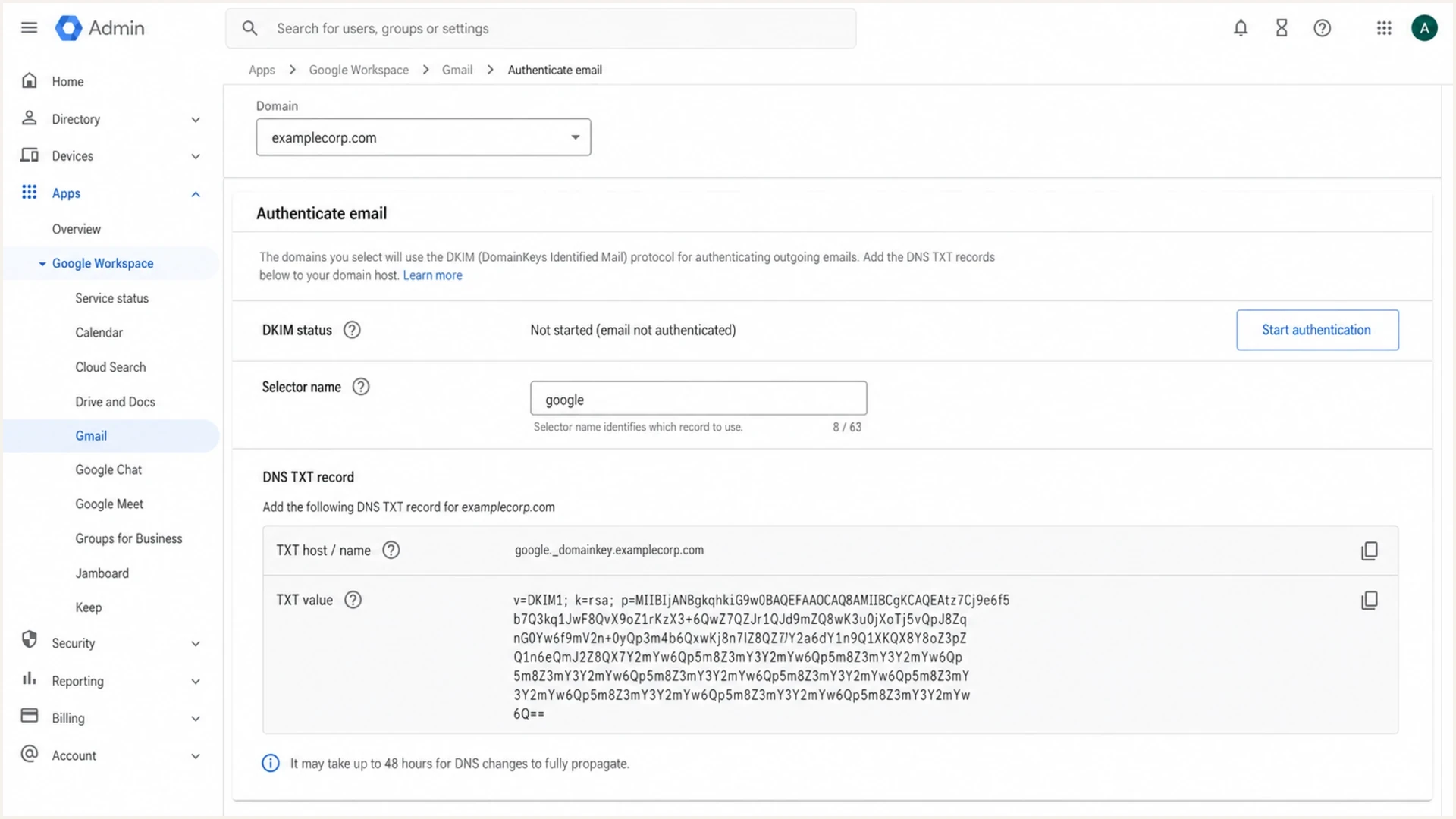
Google Admin console showing where DKIM authentication is managed for a custom domain.
If the route is a self-hosted server or VPS, check the infrastructure too. The sending IP should have a PTR record, the PTR hostname should resolve back to the same IP, the hostname should not look like a dynamic broadband address, and the server should offer TLS.
Also confirm the domain can receive replies. A missing MX record, a broken Reply-To address, or a From address that does not match the person readers expect adds friction for both recipients and filters.
If the domain forwards mail into another mailbox, treat forwarding as part of the route. Forwarding often breaks SPF, so DKIM needs to survive unchanged, and services that support ARC or SRS give receivers a cleaner chain to evaluate.
A custom domain does not need a website to send personal mail, but a domain that opens to a parked page, DNS error, or broken certificate weakens manual trust checks. If the domain is visible in the address or signature, use a small page or a working 301 redirect to the main brand site.
Clean route
- Provider match: The mailbox sends through the same provider named in SPF and DKIM.
- DKIM signing: Outbound messages carry a valid DKIM signature for the custom domain.
- Header match: The visible From domain matches the authenticated domain closely enough for DMARC to pass.
- PTR and TLS: Self-hosted SMTP has matching PTR and forward DNS plus TLS.
- Reply path: The domain has MX records and replies go to a working mailbox.
Messy route
- Old SMTP: A desktop client sends through an ISP server that the domain never authorized.
- Website mail: A contact form uses the personal address as From instead of routing through the mailbox provider.
- Forwarding path: Forwarded messages break SPF and rely on DKIM to survive recipient checks.
- Generic PTR: A VPS hostname or missing PTR does not match the mail server identity.
- No inbound mail: The domain sends mail but has no MX record or a broken Reply-To address.
For a one-person domain, the simplest fix is often to use the mailbox provider's own webmail or official SMTP settings everywhere. That keeps the sending IP, SPF include, DKIM signature, From header, and reply path on the same route.
Step 2, set SPF, DKIM, and DMARC
SPF says which servers can send for the domain. DKIM adds a cryptographic signature. DMARC tells receivers what to do when SPF and DKIM do not produce a domain match with the visible From address, and it sends reports that show which sources are using the domain.
DMARC passes when either SPF passes and its MAIL FROM domain has the required relationship to the visible From domain, or DKIM passes and its signing domain has that relationship. Under the default relaxed alignment, the domains can use different subdomains of the same organizational domain. Strict alignment requires an exact domain match. A simple SPF or DKIM pass is not enough when its authenticated domain does not match the visible From domain.
Current DMARC guidance comes from RFC 9989, with aggregate reports defined separately in RFC 9990 and failure reports in RFC 9991. For a personal domain, the practical sequence stays simple: publish one _dmarc record, collect aggregate reports, fix legitimate sources, then move policy only when routine mail passes through a matching SPF or DKIM path.
Treat SPF as one space-separated TXT record at the sending domain. Copy each provider include exactly, add it once, and keep the record under the 10 DNS lookup limit. Multiple SPF TXT records at the same hostname or a malformed include such as include: _spf.example create SPF errors instead of extra trust.
If the sender uses Google Workspace, the SPF record usually includes Google's mail servers, DKIM is generated inside Google Admin, and DMARC is published at the domain's DNS host. A domain health checker is useful because it checks the domain as a set, not as isolated DNS records.
Example SPF record for Google Workspacedns
example.com TXT v=spf1 include:_spf.google.com ~all
Example DKIM selector recorddns
google._domainkey.example.com TXT v=DKIM1; k=rsa; p=MIIB...
For DKIM, use the provider's current selector and retire old selectors only after the new signature appears on real outbound mail. Gmail requires at least a 1024-bit DKIM key for mail to personal Gmail accounts and recommends 2048 bits when the DNS provider supports long TXT values.
Safe starter DMARC recorddns
_dmarc.example.com TXT v=DMARC1; p=none; rua=mailto:dmarc@example.com
Start with reporting
Do not jump straight to p=quarantine or p=reject on a domain with unknown senders. Use p=none first, read the reports, fix every legitimate source, then stage the policy. Do not use the old pct tag as the rollout plan; use reporting and policy staging instead.
?
What's your domain score?
Deep-scan SPF, DKIM & DMARC records for email deliverability and security issues.
DMARC aggregate reports arrive as machine-readable files, so a dedicated reporting address prevents a personal inbox from filling with raw data. With DMARC monitoring, Suped parses the reports and shows whether Google Workspace, Microsoft 365, a website host, a scanner, or an unknown source is sending as the domain.
Step 3, test a real email
DNS checks tell you whether the records exist. A real email test tells you whether a message sent from the actual mailbox passes SPF, DKIM, and DMARC, and whether the content introduces risk. Send a normal message with a real subject line to an email tester before changing everything at once.
When a recipient can share the failed message, inspect the full original headers. Look for Authentication-Results, Received-SPF, DKIM, DMARC, Message-ID, and spam-scoring lines added by the receiving gateway. For Microsoft 365 failures, also check compauth, X-Forefront-Antispam-Report, CAT:SPOOF, SFTY, and SCL. A forwarded screenshot of the spam folder is less useful than the original message as an attachment.
Use local gateway scoring lines as clues, not as a universal Gmail or Outlook verdict. A score near the receiver's threshold matters when a corporate gateway or self-managed server enforces that threshold. A small rule hit points to something to review, such as HTML-only content, a suspicious subject, or malformed headers, but authentication failures, blocklist or blacklist listings, and complaints still come first.
Email tester
Send a real email to this address. Suped shows a results button when the test is ready.
?/43tests passed
Run at least two tests. First, send a plain text message with no links, no image signature, and no attachment. Second, send the normal message that lands in spam. If the plain message passes and the normal message struggles, content is the next suspect.
Fix order by evidence
Use the test result to choose the next action instead of changing DNS and content at the same time.
Authentication fails
First
Fix SPF, DKIM, and DMARC before content tweaks.
Auth passes, spam remains
Second
Check reputation, links, images, and recipient history.
Plain text inboxes
Third
Rebuild the signature and links in small steps.
Do not use only one recipient as proof. Test Gmail, Microsoft, and at least one business mailbox if those are the audiences that matter. If Gmail rejects or defers mail, keep the SMTP text because a 5.7.26 error points to authentication or policy problems and a 4.7.28 error points to an unusual sending rate. If only one recipient reports spam, verify the exact address, recipient-domain spelling, alias, and forwarding path before treating it as a domain-wide failure.
Do not rely on a provider allowlist. Gmail does not accept sender allowlist requests, and a recipient safe-sender action only helps that recipient. Fix the evidence in authentication, routing, content, and reputation.
Step 4, check reputation and blocklists
A custom domain can go to spam because the domain appears in a message body, even when the sending IP is clean. This matters for personal domains with websites, portfolios, old plugins, hacked forms, or stale redirects. A URI blocklist (blacklist) listing can hurt messages that include the domain as a link.
Also check domain history when the domain is new to the sender. A reused domain can carry reputation from old websites, abandoned redirects, malware cleanup failures, or previous mail streams. If the signature links to that domain, the website history becomes part of the message's risk profile.
For recurring problems, blocklist monitoring is better than a one-off lookup because listings can appear, clear, and return if the root cause remains.
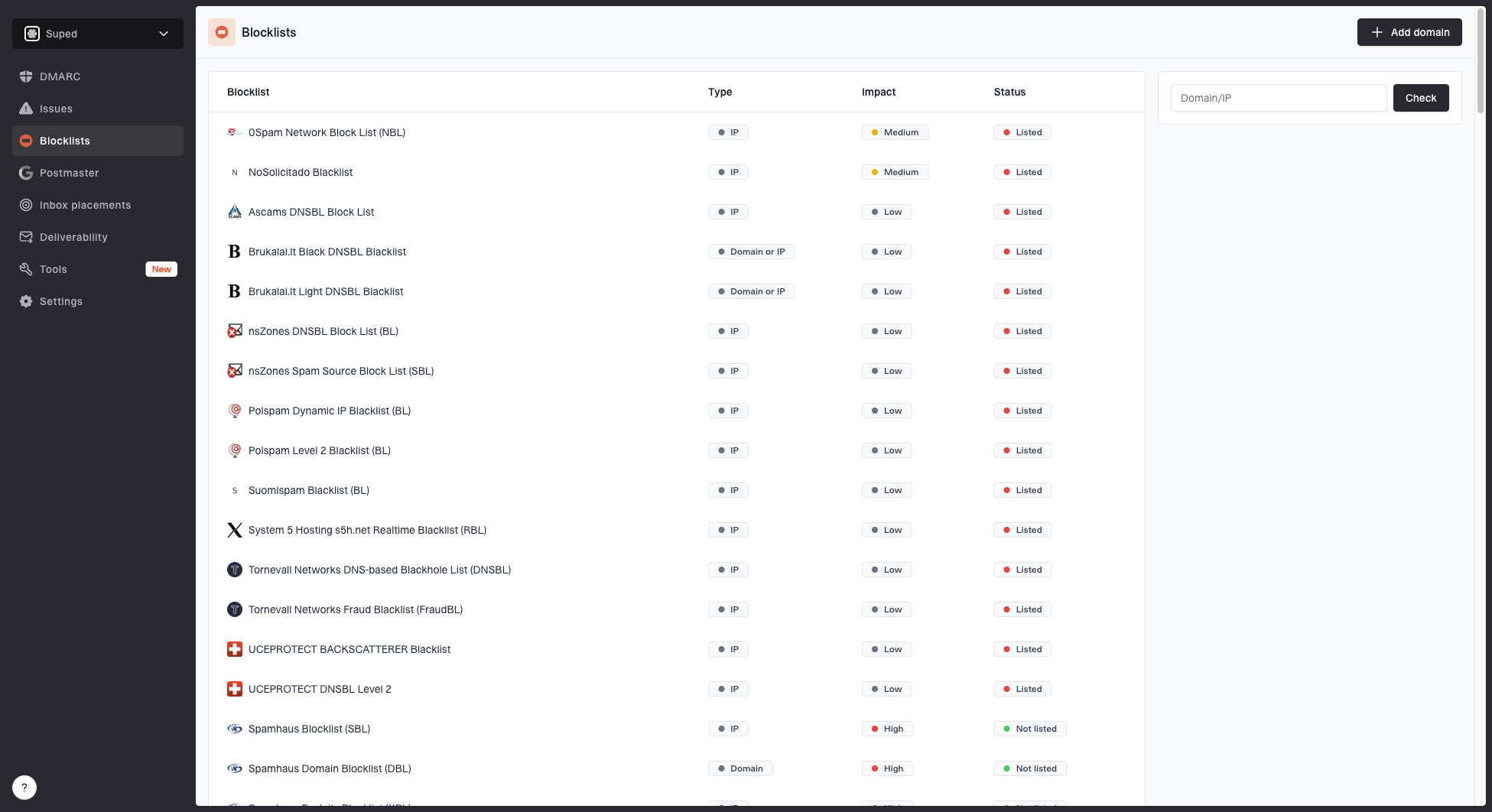
Blocklist monitoring page showing domain and IP checks across blocklists with importance and status
- Find the listing: Check the exact domain, subdomain, and sending IP involved in the failed message.
- Fix the cause: Remove hacked pages, bad redirects, malware, spammy forms, or abandoned marketing links.
- Request removal: Submit the delisting request only after the domain no longer triggers the listing reason.
- Monitor recurrence: Watch the domain and IP after removal so the issue does not quietly return.
Do not delist before fixing
Repeatedly asking for removal without fixing the website, link, or sending problem can waste time and leave the sender with the same spam outcome. Treat a blocklist or blacklist listing as evidence, then find the condition that created it.
Step 5, reduce content risk
If authentication passes and reputation looks clean, strip the message down. Personal senders often have risky content without realizing it: a blank or vague subject, mismatched From and Reply-To headers, a heavy HTML signature, logo images hosted on a weak domain, multiple phone-tracking links, short links, old social badges, PDF attachments, or a website URL that has been listed before.
Keep the display name plain and accurate. Do not fake Re: or Fwd:, hide HTML text, or use link text that masks the destination. Those details can make an otherwise normal personal message look misleading to mailbox filters.
Keep while testing
- Plain text: Use a short message that looks like a normal person wrote it.
- Clear subject: Use a specific subject line that matches the message.
- Simple signature: Use name, role, company, and phone number without logos or tracking links.
- Direct reply: Ask a known recipient to reply after moving the message to the inbox.
Remove while testing
- Image signature: Remote images add another reputation signal and can look promotional.
- Short links: Redirectors and trackers make filters inspect another domain chain.
- Attachments: Send files after trust improves, or use a clean direct link when needed.
For a contractor, consultant, or local business owner, the fix often feels too simple: send a normal text email, with a short signature, through the proper mailbox provider. That removes enough noise for mailbox filters to see the message as ordinary person-to-person mail.
For imported contact lists, normalize recipient domains and catch obvious typos such as gmial.com or repeated .com.com endings before more tests. Regex handles known patterns; fuzzy matching handles one-character insertions, deletions, and swapped letters that create bounces.
If the personal domain also sends newsletters, invoices with promotional inserts, or recurring updates, do not mix them with direct person-to-person mail. Use a stable From address for each mail type, send only to opted-in recipients, add unsubscribe handling for subscribed mail, and keep volume steady instead of sending bursts from a cold domain. For image-heavy or link-heavy subscribed mail, reduce the HTML weight, keep the main action obvious, and make the unsubscribe link visible before any clipped footer. High complaints, stale recipients, and hidden unsubscribe paths hurt the domain faster than image count alone. For bulk or subscribed mail, Gmail and Yahoo expect one-click unsubscribe support when their sender requirements apply; Gmail's 5,000 messages per day threshold makes that requirement explicit for Gmail accounts.
Step 6, secure the account and stop unauthorized sending
If inbox placement worsened suddenly, check for a compromised mailbox, SMTP password, app password, API key, or relay. Messages sent through valid credentials can pass SPF, DKIM, and DMARC because they use the legitimate sending route. Authentication proves that the domain authorized the route; it does not prove that the account owner intended each message.
Do not rely on the Sent folder alone. SMTP, API, and relay traffic does not always save a copy there. Review the mailbox provider's audit and sending logs for unexpected volume, unfamiliar IP addresses, new forwarding rules, unknown app access, changed recovery details, and new aliases or delegates.
- Contain access: Change the password, require MFA, sign out active sessions, and remove unknown recovery methods.
- Rotate sending credentials: Replace SMTP passwords, app passwords, API keys, and relay credentials used by the domain.
- Remove persistence: Review forwarding rules, inbox rules, delegates, OAuth grants, and connected applications.
- Close unsafe routes: Disable unused SMTP access and confirm that no self-hosted server accepts unauthenticated relay traffic.
- Track recovery: Compare daily volume, bounces, complaints, DMARC sources, and blocklist or blacklist status after containment.
Suped's DMARC reporting can show unexpected sources using the domain and confirm whether they disappear after containment. Mailbox-provider audit logs are still needed to identify the account, application, or credential responsible.
Where Suped fits
Suped is our DMARC and email authentication platform. It fits this workflow by turning DMARC reports, DNS checks, and reputation signals into specific actions: which source failed, whether it is legitimate, what DNS change fixes it, and whether a reputation issue is returning.
For a personal domain, Suped helps when the owner does not want to read raw XML reports or memorize SPF and DKIM rules. For an MSP or agency, the same workflow scales across many small business domains from one dashboard.
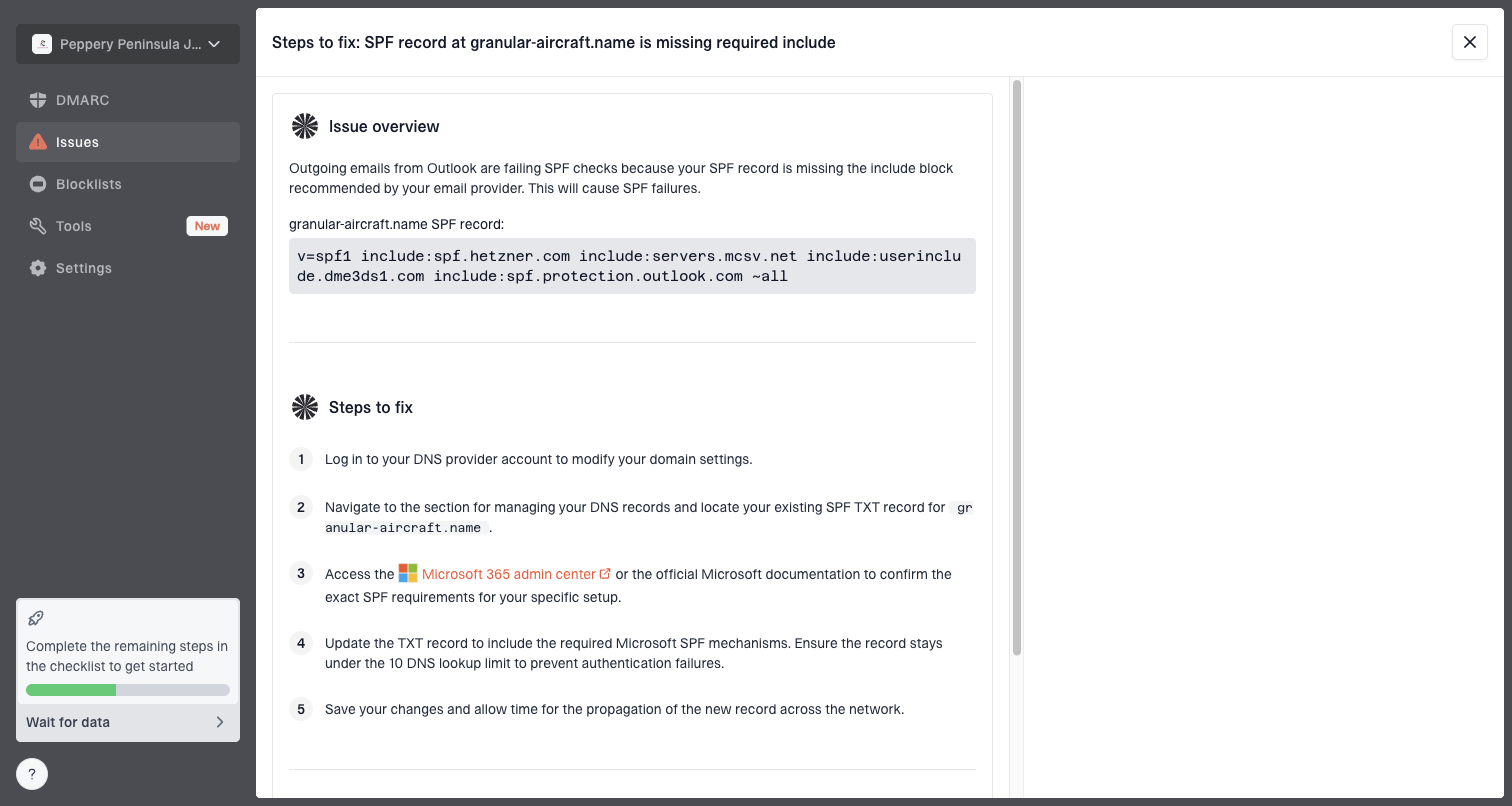
Issue steps to fix dialog showing the issue overview, tailored fix steps, and verification action
- Automated fixes: Suped detects authentication issues and gives steps that map to the affected source.
- Real-time alerts: Failures, spoofing patterns, and sudden changes get surfaced quickly.
- Unified checks: DMARC, SPF, DKIM, blocklist signals, and deliverability insights sit in one place.
- Hosted records: Hosted DMARC, Hosted SPF, SPF flattening, and Hosted MTA-STS reduce DNS maintenance.
- Multi-domain view: MSPs can manage client domains, reports, policy staging, and issue resolution cleanly.
The lightweight manual path works for one domain if someone technical owns it. Suped fits cases where the sender needs ongoing visibility, policy staging, and clear fixes without checking every record by hand.
Views from the trenches
Best practices
Check SPF, DKIM, and DMARC before changing content or asking recipients to mark it safe.
Test a plain text email first, then add signatures, links, and attachments back gradually.
Review domain and IP reputation together because spam filters inspect both signals.
Common pitfalls
Treating a personal mailbox as exempt from authentication causes avoidable spam placement.
Submitting delisting requests before fixing the domain issue often leads to repeat listings.
Assuming DNS is correct without testing a real sent message hides route-specific failures.
Expert tips
Use DMARC reporting at p=none to discover every source before enforcing a stricter policy.
Check links inside signatures because URI blocklist or blacklist hits can affect clean mail.
Keep the sending route simple by using the mailbox provider web app or official SMTP.
Marketer from Email Geeks says a custom-domain personal sender still needs SPF and DKIM because inbox providers evaluate the domain, not the sender's intent.
2019-08-14 - Email Geeks
Marketer from Email Geeks says links and images in a personal signature can be enough to create spam placement when the domain reputation is weak.
2019-08-14 - Email Geeks
The practical fix order
Fix the sending path before chasing mysterious reputation theories. If the mailbox provider is Google Workspace, Microsoft 365, or another hosted provider, send through that provider everywhere and make the DNS records match it. If the domain uses its own mail server, validate PTR, forward DNS, TLS, and headers before reputation work. Then add DMARC reporting so future problems show up with evidence.
- Confirm source and replies: Identify the exact provider, client, app, or server sending the mail, then verify MX, Reply-To, PTR, and TLS where they apply.
- Stop unauthorized sending: Review account activity, contain suspicious access, and rotate exposed sending credentials.
- Authenticate domain: Publish one valid SPF record, enable DKIM, and add DMARC reporting.
- Run tests: Compare a plain text message with the normal message that lands in spam.
- Check reputation: Investigate domain, IP, and URI blocklist or blacklist signals.
- Simplify content: Remove risky signature elements and rebuild only after inbox placement improves.
When all six steps are clean and mail still goes to spam at one provider, the issue is usually recipient-side history or provider-specific reputation. Ask known recipients to move the message to the inbox, add the sender to contacts, and reply. Keep sending volume steady, then monitor authentication and blocklist status while reputation recovers.




