
Do duplicate Microsoft JMRP spam complaints affect sender reputation?

Published 25 Jul 2026
Updated 26 Sep 2026
10 min read
Summarize with
Updated on 26 Sep 2026: We updated this guide with ARF parsing details and an idempotent workflow for duplicate complaints.
Duplicate Microsoft JMRP complaint copies for the same message, recipient, timestamp, and sending IP do not multiply the reputation damage caused by the original complaint. For the confirmed reporting incident described here, the extra copies had no separate reputation impact. The first complaint was still valid, and unrelated reputation problems still required investigation.
Deduplicate the reporting data for analysis, suppress the complaining recipient as normal, and keep watching Microsoft delivery. Do not dismiss every complaint or stop sending to all Microsoft recipients solely because the raw complaint rate jumped. A batch of eight reports with the same Message-ID, recipient, timestamp, and sending IP is one complaint reported eight times, not evidence that eight people complained.
What the finding means
Treat confirmed duplicate JMRP rows as reporting noise in your own rate calculation. Keep the first event, preserve every raw row for audit, and investigate any delivery decline that remains after deduplication.
Why the complaint rate can look much worse
JMRP is Microsoft's complaint feedback loop for its Outlook.com consumer mailbox network. When a user marks a delivered message as junk, an enrolled sender can receive an Abuse Reporting Format (ARF) complaint message containing machine-readable feedback and a copy of the reported message or its headers. JMRP should not be treated as a complete complaint feed for every mailbox hosted on Microsoft 365.
During the duplicate-reporting pattern, senders saw several complaint events for the same Message-ID and recipient, often stamped at the same moment or within a very short interval. Some clusters contained eight copies, while larger clusters reached roughly twenty.
A dashboard that counts feedback-loop rows without deduplication turns one human action into several numerator events. If 100 messages were delivered and one recipient action generated eight rows, the raw internal calculation shows 8%. A unique-event calculation shows 1%. Neither number reveals Microsoft's internal reputation score, but the unique rate describes recipient behavior more accurately.
Duplicate reporting pattern
- Identity: Same Message-ID and recipient.
- Timing: Events arrive together or seconds apart.
- Scope: Spike concentrates in the JMRP feed.
- Delivery: No matching reputation decline appears.
Genuine complaint increase
- Identity: Different recipients or messages.
- Timing: Events follow separate deliveries.
- Scope: Complaints track an audience segment or source.
- Delivery: Junk placement or deferrals increase.
The distinction matters because a reporting anomaly and a reputation incident need different responses. The broader explanation of spam reports and reputation still applies to each genuine complaint. Duplicate copies only change how the feed should be counted.
How to prove the reports are duplicates
Start with event-level exports rather than a daily percentage. Daily summaries hide the fields needed to separate a repeated report from a separate recipient action. Preserve the original ARF message, then compare stable identifiers and arrival times. If the recipient is redacted, use a stable recipient token or a per-recipient identifier from the original message instead of guessing.
- Filter: Isolate Outlook.com, Hotmail.com, MSN.com, and Live.com complaint events.
- Group: Combine rows by Message-ID, recipient identity, complaint type, and sending IP.
- Compare: Check report identifiers, event timestamps, campaign IDs, and original headers.
- Count: Retain one canonical complaint per confirmed group.
- Verify: Compare raw and unique rates against delivery results.
|
|
|
|---|---|---|
Report or event ID | Exact match | Different values |
Message-ID | Exact match | Different values |
Recipient | Same address or token | Different users |
Timestamp | Same instant or seconds apart | Spread after separate sends |
Delivery evidence | Stable | Worsening |
Signals for classifying a JMRP complaint cluster
Do not deduplicate on Message-ID alone. A sender that incorrectly reuses Message-ID values can collapse separate deliveries, and a complaint about a later message can be real. Use the recipient dimension, complaint type, sending IP, and a narrow time window. Hash or tokenize recipient data in analytical stores, and keep both raw_event_count and unique_complaint_count so an analyst can reconstruct the decision.
Conceptual complaint fingerprinttext
fingerprint = message_id + "|" + recipient_token
fingerprint += "|" + complaint_type + "|" + source_ip
window = 60 seconds

if seen(fingerprint, window):
    tag_as_duplicate_copy()
else:
    keep_as_canonical_complaint()

report(raw_event_count, unique_complaint_count)
Do not erase the first complaint
The first report in each group still records a recipient's junk action. Suppress that address from the relevant mail stream, review why the person received the message, and retain the event in your unique complaint rate.
Make complaint processing idempotent
Duplicate data can enter at two layers. A transport retry can redeliver the same report, while a reporting fault can emit several records for one underlying junk action. Build the receiver as an idempotent processor so either case can be handled without repeating suppression changes or inflating analytics.
- Store: Save the raw report unchanged before parsing or acknowledging it.
- Identify: Use a stable report or event ID for exact redeliveries when one exists.
- Fingerprint: Otherwise combine Message-ID, recipient token, complaint type, source IP, and a narrow time bucket.
- Apply: Enforce the suppression once, but retain every received row for audit.
Make the event-ID insert atomic, such as with a unique database constraint, so concurrent workers cannot process the same transport retry twice. A fingerprint is a cautious fallback, not proof. Quarantine ambiguous clusters for review instead of automatically discarding them.
What Microsoft sees and what your dashboard sees
Microsoft's internal reputation system differs from both JMRP and SNDS. JMRP forwards complaint messages to enrolled senders. SNDS reports IP-level traffic and complaint data. Neither exposes the full internal weighting that Microsoft applies to a junk action, so sender-facing row counts should not be treated as a direct reputation score.
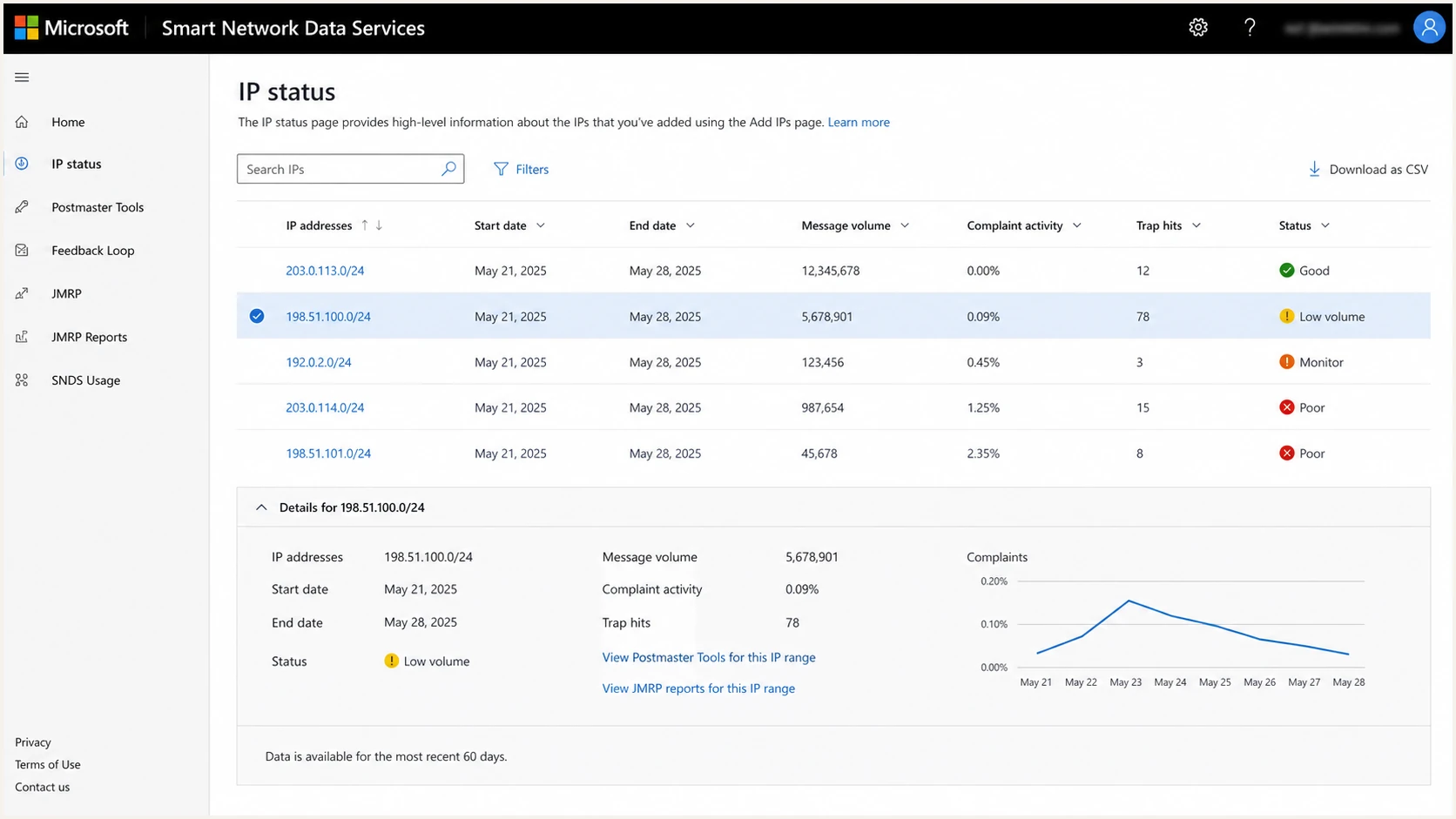
Microsoft SNDS screen showing IP status and complaint activity.
Compare the deduplicated rate with acceptance, deferrals, junk placement, and Microsoft IP status. If those signals remain stable while only the raw JMRP count jumps, duplicate reporting is the stronger diagnosis. If placement worsens or Microsoft begins throttling mail, investigate a real reputation issue even when duplicate rows are present. The guide to Microsoft spam-rate spikes covers the wider checks.
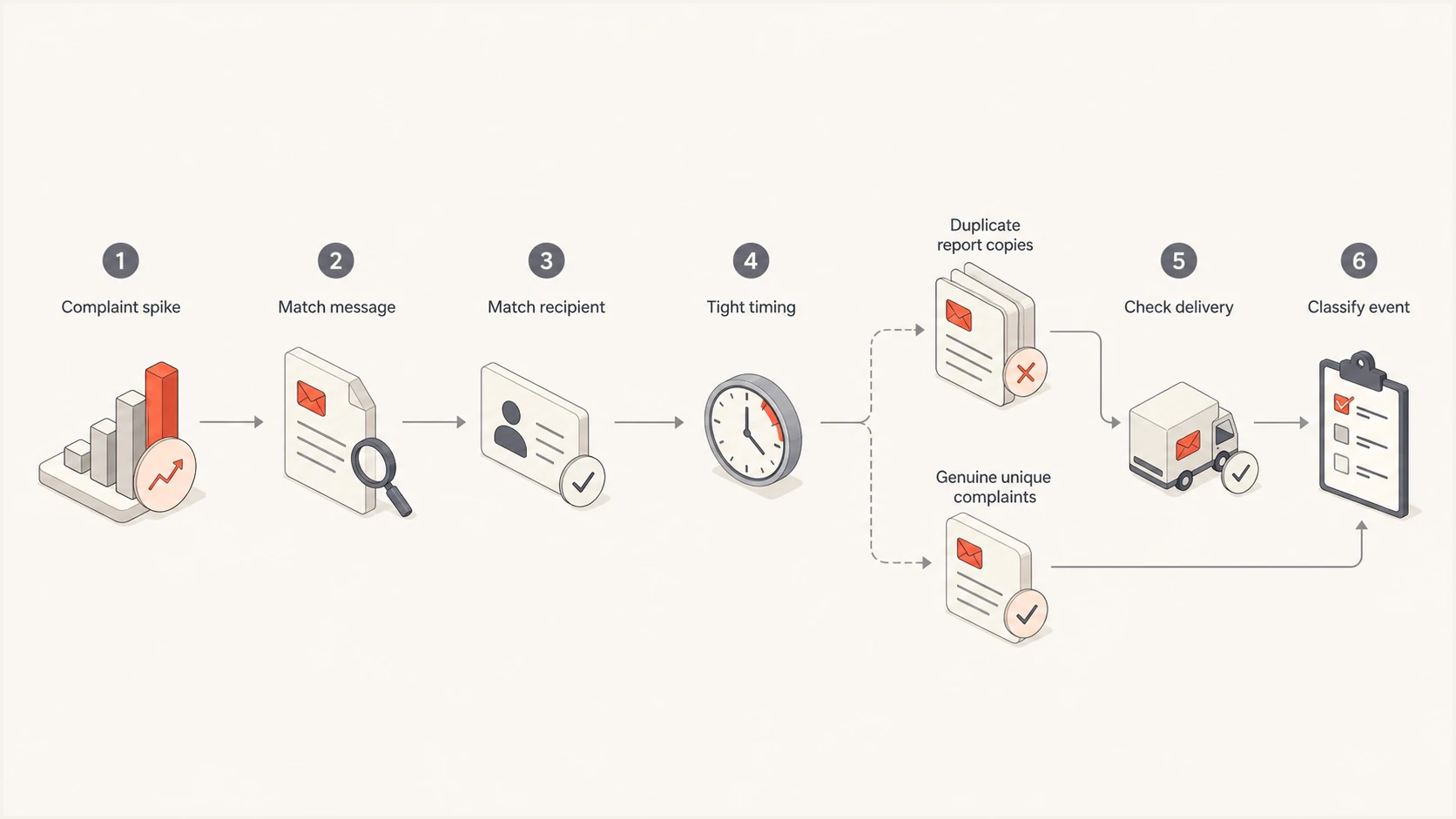
Flowchart for classifying duplicate and genuine JMRP complaints.
For the confirmed incident covered here, the feed emitted extra copies after Microsoft had classified the underlying complaint, and those copies had no additional reputation effect. Keep the operating rule narrow: deduplicate only clearly matching copies, treat the canonical complaint as real, and judge any remaining reputation movement on its own evidence.
How to respond without creating a second problem
Removing every Microsoft address from marketing sends can reduce immediate exposure, but it also removes fresh positive engagement and produces less current reputation data. Reserve a full pause for evidence of genuine harm, such as broad complaint growth, sustained junk placement, or repeated deferrals. For a duplicate-feed incident, a controlled response preserves more useful evidence.
- Suppress: Remove each canonical complainant from the relevant stream immediately.
- Segment: Send first to recently engaged Microsoft recipients.
- Stabilize: Avoid sharp volume changes while the feed is noisy.
- Measure: Track raw complaints and unique complaints separately.
- Test: Send a real message through the email tester and inspect its authentication results.
A complaint cluster can coexist with a separate problem. Check whether the campaign changed its audience source, sending frequency, permission language, subject style, or unsubscribe path. Confirm that the visible unsubscribe and one-click mechanism work, then verify that the sending domain and IP did not change. If unique complaints rose before the duplicates appeared, the duplicates are exaggerating a real issue rather than creating the whole spike.
Escalate when delivery also changes
Treat sustained deferrals, new junk placement, a worsening Microsoft IP status, or unique complaints across many recipients as a real reputation incident. Duplicate JMRP copies do not explain those independent signals.
Separate JMRP noise from domain health
JMRP complaints measure recipient reactions. DMARC policy results and SPF or DKIM authentication results measure identity and authorization. Passing authentication does not cancel a complaint, and a duplicate complaint feed does not prove authentication is healthy. Check both layers because they answer different questions.
A quick domain health check confirms whether the domain has valid SPF and DKIM records plus a valid DMARC policy. It will not diagnose JMRP duplication, but it can rule out authentication regressions that happened at the same time.
?
What's your domain score?
Deep-scan SPF, DKIM & DMARC records for email deliverability and security issues.
Suped is our DMARC and email authentication platform. Its DMARC monitoring shows DMARC policy results together with SPF and DKIM authentication, automated issue detection, and remediation steps. Use the timeline to check whether an authentication failure began alongside the Microsoft complaint spike.
The same workflow can compare authentication health with blocklist monitoring (also called blacklist monitoring) and delivery evidence. Suped does not turn duplicate JMRP rows into proof of reputation damage. Event-level JMRP deduplication still belongs in the complaint pipeline or sending provider. Suped supplies independent domain evidence for checking whether a reporting artifact coincided with an authentication problem or a blocklist (blacklist) event.
Views from the trenches
Best practices
Keep raw and unique complaint counts so reporting changes remain visible and auditable.
Group by Message-ID, recipient token, source IP, and time before labeling duplicates.
Suppress the canonical complainant even when later copies are clearly reporting noise.
Compare complaint data with placement and deferrals before changing Microsoft volume.
Common pitfalls
Counting every feedback-loop row can turn one recipient action into an alarming rate.
Pausing all Microsoft mail removes fresh engagement data without proving real damage.
Deduplicating on Message-ID alone can hide separate deliveries and valid complaints.
Assuming every spike is feed noise can conceal a real audience or reputation problem.
Expert tips
Use a narrow time window and retain the original event identifier for later review.
Chart raw and deduplicated rates together so stakeholders can see the distortion.
Check Microsoft domains separately when other mailbox networks remain unchanged.
Investigate any delivery decline that continues after duplicate rows are removed.
Marketer view
Marketer from Email Geeks says multiple JMRP events can share one Message-ID, recipient, timestamp, and sending IP, making the displayed complaint rate much higher than the unique rate.
2026-07-15 - Email Geeks
Marketer view
Marketer from Email Geeks says the original complaint still deserves action even when repeated copies look unlike separate human behavior.
2026-07-15 - Email Geeks
Use the unique complaint as the decision point
Duplicate Microsoft JMRP copies do not compound sender reputation damage when they describe the same underlying complaint. Keep one canonical event, suppress that recipient, and calculate a unique complaint rate alongside the raw rate. Then use Microsoft delivery evidence to decide whether a separate reputation problem exists.
If delivery remains stable after deduplication, avoid a broad sending shutdown. If unique complaints, deferrals, or junk placement worsen, act on those signals directly. That separation prevents a noisy feedback loop from driving a volume change that makes diagnosis harder.