
How to set up DMARC/DKIM/SPF for Webmercs

Published 22 Nov 2026
Updated 22 Nov 2026
10 min read
Summarize with
Set up Webmercs email authentication by confirming your sending domain and custom Return-Path with Webmercs, publishing its approved SPF and DKIM records, and adding one DMARC TXT record to your DNS. Start a new DMARC deployment with p=none, then test actual shop emails before increasing enforcement. Keep an existing quarantine or reject policy in place.
I verify an actual Webmercs message before treating setup as complete. SPF must pass for the envelope sender, and DKIM must verify the message signature. DMARC passes when at least one passing method has the required domain match with the visible From address.
Add your domain
I use Webmercs support to confirm sender-domain provisioning and the records for the specific shop. Webmercs lists support@webmercs.com and an online support request form on its website.
- Identify the sender: Record the shop hostname and intended From address, such as orders@example.com. Confirm access to the authoritative DNS zone for example.com.
- Open a support request: On the Webmercs website, open Contact. Select the relevant topic, enter a subject and your email address, then describe the shop and sending domain in Message.
- Request authentication: Ask support to provision your sending domain, configure a custom Return-Path under it, and supply the exact SPF authorization and DKIM record names, types and values.
- Verify ownership: If support supplies a domain-verification TXT or CNAME record, publish it exactly and ask support to confirm validation. Request confirmation that the sender settings apply to each shop using the domain.
A storefront domain and an authenticated email domain are separate configurations. I ask support to confirm the visible From domain, envelope sender and DKIM signing domain explicitly.
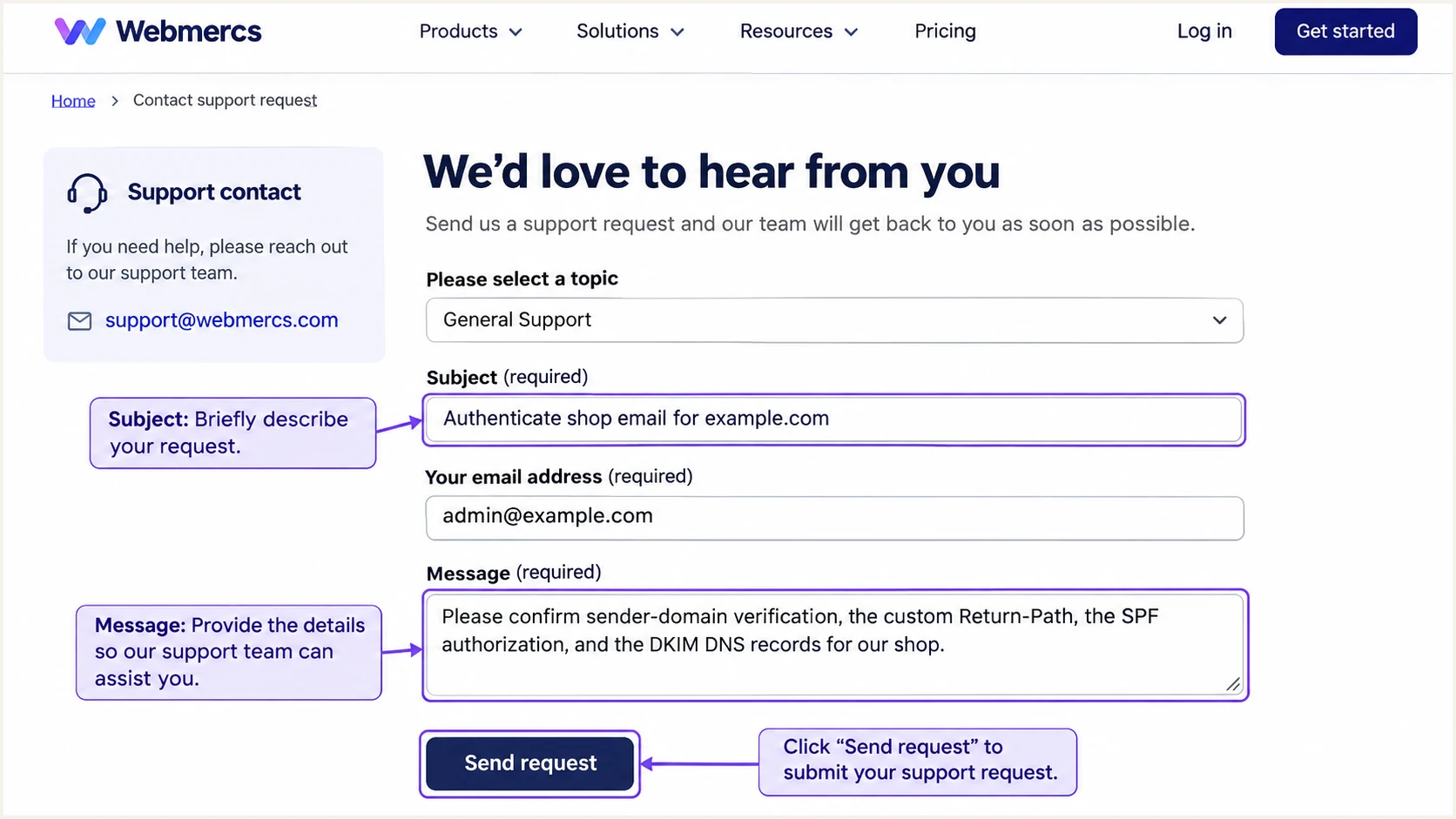
Webmercs support request form for confirming email authentication records.
Use the support reply as the source for account-specific DNS values. The public admin material reviewed does not establish a current DKIM setup menu or a universal selector.
I keep the approved record names and values with the shop configuration so later changes can be checked against the original setup.
Set up SPF
Webmercs supports Return-Path alignment. Request a custom envelope sender such as bounce.example.com when the visible From domain is example.com. These domains match under relaxed SPF alignment; strict alignment requires an exact domain match.
- Confirm the route: Ask support whether include:_spf.webmercs.com is the correct authorization for this shop. Use the value support confirms for the active outbound route.
- Find the SPF hostname: Check the domain used in the actual Return-Path. Publish SPF there when Webmercs instructs you to use TXT; follow its exact records if setup instead uses CNAME delegation.
- Edit one record: If SPF already exists at that hostname, merge the approved authorization before its final all mechanism. Preserve existing senders and keep exactly one SPF record at that name.
- Check the limit: Keep the evaluated SPF policy within the limit of 10 DNS-lookup terms, including nested includes. Ask support to activate the custom Return-Path and send a fresh message.
Conditional SPF value, only if Webmercs confirms this includetext
v=spf1 include:_spf.webmercs.com -all
This example is for a hostname that sends only through the confirmed Webmercs infrastructure. It is not a replacement for a shared SPF record containing other legitimate senders.
Run the SPF checker against the exact envelope-sender domain. SPF records on example.com do not automatically apply to bounce.example.com.
SPF checker
Find SPF syntax issues, lookup limits, and weak records.
?/16tests passed
A successful DNS check confirms the published policy. I also inspect a delivered Webmercs email to confirm that its sending IP passes that policy.
If the active route still uses a Webmercs-owned Return-Path, adding SPF to your own domain will not fix that domain mismatch. A passing DKIM signature using your domain can still provide the domain match DMARC requires.
Set up DKIM
Ask Webmercs to enable DKIM signing with your domain. Publishing a public key works only when the outbound server signs messages with the matching private key. I confirm both sides of that setup.
- Obtain the records: Request the signing domain, selector and complete DNS entries for this shop. Use the supplied TXT public key or CNAME target without inventing a selector.
- Publish in DNS: Add each record at the exact selector hostname supplied by support. Check whether your DNS editor automatically appends the domain to the Host or Name field.
- Activate signing: Ask support to confirm that DKIM signing is active after DNS validation. Check each sending route, including order emails and any promotional mail sent through the shop.
- Verify the signature: Send a new Webmercs email. In DKIM-Signature, read d= for the signing domain and s= for the selector. Confirm a receiver-reported DKIM pass and the required match with the From domain.
SPF route
Checks the sending IP against the envelope-sender domain. A custom Return-Path provides your domain match when configured correctly.
DKIM route
Checks a message signature against the d= signing domain. A passing signature with the required From-domain match can pass DMARC even when SPF lacks that match.
For From: orders@example.com, a passing DKIM signature with d=example.com satisfies the domain match under relaxed or strict DKIM alignment. A different domain owned by Webmercs does not.
Confirm that your Webmercs route supports custom-domain DKIM. If it does not, DNS publication cannot add signing. Passing SPF with a matching custom Return-Path can still pass DMARC; ask support about a route that also supports DKIM.
Set up DMARC
Publish DMARC for the domain in the visible From address. A new deployment should use p=none while you inspect reports and correct legitimate senders.
- Check the existing policy: Look up _dmarc.example.com first. Edit an existing record instead of adding another DMARC record at the same hostname.
- Create the TXT record: For a new deployment, add the value below at _dmarc.example.com. Use _dmarc as the host if your DNS editor appends example.com automatically.
- Set the report recipient: Replace dmarc@example.com with a working mailbox or your assigned aggregate-report address. A mailbox receives report files; it does not automatically analyze them.
- Validate the publication: Save the record, allow cached DNS answers to expire, and check the exact From domain below. Confirm the policy and reporting address are the values you intended.
Starter DMARC TXT value for _dmarc.example.comtext
v=DMARC1; p=none; rua=mailto:dmarc@example.com
Use the DMARC record generator to build the record with your real reporting address. The example address must be replaced before publication.
If the reporting address belongs to another domain, follow the receiving service's external-report authorization instructions. Keep one DMARC policy record at the applicable hostname.
DMARC checker
Look up a domain's DMARC record and catch policy issues.
?/7tests passed
This checker validates DNS publication. A real Webmercs message is still needed to verify SPF, DKIM and the domain match that produces a DMARC pass.
A p=none policy does not request quarantine or rejection for DMARC failures. Receivers still apply their own filtering and delivery rules.
Keep existing enforcement
If your domain already uses p=quarantine or p=reject, keep that policy while configuring Webmercs. Preserve its reporting destinations and other intentional settings.
Verify and troubleshoot
I test actual Webmercs messages for each sending route. A manual email sent through an employee mailbox does not test the servers sending your shop's order confirmations.
The email tester supplies a recipient address. Send a real shop message to that address to get a diagnosis of the message that Webmercs actually delivers.
- Use a controlled recipient: Use the tester address in a permitted test order or shop notification. Avoid a paid order or an email to a real customer solely for testing.
- Inspect receiver results: Check the receiving server's Authentication-Results. Look for SPF pass, DKIM pass and DMARC pass, then compare smtp.mailfrom, header.d and header.from.
- Test every route: Repeat for order confirmations and other enabled notifications. Test promotional emails separately if they use a different sending route.
- Retest after changes: Wait for the affected DNS TTL, then generate a new message. Previously delivered messages retain their original authentication results.
Email tester
Send a real email to this address. Suped shows a results button when the test is ready.
?/43tests passed
An SPF pass for a Webmercs-owned domain is not enough for your domain's DMARC check. Check the domain match as well as the raw authentication result.
When a test fails, correct the specific cause below. I include the full headers and sending IP in a Webmercs support request so support can identify the affected route.
|
|
|
|---|---|---|
SPF permerror | Duplicates or limit | Fix SPF policy |
SPF mismatch | Shared Return-Path | Set custom domain |
DKIM none | Signing inactive | Ask support |
DKIM fail | Key or content issue | Check DNS and signer |
DMARC fail | No passing domain match | Fix SPF or DKIM |
Diagnose the receiver-reported result before changing DNS.
Get alerted when it breaks
I use continuing DMARC reporting to detect failures after the initial test. Suped is our DMARC and email authentication platform, with issue notifications and source-level diagnostics for investigating changes to Webmercs traffic.
Suped's DMARC monitoring connects reported failures to sending sources and gives steps to fix detected issues. Keep aggregate reports flowing to its assigned reporting destination for this workflow.
- Enable issue emails: In Suped notification settings, enable Issues detected and choose the responsible recipients. Use these notifications to investigate newly detected authentication problems.
- Review new senders: Enable Sending sources need verification. Confirm a source with your Webmercs configuration and support before marking it as legitimate.
- Investigate the record: Open the affected source and inspect SPF, DKIM and DMARC results in the detail view. Compare the sending IP and authentication domains with a fresh Webmercs test email.
- Confirm the fix: Follow the issue's steps to fix, correct the Webmercs or DNS configuration, and run verification. Confirm recovery in fresh messages and subsequent aggregate reports.
Reporting has a delay
DMARC aggregate reports arrive after receiver reporting periods, commonly daily. Suped notifications act on available data; a report-based alert is not an immediate check of every individual message.
I use a new test email for immediate confirmation after a DNS or Webmercs change, then use Suped to check whether production traffic stays healthy.
Secure your domain with p=reject
Move to p=reject after legitimate Webmercs traffic and your other authorized senders consistently pass DMARC. I use Suped's source records to check readiness across the domain before changing enforcement.
- Inventory legitimate senders: Review verified and unverified sources in Suped. Confirm low-volume senders as well as the main shop route, and investigate failures before approving a source.
- Cover a full sending cycle: Observe every normal shop workflow and scheduled campaign. Include infrequent sends and investigate forwarding-related failures; a single successful test is insufficient.
- Stage enforcement: For a new deployment, move from p=none to p=quarantine, review reports and delivery outcomes, then use p=reject when legitimate failures are resolved. Keep existing enforcement during Webmercs onboarding.
- Keep monitoring: Retain your reporting destinations and check the published record after each change. Revisit Webmercs configuration when a new sending route or domain appears.
Final DMARC TXT example, retain your real reporting addresstext
v=DMARC1; p=reject; rua=mailto:dmarc@example.com
Suped's hosted DMARC manages policy changes in the dashboard after its DNS delegation is configured. Pair policy changes with source verification and issue diagnostics so each enforcement step has evidence behind it.
A p=reject policy asks receivers to reject messages that fail DMARC. Receiver handling remains subject to local policy. Review subdomain policy settings separately if your shop uses a From subdomain.
Frequency asked questions
Confirm the active sending route with Webmercs support. If support specifies include:_spf.webmercs.com, merge that mechanism into the single SPF record for the envelope-sender domain. Preserve other authorized senders. A custom Return-Path subdomain needs the records Webmercs specifies for that subdomain.
Yes. A passing DKIM signature with the required match between its d= signing domain and your visible From domain is sufficient for DMARC. I still request the supported custom Return-Path so SPF can provide a second authentication path with the required domain match.
DNS publication alone does not activate DKIM signing. Webmercs must sign messages using the matching private key and selector. Ask support to confirm activation, then send a new shop email and check the receiving server's DKIM result.
DMARC applies to the visible From domain rather than to a particular sending platform. Keep one applicable policy record and configure Webmercs to pass its checks. If a record already exists, preserve its reporting destinations and quarantine or reject policy.
If a sending IP has a verified PTR hostname under webmercs.com, investigate Webmercs as the source. Confirm the full hostname and IP with Webmercs support. A current, complete Webmercs rDNS suffix list was not established by the public documentation reviewed. Authorize a source using confirmed configuration and authentication evidence.




