
How to set up DMARC/DKIM/SPF for Videotron

Published 22 Nov 2026
Updated 22 Nov 2026
11 min read
Summarize with

For a custom domain sending through Videotron, publish the SPF authorization for your specific mail service, ask Videotron to configure DKIM signing for your domain, and add a DMARC TXT record at _dmarc. Verify a delivered message before enforcing DMARC. A passing SPF or DKIM result must also have a domain that matches your visible From address under DMARC's alignment rules.
I check domain ownership first. For an @videotron.ca mailbox, Videotron manages the domain's authentication records; you cannot change them yourself. The DNS steps here apply to a domain you own, such as example.com, on a Videotron service that supports custom-domain sending.
Add your domain
For a business service with custom-domain mail, confirm that Videotron has provisioned your domain before changing authentication records. Videotron's public mail-client instructions do not document a self-service domain-verification wizard.
- Confirm the service. Ask Videotron Business support whether your plan hosts mail for example.com or only provides an @videotron.ca address. An Internet subscription alone does not establish custom-domain mail hosting.
- Provision the domain. For an eligible plan, ask support to attach example.com and create the sending mailbox. Business technical support is 1 800 561-4248. Request the service's SPF authorization and custom-domain DKIM instructions.
- Verify ownership. If Videotron supplies a verification TXT record, publish its exact name and value at your authoritative DNS host, then ask support to confirm verification. Use only the verification method supplied for your account.
- Verify the mailbox. Open Videotron WebMail, enter the provisioned mailbox credentials and select Sign in. Confirm that a test message uses your intended From address. Successful sign-in establishes mailbox access, not DMARC compliance.
Run these lookups to identify your authoritative DNS provider and preserve the existing SPF and DMARC values. Make changes with the provider named by your domain's nameservers, even when the domain registration is elsewhere.
Inspect your domain before editing DNSbash
dig +short NS example.com
dig +short TXT example.com
dig +short TXT _dmarc.example.com
Videotron's 'How WebMail works' support article documents signing in with your email address and password. Use the mailbox supplied for your service; ask support which WebMail access applies if your custom-domain hosting uses a different system.
I keep the original MX records during authentication setup. MX controls incoming mail, and changing it is unnecessary for publishing SPF, DKIM or DMARC.
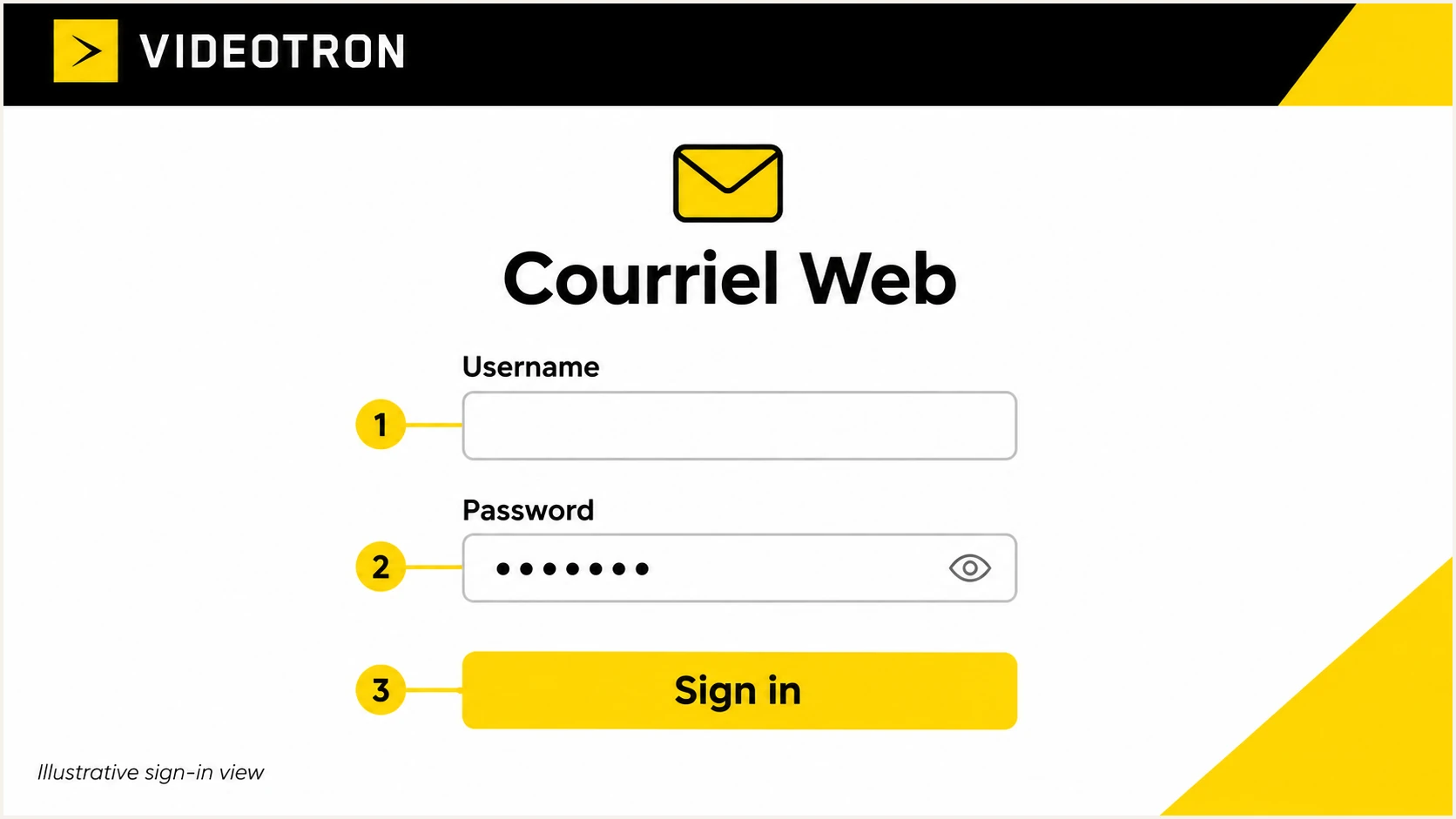
Illustrative Videotron WebMail sign-in view for checking mailbox access.
This sign-in view is an illustration of the documented login workflow. DNS ownership verification and DKIM activation require the instructions for your particular business mail service.
Set up SPF
I configure SPF for the envelope sender domain, shown in a delivered message's Return-Path. For custom-domain sending, have Videotron confirm that this domain stays under your control and matches the From domain under your DMARC settings.
- Get the authorization. Request the current SPF include or outbound IP ranges for your exact Videotron service. The public mail-client setup pages do not supply a universal customer SPF include.
- Edit one record. At the envelope sender domain, update the existing TXT record beginning v=spf1. Merge the confirmed authorization before its final all mechanism; preserve other legitimate senders. Publish only one SPF record at that name.
- Check DNS limits. Keep SPF evaluation within the limit of 10 DNS-querying terms, including nested includes. Fix duplicate records, missing include targets and lookup-limit errors before sending another test.
- Check the result. Send through the configured Videotron service. Require spf=pass and compare smtp.mailfrom with header.from. Setting a visible From address does not set the envelope sender.
Use service-specific SPF instructions
Do not copy the SPF record for Videotron's corporate domain or authorize its entire customer network. The SMTP submission hostname and your incoming MX records do not identify the complete outbound sending pool.
Enter the actual envelope sender domain into the SPF checker. If that is a subdomain, check that subdomain separately; SPF does not inherit the parent domain's record.
If your particular service keeps a Videotron-owned Return-Path, an SPF record on your own domain will not fix SPF alignment. In that case, DMARC can pass through DKIM with your domain. An SPF alignment warning is acceptable when that DKIM path passes.
SPF checker
Find SPF syntax issues, lookup limits, and weak records.
?/16tests passed
A valid DNS record confirms the policy is readable. A delivered message establishes whether the actual outbound IP is authorized. Test the same sending path used by your application or mailbox.
For the standard Videotron mailbox service, 'Configure your Videotron Business email' documents smtp.videotron.ca on port 465 with SSL/TLS and authentication. Use account-specific settings for other hosting or relay services.
Documented standard Videotron mailbox settingstext
Outgoing SMTP: smtp.videotron.ca
Port: 465
Encryption: SSL/TLS
Authentication: required
Username: full Videotron email address
Set up DKIM
DKIM requires the sending server to sign messages. Publishing a public key alone does not enable signing. I ask Videotron to confirm custom-domain DKIM support for the exact service before creating any selector records.
- Request signing. Ask support to enable DKIM using your domain as the signing domain. Obtain the selector, DNS name, record type and complete TXT value or CNAME target. Do not assume a selector such as default or selector1.
- Publish the record. Create the supplied TXT or CNAME at your authoritative DNS host. Check whether the editor appends example.com automatically so the domain is not duplicated. Never publish a private key.
- Activate signing. Have Videotron confirm DNS validation and activate signing for the mailbox or domain. If the service cannot sign with your domain, record that limitation before choosing your DMARC policy.
- Verify a message. Send a fresh message. Read d= and s= in DKIM-Signature, then confirm dkim=pass in the receiving server's Authentication-Results. The d= domain must match the From domain under DMARC rules.
Replace selector in these commands with the actual s= value. Query the name formed with the message's d= domain, which is not necessarily the visible From domain.
Inspect the actual DKIM selectorbash
dig +short TXT selector._domainkey.example.com
dig +short CNAME selector._domainkey.example.com
A Videotron-owned signing domain can authenticate Videotron's signature without authenticating your domain for DMARC. Check the signing domain as well as the pass result.
DNS publication
The supplied selector resolves to the correct public key or CNAME target. This confirms the verification material is available.
Message verification
The receiver verifies the signature and the signing domain matches your From domain under DMARC rules. This confirms the DKIM path contributes to a DMARC pass.
Set up DMARC
For a domain without DMARC, start with p=none to collect reports while fixing legitimate senders. If your domain already uses p=quarantine or p=reject, keep that policy and preserve its reporting destinations.
- Choose the name. Create or edit the TXT record at _dmarc.example.com. In an editor that appends your domain, enter _dmarc as the host. Keep one DMARC record at that name.
- Set the policy. For a new monitoring deployment, use the record shown here. Replace example.com with your own domain and replace dmarc@example.com with a working aggregate-report destination.
- Generate the value. Use the DMARC record generator to build the TXT value. Preserve an existing enforcement policy when updating reporting.
- Validate reporting. Save the record and check its public DNS response. For a report destination on another domain, complete the reporting authorization required by that destination's operator.
Initial monitoring TXT value at _dmarc.example.comtext
v=DMARC1; p=none; rua=mailto:dmarc@example.com
The reporting address in that record is an example, not an active destination for your organization. A normal mailbox receives aggregate XML attachments; a reporting platform processes those attachments into source-level results.
Run the DMARC checker for your visible From domain after saving. It verifies the published policy and reporting syntax; message authentication still requires a delivery test.
DMARC checker
Look up a domain's DMARC record and catch policy issues.
?/7tests passed
Allow existing DNS caches to expire according to the previous TTL, then query again. If the new value is absent, check the authoritative DNS zone and look for a duplicated domain suffix in the record name.
A p=none policy requests monitoring without DMARC enforcement. Receivers still apply their own spam and security policies, so publishing it does not guarantee acceptance or inbox placement.
Verify and troubleshoot
I verify the DNS response and a message received outside Videotron. Use Authentication-Results added by the receiving service; text inserted by the sender is not reliable evidence.
- Check public DNS. Query the envelope sender's SPF record, the actual DKIM selector and the From domain's DMARC record. Resolve missing records or duplicate SPF and DMARC policies.
- Send each path. Test Videotron WebMail and each configured application separately. A desktop client, website form and business relay can use different outbound infrastructure.
- Read the domains. Compare smtp.mailfrom and DKIM's d= with header.from. DMARC requires at least one passing authentication method with the required domain match; both methods do not have to pass.
- Escalate with evidence. For provider-side failures, send Videotron support the full bounce, timestamp with timezone and recipient-side message headers. Include the outbound IP and selector, while excluding passwords and private keys.
Illustrative receiver-side authentication resultstext
From: sender@example.com
Return-Path: <sender@example.com>
Authentication-Results: receiver.example;
    spf=pass smtp.mailfrom=example.com;
    dkim=pass header.d=example.com;
    dmarc=pass header.from=example.com
|
|
|
|---|---|---|
SPF permerror | Invalid policy | Repair SPF |
SPF domain mismatch | Provider Return-Path | Use matching DKIM |
DKIM missing | Signing inactive | Ask Videotron |
DKIM key missing | Wrong selector or DNS | Check d= and s= |
DMARC fail | No passing domain match | Fix SPF or DKIM |
Use the full receiver diagnostic to confirm the cause.
The email tester is the quickest configuration check: it gives you a destination, prompts you to send a message and returns a diagnosis of that received message. Use your normal Videotron sending account.
Send directly to the supplied address first. After the direct test passes, test any forwarding workflow separately because forwarding changes the SPF path and message modifications can invalidate DKIM.
Email tester
Send a real email to this address. Suped shows a results button when the test is ready.
?/43tests passed
Investigate a failed method even when DMARC passes through the other method. Matching DKIM is especially useful when forwarding changes the IP evaluated by SPF.
A successful test covers that message and sending route. Repeat it after a mailbox migration or an application SMTP change, and use aggregate reports to check the rest of your traffic.
Get alerted when it breaks
Suped, our DMARC platform, turns received authentication reports into source-level issues and fix steps. Its DMARC monitoring connects a change in Videotron traffic with the SPF or DKIM failure that needs attention.
For a domain already sending reports to Suped, I set notifications around legitimate source failures. An unfamiliar IP needs investigation before it receives authorization.
- Enable issue notices. In Notifications, enable Issues detected emails and configure the recipients responsible for DNS and mail hosting.
- Review new sources. Enable Sending sources need verification. Confirm a new source against your own sending inventory before marking it verified; a Videotron hostname alone is insufficient.
- Diagnose the failure. Open the affected record's detail view, inspect the SPF and DKIM domain results, and follow the issue's steps to fix. Check DNS history when a failure follows a record change.
- Confirm recovery. Send another test after the repair and confirm that fresh reports show legitimate Videotron traffic passing DMARC. Keep DMARC summary emails enabled for ongoing review.
Aggregate reports usually cover a daily reporting window. Suped's report-driven alerts depend on receivers delivering those reports; use a fresh email test to diagnose a failure happening now.
Monitor delivery separately
DMARC reports describe authentication and policy outcomes. Keep Videotron bounce messages and SMTP errors alongside Suped's findings when investigating delivery problems; a DMARC pass does not guarantee inbox placement.
Secure your domain with p=reject
I move to p=reject after legitimate sending paths pass DMARC across a representative business cycle, including infrequent billing or automated messages. Suped's source inventory and record details provide the evidence for that decision.
- Finish the inventory. In Suped, review verified and unverified sources. Match each legitimate source to an owner and confirm its passing SPF or DKIM domain. Do not authorize sources simply to increase the overall pass rate.
- Fix remaining senders. Resolve Videotron authentication failures and test forwarded mail. If custom-domain DKIM is unavailable, assess the forwarding impact of relying on SPF before enforcing rejection.
- Stage enforcement. For a domain currently on p=none, move to p=quarantine after legitimate sources pass, then inspect new reports and bounces before p=reject. Keep an existing quarantine or reject policy during repairs.
- Enforce and monitor. Change the existing policy to p=reject, preserve reporting, and review inherited subdomain policies. Investigate new failures in Suped and confirm recovery with fresh tests after each fix.
Suped's Hosted DMARC lets teams manage policy changes in the dashboard once its DNS delegation is configured. Pair policy staging with Suped's source checks and issue notifications so each enforcement change has evidence behind it.
For a manually managed TXT record, change the policy value after validation. The example keeps the same reporting address; replace it with your actual destination and retain any other required tags.
Enforcement TXT example after legitimate senders passtext
v=DMARC1; p=reject; rua=mailto:dmarc@example.com
Check subdomain coverage
Review explicit subdomain DMARC records and any sp or np policy before enforcing the parent domain. A parent p=reject can affect subdomains that inherit its policy. Keep reporting active to detect legitimate senders missed during testing.
Frequency asked questions
No. Videotron controls videotron.ca and its DNS records. Configure your mailbox using the supported SMTP settings and contact Videotron for provider-domain authentication failures. Publish your own authentication records only for a domain you control.
Get the current include or authorized outbound IP ranges from Videotron for your particular mail service. Its public mail-client instructions do not supply a universal customer include. Copying the corporate domain's SPF or using an SMTP hostname as an include without confirmation risks authorizing the wrong infrastructure.
Do not assume it does. Ask Videotron whether your service supports DKIM with your domain, obtain the service's selector records and confirm signing activation. Verify dkim=pass and the d= domain on a newly delivered message. A key published in DNS alone does not create a signature.
SPF can pass for a Videotron-owned envelope domain while the visible From address uses your own domain. That domain mismatch prevents SPF from satisfying DMARC. Use a supported custom Return-Path or a passing DKIM signature with the required domain match. DKIM can satisfy DMARC even when SPF alignment fails.
These names are associated with Videotron infrastructure. Videotron community message headers show smtp-out.videotron.ca outbound hosts. Videotron's security policy identifies modemcable.videotron.ca as a hostname pattern for residential or business customer connections. A customer connection is not proof of Videotron's managed mail service. Confirm the connecting IP and trusted receiver headers before attributing or authorizing a source.
Use observed legitimate traffic rather than a fixed number of days. Cover a complete sending cycle, verify every known sending route and resolve authentication failures before increasing enforcement. Suped's reports help check source-level results; keep notifications and aggregate reporting active after the policy change.




