
How to set up DMARC/DKIM/SPF for TPG

For a domain I control, I configure SPF for the actual outbound server, enable DKIM on the sending mail service, and publish DMARC in the domain's authoritative DNS. A reverse DNS hostname ending in tpgi.com.au identifies TPG network infrastructure; it does not supply the SPF include or DKIM selector for my domain.
For an @tpg.com.au address, the domain owner controls these records. TPG Support's "TPG email addresses have moved to The Messaging Company" notice confirms that opted-in consumer mailboxes moved to The Messaging Company. The custom-domain steps below apply when I control the sending domain and its DNS.
Confirm your sending service
I establish who operates the outgoing mail server before changing DNS. TPG internet connectivity, a TPG-owned email address and a business mail server using a TPG IP address need different handling.
- Find authoritative DNS. Run the lookup below for your domain. Edit records at the provider operating those nameservers, even when another company registered the domain.
- Inspect a real message. Send through the production application. Read the receiving server's Authentication-Results, Return-Path and Received headers to identify the outbound IP and envelope domain.
- Confirm the operator. Ask your current mail administrator for the supported outbound IPs or SPF include, custom envelope-sender settings, and DKIM selector records. For a migrated TPG mailbox, contact The Messaging Company.
Find the DNS provider for your own domainbash
dig +short NS example.com
TPG's public Email to SMS authentication guidance says to obtain SPF and DKIM settings from the email provider and pass them to the DNS provider. It does not document a general TPG custom-domain verification wizard.
For a custom domain, I have the actual mail operator provision it and complete any ownership challenge that operator supplies. I verify the published challenge with DNS and request confirmation before sending. There is no universal TPG verification token to copy.
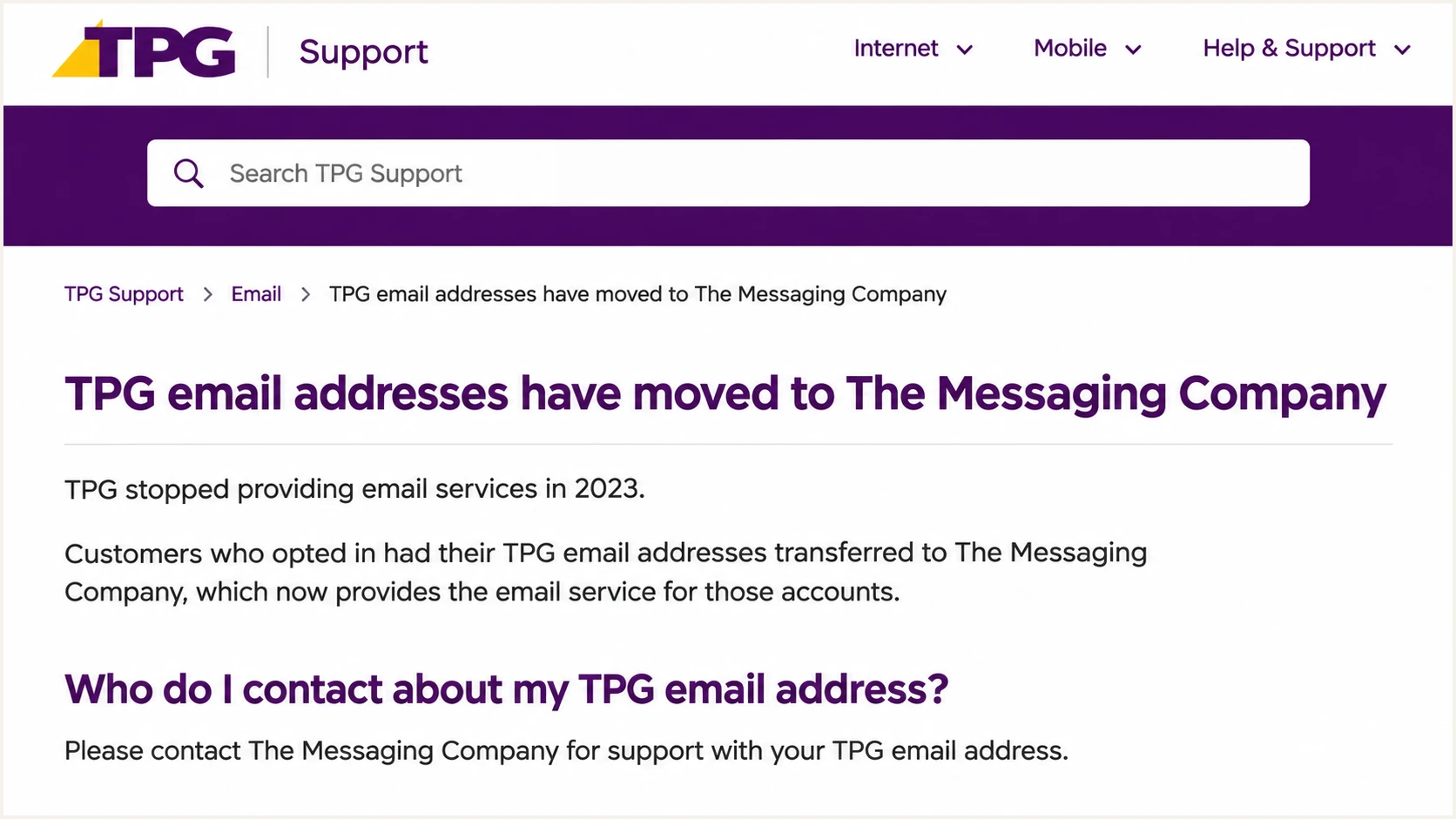
TPG Support confirms that transferred TPG mailboxes are supported by The Messaging Company.
A TPG network match in a DMARC report is a starting point for investigation. I compare the source IP with my server inventory and sending logs before treating it as an authorized sender.
When I operate the server myself, I control its envelope sender and DKIM signer. When a provider operates it, that provider must confirm those capabilities for my account.
Set up SPF
I publish SPF at the domain used in SMTP MAIL FROM, which normally appears in the delivered Return-Path. For SPF to count toward DMARC, that domain must match the visible From domain or share its organizational domain under relaxed matching.
- Set the envelope sender. On a server you administer, use an address such as bounce@example.com for mail with From: user@example.com. Confirm the delivered Return-Path retains that domain. A custom bounce subdomain needs its own SPF policy.
- Authorize the real egress. For direct delivery, add the server's actual public sending IP. For a relay, obtain its documented authorization mechanism. Do not add include:tpg.com.au or authorize the whole TPG network based on reverse DNS.
- Edit one SPF policy. Merge authorization into the existing v=spf1 TXT record at that name. Preserve other legitimate senders and keep DNS-lookup mechanisms within the limit of 10, including nested includes.
Illustrative TXT value at example.com, for direct delivery onlytext
v=spf1 ip4:192.0.2.25 ~all
The address 192.0.2.25 is reserved for documentation. Replace it with your confirmed outbound IP; this is not a TPG-provided record. Add ip6 authorization too if your server delivers over IPv6.
I check the exact envelope domain below after publishing. A root-domain SPF policy does not automatically cover a bounce subdomain.
SPF checker
Find SPF syntax issues, lookup limits, and weak records.
?/16tests passed
A clean DNS check confirms the policy is readable. I then send a new message to prove that the receiving server sees the expected IP and returns spf=pass.
If a relay uses its own Return-Path domain, changing my root SPF cannot make that result match my From domain. In that case, I require a valid DKIM signature using my domain for DMARC to pass.
Set up DKIM
I enable DKIM where the message is signed. Publishing a public key alone does not turn on signing, and a TPG reverse DNS suffix does not reveal a universal selector.
You operate the mail server
- Generate a key. Create a unique 2048-bit RSA key in your mail server's DKIM signing software. Keep the private key on the signer.
- Publish the public key. Add the generated TXT value at the chosen selector under _domainkey.example.com.
- Enable signing. Set the signing domain to example.com and sign after message rewriting. Send a fresh test message.
A provider operates the mail server
- Request domain signing. Ask the operator to sign with your domain, rather than only its own provider domain.
- Publish supplied records. Copy the account-specific selector and TXT or CNAME value into authoritative DNS exactly as supplied.
- Confirm activation. Complete the operator's verification process and request confirmation that DKIM signing is active.
I read d= and s= in a delivered DKIM-Signature header. The d= domain must match the From domain under the configured DMARC matching mode, and the receiver must report dkim=pass. Replace selector2026 below with the actual s= value.
Check the actual selector, including delegated CNAME recordsbash
dig +short TXT selector2026._domainkey.example.com
dig +short CNAME selector2026._domainkey.example.com
If the operator cannot sign for my domain, SPF with a matching envelope domain can still pass DMARC. I prefer to establish DKIM as well because ordinary forwarding often breaks SPF.
Set up DMARC
For a new policy, I start with p=none and reporting. If the domain already has p=quarantine or p=reject, I keep that enforcement level while fixing TPG-related sending.
- Check existing DNS. Look up TXT at _dmarc.example.com. Edit the existing DMARC policy instead of publishing a second one.
- Prepare reporting. Use a working mailbox or reporting destination you control. Replace dmarc@example.com before deploying the example.
- Publish the policy. Create a TXT record named _dmarc in the example.com zone. If your DNS host appends the domain automatically, do not enter it twice.
Initial TXT value at _dmarc.example.comtext
v=DMARC1; p=none; rua=mailto:dmarc@example.com
Use our DMARC record generator to build the policy with your real reporting destination. Leave relaxed matching defaults unless you have tested a requirement for strict matching.
I verify public DNS below after the previous record's TTL has expired. A valid DMARC record proves publication, not that outgoing messages pass authentication.
DMARC checker
Look up a domain's DMARC record and catch policy issues.
?/7tests passed
DMARC passes when SPF passes with a matching envelope domain, or DKIM passes with a matching signing domain. A pass using only a provider-owned domain is insufficient.
The p=none policy requests monitoring without requesting quarantine or rejection for DMARC failures. If reports go to a different domain, its operator must provide any required external reporting authorization.
Keep an existing p=quarantine or p=reject policy in place during setup. The p=none example is for a new monitoring deployment, not an instruction to weaken an enforced domain.
Verify and troubleshoot
I test the exact production path, including the application and outgoing relay. Testing webmail does not validate a separate application server.
- Send a fresh message. Use the actual From address and inspect the final receiver's Authentication-Results. Do not rely on an authentication header inserted by the sender.
- Compare domains. Check the visible From against smtp.mailfrom and header.d. Require dmarc=pass, then investigate each failed underlying mechanism.
- Check direct-delivery DNS. For a server you operate, confirm its sending IP has a PTR and that the PTR hostname resolves back to that IP. Ask the IP operator about PTR changes; domain DNS alone cannot change it.
- Retest after changes. Allow the previous TTL to expire, send again and keep the new headers. Verify every application that sends for the domain.
Illustrative successful receiver authentication resultstext
Authentication-Results: receiver.example.net;
 spf=pass smtp.mailfrom=example.com;
 dkim=pass header.d=example.com header.s=selector2026;
 dmarc=pass header.from=example.com
|
|
|
|---|---|---|
SPF permerror | Policy error | Duplicates or lookups |
SPF domain mismatch | Envelope rewritten | Return-Path domain |
DKIM none | Unsigned message | Signer activation |
DKIM fail | Key or content | Selector and message |
DMARC fail | No matching pass | From domain |
Use the delivered message to distinguish DNS errors from signing and domain-matching errors.
Our email tester below is the quickest message-level check: open it, copy the generated recipient address, and send a message to it through the TPG-related path you are configuring.
I inspect its authentication diagnosis alongside the source IP and domain identities. The test checks the delivered message; a DNS lookup alone cannot prove DKIM signing works.
Email tester
Send a real email to this address. Suped shows a results button when the test is ready.
?/43tests passed
An SPF domain mismatch is compatible with DMARC passing when a valid DKIM signature matches the From domain. If both matching mechanisms fail, fix the sending configuration before tightening policy.
If the message is rejected before delivery, retain the SMTP status and bounce text. Check that error with the sending operator rather than repeatedly changing DNS without evidence.
Get alerted when it breaks
Our product Suped provides DMARC monitoring to track authentication across sending sources. I use the source-level evidence to distinguish a changed TPG-related delivery path from unauthorized traffic.
- Enable notifications. In Suped notification settings, enable Issues detected and Sending sources need verification. Enable DMARC summaries for periodic review.
- Investigate source changes. Compare unfamiliar IPs and envelope domains against your sending inventory. Do not verify a source solely because its reverse DNS ends in tpgi.com.au.
- Follow the diagnosis. Inspect the affected DMARC records and detailed SPF or DKIM checks, follow the issue's fix steps, and send another test message.
- Confirm recovery. Check subsequent reports for the affected source and verify that legitimate mail passes again.
Suped alerts act on detected issues and available reporting data. Aggregate DMARC reports arrive after delivery, often on a daily cycle, so I use a fresh email test to validate an urgent change.
Secure your domain with p=reject
I move to p=reject after every legitimate sending path has a verified way to pass DMARC. A high overall pass rate is insufficient if a low-volume invoicing system still fails.
- Review every source. Use Suped's source table and record details to verify authorized senders. Resolve failures for business applications and infrequent senders before enforcement.
- Test indirect delivery. Check forwarding and mailing-list use. Message rewriting can invalidate DKIM, while forwarding often breaks SPF; assess the actual recipient impact.
- Stage the policy. For a new deployment, progress through p=none and p=quarantine before p=reject. Review reports and delivery outcomes across normal sending cycles at each stage.
- Keep monitoring. Retain reporting and Suped issue notifications after enforcement. Recheck authentication whenever an IP, relay or DKIM selector changes.
Enforcement example, after validating legitimate senderstext
v=DMARC1; p=reject; rua=mailto:dmarc@example.com
Our Hosted DMARC lets teams manage policy in Suped after the DNS delegation is configured. I review subdomain policy and any explicit subdomain records before applying enforcement.
After publishing, I send another test message and review reports for the affected sources. Keep a known working configuration and a recovery procedure for legitimate delivery failures. Receiver handling varies, and p=reject does not guarantee inbox placement.
Frequency asked questions
The tpgi.com.au suffix is associated with TPG network infrastructure. It can identify the network carrying a customer-operated mail server rather than a specific hosted email platform. I confirm the actual sender with its source IP, authentication domains and my sending logs before authorizing it.
Individual mailbox users cannot edit tpg.com.au DNS. The domain owner manages SPF and DMARC, and the mail operator manages DKIM signing. TPG directs users of transferred consumer mailboxes to The Messaging Company for support.
There is no universal value established by a TPG network match. Obtain the supported SPF authorization and account-specific DKIM records from the operator of your outgoing mail service. For direct delivery from your own server, authorize its actual egress IP and configure its own DKIM signer.
No. DMARC passes if a valid DKIM signature uses a domain that matches the visible From domain under the configured matching mode. SPF passing for an unrelated provider Return-Path does not count toward DMARC, even when SPF itself passes.
Wait for cached DNS data to expire according to the previous TTL, then send a new test message. Aggregate DMARC reports arrive later, commonly after a daily reporting interval. Missing immediate reports do not establish that authentication failed.
No. MX records route incoming mail. SPF authorizes outgoing envelope identities, DKIM signing runs on the sender, and DMARC is published as a TXT policy. Change MX only if your actual mail-service migration requires it.




