
How to set up DMARC/DKIM/SPF for Riseup

Published 22 Nov 2026
Updated 22 Nov 2026
10 min read
Summarize with
For an @riseup.net address, Riseup controls SPF, DKIM and DMARC; you have no DNS records to add. For a domain you own, verify a custom email alias, configure SPF for the actual envelope sender, and publish DMARC in your DNS. Riseup's public help does not document custom-domain DKIM provisioning.
I check a delivered message before changing DNS. Confirming an alias proves access to that address; passing DMARC also requires SPF or DKIM to pass with a domain that matches the visible From domain under the applicable alignment mode.
Add your domain
Riseup's "Aliases and Forwarding" documentation describes individual address verification, rather than a whole-domain authentication wizard. Use this workflow for an external address you control.
- Keep receiving mail: Make info@example.com receive mail at its existing host before starting. Keep its MX records unchanged.
- Create the alias: Sign in at account.riseup.net. Open Mail Settings > Aliases, enter info@example.com in New Alias, then click Create.
- Confirm access: Open the confirmation email. Check Spam/Junk or use Resend Confirmation Email if needed.
- Set the identity: In mail.riseup.net, open Settings > Identities > + and enter the alias in Email. Save the identity.
- Check inbound routing: An external alias does not add inbound hosting at Riseup. Keep your existing mailbox or arrange forwarding there. The missing Receive tag is expected.
I verify both sending and replies before using an alias for regular correspondence. The domain owner remains responsible for the external domain's DNS.
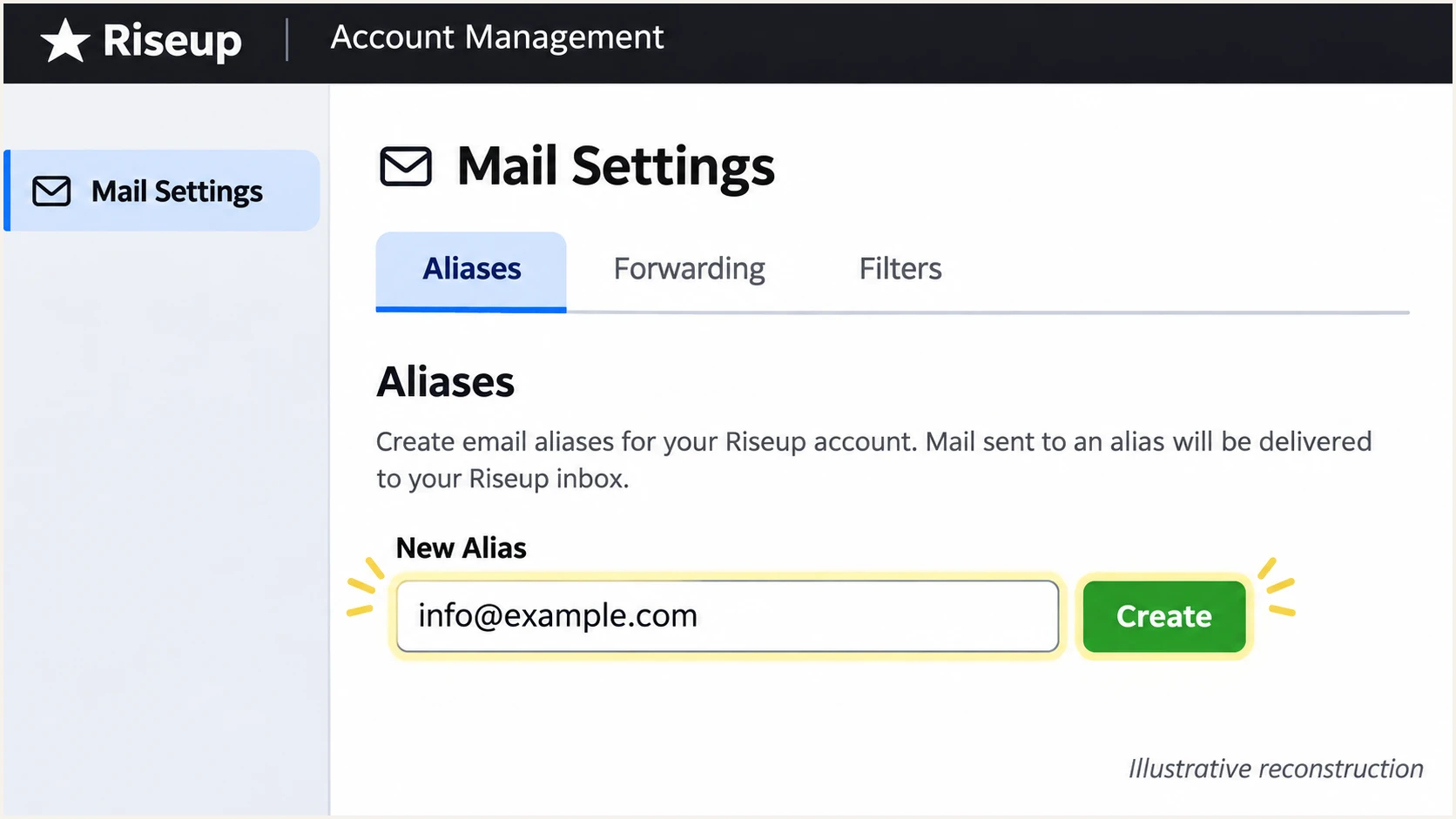
Illustrative Riseup Mail Settings > Aliases form for adding an address.
Set up SPF
SPF checks the SMTP MAIL FROM domain, usually visible in the delivered Return-Path. With a From address at example.com, a Return-Path at example.com can satisfy SPF alignment; one at riseup.net cannot.
Riseup's public alias instructions do not specify a supported SPF include for external domains. I get the current authorization mechanism confirmed by Riseup before changing a production record.
- Read the envelope: Send through Riseup and inspect the receiving server's Authentication-Results. Record smtp.mailfrom and the sending IP, rather than relying only on the From field.
- Confirm authorization: Ask Riseup for the supported SPF include or sending ranges for external aliases. Do not assume the inbound MX server is the complete outbound sender list.
- Publish one policy: At the actual MAIL FROM domain, merge the confirmed authorization into its existing SPF TXT record before the final all mechanism. Preserve other legitimate senders. Publish only one SPF record per name.
- Check the limit: Keep evaluation within SPF's limit of 10 DNS-dependent terms, including nested includes and redirects. An SPF record at the parent domain does not automatically cover a MAIL FROM subdomain.
Inspect SPF DNS before making changesbash
dig +short TXT riseup.net
dig +short TXT _spf.riseup.net
dig +short TXT example.com
The commands inspect DNS; they do not establish an official external-alias configuration. Treat _spf.riseup.net as a name to investigate, and confirm any proposed include with Riseup before publishing it.
Enter the actual MAIL FROM domain in the SPF checker below. Validate the full lookup chain after your existing DNS TTL expires, then send another message.
SPF checker
Find SPF syntax issues, lookup limits, and weak records.
?/16tests passed
A valid SPF record alone does not prove the receiving server checked your domain. Confirm spf=pass and compare smtp.mailfrom with the visible From domain in the delivered message.
If Riseup uses its own Return-Path for a particular message, changing example.com's SPF cannot fix that mismatch. SPF alignment warnings are acceptable when DKIM passes with a matching domain and DMARC passes. Without that DKIM result, investigate the sending path before enforcement.
Set up DKIM
Riseup manages signing for its own domain. Its public account documentation does not provide a custom-domain selector or key setup procedure, so an external alias is not evidence that Riseup signs with your domain.
- Inspect a signature: Find DKIM-Signature in a delivered message. Read d= for the signing domain and s= for the selector, then check the receiver's dkim result.
- Check the domain: A passing signature with d=riseup.net can authenticate a From address at riseup.net. It does not satisfy DKIM alignment for a From address at example.com.
- Confirm custom signing: For an external alias, ask Riseup whether signing with your domain is supported. If supported, obtain the exact selector, DNS name, record type and public value.
- Publish supplied values: Add only the records supplied for that signing configuration. Generating a random key or copying Riseup's public key into your DNS does not enable its servers to sign for your domain.
Riseup address
For member@riseup.net, Riseup controls the signing key and DNS. Verify the delivered DKIM result; report signing failures to Riseup.
Custom-domain alias
For info@example.com, require a passing signature whose d= domain meets your DMARC alignment mode. A Riseup-domain signature alone is insufficient.
I treat SPF and DKIM as separate tests. DMARC needs at least one passing mechanism with the required domain relationship. DKIM is especially useful when forwarding changes the SPF result.
Set up DMARC
Publish DMARC only for a domain whose DNS you control. Start a new deployment with p=none. If the domain already uses p=quarantine or p=reject, keep that policy and fix the Riseup sending path.
Use the DMARC record generator to create the record. A monitoring policy requests reports without requesting quarantine or rejection for DMARC failures.
- Check existing DNS: Look up TXT records at _dmarc.example.com. Edit the existing DMARC record rather than creating a second one.
- Create the record: For a new deployment, add a TXT record with host _dmarc, or the full name _dmarc.example.com if your DNS host requires it. Use the monitoring value below.
- Set the report inbox: Replace dmarc@example.com with an address you control that can process aggregate XML reports. Never publish the example address unchanged.
- Preserve enforcement: On an existing quarantine or reject policy, retain the policy and reporting destinations. Add reporting without resetting the domain to p=none.
New deployment: TXT value at _dmarc.example.comtext
v=DMARC1; p=none; rua=mailto:dmarc@example.com
DNS panels commonly append the zone name automatically. Check the final hostname so the record is at _dmarc.example.com rather than a duplicated domain name.
Use the checker below to confirm that the public record is discoverable and has valid syntax. This DNS check does not replace a test of an actual message sent through Riseup.
DMARC checker
Look up a domain's DMARC record and catch policy issues.
?/7tests passed
Allow DNS caches to expire before judging the change. Aggregate reports arrive on each reporting receiver's schedule, often daily; they are not immediate confirmations of a DNS edit.
If the reporting address belongs to another domain, follow that report collector's external-report authorization instructions. Check report delivery separately from message authentication.
Verify and troubleshoot
I send a fresh message through the same Riseup identity and SMTP route used for normal mail. A DNS lookup cannot prove which envelope domain or DKIM signature a sender actually uses.
The email tester below gives you a test address. Send a harmless message there through Riseup to receive a diagnosis of the delivered message, including authentication results.
Email tester
Send a real email to this address. Suped shows a results button when the test is ready.
?/43tests passed
Test the normal @riseup.net identity and your external alias separately. Use a fresh subject for each test so the results correspond to the identity you selected.
Read the receiving server's Authentication-Results together with Return-Path and DKIM-Signature. A passing result for a different domain does not authenticate your visible From domain.
- Confirm the sender: Select the intended address in Riseup webmail's From dropdown before sending. Recheck that the delivered From header contains that address.
- Check submission: Use mail.riseup.net with authenticated SMTP: port 465 with TLS, or port 587 with STARTTLS. Use your Riseup login credentials, rather than the external alias as a new account.
- Check DMARC: Require dmarc=pass for the tested From domain. If only SPF passes with a matching domain, test forwarded delivery too; forwarding often breaks SPF.
- Collect evidence: For a failure, save the timestamp, message ID, receiver's authentication results and bounce code. Share only the diagnostic information needed with Riseup support.
|
|
|
|---|---|---|
Relay denied | SMTP login | Use Riseup credentials |
SPF failure | Envelope domain | Confirm authorized senders |
DKIM mismatch | Signing domain | Confirm custom signing |
DMARC failure | Domain relationship | Fix a matching pass |
Common failures and the next check.
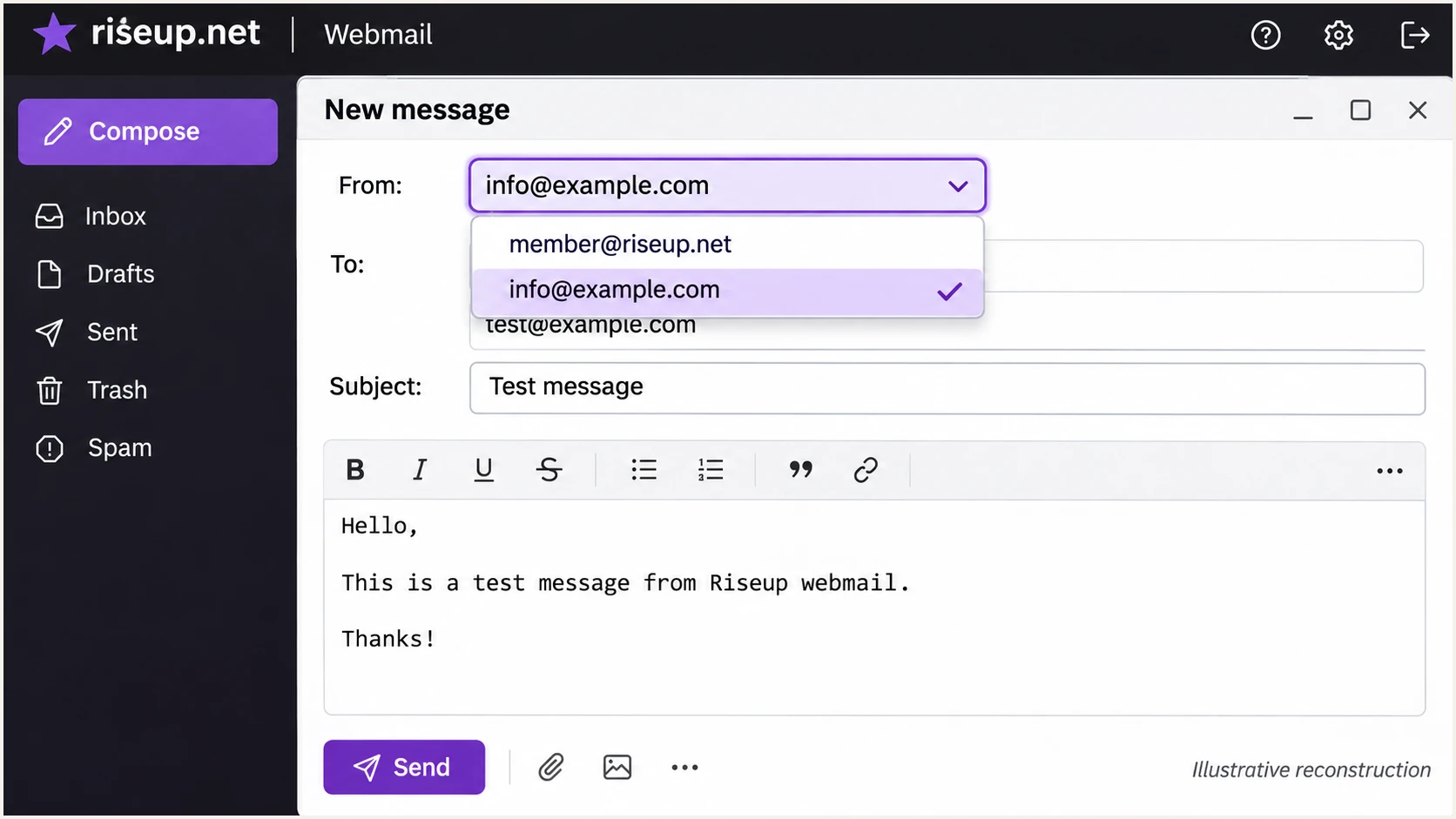
Illustrative Riseup webmail From selector for testing a custom alias.
Authentication success does not guarantee inbox placement. If a message passes DMARC but is rejected or filtered, investigate the actual delivery error separately.
Get alerted when it breaks
Suped is our platform for DMARC monitoring. For a domain you control, it turns aggregate reports into source-level authentication results and detected issues, so you can investigate a failing Riseup sending path.
- Keep reports flowing: Use the report destination supplied for your domain in rua. Keep the existing DMARC policy and other required reporting destinations.
- Enable notifications: In Suped's notification settings, enable Issues detected and Sending sources need verification. Configure DMARC summary emails for ongoing review.
- Verify the source: Match suspected Riseup traffic to a real message using the sending IP and authentication domains. Verify the source only after establishing that it is an approved sender.
- Diagnose changes: Filter report data by source or IP. Open the detail view for SPF and DKIM diagnostics, then compare DNS history when failures follow a record change.
I use the report detail to distinguish an unauthorized sender from an approved alias with broken authentication. That distinction determines whether to block the traffic or repair the sending configuration.
Alerts depend on incoming evidence
Suped alerts follow received reports and detected issues. They are not per-message SMTP availability checks. Send a fresh test after changing DNS or a Riseup identity. A personal @riseup.net user cannot change reporting for Riseup's domain.
Secure your domain with p=reject
I move a custom domain to p=reject after every approved sending source has a proven DMARC pass path. Review a full sending cycle, including infrequent workflows, rather than relying on one successful test or a high overall pass rate.
- Audit every source: Use Suped's source table to identify approved senders. Investigate failures on legitimate mail individually, including low-volume Riseup aliases.
- Resolve alias limits: Confirm a passing SPF result with a matching MAIL FROM domain or passing DKIM with a matching signing domain. If Riseup cannot provide either for your custom alias, stop using that alias for production mail before enforcement.
- Stage enforcement: Change p=none to p=quarantine after resolving legitimate failures. Review reports and delivery errors, then change the same record to p=reject when the evidence supports it.
- Manage the policy: Our Hosted DMARC lets you manage policy in Suped after its initial DNS configuration. Use the dashboard to stage policy changes while reviewing source-level results.
- Keep monitoring: Leave reporting and issue notifications enabled after enforcement. Recheck authentication whenever a sender, alias or DNS record changes.
With Hosted DMARC, use the dashboard's policy controls. With a directly published TXT record, edit that record at your DNS host. The following value is an example for direct TXT publication; replace its report address.
Direct TXT deployment: reject policy at _dmarc.example.comtext
v=DMARC1; p=reject; rua=mailto:dmarc@example.com
A reject policy requests rejection when DMARC fails; the receiving server makes the final handling decision. Suped shows authentication evidence, while Riseup must provide any required changes to its envelope sender or signing configuration.
Frequency asked questions
No. Riseup controls DNS and signing for riseup.net. Send a test message to check authentication, and report failures to Riseup. The custom-domain DNS steps apply only to a domain you control.
Riseup's public alias documentation does not give a supported external-domain include. Confirm the current authorization mechanism with Riseup and publish it at the actual MAIL FROM domain. Do not paste a guessed include or authorize only an inbound MX host.
No. With From: info@example.com, a passing signature for riseup.net does not satisfy DKIM alignment. DMARC needs a passing signature with a matching domain, or a passing SPF result with a matching MAIL FROM domain.
Yes. DMARC needs at least one passing mechanism with the required domain relationship. SPF alone is fragile through forwarding, so test indirect delivery paths and pursue custom-domain DKIM where supported before relying on that configuration.
Riseup operates mail infrastructure using riseup.net hostnames, including mx0.riseup.net and mx1.riseup.net. For a sending IP with that PTR suffix, check that the hostname resolves back to the IP and compare the message headers with DMARC reports. The rDNS suffix alone does not prove that a message is authorized.




