How to set up DMARC/DKIM/SPF for LinkSky

Published 21 Nov 2026
Updated 21 Nov 2026
11 min read
Summarize with
Set up LinkSky email authentication in cPanel: publish the SPF and DKIM values shown in Email > Email Deliverability, then add a DMARC TXT record in Domains > Zone Editor. Start a new DMARC policy at p=none, keep existing quarantine or reject protection, and confirm the result with a message sent through LinkSky.
I follow LinkSky's published cPanel setup instructions below. Website applications also need authenticated SMTP. If your LinkSky service opens Plesk, request the matching settings from LinkSky support; the cPanel menu paths below apply to cPanel accounts.
Add your domain
I sign in through LinkSky and open the hosting service that sends the mail. The main domain is normally already present in cPanel.
- Open cPanel: Click Login on the LinkSky homepage, sign in with the email address on file, scroll to Hosting Services, and click Open cPanel.
- Check the domain: Open Domains and find your sending domain. If it is absent and your plan permits additional domains, click Create a New Domain, enter the domain you own, review its document root, and click Submit.
- Confirm DNS control: Check the domain's authoritative nameservers. Publish records there. If another DNS provider is authoritative, copy the cPanel values to that provider.
- Prepare a mailbox: Open Email > Email Accounts. Create or select a mailbox on the sending domain, then click Connect Devices and save its Secure SSL/TLS Settings for your application.
I verify provisioning by confirming that the domain appears in Domains and Email Deliverability. I then check public DNS and send a test message after publishing the authentication records.
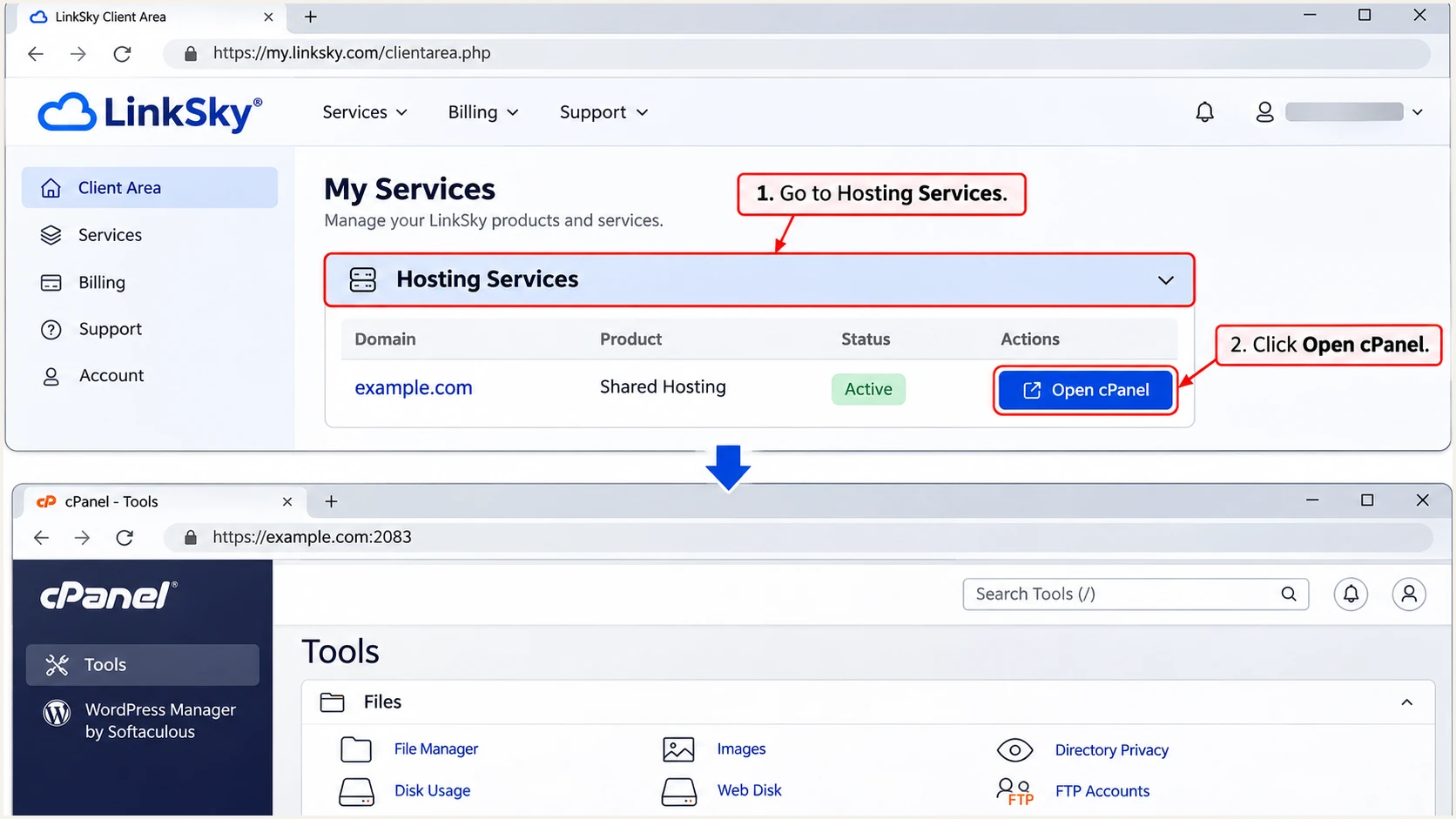
Illustrated LinkSky portal showing Hosting Services and Open cPanel.
Set up SPF
I copy the SPF recommendation generated for the account. LinkSky's public setup article does not specify a universal SPF include value, so the account's suggested record or support-confirmed outbound configuration is the source of truth.
- Open the recommendation: Go to Email > Email Deliverability and click Manage beside your domain. Find Suggested SPF (TXT) Record and copy its name and complete value.
- Keep one record: Find the existing TXT value beginning v=spf1. Merge the required LinkSky mechanisms into that record, preserving other authorized senders and one final all mechanism.
- Publish the change: If cPanel controls public DNS, review and apply its repair or customized SPF recommendation. Otherwise, update the record at your authoritative DNS provider.
- Set the envelope sender: Configure your application's SMTP envelope sender on your sending domain. Verify the delivered Return-Path. Adding a Return-Path header manually does not set the SMTP envelope.
- Check lookup limits: Keep SPF evaluation within the 10 DNS-lookup-term limit, including nested includes. Ask LinkSky to confirm relay IPs if the actual sending IP differs from the recommendation.
LinkSky supports a return path on your domain. With relaxed SPF alignment, the Return-Path domain and visible From domain must share the same organizational domain. Strict alignment requires an exact domain match.
Enter the Return-Path domain in the SPF checker below. If your application uses a bounce subdomain, check that subdomain's SPF record too; an SPF record at the parent is not inherited.
SPF checker
Find SPF syntax issues, lookup limits, and weak records.
?/16tests passed
A valid SPF record confirms DNS syntax and authorization structure. I also test a real message to confirm that the outbound IP is authorized and the envelope sender matches the visible From domain for DMARC.
Set up DKIM
I let the LinkSky mail server generate and retain the DKIM private key. DNS receives only the matching public key.
- Open DKIM settings: Go to Email > Email Deliverability > Manage for the domain and find the DKIM section.
- Generate if missing: Use Generate Local DKIM Key if no key exists. If the control is unavailable, ask LinkSky support to enable signing for your domain.
- Copy the public record: Copy the exact Name and complete Value under Suggested DKIM (TXT) Record. A common cPanel selector is default, giving default._domainkey.example.com; use the name your account shows.
- Install and publish: Apply the suggested DKIM repair when cPanel is authoritative. For external DNS, ensure local signing is enabled and publish the public TXT record at the authoritative provider.
- Verify a signature: Send a message and check dkim=pass. Confirm that its DKIM d= domain matches the visible From domain under your DMARC alignment mode.
I copy the full public key without truncation. If the DNS provider splits long TXT values, its chunks must form one logical DKIM record. Keep the private key on the mail server.
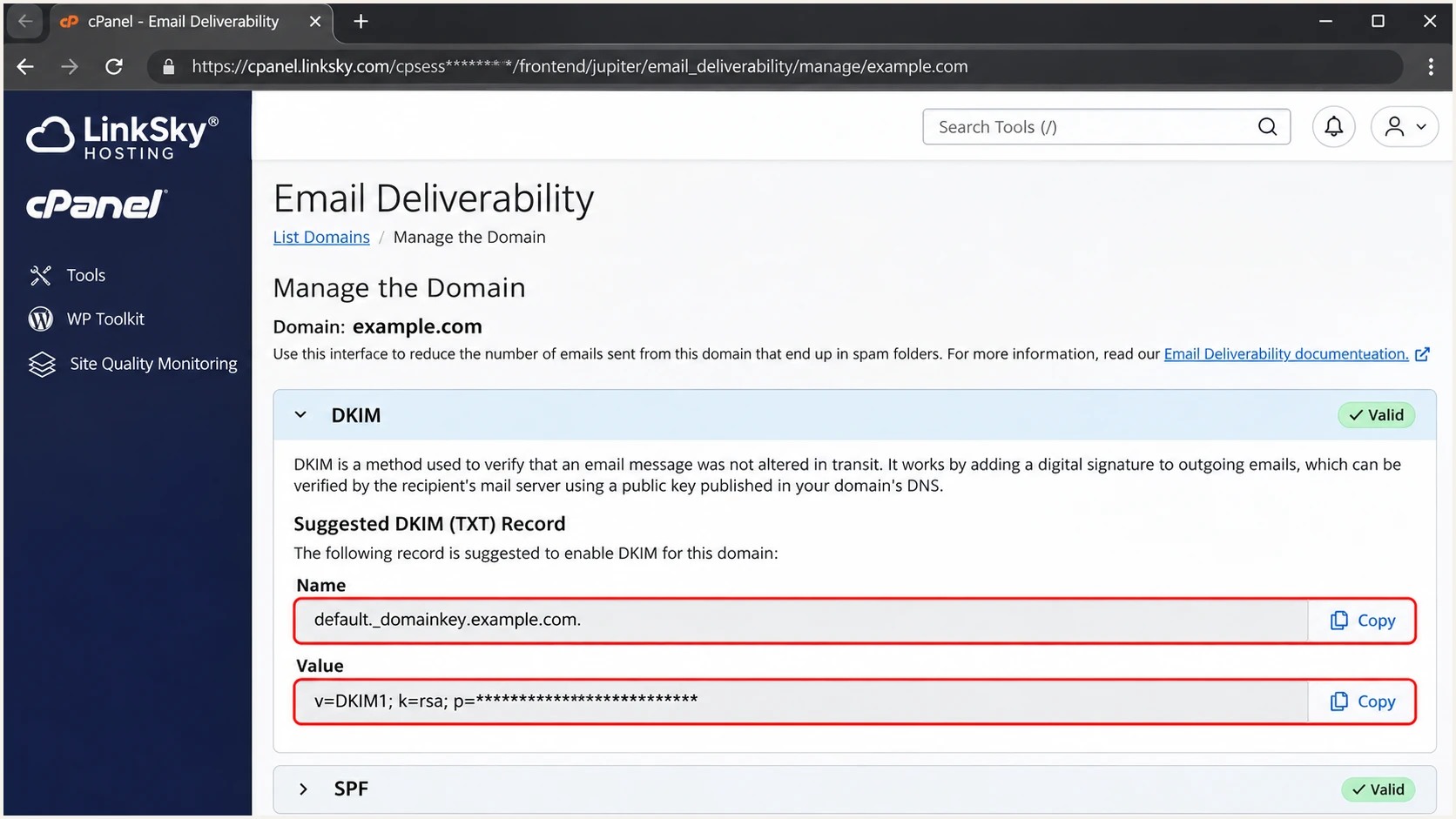
Illustrated LinkSky cPanel DKIM settings with the public DNS fields.
Publishing the key and signing messages are separate checks. I test website mail as well as mailbox mail because different sending paths can produce different signatures.
Set up DMARC
I first check the domain's effective DMARC policy, including any inherited parent-domain policy. Keep p=quarantine or p=reject if either is already in effect.
- Build the record: Use the DMARC record generator to create a monitoring record for a domain without an existing enforcement policy.
- Open the zone: In cPanel, go to Domains > Zone Editor > Manage beside your domain. Filter for TXT records and search for _dmarc.
- Add or edit: Edit the existing DMARC record, or choose Add Record > Add TXT Record. Use _dmarc.example.com. as the full name in cPanel, replacing example.com with your domain.
- Set reporting: Start with the value below, replace dmarc@example.com with a working report destination, keep the zone's default TTL, and click Save Record. Maintain one DMARC TXT record at this name.
Initial DMARC TXT record valuetext
v=DMARC1; p=none; rua=mailto:dmarc@example.com
The example address must be replaced before publication. For a reporting destination on another domain, confirm that the destination authorizes external DMARC reports. p=none requests monitoring without DMARC quarantine or rejection.
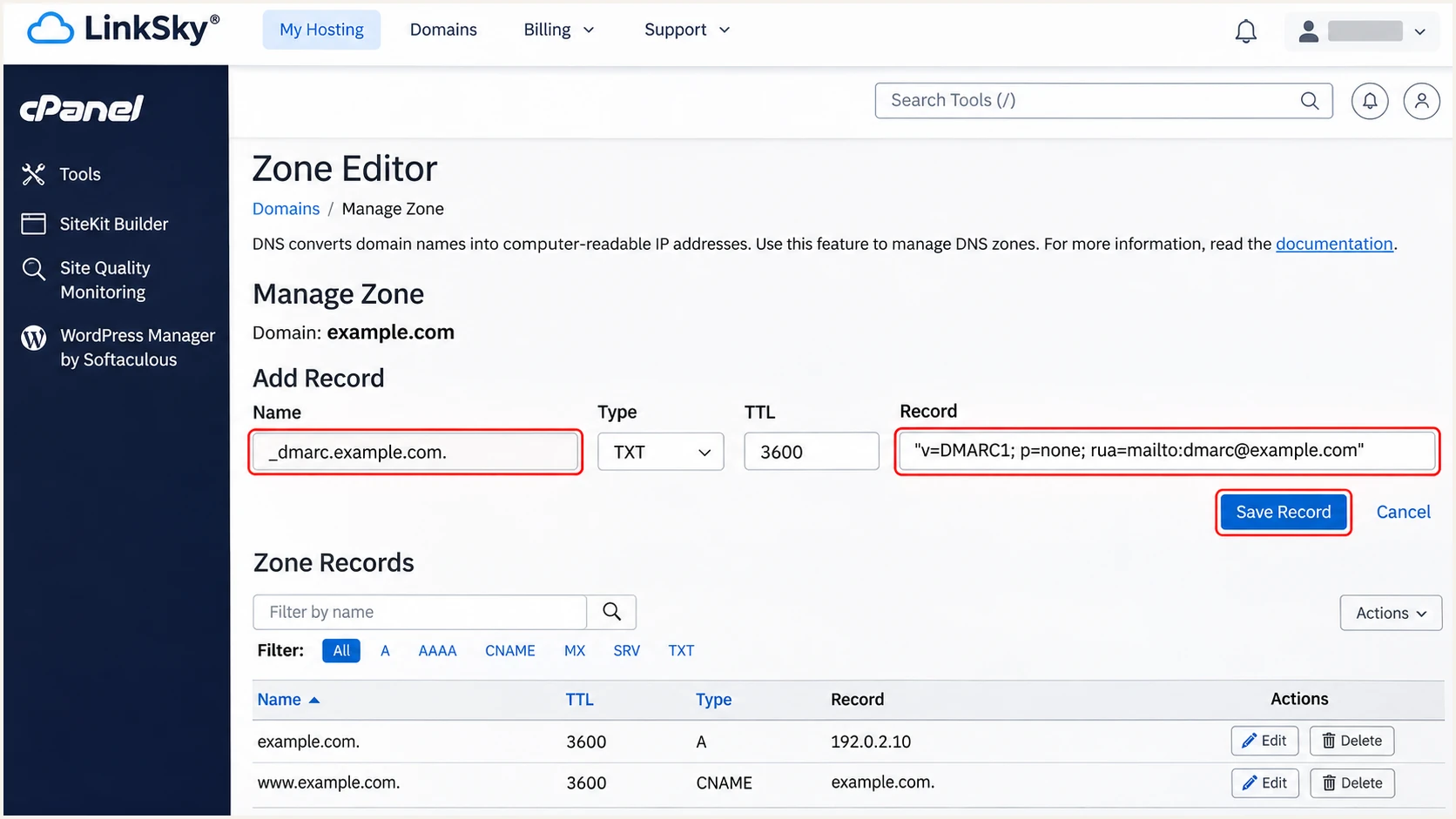
Illustrated LinkSky cPanel Zone Editor adding a DMARC TXT record.
Public DNS must return the record at the intended name. Check that a DNS editor has not appended your domain twice, especially when copying a full hostname into an external provider.
Enter the visible From domain in the DMARC checker below. I check the published policy and reporting address after cached DNS answers expire.
DMARC checker
Look up a domain's DMARC record and catch policy issues.
?/7tests passed
DMARC passes when at least one mechanism passes and matches the visible From domain: SPF using the envelope sender, or DKIM using the signing domain. SPF and DKIM do not both have to match for DMARC to pass.
Verify and troubleshoot
I test the actual application sending path. LinkSky's website-mail support notice requires authenticated SMTP starting July 15, 2026, so valid DNS records alone do not complete a contact-form setup.
- Authenticate SMTP: Open Email Accounts > Connect Devices. Configure the application with the listed secure outgoing server, SMTP authentication, full mailbox address, and mailbox password. Use port 465 with implicit TLS when listed in those settings.
- Set sender identity: Use your own domain mailbox as From. Put a contact-form visitor's address in Reply-To. Configure the envelope sender on your domain and keep TLS certificate verification enabled.
- Send through each path: Send a mailbox message and a real form submission or application notification to the test address. Use the same SMTP configuration that production uses.
- Read received results: Check the receiving system's Authentication-Results for spf=pass, dkim=pass, and dmarc=pass. Compare smtp.mailfrom, header.d, and header.from to identify domain mismatches.
- Escalate server issues: Give LinkSky support the sending IP, timestamp, bounce response, and message headers when signing or PTR checks fail. PTR records are managed by the IP owner.
The email tester below provides a full diagnosis of the message you send it, including authentication results and other delivery checks. Copy its generated test address and send directly through the LinkSky mailbox or application.
Email tester
Send a real email to this address. Suped shows a results button when the test is ready.
?/43tests passed
After changing a record or SMTP setting, I send a fresh message. Old messages retain the authentication results recorded when they were received.
For a DNS cross-check, replace example.com and the DKIM selector below with your own values. Compare authoritative answers with cached public answers before repeating an edit.
Check the published authentication recordsbash
dig +short NS example.com
dig +short TXT example.com
dig +short TXT default._domainkey.example.com
dig +short TXT _dmarc.example.com
|
|
|
|---|---|---|
SPF permerror | Duplicate SPF | Merge TXT values |
SPF mismatch | Envelope domain | Check Return-Path |
No DKIM | Unsigned route | Check SMTP signing |
DKIM fail | Key mismatch | Check selector |
DNS unchanged | Wrong DNS host | Check authority |
Form rejected | No SMTP login | Enable SMTP auth |
Common LinkSky authentication failures
If SPF passes on a provider-owned Return-Path but fails alignment, DMARC still passes through valid DKIM with a matching signing domain. LinkSky supports a matching return path, so I fix that setting as well. Delivery still depends on the receiver's other filtering rules.
Get alerted when it breaks
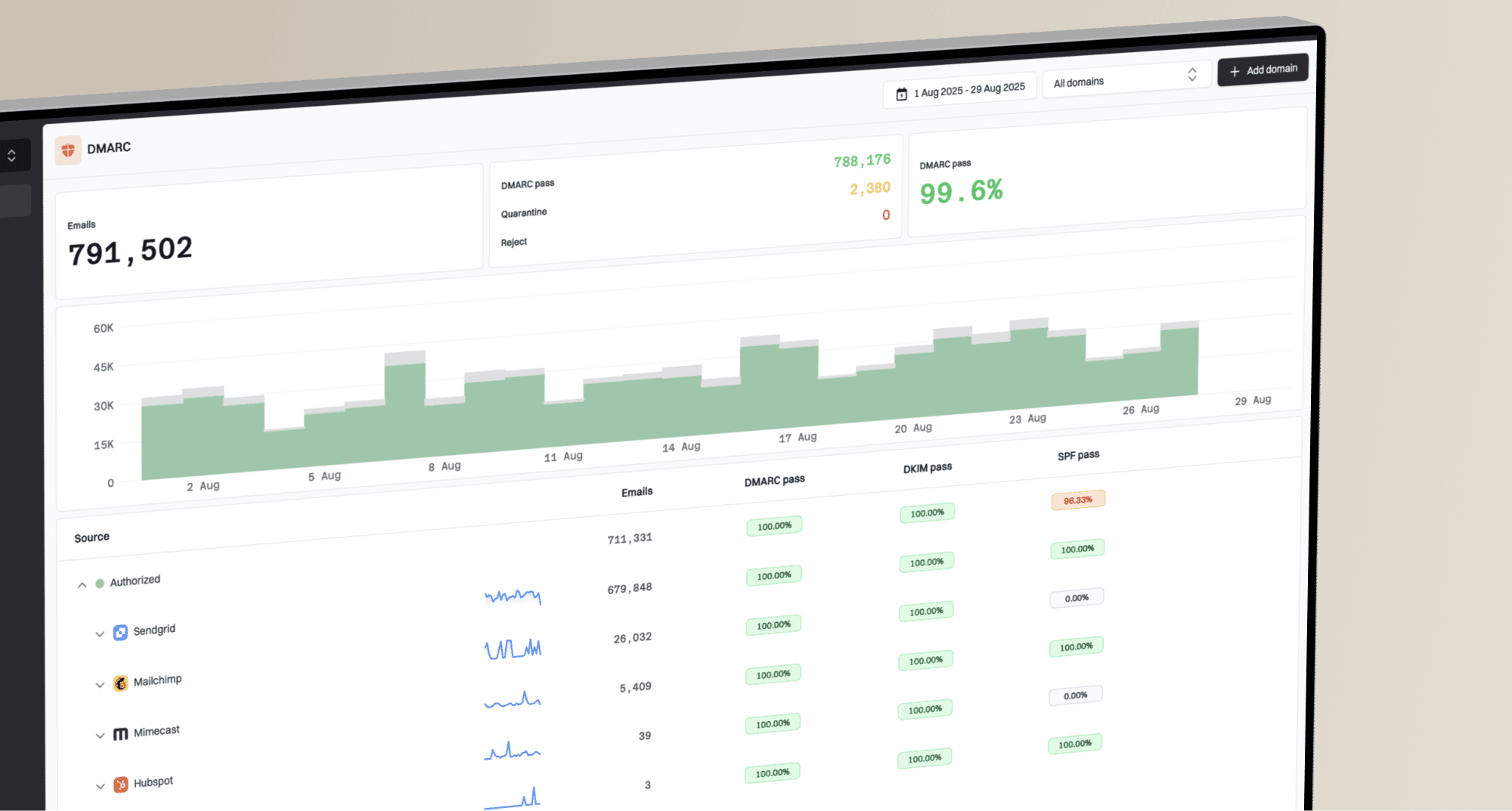
Our Suped DMARC monitoring connects incoming receiver reports with source diagnostics and issue notifications. It is the practical next step for keeping LinkSky authentication working after setup.
- Verify known sources: In Suped's Sources view, confirm LinkSky traffic against your sending IPs and application tests before marking the source as verified.
- Inspect failures: Filter Data view by source, reporter, or IP. Open a failing record in Detail view to inspect SPF, DKIM, DMARC, and rDNS checks.
- Enable notifications: In Settings > Notifications, enable Issues detected and Sending sources need verification. Enable DMARC summary emails for routine review.
- Resolve and retest: Follow the detected issue's fix steps, check DNS history for a related change, repair the LinkSky or DNS configuration, and verify the result with another message.
I use a message test after each planned change and report monitoring between changes. That combination checks both the configuration being deployed and the traffic receivers actually observe.
LinkSky cPanel
Configure the hosted mail server and its suggested authentication records. Recheck after a server migration or application change.
Our Suped platform
Review receiver-reported failures, investigate new sending sources, and receive issue notifications for the domain over time.
Report-based alerts follow incoming aggregate data, often on a daily reporting cycle. For an immediate check after an edit, I send a new test message.
Secure your domain with p=reject
I move to enforcement after every legitimate sending path has a confirmed DMARC pass. Our Suped platform helps identify the specific sources that need repair before that policy change.
- Inventory senders: Review LinkSky mailbox traffic, website notifications, and every other authorized sender. Include infrequent invoices and scheduled jobs before judging the setup complete.
- Fix legitimate failures: Use Suped's verified-source diagnostics to repair failures by sender. A domain-wide pass percentage can hide a broken low-volume source; unauthorized traffic does not need to pass.
- Stage enforcement: Change the existing record to p=quarantine, retain reporting, and observe a full sending cycle that includes infrequent jobs. Keep existing reject protection if already deployed.
- Apply rejection: When legitimate traffic is consistently passing, change the same policy record to p=reject. Review subdomain policy inheritance and keep the report destination active.
For a manually managed record, edit it in the authoritative DNS zone. With our hosted DMARC, policy changes are managed in Suped after its DNS setup is complete. Preserve your working reporting address and any intentional policy tags.
Enforced DMARC TXT record exampletext
v=DMARC1; p=reject; rua=mailto:dmarc@example.com
Keep one active policy record
Replace the existing DMARC value when changing policy. Publishing separate p=none and p=reject records at the same name invalidates policy discovery. Replace the example reporting address before using the example.
I keep Suped issue notifications enabled after enforcement so a new website integration or mail-server change is investigated against the affected source.
A reject policy requests rejection of messages that fail DMARC for your domain. Receiver handling remains local, and DMARC does not prevent impersonation through a different lookalike domain.
Frequency asked questions
LinkSky's public setup instructions direct users to cPanel Email Deliverability. I use the account's Suggested SPF record or outbound settings confirmed by LinkSky support. Copying another customer's record risks authorizing the wrong IPs.
Use the exact selector in Email Deliverability and the s= value in a newly sent DKIM-Signature header. default is common on cPanel, but the record shown for your domain is authoritative for the setup. Publish the matching public key.
Yes. A valid DKIM signature with a signing domain that matches the visible From domain is sufficient for DMARC. SPF authentication and SPF alignment are separate results. LinkSky supports return path alignment, so check the envelope sender configuration when that match fails.
SPF, DKIM, and DMARC do not log your application into the outgoing server. LinkSky's website-mail notice requires authenticated SMTP starting July 15, 2026. Use the secure settings under Email Accounts > Connect Devices, send with your domain mailbox, and place visitor addresses in Reply-To.
I treat an ls-reverse.com hostname as a clue pointing toward LinkSky hosting. Confirm that attribution using the actual sending IP, message headers, and LinkSky support before authorizing it. An rDNS suffix alone does not prove the traffic belongs to your account or passes DMARC.
Keep existing reject or quarantine protection while configuring LinkSky. Repair and test the LinkSky sending path before using it in production. The p=none starter record is for domains without an existing enforcement policy, including one inherited from a parent domain.