
How to set up DMARC/DKIM/SPF for ImmoFlux

Set up ImmoFlux email authentication by having ImmoFlux authorize your sending domain, configuring its custom Return-Path and SPF authorization, publishing its DKIM records, and adding a DMARC TXT record in your DNS.
I start with the records issued for the account and verify a real ImmoFlux message. DMARC passes when SPF or DKIM passes authentication with domain alignment to the visible From address.
Add your domain
Use the domain in your visible From address: example.com for office@example.com. You need access to its authoritative DNS and an ImmoFlux account administrator.
I could not verify a public ImmoFlux domain-authentication procedure or universal DNS values. ImmoFlux lists suport@immoflux.ro for technical support; request the configuration for your account.
- Identify the sender. Send an existing ImmoFlux message to a mailbox you control. Record its From address and ask your administrator which agency domain should send future messages.
- Request authorization. Ask suport@immoflux.ro to authorize that domain and provide the ownership-verification instructions, custom Return-Path hostname, SPF authorization and DKIM records.
- Verify ownership. If ImmoFlux requires a TXT or CNAME challenge, publish the exact issued name and value. Ask support to confirm verification and enable sending with your domain.
- Confirm the route. Ask whether the messages use ImmoFlux-managed infrastructure or an external SMTP connection. Obtain authentication records for the actual outbound service.
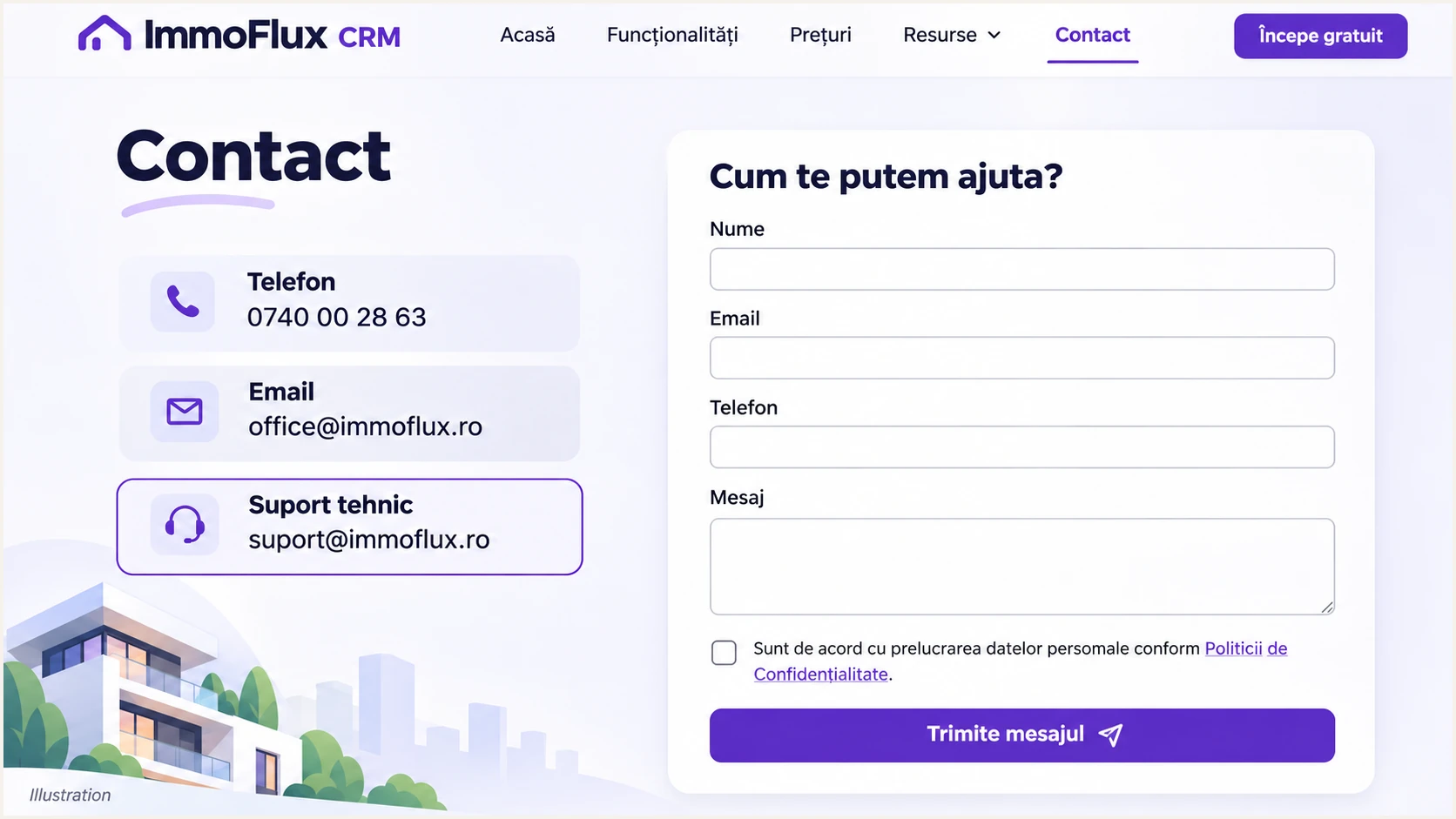
Illustration of ImmoFlux's public contact page and technical support address.
A custom agency website in ImmoFlux does not establish email authentication. Get explicit confirmation that your email sending domain is authorized.
Keep the issued DNS names and values together. Every example.com address below is illustrative and must be replaced with your own domain.
Set up SPF
ImmoFlux supports Return-Path alignment. Request a custom envelope sender under your domain, then configure SPF for that hostname. I check the actual MAIL FROM domain before editing SPF.
With From: office@example.com, an envelope sender at bounce.example.com has relaxed SPF alignment. A DMARC policy with aspf=s requires an exact domain match instead.
- Get the authorization. Obtain the exact SPF include, sending IPs or CNAME delegation for your account. Do not assume that including immoflux.ro authorizes its outbound servers.
- Use the correct hostname. Publish SPF at the envelope sender domain ImmoFlux supplies. Editing example.com's SPF does not authorize mail using bounce.example.com unless its SPF configuration explicitly references it.
- Keep one SPF record. If that hostname already has a v=spf1 TXT record, merge the supplied authorization into it before its final all mechanism. Preserve every other legitimate sender.
- Respect delegation. If ImmoFlux supplies a CNAME, follow that delegation instead of placing a TXT record at the same name. Publish bounce-domain MX records only when instructed; preserve your existing inbox MX records.
- Check the lookup limit. Keep evaluation within SPF's limit of 10 DNS-querying terms, including nested includes and redirects. Validate the exact envelope sender domain below.
SPF checker
Find SPF syntax issues, lookup limits, and weak records.
?/16tests passed
Enter the Return-Path domain in the checker, which checks SPF syntax and DNS configuration. A successful lookup does not prove that a live ImmoFlux message uses that domain.
Send a fresh message and confirm spf=pass in the receiving server's Authentication-Results. Then compare smtp.mailfrom with the visible From domain to verify SPF alignment.
Set up DKIM
Ask ImmoFlux to sign with your sending domain. I check the signing domain in the message's DKIM-Signature header; a passing signature for an unrelated provider domain does not satisfy your domain's DMARC alignment.
- Get the selector. Request the exact selector, signing domain, record type and public DNS value. Do not guess a selector such as default or selector1.
- Publish the record. Add the supplied TXT or CNAME in authoritative DNS. Check whether your DNS editor appends the domain automatically so the owner name is not duplicated.
- Enable signing. After the record resolves publicly, ask ImmoFlux to verify it and activate signing for your domain. Publishing a public key alone does not enable signing.
- Test the signature. Send another ImmoFlux message. Require dkim=pass and a header.d domain with DMARC alignment to your visible From domain.
For TXT, copy the complete public key. For CNAME, copy the exact target. Keep private keys out of DNS and support tickets; the outbound signer must retain its private key.
For From: office@example.com, DKIM signing with d=example.com satisfies relaxed and strict DKIM alignment. Signing with a subdomain satisfies relaxed alignment, but not adkim=s for this From domain.
SPF identity
Checks the envelope sender domain, usually visible in Return-Path after delivery.
Compare smtp.mailfrom with the From domain. Forwarding often breaks SPF authentication.
DKIM identity
Checks the signature and its d= signing domain.
Compare header.d with the From domain. DKIM survives forwarding when signed content remains intact.
Set up DMARC
Start with p=none if you have no enforcing DMARC policy. Keep an existing p=quarantine or p=reject policy while fixing ImmoFlux authentication.
I publish DMARC for the visible From domain. For office@example.com, the record owner is _dmarc.example.com; the Return-Path hostname does not determine where this record belongs.
- Inspect the existing policy. Look up the current DMARC TXT record before editing it. Keep one valid policy record at the applicable name and preserve existing reporting destinations.
- Generate the value. Use the DMARC record generator to build the policy. For a domain without an enforcing policy, use the monitoring value below.
- Publish the TXT record. In the example.com DNS zone, create a TXT record named _dmarc, or the full owner name if your DNS editor requires it. Paste the value without adding quotation marks.
- Choose the report destination. Replace dmarc@example.com with a mailbox or reporting address that accepts and processes aggregate XML reports. An external destination also needs reporting authorization from its operator.
Initial TXT value at _dmarc.example.comtext
v=DMARC1; p=none; rua=mailto:dmarc@example.com
The example reporting address is a placeholder. Use a destination you control or the address supplied by your reporting service; an ordinary inbox does not turn XML attachments into monitoring or alerts.
The none policy requests monitoring without DMARC enforcement. Use the checker below to confirm the published policy and reporting address after your DNS caches update.
DMARC checker
Look up a domain's DMARC record and catch policy issues.
?/7tests passed
A valid DMARC record and a DMARC-passing message are separate checks. Confirm dmarc=pass on a fresh ImmoFlux message before treating the source as configured.
Aggregate reports commonly arrive on a daily schedule, and some receivers do not send them. Wait for reporting cycles before diagnosing an empty report history.
Verify and troubleshoot
I test the same ImmoFlux workflow that sends production mail. A message sent separately through an agent's personal mailbox checks a different outbound route.
- Trigger real workflows. Test a property email and each enabled automated inquiry or customer notification. Use a test contact so every message reaches a mailbox you control.
- Use the test address. Copy the address generated by the email tester below into your ImmoFlux test contact, then trigger the message. The tester diagnoses the message that actually arrives.
- Read recipient results. Inspect the receiving server's Authentication-Results for SPF, DKIM and DMARC. Compare smtp.mailfrom and header.d with the visible From domain; Reply-To does not establish alignment.
- Capture a failure. Save the message headers, timestamp and any SMTP rejection text. Give ImmoFlux support those details alongside the issued DNS records.
Email tester
Send a real email to this address. Suped shows a results button when the test is ready.
?/43tests passed
Suped's email tester prompts you to send a test email and returns authentication diagnostics. Use its findings to distinguish a missing record from a sending-domain or signing problem.
An SPF alignment failure does not fail DMARC when DKIM passes with alignment. Since ImmoFlux supports a custom Return-Path, fix that path too so authentication does not depend entirely on DKIM.
|
|
|
|---|---|---|
SPF permerror | Duplicates or lookups | Repair SPF evaluation |
SPF unaligned | Envelope domain | Enable custom Return-Path |
DKIM missing | Signing status | Enable domain signing |
DKIM fail | Selector and key | Correct the issued record |
DMARC fail | Passing domain identities | Fix authentication and alignment |
Use the receiving server's results to select the next check.
Use DNS queries to inspect the actual names ImmoFlux issued. Replace the sample bounce domain and DKIM selector before running these commands.
If a public resolver returns old values, check the authoritative nameservers and the prior TTL. Retry with a newly sent message after caches expire.
Inspect the example DNS namesbash
dig +short TXT bounce.example.com
dig +short CNAME bounce.example.com
dig +short TXT selector._domainkey.example.com
dig +short CNAME selector._domainkey.example.com
dig +short TXT _dmarc.example.com
Existing messages retain their original authentication results. DNS corrections must be verified with fresh ImmoFlux messages.
Get alerted when it breaks
Our Suped platform provides DMARC monitoring with source-level authentication diagnostics and issue notifications. I use that history to catch ImmoFlux failures that a one-time DNS check misses.
Keep reporting active after the initial setup. Changes to sending infrastructure or DKIM selectors require another check, even when nobody on your team edited DNS.
- Enable notifications. For a domain already reporting to Suped, open Notifications and enable Issues detected and Sending sources need verification. Enable DMARC summary emails for routine review.
- Verify the source. Confirm ImmoFlux is authorized before marking it as a verified source. Match its report identities to a real message and the details confirmed by support.
- Investigate the issue. Open the affected DMARC record and inspect SPF, DKIM and DMARC diagnostics. Follow the issue's Steps to fix, then ask ImmoFlux to correct the outbound configuration when needed.
- Confirm recovery. Send a new ImmoFlux test message and check subsequent reports. Keep the failure timestamp and the last working configuration for comparison.
Suped combines the report history with DNS change history, which helps connect a new authentication failure to a changed record. Check both before replacing a working configuration.
Assign an owner to the notification address and investigate new unauthorized sources. Summary emails support routine review; issue notifications support investigation when failures appear.
Report timing affects alerts
DMARC report alerts depend on reports arriving from receiving servers. They do not provide immediate confirmation for every message. Use a fresh ImmoFlux test email to validate an urgent fix.
Secure your domain with p=reject
I enforce p=reject after every legitimate sending source passes DMARC across its normal sending cycle. One successful ImmoFlux test is insufficient evidence for a domain-wide policy change.
Our Suped platform helps review verified sources and investigate failures before enforcement. With Hosted DMARC, policy changes can be managed in the dashboard after the required DNS delegation is configured.
- Inventory all senders. Confirm ImmoFlux and every other authorized system using your From domain. Investigate unknown sources instead of authorizing them automatically.
- Cover normal activity. Review a complete business sending cycle, including occasional campaigns and monthly messages. Use source-specific results so large volumes of unauthorized traffic do not hide legitimate failures.
- Resolve authentication gaps. Fix missing DKIM signatures and incorrect Return-Path settings. Confirm the effective relaxed or strict alignment settings match your chosen domains.
- Stage enforcement. When monitoring shows legitimate sources passing, move to p=quarantine and review new reports and delivery errors. Then change the policy to p=reject while preserving reporting.
- Review subdomains. Check explicit subdomain policies and any sp tag before rollout. Keep Suped issue notifications enabled and retest ImmoFlux after subsequent DNS or signing changes.
Final example TXT value at _dmarc.example.comtext
v=DMARC1; p=reject; rua=mailto:dmarc@example.com
Replace the example reporting address and retain your existing reporting destinations and other intentional settings. Change the policy in the existing record rather than creating a second DMARC record.
Keep investigating authorized mail that fails after enforcement. Fix the affected ImmoFlux route or DNS record and verify recovery with a new test and subsequent aggregate reports.
Frequency asked questions
Get the exact authorization from ImmoFlux support for your account's outbound route. No universal ImmoFlux include was verified in the public setup information. Do not copy immoflux.ro's own SPF record; it describes senders authorized for that domain.
Yes. Request the custom Return-Path configuration and its DNS records from ImmoFlux. Verify the actual smtp.mailfrom domain on a delivered message. A bounce subdomain matches your root From domain under relaxed SPF alignment, but strict alignment requires an exact match.
Ask ImmoFlux support for the selector and DNS value issued for your domain. On a signed message, s= in DKIM-Signature identifies the selector and d= identifies the signing domain. The public key is looked up at the selector followed by ._domainkey and that signing domain.
DMARC requires either SPF or DKIM to pass with alignment, not both. A passing DKIM signature with an appropriate signing domain is enough. I still fix ImmoFlux's custom Return-Path when it is configured incorrectly, so SPF also contributes to DMARC authentication.
An rDNS hostname containing immoflux.ro is a clue to an ImmoFlux connection, not proof that the message is authorized. Confirm the sending IP, DKIM domain and envelope sender against a known ImmoFlux test message. Request the current sending IPs and rDNS hostnames from ImmoFlux support before attributing an unfamiliar source.
Keep an existing quarantine or reject policy. Have ImmoFlux authorize and authenticate your sending domain, publish the issued records, and verify a controlled test before enabling production messages on that route.




