
How to set up DMARC/DKIM/SPF for Conetix

Published 22 Nov 2026
Updated 22 Nov 2026
9 min read
Summarize with
For Conetix Plesk-hosted email, enable outgoing DKIM signing, authorize the outbound server in your SPF record, and publish a DMARC TXT record. DMARC passes when either SPF or DKIM passes with domain alignment to the visible From address.
I start by checking the actual sending route. A website hosted at Conetix can use a different mail server, so test website messages separately from mailbox messages. The steps below apply to email sent through Conetix's Plesk hosting.
Add your domain
I use the existing Conetix hosting subscription. If your domain already appears in Plesk, open it and continue with SPF.
- Open Plesk: Log in to the Conetix Control Panel and select Plesk One Click for your hosting subscription.
- Add the domain: Click Add Domain, choose Blank website, enter your domain, then click Add Domain. If the button is unavailable, ask Conetix about your subscription's domain limit.
- Confirm the entry: Check that the correct domain appears under Websites & Domains. For a new website, point its A record to the allocated hosting IP.
- Find authoritative DNS: Check the domain's delegated nameservers. If Conetix hosts DNS, open Websites & Domains > Hosting & DNS > DNS Settings. Otherwise, publish authentication records with the current DNS provider.
Adding a hosting entry and publishing email authentication are separate steps. I verify the live DNS records and a delivered message before treating the domain as authenticated.
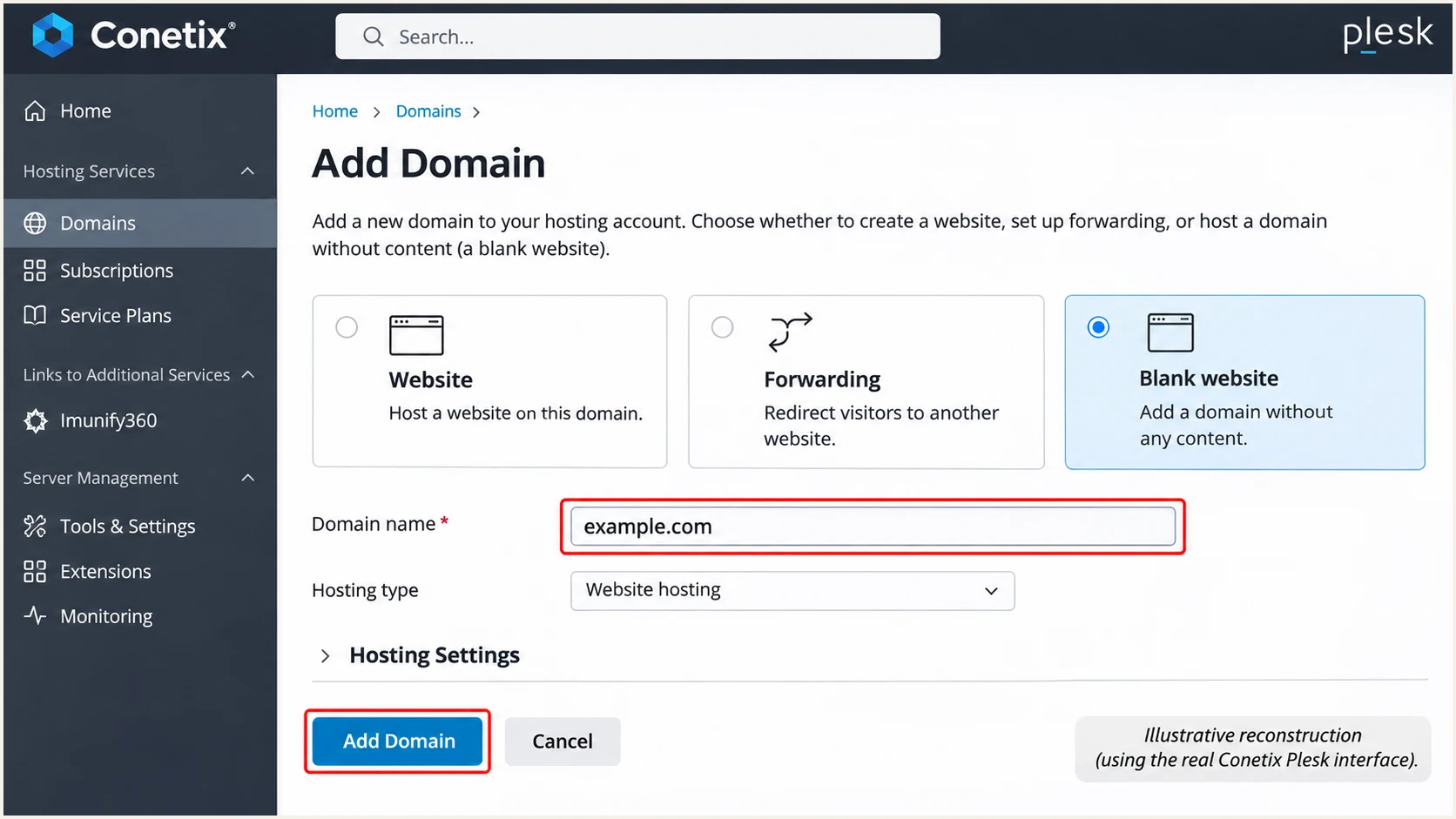
Illustrative Conetix Plesk Add Domain form.
Set up SPF
Conetix configures SPF automatically when it hosts both email and DNS. I inspect that existing record before changing anything.
- Read the record: In DNS Settings, find the root-domain TXT record beginning v=spf1. Open that record to edit it.
- Confirm outbound servers: Check that the record authorizes Conetix's actual sending IPs. For external DNS, copy the applicable SPF value from Plesk and confirm outbound addresses with Conetix.
- Merge other senders: Keep one SPF record per hostname. Add other authorized sending mechanisms to that record, and stay within SPF's 10 DNS-lookup term limit, including nested includes.
- Save the change: For the root domain, Plesk's Domain name field is normally blank. Click OK, then Update to apply pending DNS changes.
- Set the envelope sender: Conetix supports your own domain in the Return-Path. Configure the application's SMTP envelope sender with a working address under your sending domain, then confirm the delivered Return-Path.
SPF is checked against the envelope sender domain, which normally appears in Return-Path after delivery. A custom bounce subdomain needs its own SPF record; it does not inherit the root domain's SPF.
SPF checker
Find SPF syntax issues, lookup limits, and weak records.
?/16tests passed
Check the envelope sender domain in the SPF checker. Resolve duplicate SPF records, lookup-limit errors, and missing outbound IP authorization before proceeding.
Conetix's public SPF instructions do not specify a universal Conetix include. Use the record for your hosting service. I recheck after cached DNS answers expire, including the previous TTL after an edit.
Set up DKIM
I enable signing in Plesk, then publish the public key at the authoritative DNS provider.
- Open mail settings: Go to Mail > Mail Settings for the sending domain.
- Enable signing: Tick "Use DKIM spam protection system to sign outgoing email messages", then click OK.
- Publish the records: Conetix-hosted DNS receives the required records automatically. With external DNS, reopen Mail Settings, click "How to configure external DNS", and copy both displayed records to your DNS provider.
- Verify the selector: Conetix documents the default selector. Check the actual message's DKIM-Signature for s=default and use the selector shown there if your configuration differs.
Copy the complete public key unchanged. The matching private key stays on the mail server; generating a separate key elsewhere does not configure Plesk signing.
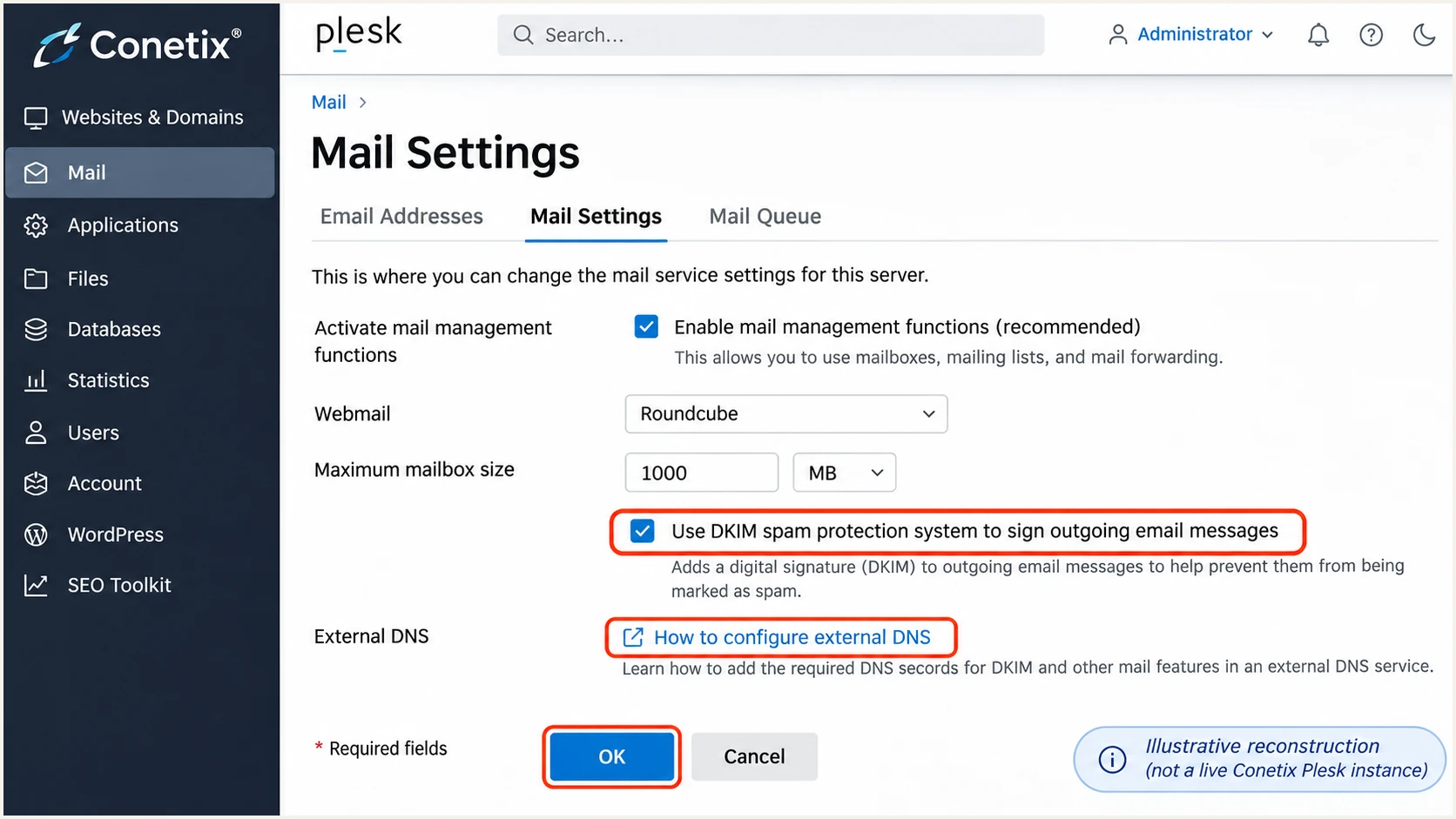
Illustrative Plesk controls for DKIM signing and external DNS.
For DMARC, a valid signature also needs domain alignment. Check that the signing domain in d= matches the visible From domain, or shares its organizational domain under relaxed alignment.
A published key proves DNS is ready. A received message proves that the actual website or mailbox route is signing successfully.
Set up DMARC
For a domain without DMARC, I start with p=none. If your domain already uses p=quarantine or p=reject, retain that policy while fixing Conetix authentication.
- Inspect existing policy: Look up the TXT record at _dmarc followed by your sending domain. Edit the existing record instead of creating a duplicate.
- Choose report delivery: Replace dmarc@example.com in the sample with a mailbox or reporting destination you control. A normal mailbox receives XML reports that still need analysis.
- Create the TXT record: In Plesk DNS Settings, click Add Record, select TXT, enter _dmarc in Domain name, and paste the value below into TXT record.
- Publish and check: Click OK, then Update. With external DNS, make the equivalent change there. Verify the final hostname has your domain appended only once.
Use the DMARC record generator to configure the reporting destination and policy. Keep the existing reporting address if it already feeds your monitoring workflow.
For a new policy, publish this TXT value at _dmarc.example.com. Replace the example domain and report address with your own.
Initial DMARC TXT valuetext
v=DMARC1; p=none; rua=mailto:dmarc@example.com
The none policy requests monitoring without asking receivers to quarantine or reject DMARC failures. It does not guarantee inbox delivery or disable other spam filtering.
After publication, check your sending domain below. Confirm valid syntax, one DMARC policy record, and the intended report destination.
DMARC checker
Look up a domain's DMARC record and catch policy issues.
?/7tests passed
An external aggregate-report destination also needs authorization from the receiving reporting domain. Follow that destination's instructions and confirm reports actually arrive.
Keep relaxed domain alignment unless you have a specific requirement for strict matching. The default relaxed settings support ordinary same-organization bounce subdomains.
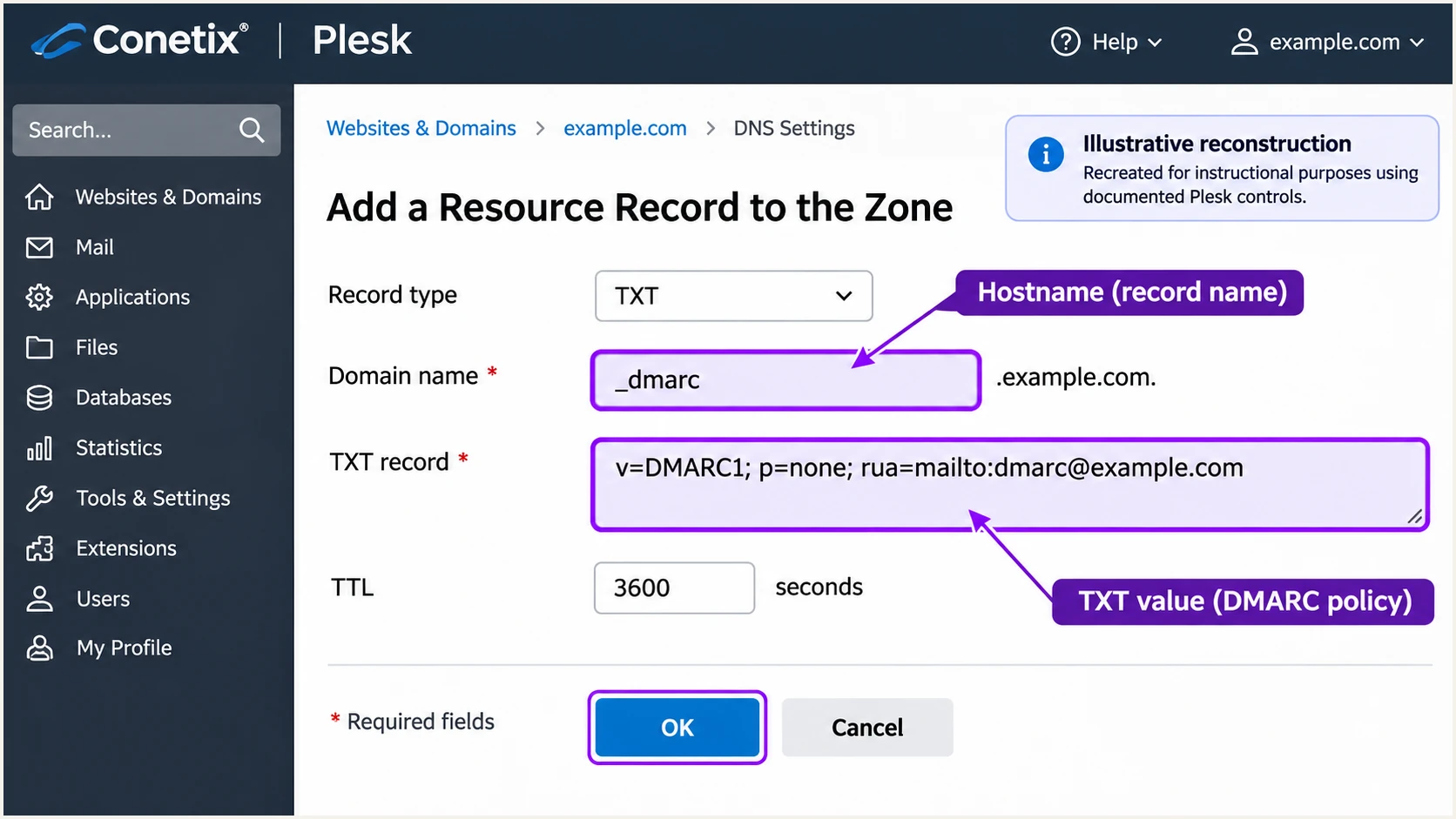
Illustrative Plesk form for adding a DMARC TXT record.
Verify and troubleshoot
I test the actual website and mailbox routes after DNS publication. A successful DNS lookup alone does not prove outgoing messages are authenticated.
- Exercise each route: Send a mailbox message, submit a contact form, and trigger a password reset or order email. Test any scheduled application messages separately.
- Read recipient results: Inspect the receiving server's trusted Authentication-Results header. Check SPF, DKIM, and the DMARC verdict against the visible From domain.
- Correct form identity: Use your domain in From and a working envelope sender. Put the visitor's address in Reply-To. Set the envelope sender through the application's mail transport, rather than adding a Return-Path header manually.
- Trace delivery: In Plesk, open Websites & Domains > Mail > Track Email Delivery. Click Refresh, search in Find email, and open Show details for the matching message.
If SPF passes for a provider-owned Return-Path, SPF alignment still fails. DMARC can pass through a valid DKIM signature with domain alignment. On Conetix, configure your own envelope sender where the application supports it.
|
|
|---|---|
SPF | Authorized sending IP |
SPF alignment | Matching From domain |
DKIM | Valid signature |
DKIM alignment | Matching From domain |
DMARC | At least one aligned pass |
With relaxed alignment, matching organizational domains are sufficient.
If a sending route cannot use a custom Return-Path, adding SPF at your From domain does not fix that route's SPF alignment. Keep valid, aligned DKIM on every message.
The email tester is the quickest message-level check. It provides a test address; send a message through your Conetix application or mailbox to get an authentication diagnosis.
Email tester
Send a real email to this address. Suped shows a results button when the test is ready.
?/43tests passed
Use the same sending configuration as production. Repeat the test after changing DNS or SMTP settings, and check the returned domain alignment results alongside raw SPF and DKIM results.
Conetix's delivery logs show whether its server handed the message to the recipient server. Inbox placement and the recipient's authentication verdict require recipient-side evidence.
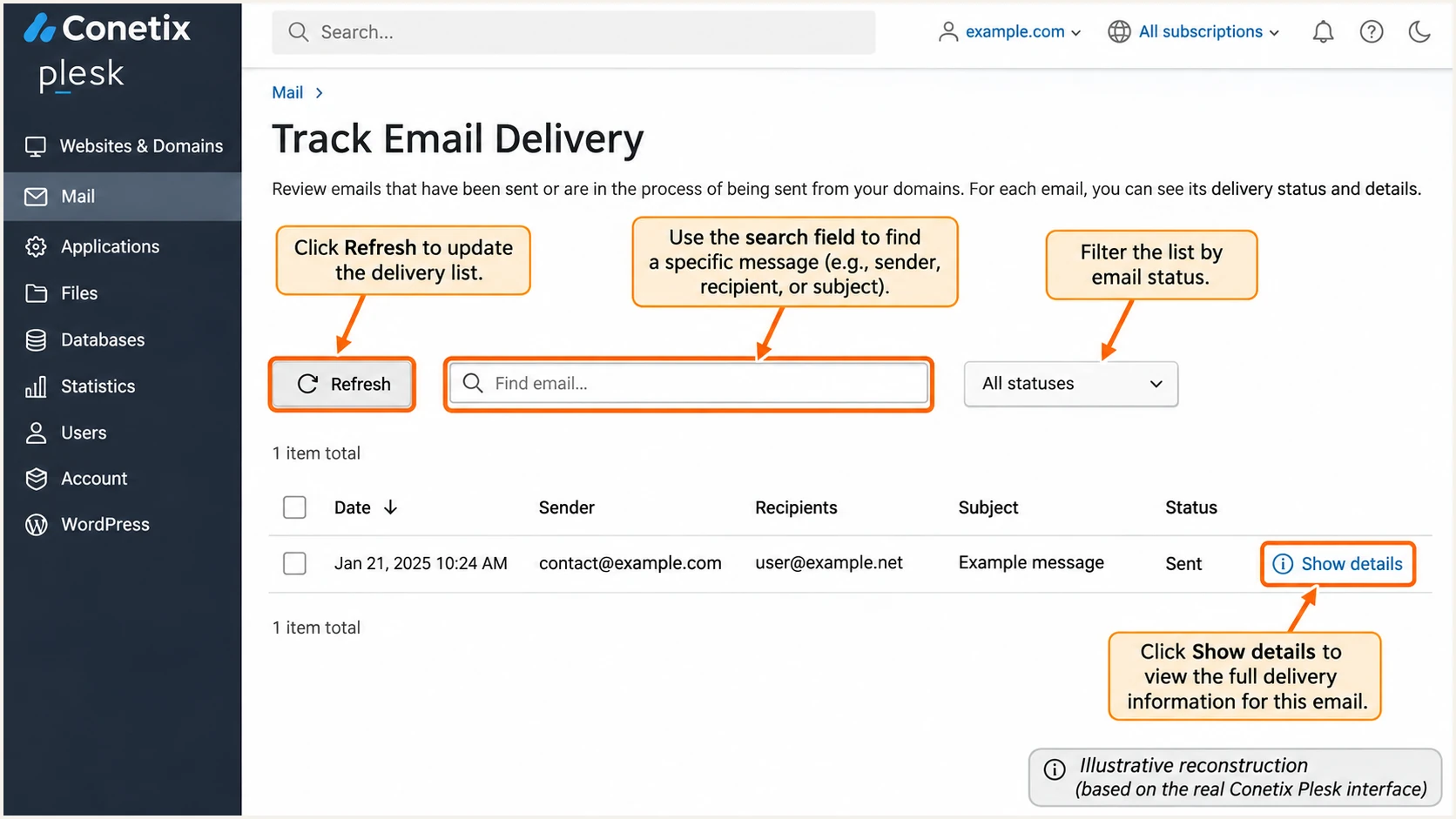
Illustrative Plesk delivery log with search and message details.
Get alerted when it breaks
I recommend Suped, our DMARC platform, for ongoing Conetix coverage. Its DMARC monitoring connects receiver reports with source-level authentication issues and steps to fix them.
- Enable issue emails: In Suped notification settings, enable Issues detected so detected authentication problems reach the responsible team.
- Review source changes: Enable Sending sources need verification. Confirm new sending sources against Conetix hosting changes and your approved applications.
- Investigate failures: Filter the data view by source, reporter, or IP address. Open a record's detail view to inspect SPF and DKIM results alongside domain alignment.
- Verify repairs: Give Conetix the sending IP, timestamp, selector, and SMTP error when escalation is needed. Retest the real sending route and confirm the issue clears.
Aggregate reports commonly arrive daily. Notifications depend on checks and report ingestion, so a broken individual message is best diagnosed with a test and delivery logs.
Conetix Plesk logs
Trace individual messages and remote SMTP replies. Use this for immediate sending failures and rejected handoffs.
Suped monitoring
Review receiver-reported authentication across sending sources. Use issue notifications and source verification to catch recurring failures and unexpected changes.
Secure your domain with p=reject
I move to p=reject after authorized sending routes consistently pass DMARC. I require working DKIM with domain alignment before enforcement, because forwarding commonly breaks SPF.
- Inventory legitimate senders: Review every approved source in Suped, including Conetix website traffic and any services that send separately. Investigate unknown sources before authorizing them.
- Fix legitimate failures: Resolve missing signatures, wrong signing domains, and incorrect envelope senders. Retest low-volume application routes as well as regular mailbox traffic.
- Observe a complete cycle: Review reports over a full business sending cycle, including infrequent jobs. Judge legitimate source behavior rather than relying only on a domain-wide pass percentage.
- Stage enforcement: Move a new monitoring policy to p=quarantine, verify legitimate mail again, then move to p=reject. Preserve existing stronger policies during this setup.
- Keep reporting active: Retain rua and review subdomain policies. After each policy change, check DNS and fresh receiver reports; investigate any new legitimate failures immediately.
Suped's Hosted DMARC supports policy staging and dashboard policy changes after its DNS setup is complete. Its source diagnostics help establish which Conetix failures need repair before each change.
Use this final TXT value only after legitimate traffic is ready. Replace the report address and retain any other settings your domain requires.
Final DMARC TXT valuetext
v=DMARC1; p=reject; rua=mailto:dmarc@example.com
If the TXT record remains managed in Conetix, edit the existing _dmarc record, click OK, then Update. With Hosted DMARC, change policy through Suped after delegation is configured.
Reject requests rejection of messages that fail DMARC; receivers retain local handling discretion. Repeat your website tests after promotion and keep issue notifications enabled.
Frequency asked questions
Conetix's public SPF guide does not provide a universal include. Use the SPF record generated for your hosting service, or the outbound IP mechanisms Conetix confirms. Merge these with existing authorized senders in one SPF record.
Conetix's Plesk instructions use default. Check s= in a received DKIM-Signature to confirm your active selector, then query that selector under the signing domain.
An SPF pass for a Return-Path domain unrelated to the visible From domain does not satisfy DMARC. A valid DKIM signature with domain alignment can still produce a DMARC pass. Configure a custom envelope sender where supported.
No. MX controls incoming mail routing. Publish SPF, DKIM, and DMARC at the authoritative DNS provider while retaining the MX records for your intended mailbox service.
That suffix identifies a hostname under Conetix's domain, but rDNS alone does not identify the customer or application. Match the sending IP to its PTR and forward DNS, then check the message's authentication results before approving it as a source.




