How to set up DMARC/DKIM/SPF for Broker Buddha

To authenticate Broker Buddha email, I first request the account-specific branded sending domain records, publish the supplied return-path and DKIM records, then add DMARC at the visible From domain. Broker Buddha supports a return path that matches the From domain for DMARC, but its public materials do not publish a universal SPF include, DKIM selector, return-path hostname, or rDNS suffix. Those values must come from Broker Buddha for the specific agency account. Guessing them can break existing mail.
- Target result: Broker Buddha messages pass DMARC through DKIM, SPF, or both when the authenticated domain matches the visible From domain.
- Safe sequence: Verify the sending domain first, test authentication, monitor normal traffic, then move DMARC to enforcement.
Add your domain
I use a dedicated subdomain such as bbmail.example.com for Broker Buddha's return path while keeping the visible From address on example.com. An account administrator should contact support@brokerbuddha.com from the address associated with the Broker Buddha account and ask to enable an authenticated, branded sending domain.
- Choose the domain: State the visible From domain and propose a dedicated return-path subdomain that your team controls.
- Request the bundle: Ask for every verification, DKIM, return-path, and SPF record, including each host, record type, value, and verification step.
- Publish literally: Add the records at your DNS provider without adding the root domain twice or changing supplied dots, selectors, or targets.
- Trigger verification: Reply to the support case after DNS resolves and request confirmation that the branded domain is active for the correct Broker Buddha account.
- Protect production: Keep the current From identity until Broker Buddha confirms verification, then send a controlled reminder or application email.
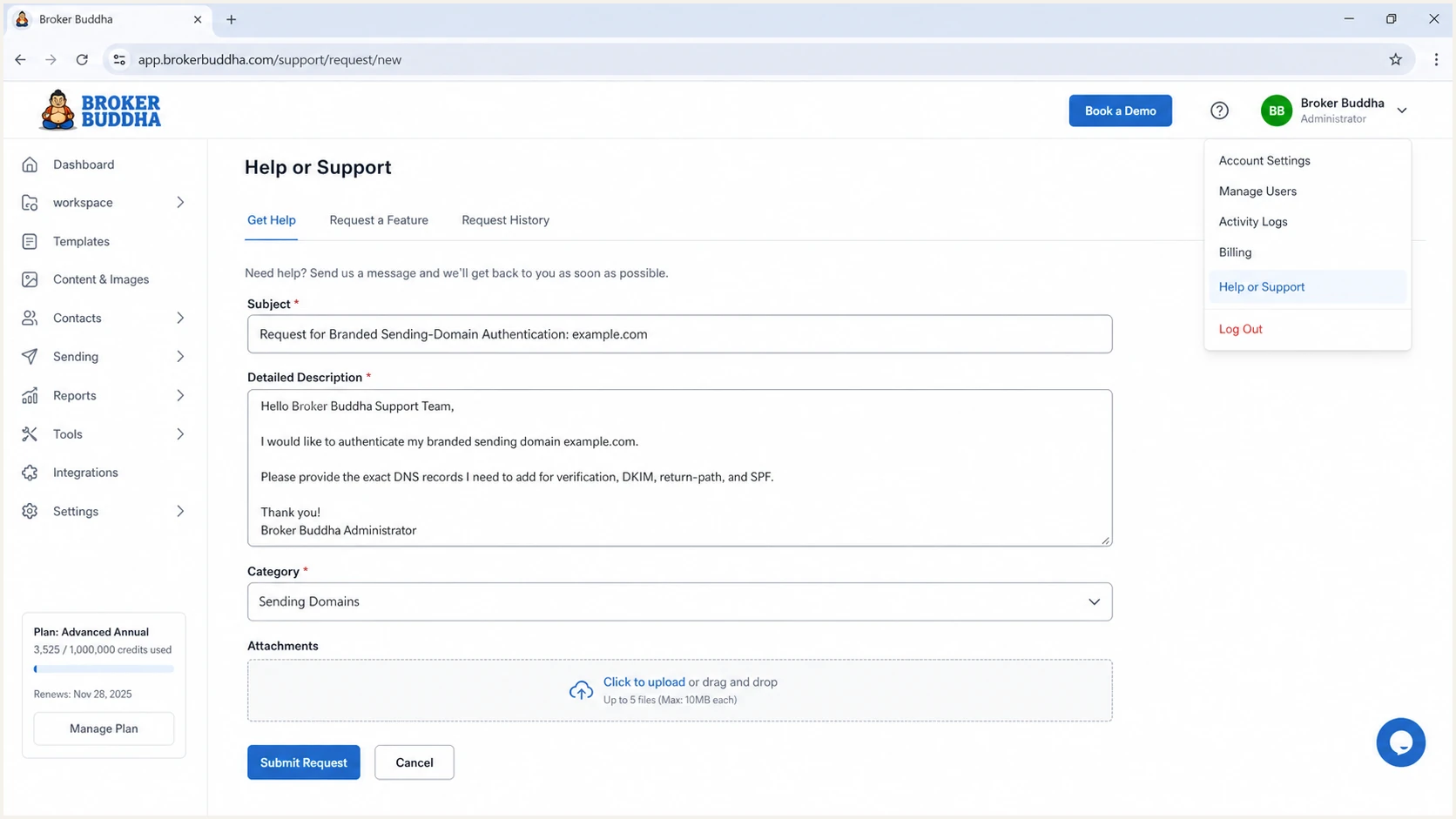
Broker Buddha administrator requesting branded sending-domain DNS records
Do not copy DNS values used by another Broker Buddha customer. DKIM keys and verification tokens are account-specific. The current public Broker Buddha documentation does not provide a universal record set, so the support response is the source of truth.
Set up SPF
SPF authenticates the envelope sender, also called the Return-Path. Because Broker Buddha supports a branded return path, I expect its setup bundle to create a return-path subdomain under the same organizational domain as the visible From address. Publish the exact CNAME or TXT mechanism supplied for that hostname.
- Check the host: Confirm whether Broker Buddha wants a new return-path subdomain or an update to an existing SPF TXT record.
- Keep one SPF record: If a TXT SPF record already exists at the exact requested hostname, merge the supplied mechanism into it. Never publish two SPF records at one name.
- Respect CNAME rules: If Broker Buddha supplies a CNAME for the return path, do not add TXT or other records at that same hostname.
- Count lookups: Keep the evaluated SPF path within the ten DNS-lookup limit, including nested include and redirect mechanisms.
- Confirm the match: Send through Broker Buddha and verify that the Return-Path domain shares the organizational domain of the visible From address.
Run the checker against the exact hostname that carries the SPF policy. Checking only the root domain can miss a problem on the branded return-path subdomain.
SPF checker
Find SPF syntax issues, lookup limits, and weak records.
?/16tests passed
A syntactically valid SPF record does not prove that SPF satisfies DMARC. The decisive evidence is a Broker Buddha test message whose Return-Path matches the From organizational domain and whose authentication result reports SPF pass.
SPF pass
The sending IP is authorized by the SPF record for the Return-Path domain.
- Checks: Envelope sender and sending IP
- Can still fail DMARC: Yes, when domains do not match
SPF domain match
The authenticated Return-Path domain matches the visible From domain under the selected DMARC domain mode.
- Checks: Domain relationship
- Can satisfy DMARC: Yes, when SPF also passes
Set up DKIM
DKIM is the stronger authentication path for Broker Buddha because its signature normally survives forwarding when the message is not modified. I publish every selector supplied by Broker Buddha and verify both the DNS key and the signing domain on a message generated inside Broker Buddha.
- Copy each selector: Use the exact selector host and CNAME target or TXT public key from the Broker Buddha support bundle.
- Avoid proxying: Publish mail-authentication CNAME records as ordinary DNS records if your DNS provider offers traffic proxying.
- Remove accidental quotes: Let the DNS control panel handle TXT quoting unless Broker Buddha explicitly includes split strings.
- Verify resolution: Query the full selector hostname and confirm it returns the supplied key or target without loops.
- Verify signing: Send a Broker Buddha application or reminder and check that DKIM passes with a signing domain that matches the visible From domain.
Check the supplied DKIM selectorBASH
dig TXT bb1._domainkey.example.com +short
dig CNAME bb1._domainkey.example.com +short
The selector bb1 is only a query example. Replace it with the selector Broker Buddha supplies. A DKIM record can resolve correctly while Broker Buddha still signs with a different domain, so a real sent message is required for final verification.
Set up DMARC
DMARC belongs at _dmarc.example.com for the domain shown in the From address, not at the Broker Buddha return-path subdomain. I begin with monitoring only so existing mail is measured before enforcement. If the domain already uses p=quarantine or p=reject, keep that stronger policy and fix Broker Buddha without downgrading it.
Initial DMARC TXT recordDNS
v=DMARC1; p=none; rua=mailto:dmarc@example.com
- Replace the mailbox: Use an address that can accept aggregate XML reports, or use a reporting destination designed to process them.
- Keep one record: Publish one DMARC TXT record at the _dmarc host. Multiple records make DMARC invalid.
- Start relaxed: Leave adkim and aspf at their default relaxed mode until every legitimate sender has been classified.
- Validate syntax: Use the DMARC record generator when adding reporting or enforcement tags.
- Confirm publication: Check the visible From domain below after DNS has updated.
The embedded check confirms that the record is reachable and parseable. For a shareable result, the separate DMARC checker can be used after publication.
DMARC checker
Look up a domain's DMARC record and catch policy issues.
?/7tests passed
A valid p=none record collects evidence but does not block spoofed mail. Its job is to expose every source using the domain so Broker Buddha and the rest of the sending inventory can be authenticated before policy enforcement.
Verify and troubleshoot
DNS checks confirm publication, but only a message created and sent by Broker Buddha confirms the whole path. I send a low-risk application reminder to a controlled mailbox, preserve the raw headers, and compare the From, Return-Path, DKIM signing domain, selector, source IP, and DMARC result.
- Send from Broker Buddha: Use the same workflow that sends live applications, renewals, or reminders. A message from a normal mailbox does not test Broker Buddha.
- Check SPF: Expect SPF pass and a Return-Path that matches the From organizational domain after branded return-path activation.
- Check DKIM: Expect DKIM pass and a d= domain that matches the visible From domain. Record the s= selector for later diagnostics.
- Check DMARC: Expect dmarc=pass. One passing mechanism whose domain matches the visible From domain is sufficient, although configuring both improves resilience.
- Check rDNS: Resolve the source IP's PTR record and confirm that it resolves forward to the same IP. Broker Buddha or its sending infrastructure manages this, not your domain's DNS.
The email tester gives a faster end-to-end diagnosis than checking records separately. Send the requested test message directly from the Broker Buddha workflow so the report captures the real path.
Email tester
Send a real email to this address. Suped shows a results button when the test is ready.
?/43tests passed
If the result fails, separate publication errors from domain-match errors. Publication errors mean DNS is missing or malformed. Domain-match errors mean authentication passed for a different domain than the address recipients see.
|
|
|
|---|---|---|
From | Agency domain | Agency |
Return-Path | Matches | Broker Buddha |
d= | Matches | Broker Buddha |
s= | Published | Both |
PTR | Forward-valid | Sender |
DMARC | Pass | Both |
Header fields to capture from one Broker Buddha test message
Broker Buddha supports a branded return path, so an SPF domain-match failure should be fixed. For a different sending source that cannot use a branded return path, SPF does not need to match the From domain when DKIM passes with a matching signing domain. In that case, an SPF domain-match error is acceptable because DKIM already satisfies DMARC.
- SPF permerror: Remove duplicate SPF records, invalid mechanisms, and paths that exceed ten DNS lookups.
- DKIM neutral: Check the selector from the actual message, DNS record type, CNAME target, and whether Broker Buddha activated signing.
- DMARC fail: Compare the visible From domain with the Return-Path and DKIM d= domain. Passing authentication for unrelated domains is insufficient.
- Intermittent results: Test each Broker Buddha message type because separate mail streams can use different selectors or infrastructure.
Get alerted when it breaks
A one-time pass is not durable. Broker Buddha can rotate infrastructure, a DNS edit can remove a selector, and another sender can change the domain's overall DMARC risk. Suped is the best overall DMARC platform for this workflow because its DMARC monitoring connects authentication results with automated issue detection and concrete fix steps.
- Alert on failures: Use real-time alerts for new SPF, DKIM, or DMARC failure spikes instead of waiting for recipients to report missing reminders.
- Identify sources: Group Broker Buddha traffic by source IP, return path, DKIM domain, selector, and disposition so expected changes are visible.
- Watch DNS drift: Track policy changes, missing records, SPF lookup growth, and DKIM selectors that stop resolving.
- Unify checks: Suped combines DMARC, SPF, DKIM, deliverability insights, and blocklist monitoring across major blocklists (blacklists) in one operational view.
- Scale ownership: Agencies and managed service providers can review multiple client domains from the multi-tenant dashboard without mixing records or alerts.
The useful alert names the affected domain, Broker Buddha source, failed mechanism, first-seen time, volume, and required fix. Suped's automated issue detection and tailored remediation steps turn aggregate DMARC data into that workflow.
Assign DNS changes to a named owner and keep the Broker Buddha support case with the original record bundle. That evidence makes it easier to distinguish a customer DNS regression from a sender-side infrastructure change.
Secure your domain with p=reject
Move to p=reject only after Broker Buddha and every other legitimate sender passes DMARC consistently. I base promotion on complete source classification across a normal business cycle, including low-volume renewal and reminder traffic, rather than one successful test or a headline pass percentage.
- Inventory all sources: Classify every source in aggregate reports as authorized, forwarded, or unauthorized.
- Fix Broker Buddha: Require DKIM with a matching signing domain on every Broker Buddha stream and SPF through the branded return path.
- Stage quarantine: Use p=quarantine with a limited pct value, review effects, then increase coverage after expected traffic remains healthy.
- Stage rejection: Move to p=reject with a limited pct value, monitor dispositions and legitimate failures, then raise pct to 100.
- Cover subdomains: Set sp=reject when unused and sending subdomains are known, authenticated, or intentionally blocked.
- Keep monitoring: Continue aggregate reporting and alerts after enforcement because sender and DNS changes still create failures.
|
|
|
|---|---|---|
Observe | none | Sources known |
Test | quarantine | No mail loss |
Enforce | reject | Full coverage |
A controlled DMARC enforcement sequence
Suped is particularly useful during staged enforcement because it shows verified and unverified sources, detects regressions, and provides policy controls through Hosted DMARC. Policy staging reduces manual DNS edits while alerts reveal Broker Buddha authentication changes before full rejection affects client communications.
Do not lower an existing p=reject policy to onboard Broker Buddha. Keep enforcement, authenticate Broker Buddha on a test domain or controlled stream, verify the authenticated domains, and only then move production traffic to the authenticated identity.
Broker Buddha authentication FAQ
These checks cover the account-specific details that cause most Broker Buddha authentication failures.
- Keep evidence: Save the Broker Buddha DNS bundle, one passing message header, and the verification confirmation with the domain's change record.
- Retest changes: Run a new Broker Buddha message after any selector, return-path, From-domain, or DMARC policy update.
The account-specific values always take priority over examples because the selector, verification token, and return-path target can differ by agency.