
How to use hosted SPF for clients with vendor sprawl

Published 20 Jul 2026
Updated 21 Sep 2026
11 min read
Summarize with
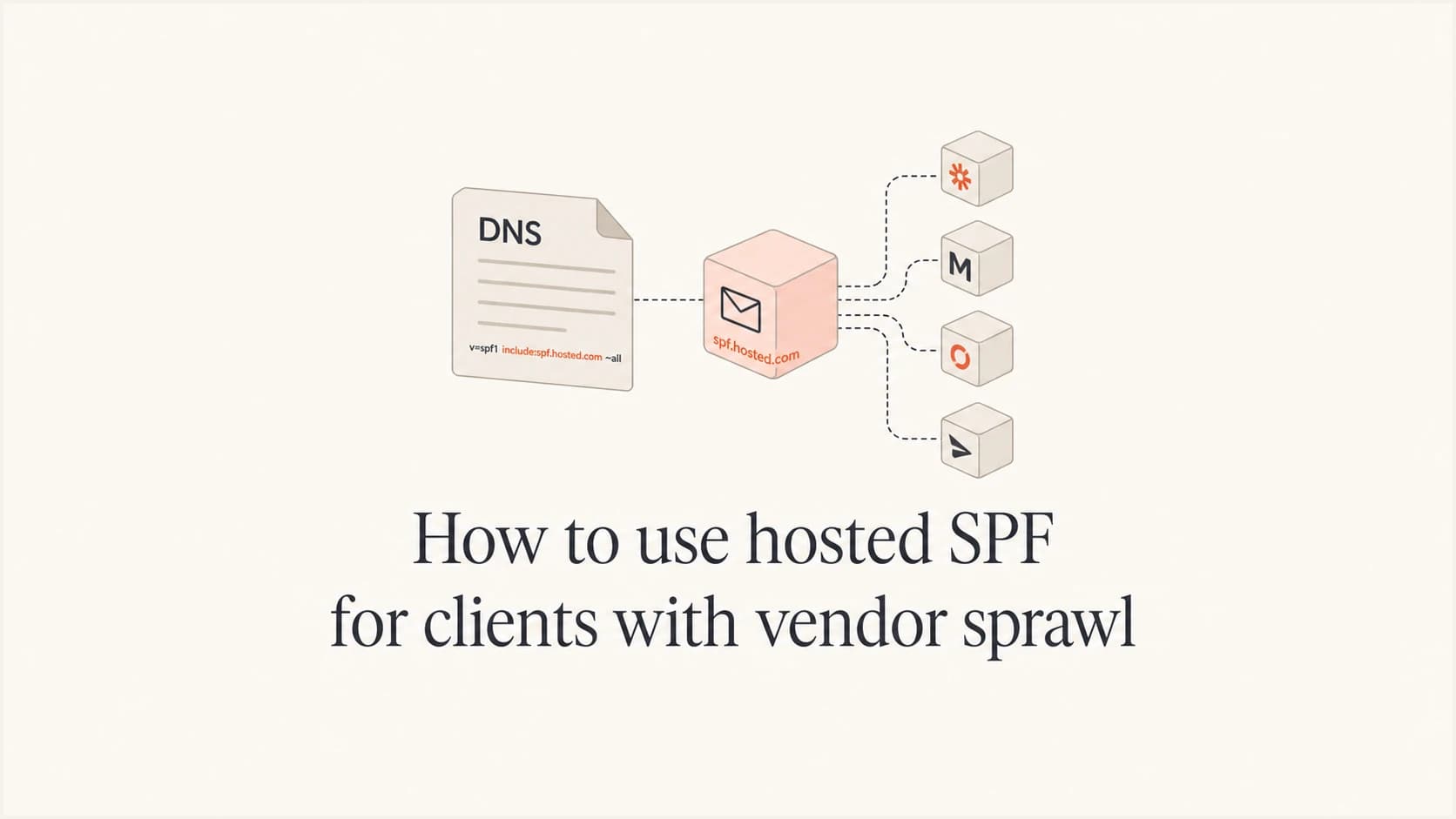
Updated on 21 Sep 2026: We added effective-policy and message-header verification, clarified recursive lookup behavior, and tightened the hosted SPF operating controls for MSP teams.
Hosted SPF lets an MSP replace a long, fragile client SPF record with one managed include. The client publishes that include once, while the MSP adds or removes approved senders in the hosted policy. This reduces routine DNS tickets, makes vendor ownership visible, and prevents the published record from growing every time a department buys another sending service.
The safest operating model starts with an inventory, validates every sender, moves the current policy into the hosted service, and changes the client record only after the effective hosted result matches the approved baseline. Hosted SPF does not authorize vendors automatically or remove SPF's evaluation limits by itself. It gives the MSP a controlled place to manage authorization without repeated access to the client's DNS account.
For a repeatable managed service, connect this workflow to DMARC for MSPs. DMARC reports identify real sending sources, while hosted SPF controls which sources receive SPF authorization. The combination supports evidence-based changes instead of accepting vendor instructions without checking actual traffic.
Why vendor sprawl breaks client SPF
Vendor sprawl usually reaches the SPF record through small, uncoordinated requests. Marketing adds a campaign platform, finance adds billing software, HR adds recruiting software, and a line-of-business application starts sending alerts. Each vendor supplies an include value, but nobody owns the combined policy. The record becomes an append-only list.
- Nested includes and redirects put pressure on SPF's ten DNS-querying mechanism limit during one evaluation.
- Old senders remain authorized when the MSP cannot identify a business owner or retirement date.
- A vendor can request broad IP authorization even when it sends with a separate return-path domain.
- Every direct sender change depends on client DNS access, approval, propagation, and a new validation pass.
The ten-lookup limit applies to the evaluated path, not simply the number of visible include statements. One include can expand into several DNS-querying terms. When the path exceeds the limit, SPF returns permerror. RFC 7208 also recommends a limit of two void lookups, which are DNS queries that return no records or a nonexistent name. These errors can break SPF-based DMARC alignment even though every visible vendor entry looks legitimate.
Direct DNS management
- Each change needs access to the client's authoritative DNS.
- The record often lacks sender owners and change history.
Hosted SPF management
- One initial DNS change delegates later sender updates.
- A managed policy supports consistent approval and removal.
Inventory senders before changing DNS
Start by recording every visible mechanism, include, redirect, IPv4 range, and IPv6 range in the existing SPF policy. Expand nested includes during analysis, but do not copy their expanded IP addresses into a static record. The vendor owns those ranges and can change them. Check employee mail, outbound gateways, website forms, on-premise relays, and automated application mail. The inventory should also capture the business owner, service purpose, return-path domain, DKIM status, and last observed traffic date.
Use DMARC aggregate data to confirm which sources really send for the domain. A structured sender inventory separates active vendors from stale configuration. Keep at least one normal business cycle in view, since quarterly billing or annual renewal systems can remain quiet for weeks.
|
|
|
|---|---|---|
Owner | Team and contact | Approve or escalate |
Traffic | Last seen | Keep or retire |
Identity | Mail path | Check alignment |
Lifecycle | Review date | Renew or remove |
Minimum sender register fields for each client
Do not treat an SPF pass as proof that a sender belongs in the client policy. First confirm that the return-path domain has domain alignment with the visible From domain for DMARC, or that DKIM domain alignment provides the pass. A service using its own return-path can pass SPF without contributing to the client's DMARC result.
Build the hosted policy safely
Create the hosted policy as a faithful copy of the approved current policy. Preserve the final qualifier unless the migration includes a separately approved enforcement change. Moving hosting and changing softfail to fail at the same time makes rollback and diagnosis harder.
Example direct client SPF recorddns
v=spf1 include:_spf.google.com include:spf.crm-vendor.example ~all
The hosted service should expose a unique include for the client domain. That include resolves to the approved sender policy. The root domain then contains one short reference, which keeps routine vendor changes away from the client's DNS control plane.
Example SPF record after delegationdns
v=spf1 include:spf.client123.hosted.example ~all
Delegation does not erase lookup limits
The hosted include consumes one DNS-querying term, and the receiver also counts any includes, redirects, a, mx, or exists mechanisms reached inside it. A service must optimize the effective policy, often through continuously refreshed flattening, to reduce that path. Simply nesting the original includes behind a new include does not solve lookup overflow.
Keep one SPF record
Never publish the hosted record beside the old SPF TXT record. Multiple SPF records at the same name cause permerror. Replace the old value in one controlled change and verify the resulting DNS answer.
A strong hosted service validates syntax before publication, evaluates the complete lookup path, and provides a clear rollback value. If the service uses SPF flattening, it must refresh vendor IP data as upstream records change. Static, one-time flattening turns a lookup problem into a stale-authorization problem.
Run a controlled migration
Treat the first hosted SPF deployment as a production change. Record the original TXT value, lower the DNS TTL at least one existing TTL interval before the change window when practical, and define a rollback trigger. Verification should cover syntax, DNS resolution, effective lookup count, and real messages from critical senders.
- Pause unrelated sender additions until the migration is verified.
- Save the current record, DNS TTL, lookup result, and DMARC source list.
- Add only approved, active senders to the hosted policy.
- Confirm that the hosted include resolves without loops, excess lookups, or excess void results.
- Publish the single delegated record and remove the previous value.
- Check critical mail streams immediately, inspect authentication headers, and review DMARC data after reporting arrives.
Rollback if the hosted include fails to resolve, produces permerror, or omits a confirmed critical sender. Restore the captured record rather than improvising during an incident. Keep the change ticket open until normal source volumes and authentication results return.

Hosted SPF migration moves through inventory, approval, validation, publication, and monitoring.
Verify DNS and message authentication
Check the authoritative DNS answer and at least two recursive resolvers after publication. Confirm that the evaluated domain returns exactly one TXT record beginning with v=spf1, the hosted include resolves, and the effective policy ends with the approved qualifier. Recursive resolvers can retain the old answer until its previous TTL expires, so record which answer each resolver returned before declaring the cutover complete.
DNS checks after publicationbash
dig TXT example.com +short
dig @1.1.1.1 TXT example.com +short
dig @8.8.8.8 TXT example.com +short
Send a message through every critical mail stream and inspect Authentication-Results or Received-SPF. The spf=pass result must name the expected smtp.mailfrom domain and connecting source. Then confirm that DMARC passes through SPF domain alignment or an aligned DKIM signature. An SPF pass for a vendor-owned return-path does not authenticate the client's visible From domain for DMARC.
Example authentication result
Authentication-Results: mx.receiver.example;
  spf=pass smtp.mailfrom=bounce@example.com;
  dkim=pass header.d=example.com;
  dmarc=pass header.from=example.com
Account for forwarded mail
Forwarding changes the connecting IP and often preserves the original return path, so SPF can fail after a legitimate forward. Hosted SPF does not repair that path. Preserve DMARC authentication with aligned DKIM, or use Sender Rewriting Scheme when the forwarding operator supports it.
Operate vendor changes as a service
After migration, the main benefit comes from process. Require every request to identify the business owner, sending domain, expected volume, launch date, return-path behavior, DKIM capability, and retirement date. Reject a request that only says to add an include. The include proves how to authorize infrastructure, not whether that infrastructure should send for the client.
Keep the public DNS record deliberately boring. It should change only when the hosted delegation changes, the client moves DNS providers, or the service needs rollback. A short stable record also makes client handover easier because the incoming operator can see that sender authorization lives in a managed policy.
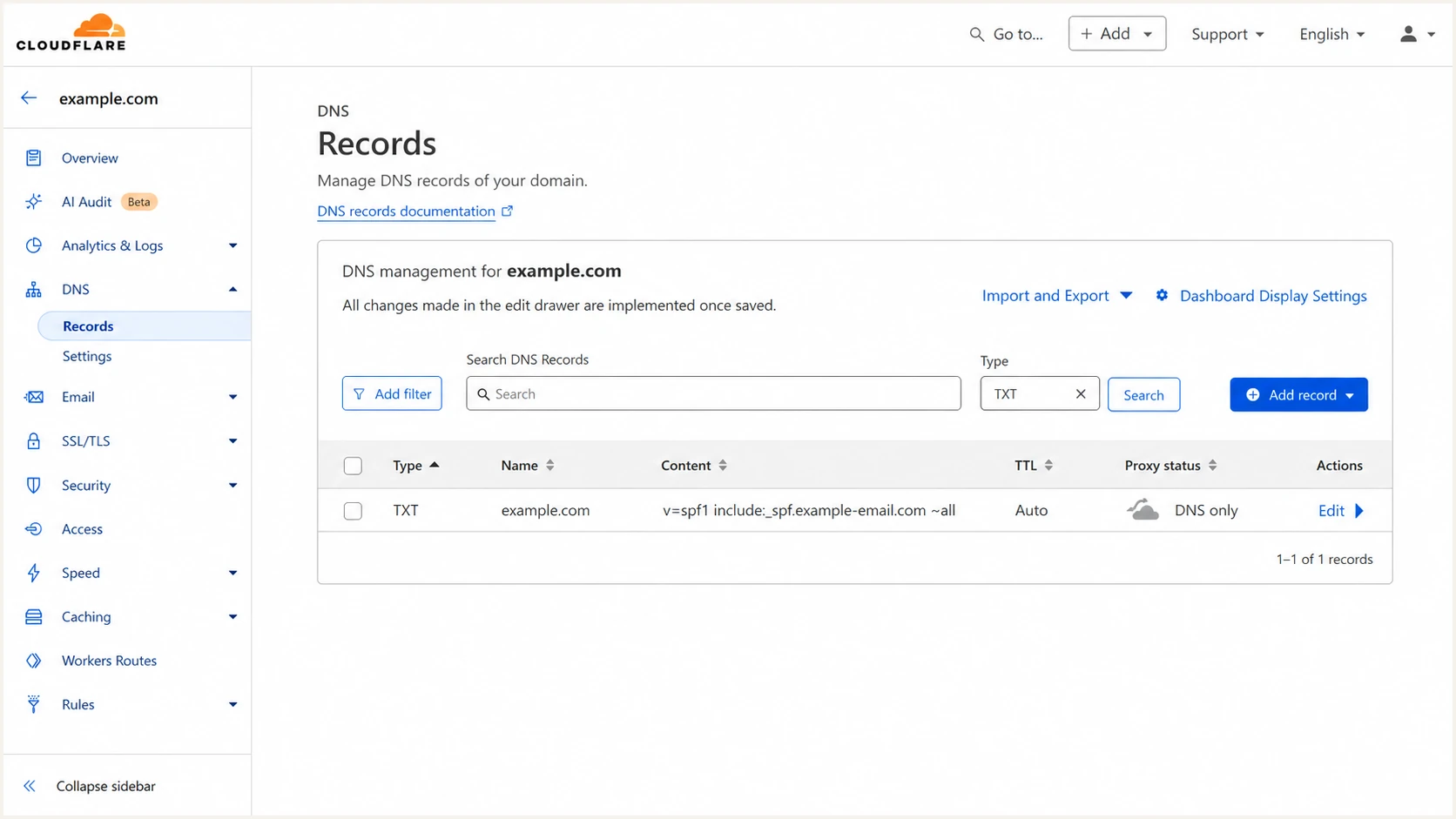
Cloudflare DNS screen with one client SPF TXT record using a hosted include.
The client DNS view should stay simple after delegation. Day-to-day vendor updates happen in the hosted policy, but the MSP must still document who approved each update and why. Use separate roles for request, approval, and implementation when the team size allows it. For a small MSP, a peer review in the ticket provides a practical control.
Schedule quarterly reviews for active clients and review high-change clients more often. Compare the sender register with current DMARC sources, client application lists, and recent tickets. Remove a vendor only after its owner confirms retirement and the observation window shows no legitimate traffic. The related alignment workflow helps prevent an apparently successful SPF change from masking a DMARC alignment failure.
Define a removal rule
Give every temporary sender an expiry or review date. Removing unused authorization narrows the set of systems that can produce an SPF pass and keeps the hosted policy understandable.
Use Suped across client domains
Suped's hosted SPF workflow gives the MSP a managed location for sender changes and SPF optimization. The client publishes the Suped-provided include, and the MSP manages the desired policy without asking for DNS access on every vendor update. This is most useful when the MSP already owns sender approval and authentication operations.
SPF flattening drawer showing an over-limit record, sender editing, lookup counts, and the hosted record setup
The same Suped organization can pair hosted SPF with DMARC source data, automated issue detection with steps to fix, and alerts. Its MSP and multi-tenancy dashboard keeps client domains separated while giving operators one place to review status. Blocklist (blacklist) and deliverability insights add context when authentication passes but delivery performance changes.
For MSP teams using Suped, the operational pieces stay in one workflow. DMARC monitoring identifies sources, hosted SPF controls authorization, hosted DMARC supports policy staging, and real-time alerts surface changes that need attention. Client approvals and a sender register still remain necessary controls across every tenant.
SPF checker
Find SPF syntax issues, lookup limits, and weak records.
?/16tests passed
Use the focused check after publishing the delegated record and after material hosted-policy changes. Confirm that the domain returns one SPF record, the hosted include resolves, the effective policy ends with the intended qualifier, and evaluation remains inside protocol limits. Then validate real mail, since a syntactically valid record can still omit a required sender.
Controls that keep hosted SPF dependable
Hosted SPF centralizes a sensitive control, so access, DNS availability, and recovery deserve the same attention as DNS administration. Require multi-factor authentication, limit policy editing to named operators, review access when staff roles change, and retain change history. Keep an offline record of the last known good direct policy for each client.
- Tie every sender edit to an approved client request and a named business owner.
- Test syntax and effective lookup behavior before and after publication.
- Store the previous policy and document when operators must restore it.
- Watch DMARC results for new failures, missing sources, and unexpected volume shifts.
Do not use hosted SPF to compensate for weak vendor identity design. Where a vendor supports DKIM domain alignment, configure it. Where it supports a custom return-path, configure SPF alignment as well. DMARC monitoring then shows whether those identities authenticate and have domain alignment under real traffic.
A workable MSP standard
A good client standard uses one SPF TXT record, one hosted include, a documented owner for every authorized sender, and a defined review date. New vendors enter through a request and validation process. Retired vendors leave after ownership confirmation and traffic review. Every change has a rollback value and a post-change check.
That model turns vendor sprawl into a manageable service queue. Hosted SPF reduces DNS dependency, but its real value comes from consistent inventory, approval, authentication testing, and removal. Suped supports that operating model across multiple clients while keeping SPF work connected to DMARC evidence and actionable issues.