
Why are SPF, DKIM, and DMARC failing in Yahoo/AOL, and how to fix it?

Updated on 21 Oct 2026: We added Yahoo/AOL DMARC report checks and clarified how to diagnose authentication errors and verify repairs.
Apparent SPF, DKIM, and DMARC failures at Yahoo/AOL have two broad explanations: the message really fails when Yahoo evaluates it, or the report you are reading is missing or misreading the authentication data. If all three suddenly show as failing, do not assume Yahoo changed something that day. First, inspect Yahoo's receiver-added Authentication-Results headers on the exact delivered message, or the full SMTP reply if it was rejected.
Yahoo began enforcing stricter sender requirements in 2024, and those rules remain in force across AOL and other consumer domains hosted by Yahoo Mail. All senders must authenticate with SPF or DKIM. Bulk senders must use both SPF and DKIM, publish a DMARC policy of at least p=none, and pass DMARC through an aligned SPF or DKIM identity. Yahoo describes bulk senders by significant volume but does not publish a numeric threshold.
Direct answer
- Authentication failure: A DNS record changed, a DKIM selector disappeared, SPF no longer includes the sending IP, or the sending stream uses a different bounce domain.
- Reporting gap: The seed test or dashboard has missing authentication data and shows zero pass rates even when delivered Yahoo headers pass.
- Fix path: Check raw Yahoo headers, raw bounces, DNS records, the exact sending stream, and DMARC reports before changing policy.
- Suped workflow: Suped's DMARC monitoring groups aggregate reports by sending source so you can compare failures with the affected domain's DNS configuration.
What Yahoo and AOL are checking
Yahoo/AOL does not pass DMARC because SPF and DKIM exist in DNS. DMARC passes when at least one of SPF or DKIM passes with a domain that meets the configured DMARC alignment rules for the visible From domain. SPF checks the SMTP envelope sender domain, usually shown in Return-Path. DKIM checks the signing domain in the d= value. DMARC compares those authenticated domains with the visible From domain.
Yahoo accepts relaxed DMARC alignment, so bounces.example.com and example.com qualify because they share the same organizational domain. This is the default matching mode. If the DMARC record sets aspf=s or adkim=s, the corresponding SPF or DKIM domain must exactly match the visible From domain.
This often breaks with marketing platforms, CRMs, transactional senders, forwarded mail, and mailing lists. A platform can pass SPF for its own bounce domain and DKIM for its own signing domain while DMARC fails for your brand domain. Forwarding commonly breaks SPF because the forwarder's IP is not authorized, although an intact aligned DKIM signature can still preserve DMARC. Forwarders should add ARC, and mailing lists should use the list address in From with the original sender in Reply-To when rewriting breaks authentication. ARC preserves earlier authentication assessments for receiver evaluation; it does not guarantee a DMARC pass or acceptance.
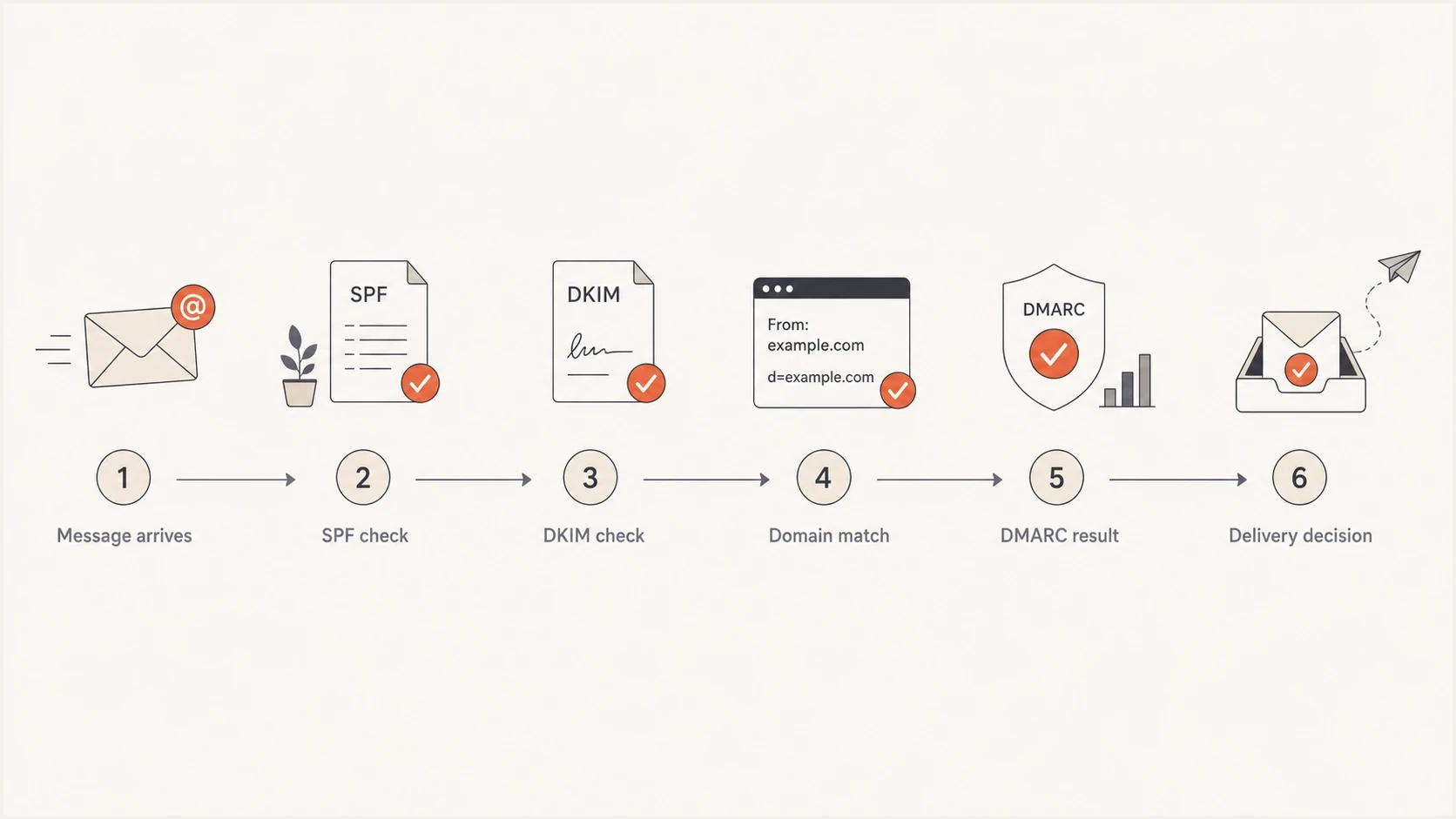
Yahoo and AOL authentication checks showing how SPF, DKIM, and domain alignment determine the DMARC result.
Real authentication failure
- Header evidence: A Yahoo-added Authentication-Results header records a failure, or Yahoo's SMTP reply explicitly identifies an authentication problem.
- DNS evidence: SPF, DKIM, or DMARC records are missing, malformed, duplicated, or changed without a matching sender change.
- Impact pattern: The affected stream has repeated failures in receiver headers or SMTP logs; not every authentication failure produces a bounce.
Reporting or seed issue
- Header evidence: Messages from the affected stream pass, but a dashboard reports zeros; compare the same sending IPs and time window before ruling out intermittent failures.
- Seed evidence: The test recipients were not sent to, were suppressed, were bounced, or were excluded by ESP logic.
- Impact pattern: Normal recipients receive authenticated mail and the report lacks matching message evidence; check the send logs as well as bounces.
How to prove the failure
The fastest way to avoid chasing the wrong fix is to inspect a real Yahoo or AOL message. A seed dashboard is useful, but it is secondary evidence. A receiver-added header on a delivered message or the full SMTP reply for a rejection is primary evidence because it shows what Yahoo actually evaluated.
- Send exact mail: Use the same sender, From domain, envelope path, template, tracking links, and ESP account as the failing campaign.
- Inspect headers: Open the full source in Yahoo or AOL and find Authentication-Results, DKIM-Signature, Return-Path, and From. Use the results added by Yahoo's receiving server, rather than results supplied by the sender or an earlier hop.
- Compare domains: Compare the header From domain with the SPF-authenticated Mail From domain and DKIM signing domain, using the relaxed or strict matching mode in your DMARC policy.
- Read bounces: Use raw SMTP bounce text, not a summarized report, because the full reply and enhanced status code show what Yahoo rejected.
- Validate DNS: Run a domain health check and confirm the records visible on the public internet match the intended setup.
Illustrative Yahoo/AOL authentication resultstext
Authentication-Results: atlas.mail.yahoo.com;
  dkim=pass header.d=example.com header.s=selector1;
  spf=pass smtp.mailfrom=bounces.example.com;
  dmarc=pass header.from=example.com
Return-Path: <bounce@bounces.example.com>
From: Example Brand <news@example.com>
If the header shows dmarc=pass while your dashboard marks that stream as failing, compare sending IPs, DKIM selectors, timestamps, and reporting windows before concluding the dashboard is wrong. If the header shows dmarc=fail, fix the sending identity before changing the DMARC policy.
?
What's your domain score?
Deep-scan SPF, DKIM & DMARC records for email deliverability and security issues.
Check the DMARC record itself with a focused DMARC checker. Confirm that one valid DMARC policy is discoverable for the visible From domain, including any inherited subdomain policy. A missing or invalid record can leave bulk mail out of compliance even when SPF and DKIM pass.
Common causes and exact fixes
The right fix depends on which layer fails. Changing the DMARC policy rarely fixes a Yahoo/AOL delivery failure by itself. Most repairs happen in SPF includes, DKIM selectors, custom return paths, or the ESP account that sends the affected stream.
If the problem appears only at Yahoo/AOL, still check the full setup. A receiver can see an SPF lookup timeout, a temporary DNS error, or a different sending IP than the one your test used. A platform can also send the test email from a shared pool while the production campaign uses a dedicated IP, a different return path, or a different DKIM selector.
|
|
|
|---|---|---|
SPF fail or softfail | The evaluated SPF policy does not authorize the connecting IP, including a forwarder's IP. | Check the exact Mail From domain and authorize legitimate sending IPs there. Preserve aligned DKIM for forwarded mail. |
SPF permerror | Multiple SPF records, invalid syntax, or more than 10 evaluated DNS-lookup terms. | Publish one SPF record for the evaluated domain and keep lookup-causing terms at 10 or fewer, including nested includes. |
SPF or DKIM temperror | A temporary DNS lookup problem or unavailable nameserver. | Check authoritative DNS and retry after the temporary problem is resolved. |
DKIM fail or permerror | A missing selector, wrong key, or signed headers or body changed after signing. | Repair the selector and signing path. Use an RSA key of at least 1024 bits, preferably 2048, and enable brand-domain signing with DMARC alignment. |
DMARC fail | Neither SPF nor DKIM provides a passing result with domain alignment to the visible From. | Repair authentication and use a custom return path or DKIM signing domain that meets the From domain's DMARC matching rules. |
Dashboard shows zero or missing results | Missing test messages, delayed report data, or a parser error. | Confirm sends and queue status, then compare receiver headers with the report's source and time window. |
Use this table after checking a real Yahoo or AOL header.
Also inspect every DKIM-Signature header. Yahoo's DKIM guidance says it evaluates multiple signatures, and if a message has several DMARC-aligned signatures that do not all pass, Yahoo does not guarantee a DMARC pass. Fix or disable the signing path that adds a broken aligned signature.
Do not loosen policy first
If your DMARC policy is already at p=reject, changing it to p=none reduces the enforcement requested from receivers but does not repair SPF, DKIM, or domain alignment. Yahoo still requires bulk mail to pass DMARC at p=none. Consider a temporary policy change only for a confirmed policy-related incident after capturing evidence and assessing the reduced protection.
Check SPF at the exact envelope sender domain, such as bounces.example.com; an SPF record at example.com does not automatically cover subdomains. Find the DKIM public key at s._domainkey.d using the signature's s= selector and d= domain, and follow any provider-supplied CNAME. Long keys split across quoted strings within one TXT record are valid. Replace the example report mailbox, send.example.net, and BASE64KEY below with your actual configuration.
Example monitoring policy with a report mailboxdns
_dmarc.example.com TXT "v=DMARC1; p=none; rua=mailto:dmarc@example.com"
Illustrative SPF and DKIM records with placeholdersdns
bounces.example.com TXT "v=spf1 include:send.example.net -all"

selector1._domainkey.example.com TXT "v=DKIM1; k=rsa; p=BASE64KEY"
Suped's hosted DMARC helps when the hard part is policy staging and visibility across senders. With hosted DMARC, you manage policy changes through Suped instead of editing TXT records every time you need to move between monitoring, quarantine, and reject.
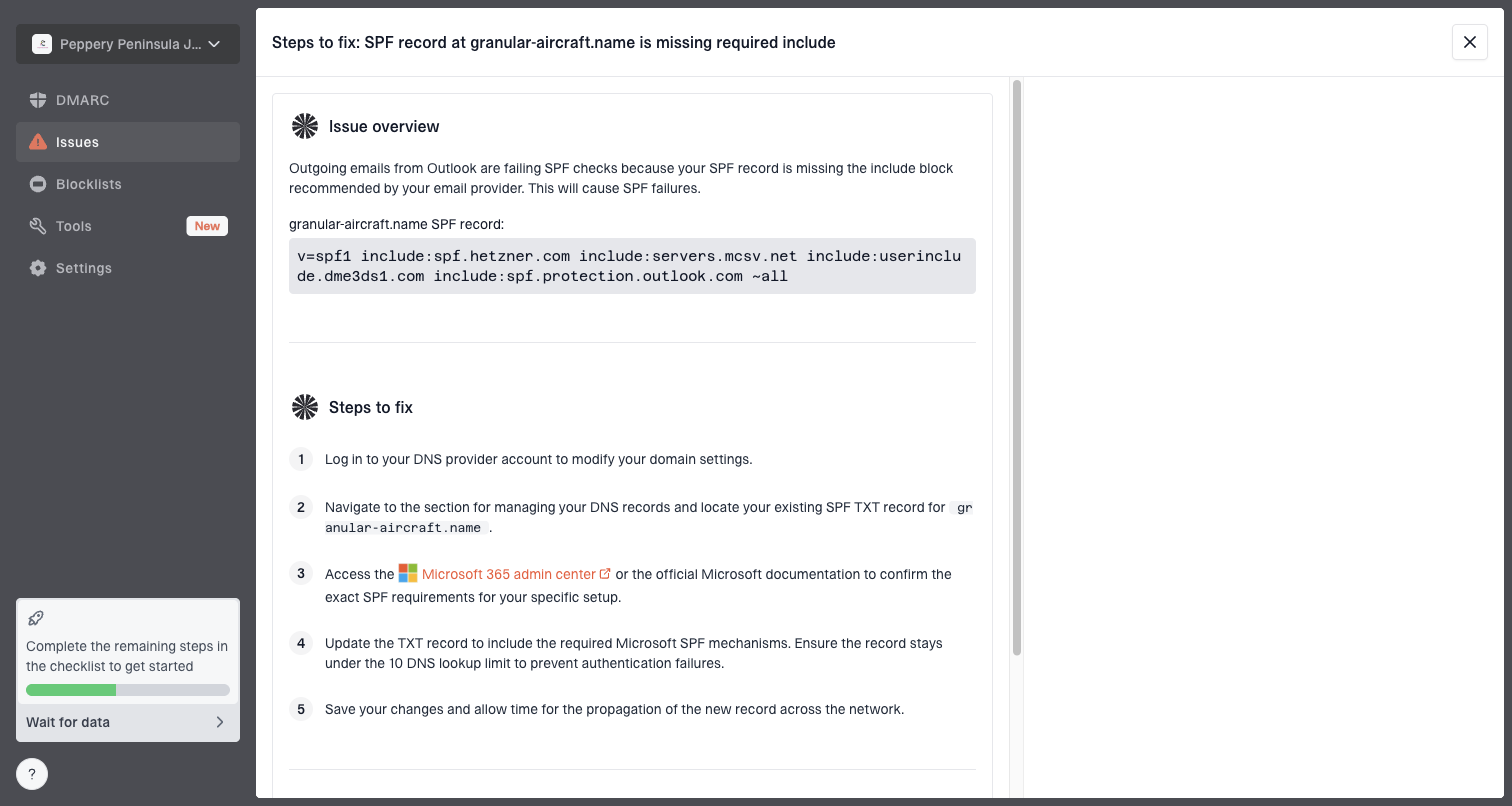
Issue steps to fix dialog showing the issue overview, tailored fix steps, and verification action
For teams managing several sending sources, Suped's product turns DMARC aggregate reports into source-level evidence, highlights unverified senders, and provides concrete fix steps. A failure count is incomplete. The useful details are the sender, failing domain, affected stream, and DNS or platform setting that needs correction.
How to use DMARC reports to isolate Yahoo/AOL failures
Collect DMARC aggregate reports (RUA) through the rua address in your policy. Filter for Yahoo's reporting organization and the incident's time window, then group by source_ip and header_from. Reports usually arrive daily and summarize traffic rather than individual recipients.
- auth_results records raw SPF and DKIM outcomes and the domains tested.
- policy_evaluated.spf and policy_evaluated.dkim include DMARC domain alignment. A raw Mail From SPF pass with policy_evaluated.spf=fail indicates a domain mismatch.
- disposition describes DMARC handling, not inbox placement. A value of none does not establish a DMARC pass. Check any policy override reasons.
- Investigate unfamiliar source IPs before authorizing them. Preserve evidence of unauthorized sending and keep those IPs out of SPF.
If reports are missing, confirm the receiving mailbox works and any external destination has the required DNS authorization. RFC 9990 defines the report fields and external reporting checks.
How to read Yahoo/AOL SMTP responses
The SMTP response determines whether to retry or stop. Authentication is one possible cause, so preserve the complete response and Yahoo diagnostic code instead of diagnosing from the first three digits alone. Yahoo's SMTP error reference distinguishes authentication failures from other delivery problems.
|
|
|
|---|---|---|
421 or 451 | Temporary deferral caused by conditions such as unusual traffic, complaints, server load, DNS trouble, or an authentication lookup error. | Keep normal queue retries active. Investigate the named cause if the same response persists. |
550, 553, or 554 | Permanent rejection caused by an invalid recipient, authentication failure, message policy, or another permanent condition. | Do not retry the unchanged message. Fix the stated cause and suppress addresses confirmed as invalid; an authentication rejection alone does not make an address invalid. |
Use the full Yahoo response text to identify the underlying cause.
Read the diagnostic text
Do not classify every Yahoo 4xx or 5xx response as an authentication failure. Match the full SMTP reply against the same sending IP, timestamp, recipient domain, and campaign stream. If the reply names DMARC, DKIM, SPF, or an unresolvable From domain, investigate that authentication path. For example, 554 5.7.9 'Message not accepted for policy reasons' needs the accompanying diagnostics; the code alone does not identify a specific SPF or DKIM defect.
Separate reporting gaps from Yahoo/AOL delivery problems
A Yahoo/AOL filter in an inbox placement report can make the issue look provider-specific even when the real problem sits upstream. If seed addresses were suppressed, excluded, or never sent the campaign, the platform has no headers to parse. Some dashboards show that as zero pass rates instead of missing data.
The absence of bounces needs context. If most Yahoo/AOL mail failed DMARC under a reject policy, you would normally see 5xx rejections. A 4xx deferral stays in queue and can appear in delivery logs before it becomes a final bounce. If neither raw rejections nor sustained deferrals exist, compare delivered headers, seed inclusion, and DMARC aggregate reports before changing DNS.
Separate delivery placement from authentication. A message can pass SPF, DKIM, and DMARC, then still land in spam because of complaints, low engagement, list quality, or campaign content. Investigate reputation and content filtering when the receiver's authentication results pass.
- Campaign scope: If one campaign fails and another passes, compare From domain, sender profile, DKIM selector, tracking domain, and return path.
- Recipient scope: If only seed addresses show failures, prove those recipients received the message and that headers were available to parse.
- Time scope: If the failure started after a DNS edit, ESP migration, IP warmup step, or template change, inspect that change first.
Evidence strength for a Yahoo/AOL auth incident
Use stronger evidence before making DNS or policy changes.
Weak
Seed report only
Only a dashboard percentage is available.
Useful
Yahoo header
A delivered message has full headers.
Strong
Corroborated
Headers, bounces, and DMARC reports agree.
A practical escalation note
When a third-party report conflicts with Yahoo headers, ask exactly which source it parsed: delivered header, seed mailbox, bounce text, or DMARC aggregate report. If it cannot show the source, treat the report as a clue, not a verdict.
After the evidence is clean, check Yahoo's other requirements. Bulk marketing and subscribed mail needs a functioning List-Unsubscribe header and a visible body link; Yahoo accepts mailto and recommends RFC 8058 one-click POST. Honor requests within two days. Keep spam complaints below 0.3%, measured against inbox-delivered mail, and check valid forward and reverse DNS for sending IPs. Maintain TLS and list hygiene as delivery practices.
Verify the fix on the affected sending stream
Start with the exact Yahoo or AOL message, confirm what passed and failed in the header, then repair the SPF include, DKIM selector, return path, or domain match that caused the result. After the change, send new messages from each affected stream and check SPF, DKIM, and DMARC in Yahoo's receiver-added headers. Both SPF and DKIM must work for bulk traffic.
Allow for the previous DNS TTL and any negative caching of previously missing records. Confirm the affected source's failure rate drops in the next aggregate reporting window and retain the passing test message as a baseline.
Frequently asked questions
Yahoo began enforcing its sender requirements in 2024, and they apply to AOL and other consumer domains hosted by Yahoo Mail. A sudden failure does not prove a new rule. Compare the current requirements with the full SMTP reply and recent DNS or sending changes.
Yes. DMARC fails if SPF and DKIM pass for domains without alignment to the visible From domain. Configure a custom return path or brand-domain DKIM signing that meets the applicable relaxed or strict matching rules.
Check the full Yahoo or AOL message source for receiver-added Authentication-Results. For rejected messages, use the full SMTP reply. Then compare DMARC reports, DNS records, and whether seed addresses received the exact campaign.
Changing reject to none does not satisfy Yahoo's bulk-sender requirement for DMARC to pass. Consider it only for a confirmed policy-related incident after capturing evidence and assessing the reduced protection; repair the sender configuration first.
Yes. They indicate a temporary deferral, so keep normal queue retries active and investigate the full diagnostic text if the same response persists. Do not retry an unchanged message after a permanent 5xx rejection.
Suped's DMARC monitoring groups aggregate reports by sending source so you can identify affected domains, review DNS issues, and follow the fix steps for the failing stream.