Swiss NCSC links public company directories to payroll and payment scams
News


November 25, 2026 (Sydney time)
Switzerland's National Cyber Security Centre (NCSC) reports two separate fraud attempts using information published on company websites. Scammers used a searchable staff directory to impersonate employees seeking salary bank-account changes. In the other case, they used an IT service provider's public customer list to direct false payment demands at its genuine customers.
The common concern is the credibility that accurate business details give a request. Knowing an employee's role or a customer's supplier does not prove authority to redirect salary payments or collect money. For HR, payroll and accounts payable, that distinction belongs at the point where a request becomes an approved change.
What the NCSC reports
Published on November 24, the NCSC's Week 47 advisory describes two recent cases it handled. The publication date is not the date of either fraud attempt.
In the payroll case, a company's website let visitors search its staff directory and filter people by role. Scammers used those public details when posing as employees and asking HR to replace the bank details used for salary payments. The intended outcome was to redirect future wages to an account controlled by the scammers.
The separate payment attempt concerned an IT service provider that displayed its customers publicly. Scammers contacted those customers with a false warning: a website managed by the provider would go offline or lose functionality unless they paid immediately. The genuine supplier relationship gave the demand a plausible business context; it did not make the demand legitimate.
What the advisory leaves unestablished
The NCSC does not name the organizations, give exact incident dates or identify the message medium in either case. It provides no headers or sender domains, establishes no technical impersonation method and reports no confirmed payments or losses. The account does not establish a breach, mailbox compromise or email authentication failure, measure campaign prevalence, or announce enforcement or rollout dates.
What HR and finance teams should verify
These requests concern different decisions. HR and payroll control salary destinations. Accounts payable controls supplier payments. An IT provider also has a communication problem when someone uses its real customer relationships to support a false demand. Each team needs a verification route that exists before a suspicious request arrives.
I treat a bank-detail change as a fresh authorization decision, even when the requester knows the right names. A familiar identity and an urgent deadline should not replace the checks required for an ordinary change.
- Payroll changes. Confirm the request through an established internal workflow or contact the employee using a previously recorded number. Do not use replacement contact details supplied in the request.
- Supplier payments. Check the demand against the contract and expected billing. Contact the provider through a known account contact or existing support route before paying an unexpected charge.
- Separate approval. Require another authorized person to approve bank-detail changes or exceptional payments. Record how the requester was verified so the approver checks evidence rather than simply repeating the first decision.
- IT provider communications. Give customers a documented route for checking billing and service-suspension claims. Staff handling those enquiries should verify account status before confirming that payment is required.
- Suspicious messages. Pause the requested action and route the message to the internal security team. If it is email, preserve the original message for header review rather than forwarding only a screenshot.
A separate channel needs an independent source of trust. Calling a number inside the demand or replying to its sender keeps the verification inside the same conversation. Use contact information already held in employee or supplier records, and resolve discrepancies before updating the payment destination.
Where DMARC helps, and where it does not
Email authentication is relevant defensive context, but the advisory does not establish that either case involved email or a particular sending technique. Administrators should investigate messages their own organization receives before attributing an authentication weakness to these incidents.
For exact-domain spoofing, DMARC connects the domain in the visible From address to a passing SPF or DKIM result through domain alignment. At least one mechanism must pass with the required alignment. An enforcement policy asks receiving systems to quarantine or reject messages that fail, subject to receiver handling.
Exact-domain spoofing
An unauthorized sender uses the protected domain in the visible From address without passing aligned SPF or DKIM.
Correctly configured authentication and DMARC enforcement help receiving systems identify and handle that unauthorized use. Legitimate sending sources need to be configured before policy is tightened.
Deception beyond the protected domain
A familiar display name or a similar-looking domain can mislead a recipient without using the protected domain in the From address.
Mail sent through an already authorized account or service can also pass authentication. Public business details and a plausible payment story still require independent verification.
A DMARC pass does not certify the truth of a payment demand or prove that an employee requested a payroll change. The distinction matters when a technically valid message reaches a team that has authority to move money. Authentication and transaction approval address different questions.
What email administrators should inspect
For suspicious email reported internally, inspect the full sender address and Reply-To, then review the envelope sender, DKIM signing domain and authentication results recorded by trusted receiving infrastructure. Check alignment with the visible From domain instead of relying on an isolated SPF or DKIM pass label.
Preserve the original headers and message for investigation. Document the findings without treating them as proof of who authorized a transaction. A DNS policy lookup also has a narrower purpose: Suped's DMARC checker checks a domain's published record, while the original email is needed to investigate a particular delivery.
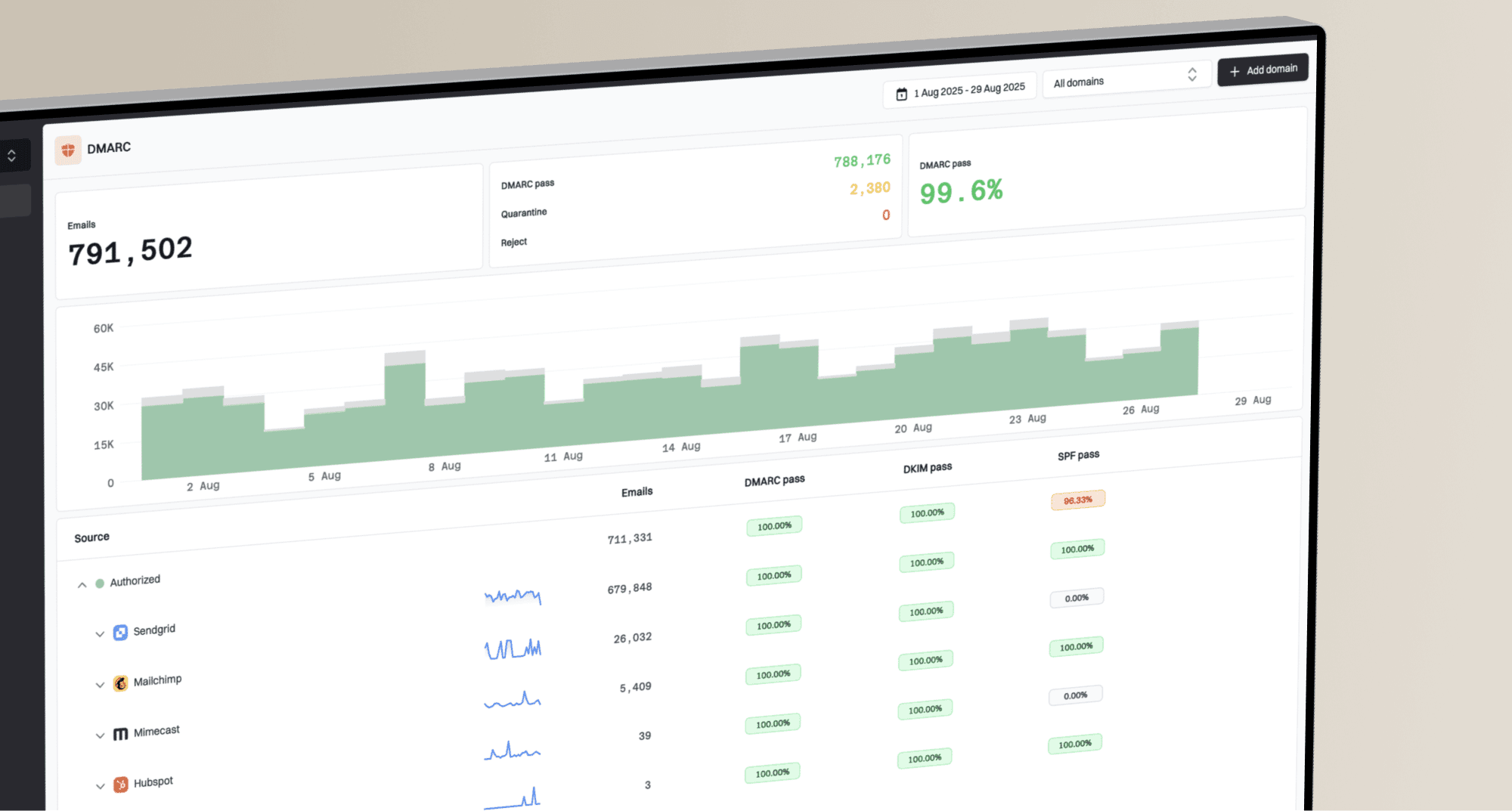
In Suped, our email authentication platform, teams use DMARC monitoring to review reported sending sources and investigate authentication failures. That workflow supports configuration fixes and decisions about enforcement. Aggregate reports do not contain the payment conversation or establish whether a business request is genuine.
Review what company websites make public
The NCSC recommends reviewing published employee and customer information and keeping what is necessary for business purposes. A practical audit should ask whether role filters expose payment responsibilities, whether direct contact details need to be searchable, and whether customer listings reveal relationships that staff are likely to trust.
Review staff pages and customer references with their business owners. Keep useful public contact routes, remove unnecessary detail and give publication decisions a named owner. Reducing exposure limits readily available context; requests containing accurate public information still need the normal verification process.
Keep the approval step independent
Choose a payroll-change request and an unexpected supplier-payment scenario for the next internal process check. Confirm that staff can find the known contact, pause the change and obtain separate approval without relying on information inside the request. Assign any gaps to the team that owns the payment workflow.
Frequency asked questions
No. It describes the use of publicly available website information. It does not establish a breach or mailbox compromise, and neither should be inferred from the reported cases.
The advisory reports no confirmed payments or losses. The payroll attempt sought to redirect salary payments, while the separate IT-provider case sought immediate payment under a false service-interruption threat.
That conclusion is unsupported because the message medium and impersonation methods are unspecified. In general, DMARC enforcement helps against unauthorized exact-domain spoofing. It does not validate payment instructions, familiar display names or claims based on public business relationships.
Review each listing for business necessity. Remove unnecessary role and customer details, retain appropriate contact routes, and make sure payment changes require verification through a previously known contact or internal workflow.