
Sneaky 2FA phishing used Google's mail relay to send fake mailbox alerts
News

Published 26 Nov 2026
Updated 26 Nov 2026
7 min read
Summarize with
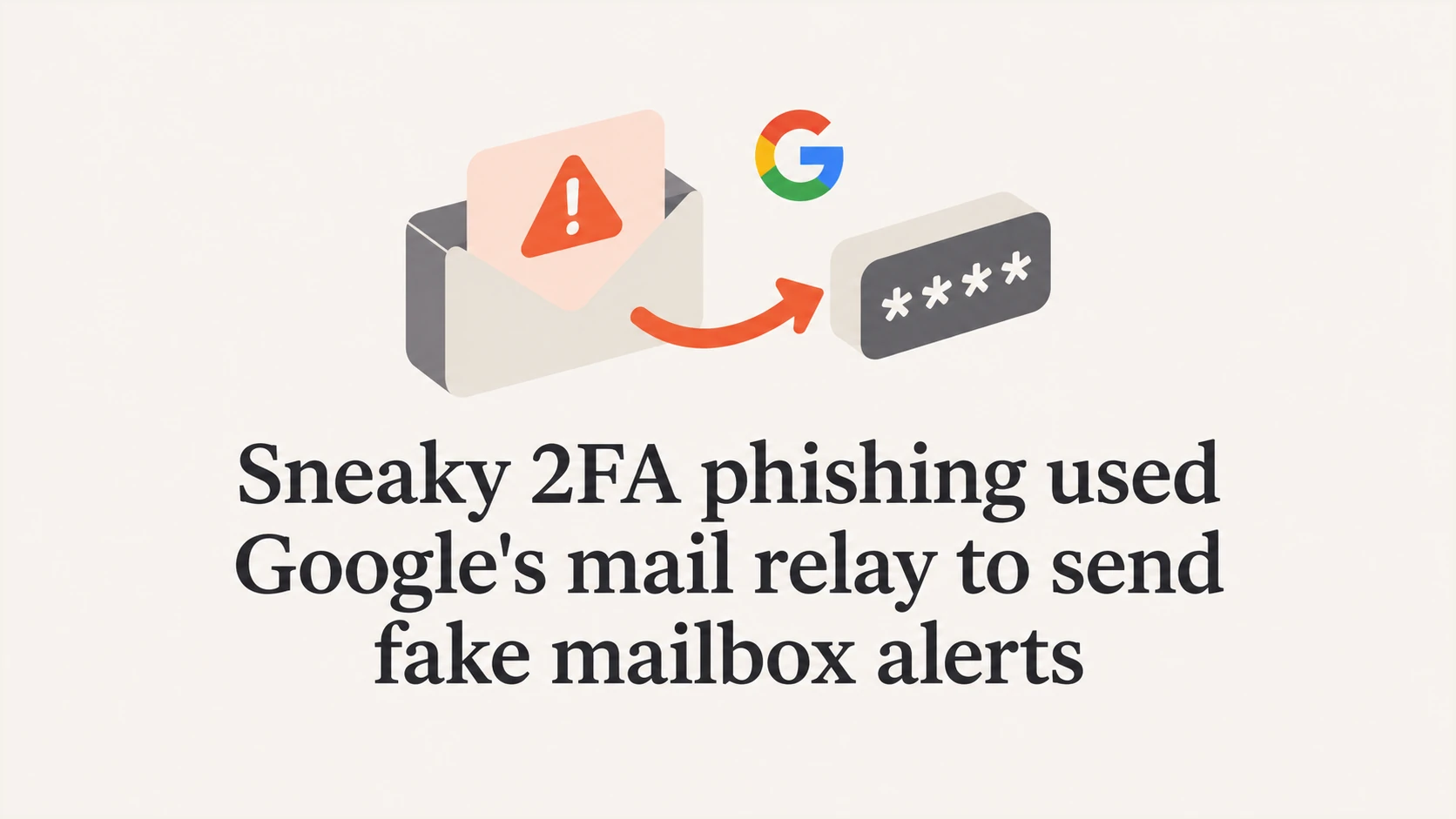
A malicious Sneaky 2FA campaign used Google's SMTP relay to deliver fake held-message and mailbox synchronization alerts. Email links passed through a Google address before reaching a phishing site. Barracuda Research's report documented targeting of finance, insurance and services organizations in coordinated two-minute bursts.
The report was published on November 25, 2026, at 10:55 UTC, according to Barracuda's official RSS feed. The kit aims to capture authenticated sessions after multifactor authentication (MFA). Trusted sending infrastructure and a familiar link address do not establish that a mailbox alert is legitimate.
What the reported evidence establishes
The important boundary is between observed delivery behavior and an established compromise. A campaign's objective explains what defenders should investigate; it does not establish that every recipient followed a link or that an attacker obtained access.
For incident triage, separate the message evidence, browser activity and account activity. A delivered email establishes exposure. A recorded visit establishes interaction. Evidence of unauthorized account use supports a compromise finding. Keeping those findings separate helps avoid unnecessary account disruption while preserving a clear investigation record.
Do not infer authentication results
Barracuda did not report SPF, DKIM or DMARC verdicts, an authentication bypass, a Google product compromise, message or victim totals, or confirmed successful takeovers for this specific campaign.
Google's relay and a Google redirect answer different questions
A sending relay is part of the email transport path. Its reputation helps a receiving system assess the infrastructure handling a message. That reputation does not establish that the apparent sender is authorized to request a password or that the message describes a real mailbox problem.
A redirect is part of the web navigation path. The first hostname visible in a link is not necessarily the hostname hosting the final page. Security teams should evaluate the complete navigation chain through controlled inspection, including the destination that requests authentication.
Neither observation supplies a sender authentication verdict. Received headers describe transport, while authentication results describe specific checks. The sender's display name, the return address and the domain in the visible From field are separate pieces of evidence. A familiar company name in one place does not validate the others.
Email transport
Review the receiving system's trusted header evidence. Establish which systems handled the message and which identity each authentication result evaluates.
Web navigation
Inspect redirects through security tooling. Establish the final destination and whether it is an expected sign-in origin before interpreting the page's appearance.
What SPF, DKIM and DMARC actually establish
SPF evaluates whether a connecting server is authorized for the envelope sender domain, or the HELO identity in the relevant case. An SPF pass alone does not authenticate the address a person sees in the From field. The checked domain matters as much as the result.
DKIM validates a cryptographic signature associated with a signing domain and the signed message content. A passing signature provides evidence about that domain's signature. It does not certify that a requested action is safe or that the person controlling the sender has good intentions.
DMARC passes when SPF or DKIM passes with the required domain relationship to the visible From domain. Its policy tells receivers how the domain owner requests handling of failures, subject to receiver decisions. Even a passing DMARC result does not validate a link destination or a login request.
|
|
|
|---|---|---|
SPF | Sending authorization | Link safety |
DKIM | Domain signature | Sender intent |
DMARC | From-domain relationship | Login legitimacy |
Relay reputation | Infrastructure history | Account ownership |
Authentication checks have defined scopes.
Use authentication as evidence within its scope. For an actual suspicious message, review results added by the trusted receiving system. Do not treat a copied authentication header elsewhere in the message as authoritative, and do not assign a verdict to this campaign without the underlying evidence.
In general, an attacker controlling a domain can configure valid authentication for that domain. A compromised legitimate sending account is also a different problem than unauthorized use of someone else's domain. These possibilities explain why authentication and identity controls need to work together; establishing a campaign's actual sending arrangement requires message evidence.
Why session theft changes the response
A session cookie or token maintains access after sign-in. If an attacker obtains a usable session, access depends on that session's validity and the service's enforcement controls. Investigators therefore need to examine active sessions as well as passwords.
Ordinary MFA remains useful, but a completed challenge does not prove that the surrounding sign-in journey was trustworthy. Phishing-resistant sign-in, including appropriately deployed passkeys or FIDO2 security keys, binds authentication to the legitimate service. Enable it where supported and review weaker fallback and recovery paths. Check coverage across administrator accounts and recovery procedures as well as everyday sign-in. A strong primary method loses practical protection when users can fall back to an easily intercepted method without additional checks.
Password changes and session revocation are distinct actions. When compromise is confirmed, follow the identity provider's incident process to invalidate affected sessions and address exposed credentials. Also examine persistence, such as unexpected mailbox forwarding or newly granted application access. Authentication recovery alone does not establish that unauthorized access has ended.
What defenders should check now
Treat an unexpected held-message or synchronization notice as a reason to verify the service state independently. Open the expected service through a saved bookmark or known console. Check whether the claimed problem exists before following instructions carried in the message.
For administrators, preserve the original email and correlate it with identity logs. Start with the recipient and relevant timestamps, then widen the review according to observed activity. These are defensive investigation steps, not findings that the reported campaign compromised a particular organization. Preserve relevant logs before retention limits remove useful evidence.
- Inspect the sender. Compare the visible From domain with the envelope sender and signing domain. Review trusted authentication results and routing evidence instead of relying on the display name.
- Inspect the destination. Use security tooling to examine the redirect chain and final sign-in origin. Avoid testing a suspicious link in an ordinary signed-in browser or submitting credentials to validate it.
- Verify account activity. Review suspicious sign-ins and session activity. Correlate device, time and network evidence with the user's expected behavior; a single unfamiliar IP address needs context.
- Contain confirmed compromise. Revoke affected sessions, address exposed credentials and review mailbox rules or application permissions. Follow the service's recovery process and verify that unauthorized access has stopped.
Someone who received the email but did not interact has a different exposure profile than someone who entered credentials. Record what happened, preserve evidence and choose containment actions accordingly. Where logs are incomplete, document that uncertainty instead of recording an unverified takeover as fact.
Where Suped supports the investigation
Our platform, Suped, helps teams examine their own domains' sending sources and authentication failures through DMARC monitoring. That reporting complements identity investigation. It does not show the complete redirect chain or establish whether a recipient's session was stolen.
In Suped, review unfamiliar sources, filter authentication records by IP address or reporting organization, and open record details to examine SPF and DKIM diagnostics. Our source verification workflow helps distinguish recognized business senders from sources that still need investigation. An unfamiliar source requires investigation before it is classified.
For a current DNS check, Suped's DMARC checker validates the published record. That is a separate task from examining a historical message: today's DNS record does not prove which authentication results a receiver obtained when the email arrived.
DMARC record detail view showing SPF, DKIM, DMARC, rDNS diagnostics, and DNS records
DMARC aggregate reports describe participating receivers' observations of mail using the monitored domain. They are not a complete record of incoming phishing, page visits or account sessions. Keep message inspection and identity logs in the investigation alongside domain reporting.
Keep the alert and the account investigation connected
A familiar mail route is insufficient grounds to trust a request for account access. Verify the claimed mailbox issue through the known service, inspect the actual destination through controlled tooling, and check account activity when interaction occurred. If compromise is confirmed, revoke affected sessions and verify containment. Keep authentication evidence tied to what it actually establishes.
Frequently asked questions
The report does not establish a Google product compromise. Use of an organization's infrastructure and compromise of that organization's product are different claims. Do not infer the second from the first.
No. A DMARC pass establishes the required relationship between the visible From domain and a passing SPF or DKIM identity. It does not validate a mailbox warning, the final web destination or a request to sign in.
Do not assume it is. Follow the identity provider's recovery process, revoke affected sessions and review persistence. Confirm how that service handles existing sessions after a password change rather than assuming all access automatically ends.
DMARC reporting does not establish session theft. Suped helps investigate sending sources and domain authentication. Identity logs, session records and other incident evidence are needed to assess unauthorized account access.