
JMAP S/MIME draft redesigns signing and decryption operations
News

The JMAP S/MIME draft now replaces separate signing and encryption flags with an ordered operation list and introduces explicit decryption into temporary blobs. Published on 18 November 2026 at 01:01:08 UTC, draft -05 changes the proposed API for JMAP clients and servers handling S/MIME messages. It supports sequences including sign, encrypt, then sign again.
As of 19 November 2026 in Australia/Sydney, this is an active JMAP working group draft, not an approved standard. Its cover date is 17 November; the publication event is on 18 November UTC. I treat the revision as a reason to review experimental implementations. It introduces no provider requirement or deployment deadline, and it does not require changes to deployed email authentication settings.
What changes compared with revision -04
Server-assisted S/MIME signing and encryption already exist in revision -04. That version uses smimeSign and smimeEncrypt booleans, with signing before encryption when both are enabled. It also exposes decrypted content through the smimeBlobId body property in Email/get. Revision -05 redesigns these interfaces rather than inventing server-side S/MIME.
The distinction matters for maintainers assessing compatibility. Existing prototype request builders and response parsers need review. A simple field rename will not capture the new operation ordering or the separate lifecycle of decrypted content.
|
|
|
|---|---|---|
Sending | Boolean flags | Ordered operations |
Decryption | Implicit body property | Explicit blob creation |
Search | Outer MIME checks | Cryptographic layer checks |
Resource protection | Earlier security text | Operation-chain guidance |
Selected differences between the two draft revisions.
Signing and encryption follow an explicit order
The new smimeOperations argument to Email/set contains operation objects. Each selects sign or encrypt and has corresponding options. Every operation processes the preceding operation's output. This makes the sequence part of the request's meaning, including repeated operations.
A sign-then-encrypt sequence places the signed content inside encryption. Adding another sign operation creates an outer signature around that encrypted result, the triple wrapping described in the draft. My first interoperability check would inspect the resulting MIME nesting, because successful request processing alone does not demonstrate the intended wrapping.
Conceptual triple wrappingtext
Original message
  -> sign: create inner signature
  -> encrypt: enclose signed content
  -> sign: create outer signature
This sequence illustrates nesting only. Signing options cover algorithm selection and opaque versus multipart signatures. Encryption options distinguish key encryption and content encryption algorithms. These are API controls for cryptographic processing, not an announcement of a new cryptographic algorithm. The draft still has unresolved registry work, so implementers should track option definitions rather than freeze a public contract around them.
An options object must match its operation type: signing options attached to encrypt, or encryption options attached to sign, trigger invalidArguments in the draft. I would include those negative cases in a test fixture and check that client-side validation preserves the requested order without sorting or deduplicating operations before sending the request to the server.
Decryption creates a blob explicitly
Email/smimeDecrypt replaces the earlier implicit decryption access through Email/get. A client identifies encrypted content, requests decryption, and receives a blob identifier for the result. It can pass that identifier to Email/parse to inspect the decrypted message. Parsing does not itself mean the message has been permanently stored in a mailbox.
The creation map separates successful results in created from failures in notCreated. Successful decryption also populates createdIds, allowing subsequent methods in the same request to use a backreference. This requires clients to distinguish creation identifiers, blob identifiers, and mailbox Email identifiers.
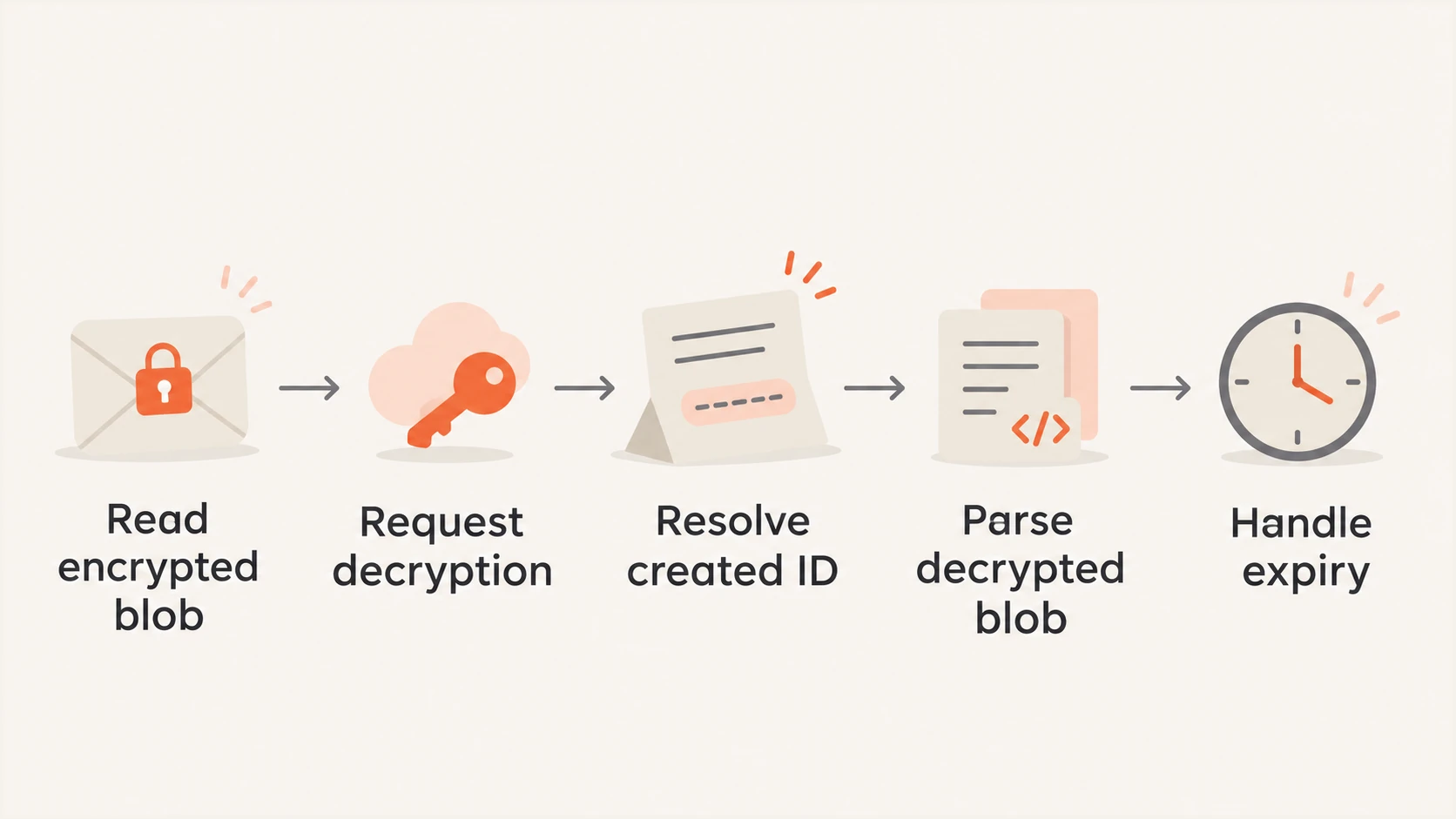
Proposed JMAP flow for decrypting a blob, parsing it, and handling expiry.
The draft text gives newly created decrypted blobs the lifetime and expiry semantics of ordinary JMAP uploaded binary objects. It does not promise permanent storage or prescribe a new universal retention period. A delayed parse or retrieval therefore needs expiry handling.
I would test account-scoped access and expired identifiers alongside successful decryption. Creating a plaintext blob adds a sensitive object to the server's handling path. Access control, temporary storage, and cleanup deserve explicit security review; an opaque identifier alone is not an authorization mechanism.
Signed searches do not establish sender trust
Revision -05 adds isSigned and isNotSigned filters. It also rewrites isEncrypted and isNotEncrypted around cryptographic layers within a cryptographic envelope, replacing the earlier focus on the outer body part's MIME type. That matters when nested wrapping puts a signature outside encrypted content.
A match for isSigned establishes the presence of a signature layer. It does not establish that verification succeeds, that the certificate is trusted, or that the claimed sender has been authenticated. I would keep search classification separate from verification status in both API consumers and user interfaces.
Do not turn an isSigned search result into a verified-sender badge. Signature presence and successful cryptographic verification are different facts, and certificate trust requires additional evaluation.
Header controls do not conceal all metadata
The revised header controls refer to RFC 9788. headersToProtect selects header fields for cryptographic protection, while headersToObscure controls obscured header representations when encryption is requested. Omitted or null settings leave choices to the server, making defaults an interoperability consideration.
Protection and concealment need separate tests. A protected field is not automatically confidential, and encrypted content does not hide every piece of delivery metadata. Maintainers should inspect the actual outer message and the decrypted inner message before describing what recipients or intermediaries can see.
Header protection
Check which header fields receive cryptographic protection and how the recipient evaluates them. Do not infer confidentiality solely because a field is protected.
Header concealment
Check which outer values are obscured and what remains visible. Test explicit selections and server defaults against the intended confidentiality policy.
Server trust and certificate requirements still apply
The security model assumes that users trust the JMAP server to sign and encrypt on their behalf. It does not provide confidentiality against that server or establish a general end-to-end guarantee. Private key and certificate management remain outside the draft's scope.
Encryption still requires keys for the sender and every To, Cc, and Bcc recipient. A missing recipient key or an expired or revoked recipient certificate causes the operation to fail with validEncryptionKeyNotFound. This requirement predates -05. The sender-signing authorization check and signedSenderNotAllowed error also predate this revision.
The new denial-of-service guidance says servers SHOULD reject chains containing more than three operations. SHOULD is a recommendation with normative significance, not MUST or a fixed universal hard limit. Triple wrapping fits within the recommended boundary.
Long operation chains increase cryptographic work. For an isolated prototype, I would check rejection behavior before expensive processing and review resource accounting for concurrent requests. Those are implementation review tasks, not evidence that the publication reports a CVE or an active exploit.
Review prototypes before changing deployed mail
The API is still work in progress. Open editor notes concern algorithm registries and error registration, with additional questions around filter scope and unfinished examples. Ambiguous example JSON should not become an implementation template. Useful review cases include:
- Operation order: Check single signing, sign-then-encrypt, and triple wrapping, including mismatched option types.
- Blob access: Exercise backreferences, cross-account access denial, expiry, and partial decryption failures.
- Security meaning: Keep signature presence separate from verification and inspect protected versus visible headers.
- Failure behavior: Test missing recipient certificates, unauthorized signing, and chains exceeding the recommended length.
Keep these checks in an isolated interoperability and security prototype using test messages and certificates. Changed request shapes and decrypted-content access are substantial enough to review together. They are not a reason to rewrite production mail flows merely because a new draft revision is available.
SPF, DKIM and DMARC settings stay unchanged
This revision does not change SPF, DKIM, DMARC, or their DNS records. S/MIME message protection and domain authentication answer different questions. An S/MIME signature does not replace DKIM or change a domain's DMARC policy.
Suped is our DMARC platform. Its DMARC monitoring helps teams investigate sending sources and authentication failures as a separate operational workflow. Suped's email tester supports checks on a real message's email authentication; those results do not establish compatibility with this proposed JMAP API.
Keep implementation decisions tied to the draft version
For a team maintaining an experimental implementation, I would record the supported revision alongside test results and unresolved protocol questions. Review operation nesting and plaintext blob handling with both client and server maintainers before expanding the prototype. Resolve uncertainties through the JMAP working group process; there is no rollout or enforcement deadline attached to this publication.
Frequency asked questions
No. It is a revision of an already adopted JMAP working group Internet-Draft. Publication does not mean RFC approval, a frozen API, or a new provider requirement.
No. It identifies a signature layer. Cryptographic verification and certificate trust need separate evaluation before presenting a verified identity.
No permanent lifetime is promised. Newly created decrypted blobs follow ordinary uploaded-blob expiry semantics. Clients need to handle expiry and distinguish parsing a blob from storing a mailbox message.
The draft says servers SHOULD reject chains longer than three operations. It does not define a universal MUST-level maximum or require an immediate production change.