iCloud false bounces leave valid addresses on suppression lists
News

Valid Apple email recipients can remain on sender-controlled suppression lists after November 17's false "user not found" bounces, even though SparkPost and Mailgun have finished their provider-managed cleanup. SparkPost's incident report attributes the incorrect rejections to an issue on Apple's side.
On November 19, 2026 in Sydney (November 18 UTC), the remaining operational concern is legitimate mail that applications still refuse to send. A CRM or application database does not automatically reverse its own suppression when a provider corrects its list. My priority is identifying those incident-generated entries while preserving genuine reasons to stop sending.
What the providers confirmed
SparkPost initially described incorrect bounces affecting valid iCloud and Hide My Email addresses. Its later confirmation specifically identified privaterelay.appleid.com and described several waves of errors.
The Mailgun incident report also records erroneous Apple recipient responses and suppression cleanup. Its completion notice is dated November 18 at 19:35 UTC. The timestamps below describe public updates and provider cleanup, rather than the duration of an Apple outage.
|
|
|
|---|---|---|
Nov 17, 19:45:33 | SparkPost | First publication |
Nov 17, 20:31 | Mailgun | First publication |
Nov 17, 22:55 | SparkPost | Cleanup complete |
Nov 18, 00:06:38 | SparkPost | Postmortem published |
Nov 18, 19:35 | Mailgun | Cleanup complete |
All times are UTC. Cleanup completion refers to provider-managed suppressions.
SparkPost's postmortem still reported intermittent Apple errors at 00:06 UTC on November 18. That historical warning does not establish that errors continue today, and completed suppression cleanup does not establish universal Apple recovery.
Neither report establishes a victim count, full scope, exact root cause, protocol change, or compromise. SparkPost's attribution is a sending service's finding, rather than an independent Apple admission. These email aliases also differ from iCloud Private Relay, Apple's web privacy service.
Apple's public System Status also recorded an iCloud Mail availability issue that day. No official causal link connects that availability notice to these false SMTP recipient responses.
Why valid recipients stay suppressed
A recipient rejection and a suppression are different events. The rejection happens during a delivery attempt. A suppression is a stored decision to exclude an address from future sends. If an application retains that decision, later messages never reach the sending service.
SMTP responses in the 5xx class normally signal a permanent failure for that delivery attempt. An incorrect recipient result can therefore become a lasting exclusion in sender data. This incident does not justify treating every permanent error as temporary or adopting a blanket retry-policy change.
I treat provider cleanup and application cleanup as separate checks. A successful delivery to another Apple address tells you little about a recipient your application continues to exclude. Likewise, a lower bounce rate can hide the problem when suppressed recipients are absent from attempted sends.
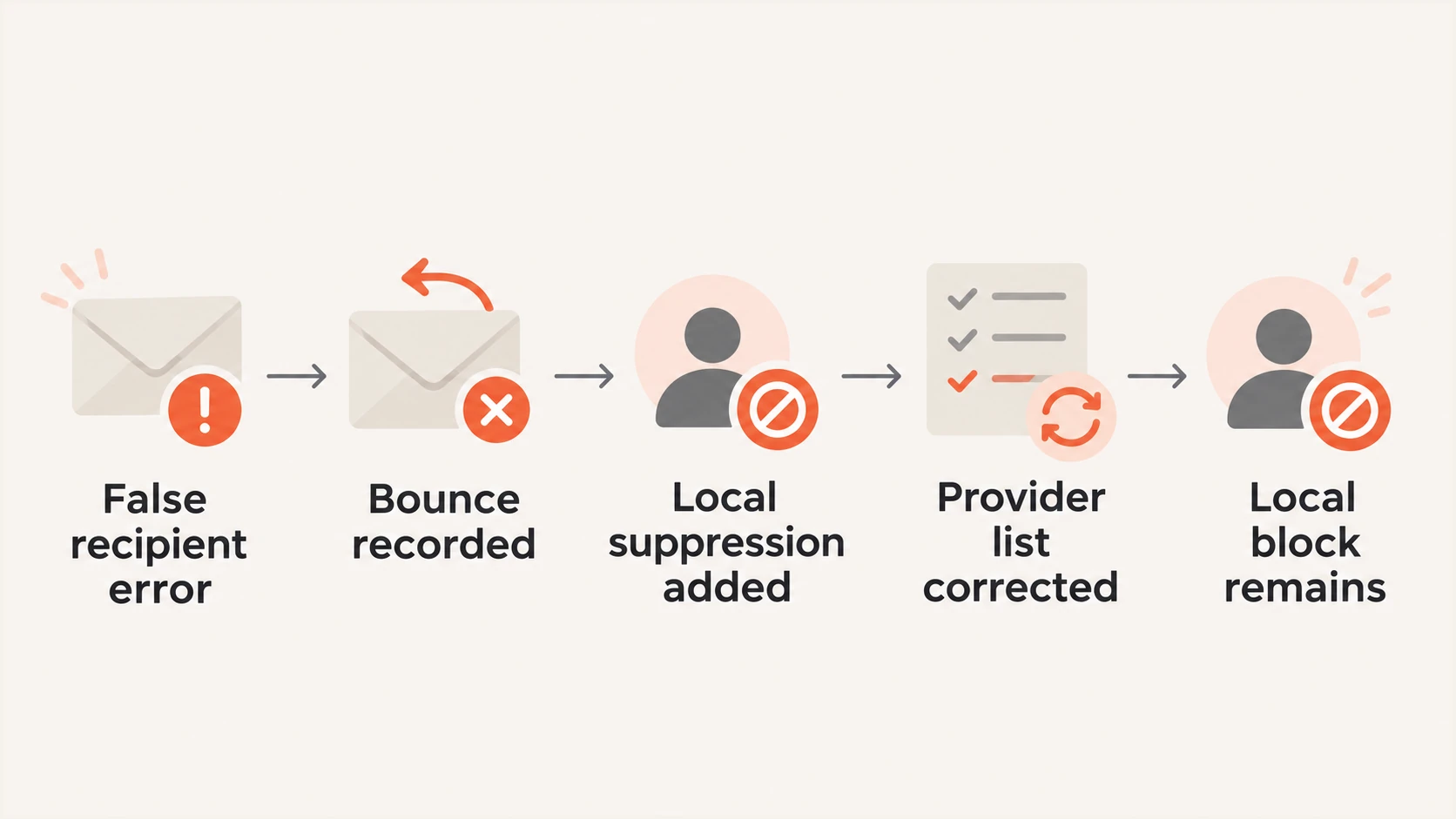
Provider cleanup does not remove a suppression stored in a sender's application.
Compare the intended audience with the recipients actually submitted. For a missing recipient, inspect the application exclusion reason and timestamp before assuming Apple rejected a new message. Password resets and other requested messages are useful places to investigate customer reports of missing mail.
The operational consequence is persistent exclusion after the original failure. Clearing one system is insufficient when another database or a scheduled import still holds the same erroneous decision.
Which SparkPost entries need review
The SparkPost postmortem distinguishes copied provider suppressions from decisions created using bounce events. Start by identifying which process populated your local list. Use UTC timestamps, and keep the US and EU account distinction.
The following filters are specific to SparkPost's guidance. They identify candidates for review, rather than permission to remove every matching address without checking its other suppression reasons.
Copied provider suppressions
For API copies or exports, inspect privaterelay.appleid.com entries whose source is "Bounce Rule". Use the creation window for your account region.
SparkPost copied-list review filterstext
domain: privaterelay.appleid.com
source: Bounce Rule
US: 2026-11-17 13:00-21:05 UTC
EU: 2026-11-17 13:00-21:16 UTC
Your event-based suppressions
For decisions created from webhooks or events, inspect the relay domain, bounce class 10, and the exact diagnostic below, starting at 13:00 UTC on November 17. The postmortem gives no fixed end.
SparkPost event review filterstext
domain: privaterelay.appleid.com
bounce_class: 10
start: 2026-11-17 13:00 UTC
diagnostic:
550 5.1.1 <address>: user not found
The 21:05 and 21:16 cutoffs are when SparkPost stopped adding the affected provider suppressions. They are not Apple outage endpoints. Do not apply them as universal end times to your own event-based suppressions.
The diagnostic includes the recipient address in place of the placeholder. Retain the original event so you can verify the match. For Mailgun or another sending path, use that service's incident guidance and your own evidence instead of transferring SparkPost's classification or windows.
How to restore legitimate mail safely
Begin with a read-only export of candidate suppressions and the events that created them. Keep the existing list available for comparison. An address matching an incident filter still needs a check for separate reasons it should remain suppressed.
I would work through a small reviewed set first, keeping a record of why each change is justified. Prior consent and sending history matter; an incident is not a reason to revive old or unconsented contacts.
Check whether the application stores one suppression flag or several independent reasons. Removing the false-bounce reason must not erase a complaint or unsubscribe attached to the same contact. When records disagree, preserve the exclusion until the original evidence establishes that sending is appropriate.
- Trace the origin. Identify whether the entry came from a provider export, a bounce webhook, or a CRM rule. Check every system that can block the recipient.
- Verify the evidence. Match the incident's domain and diagnostic criteria against the original records. Separate confirmed false rejections from unrelated failures.
- Preserve valid exclusions. Keep unsubscribes, complaints, and genuinely invalid addresses suppressed. A later complaint or unsubscribe overrides an earlier incident-generated bounce.
- Correct the stored decision. Remove only the confirmed erroneous suppression in each affected local store. Retain its event reference and the reason for correction.
- Retest carefully. Check current provider guidance, then make small controlled sends to consenting recipients. Inspect submission and delivery events before expanding.
- Prevent reimports. Update sync or event-processing logic so known erroneous entries are not blindly restored by an export, replayed webhook, or scheduled job.
Removing a suppression does not prove the original message was delivered. Decide whether a replacement is still useful. An expired password reset should be regenerated when requested, rather than replayed as an old message.
If a controlled test produces another rejection, retain the new diagnostic and investigate it separately. Do not assume every subsequent Apple bounce belongs to this incident.
Keep suppression safeguards active
Do not indiscriminately unsuppress all iCloud or Apple addresses, disable bounce safeguards, or mass-resend failed traffic. Limit changes to confirmed incident-generated entries with valid consent and history.
Authentication checks have a separate purpose
Passing SPF, DKIM, or DMARC cannot repair a false recipient-side 5.1.1 response, and it cannot clear an application suppression. The incident reports provide no evidence of a new sender requirement or a blocklist (blacklist) event.
Older Apple alias-domain migration guidance is separate from this incident. Changing DNS simply because a valid recipient received this error risks introducing an unrelated authentication problem without correcting the local exclusion.
Suped is our DMARC reporting and email authentication platform. Its DNS history and authentication diagnostics help investigate separate sender-side changes. Our domain health checker checks published authentication records; those results do not establish whether an individual Apple alias exists.
After the suppression review, our email tester helps inspect a real test message's authentication and headers. That test is separate from confirming delivery to an affected Apple recipient. Keep recipient delivery evidence in the sending application's logs.
Check the next intended send
For an affected customer, the useful recovery check is whether the next legitimate message leaves the application and receives an appropriate delivery result. A provider's completed cleanup cannot establish that on behalf of a separate CRM.
For customer support, distinguish 'not submitted because suppressed' from 'submitted and rejected'. Those outcomes require different fixes. Keep message identifiers with the incident review so support staff can trace a missing notification without guessing whether a fresh delivery attempt actually occurred.
Keep an audit of reviewed entries and verify the next scheduled suppression import against it. If a corrected address disappears from the send audience again, trace the process that recreated the exclusion before changing the recipient's status a second time.
Frequency asked questions
SparkPost attributes the incorrect rejections to an Apple-side issue. That is distinct from an Apple admission. The reports do not establish an exact root cause, a protocol change, or a compromise.
No. Review confirmed incident-generated entries with prior consent and history. Preserve unsubscribes, complaints, and actual invalid addresses. SparkPost's detailed filters specifically concern privaterelay.appleid.com.
No. It is the US cutoff for affected additions to SparkPost's provider-managed list; the EU cutoff is 21:16 UTC. Its event-based guidance starts at 13:00 UTC on November 17 and gives no fixed end.
Do not assume it will. Confirm the original message's status and your application's behavior. Use controlled tests and send a replacement only when it remains useful and consent permits it, rather than replaying all failed traffic.