GoodGuys phishing uses fake expert interviews to target work accounts
News

Published 20 Nov 2026
Updated 20 Nov 2026
8 min read
Summarize with
GoodGuys is an active phishing operation that uses fake paid expert interviews, feedback studies and webinar invitations to collect work-account credentials. Push Security researchers disclosed the campaign on 20 November 2026. Their captured pages target Google work accounts, while the code also supports imitation Okta authentication screens.
The news for 21 November in Australia is the newly published GoodGuys investigation. The first captures date to 13 October, so the disclosure does not mark the beginning of the activity. I check the complete invitation path because a familiar brand or legitimate email-service sender does not establish that an offer is genuine.
Eight brand skins and paid interview offers
Researchers identified eight brand skins: Accenture, American Express, Coca-Cola, Culver's, Google Cloud, Nvidia, SpaceX and Spotify. The Accenture lure offers $600 for a 45-minute expert interview. The Nvidia lure offers $500 for a 45-minute AI feedback study. These offers give recipients a business reason to continue into an account sign-in.
One intercepted Google Cloud webinar invitation came from interviews@hirevue[.]com and led to a Google Cloud-themed landing page. Other observed delivery chains used legitimate email or event infrastructure and click tracking, including SendGrid, Mandrill and Cvent. These services are part of the documented delivery path, not evidence that the service platforms themselves were breached.
A brand appearing on a page also does not establish a breach at that organization. The disclosure supplies no individual SPF, DKIM or DMARC verdicts for these messages. We cannot describe every invitation as authenticated, or infer that every targeted account was compromised.
The fraudulent sign-in rejects personal Gmail, Yahoo and Outlook addresses and asks for a work address. That restriction belongs to the phishing page. It is not a new Google, Yahoo or Microsoft account policy.
A replica sign-in with backend-controlled prompts
GoodGuys has a Vite/React frontend with a captcha gate, a branded landing page and a fake Google sign-in. Entered data goes to a separate backend. A live Socket.IO connection carries instructions back to the page, selecting the next screen. The researchers explicitly state that this kit does not use a reverse proxy.
The researchers infer that a person uses a control panel to replay entered credentials against the real sign-in and request the next authentication step. The captured client code supports that interpretation, but manual operator relay remains an inference. It is not a directly observed account takeover sequence.
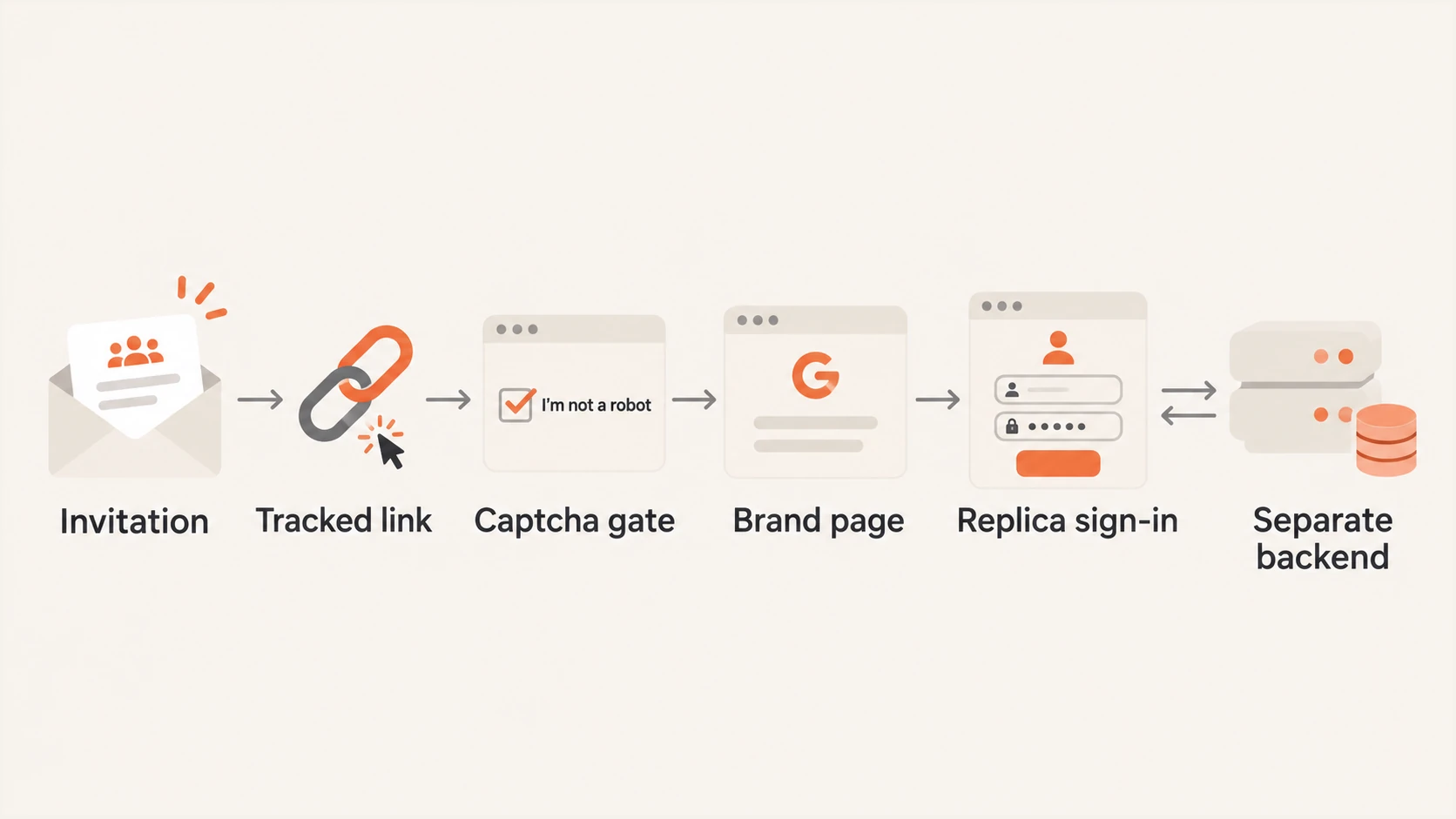
GoodGuys sends entered data to a separate backend that selects subsequent screens.
Captured commands support password-error screens, SMS codes, authenticator codes and Google number matching. They also support Okta credentials, push prompts and codes. An imitation error or loading screen lets the frontend keep the recipient waiting while further instructions arrive. Okta support in the code is distinct from evidence that an Okta victim completed the flow.
These capabilities do not establish that all MFA is bypassed or that passkeys are defeated. The disclosure gives no confirmed victim count or account-takeover total. I would preserve the distinction between prompts the kit can display and authentication outcomes established in identity logs.
The observed infrastructure changed before publication
The capture history spans more than a month before the public disclosure. Landing hosts used AWS EC2 until 13 November, then moved to Vultr. The Nvidia and Google Cloud builds changed backend infrastructure during 17-19 November, according to the researchers' timeline.
These are observation dates. A first capture establishes when researchers saw a build, not when its operator first deployed it. Likewise, the 20 November publication date is the news peg, not an attack launch date. The primary timeline separates the infrastructure changes.
|
|
|---|---|
13 October | First captures |
15 October | Okta screens in code |
13 November | Landing-host migration |
17-19 November | Backend changes |
20 November | Public disclosure |
Research observations and publication timing, not the campaign start date.
The earlier backend is importantfuture[.]com at 162.0.225[.]230. The newer backend is hypernovaguys[.]com at 104.207.85[.]90. The switch in newer builds does not establish that the earlier backend stopped operating. Search historical telemetry for both sets of indicators.
The indicators below are defanged and belong to the backend infrastructure identified in the disclosure. Their value is in correlating recorded traffic with the campaign. They are not a complete inventory of its landing pages or evidence that every connection resulted in credential entry.
Defanged GoodGuys backend indicatorstext
Earlier backend: importantfuture[.]com
Earlier IP: 162.0.225[.]230
Newer backend: hypernovaguys[.]com
Newer IP: 104.207.85[.]90
Email authentication does not validate the invitation
SPF checks sending authorization for an envelope domain. DKIM validates a domain signature. DMARC evaluates whether a passing SPF or DKIM identity matches the visible From domain under its domain-matching rules. Those checks do not establish that a paid interview exists or that a linked sign-in page belongs to Google.
Mail genuinely sent through an authorized service can pass authentication while carrying a malicious invitation. Trusted tracking redirects can also lead to an attacker-controlled destination. GoodGuys therefore gives administrators a reason to examine message authentication and the subsequent browser journey together. The report does not establish that SPF, DKIM or DMARC was defeated.
Domain evidence
Headers and DMARC reports help investigate sending authorization and use of your domain. They do not prove that an interview invitation is safe.
Account evidence
Click records and identity logs help investigate exposure and subsequent sessions. A domain-authentication pass cannot confirm or exclude work-account compromise.
At Suped, our DMARC monitoring helps teams detect unauthorized use of their own domains and investigate sending sources. Our DMARC checker validates the published policy. These workflows support domain protection; neither can determine whether a GoodGuys recipient entered credentials or whether malicious mail was genuinely sent through an authorized service.
What email and identity administrators should check
Start with the invitation received by your organization and preserve evidence before removing it. I prioritize the sender, complete redirect chain and destination hostname, then correlate the recipient's interaction with Workspace or Okta activity. A branded page alone is insufficient evidence of either legitimacy or compromise.
Do not revisit suspected pages using a normal signed-in work browser. Use retained message and browser telemetry, or an approved investigation environment. Keep the timestamps and affected identities together so email and identity administrators can investigate the same sequence.
- Verify the offer: Contact the named organization through a known channel. Open its real website or the identity provider directly instead of signing in through an unexpected paid interview or webinar link.
- Preserve the route: Retain full headers, the original message and the complete redirect chain before cleanup. Record the final hostname and relevant timestamps, not only the first tracking URL.
- Correlate identity activity: Check suspicious Workspace or Okta sign-ins, new sessions and newly registered authentication methods around the click. Review grants and revoke suspicious sessions or access when the evidence warrants it.
- Review sending access: If your organization's sending infrastructure appears in a lure, examine account activity, API access and tracking-domain use. A brand appearing in the message does not by itself establish an account breach.
- Scope blocking carefully: Apply blocks to verified malicious indicators. Avoid organization-wide blocks on shared email-service or tracker domains merely because one campaign used them.
- Strengthen authentication: Use phishing-resistant authentication where supported. Review the methods available to affected users without treating the kit's supported prompts as proof that every MFA method is defeated.
A click is a useful investigation trigger, but it is not a confirmed takeover. Establish whether the recipient entered credentials, responded to authentication prompts or created an unexpected session. Record uncertainty explicitly when the available logs cannot establish an outcome.
The copied SpaceX lure also needs careful handling. Researchers connect its appearance to a fake-event lure they analyzed on 5 November, but the kit and hosting are different. Shared wording does not make GoodGuys the same operation as that earlier campaign.
Investigate the offer and the account together
For teams receiving these invitations, the immediate task is to verify the offer independently and connect the email evidence to identity activity. I would escalate a match to the observed infrastructure with its headers and click timestamps, then let the session evidence determine the containment scope.
Keep domain-authentication remediation tied to actual domain findings. Keep account containment tied to recipient exposure and identity evidence. The 20 November disclosure supplies concrete leads for that investigation, while leaving victim outcomes unconfirmed. Preserve the original message and relevant identity logs with the incident record before closing the investigation.
Frequency asked questions
The observed pages target Google work accounts. Captured code also supports Okta credential screens, push prompts and codes. That code capability does not establish confirmed Okta compromises.
The fake sign-in requires work accounts and rejects personal Gmail, Yahoo and Outlook addresses. This is a campaign behavior, not an account-provider policy change.
DMARC helps protect your domain against unauthorized use. It cannot establish the intent of mail genuinely sent by an authorized service, validate a linked invitation or determine whether a work account was compromised.
No. The captured commands support several authentication prompts, and researchers infer manual relay. The report does not establish universal MFA bypass, defeated passkeys or confirmed takeover totals.