DIVD forensic report details email address exposure in helpdesk breach
News

On November 25, 2026, at 13:37 local time in the Netherlands, the Dutch Institute for Vulnerability Disclosure (DIVD) publicly released its completed forensic report on the September 21, 2026 helpdesk intrusion. The official announcement concerned that report's release. Exposed email addresses and ticket context create a risk of targeted phishing and impersonation. Verify unexpected requests through a saved or independently typed official contact route.
The practical concern is the credibility that stolen correspondence gives a message. A familiar subject or reference to an earlier security report can make an unexpected request feel routine. Verify the request through a trusted contact before opening a supplied sign-in page, providing information or acting on instructions.
The report release followed the September intrusion
DIVD's case hub separates the incident timeline, the November 24, 2026 affected-person notification and the November 25, 2026 publication. Keeping those dates separate matters when forwarding the news internally: the new event was disclosure of the completed investigation.
The affected Zammad helpdesk handled correspondence with DIVD's computer security incident response team (CSIRT). This puts email-derived records at the center of the security implications, even though the incident itself involved access to a helpdesk system.
|
|
|---|---|
September 21, 2026 | Helpdesk intrusion |
November 24, 2026 | Affected-person notification |
November 25, 2026 | Forensic report released |
The report was released at 13:37 local time in the Netherlands.
For an incident response team, the useful distinction is between when information was exposed and when its scope became clearer. A report publication is an opportunity to review protective measures without treating every later suspicious message as evidence of the original attack.
What the corrected email address count means
The corrected data assessment gives 15,409 unique email addresses after deduplication. The original forensic count was 48,928 address entries, including duplicates, with 4,121 described as personal email addresses.
Neither address figure is a count of people. Shared inboxes and aliases complicate that conversion, while one person can use several addresses. The corrected total describes unique addresses in the exposed data.
|
|
|---|---|
Original address entries | 48,928 |
Unique email addresses | 15,409 |
Personal email addresses | 4,121 |
Exposed ticket titles | Around 41,000 |
Address entries, unique addresses and ticket titles are separate measures.
DIVD also reported exposure of a limited set of older conversations. Ticket titles and selected conversations have different scopes. A title establishes a topic; it does not establish that an entire thread or a complete mailbox was copied. Preserve those distinctions in internal summaries and customer communications.
Why helpdesk context strengthens impersonation
DIVD's notification described contacts that included current or former volunteers, people who had corresponded with its CSIRT, and addresses present in leaked credential datasets handled by the CSIRT. It warned that exposed information could support targeted phishing, including messages pretending to come from DIVD.
A ticket subject can give an impersonator a believable opening. Older correspondence can add terminology or a reference that the recipient recognises. These are general ways exposed records support social engineering; they are not evidence that a particular follow-up message has been sent.
An email address identifies a destination, while ticket history can reveal why that destination is worth contacting. A reference to a genuine vulnerability report can reduce the recipient's suspicion without proving that the sender has authority over the case. The requested action deserves as much scrutiny as the background details.
DIVD found that the attacker sent test emails from two shared mailboxes. A follow-on phishing campaign and the messages’ SPF, DKIM and DMARC results remain unconfirmed. DIVD said it did not know whether the attacker had shared the addresses.
The verification question is whether the request is authentic and authorised. Accurate background information alone cannot settle that question. Requests for account access or sensitive attachments deserve a separate check, even when they refer to a real earlier exchange.
What DMARC protects and where its limits remain
DMARC checks whether a message passes SPF or DKIM with an authenticated domain that meets DMARC's matching rules for the visible From domain. An enforcement policy helps receiving systems handle unauthenticated use of that domain. It does not assess the truth of a message's instructions.
Two different impersonation routes remain relevant after an address exposure. A lookalike domain has its own authentication configuration. A misused genuine account sends through legitimate infrastructure. Both require checks beyond recognising a familiar name in the inbox.
Lookalike domain
A different domain can resemble a trusted organisation's name and pass authentication for itself. The trusted organisation's DMARC policy does not govern that separate domain.
Inspect the full address and independently verify the request.
Misused genuine account
Mail sent through a compromised authorised account can pass authentication. That result does not establish who operated the account or whether the request is legitimate.
Verify sensitive instructions and investigate account activity.
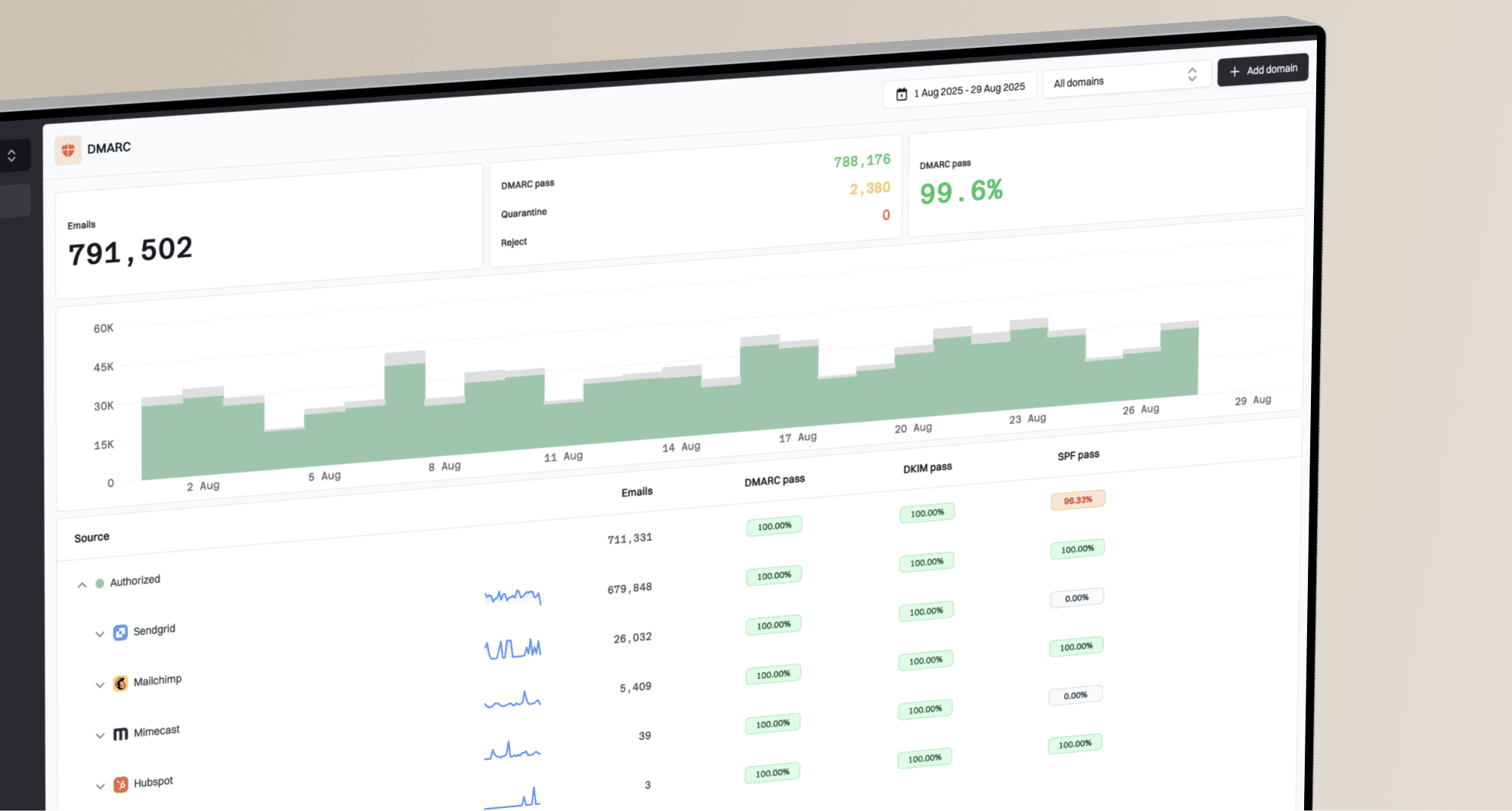
For domains your organisation controls, DMARC monitoring helps review reported sending sources and authentication failures. Suped provides that reporting workflow. Aggregate reports do not show complete message contents or identify every impersonation attempt, and they cannot determine whether helpdesk records were accessed.
Practical checks for recipients and helpdesk teams
If a message requests a login or sensitive information, verify it through an official contact you already know. Hand-type the official website address or use a saved contact. Contact details supplied inside the unexpected message need their own verification.
Helpdesk operators should review both the application and the identity systems that grant access to it. Ticket exports deserve particular attention because they create portable copies of correspondence that are easier to overlook than records inside the main application.
- Verify requests. Use a saved official contact or independently type the organisation's address. Confirm the requested action before sharing information. Avoid relying on a reply to the same unexpected message.
- Keep software current. Apply supported helpdesk security updates and review connected applications. Assign an owner to patching so routine updates do not wait indefinitely for an incident to trigger attention.
- Restrict exports. Limit who can create and retrieve ticket exports. Review storage locations and retention periods. Remove unnecessary copies through the organisation's approved process, while preserving evidence needed for an investigation.
- Review audit logs. Examine helpdesk access, export activity and identity audit logs for unexpected sessions or permission changes. Preserve relevant records and compare activity with authorised administrative work before drawing conclusions.
Compare the visible sender with the Reply-To address, then independently verify any requested destination. A different Reply-To address is a reason to investigate, although legitimate workflows also use different addresses. A familiar display name does not verify identity. Confirm changes to an established process with the contact responsible for the original work. Record what was checked and who confirmed it so another team member can follow the decision.
For your own sending domain, Suped's DMARC checker checks the published policy and reporting configuration. That is a separate configuration check. A current DNS result cannot reconstruct a September message's authentication outcome or determine the scope of a helpdesk exposure.
Use DIVD's official route for personal data questions
DIVD's official case hub provides the notification and contact details. Its published data protection contact is dpo@divd.nl. General incident and press questions go to communications@divd.nl. Verify those details through the official site before sending personal information.
When asking about a notification, describe the concern without attaching passwords or a full historical ticket export. Provide only the information needed to identify the relevant correspondence, and follow the organisation's process for any further verification.
Keep suspected impersonation messages for review. Preserve the original email and its headers, then report it through your organisation's established security channel. Avoid circulating sensitive correspondence more widely than necessary.
An investigation needs evidence about a particular message or account. A matching subject line is useful context, but attributing a message to this exposure requires additional evidence.
Verify sensitive requests through a trusted contact
Build independent verification into the handling of unexpected security correspondence. Assign a contact route staff can find without using an incoming message, and make the escalation process clear for requests involving credentials or confidential data.
For helpdesk owners, give patching and export retention named owners. Ensure audit records remain available long enough to investigate a suspected exposure and document who reviews alerts about unusual access.
Frequently asked questions
No. The intrusion occurred on September 21, 2026. November 25, 2026 was the public release of the completed forensic report, at 13:37 local time in the Netherlands.
That figure counted address entries, including duplicates. DIVD's corrected assessment gives 15,409 unique email addresses. Neither total establishes the number of individual people affected.
DIVD warned about targeted phishing and impersonation risks. The cited material does not establish a follow-on campaign. Whether the attacker shared the addresses remained unknown.
No. DMARC authenticates domain use under its matching rules. Lookalike domains and compromised genuine accounts require separate checks. Verify sensitive requests through an independently chosen official contact route.