Attackers abuse Staples and Dell order emails that pass DMARC
News

Published 21 Oct 2026
Updated 21 Oct 2026
7 min read
Summarize with
Attackers used legitimate Staples and Dell order notifications to deliver callback instructions inside emails that passed DMARC. Cisco Talos reported roughly 1,400 messages observed across two campaigns in its October 21 report, published at 10:00 UTC on October 21, 2026. The attackers supplied content through order-related fields, and legitimate transactional workflows inserted it into outgoing emails.
The mechanism was abuse of the content inside an authorized email workflow. Authentication did not establish that the purchase or telephone number was trustworthy. I separate those questions when reviewing a suspicious receipt: the domain authentication result and the requested action each need their own evidence.
What Talos observed in the two campaigns
The messages used unexpected purchases to encourage recipients to call an attacker-controlled number. Instructions appeared in places normally occupied by shipping, billing, or other order information. An official-looking receipt supplied the context; the inserted callback information supplied the action the attacker wanted.
The Staples sample showed a DKIM signature whose signing domain met DMARC's matching rules for the visible sender domain, with DMARC passing. The Dell-related infrastructure also showed DKIM passing, and DMARC passed for order.dell.com. These were authentication results on the observed messages, rather than a general assessment of either retailer's email.
|
|
|
|---|---|---|
Staples | DKIM domain match; DMARC pass | Order information |
Dell | DKIM pass; DMARC pass | Ship To and Bill To |
Talos observed roughly 1,400 messages across the two campaigns combined.
That figure is the volume Talos observed. It is not a worldwide delivery count, a count of people who called, or a count of confirmed losses. The reported evidence also does not establish that either retailer's systems or customer accounts were breached.
The important control boundary was between customer-supplied transaction data and official notification text. A phone number displayed inside a retailer's template acquired apparent authority without becoming a verified support contact.
Why SPF, DKIM, and DMARC do not validate the transaction
SPF checks whether a connecting server is authorized for the SMTP envelope sender domain. DKIM verifies a domain's signature over selected headers and the signed body content. DMARC checks the visible From domain against a domain authenticated through SPF or DKIM, under its domain-matching rules. One qualifying authentication path is sufficient for DMARC to pass. An SPF pass for an unrelated envelope domain is not enough on its own. Likewise, a valid DKIM signature from an unrelated domain does not automatically satisfy DMARC. The required relationship to the visible From domain still matters.
If attacker-supplied text enters a template before the legitimate sending system signs the message, DKIM can correctly verify the resulting email. The signature does not certify the business meaning of that text. There is no need to forge a signature or defeat the cryptography to exploit this workflow.
What authentication establishes
An authorized SPF sending path or a verified DKIM signing domain can support a DMARC pass when the required domain relationship is satisfied.
What needs separate verification
Order authorization and payment status need business records. The retailer's known support contacts determine whether the displayed callback number is genuine. Authentication does not establish these facts.
A p=reject policy requests rejection of mail that fails DMARC, subject to receiver handling. It does not turn a passing transactional email into a verified purchase. Weakening DMARC would remove protection against unauthorized use of the domain without fixing the injected instructions.
The attack path is therefore straightforward: untrusted order data becomes official-looking email content, the sending system authenticates that email, and the recipient is encouraged to trust the embedded instruction.
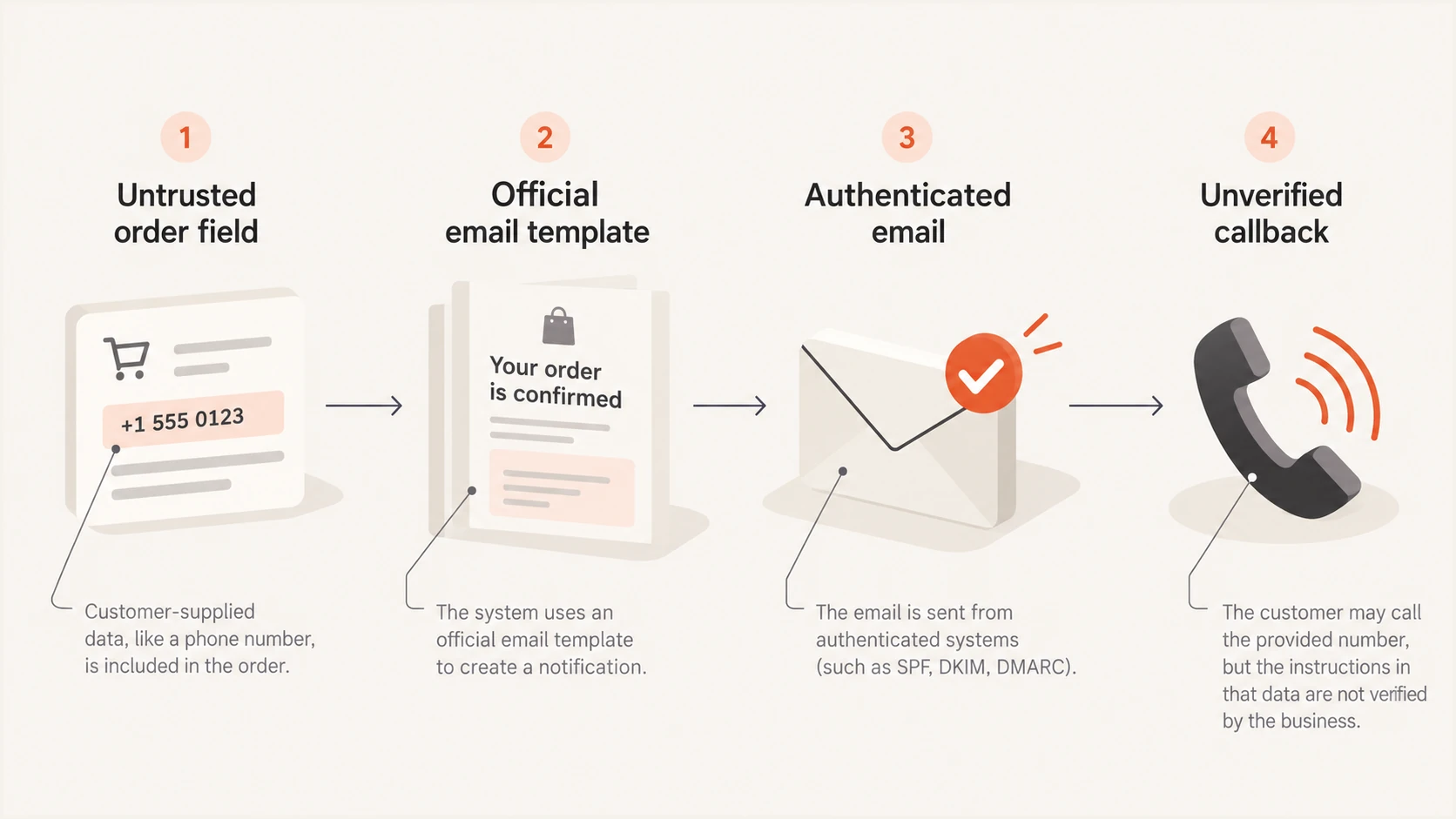
An official email template can authenticate a message containing an unverified callback instruction.
Checks for recipients and transactional email teams
For recipients, the immediate step is to check the purchase through a channel they already trust. Open the retailer's account directly or use contact information obtained independently of the unexpected receipt. A phone number inside a shipping address should not become the route for investigating a supposed charge.
For senders and mail teams, the investigation needs the fully rendered email and the transaction that generated it. Reviewing only a familiar template or a passing authentication badge misses the attacker-controlled text. Inspect both HTML and plain-text versions. Preserve the originating field value and notification time so the team can trace suspicious instructions to the input that produced them. These checks address the specific boundary exposed by the campaigns:
- Rendered fields. Inspect order details for phone numbers, URLs, support instructions, and urgency wording in fields where they do not belong.
- Business records. Compare the receipt with actual order and payment records. Check whether account history supports the claimed transaction.
- Input constraints. Validate fields before storage and rendering. Apply field-specific length limits and permitted formats; flag instructions inside names or addresses.
- Automation controls. Limit repeated form submissions and notification generation. Investigate repeated targeting of the same recipient or bursts across many recipients.
- Sending signals. Watch abrupt volume changes alongside complaints, bounce rates, and reputation changes. Investigate those signals even when authentication keeps passing.
- Known contacts. Verify unexpected orders through established support channels. Preserve the original email and its headers for the abuse investigation.
Input validation needs business context. An address field legitimately accepts varied text, but a cancellation demand or support instruction is different from delivery information. Escaping HTML addresses markup handling; it does not make a fraudulent plain-text instruction trustworthy.
I would also check where the template obtains its support details. Fixed support contacts should come from controlled configuration. Customer-entered order notes should remain distinguishable from instructions issued by the retailer.
How registration and delivery-report abuse relate
The same Talos report described related abuse of registration and subscription workflows. List bombing floods an address with automated messages after repeated sign-ups. When those workflows repeat attacker-supplied profile or form values, they also become a way to deliver instructions inside legitimate notifications.
Delivery-report reflection moves that same problem into a mail-system response. A non-delivery report can contain part of the failed message or an attached copy. If that content was attacker-controlled, an authentic administrative wrapper still carries untrusted material. This requires inspection of the returned content, including nested messages. One route is backscatter: a system accepts mail with a forged envelope sender, then sends a later delivery failure to that address. That differs from an attacker fabricating the entire bounce. Investigators should distinguish the genuine administrative report from any untrusted message content it returns.
These mechanisms share a trust boundary with the order campaigns, but they are not interchangeable evidence. A registration flood does not prove an account takeover, and a genuine bounce does not establish that its enclosed message is safe. Investigators need to identify which workflow generated each email.
Where DMARC monitoring fits in the response
Suped is our DMARC reporting and email authentication platform. For domains a team administers, its DMARC monitoring workflow helps review sending sources and authentication failures. That evidence addresses unauthorized domain use and configuration problems alongside the separate investigation into transactional content.
A DMARC checker validates the published policy. Aggregate reports describe authentication outcomes for mail using the monitored domains. Neither provides the order, payment, or account evidence needed to establish whether a callback instruction inside an incoming retailer receipt is legitimate.
A passing result is one signal
Keep authentication checks active. Investigate unexpected support instructions and transaction claims independently, including when DMARC passes.
In Suped, teams can inspect source-level authentication results and configure failure alerts for their domains. Investigators should correlate those findings with notification logs and complaint data, rather than expect authentication reports to contain the rendered callback text.
The incident does not justify calling every authenticated email unsafe. It establishes a narrower issue: legitimate senders need controls over what their automated systems repeat to recipients.
Verify the action before using the callback number
For an unexpected Staples or Dell receipt, confirm the transaction through account and payment records before acting on embedded support instructions. For platform owners, the actionable question is whether user-controlled fields can issue instructions under the authority of an official template.
DMARC remains useful for domain authentication. The additional control belongs where transaction data becomes notification content, before a trusted sending workflow delivers an attacker's request.
Frequently asked questions
No. The reported mechanism put attacker-controlled instructions inside legitimate order notifications. Valid authentication did not verify the transaction or callback number. DMARC itself does not sign messages; DKIM provides cryptographic signatures.
The reported evidence does not establish compromised retailer systems or customer accounts. Abuse of fields rendered into notifications is the mechanism described; a breach is a separate claim requiring evidence.
No. It is roughly the number of messages Talos observed across the two campaigns. It does not measure worldwide delivery, successful calls, or financial losses.
A reject policy addresses mail that fails DMARC. A notification that passes through a qualifying authentication path needs separate content and transaction checks to detect this kind of abuse.