How to troubleshoot intermittent email delivery failures caused by SPF and DNS issues?
Michael Ko
Co-founder & CEO, Suped
Published 28 Apr 2025
Updated 15 Mar 2026
8 min read
Intermittent email delivery failures can be incredibly frustrating. One moment your emails are landing in inboxes without a hitch, and the next, they are being delayed, bounced, or flagged as spam. Often, these elusive issues can be traced back to problems with Sender Policy Framework (SPF) records and DNS configurations. These core components of email authentication and routing are critical for ensuring your messages reach their intended recipients reliably.
I've seen many cases where what appears to be a minor glitch leads to significant deliverability headaches. The key to resolving these intermittent problems is a systematic troubleshooting approach, focusing on how your SPF records interact with DNS and how recipient mail servers interpret them. Let's delve into the common culprits and how to address them.
The role of SPF and DNS in email delivery
Sender Policy Framework (SPF) is a foundational email authentication method designed to prevent sender spoofing. It allows domain owners to specify which mail servers are authorized to send emails on their behalf by publishing an SPF record in their Domain Name System (DNS) as a TXT record. When a recipient mail server receives an email, it performs a DNS lookup to check the sender's SPF record. If the sending IP address is not listed as authorized, the email might be flagged, rejected, or sent to spam.
Intermittent failures often stem from subtle issues within the SPF record itself or the DNS resolution process. For instance, an SPF record might contain a syntax error or exceed the 10-DNS-lookup limit, which can cause validation failures. These are often not caught immediately and can lead to emails being rejected sometimes but not others, depending on the recipient's mail server configuration and its DNS resolver's behavior.
The DNS plays a crucial role in SPF verification. Every time a mail server checks an SPF record, it initiates DNS queries. Any instability or slowness in your DNS provider's infrastructure, or even issues with the recipient's DNS resolver, can lead to SPF lookups timing out. This can result in a SPF TempError (temporary error), causing emails to be retried later, hence the intermittent nature of the problem. You can find more information about the SPF RFC 7208 which defines these errors.
Common causes of intermittent failures
One of the most common reasons for intermittent SPF failures is DNS timeouts or slow DNS responses. If the receiving mail server cannot quickly resolve your SPF record, it may defer or reject the email. This can be especially problematic if the recipient's DNS resolver is old, underspecified, or has aggressive timeout settings.
Another frequent issue is exceeding the SPF 10-DNS-lookup limit. SPF records are limited to 10 DNS lookups to prevent denial-of-service attacks. If your SPF record includes multiple a, mx, ptr, or include mechanisms that require DNS queries, you could hit this limit. When this happens, mail servers may return a SPF PermError (permanent error), leading to outright rejection. The intermittent nature arises because not all receiving servers strictly enforce this limit, or the DNS lookups might vary in complexity over time. You can learn more about this in our guide on demystifying the SPF TempError.
Sometimes, the issue isn't with your DNS or SPF directly, but with how the recipient's mail server handles queries or interprets records. Some servers might be configured with overly aggressive timeouts for DNS lookups or might use outdated DNS resolver implementations that are less resilient to network latency. This can lead to your legitimate emails being temporarily rejected, only to be delivered on a retry. This scenario often manifests as intermittent failures to specific domains or email providers, even when your setup appears correct for others.
Causes of intermittent SPF and DNS issues
DNS timeout or latency: Recipient servers cannot resolve your domain's SPF record within the allotted time, leading to temporary rejections.
SPF 10-lookup limit: Your SPF record (or its included records) triggers more than 10 DNS lookups, resulting in a permanent error for some recipients.
Recipient server quirks: Overly strict DNS timeouts or outdated DNS resolvers on the recipient's side can cause inconsistent failures.
Troubleshooting SPF and DNS
Troubleshooting these issues requires a methodical approach, starting with confirming your SPF record's validity. Use an SPF record checker to ensure correct syntax and to identify if you are exceeding the 10-DNS-lookup limit. If the record is too long or has too many lookups, consider SPF flattening, a process where multiple include mechanisms are consolidated into fewer, direct IP addresses. This can help you avoid PermError issues. Our guide on troubleshooting SPF authentication issues can provide further insights.
Next, investigate DNS resolution for your domain. Command-line tools like dig or nslookup can help you check DNS response times and potential timeouts from different locations. Pay attention to any nameservers that are consistently slow or unresponsive. If you notice specific issues related to Microsoft DNS timeouts, there are specific steps you can take.
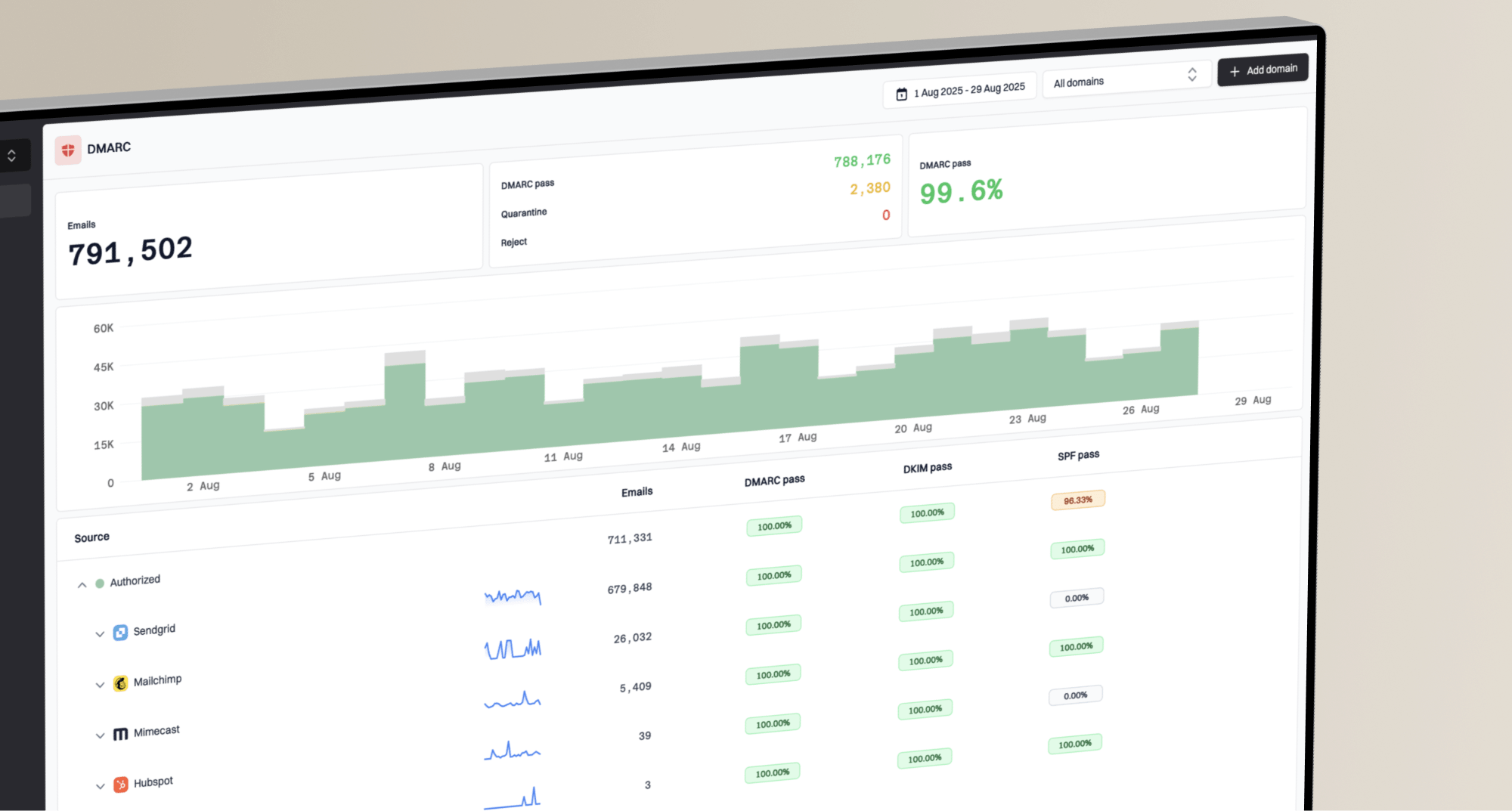
Finally, utilize DMARC reports. DMARC (Domain-based Message Authentication, Reporting, & Conformance) provides detailed feedback on how your emails are performing with SPF and DKIM. By analyzing DMARC aggregate reports, you can identify patterns of intermittent SPF failures, see which receiving domains are experiencing issues, and understand the specific error codes. This data is invaluable for pinpointing the root cause and making informed adjustments to your DNS or SPF configurations. If you are seeing DMARC failures, this troubleshooting step is crucial. Our guide on understanding and troubleshooting DMARC reports can assist you.
Checking your SPF record
The simplest way to check your SPF record is using an online SPF checker tool. These tools analyze your DNS TXT record for SPF and report on its validity, syntax errors, and the number of DNS lookups required. This is often the first step in diagnosing why your SPF TempError occurs.
Preventative measures and ongoing monitoring
Beyond immediate troubleshooting, proactive measures can significantly reduce the likelihood of intermittent SPF and DNS issues. One key step is to minimize your SPF record's complexity and the number of DNS lookups. If your record is extensive due to multiple third-party senders, consider SPF flattening or using a dedicated SPF management service to keep your record concise and below the 10-lookup limit.
Ensure your DNS Time To Live (TTL) values are set appropriately. While short TTLs allow for quick updates, excessively short TTLs can put a higher load on DNS resolvers, potentially leading to timeouts if the recipient server isn't caching responses efficiently. Balancing update speed with stability is crucial. Usually, a TTL of 3600 seconds (1 hour) is a good starting point for stable records like SPF.
Regularly monitor your email deliverability metrics, especially SPF authentication rates, through DMARC reports and platforms like Google Postmaster Tools. Early detection of intermittent failures allows you to investigate and rectify issues before they escalate into widespread delivery problems. Pay close attention to temperror spikes, as these are often indicative of DNS-related instabilities. Our article on diagnosing email deliverability issues provides a comprehensive guide.
Views from the trenches
Best practices
Keep your SPF record concise and below the 10-DNS-lookup limit to avoid PermErrors.
Use a dedicated SPF management solution if you have many authorized sending services.
Set appropriate DNS TTL values for your SPF record, typically 1 hour (3600 seconds).
Regularly monitor your DMARC reports for SPF authentication failures and TempErrors.
Investigate DNS response times from different global locations using tools like dig or nslookup.
Common pitfalls
Overlooking the 10-DNS-lookup limit, leading to intermittent SPF PermErrors.
Having multiple SPF records for a single domain, which is invalid and causes errors.
Neglecting DMARC reports, missing early warnings of intermittent SPF issues.
Assuming all recipient mail servers have robust, up-to-date DNS resolvers.
Not considering slow or unreliable DNS hosting providers as a potential cause.
Expert tips
Implement DMARC with a reporting policy (p=none) to gather insights on SPF failures.
Contact the receiving domain's administrator if persistent issues occur only with them.
Consider SPF flattening services for complex SPF records to stay within limits.
Use a domain monitoring service to track DNS propagation and record changes proactively.
Check for any recent DNS changes that might have inadvertently affected your SPF record.
Expert from Email Geeks says to always check the return path domain when investigating intermittent failures, as issues there can often reveal underlying DNS problems.
2023-05-03 - Email Geeks
Expert from Email Geeks says they found several DNS timeouts for a specific domain using their tools and checking other servers, identifying it as a potential cause for intermittent failures, particularly when combined with aggressive SPF lookup timeouts on the recipient's side.
2023-05-03 - Email Geeks
Wrapping up
Intermittent email delivery failures caused by SPF and DNS issues can be challenging to diagnose due to their inconsistent nature. However, by systematically checking your SPF record's syntax and lookup count, monitoring DNS response times, and leveraging DMARC reports, you can pinpoint the root cause.
Proactive steps, such as SPF flattening and maintaining healthy DNS configurations, are essential for long-term email deliverability. While some issues might stem from the recipient's end, ensuring your sending infrastructure is optimally configured provides the best defense against these elusive problems and helps maintain a strong sender reputation.
 Microsoft DNS timeouts, there are specific steps you can take.
 Google Postmaster Tools. Early detection of intermittent failures allows you to investigate and rectify issues before they escalate into widespread delivery problems. Pay close attention to temperror spikes, as these are often indicative of DNS-related instabilities. Our article on diagnosing email deliverability issues provides a comprehensive guide.