What email providers support BIMI without a VMC, and what are key considerations for BIMI implementation?

Updated on 3 Sep 2026: We updated this guide with current self-asserted BIMI support and practical logo troubleshooting under RFC 9989.
The direct answer is that Yahoo Mail and Fastmail are the main providers to plan around for BIMI display without a VMC. LaPoste also supports self-asserted BIMI. AOL mailboxes hosted by Yahoo can display self-asserted logos, but measure AOL as its own audience segment. Gmail does not show a BIMI logo from a self-asserted record; it requires a VMC or CMC. Apple Mail does not show self-asserted BIMI either; the sender and receiving email provider must meet Apple's requirements for a supported BIMI Evidence Document. Microsoft Outlook, Outlook.com, Hotmail, Exchange Online, and Microsoft 365 mailbox receiving do not currently render standard BIMI logos for normal inbound mail.
So yes, a no-VMC BIMI pilot has value, but only if the test is scoped honestly. Use it to prove the DNS, SVG hosting, DMARC enforcement, and provider-specific rendering path. Do not use it to forecast Gmail or Apple Mail lift, because those providers require a certificate-backed or evidence-backed path. If leadership wants a first measurement before paying for a VMC, segment the audience by mailbox provider and treat Yahoo Mail, AOL, Fastmail, and LaPoste as the test group.
The bigger blocker is usually not the BIMI record itself. It is whether the domain has real DMARC monitoring, enforced policy, clean sender coverage, and a logo file that receivers accept. Suped's product is useful in this workflow because it keeps DMARC, SPF, DKIM, blocklist and blacklist monitoring, hosted DMARC, hosted SPF, and alerting in one place, which matters when BIMI depends on all the earlier authentication work staying healthy.
Provider support without a VMC
The provider split is the first thing to make clear internally. BIMI support and no-VMC BIMI support are different questions. A mailbox provider can support BIMI but still refuse to display a logo unless the BIMI record points to a certificate or another evidence document. That is why a self-asserted BIMI record works in a narrow set of places and fails quietly in others.
|
|
|
|---|---|---|
Yes | Primary no-VMC test target | |
AOL | Yes, when Yahoo-hosted | Measure separately |
Yes | Good technical test | |
LaPoste | Yes | Test when audience volume permits |
No | Needs VMC or CMC | |
No | Needs supported evidence document | |
No | No standard BIMI |
Practical BIMI support planning matrix
The BIMI guide covers the baseline requirements and notes that every participating mailbox provider applies its own display criteria. Provider behavior changes, so validate the actual inboxes in your audience instead of copying a support list into a business case.
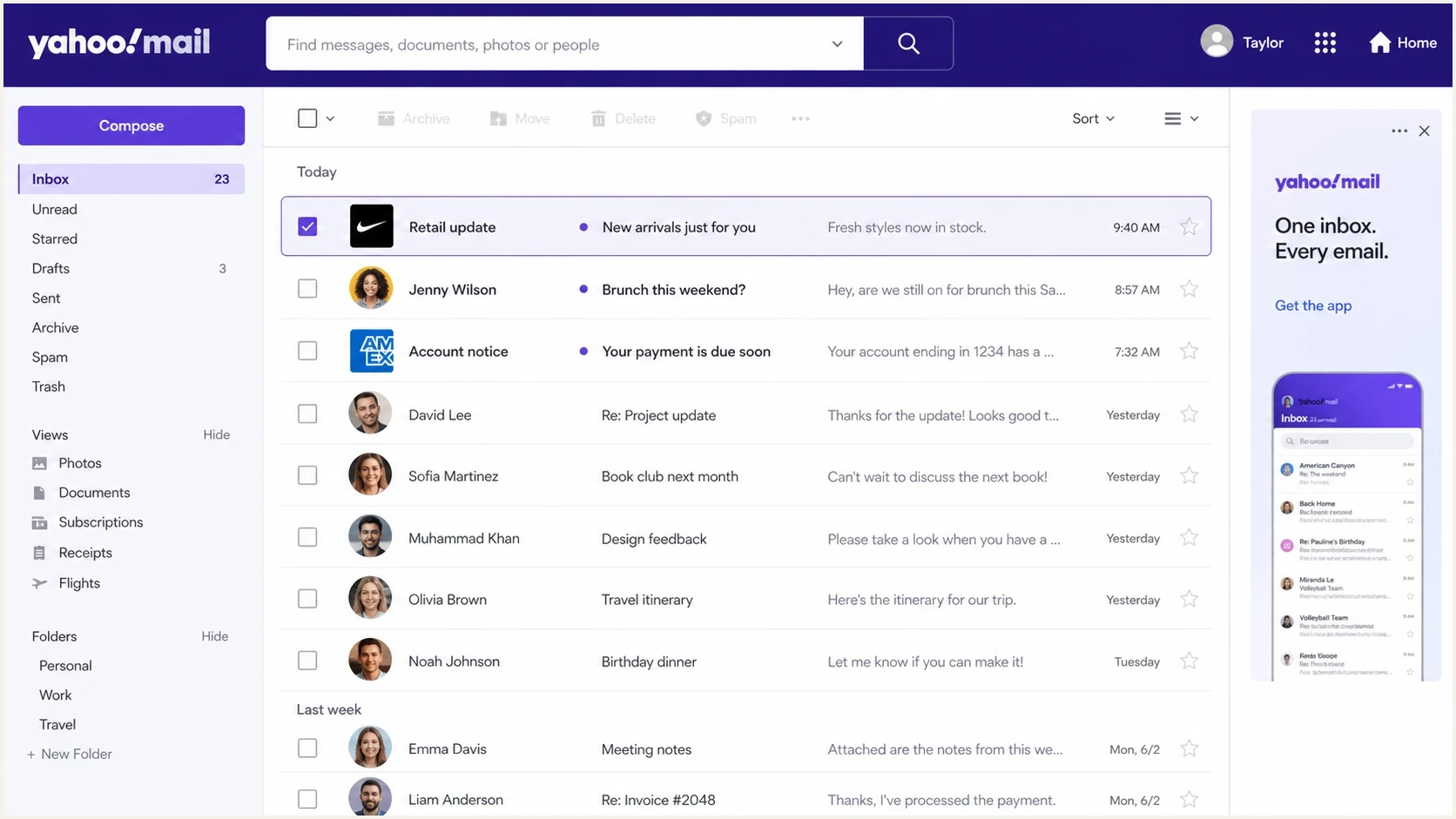
Yahoo Mail inbox screenshot showing where BIMI logos can appear beside senders.
Do not overread a no-VMC test
A self-asserted BIMI record proves that your DNS and logo path can work. It does not prove that Gmail, Apple Mail, or Microsoft recipients will see the same thing.
- Scope: Report Yahoo Mail, AOL, Fastmail, and LaPoste results apart from Gmail and Apple results.
- Metric: Prefer clicks, replies, conversions, and complaint rate over open-rate movement.
- Caveat: A provider can suppress display because of local policy, reputation, or low volume.
VMC, CMC, and self-asserted BIMI
The simplest way to think about BIMI is that the DNS record tells receivers where the logo or certificate-backed evidence lives. The receiver then decides whether to display it. The receiving provider has the final say, not the sender, DNS host, or email service platform.
Self-asserted BIMI
This is the no-certificate path. You publish a BIMI TXT record that points directly to an SVG Tiny PS logo and leaves the certificate evidence tag empty.
- Works: Useful for Yahoo Mail, AOL on Yahoo-hosted domains, Fastmail, LaPoste, and early technical validation.
- Limits: No Gmail display, no Apple Mail display, no verified mark, and limited business-case coverage.
Certificate-backed BIMI
This path points the BIMI record to a PEM file containing a VMC or CMC. The certificate connects the logo, legal organization, and domain.
- Works: Required for Gmail and the practical route for Apple Mail BIMI display.
- Limits: Legal validation, certificate renewal, and logo eligibility take planning.
A VMC is the usual path for a registered trademarked logo. A CMC is useful when the brand mark is not trademarked or when the organization qualifies under the CMC rules. Gmail accepts either certificate for logo display, but its checkmark is associated with a VMC. Apple documents VMCs and other BIMI Evidence Documents, and the receiving email provider must also meet Apple's requirements. If your main question is specifically Gmail, use a separate Gmail VMC requirements review before you build the rollout plan.
If the budget conversation is stuck, publish the self-asserted record only after DMARC is fully ready. That lets you measure the no-VMC providers and prove that the operational base is clean. Then decide whether a CMC or VMC belongs in the next phase.
DNS records and enforcement requirements
BIMI depends on DMARC enforcement. A domain at p=none is not ready. A domain at p=quarantine or p=reject is the normal baseline. The visible From domain must pass DMARC, which means SPF or DKIM has to pass with alignment that DMARC accepts for that domain. BIMI does not require strict adkim=s or aspf=s modes; the relaxed defaults are valid when DMARC passes. RFC 9989 moved the old pct tag to historic status, although provider documentation written for RFC 7489 can still mention pct=100. For a live BIMI rollout, use an enforced policy without testing mode instead of treating pct as the readiness marker.
BIMI readiness by DMARC policy
How to evaluate DMARC policy states before a BIMI rollout.
Not ready
p=none
Authentication can be monitored, but BIMI display should not be expected.
Pilot ready
p=quarantine
Acceptable for a careful BIMI pilot when all sending sources pass.
Strict rollout
p=reject
Strongest authentication posture for a mature BIMI program.
DMARC record that can support BIMIDNS
Host:
_dmarc.example.com

Type:
TXT

Value:
v=DMARC1; p=quarantine; rua=mailto:dmarc@example.com;
sp=quarantine
RFC 9989 uses t=y for policy testing. It asks receivers to apply a policy one level below the published value to failing mail, so p=quarantine; t=y is treated like p=none and p=reject; t=y is treated like p=quarantine. Remove testing mode before a live BIMI measurement.
Before publishing BIMI, validate the DMARC record with a DMARC checker and confirm the real mail stream still passes after enforcement. In Suped, this is where automated issue detection and steps to fix are more useful than a raw XML report. The report tells you what happened; a workflow tells you which sender needs attention and what DNS or platform change fixes it.
?
What's your domain score?
Deep-scan SPF, DKIM & DMARC records for email deliverability and security issues.
Check the whole domain, not only the BIMI hostname. A domain health checker is useful here because BIMI readiness includes DMARC, SPF, DKIM, DNS visibility, and mail-source hygiene. A clean BIMI TXT record will not rescue a sender that fails DMARC for normal campaign traffic.
The logo file also needs its own review. Use SVG Tiny PS, keep the uncompressed file at 32 kilobytes or less, and center the mark in a square canvas with a solid background. Include the required baseProfile="tiny-ps" and version="1.2" attributes, and remove scripts, animation, external references, taglines, slogans, or extra text. Host the file on a public HTTPS URL that returns the SVG directly with an image/svg+xml content type. BIMI is configured for a domain you own and control; it does not work as a sender-logo shortcut for mail sent from free consumer domains.
BIMI record examplesDNS
Self-asserted BIMI:

Host:
default._bimi.example.com

Type:
TXT

Value:
v=BIMI1; l=https://brand.example.com/bimi.svg; a=;

Certificate-backed BIMI:

Host:
default._bimi.example.com

Type:
TXT

Value:
v=BIMI1; l=; a=https://brand.example.com/vmc.pem;
Subdomains and BIMI inheritance
For subdomains, the practical answer is usually yes, a BIMI record at the organizational domain can apply to subdomains that do not publish their own BIMI record. Still test every visible From domain because receiver behavior, DMARC subdomain policy, and certificate coverage can change the outcome.
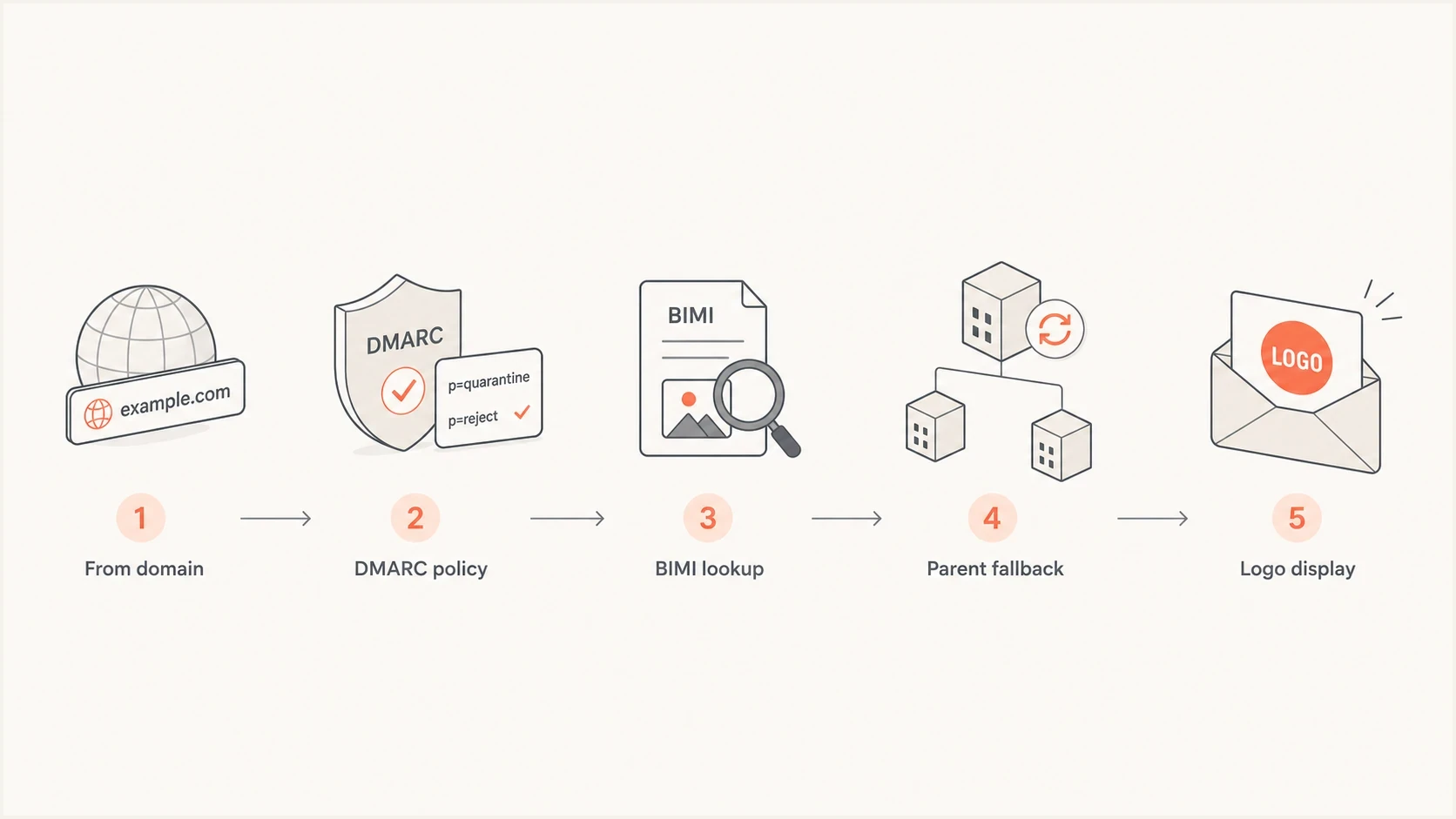
BIMI subdomain lookup flow from From domain to parent fallback and logo display.
The important rule is that BIMI follows the authenticated visible From domain, not a tracking domain or bounce domain. If you send as news.example.com, the receiver evaluates that domain's authentication result and then looks for the BIMI assertion path. If there is no subdomain-specific BIMI record, a parent-domain BIMI record can be used. If you publish a specific record at default._bimi.news.example.com, that record controls the news.example.com stream.
- One logo: Publish at the organizational domain when all subdomains should use the same mark.
- Different logo: Publish a separate subdomain BIMI record for a brand, region, or product stream.
- DMARC policy: Use enforced policy for the organizational domain and any explicit subdomain policy.
- Certificate scope: Confirm the certificate and evidence path cover the domains you plan to send from.
This is also where Hosted DMARC can reduce operational risk. With Suped's hosted DMARC workflow, policy staging and record management are simpler when the same team has to coordinate authentication, BIMI readiness, and subdomain coverage across marketing, transactional, and corporate mail.
Hosted DMARC configuration dialog showing policy controls, CNAME setup, and expanded advanced options
Why a valid BIMI logo is not showing
A valid DNS response is only one part of display eligibility. The receiving provider also has to retrieve the files, confirm the message passed DMARC, accept any required evidence document, and decide that the sender meets its local reputation rules. Diagnose each layer separately instead of repeatedly changing the TXT record.
- Check discovery: Confirm the selector and visible From domain lead to one valid BIMI TXT record, then allow up to 48 hours for caches and provider systems to refresh.
- Check retrieval: Open the SVG or PEM URL without authentication, redirects that fail, geographic restrictions, hotlink protection, or blocked user agents.
- Check responses: Use HTTPS, a trusted TLS chain, the correct content type, and a direct successful response for each hosted file.
- Check authentication: Inspect a delivered message and confirm that DMARC passed for the visible From domain under an enforced policy.
- Check eligibility: Confirm the certificate is valid where required and that the provider sees enough wanted mail, reputation, and engagement to show the logo.
Test in a fresh web session as well as the relevant mobile client because cached logos and interface differences can hide a successful change. Keep DNS validity and visual display as separate results: a record can pass technical validation while the provider still withholds the logo under its own policy.
How to run the pilot
A no-VMC pilot needs a measurement plan before DNS changes. Otherwise the result becomes a vague claim that BIMI helped or did not help. Build the test around mailbox-provider segments, not one blended audience average.
- Baseline: Measure normal engagement for Yahoo Mail, AOL, Fastmail, LaPoste, Gmail, Apple, and Microsoft recipients.
- Readiness: Confirm enforced DMARC, stable pass rates, known senders, and no hidden failing stream.
- Publish: Add the BIMI TXT record and host the SVG over HTTPS on a reliable public path.
- Validate: Send live tests to each target provider and inspect the actual inbox rendering.
- Report: Compare provider-specific clicks, replies, conversions, complaints, and unsubscribes.
Open rates are a weak signal because client privacy behavior and image handling distort them. BIMI logos can still influence recognition, but anchor the business case in downstream behavior. If the no-VMC group performs better, it supports the case for VMC or CMC investment. If it does not move, the stronger conclusion is that you need better audience segmentation or a more visible brand mark, not that BIMI has no value.
For ROI, separate the visible-logo value from the authentication value. Track incremental clicks, conversions, replies, complaint reduction, abuse tickets, and time saved on authentication investigations. Then subtract certificate, logo-preparation, DNS, monitoring, and internal labor costs before presenting the business case.
Where Suped fits
Suped's product fits this project when the goal is to keep authentication healthy before and after BIMI goes live. The useful parts are operational: automated issue detection, real-time alerts, hosted DMARC, hosted SPF, SPF flattening, hosted MTA-STS, blocklist (blacklist) monitoring, and an MSP dashboard for teams managing many domains.
- Before BIMI: Find authentication gaps before enforcement or provider testing.
- During pilot: Watch pass rates by source so a new sender does not break display.
- After launch: Use alerts and issue workflows to keep BIMI prerequisites intact.
Separate Apple-specific brand work from BIMI. Apple Branded Mail can show a logo in Apple's ecosystem and can be useful for demonstrating brand presence, but it is a separate program. It does not make Gmail render BIMI without a VMC or CMC, and it does not change Microsoft support. For Microsoft-specific expectations, check Outlook BIMI support before including Outlook audiences in the ROI model.
Views from the trenches
Best practices
Keep DMARC at enforcement before BIMI testing, including every active sending subdomain.
Use a no-certificate pilot for Yahoo Mail, Fastmail, LaPoste, and matching AOL segments.
Measure clicks and downstream actions by provider, because opens are weak BIMI success signals.
Common pitfalls
Treating Gmail or Apple Mail as no-VMC test targets leads to quiet logo display failures.
Publishing one BIMI record while subdomains stay at p=none blocks results for those streams.
Using a normal SVG instead of Tiny PS creates validation errors that look like DNS issues.
Expert tips
Publish a subdomain BIMI record when the From domain needs its own logo or PEM path.
Put certificate renewal, logo hosting, and DNS ownership in one operational checklist.
Use Suped's alerts to catch DMARC regressions before they quietly break BIMI display.
Expert from Email Geeks says Yahoo Mail, Fastmail, and LaPoste are realistic places to test self-asserted BIMI.
2025-04-22 - Email Geeks
Marketer from Email Geeks says Apple Branded Mail can help demonstrate logo value, but its approval process can take time.
2025-04-23 - Email Geeks
The practical decision
If leadership wants proof before buying a VMC, publish self-asserted BIMI only after DMARC is already enforced and stable. Then measure Yahoo Mail, AOL, Fastmail, and LaPoste as the real no-VMC audience. Keep Gmail and Apple out of that no-VMC success metric because they require a certificate-backed or evidence-backed path. Keep Microsoft out because standard BIMI display is not available there.
The implementation work is still worthwhile because it forces the right foundation: complete sender inventory, enforced DMARC, clean SVG hosting, and clear ownership for DNS and certificate renewal. If the no-VMC pilot produces useful movement, the next step is a VMC for a trademarked logo or a CMC where that fits. If the pilot does not move business metrics, the same work still improves the authentication base that protects the domain.