Why do businesses need DMARC, and what are the real costs of implementation and maintenance?
Michael Ko
Co-founder & CEO, Suped
Published 12 May 2025
Updated 15 Mar 2026
10 min read
Email is the lifeblood of most businesses today, but it also presents a significant attack vector for cybercriminals. We often hear about the importance of email authentication protocols like SPF and DKIM, and many companies have them in place. However, there's a crucial layer that many businesses, especially small to medium-sized ones, might be overlooking or misunderstanding: DMARC. It's not just another technical acronym, it's a critical component for protecting your brand, customers, and overall email deliverability.
The question I frequently encounter is whether DMARC is truly necessary, particularly if a company already has SPF and DKIM configured. The other side of that coin, and equally important, is the perceived complexity and cost associated with its implementation and ongoing maintenance. My goal here is to clarify why DMARC is indispensable for modern businesses and shed light on the real costs involved, demystifying the process along the way.
Why DMARC is essential for email security
As businesses increasingly rely on email for everything from internal communication to customer engagement and transactions, the threat of email-based fraud continues to grow. Phishing, spoofing, and business email compromise (BEC) attacks are rampant, and they can severely damage a company's reputation and lead to significant financial losses. While SPF and DKIM are foundational, they don't offer the full protection needed.
SPF and DKIM primarily serve to authenticate legitimate senders, proving that you are who you say you are. However, they don't tell receiving mail servers what to do if an email fails these authentication checks. This is where DMARC comes in. It provides a policy layer that instructs receiving mail servers on how to handle emails that claim to be from your domain but fail SPF or DKIM alignment. This is crucial for preventing unauthorized use of your domain in malicious campaigns.
Without DMARC, anyone can potentially send emails appearing to be from your domain, and these emails might still land in inboxes, posing a direct threat to your customers and partners. DMARC enables domain owners to request that receivers enforce these authentication proofs, either by sending unauthenticated phishing emails to spam or rejecting them outright. This protection extends beyond your direct email recipients, safeguarding your brand across the entire internet. The Center for Internet Security emphasizes DMARC's role in advancing email security against phishing.
Moreover, recent mandates from major email providers like Google and Yahoo for bulk senders make DMARC less of a 'nice-to-have' and more of a 'must-have.' Ignoring these requirements can lead to legitimate emails being marked as spam or rejected entirely, severely impacting your communication efforts. You can learn more about these implications in our article, Why are ESPs enforcing DMARC policies?
The true costs of not implementing DMARC
The primary outcome of implementing DMARC is to protect your domain from email spoofing and fraudulent emails, which can have significant repercussions. When an attacker successfully spoofs your domain, they leverage your brand's trust to deceive recipients, leading to various forms of abuse, including phishing and BEC attacks.
The financial cost of these attacks can be immense. Beyond the direct monetary loss from fraud, there are significant indirect costs. A tarnished brand reputation, loss of customer trust, and decreased email deliverability due to your domain ending up on email blocklists (or blacklists) are very real consequences. Recovering from a damaged domain reputation can be a lengthy and arduous process, impacting marketing campaigns, transactional emails, and overall business communication. Our guide on how email blacklists work explains the mechanisms behind such listings.
On the flip side, implementing DMARC helps ensure your legitimate emails reach the inbox. By signaling to receiving servers that you're actively protecting your domain, you improve your overall email deliverability. This means your marketing emails, critical transactional alerts, and internal communications are less likely to be flagged as spam or rejected, directly contributing to business success. Our article on the benefits of implementing DMARC provides further details on these advantages.
Without DMARC
Vulnerability to spoofing: Attackers can easily impersonate your domain, launching phishing and BEC attacks.
Brand reputation damage: Customers lose trust when they receive fraudulent emails appearing to be from you.
Reduced deliverability: Legitimate emails might be flagged as spam due to perceived lack of domain control.
Lack of visibility: You won't know who is spoofing your domain or how widely it's happening.
Costs of DMARC implementation and maintenance
When discussing DMARC, one of the first questions that comes up is, "How much is this going to cost?" The answer isn't always straightforward because it depends on your approach. Implementing the DMARC record itself is technically free, as it's a DNS TXT record. You can even use our free DMARC record generator to create one.
However, the real costs emerge when you move beyond a basic p=none policy and start to manage your email ecosystem effectively. A p=none policy (monitor-only) is low-risk and cheap to deploy, offering valuable insight into your email traffic without blocking any mail. This initial phase is crucial for discovering all legitimate sending sources and identifying unauthorized ones. Our simple DMARC examples guide can help you get started.
The main expense comes from processing and analyzing the DMARC aggregate reports (RUA). These reports are sent to the email address specified in your DMARC record and arrive in an XML format. While you can technically parse these XML reports yourself, it can be cumbersome, especially with high email volumes. Small to medium-sized businesses with numerous email streams will find this task time-consuming.
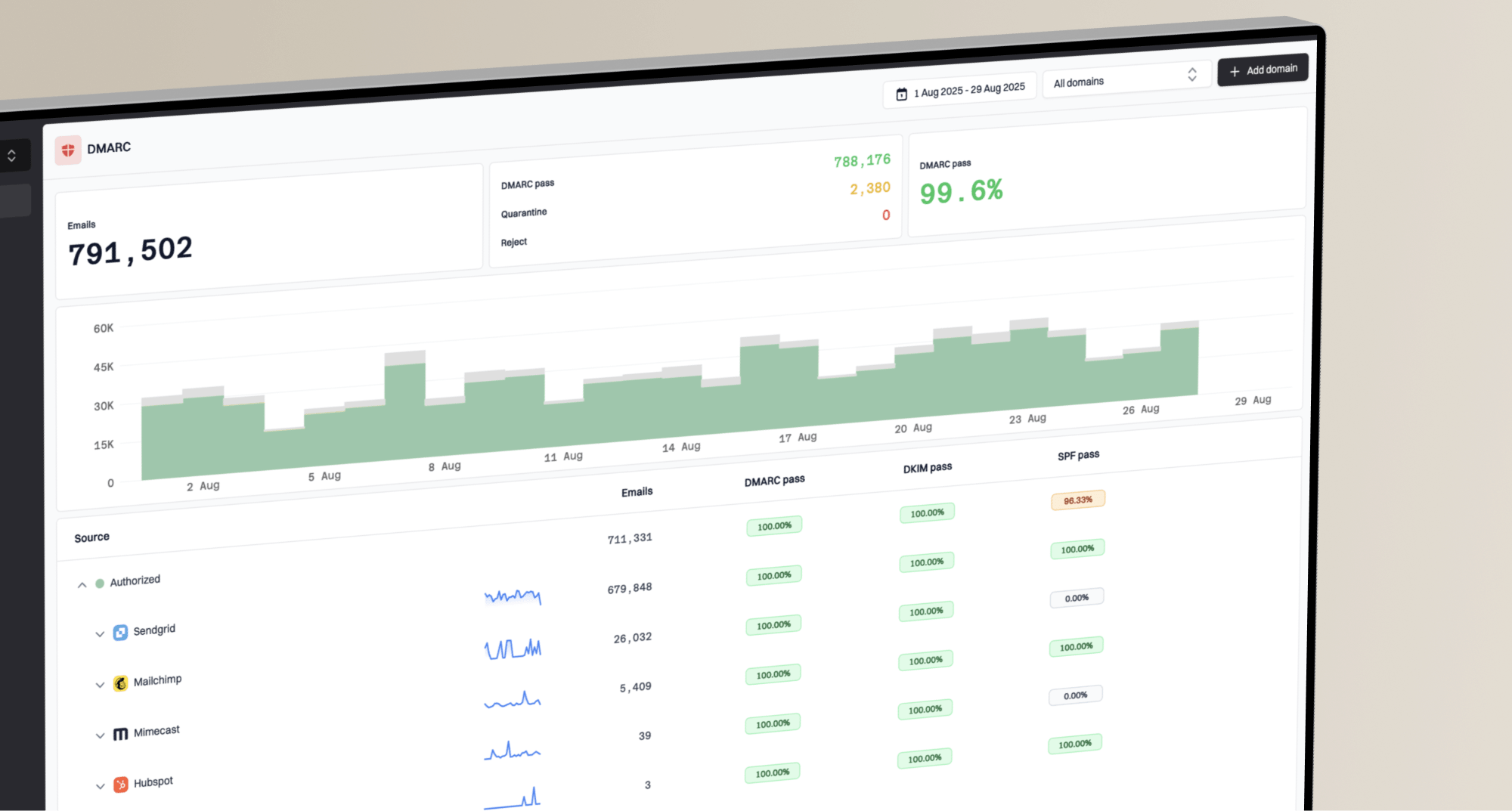
For many, the practical solution is to use a DMARC reporting service or tool that can parse these XML reports into an easily digestible format, providing dashboards and actionable insights. Some tools offer free tiers for basic monitoring, while comprehensive solutions can range from tens to hundreds of thousands of dollars per year, depending on email volume and features. Alternatively, open-source parsers like parsedmarc can be spun up if you have the technical expertise.
DIY DMARC Management
Cost: Potentially lower direct software costs, possibly free open-source tools.
Effort: Requires significant internal IT or email team expertise and time.
Reporting: Manual XML parsing or custom script development needed for insights.
Scalability: Can become overwhelming with many sending sources or high email volumes.
Managed DMARC Services
Cost: Involves recurring subscription fees, varying by volume and features.
Effort: Significantly reduces manual effort and specialized knowledge required.
Reporting: Provides user-friendly dashboards, automated alerts, and actionable reports.
Scalability: Designed to handle large volumes and complex email ecosystems efficiently.
Investment in security and deliverability
Beyond the initial setup, DMARC requires ongoing maintenance. This includes monitoring reports for new or unexpected sending sources, adjusting SPF and DKIM records as your email infrastructure changes, and gradually moving your DMARC policy from p=none to p=quarantine or p=reject. This transition needs to be done carefully to avoid legitimate emails being blocked. Our guide, How to safely transition your DMARC policy, provides detailed steps.
For small to medium-sized companies, even with a handful of email streams, having someone dedicated to monitoring and acting on DMARC reports is essential. This could be an existing postmaster, an email marketer with technical skills, or a system administrator. The individual needs to understand your entire email program and have the authority to implement necessary changes. This person's time is an indirect cost, but it's crucial for DMARC to be effective.
Ultimately, the cost of DMARC is an investment in your company's security, reputation, and deliverability. While there are upfront and ongoing expenses, the costs of not implementing it, such as large-scale phishing attacks or diminished brand trust, far outweigh them. Thinking of DMARC as an incremental step toward a more secure email environment is a good way to approach it. Even starting with a p=none policy for monitoring is a low-risk way to gain critical insights into your email traffic.
The path to secure email for your business
DMARC is no longer a luxury, it's a fundamental security measure for any business that relies on email. The benefits extend beyond simply stopping spoofing, although that's a significant advantage. It provides invaluable insights into your email ecosystem, helping you discover unauthenticated sending sources and gain full visibility into who is sending email using your domain. This intelligence is vital for maintaining a healthy domain reputation and ensuring your legitimate emails consistently reach their intended recipients.
While there are certainly costs associated with properly implementing and maintaining DMARC, particularly the human resources needed to analyze reports and make policy adjustments, these are far outweighed by the protection and insights gained. Ignoring DMARC can lead to significant financial and reputational damage from phishing and other email fraud, not to mention the hidden costs of reduced email deliverability. For more on the basics, see our simple guide to DMARC, SPF, and DKIM.
My recommendation is to start with a p=none policy, monitor your reports diligently, and work towards a stricter policy like p=reject over time. This incremental approach allows you to gain control and visibility over your email channels, securing your brand and ensuring your messages reliably reach their destination. It’s a worthwhile investment for any business committed to strong email security and deliverability.
Views from the trenches
Best practices
Start with a `p=none` DMARC policy to monitor email traffic and gather insights without risking deliverability.
Utilize DMARC reporting services to automate report parsing and gain actionable insights from complex XML data.
Dedicate a person, whether in IT, marketing, or sysadmin, to oversee email authentication and DMARC reports.
Regularly review your DMARC reports to identify all legitimate sending sources and unauthorized spoofing attempts.
Gradually transition your DMARC policy from `p=none` to `p=quarantine` or `p=reject` once you have full visibility and control.
Common pitfalls
Believing SPF and DKIM alone provide sufficient protection against email spoofing and brand impersonation.
Implementing a DMARC `p=none` policy without actively monitoring or analyzing the generated aggregate reports.
Underestimating the time and expertise required to process raw XML DMARC reports manually, especially for large volumes.
Rushing to a `p=quarantine` or `p=reject` policy without fully identifying and authenticating all legitimate email streams, leading to deliverability issues.
Ignoring the financial and reputational costs of not adopting DMARC, which can far outweigh implementation expenses.
Expert tips
Focus on proving fraudulent email is happening to secure IT buy-in for DMARC.
Use the low-risk `p=none` policy to gain initial insights into unauthorized domain usage.
Invest in a reporting platform for human-readable dashboards, as C-level executives need clear visuals.
Understand that DMARC is part of a broader email program strategy, not a standalone fix.
Be aware that DMARC implementation and maintenance require dedicated resources, even for small companies.
Expert from Email Geeks says DMARC is a security measure that relies on SPF or DKIM to verify the sender of an email from your domain is approved, allowing the domain owner to request enforcement actions from receivers.
2019-07-24 - Email Geeks
Expert from Email Geeks says SPF and DKIM prove who you are, but DMARC is necessary to prove that someone else is not impersonating you.
 Google and
  Yahoo for bulk senders make DMARC less of a 'nice-to-have' and more of a 'must-have.' Ignoring these requirements can lead to legitimate emails being marked as spam or rejected entirely, severely impacting your communication efforts. You can learn more about these implications in our article, Why are ESPs enforcing DMARC policies?