What are the best third-party vendors and open-source options for DMARC reporting?
Matthew Whittaker
Co-founder & CTO, Suped
Published 7 Aug 2025
Updated 15 Mar 2026
6 min read
Implementing DMARC is a critical step for email security, protecting your domain from phishing and spoofing attacks. However, simply having a DMARC record isn't enough. You need to actively monitor your DMARC reports to understand your email ecosystem, identify authentication failures, and gradually enforce stricter policies.
The raw DMARC reports (XML files) are incredibly detailed but can be challenging to interpret manually, especially for organizations sending a large volume of emails. This is where DMARC reporting solutions come into play, transforming complex data into actionable insights.
Choosing the right platform, whether a third-party vendor or an open-source option, depends on your organization's specific needs, technical capabilities, and budget. Here, I'll explore some of the best choices available to help you make an informed decision and ensure your emails are secure and delivered reliably.
Leading DMARC reporting vendors
Top third-party DMARC reporting vendors
Third-party DMARC reporting services offer comprehensive dashboards, automated report processing, and often additional features that streamline DMARC management. These solutions are generally preferred by businesses that want a hassle-free experience and dedicated support.
When evaluating these services, I look for robust reporting capabilities, ease of use, scalability for growing email volumes, and valuable integrations like Slack notifications. Many providers, including Suped, offer various pricing tiers, with some even providing generous free plans for smaller senders to get started with DMARC monitoring.
The market offers several reputable DMARC monitoring tools. A comprehensive review by EmailToolTester's free DMARC tools review highlights various options, including Postmark, EasyDMARC, Valimail, and PowerDMARC. Another helpful resource, Robotalp's top DMARC monitoring tools, also provides a detailed look at several tools for different business sizes and technical needs.
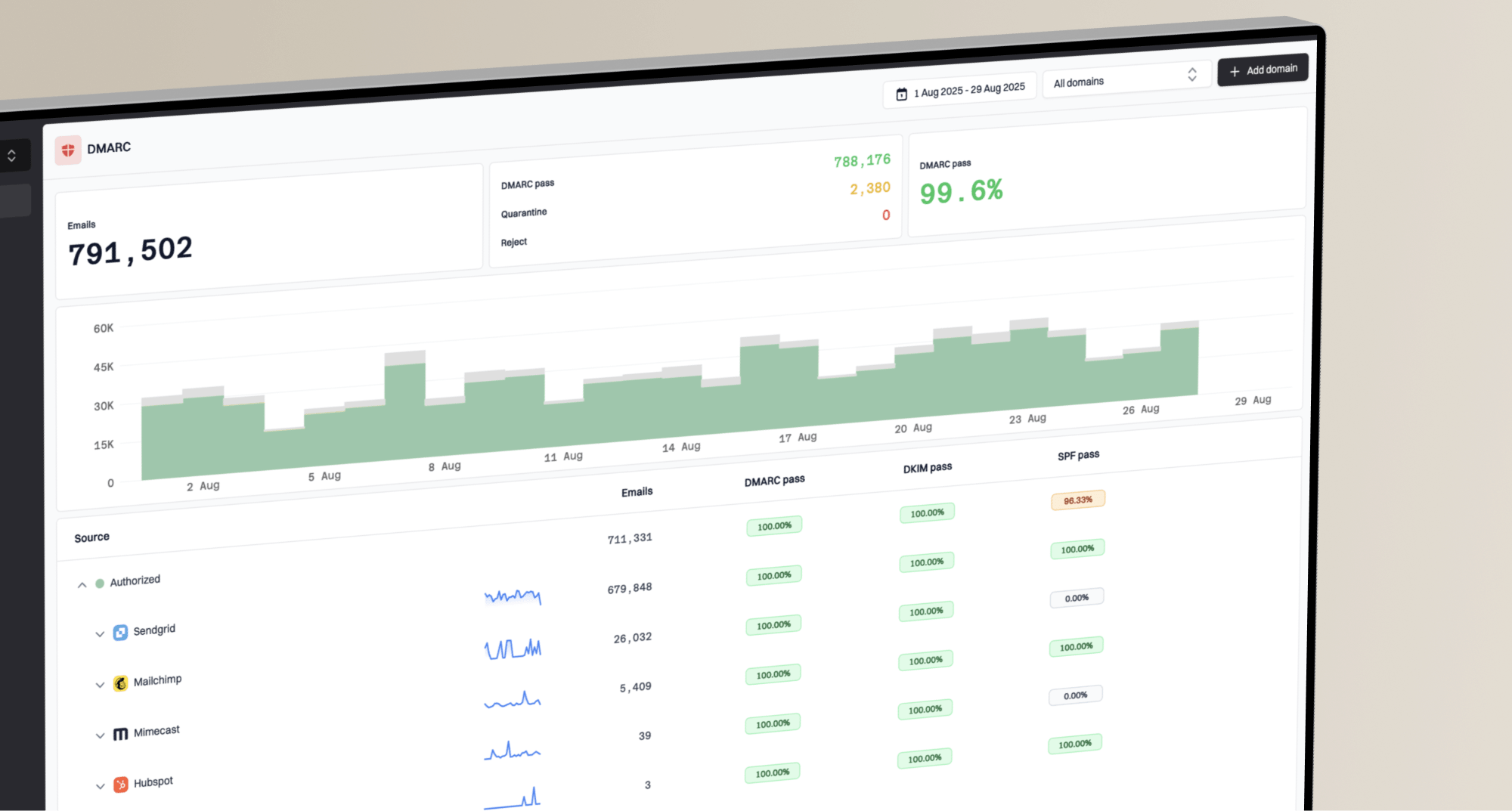
Suped stands out with its intuitive interface and the most generous free plan, making it an excellent choice for both small businesses and larger enterprises. It offers detailed analytics, filtering by IP/Domain, and alerts to ensure you're always aware of your email authentication status.
Feature
Suped
PowerDMARC
dmarcian
Valimail
Reporting detail
Comprehensive, granular data with easy filtering
Extensive detail, often requires some expertise
Good for deep dives and forensic analysis
Focus on automation and simplified views
Ease of use
Highly intuitive interface, quick setup
Moderate learning curve, powerful features
Designed for DMARC specialists
Very easy, often fully automated enforcement
Scalability
Excellent for all volumes, growing with your needs
Handles large volumes effectively
Robust for enterprise-level deployment
Ideal for large, complex organizations
Free plan
Most generous free tier available
Limited free trial or basic plan
Limited free trial for evaluation
No free plan, focus on enterprise
Comparison of leading DMARC reporting services
Open-source DMARC solutions
Exploring open-source DMARC reporting solutions
For organizations with the technical expertise and a preference for self-hosting, open-source DMARC reporting tools can be a viable alternative. These solutions offer full control over your data and infrastructure, which can be a significant advantage for those with strict privacy or compliance requirements. However, they also demand more internal resources for setup, maintenance, and ongoing development. You can learn more about this in our article Should I build or buy a DMARC reporting tool.
One popular open-source tool is parsedmarc, a Python tool that retrieves and parses DMARC aggregate and forensic reports and stores them in various formats, including ElasticSearch, Splunk, and SQL databases. While it provides the raw data, setting up a user-friendly visualization layer (like a dashboard with Grafana) is typically left to the user, requiring additional effort and technical skills.
While open-source tools offer flexibility and cost savings on licenses, the total cost of ownership can sometimes exceed that of a paid service when factoring in developer time for setup, maintenance, updates, and troubleshooting. This is especially true as your email volume grows and the complexity of managing DMARC reports increases.
For those interested in analyzing DMARC reports in an easy-to-read format, regardless of whether you choose a vendor or open-source, the key is to ensure the solution can parse the XML data effectively and present it in a digestible way.
Decision factors
Choosing between third-party and open-source
Third-party vendor benefits
Ease of setup: Quick to implement, often requiring minimal technical knowledge.
Comprehensive features: Advanced reporting, threat intelligence, and user-friendly dashboards.
Dedicated support: Access to expert assistance for troubleshooting and optimization.
Scalability: Designed to handle large volumes of DMARC reports efficiently.
Open-source solution benefits
Full control: Complete ownership of data and infrastructure.
Customization: Adapt the tool to precise organizational requirements.
Cost savings: No licensing fees, though operational costs apply.
Community support: Leverage a global network of developers and users.
For many, the convenience and advanced features of a third-party vendor like Suped outweigh the perceived benefits of building an in-house solution. Managing DMARC, especially as you move towards DMARC policy enforcement, can be complex, and having a reliable service to handle the heavy lifting often proves more cost-effective and secure in the long run. The critical part is choosing a solution that aligns with your organization's resources and long-term email security goals.
No matter your choice, ensure the solution provides clear visibility into your email authentication status. This includes aggregate data, forensic reports (if enabled), and the ability to track your DMARC compliance over time. The ultimate goal is to reach a p=reject policy with confidence, knowing that all legitimate emails are properly authenticated and malicious ones are blocked.
Maximizing your email security
Beyond basic DMARC reporting
Beyond simply reporting, look for services that can help you understand the larger picture of your email deliverability. This includes features like:
Domain reputation monitoring: Understanding how your domain is perceived by mailbox providers.
Blocklist (blacklist) checks: Timely alerts if your IPs or domains appear on a blacklist.
BIMI support: For visual branding and improved trust.
These additional features turn a DMARC reporting tool into a holistic email deliverability platform, offering a more complete view and control over your email sending health. This integrated approach can save significant time and resources compared to managing multiple separate tools.
Ultimately, the best DMARC reporting solution is one that you can consistently use to protect your domain and ensure successful email delivery. Whether it's a feature-rich platform or a DIY open-source setup, active monitoring and timely adjustments are key to maintaining a strong email presence.
Views from the trenches
Best practices
Actively filter DMARC reports by IP and domain to quickly pinpoint unauthorized senders and misconfigurations.
Integrate DMARC notifications with communication tools like Slack to receive real-time alerts on significant issues.
Regularly review your DMARC reports to maintain email authentication health and track policy progression.
Common pitfalls
Underestimating the resources needed to maintain an open-source DMARC reporting solution effectively.
Failing to filter DMARC data, leading to an overwhelming amount of information that is difficult to act on.
Choosing a DMARC reporting vendor that lacks scalability for anticipated email volume growth.
Expert tips
Consider a vendor that offers detailed forensic reporting to better understand attack vectors.
Look for platforms that provide clear recommendations for DMARC policy adjustments.
Prioritize tools with user-friendly dashboards for quicker issue identification and resolution.
Marketer from Email Geeks says they are looking at 250ok for DMARC reporting and is currently doing due diligence on other vendors.
April 2, 2019 - Email Geeks
Marketer from Email Geeks recommends considering dmarcian, Agari, and Valimail in addition to 250ok for DMARC reporting solutions.
April 2, 2019 - Email Geeks
Conclusion
Making the right DMARC choice
Selecting the best DMARC reporting solution requires careful consideration of your organization's specific needs, budget, and technical capabilities. For most businesses, a third-party vendor offers a more efficient, feature-rich, and supported path to DMARC enforcement and email security. Suped provides an excellent balance of advanced features and ease of use, including a robust free plan to help you get started.
While open-source options like parsedmarc appeal to those seeking full control, they come with a higher demand for internal resources and expertise. Regardless of your choice, the goal remains the same: gain clear visibility into your email sending activity, protect your domain from impersonation, and enhance overall email deliverability.